Selling Solar Around Net Metering and Rate Design
Turn this article into takeaways for your work.


Each assistant summarizes the article only for you and suggests best practices for your work.
Ask ten solar reps to explain net metering and you'll get ten different answers, and most of them will be wrong for at least one utility in their own territory. That's the problem. Net metering isn't a single federal policy. It's a patchwork of state laws and individual utility tariffs, and the difference between a favorable and unfavorable structure can swing a homeowner's payback period by years.
This guide breaks down what net metering actually is, why it varies so much, and how to sell honestly and effectively when the export credit rate isn't what the homeowner assumes it is.
What Does Net Metering Actually Mean?
Net metering is the billing arrangement that determines what a homeowner gets credited for excess solar energy their system sends back to the grid. When their panels produce more than the home uses, the extra power flows out to the grid, and the utility credits the homeowner for it. How much credit, and in what form, is where everything varies.
There are roughly three structures reps run into:
| Structure | How it works | Where it's common |
|---|---|---|
| Full retail net metering (often called NEM 1.0 or "legacy") | Exported power is credited at the same rate the homeowner pays for imported power. 1-for-1 offset. | Grandfathered customers in states that have since changed policy |
| Modified net metering (NEM 2.0/3.0 style, net billing) | Exported power is credited at a lower rate than retail, often tied to wholesale or avoided-cost pricing. May include added fees or time-of-use structures. | Increasingly common as states revise older 1-for-1 policies |
| No net metering / flat buyback | Utility buys excess power at a set, often low, wholesale-style rate with no retail offset | Some utility territories and states without a net metering mandate |
The exact terms and acronyms differ by state and even by utility within a state, so never assume the structure a homeowner heard about from a neighbor or online forum applies to their specific utility account. The DSIRE database, maintained by the N.C. Clean Energy Technology Center, tracks net metering and net billing rules state by state and is a solid way to confirm a policy before you walk into a home. Always confirm the current tariff for their utility before presenting numbers.
Key Facts
- Net metering and net billing structures are set at the state and utility level, not federally, so the export credit rate a homeowner receives can differ significantly even between neighboring utility territories.
- Average US residential electricity rates rose from 16.0 cents per kWh in 2023 to 16.5 cents per kWh in 2024, according to the EIA (U.S. Energy Information Administration).
- Systems designed around self-consumption and storage tend to hold their promised savings better under reduced net-metering credit structures than systems sized purely for maximum export.
Why This Matters More Than Almost Any Other Variable
System size, roof orientation, and financing get most of the attention in training, but net metering structure often has the single biggest effect on payback period, because it determines what every kilowatt-hour the system produces beyond immediate household use is actually worth.
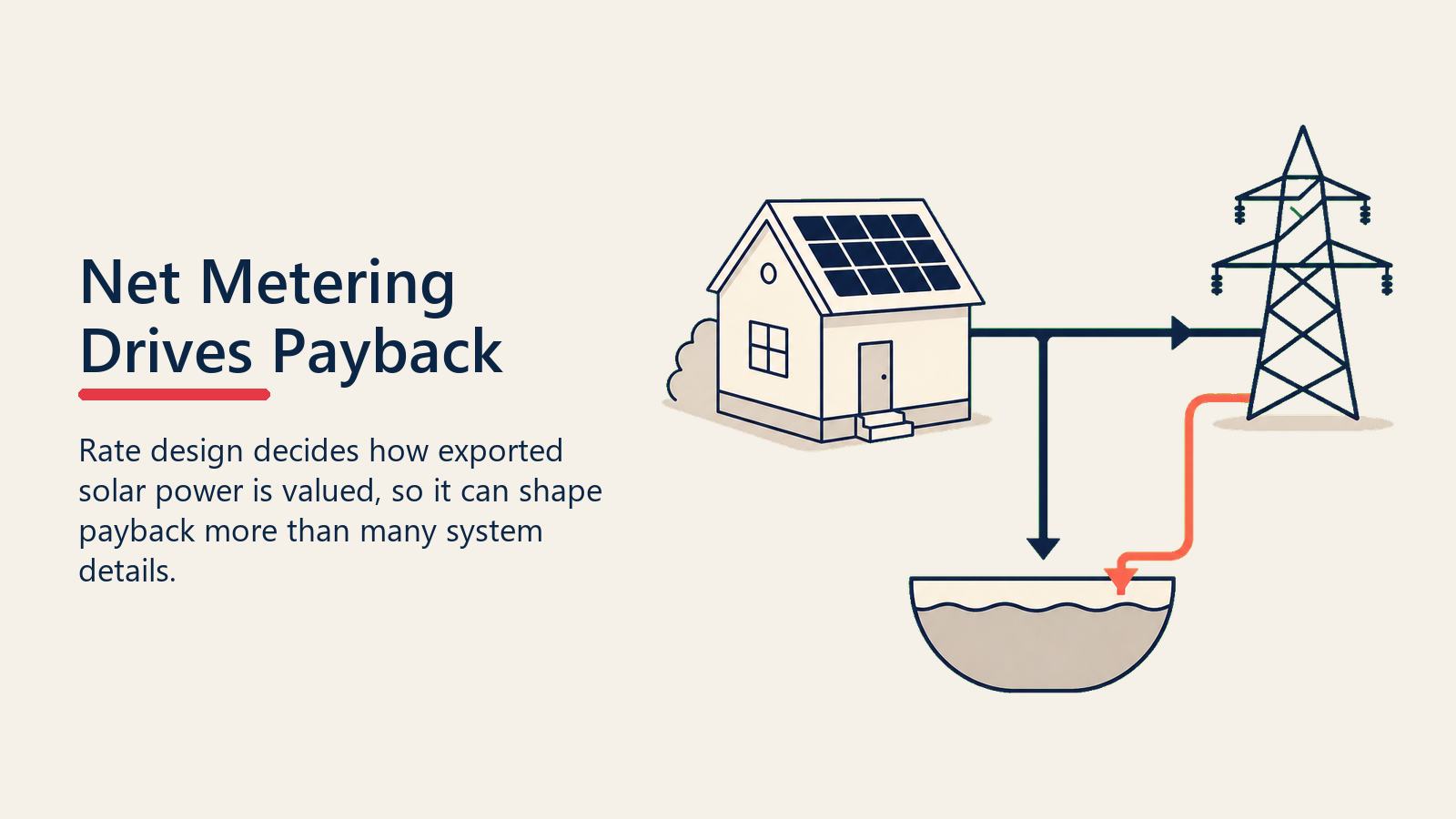
Consider two nearly identical homes in different utility territories:
- Home A is under a full retail net metering tariff. Every exported kWh offsets a future imported kWh at the same rate, roughly 17 cents. The system was sized to fully offset annual usage.
- Home B is under a net billing tariff where exports are credited at 6 cents per kWh, well below the 17-cent retail rate they pay for imported power. The same system size produces the same energy, but a much smaller share of that value flows back to the homeowner unless usage is shifted to match production hours.
Home B's system, priced and sized the same way, delivers meaningfully less bill savings unless the design changes: more self-consumption, different system sizing, or a battery attached to store excess production for evening use instead of exporting it at a low credit rate. That's not a minor footnote. It's the difference between a proposal that holds up and one that falls apart on inspection three years later when the homeowner compares actual bills to promised savings.
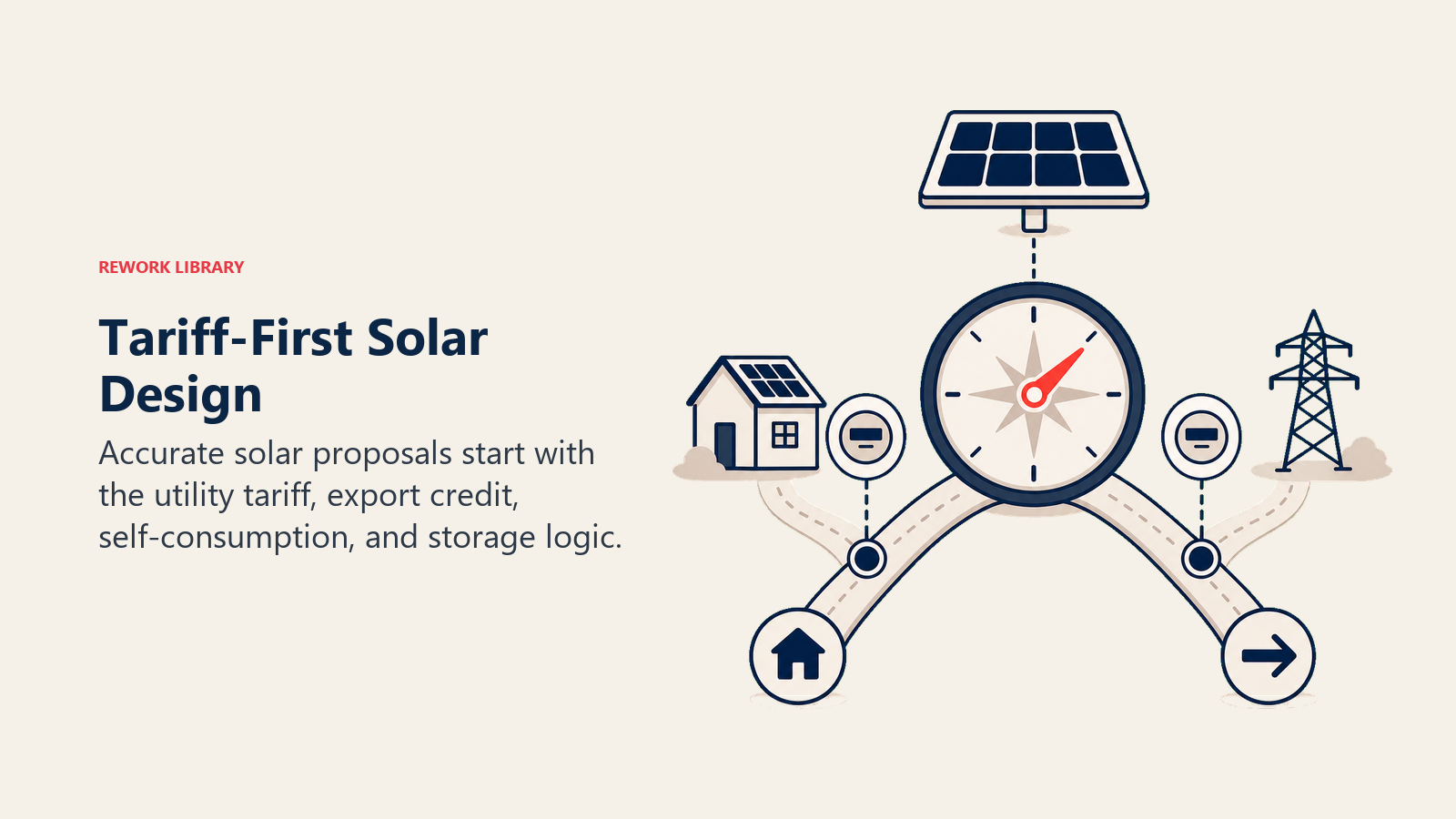
Reps who consistently avoid that failure use what we call the Tariff-First Design method: confirming the exact export credit rate for a homeowner's specific utility before finalizing system size, rather than sizing to a generic 100% annual offset target and hoping the export math works out. Under the Tariff-First Design method, the tariff drives the design decision, not the other way around.
"A system sized to offset 100% of annual usage under a full retail net metering tariff can deliver meaningfully less bill savings than the same system under a net billing tariff where exports are credited at a fraction of the retail rate, which is why the export credit rate has to be confirmed before the system is sized, not after."
The Sales Conversation: What to Cover and When
1. Identify the utility and tariff before you walk in
This should happen during appointment prep, not during the in-home visit. Your confirming and prepping the appointment process should include a utility lookup step: which utility serves this address, and what net metering or net billing tariff currently applies to new solar customers there.
2. Explain the concept in plain language, without acronyms first
Don't lead with "NEM 3.0." Lead with the mechanic: "When your system makes more power than your house uses in the moment, that extra power goes back to the grid, and your utility credits you for it. The rate they credit you depends on the specific program here, so let's look at exactly what that is for your address."
3. Show the actual credit rate, sourced from the current tariff
Pull the utility's published rate schedule or your company's verified data source. Never estimate or use a rate you remember from a different project a year ago. Utility tariffs change, sometimes annually.
4. Size the system with the tariff in mind, not against a generic 100% offset target
Under full retail net metering, sizing to 100% of annual usage often makes sense. Under a lower export-credit structure, oversizing beyond what the home can use directly (or store) produces energy that's worth less than the homeowner assumed. This is where the home energy needs assessment and system design need to talk to each other explicitly.
5. Introduce battery storage as a rate-design response, not just a backup feature
When export credits are low relative to retail rates, storing excess solar for evening use instead of exporting it can be worth more to the homeowner than the export credit. See selling battery storage as an attach for how to build that into the proposal without turning it into a hard upsell.
What Are the Most Common Rate-Design Objections?
"My neighbor said they get paid full price for their extra power."
This is often true, and often outdated. The neighbor may be grandfathered under an older tariff that's no longer available to new customers. Say so directly: "That's likely because they signed up under an older program that's since been closed to new customers. Let's look at what's actually available for your account today, because the current structure here is different." Confirm this against your utility data source, don't guess. Once the homeowner accepts the current numbers, move the conversation forward instead of dwelling on the comparison. The assumptive close approach works well here: talk through next steps as though the decision is already headed toward yes, because the objection has been answered, not left open.
"Why would I go solar if I don't get full credit for what I export?"
Reframe around self-consumption and offset, not just export credit. Even under a lower export rate, the energy the home uses directly from its own panels (rather than exporting and re-importing) is worth full retail value. The pitch shifts to "use what you make, store what you can, and the export credit is a bonus on top of that," which is both accurate and still holds up in the room.
"Is this rate locked in, or can it change after I sign?"
Answer honestly: net metering and net billing tariffs are set by state regulators and utilities, and rules can change over time, including for customers already on the program in some states, though many jurisdictions grandfather existing customers for a defined period. Don't promise a rate is locked forever unless your state's specific rules and your company's contract terms actually guarantee that. If your state does offer a grandfathering period, know the exact length and say so specifically.
"Is time-of-use pricing part of this too?"
Increasingly, yes. Many utilities pair net billing changes with time-of-use rate structures, where the value of exported and imported power depends on the hour of day. This is another reason to know your local tariff cold. If a homeowner's utility uses time-of-use pricing, a battery that shifts stored solar power to cover expensive evening peak hours can be worth more than the same power exported during a low-value midday window.
Building This Into Your Sales Process, Not Just Your Script
A one-off training session on net metering doesn't stick. The reps who consistently get this right have it built into their workflow at multiple stages:
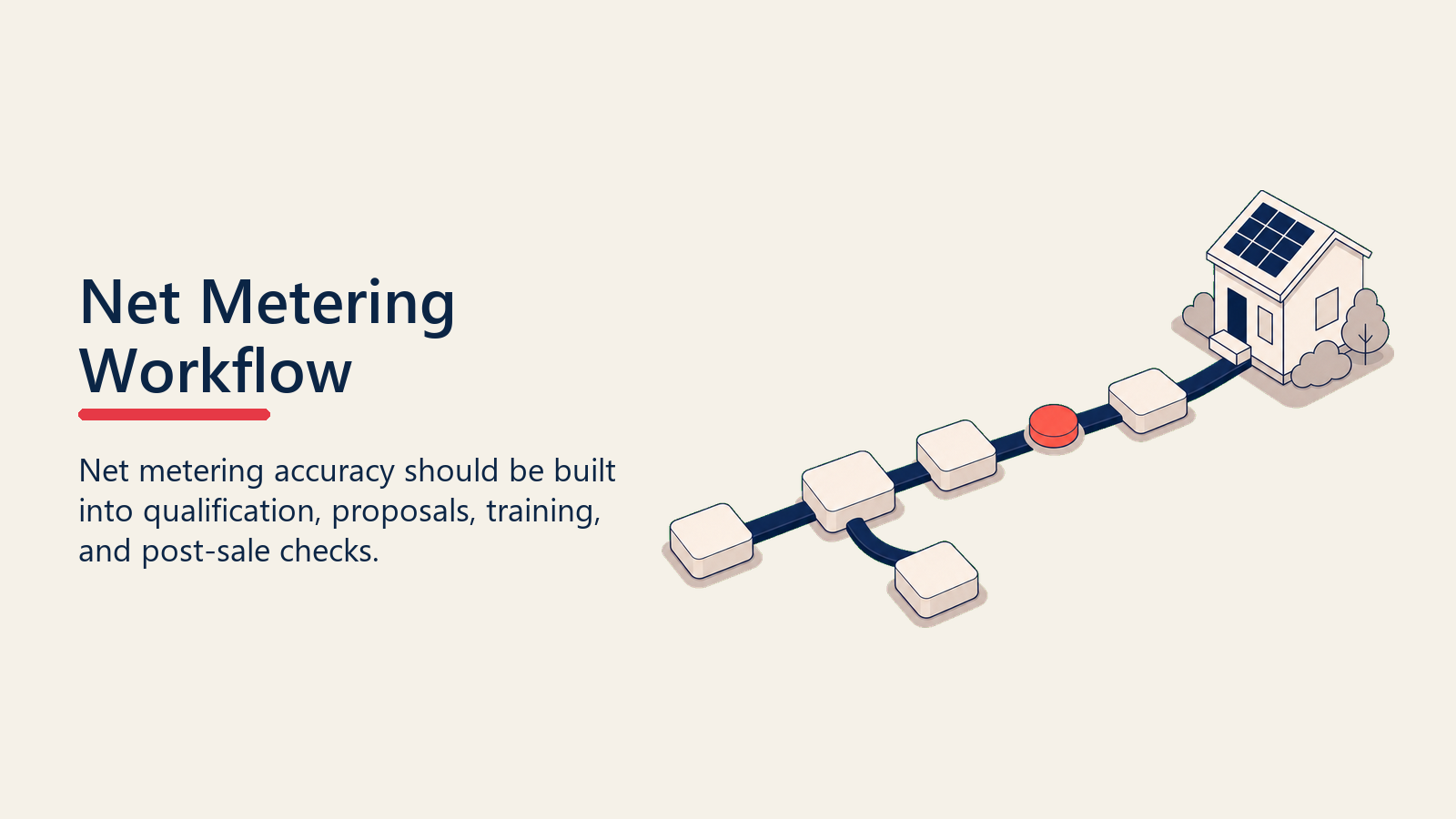
Lead qualification. Setters should flag the homeowner's utility during solar lead qualification and pre-screening, so the closer walks in already knowing the applicable tariff instead of discovering it live.
Proposal generation. Your solar CRM and proposal tools should pull current, utility-specific net metering or net billing rates automatically, not rely on a rep's memory or a static rate table that goes stale. State utility regulators, such as those tracked through the DSIRE database, update these rules regularly, and a proposal tool that isn't refreshed against current tariffs creates the exact kind of promised-savings gap that drives cancellations and bad reviews.
Ongoing training. Utility tariffs change. What was accurate last year might not be accurate this quarter. Build a recurring review into your coaching and ride-alongs cadence so reps stay current, especially in markets where regulators have been actively revising net metering rules.
Qualifying for Rate Design in the Room
This is also a place where good opportunity qualification technique pays off. Before you get deep into system design, confirm the utility, the tariff, and the homeowner's actual usage pattern (do they use most of their power during the day, or mostly evenings?). That qualification step changes whether you lead with a standard grid-tied system, a heavier self-consumption design, or a battery-forward pitch. Skipping it means building a proposal you'll have to rebuild once the real numbers surface.
Frequently Asked Questions about Selling Solar Around Net Metering and Rate Design
What is the difference between net metering and net billing?
Net metering typically credits exported solar power at or near the retail rate the customer pays for imported power, a roughly 1-for-1 exchange. Net billing credits exported power at a different, often lower rate tied to wholesale or avoided-cost pricing. Many states have shifted from older net metering programs toward net billing structures for new solar customers, though the exact terms vary by state and utility.
How do I know which structure applies to a specific homeowner?
Check the current tariff for their specific utility, not a general assumption about their state. Utility policies can differ even within the same state, and older customers may be grandfathered under a different program than what's currently offered to new applicants. Verify with your company's current utility data source before presenting numbers.
Does a lower export credit rate mean solar isn't worth it?
Not necessarily. It changes how the system should be designed and sold. Self-consumption (using solar power directly instead of exporting it) retains full retail value regardless of the export credit rate, and battery storage can capture more of that value by shifting stored power to cover higher-cost hours.
Can a homeowner's net metering rate change after they sign up?
It depends on the state and utility. Many jurisdictions grandfather existing solar customers under the tariff in place when they interconnected, for a defined period or indefinitely, while new customers move to updated terms. Reps should know their state's specific grandfathering rules and never promise a rate is locked forever unless the contract and regulatory rules actually guarantee it.
How should system sizing change under a lower export-credit structure?
Instead of sizing purely to offset 100% of annual usage through export credits, factor in the home's actual usage pattern and consider battery storage to capture excess production for direct use later, since that captured energy is generally worth more than a low export credit rate.
Learn More

Senior Implementation Consultant
On this page
- What Does Net Metering Actually Mean?
- Key Facts
- Why This Matters More Than Almost Any Other Variable
- The Sales Conversation: What to Cover and When
- 1. Identify the utility and tariff before you walk in
- 2. Explain the concept in plain language, without acronyms first
- 3. Show the actual credit rate, sourced from the current tariff
- 4. Size the system with the tariff in mind, not against a generic 100% offset target
- 5. Introduce battery storage as a rate-design response, not just a backup feature
- What Are the Most Common Rate-Design Objections?
- Building This Into Your Sales Process, Not Just Your Script
- Qualifying for Rate Design in the Room
- Learn More