Partner Channel and Referral Programs for Solar Growth
Turn this article into takeaways for your work.


Each assistant summarizes the article only for you and suggests best practices for your work.
Most solar companies have a homeowner referral program. Happy customer refers a neighbor, gets a check or a bill credit, everyone's happy. That's a good channel, and it should exist. But it caps out at the size of your installed customer base, and it depends entirely on how proactively you ask for referrals after install.
There's a second referral channel that a lot of solar sales organizations underbuild: business-to-business partnerships with roofers, HVAC contractors, electricians, real estate agents, and property managers who are already inside homes having relevant conversations. These partners don't need to become solar experts. They just need a reason and a simple mechanism to say "you should talk to my solar guy" at the right moment.
Below is how to identify, recruit, and manage a B2B partner referral channel that runs alongside your homeowner referral program, not instead of it.
Why B2B Partner Channels Work for Solar
A roofer who just inspected a 20-year-old roof and told the homeowner they need a replacement is standing in the single best moment to mention solar. Same with an HVAC contractor replacing an aging AC unit and talking to the homeowner about energy costs. Same with a real estate agent listing a home who knows the seller is trying to make it more attractive to buyers.
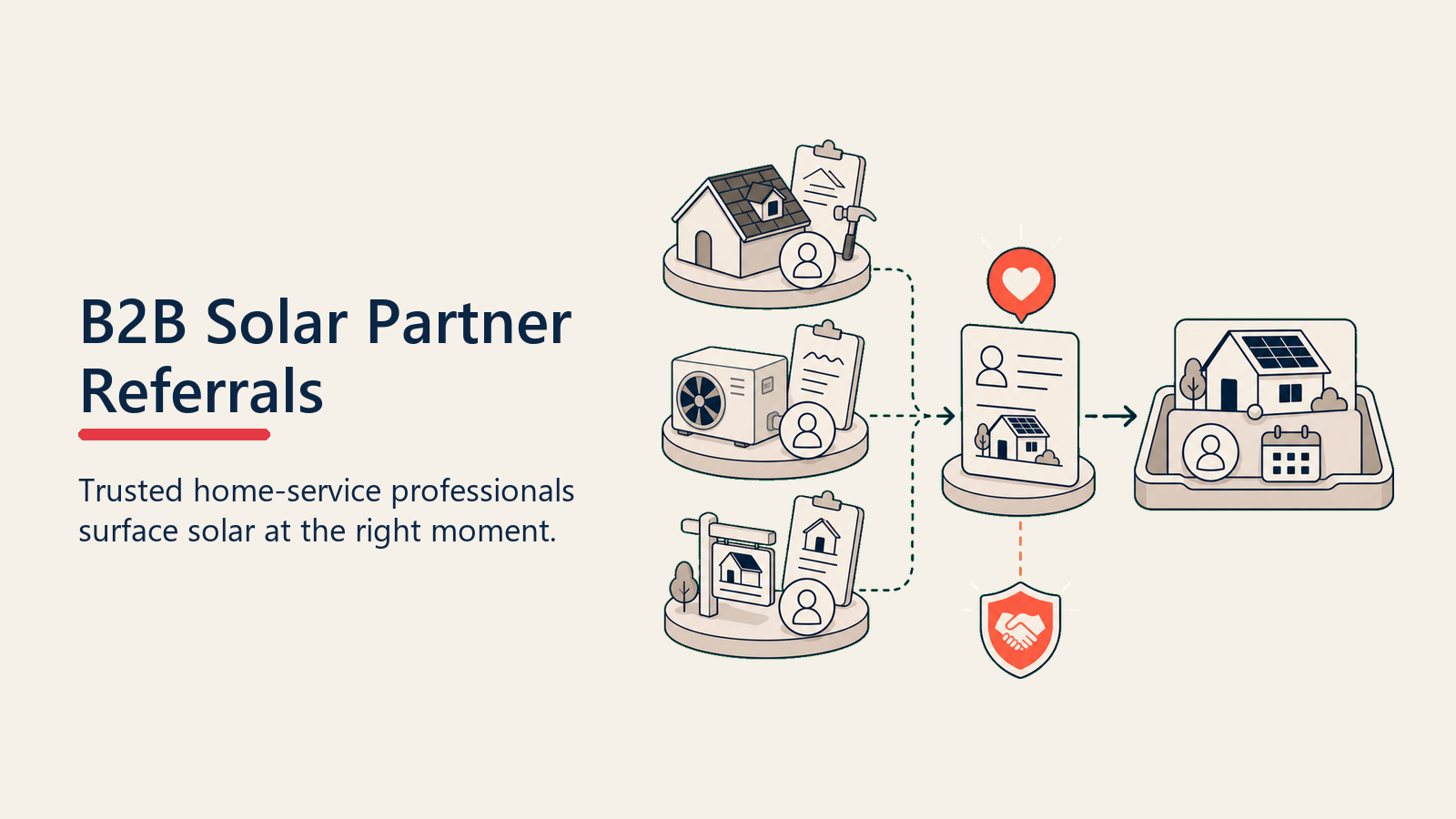
These professionals are already inside the home, already trusted, and already having an adjacent conversation. The lead quality from a warm professional referral tends to run higher than cold digital leads because the homeowner has already vetted the referring professional's judgment. That trust effect isn't just intuition: Nielsen's research on consumer trust found that 88% of people trust recommendations from people they know more than any other channel, well above branded advertising or digital ads.
There's another advantage worth calling out: it's a channel that scales independently of your own sales headcount and marketing spend. A single well-run partnership with a mid-size roofing company can produce a steady trickle of leads for years with minimal ongoing cost beyond the referral fee itself. That's a very different cost profile from door-to-door canvassing, which delivers volume on demand but requires ongoing headcount and management to sustain.
Key Facts: Partner Channel and Referral Programs
- 88% of people trust recommendations from people they know more than any other channel, according to Nielsen's research on consumer trust.
- Homes with solar panels have sold for an average of 4.1% more than comparable homes without solar, a premium Zillow's research found equated to thousands of dollars at the median home value, a fact that gives real estate agent partners a concrete reason to raise solar with sellers.
- Paid referral endorsements from business partners must disclose the financial connection to the homeowner if it would affect how they weigh the recommendation, under the FTC's endorsement guidance.
Which Partner Types Make Sense, and Why
| Partner Type | Why the Conversation Fits | Typical Trigger Moment |
|---|---|---|
| Roofers | Roof condition and age often come up alongside solar feasibility | Roof replacement or major repair |
| HVAC contractors | Energy usage and bills are a natural adjacent topic | AC or heating system replacement |
| Electricians | Panel upgrades are sometimes needed for solar anyway | Electrical panel upgrade or rewiring job |
| Real estate agents | Solar adds resale value and appeals to eco-conscious buyers | Home listing or buyer home search |
| Roof inspectors / home inspectors | Direct visibility into roof condition pre-sale | Pre-listing or pre-purchase inspection |
| Property managers | Multiple properties, ongoing relationship | Portfolio-wide cost reduction conversations |
| Pool and landscaping companies | High-electricity-use households are a strong solar fit | New pool install (pumps increase electric bills) |
Not every category will make sense in every market. A roofer partnership is nearly universal. A pool company partnership works great in Arizona, Florida, and similar climates, and barely matters in a market with few pools.
Building the Recruitment Pitch
Partners won't join a program because it's good for you. They join because it's a clean, low-effort way to add value for their own customers and make some extra income without extra work. Frame the pitch accordingly:
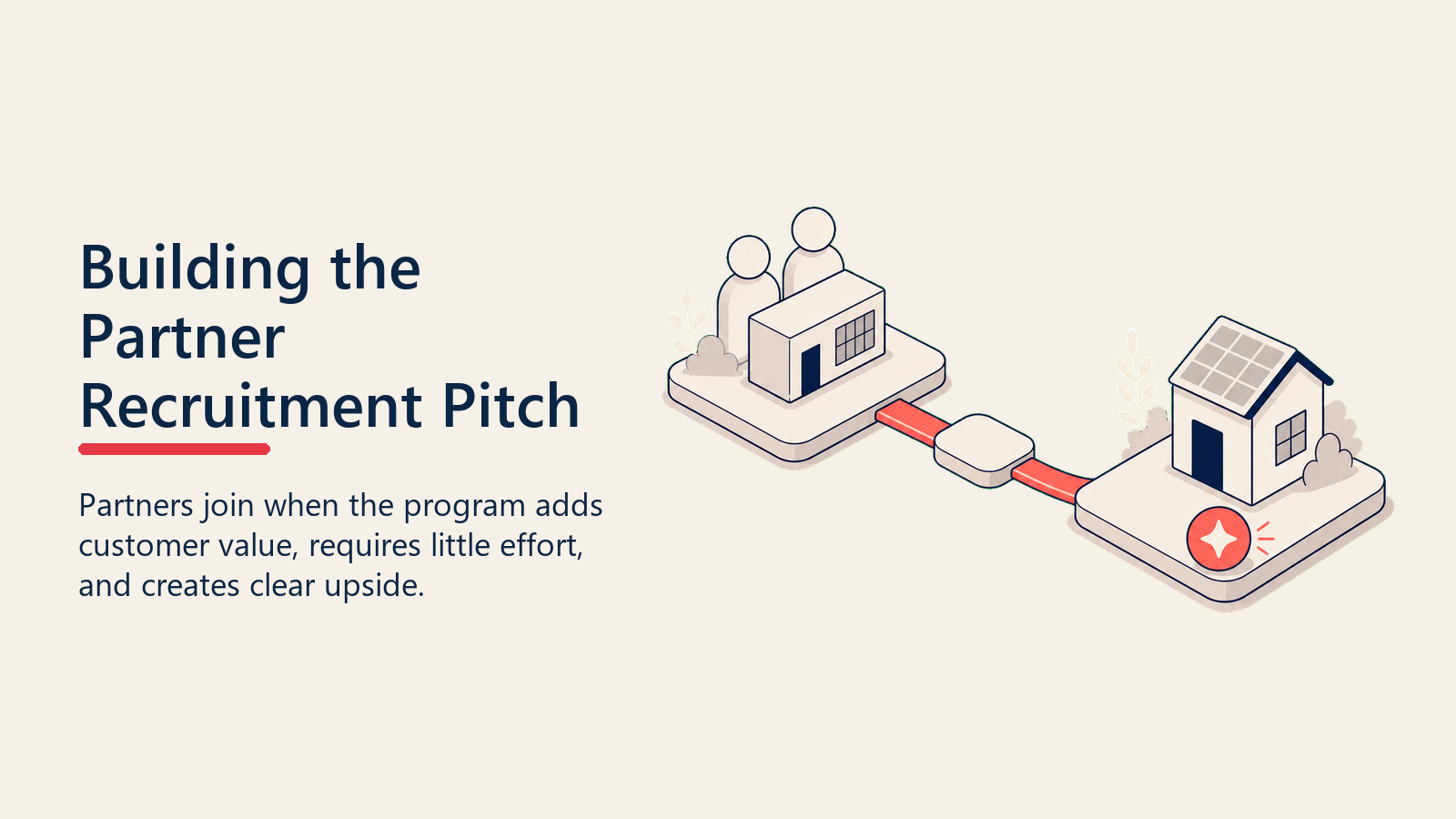
Lead with the customer benefit to them, not to you. "Your customers are already trusting your judgment about their home. Giving them a name for solar when it comes up adds value to your service without costing you anything." That's a stronger opening than "we want your leads."
Make the ask genuinely low-effort. The easier it is for a partner to refer, the more they'll do it. A single link, a QR code on a business card, or a simple text-to-refer number outperforms anything that requires the partner to fill out a form or make a phone call on your behalf.
Be specific about compensation. Vague promises of "we'll take care of you" don't motivate consistent behavior. A clear, written referral fee schedule does.
Offer to train, not just recruit. A 20-minute session with a roofing company's crew on how to spot solar-fit homes (south-facing roof, older electrical panel, high summer bills, minimal shading) turns passive awareness into active referrals. Most partners won't refer well without a little coaching on what to look for and what to say. It's the same reason a new setter needs structured onboarding before they're any good at spotting a qualified home. See recruiting and ramping solar reps for the training principles that translate directly to partner coaching.
The Recruit-Train-Report Loop: recruit partners on customer benefit rather than a pitch for leads, train them briefly on what a solar-fit home looks like, then report back on referral outcomes so the partner sees the payoff and keeps referring, instead of treating recruitment as a one-time signup event.
Structuring Referral Compensation
Compensation structures for B2B partners typically look different from homeowner referral rewards. Homeowner referrals are usually a flat bill credit or gift card. Business partner referrals need to reflect that you're asking a professional to spend their reputation and relationship capital on your behalf.
Common structures:
- Flat fee per qualified lead. Paid when a referred lead becomes a set appointment, regardless of close outcome. Simple, predictable, but can attract low-quality referrals if the bar for "qualified" isn't clear.
- Flat fee per closed deal. Paid only when the referral results in a signed contract. Aligns incentive with quality but delays payment, which can reduce partner enthusiasm if cycles are long.
- Tiered fee based on referral volume. Higher per-referral payout once a partner crosses a monthly or quarterly volume threshold, rewarding partners who build the habit rather than referring once and forgetting.
- Percentage of contract value. Less common in residential due to complexity, more common in commercial partner arrangements.
Whatever structure you choose, put it in writing with clear definitions of "qualified lead" and "closed deal," and pay promptly. A partner who has to chase you for a referral fee will stop referring, and they'll tell other potential partners about the bad experience. Vague terms are also where partner disputes turn ugly, so borrow from the same clarity principles in negotiation fundamentals: define terms precisely up front so there's nothing to argue about later.
There's a compliance angle worth building into your partner agreements too. When a roofer, HVAC contractor, or real estate agent recommends your company in exchange for a fee, that's a paid endorsement, and the FTC's endorsement guidance expects the connection to be disclosed to the homeowner if it would affect how they weigh the recommendation. Build a simple disclosure line into your partner training so a referral doesn't quietly become a legal liability for either side.
Partner Referral Program Structure Checklist
- Target partner categories identified for your specific market and climate
- Referral fee structure defined in writing (flat fee, tiered, or per-close)
- Simple referral mechanism built (link, QR code, or dedicated phone line)
- Training materials created: what a solar-fit home looks like, what to say
- Clear payment timeline and process documented
- Dedicated partner contact on your team assigned
- Tracking system in place to attribute leads to the correct partner
- Quarterly check-in cadence scheduled with active partners
Managing and Growing the Channel Over Time
Recruiting a partner is the easy part. Keeping the referrals flowing takes ongoing management.
Assign a real owner internally. Partner channels that report to "whoever has time" fade fast. Someone on your team, often in marketing or business development, should own the relationship, track performance, and keep partners engaged.
Report back to partners. Tell a roofer when their referral closed. Tell them how much their customer is saving. This closes the loop and reinforces why the referral mattered, which keeps the behavior going. It also gives the partner something positive to share with their own customer after the fact.
Recognize top performers. A simple leaderboard, a bonus for the top referring partner each quarter, or even just public recognition in a local trade group can keep partners engaged beyond the direct financial incentive.
And don't forget to re-engage dormant partners. Partners who referred once and then stopped usually didn't lose interest. They just forgot, or didn't have another obvious trigger moment. A quarterly check-in reminding them of the program and sharing a recent success story often reactivates them.
Expand geographically as you grow. As you enter new territories, your partner recruitment should expand alongside your canvassing and digital lead generation, not as an afterthought once other channels plateau. See solar buying vs. self-generated leads for how a partner channel fits into your broader lead mix strategy and cost-per-lead comparison.
How Should Partner Leads Flow Into Your Sales Process?
Partner-referred leads deserve a slightly different intake process than cold leads, because they arrive with an implicit endorsement that a cold lead doesn't have.
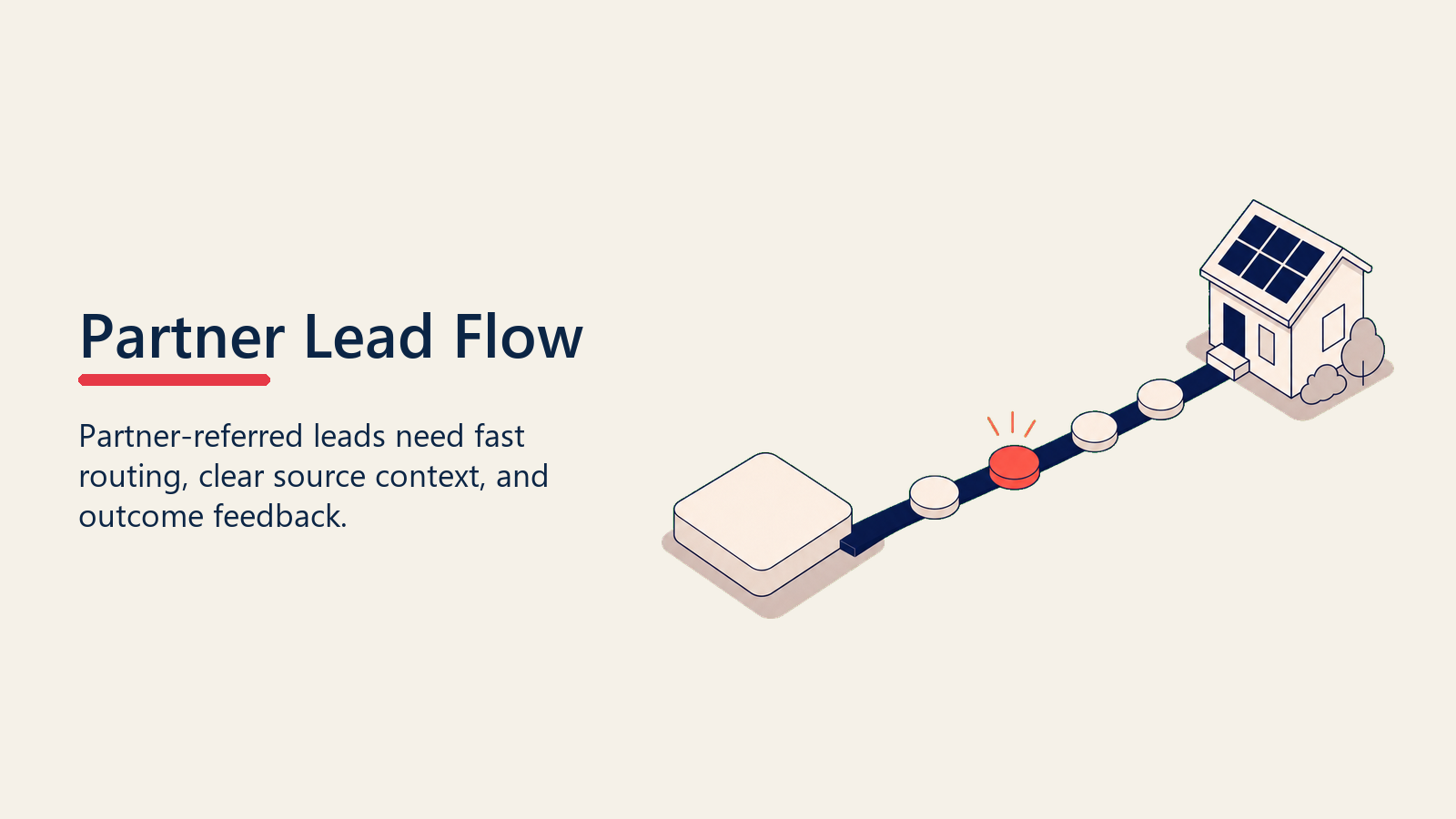
- Route them faster. A partner referral that sits in a queue for two days loses the warmth of the original recommendation. Fast follow-up, same day and ideally within the hour, respects both the partner's referral and the homeowner's initial interest.
- Acknowledge the referring partner by name on first contact. "Hi, this is [rep] from [company]. [Partner name] mentioned you were looking into your roof and thought solar might make sense for your home." This confirms the connection and builds instant credibility.
- Feed outcome data back into lead scoring. Partner-sourced leads often convert at different rates than digital or canvassed leads. Track this separately so your lead scoring model reflects the actual quality of each source rather than treating all leads the same.
- Still run them through prescreening. A warm referral is not the same as a qualified lead. Confirm homeownership, roof condition basics, and financial readiness using the same lead qualification and prescreening steps you'd apply to any other source, just move faster given the added trust.
Common Mistakes in Partner Channel Programs
Treating it as a one-time recruitment push is a common failure mode. Signing up ten partners in a launch month and never following up again is how a promising channel goes dormant within a quarter.
Overcomplicating the referral mechanism is another. If a roofer has to log into a portal, fill out a multi-field form, and remember a code, most simply won't bother, even if they mean well.
Underpaying relative to the relationship capital being spent costs more than it saves. A partner referring a customer they've served for years is putting their own reputation on the line. Lowball compensation reads as disrespect for that trust, and word travels fast in local trade communities.
Not training partners on what a good fit looks like backfires too. Without guidance, partners either refer everyone, creating a flood of low-quality leads, or refer no one because they're unsure when it's appropriate to bring it up.
And losing track of who referred whom quietly kills channels. Attribution gaps lead to unpaid or late-paid partners, which is one of the fastest ways to end a partner's enthusiasm.
Quotable Nuggets
"Homes with solar panels have sold for an average of 4.1% more than comparable homes without solar, according to Zillow research, giving real estate agent partners a concrete, dollar-backed reason to raise solar with home sellers."
Frequently Asked Questions about Partner Channel and Referral Programs for Solar Growth
What types of businesses make the best solar referral partners?
Roofers, HVAC contractors, electricians, and real estate agents tend to perform best because they're already inside homes having adjacent conversations about roof condition, energy use, or resale value. The right mix depends on your local market and climate.
How much should we pay a business partner for a solar referral?
There's no universal number since it varies by market and deal economics, but the structure should be written down clearly, whether it's a flat fee per qualified lead or per closed deal, and paid promptly. Underpaying relative to the trust a partner is extending tends to kill the relationship faster than any other mistake.
How is a B2B partner referral program different from a homeowner referral program?
Homeowner referral programs reward past customers for referring people they know personally, usually with a flat credit or gift. B2B partner programs compensate other businesses for referring their own customers, which requires clearer written terms, training on what a good referral looks like, and ongoing relationship management since it's a professional, not personal, relationship.
How quickly should a partner-referred lead be contacted?
As fast as possible, ideally within the hour and same-day at the latest. Partner referrals carry warmth and implicit trust from the original recommendation that fades quickly if the homeowner doesn't hear from you promptly.
Should partner-sourced leads be tracked differently in the sales pipeline?
Yes. Partner leads often convert at different rates than digital or canvassed leads, and tracking that separately lets you measure the channel's true value and refine your lead scoring and mix strategy over time.

Senior Implementation Consultant
On this page
- Why B2B Partner Channels Work for Solar
- Which Partner Types Make Sense, and Why
- Building the Recruitment Pitch
- Structuring Referral Compensation
- Partner Referral Program Structure Checklist
- Managing and Growing the Channel Over Time
- How Should Partner Leads Flow Into Your Sales Process?
- Common Mistakes in Partner Channel Programs
- Quotable Nuggets