Sales and Install Operations Alignment for Solar Companies
Turn this article into takeaways for your work.


Each assistant summarizes the article only for you and suggests best practices for your work.
Here's a pattern that plays out at solar companies of every size: a rep closes a deal, hands off the file, and moves on to the next prospect. The install team picks up that file and immediately sees a problem. The site survey hasn't been scheduled. The roof type the rep noted doesn't match what the photos show. The customer was promised a 6-week timeline that operations can't possibly meet given current permit backlogs.
Nobody told the customer any of this. They signed the contract 3 weeks ago and haven't heard from anyone. Their first contact with the install side of the business is a call telling them their timeline has slipped.
That call is where cancellations come from. It's also where 1-star reviews about communication get written. And it's almost entirely preventable.
Sales-to-install alignment isn't a culture initiative. It's a revenue protection strategy. This article breaks down where the friction lives, what each team blames the other for, and what the process fixes actually look like.
Why Do Sales and Install Think Differently?
The misalignment between solar sales and install operations isn't about bad people. It's about different incentive structures pointing in opposite directions.

Sales teams are incentivized to close. Commission structures, quota pressure, and manager focus all point toward signed contracts. The faster a rep closes and the more deals they get across the line, the better their outcome. Timeline promises get made in the moment, with whatever answer keeps the deal moving. Roof complexity gets downplayed. Credit risk gets glossed over.
Install teams are incentivized to execute. They own permit timelines, city inspection schedules, subcontractor availability, equipment delivery windows, and the physical reality of what's on the roof. They can't manufacture more installer capacity or shrink a permit backlog. When sales promises something that doesn't match operational reality, install absorbs the customer fallout.
This dynamic is not unique to solar, but it's amplified here because the fulfillment cycle is long. According to NREL's SolarTRACE research, median permit-to-inspection timelines for residential PV projects run 33 to 48 days even in well-functioning jurisdictions, and interconnection queues can stretch months beyond that. The gap between what sales promises and what operations can deliver is structural, not personal.
The result is predictable: sales resents install for "killing deals" by being inflexible; install resents sales for making promises that can't be kept. Customers get caught in the middle. So where exactly does the friction show up?
Key Facts
- NREL's SolarTRACE data covering 700,000+ residential rooftop PV projects found that median permit-to-inspection timelines run 33 to 48 days even in well-functioning jurisdictions, with interconnection queues capable of stretching months beyond that. (NREL SolarTRACE, 2024)
- A 2022 NREL study of residential solar installer data found that 51% of contracts did not result in an installed system, with a median installer cancellation rate of 33%. Permitting delays and changes in customer finances ranked as the top two drivers. (NREL, "Evaluating the Impact of Residential Solar Contract Cancellations," 2022)
- Post-sign cancellations add an estimated $0.20 per watt to soft costs on average, representing roughly 25% of direct pre-install soft costs industry-wide. (NREL, 2022)
Where the Friction Concentrates
Alignment problems in solar show up at five specific handoff points.
1. Site survey and design discrepancy
Reps sometimes conduct preliminary roof assessments during the in-home consultation and quote production numbers based on their own judgment. When the actual site survey and design process produces a different result (different roof usable area, shading issues, structural limitations), the customer gets a revised proposal that doesn't match what they signed.
If the delta is significant enough, customers push back or cancel. The sales team feels blindsided. The design team feels like they're being pressured to approve a design that doesn't work.
The fix: separate the preliminary assessment from the commitment. Reps should communicate roof estimates as directional, not final, and set the customer's expectation that the formal site survey will confirm (or adjust) the numbers. See site survey and design confirmation for the detailed handoff process.
2. Timeline promises that don't reflect reality
"Six to eight weeks" is a common sales promise. In markets with active permit backlogs or utility interconnection queues, six to eight weeks from signing to activation can be six to eight months. Reps making timeline promises without real-time data from operations create a credibility problem that install then has to manage.
The fix: give sales reps access to a live timeline dashboard. If your current permit backlog in a given jurisdiction is 14 weeks, reps need to know that before they sit across from a customer and quote 8 weeks. Ops should update this dashboard at minimum weekly, and sales managers should make it part of the pre-consultation briefing.
3. Credit and financing fallouts after signing
Some companies run credit checks before the in-home consultation. Others let sales close and then run credit as part of the post-sign processing. When credit comes back declined or at a significantly lower amount than the customer's proposal assumed, the deal needs to be restructured. Sometimes dramatically.
If no one told the customer this was a possibility, they're blindsided. Some cancel on principle. The sales rep, who already moved on to the next deal, is rarely the one managing this conversation.
The fix: be explicit with customers during the close that financing approval is the next step and that their proposal may adjust based on the approval. This isn't a deal-killer; it's honest framing that prevents cancellations caused by post-sign surprise. See solar financing models and sales for how to frame financing expectations at the close.
4. The project handoff dead zone
After signing, customers often enter a communication gap. Sales is done. Install hasn't started. Permitting is being filed. Nothing is visibly happening, but the homeowner has just committed to a 25-year financial obligation. Silence during this gap produces anxiety, and anxious customers cancel.
The fix: assign project ownership the moment a contract is signed. This doesn't mean the install team starts work. It means a specific person (project coordinator or customer success rep) is assigned to that customer and makes contact within 48 hours of signing. Their job is to set the roadmap, communicate the current status, and be the named contact for any questions.
5. Pre-install customer expectations set incorrectly
Reps sometimes over-promise the installation experience itself. "It'll be a one-day install, you'll barely notice they're there." When a crew shows up for two full days, cuts power multiple times, and leaves minor roof debris, the customer's expectations are violated even if the install was technically flawless.
The fix: install operations should write the installation experience description that sales uses. Not sales writing it from memory and ops inheriting whatever comes out.
Building the Alignment Infrastructure
Fixing these friction points requires structural changes, not just better communication.
Shared visibility on the pipeline
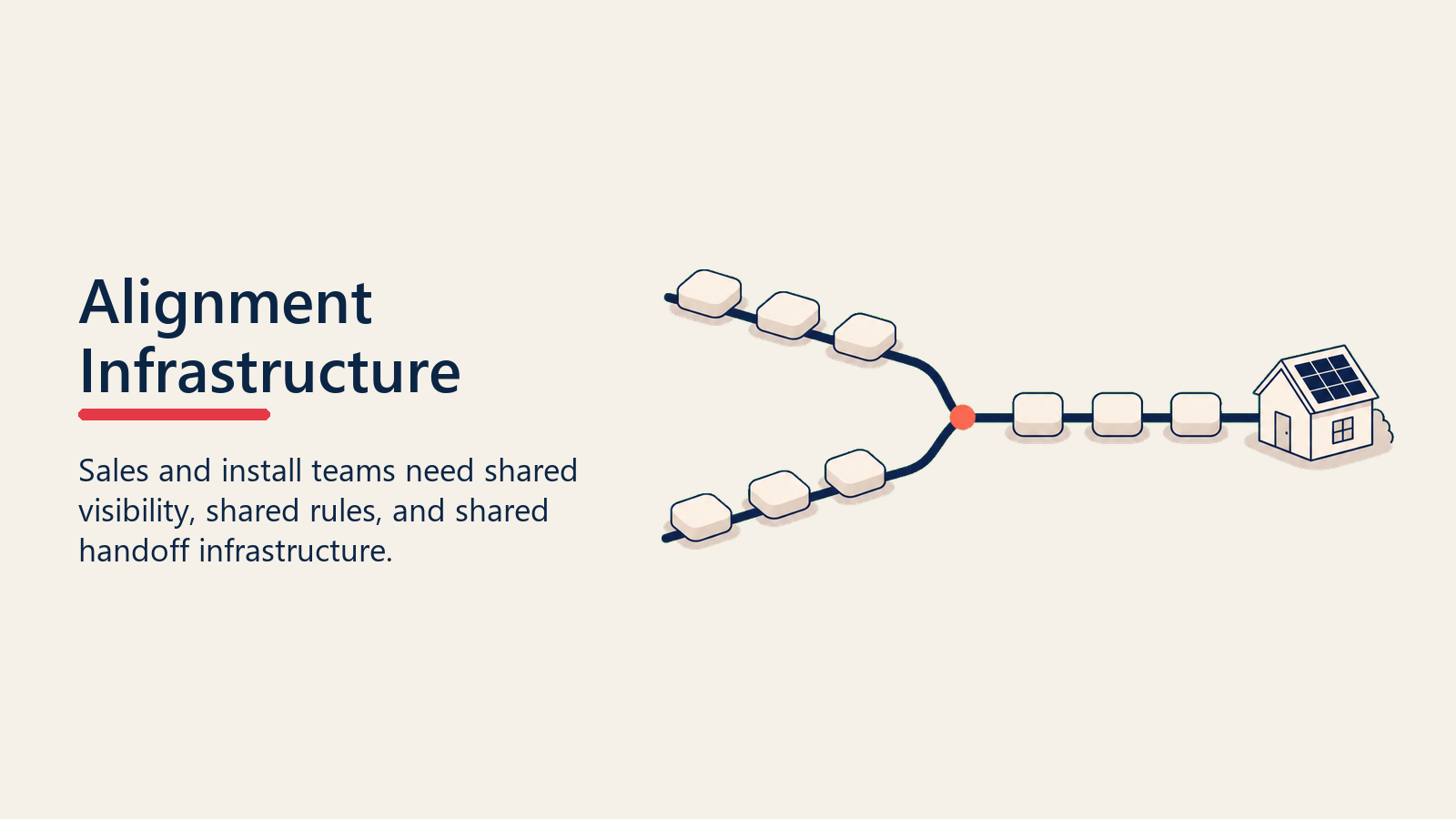
Sales and install need to see the same pipeline. In many solar companies, sales tracks deals in their CRM and install tracks projects in a separate tool (or a spreadsheet). These systems don't talk to each other, which means the handoff is a document export or an email.
This creates a version-of-truth problem. Sales thinks a job is in processing. Install thinks it's waiting on a document that nobody chased. The customer is assuming things are progressing.
The minimum viable solution is a shared project stage in your CRM or project management tool that both teams can see and update. A deal that moves from "closed" to "in permitting" to "permit approved" to "scheduled" to "installed" to "activated" gives both teams (and the customer) real-time status without anyone having to chase anyone.
For the tooling considerations, see solar CRM and proposal tools.
The joint SLA document
Write down what each team promises the other. This isn't a management exercise. It's a practical document that prevents the "I didn't know that was my job" problem.
A sample joint SLA framework:
| Handoff event | Sales responsibility | Install responsibility | Timing |
|---|---|---|---|
| Contract signed | Complete intake form, upload site photos, flag any site concerns | Assign project coordinator, send welcome message to customer | Within 24 hours of sign |
| Site survey scheduled | Confirm appointment with customer | Conduct survey, upload results within 24 hours | Within 5 business days of sign |
| Permit submitted | N/A | Notify customer permit filed, provide expected timeline | Within 3 business days of survey |
| Permit approved | N/A | Contact customer to schedule install, update CRM | Within 24 hours of approval |
| Install complete | N/A | Walk customer through system, confirm activation steps | Day of install |
| System activated | Request review and referral | Send monitoring login, confirm first 30-day check-in | Within 48 hours of activation |
Get both teams into a room to write this together. The process of writing it surfaces assumptions on both sides that nobody knew existed.
The weekly alignment meeting
Install and sales managers should have a standing 30-minute weekly meeting that covers:
- Jobs currently in the install queue and their status
- Permit or utility issues that need customer communication
- Jobs where the customer has raised concerns (cancellation risk)
- Timeline accuracy review: are reps quoting realistic timelines based on current operations?
- Upcoming capacity: can install handle the volume currently being closed?
This meeting isn't about assigning blame. It's about catching problems before they become customer experience failures. Companies that run this consistently see measurable drops in post-sign cancellation rates within 60 days. The Salesforce State of Sales report identifies cross-functional alignment as the number one tactic sales leaders cite for driving growth, and the same principle applies between sales and install: shared visibility changes the conversation from blame to problem-solving.
Feedback loops from install back to sales
Install teams see things that sales teams need to know. A specific roof type that keeps generating permit problems. A neighborhood where the utility is running 14-week interconnection queues. A panel brand that's been generating installation issues.
Without a feedback loop, sales keeps repeating the same mistakes because they never hear about the downstream consequences. Build a formal feedback mechanism, even if it's as simple as a monthly email from the install manager to the sales manager summarizing the top 3 operational issues that originated from sales commitments.
The Cancellation Risk Signal
One of the most valuable outputs of sales-install alignment is early identification of customers at risk of canceling. This is a joint responsibility.
Signs a deal is at cancellation risk:
- Customer hasn't responded to project coordinator outreach in 7+ days since signing
- Timeline has been communicated as delayed more than once
- Customer has asked to speak to a manager about a process issue
- The permit timeline in the customer's jurisdiction is running more than 40% over the estimate given at signing
- Customer's financing structure changed post-sign and they had a negative reaction
When any of these signals appear, escalate immediately. Don't let the project coordinator manage it alone. Get the original sales rep involved (they have the relationship), loop in a manager if needed, and make a personal call.
The cost of a cancellation in solar is high: you've spent acquisition cost to generate the lead, compensation to the setter, compensation to the closer, and internal project overhead. You've also tied up capacity in your design and permitting pipeline. A proactive call that saves the deal costs 20 minutes. A cancellation costs thousands.
For the broader cancellation prevention playbook, see managing install wait times and cancellations. And for the principles behind keeping customers loyal through a long fulfillment cycle, see retention fundamentals. The same drivers that reduce churn in post-sale management apply during the install wait period.
Quotable Nuggets
"A proactive delay call costs 20 minutes. A cancellation costs thousands in acquisition spend, setter pay, closer comp, and pipeline capacity. The math on over-communication is obvious." Operations principle grounded in NREL cancellation-cost research
"The Salesforce State of Sales identifies cross-functional alignment as the number one tactic sales leaders cite for driving growth. In solar, that alignment lives between sales and install, not between sales and marketing."
The Alignment Accountability Framework: Map every handoff between sales and install as a three-column table: (1) the triggering event, (2) which team owns the action and within what timeframe, and (3) which team owns the customer communication. When a column is blank or disputed, that is where your cancellations originate. Write the table jointly. The act of filling it in surfaces assumptions neither team knew existed.
What Does Good Alignment Actually Look Like in Practice?
A solar company with functioning sales-install alignment looks like this: a rep closes a deal at 7pm on a Tuesday. By Wednesday morning, the project coordinator has sent the customer a welcome email with their project timeline, their permit filing status, and the coordinator's direct contact info. The customer responds with a thank-you. The coordinator logs the contact in the CRM.
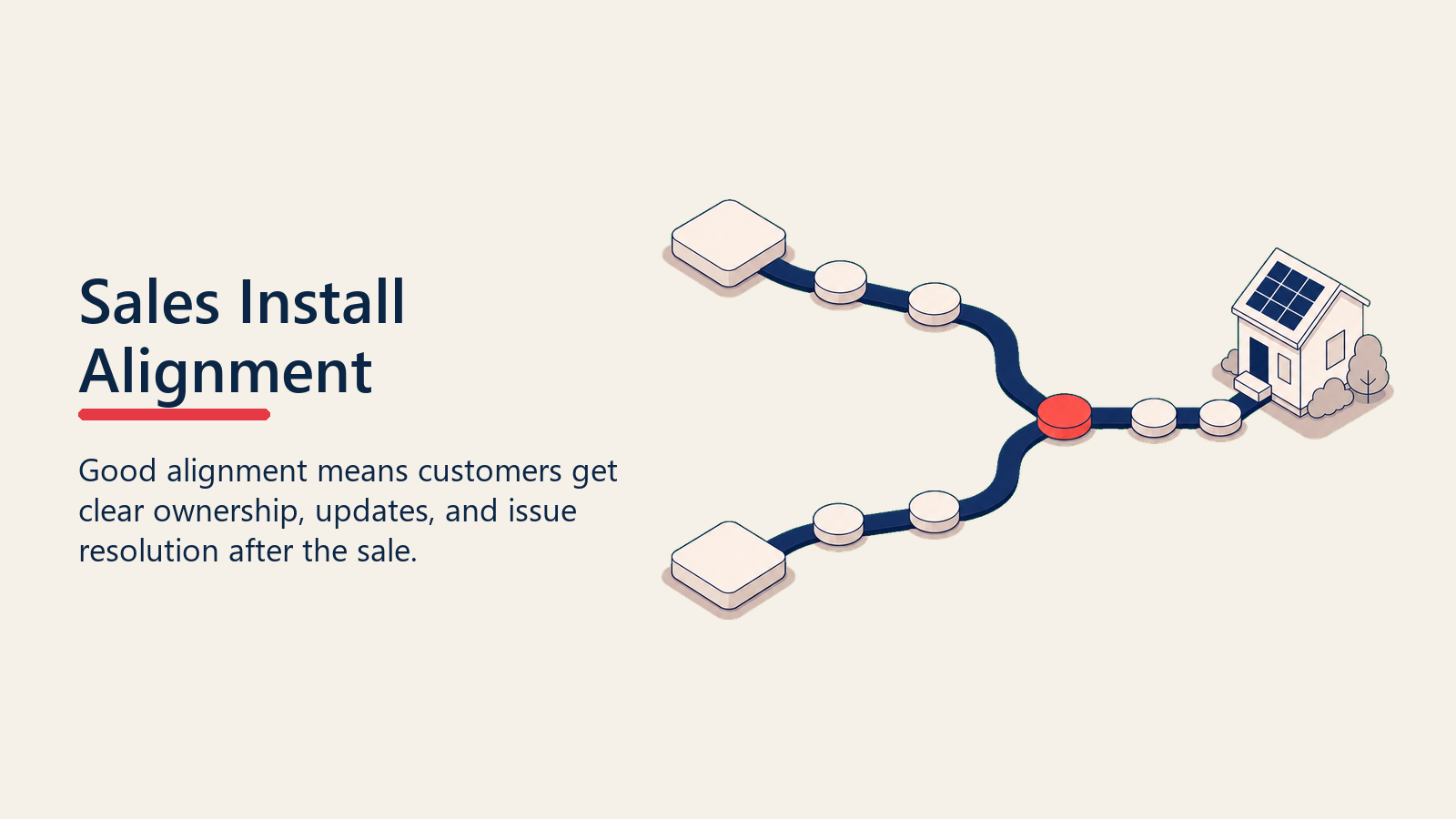
Three weeks later, the permit comes back with a request for additional documentation. The coordinator catches it the same day through the install team's permit tracking system. She calls the customer before they've had any reason to wonder what's happening. She explains the situation, what's needed, and the revised timeline. The customer says "thanks for keeping me posted."
The system activates 9 weeks after signing, 1 week behind the 8-week estimate the rep gave at the close. The customer knew about the potential delay 3 weeks in. When activation happens, they're happy, not resentful.
That customer leaves a 5-star review. They refer two neighbors. They answer a phone call from your service team 18 months later when a monitoring alert flags a production dip.
That customer lifecycle starts with what the rep promised and what the install team delivered matching close enough that the customer never felt misled. Alignment is how that happens consistently.
For the related challenge of how setters and closers coordinate on the sales side, see setter to closer handoff. The internal handoff principles apply on both sides of the business. And for the qualification process that sets realistic expectations before the customer ever signs, see opportunity qualification. Deals that enter the pipeline with accurate data are far easier for install to fulfill without surprises.
Frequently Asked Questions about Sales and Install Operations Alignment for Solar Companies
What is the most common reason solar deals cancel after signing?
NREL research on residential solar contract cancellations identified permitting delays and changes in customer finances as the top two drivers. Both are addressable with better communication protocols: proactive delay notifications and upfront financing expectation-setting at the close reduce the cancellation risk significantly.
How should we handle a permit timeline that runs longer than what sales promised?
Contact the homeowner before they contact you. Assign a project coordinator to make a personal call explaining the delay, the revised estimate, and what is being done to move the process forward. Customers who receive proactive communication about delays cancel at far lower rates than customers who experience silence and then discover the problem on their own.
What should a joint SLA between sales and install actually include?
At minimum: which team owns each handoff action (with a named role, not just a team), the timing requirement for each action, and which team is responsible for customer-facing communication at each stage. A table format works well. Both team managers should co-author it, because the writing process surfaces assumptions neither side knew the other held.
How do we get sales reps to give accurate timelines when they're under closing pressure?
Give them access to a live operations dashboard that shows current permit backlogs by jurisdiction and upcoming install capacity. When a rep can see in real time that the average permit timeline in their market is currently 11 weeks, they stop quoting 6. Operations should update this dashboard weekly and sales managers should make it part of the pre-consultation briefing.
Who should own customer communication during the install wait period?
A dedicated project coordinator, not the original sales rep. The rep has moved on to the next deal; the coordinator has the systems access and the bandwidth. The coordinator should make first contact within 48 hours of signing, and should have a standing check-in cadence with the customer through activation.
How do we measure whether alignment is actually improving?
Track post-sign cancellation rate, timeline accuracy (actual activate date vs. promised date), and 30-day post-sign NPS. Those three metrics together tell you whether the communication bridge between sales and install is working. Run them in your weekly joint alignment meeting so both teams see the same numbers.
What should the weekly alignment meeting cover?
Jobs currently in the install queue and their status, permit or utility issues that need customer communication, jobs where the customer has raised concerns, whether reps are quoting realistic timelines based on current operations, and upcoming capacity relative to the deals currently being closed. Cap it at 30 minutes and keep it structured. This is a diagnostic session, not a blame session.
When should we escalate a cancellation-risk customer?
Immediately, when any of these signals appear: no response to coordinator outreach in 7+ days since signing, timeline communicated as delayed more than once, customer asked to speak to a manager, permit timeline running more than 40% over the estimate given at signing, or financing structure changed post-sign with a negative customer reaction. Get the original sales rep and a manager involved personally, not through another coordinator message.
Metrics That Show Whether Alignment Is Working
You can't manage alignment without measuring it. Track these:
| Metric | Description | Healthy range |
|---|---|---|
| Post-sign cancellation rate | Deals canceled after signing, before install | Under 8% |
| Timeline accuracy | Actual activate date vs. promised date at signing | Within 3 weeks, 85%+ of installs |
| Customer contact rate in first 48h | % of new customers contacted by coordinator within 48h of signing | 100% |
| Permit delay notifications | % of customers proactively notified when permit exceeds timeline | 100% |
| Survey-to-design discrepancy rate | Jobs where site survey materially changes the original proposal | Track and trend down |
| Post-sign NPS (Net Promoter Score) | Survey customers at 30 days post-sign on process experience | 50+ |
Run these in your weekly alignment meeting. When a metric trends the wrong direction, trace it back to the specific handoff point that broke. Most problems concentrate at one or two stages, which makes the fix more manageable than it looks from the outside.

Senior Implementation Consultant
On this page
- Why Do Sales and Install Think Differently?
- Where the Friction Concentrates
- 1. Site survey and design discrepancy
- 2. Timeline promises that don't reflect reality
- 3. Credit and financing fallouts after signing
- 4. The project handoff dead zone
- 5. Pre-install customer expectations set incorrectly
- Building the Alignment Infrastructure
- Shared visibility on the pipeline
- The joint SLA document
- The weekly alignment meeting
- Feedback loops from install back to sales
- The Cancellation Risk Signal
- Quotable Nuggets
- What Does Good Alignment Actually Look Like in Practice?
- Metrics That Show Whether Alignment Is Working