Coaching and Ride-Alongs: How Solar Sales Managers Build High-Performing Teams
Turn this article into takeaways for your work.


Each assistant summarizes the article only for you and suggests best practices for your work.
The biggest gap in most solar sales organizations isn't lead quality or financing options. It's the space between what reps are trained to do in onboarding and what they actually do in front of a homeowner.
Ride-alongs close that gap faster than anything else. When a manager sits in on a live appointment, they see exactly where the rep loses momentum, rushes the needs assessment, or handles an objection in a way that kills the deal. No role-play exercise replicates that.
But ride-alongs only work when they're structured. A manager who just "watches" and says "good job" at the end adds almost nothing. This guide covers how to build a coaching system around ride-alongs that actually moves numbers.
Does In-Field Coaching Actually Outperform Classroom Training?
Solar sales is a high-stakes, in-home, consultative process. The rep has roughly 90 minutes to build trust, assess the home's energy situation, design a system, present financing, and ask for a same-day decision.
No amount of product knowledge or script memorization prepares a rep for the silence after they quote a price. That silence is something you learn to sit with, not something you read about.
Field coaching works because it puts feedback in context. A manager who watched the exact moment a rep broke eye contact during the price reveal can coach to that specific behavior. A manager reading a customer relationship management (CRM) note cannot.
Key Facts
- Nearly 4 in 10 field sales managers spend less than 3 hours per week coaching their reps. (SPOTIO, Sales Management Process)
- Only 18% of field sales organizations achieve sustainable success, meaning consistently hitting quota while keeping turnover under control. (SPOTIO, Sales Management Process)
- 41% of field sales teams report annual rep turnover of 50% or higher. (SPOTIO, 140+ Sales Statistics)
In solar specifically, where commission-based reps are self-managing most of their day, regular in-field contact from a manager is also a strong retention signal. Most managers know they should coach more. The data shows very few actually do.
The Four Types of Ride-Alongs
Not every ride-along has the same purpose. Mixing them up without intention leads to inconsistent feedback and frustrated reps.
| Type | When to Use | Manager's Role |
|---|---|---|
| Observation-only | New reps, first 30 days | Silent witness; debrief after |
| Shadow and assist | Weeks 5-12 | Manager leads one section; rep sees the method live |
| Side-by-side coaching | Any rep post-ramp | Manager prompts rep before each stage |
| Peer ride-along | Top performers with newer reps | Top rep leads; manager observes both |
For new reps, start with observation-only. Your goal is to build a baseline. You can't coach without knowing what the rep's natural tendencies are first.
Shadow-and-assist is the highest-value tool for reps who are stuck. When a manager steps in to demonstrate how to navigate the needs assessment or re-anchor after price shock, the rep sees the exact skill they need to develop, in the exact moment they usually fail.
Building a Ride-Along Schedule That Doesn't Burn Out Managers
Most solar organizations either ride along too rarely (once a month, or only when performance tanks) or mandate so many that managers spend more time in cars than doing actual management work.
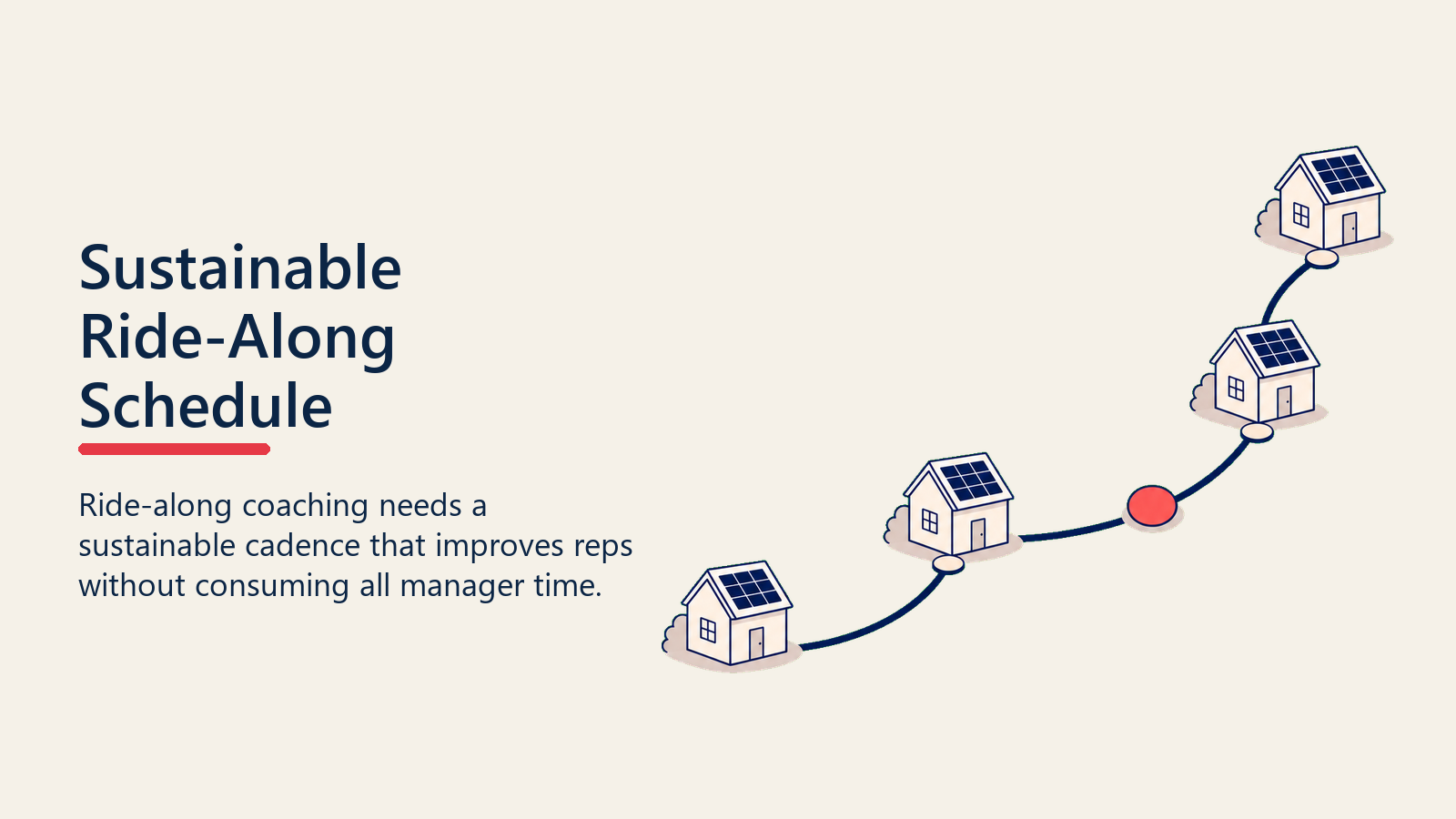
A sustainable cadence for a team of 8-12 reps looks like this:
- New reps (0-60 days): 3-4 ride-alongs per week, manager or senior closer
- Ramping reps (60-120 days): 1-2 per week, with structured debrief
- Established reps: 1 per month minimum, plus any triggered by performance flags
- Top performers: quarterly check-in ride-along, often with a peer element
"Performance flags" are worth defining explicitly. Don't wait for end-of-month numbers to drop before scheduling a ride-along. Define the triggers in advance:
- Close rate drops below team baseline for two weeks
- Three or more no-decisions in a row
- A pattern of late-stage drops showing up in pipeline data
- Rep requests coaching support
Proactive ride-alongs based on pipeline patterns prevent problems before they compound. This is where your solar pipeline and funnel analytics become directly actionable: when funnel data shows a rep is losing deals at the proposal stage, you schedule a ride-along to that specific stage, not a general check-in.
The Pre-Ride-Along Prep Conversation
A ride-along without a pre-conversation is wasted time.
Before you walk into an appointment together, you need to align on two things: what the rep is working on, and what success looks like for this specific appointment.
A good pre-conversation takes five to ten minutes and covers:
What the rep already knows about this lead. What was the pre-qualification conversation? What do we know about the home's usage, roof condition, and financing posture? If the rep hasn't reviewed this, you've already spotted a coaching opportunity: preparation is part of the process.
What the rep wants feedback on. Ask directly. Reps who are self-aware about their gaps will tell you exactly where they want coaching. Those who don't know yet will give you a blank stare, which is also useful information.
What you're watching for. Be transparent. If you're specifically watching how they handle the energy needs assessment or transition from assessment to proposal, tell them. Ambiguity about what you're evaluating raises anxiety and distorts behavior.
Review the appointment details together in your CRM. If your team uses a tool that links pre-qualification notes to the appointment record, this is where that pays off. See how the setter documented the lead and whether the closer has read it.
This connects directly to how well your setter-to-closer handoff is working. If the rep arrives at a house knowing almost nothing about the lead, that's not a rep problem, it's a process problem.
Understanding whether a rep is reading deal signals correctly also comes down to opportunity qualification: the same principles that separate a viable pipeline deal from wishful thinking apply to how a rep reads a homeowner's intent before ever presenting a proposal.
What to Watch During the Appointment
Observation is a skill. Managers who ride along without a framework tend to fixate on the wrong things, usually the big pitch moments, while missing the subtle behaviors that actually determine the outcome.
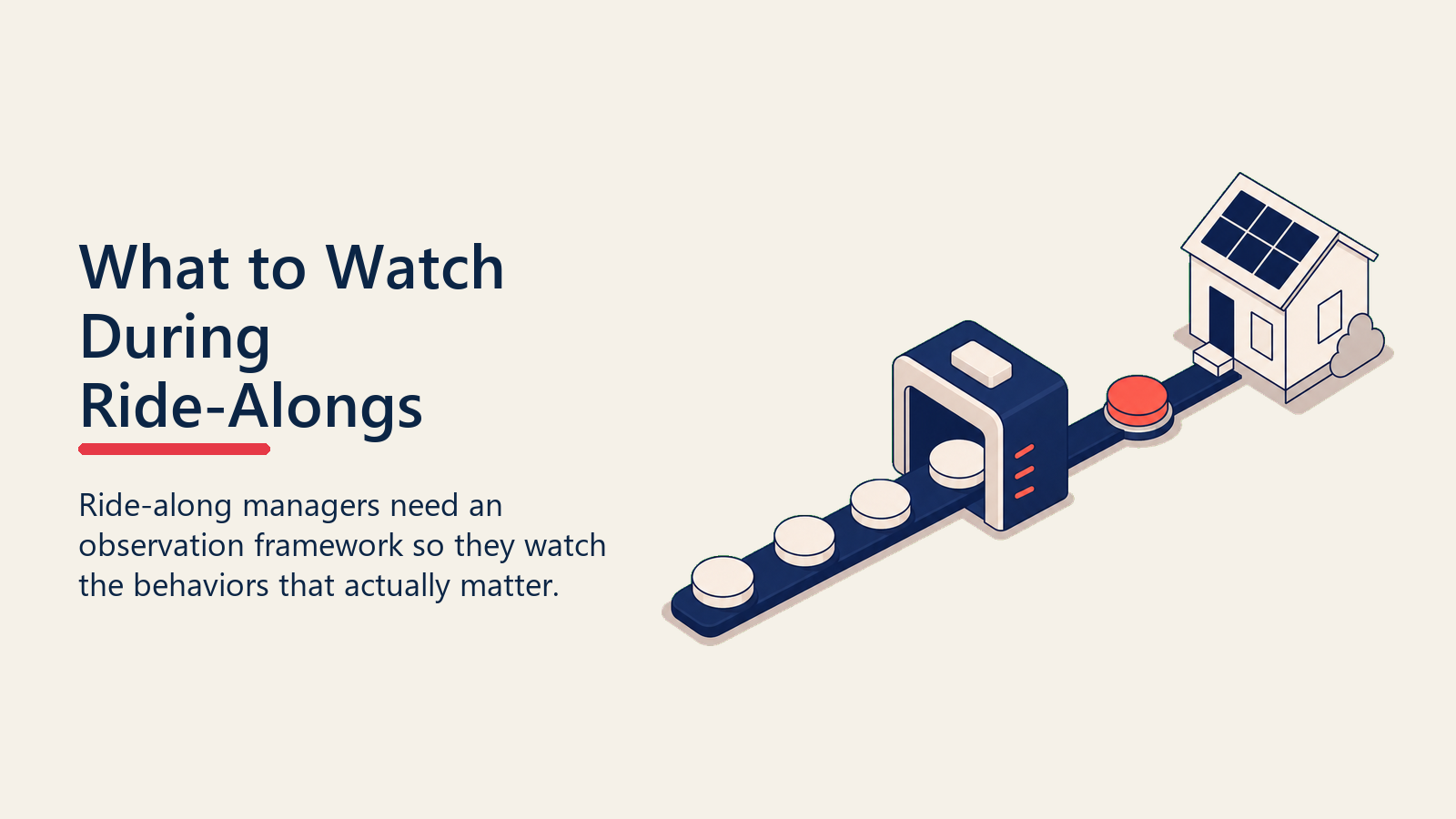
Use a simple observation checklist organized by stage:
Arrival and rapport (first 10 minutes)
- Does the rep make an immediate, genuine connection with all decision-makers present?
- Are both homeowners engaged, or is one being ignored?
- Is the rep controlling the physical setup (where they sit, how they position their materials)?
Needs assessment (15-25 minutes)
- Does the rep ask open questions about energy use, goals, and concerns?
- Are they listening to the answers and following up, or running through a script?
- Do they take notes in a way that shows the homeowner their input matters?
Proposal presentation
- Does the rep anchor on value and system performance before introducing price?
- Is the proposal customized to what the homeowner said they cared about?
- Does the rep pause and check for understanding, or rush through numbers?
Financing conversation
- Is the rep confident and clear, or apologetic about cost?
- Do they explain monthly savings in context of current utility bills?
- Do they present financing as a smart financial decision, not a consolation prize?
Close and decision handling
- Does the rep ask for the decision directly?
- How do they handle a "we need to think about it"?
- Are they applying pressure that feels coercive, or creating genuine urgency?
Taking notes by stage lets you give specific, behaviorally grounded feedback in the debrief. "Your rapport building was good" means nothing. "When you asked about their last utility bill and then paused to write down the number, I watched the wife lean forward for the first time in the conversation" means something.
The Debrief: Where Coaching Actually Happens
The debrief is the whole point of the ride-along. Without it, you've just observed.
Do the debrief within 30 minutes of leaving the appointment. Drive to a coffee shop or sit in the car. Don't put it off until the next morning. The rep's experience is fresh, and the emotional texture of the appointment (what felt awkward, what felt good) is still accessible.
A structured debrief runs 15-20 minutes:
Start with the rep's self-assessment. Ask: "What did you think went well? What would you do differently?" This matters for two reasons. It develops self-awareness, which is the foundation of independent improvement. And it tells you whether the rep's perception matches reality.
Affirm specifically. Pick one or two things they did well and describe exactly what they did and why it worked. Vague praise doesn't transfer. Specific positive feedback gets repeated.
Develop one focus area. Don't give five pieces of feedback. Pick the one behavior that, if changed, would most affect outcomes. Frame it as a skill to develop, not a failure to correct. "The moment you quoted the price without pausing to check whether they were ready" is a skill gap. "You rushed the price" is a judgment.
Agree on one specific behavior to practice in the next appointment. The rep should be able to describe exactly what they'll do differently. If the focus is on how they handle objections at the financing stage, they should be able to say what words they'll use. That's the kind of specificity that negotiation fundamentals training reinforces: concrete language beats vague intent every time.
Set the next check-in. Either schedule another ride-along or agree on what metric or behavior you'll both look at to see if the change is happening.
Quotable Nuggets
"A manager who watched the exact moment a rep broke eye contact during the price reveal can coach to that specific behavior. A manager reading a CRM note cannot." The specificity of in-field observation is irreplaceable.
Only 18% of field sales organizations hit quota consistently while keeping turnover under control. The separating variable in most cases isn't rep quality. It's how deliberately the manager develops people. (SPOTIO)
"The debrief is the whole point of the ride-along. Without it, you've just observed." Coaching only compounds when the rep leaves with one concrete behavior to change, not five pieces of feedback.
Turning Ride-Along Insights Into Team Learning
Individual coaching is valuable, but the real leverage comes from systematizing what you learn.
When you see the same behavior pattern across multiple reps, that's a training signal, not a coincidence. If three different closers are losing deals when homeowners say "we want to get other quotes," and all three are responding with the same ineffective response, you have a team-level objection-handling gap, not three individual problems.
Build a simple observation log in your CRM or a shared doc: date, rep, appointment stage, what you observed, what you coached. Review this monthly. Patterns will surface.
Use those patterns to build out your solar objection handling playbook. The best objection frameworks come from real appointments, not sales training books.
Share win stories from ride-alongs at team meetings, with the rep's permission. When the team hears "during our ride-along last Tuesday, Marcus tried this approach to the financing question and here's how the homeowner responded," it's more credible and memorable than a technique introduced in training.
Coaching Reps at Different Stages
New reps, mid-level reps, and veterans need different things from ride-alongs.
New reps need safety and scaffolding. They're still building confidence. Your job is to help them complete appointments successfully, even if that means stepping in. A new rep who bombs their first few appointments badly may wash out before they get a chance to develop. Debrief with encouragement alongside honest feedback.
Mid-level reps (3-12 months in, closing 15-25% of appointments) usually have one or two behaviors that are capping their performance. These are great coaching targets because the rep already has enough experience to understand the context and apply the feedback quickly.
Veteran reps are often resistant to coaching, and sometimes for good reason: they've figured out what works. Your ride-along goal with veterans is different. You're not there to fix them. You're there to understand their best practices so you can transfer those to newer reps. Treat it as a peer learning conversation, not a performance review.
For veterans who are genuinely underperforming, separate the ride-along from the performance conversation. If a rep knows you're there because their close rate dropped, the anxiety of being evaluated will distort what you see. Frame it as a support visit first.
Connecting Coaching to Your CRM and Performance Data
Ride-along insights are most powerful when they're connected to data.
If your CRM tracks pipeline stage conversion rates by rep, you can identify which stage each rep drops deals and target your ride-along to that stage. A rep with a strong close rate but low appointment-to-proposal rate probably has an assessment problem. A rep with strong proposals but low one-call closes has a decision-handling problem.
This is the core value of connecting coaching to your lead and setter performance dashboards: the data tells you who needs coaching and on what, so you're not guessing or relying on anecdote.
After a focused coaching cycle on a specific behavior, look at the data for that rep to see if the metric moved. This closes the feedback loop between field coaching and business outcomes. It also makes the case to reps that coaching is helping their income, not just satisfying a management checklist.
Value-based coaching conversations are more effective when the rep understands the financial logic behind each stage. Pairing ride-along debriefs with the principles in value selling gives reps a framework for explaining solar economics clearly, which is often the real gap in late-stage deal loss.
Recruiting and Retention Benefits of Active Coaching
Structured coaching is also a recruiting story.
High-performing solar sales reps have options. They can work for your company or a dozen others. When reps see that your managers ride along regularly, give specific feedback, and actively invest in their development, that differentiates you from organizations where reps are essentially independent contractors with a company logo on their polo shirt.
When recruiting, be specific about your coaching program: "Our managers ride along at least once a month with every rep, and new reps get multiple ride-alongs per week in their first two months." That's a concrete commitment that signals investment.
Retention data from sales organizations consistently shows that reps who receive regular coaching stay longer. SPOTIO's research found that 41% of field sales teams report annual rep turnover of 50% or higher, and it takes 6 to 12 months for most new reps to reach full productivity. The investment in ride-alongs pays back in avoided turnover costs, which in solar (where ramp time runs 60 to 120 days) is significant.
Building a coaching culture starts with the manager's calendar. If ride-alongs aren't scheduled, they don't happen. Block them in advance, treat them as non-negotiable, and protect them from meeting conflicts.
What Does a Simple Ride-Along Tracking System Look Like?
The Observe-Debrief-Track Loop: This three-part framework keeps coaching from drifting into anecdote. Observe (ride along with a structured checklist by stage). Debrief (within 30 minutes, one behavior to change). Track (log the behavior, the date, and the agreed next check-in). The loop only works if all three steps happen consistently. Most managers do the first, sometimes do the second, and rarely do the third. Tracking is where accountability lives.
You don't need a complex tool to manage your coaching program. A lightweight tracker in your CRM or a shared spreadsheet is enough to start.
Track at minimum:
- Rep name
- Date of ride-along
- Appointment stage focus (full appointment, specific stage, or post-appointment shadow)
- One key observation
- One agreed-upon coaching behavior
- Follow-up date
Review the tracker weekly as part of your management rhythm. If a rep hasn't had a ride-along in three weeks, schedule one. If a rep's coaching focus hasn't changed after four sessions, dig into whether the behavior is actually improving or whether you need a different approach.
The data you gather here feeds directly into conversations about commission structure, promotion decisions, and performance management. When you have specific behavioral observations tied to specific dates, those conversations become more objective and more productive for both sides.
Coaching is the highest-leverage activity a solar sales manager does. Deals close in the field, and the manager's job is to make sure their reps are getting better at every appointment they run.
Frequently Asked Questions about Coaching and Ride-Alongs
How often should a solar sales manager do ride-alongs?
New reps (first 60 days) need 3 to 4 ride-alongs per week. Ramping reps (60 to 120 days) benefit from 1 to 2 per week with structured debriefs. Established reps should have at least one per month, plus triggered rides when pipeline data shows a stage-specific drop. Veteran reps benefit from quarterly peer ride-alongs. More than that cadence, consistency matters: a monthly ride-along that happens every month beats a bi-weekly schedule that gets skipped half the time.
What's the difference between a ride-along and a joint appointment?
In a joint appointment, the manager co-sells alongside the rep. In a ride-along, the manager observes and coaches. Mixing the two creates confusion about roles and distorts what you're watching. Shadow-and-assist is a middle ground: the manager leads one specific section to demonstrate a skill, then steps back. That's a tool for reps who are stuck on a particular stage, not a substitute for pure observation rides.
How do you debrief a rep after a ride-along without demoralizing them?
Start with the rep's own self-assessment before giving feedback. Ask what they thought went well and what they'd change. This reveals whether their perception matches reality and builds self-awareness. Then affirm one or two specific behaviors, not vague praise. End with a single focus area framed as a skill to develop. Reps who leave a debrief with one concrete thing to try are more likely to act on it than those who get five pieces of feedback at once.
What should a ride-along checklist include?
Organize it by appointment stage: arrival and rapport, needs assessment, proposal presentation, financing conversation, and close. For each stage, track two or three specific behaviors (not general impressions). Examples: did the rep engage all decision-makers present, did they pause after quoting price, did they ask for the decision directly. Behavioral observations translate into coaching language. General impressions don't.
Can senior reps resist ride-alongs and should managers push back?
Veteran resistance is common and often rational. If a rep is performing well, they may feel observed rather than supported. For top performers, reframe the ride-along purpose explicitly: "I'm here to learn what you're doing well so I can coach it to the rest of the team." That's a peer conversation, not a performance review. For veterans who are underperforming, separate the ride-along from the performance conversation to avoid defensive behavior that distorts what you observe.
How do ride-alongs connect to CRM and pipeline data?
Pipeline stage conversion by rep tells you where to focus the ride-along. A rep with strong appointment completion but low proposal rates needs coaching at the consultation stage. A rep with high proposal rates but low one-call close rates needs work at the decision and objection-handling stage. Running a ride-along without checking the rep's stage conversion first means you're coaching by impression, not evidence. The data tells you where to look; the ride-along tells you what's actually happening there.
What's the cost of not doing ride-alongs consistently?
SPOTIO research found that 41% of field sales teams have annual rep turnover of 50% or higher. Ramp time for a new solar rep runs 60 to 120 days. When a rep leaves and must be replaced, the cost compounds: recruiting, onboarding, lost deals during ramp, and manager time. Regular ride-alongs are one of the highest-ROI activities for preventing that cycle, because reps who feel actively developed by their manager stay longer.

Senior Implementation Consultant
On this page
- Does In-Field Coaching Actually Outperform Classroom Training?
- The Four Types of Ride-Alongs
- Building a Ride-Along Schedule That Doesn't Burn Out Managers
- The Pre-Ride-Along Prep Conversation
- What to Watch During the Appointment
- The Debrief: Where Coaching Actually Happens
- Turning Ride-Along Insights Into Team Learning
- Coaching Reps at Different Stages
- Connecting Coaching to Your CRM and Performance Data
- Recruiting and Retention Benefits of Active Coaching
- What Does a Simple Ride-Along Tracking System Look Like?