Solar Financing Models and the Sales Conversation
Turn this article into takeaways for your work.


Each assistant summarizes the article only for you and suggests best practices for your work.
The financing conversation is where most residential solar deals live or die. A homeowner who loves the idea of solar can walk away because the money talk felt confusing, pushy, or just off. And a homeowner who seemed lukewarm can sign on the spot when you present the numbers clearly and connect them to something real in their life.
This guide covers the four main residential solar financing structures, how to position each one in-home, and how to handle the money objections that come up on nearly every kitchen table.
What Are the Four Solar Financing Models You'll Actually Use?
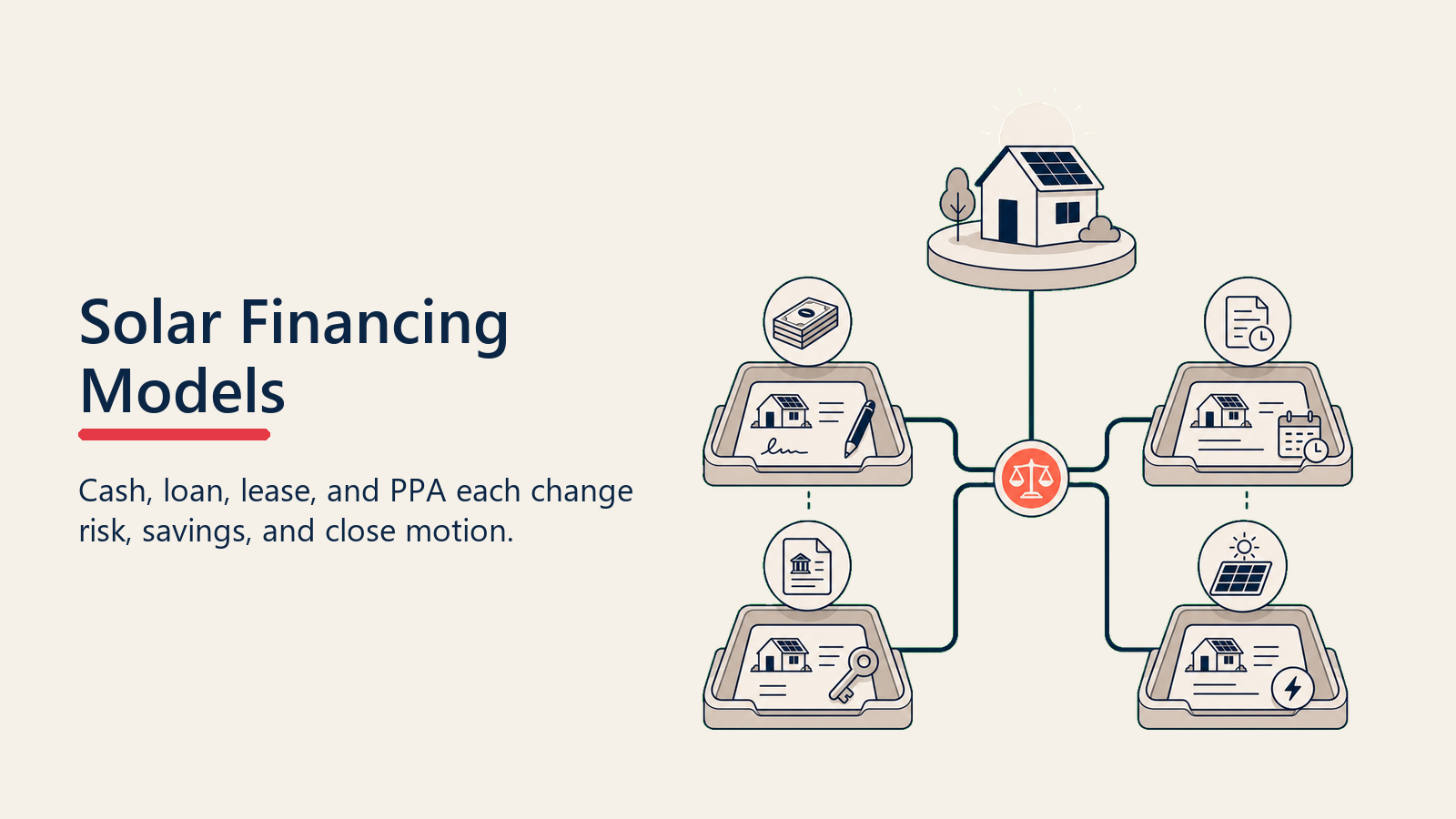
Most solar companies offer some combination of these. Know the mechanics cold and you can explain them in plain English without reaching for a brochure.
Cash Purchase
The homeowner writes a check (or transfers funds) for the full system cost. No lender, no monthly payment, no interest.
Best for: Homeowners with liquid savings, strong equity, or a recent windfall (inheritance, home sale, insurance payout). Also common for rentals where the owner wants to add value and reduce costs without ongoing commitments.
Sales angle: Cash buyers are often the easiest close on paper but can be the hardest in practice, because they feel the full sticker price. Your job is anchoring to lifetime value, not system cost. A $35,000 system that eliminates a $280/month bill pays for itself in 10 years and saves $60,000-plus over 25 years. Lead with that math, not the upfront number.
Watch for: Cash buyers who want to negotiate hard. Know your floor before you sit down.
Solar Loan (Consumer or Home-Equity)
The homeowner borrows money through a third-party lender (GreenSky, Mosaic, Sunlight Financial, etc.) or a home equity loan/HELOC and pays monthly. They own the system from day one.
Best for: Homeowners who want ownership, tax credit eligibility, and a payment that's ideally lower than or close to their current electric bill.
Sales angle: The payment-versus-bill swap. If their bill is $220/month and the loan payment is $189/month, they're saving money immediately. Ownership also means the homeowner may have been eligible for the federal Investment Tax Credit (ITC). However, the Section 25D residential credit (30%) ended for owner-purchased systems placed in service after December 31, 2025, under the One Big Beautiful Bill Act. If the homeowner is asking about the ITC, direct them to the IRS FAQ on OBBB energy credit changes for current guidance.
Watch for: Homeowners who plan to sell in 5-7 years. Walk them through how a solar loan transfers at closing versus how a lease/PPA does.
Power Purchase Agreement (PPA)
A third-party company installs and owns the solar system on the homeowner's roof. The homeowner buys the power the system produces at a contracted rate, typically below their utility rate. No ownership, no tax credit, no large upfront cost.
Best for: Homeowners who want lower bills without ownership complexity, or who don't have enough tax liability to benefit from the ITC. Also works for homeowners with mid-tier credit who don't qualify for the best loan rates.
Sales angle: Simplicity. "You pay for the power, not the panels. If something breaks, we fix it. Your rate is locked for 20 years while the utility rate keeps climbing." The EIA Electric Power Monthly tracks average residential electricity rates by month; the national average reached 16.5 cents per kWh in 2024, up from 16.0 cents in 2023. That kind of real, citable data makes the locked-rate argument concrete. Pull up their local utility's rate history and project the savings.
Watch for: PPAs complicate home sales. Know your state's PPA transfer process. Some buyers are nervous about assuming a 20-year contract.
Solar Lease
Similar to a PPA but structured differently: the homeowner pays a fixed monthly amount to rent the system rather than paying per kilowatt-hour produced. The company still owns and maintains the equipment.
Best for: Similar profile to PPA customers. Useful when production guarantees are in play.
Sales angle: Predictability. "Same payment every month, guaranteed production." If the system underperforms, the company typically owes the customer a credit.
Watch for: Same home-sale complexity as PPAs. Leases and PPAs often trip up real estate agents who aren't familiar with how they transfer.
Key Facts
- The average US residential electricity rate was 16.5 cents per kWh in 2024, up from 16.0 cents in 2023. Source: EIA Electric Power Monthly. Rising rates strengthen the locked-rate argument for PPAs and the long-term savings case for loans.
- The Section 25D residential solar tax credit (30%) ended for owner-purchased systems placed in service after December 31, 2025, under the One Big Beautiful Bill Act. Source: IRS FAQ on OBBB energy credit changes.
Financing Comparison Table
| Model | Ownership | Federal Tax Credit (2026+) | Monthly Payment | Best Fit |
|---|---|---|---|---|
| Cash | Homeowner | No (Section 25D ended Dec 31, 2025) | None | High liquidity, long-term ROI focus |
| Solar Loan | Homeowner | No (Section 25D ended Dec 31, 2025) | Yes (fixed) | Wants ownership + bill swap |
| PPA | 3rd Party | May apply via commercial credit path | Per kWh | Simplicity, lower credit, no upfront |
| Lease | 3rd Party | May apply via commercial credit path | Yes (fixed) | Predictability, low upfront |
The Payment-to-Bill Framework
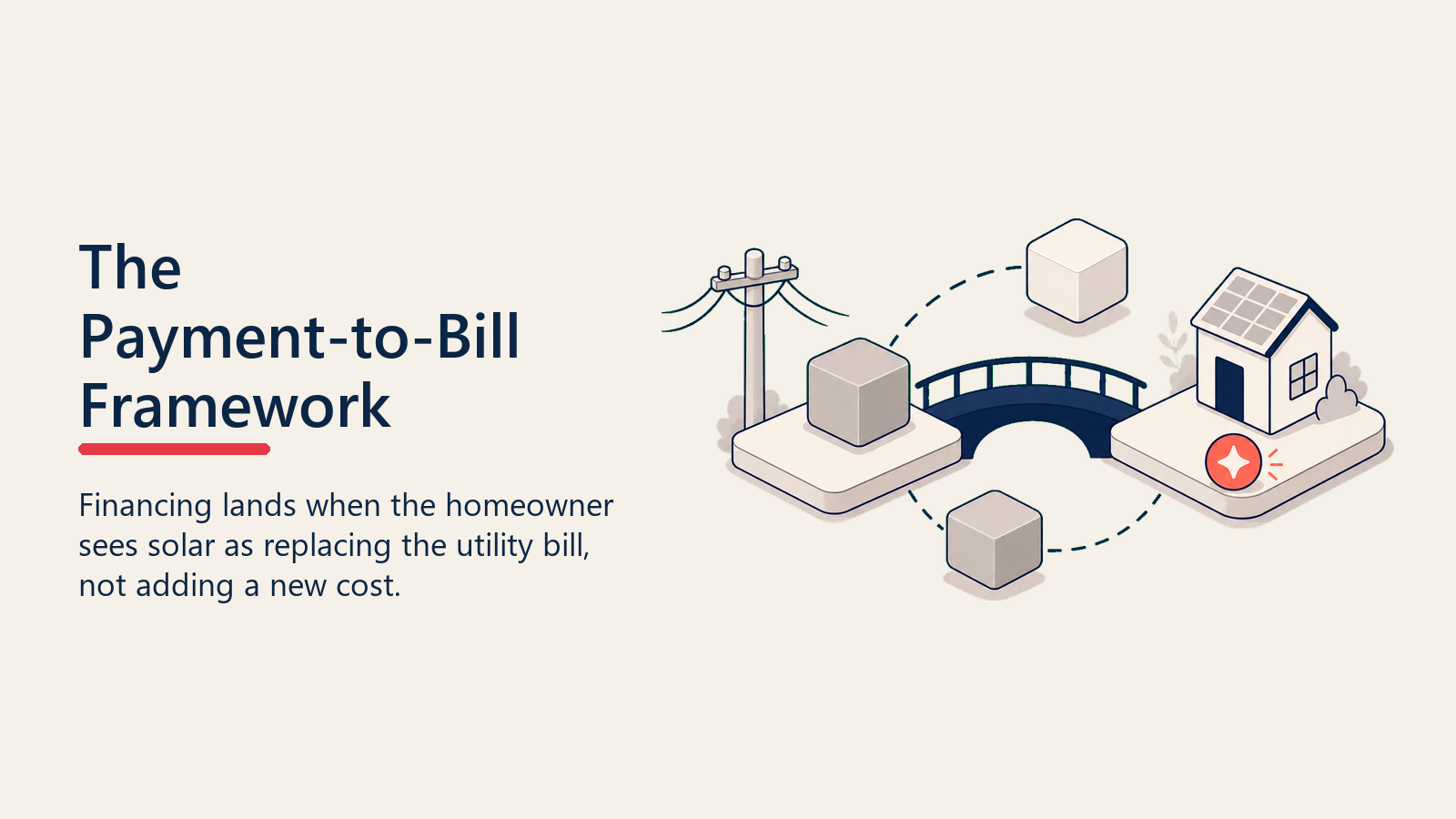
The single most effective way to present financing in-home is the payment-to-bill swap. Stop talking about cost. Start talking about the bill replacement.
Here's a clean structure:
- Show their current bill. Ask them to pull up their last few statements, or get the average from your utility analysis. Write it down.
- Show the projected system production. Based on roof assessment and shading, what will this system generate?
- Show the loan payment (or PPA rate times monthly production). Use your proposal software to generate the number.
- Subtract. If the payment is lower than the bill, they're saving from day one.
- Project forward. Their electric rate will likely rise 3-5% annually. Their loan payment won't. Widen that gap over time.
Example: A homeowner in Phoenix pays $315/month in summer, $140/month in winter, averaging $220/month. You size a system that offsets 95% of usage. Loan payment: $195/month at 6.49% over 25 years. They save $25/month immediately and more as rates climb. That's the conversation. Note: the Section 25D residential ITC no longer applies for owner-purchased systems placed in service after December 31, 2025. If the homeowner installed or signed before that date, their tax professional can advise on credit eligibility for that specific system.
Handling the Money Objections
"I need to think about it."
This usually means the numbers didn't land clearly or there's a concern they haven't named. Don't let the appointment end with this phrase.
Try: "I hear you. What's the part you want to think through most, is it the financing structure or whether solar makes sense for your home?" That opens a specific conversation instead of leaving a vague out.
"I can't afford the monthly payment."
First, confirm they understand the payment replaces the bill. Sometimes homeowners hear a new payment and mentally add it to their current bill rather than replacing it.
If affordability is still a real concern, shift to a longer loan term (25 years vs. 10 years lowers the monthly significantly) or explore a PPA with zero upfront. If they have strong equity, a HELOC might offer a lower rate than a consumer solar loan.
"I want to pay cash but the price feels high."
Anchor to the lifetime value calculation. A $40,000 cash purchase with $280,000 in avoided utility costs over 25 years (at projected rates) has a very strong return even without the residential ITC, which ended for new owner-purchased systems placed in service after December 31, 2025. Show the long-term bill elimination math in writing. If the homeowner installed before the deadline and asks about claiming the credit, direct them to a tax professional.
"What happens when I sell my house?"
For owned systems (cash or loan), solar adds home value. A Zillow study found homes with solar-energy systems sold for 4.1% more on average, translating to roughly $9,274 for the median-valued home. For loans, the buyer can assume the loan or the homeowner can pay it off at closing.
For PPAs and leases, you need to be honest and thorough. Buyers can either assume the agreement or the system can sometimes be bought out. Know your company's specific transfer process and walk them through it step by step. Hiding this detail loses trust and referrals.
"I heard the tax credit is going away."
The federal ITC picture changed in 2025. The Department of Energy's ITC overview covers the credit history, and you should know the current status cold before walking into any home. As of 2026, the residential owner-occupied tax credit (Section 25D) ended for new customer-owned systems on January 1, 2026. Third-party owned products (leases and PPAs) still qualify through a separate commercial credit path. Tell the truth and show documentation. Don't manufacture false urgency, but don't let them wait without context either. If a homeowner installed before the deadline and hasn't claimed the credit yet, direct them to the SEIA Residential Consumer Guide for current guidance.
See creating urgency ethically in same-day solar closes for how to handle timing conversations without pressure tactics.
Structuring the Financing Reveal in Your Presentation
The order matters. Here's a sequence that works:
- Complete the home energy needs assessment and build system sizing before any money talk.
- Present the system first: panels, inverter, production projections. Let them fall in love with the solution.
- Introduce financing as the mechanism that makes it happen, not the product itself.
- Start with the option that fits their profile best (don't present all four equally and confuse them).
- Show the payment-to-bill comparison. Write it down on paper or your tablet.
- Invite questions. Close.
When you build the custom solar proposal, make sure your financing options are already pre-loaded and correct for that homeowner's credit profile. Don't fumble the numbers in the room.
Credit Qualification and Sales Flow
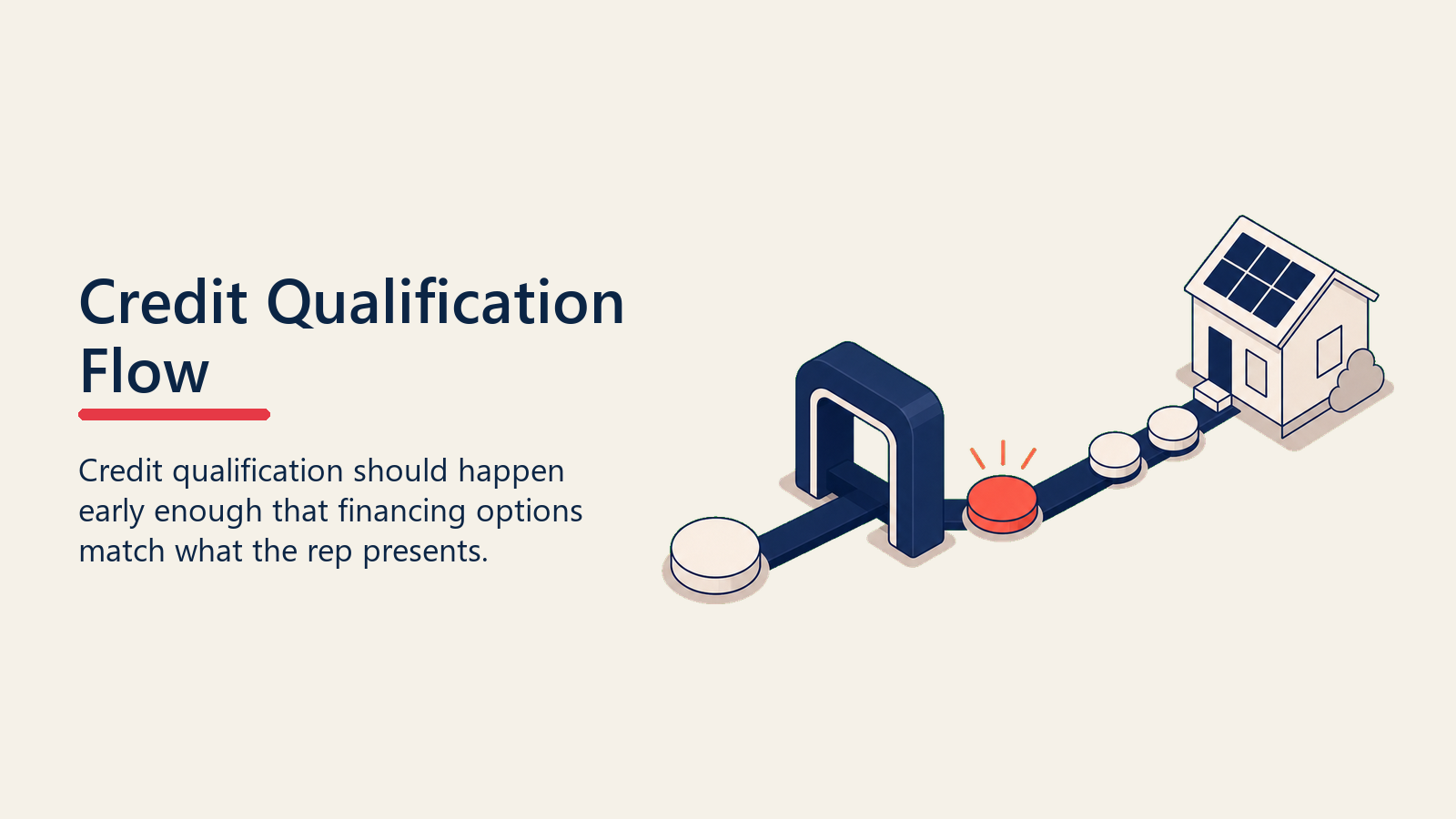
Many companies run a soft credit pull during appointment confirmation and preparation. This lets you know going in which loan products are available at what rate. If you show up and the best rate doesn't apply, you've lost credibility.
Build your pre-appointment workflow around knowing:
- Homeowner credit tier (rough band: above 700, 650-699, below 650)
- Which lenders your company works with at each tier
- Fallback options (PPA/lease if loan doesn't work)
When loan options are limited by credit, pivot to the PPA or lease story confidently. Don't apologize for it. "Based on the financing picture, the option that makes the most sense for your situation is..." is a clean transition.
For more on aligning with your finance partners, see sales and finance credit alignment.
What the Best Closers Do Differently
The reps who consistently close at financing conversations share a few habits:
They know the current credit landscape cold. They can explain the Section 25D change accurately (ended for new owner-purchased systems after December 31, 2025) and know which financing paths (PPAs, leases) may still access a commercial credit. They don't manufacture false urgency and don't recite outdated "30% through 2032" framing.
They translate everything into monthly terms. Homeowners don't think in lifetime value naturally. But they understand "this replaces $220 a month with $195 a month." Lead with the month.
They qualify financing fit before the appointment. See solar lead qualification and prescreening for how to surface credit and home ownership before the closer shows up.
They handle objections as information, not rejection. When a homeowner raises a money objection, they get curious. They ask a question. They don't defend.
They use the right value-selling frameworks to connect financial outcomes to personal motivations. The homeowner who wants energy independence is different from the one who's just angry about their electric bill. Read the room, then connect the numbers to what they care about.
Quotable Nuggets
"The financing conversation is where most residential solar deals live or die. A homeowner who loves the idea of solar can walk away because the money talk felt confusing. The product is fine. The presentation killed it."
"US residential electricity rates have risen year over year, and the EIA publishes that data monthly. Every rate increase widens the gap between the homeowner's current bill and their projected solar payment. That is a real, data-backed closing argument, not a manufactured one." (Source: EIA Electric Power Monthly)
"When a homeowner asks what happens to the system when they sell, the answer starts with the fact that solar-equipped homes command a measurable sale price premium, not just a transfer process. That reframes the question entirely."
Building a Financing-Literate Sales Team
If your reps are inconsistently presenting financing, the problem is usually one of two things: they don't understand it well enough to explain it simply, or they're afraid of the objections. Both are training problems.
Build financing fluency through:
- Role-play sessions focused specifically on the money conversation
- Ride-alongs where managers demonstrate the payment-to-bill swap
- A short reference card reps can review before each appointment
Structured approaches to both are in the Learn More section below.
Reps who close consistently at financing conversations also tend to qualify better before they get there. A structured lead qualification framework lets setters surface credit fit and financial readiness before a closer drives across town, which means fewer awkward "we can't get you financed" moments in the home.
Financing isn't just a back-office function. It's the conversation that determines whether a homeowner says yes or no. Train it like the close, because that's exactly what it is.
Learn More
- Coaching and ride-alongs in solar sales
- Presenting price and financing in the home
- Building a custom solar proposal
- Confirming and prepping the appointment
The Payment-to-Bill Framework (Named Model)
The Payment-to-Bill Swap: a five-step in-home financing presentation model that replaces sticker-shock framing with a direct bill comparison. The five steps are: (1) surface the homeowner's current electric bill in writing, (2) show the projected system production for their specific home, (3) calculate the loan payment or PPA rate times monthly production, (4) subtract to show day-one savings or parity, and (5) project the gap forward using historical utility rate trends. The framework works because it anchors the conversation to a monthly cost the homeowner already pays rather than a new expense they are being asked to take on.

Senior Implementation Consultant
On this page
- What Are the Four Solar Financing Models You'll Actually Use?
- Cash Purchase
- Solar Loan (Consumer or Home-Equity)
- Power Purchase Agreement (PPA)
- Solar Lease
- Financing Comparison Table
- The Payment-to-Bill Framework
- Handling the Money Objections
- "I need to think about it."
- "I can't afford the monthly payment."
- "I want to pay cash but the price feels high."
- "What happens when I sell my house?"
- "I heard the tax credit is going away."
- Structuring the Financing Reveal in Your Presentation
- Credit Qualification and Sales Flow
- What the Best Closers Do Differently
- Quotable Nuggets
- Building a Financing-Literate Sales Team
- Learn More
- The Payment-to-Bill Framework (Named Model)