Home Energy Needs Assessment: How to Uncover What the Customer Actually Needs
Turn this article into takeaways for your work.


Each assistant summarizes the article only for you and suggests best practices for your work.
Most solar reps blow through the needs assessment to get to the numbers. That's backwards. The assessment is where you earn the right to present a proposal. Done well, it surfaces the specific pain points, usage patterns, and future plans that let you build a system the customer genuinely needs and wants to buy. Done poorly, you're just guessing on system size and hoping the numbers land.
This guide covers the full home energy needs assessment: what to look for, what to ask, how to conduct the physical walkthrough, and how to tie it all back to a proposal that closes.
Why the Needs Assessment Comes Before Any Numbers
Key Facts:
- NREL's 2024 Annual Technology Baseline models the representative residential solar system at 7.9 kWdc, per NREL ATB 2024, meaning every needs assessment is ultimately sizing toward an investment in the $24,000-$32,000 range; context that underlines why "just guessing" on system size causes post-install regret
- The average US residential electricity bill was $144/month in 2024, per EIA Electric Sales data, with state-level variation from $89 (Utah) to over $200 (Hawaii and Connecticut); the rep who actually reviews the bill together builds real value, not a round-number estimate
- Nominal residential electricity rates rose roughly 3.3% per year over the past decade in the US, per EIA retail electricity price analysis, a verifiable trend to cite when explaining why locking in a solar payment today makes financial sense
The temptation is to pull out the utility bill, size a system, and start talking dollars. But customers who haven't talked through their own situation first treat the proposal as a commodity. They compare your price to the next company's price with no basis for choosing.
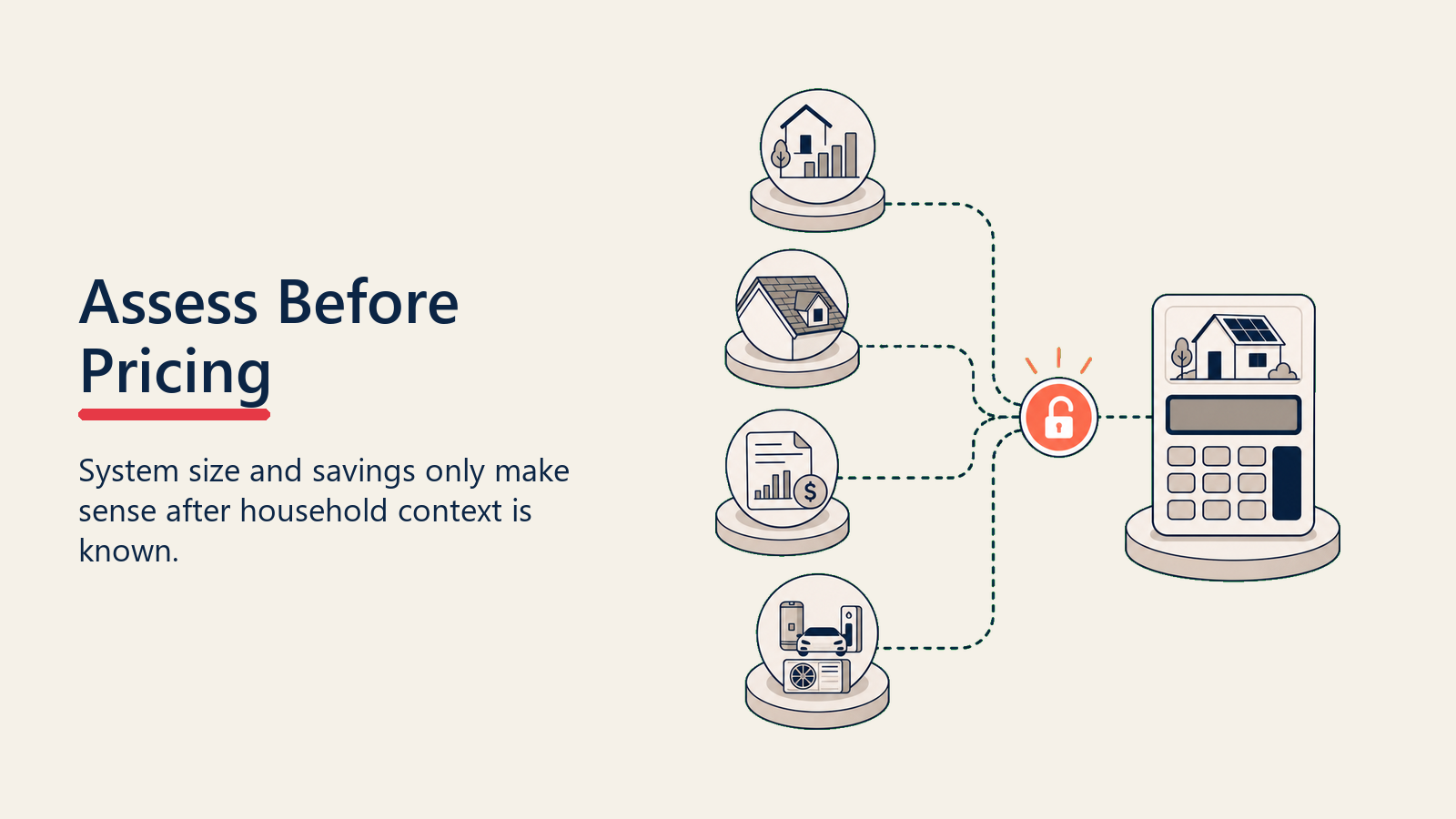
When you run a proper assessment first, a few things shift:
- The customer starts explaining their own pain ("our bill was $340 last month and it's only going to get worse")
- You discover details that change system sizing, like an electric vehicle (EV) they're planning to buy or a pool added last year
- You can reference their specific answers when you present price ("Remember when you told me you hate not knowing what your bill will be? Here's how this fixes that")
The assessment creates the context the proposal needs to make sense. Think of it as building the "before" so your solution can be the "after." For the overall flow this fits into, see the in-home sales funnel.
Before You Step Inside: Pre-Assessment Prep
Your setter should have gathered basic info during scheduling. Before arriving, review:
- 12-month utility history if the setter obtained it, or plan to collect it on-site
- Home details from the appointment form: age of home, square footage, number of occupants
- Pre-qualification data from the solar lead qualification and prescreening step: credit tier, ownership status, HOA status
This prevents you from asking basic questions the setter already answered, which erodes trust immediately.
The Three-Part Needs Assessment Structure
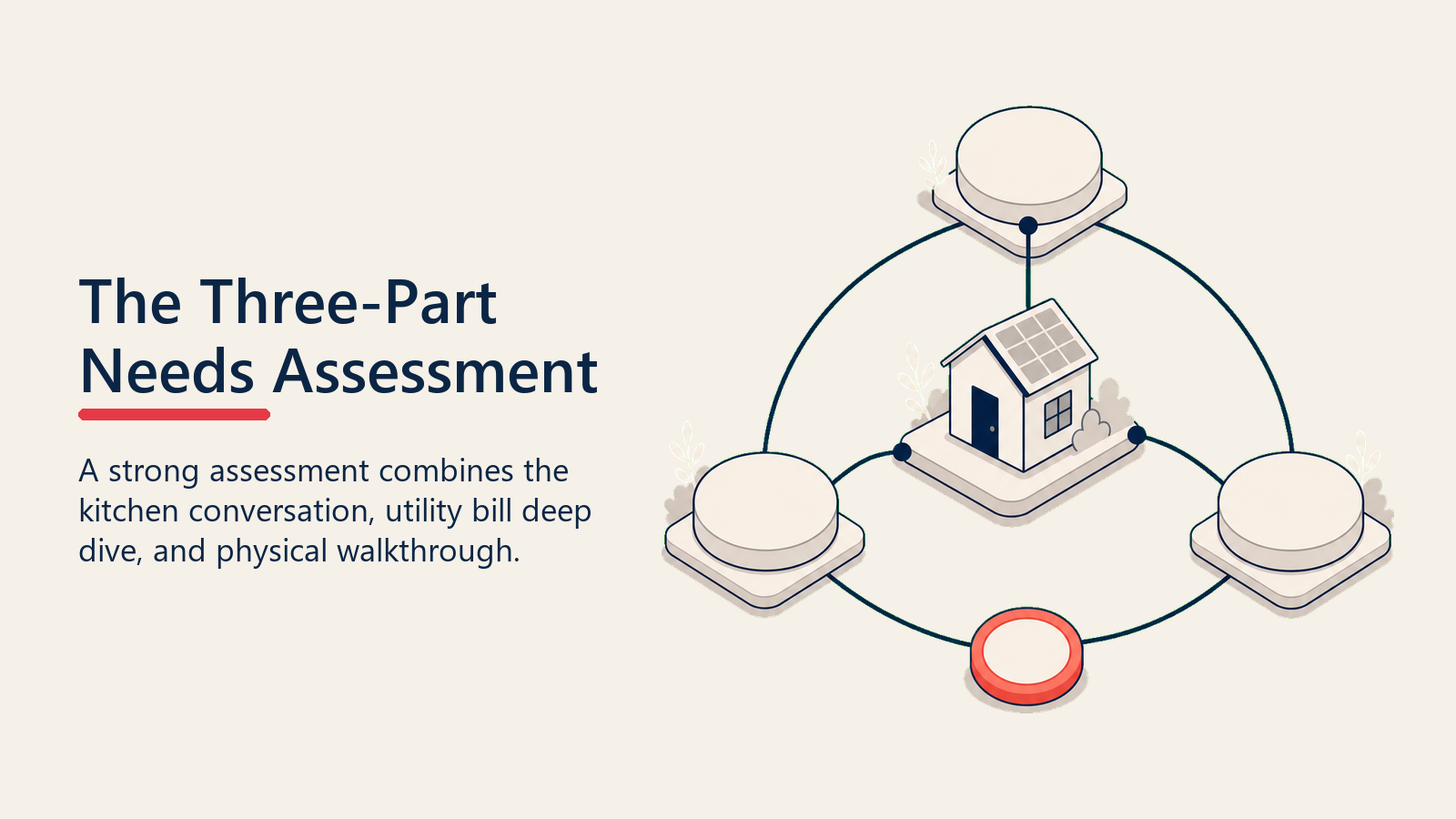
A strong residential solar needs assessment has three parts: the kitchen conversation, the utility bill deep-dive, and the physical walkthrough. Each serves a different purpose.
Part 1: The Kitchen Conversation (10-15 minutes)
Sit down with the decision-makers. Your goal here is to understand their motivations, frustrations, and future plans. This is not a pitch. You're gathering.
Opening questions to build rapport and get them talking:
- "Walk me through what a typical month looks like on your energy bill. Does it stay pretty steady or does it swing around?"
- "What made you want to look at solar now, as opposed to a year ago or two years from now?"
- "Besides the bill, is there anything about your current energy situation that frustrates you?"
Usage and lifestyle questions that affect system size:
- "How many people live in the home full-time? Anyone working from home?"
- "Do you have an EV, or are you planning to get one?"
- "Pool, hot tub, anything like that?"
- "Do you keep the house pretty cool in summer, or do you run the AC conservatively?"
Future-looking questions that affect proposal design:
- "Any plans to add square footage, a garage, ADU?"
- "How long are you planning to stay in this house?"
- "If you could design your ideal energy situation, what would it look like?"
This last question is the most powerful one in the set. Most customers say some version of: "I just want to know what I'm paying every month and not have it go up." That's your anchor for the entire presentation.
Part 2: The Utility Bill Deep-Dive (10 minutes)
You need 12 months of bills. If the customer has them, great. If not, most utilities let you pull the usage history through their online portal with the customer's login, or you can call the utility with the customer on the line.
What you're analyzing:
| Data Point | What It Tells You |
|---|---|
| Average monthly kWh usage | Baseline system size |
| Summer vs. winter swing | Whether to size for peak or annual average |
| Current rate tier or TOU plan | Affects offset math and payback period |
| Service charge (fixed) | Part of bill that solar won't offset |
| Net metering credits (if any) | Whether they've tried solar before |
Avoid the mistake of looking only at the monthly dollar amount. Rates change. What you need is the kWh consumption pattern. A customer paying $280/month on a high rate might use fewer kWh than a customer paying $200/month on a low rate. System size follows consumption, not spend. The EIA Electric Power Monthly tracks average retail electricity rates by state every month, a credible source to pull up when a customer wants to understand their local rate environment.
Walk the customer through the bill as you review it. Point things out: "See this charge here? This is your service charge, it stays the same no matter what. And this is your actual consumption. This is what we're working with."
Getting them engaged with their own bill builds urgency without you having to create artificial pressure.
Part 3: The Physical Home Walkthrough (10-15 minutes)
This is where most reps skip and they shouldn't. Walking the home serves three purposes: you're gathering data for the proposal, you're building credibility as someone who actually knows what they're doing, and you're catching issues that could kill the deal later (shading problems, old panels, roof condition).
What to check on the exterior:
- Roof age and condition. If the roof is older than 10-12 years and shows wear, flag it now. A roof replacement before or during solar install is a conversation you need to have early, not after signing.
- Shade assessment. Walk the property and look at trees, neighboring structures, chimneys. Note which directions cause shading and at what time of day.
- Roof orientation and pitch. South-facing roofs at 25-35 degree pitch are ideal. Note deviations that will affect system output. The DOE Homeowner's Guide to Solar explains how roof angle, orientation, and shading each affect the production estimate your design tool will generate.
- Panel availability. Count usable roof faces and approximate square footage.
- Main electrical panel location. Note whether it's accessible for upgrade if needed.
What to check on the interior:
- Electrical panel age and capacity. Open the box and look. A 100-amp panel in an older home may need an upgrade, which adds to cost. Know this before you build the proposal.
- Main appliances. What's electric? What's gas? An all-electric home with a heat pump uses significantly more power than a mixed-fuel home.
- Attic insulation. Worth a quick mention. Poor insulation means higher heating and cooling loads, which means larger solar system needed to offset.
- EV charging setup. If they have or plan to get an EV, note the panel capacity and whether they'll need a 240V circuit.
Take photos as you go. This does two things: it shows professionalism, and it gives you reference material when you're building the proposal.
Documenting the Assessment
Everything you gather should be captured in your CRM or proposal tool before you sit back down. The solar CRM and proposal tools you use should have a structured input form for this data.
At minimum, document:
- 12-month kWh usage and monthly breakdown
- Average bill and rate plan
- System constraints: roof faces, shading, panel capacity
- Customer motivations (verbatim if possible)
- Future plans affecting usage
- Flags: roof age, panel upgrade needed, HOA approval required
This documentation serves you in three ways. It powers the proposal you're about to build. It provides a handoff record if the job goes to a closer or a site surveyor. And it protects you if the customer later says the system isn't performing as expected.
Connecting the Assessment to the Proposal
Before you move to building the custom solar proposal, you should be able to answer these questions from memory:
- What's this household's average monthly kWh consumption?
- What's their biggest energy pain point?
- What future usage changes should we plan for?
- Are there any site constraints that affect system design or cost?
- What does this customer actually want? (Not what they said they want, but the underlying need)
If you can answer all five, you have what you need. If you're fuzzy on any of them, go back and ask before building the proposal. A proposal built on incomplete information leads to objections you can't answer and often kills the deal.
Quotable Nuggets
On what the assessment is actually doing: "The needs assessment is doing more than collecting information. It's building the psychological foundation for the close. A customer who has spent 20-30 minutes talking about their energy situation, walking through their home with you, and seeing you take notes is a customer who is engaged. They've invested time. They feel understood."
On the silent decision-maker: "If both spouses are in the room and one is noticeably quiet, find a way to draw them in. A silent decision-maker is often the one who kills the deal later with 'we need to think about it.'" The assessment is the only moment where you can engage that person before it becomes the objection that ends the appointment.
On the physical walkthrough: "A rep who walks the roof, opens the panel, and asks smart questions looks like an expert. A rep who just sits at the kitchen table looks like a salesperson." The walkthrough is a credibility signal before it's a data-collection exercise.
The Context-Data-Constraints Framework
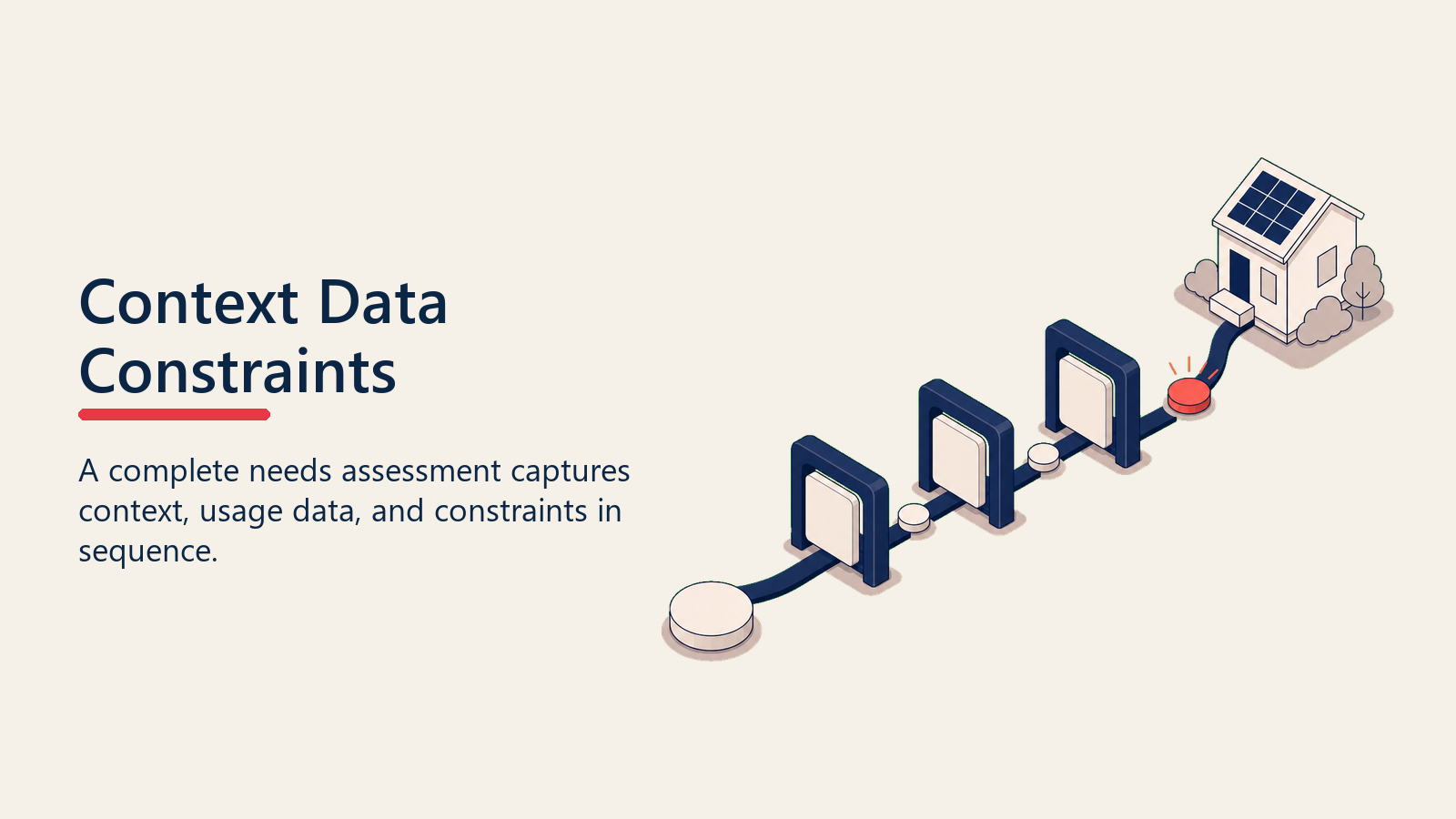
The Context-Data-Constraints Framework: A complete residential solar needs assessment runs through three categories in sequence. Context first: who lives there, why they're interested, what they want from energy, and what their future looks like. Data second: 12 months of kWh consumption, rate structure, fixed charges, and seasonal swings. Constraints third: roof condition and orientation, shading, panel capacity, HOA requirements. Only when all three are captured can a rep build a proposal that's actually sized and priced for this homeowner's situation. Skipping context to jump straight to data produces a proposal that's technically accurate but doesn't speak to what the customer cares about. Skipping constraints produces surprises at install.
Common Mistakes in the Needs Assessment
Rushing to the bill and skipping the conversation. Numbers without context feel like a sales pitch. Context first, numbers second.
Asking closed questions that get yes/no answers. "Do you have an EV?" gets a yes or no. "Tell me about your vehicle situation, do you have anything electric or are you thinking about it?" opens a conversation.
Ignoring what's not said. If both spouses are in the room and one is noticeably quiet, find a way to draw them in. A silent decision-maker is often the one who kills the deal later with "we need to think about it."
Treating the walkthrough as optional. The walkthrough isn't just data collection. It's also a credibility signal. A rep who walks the roof, opens the panel, and asks smart questions looks like an expert. A rep who just sits at the kitchen table looks like a salesperson.
Not taking notes. Memory is unreliable under the pressure of a presentation. Write things down, or capture them in your phone. When you reference a specific detail from the assessment during your close, the customer feels heard. That's a significant trust signal.
Assessment Checklist
Use this before moving to proposal:
- Kitchen conversation complete: motivations, frustrations, future plans captured
- 12 months of utility data collected and analyzed
- Average monthly kWh established
- Rate plan and tier structure noted
- Exterior roof condition, shading, orientation assessed
- Interior panel age, capacity, and appliance mix noted
- Photos taken of roof, panel, and any problem areas
- Customer's key quote captured (the thing they said that is their real motivation)
- All data entered into CRM before starting proposal
Why Does This Step Make or Break the Close?
The needs assessment is doing more than collecting information. It's building the psychological foundation for the close. A customer who has spent 20-30 minutes talking about their energy situation, walking through their home with you, and seeing you take notes is a customer who is engaged. They've invested time. They feel understood.
That's a very different starting point than a customer who sat passively while a rep ran through a pitch.
The best solar closers understand that the close starts during the assessment, not during the presentation. Every question you ask, every thing you notice, every moment you show genuine curiosity about their situation is building toward a yes.
For a view into how this fits the complete selling system, see the residential solar sales growth model, the guidance on value selling frameworks, and opportunity qualification for how to sharpen needs discovery into a real qualification read.
When the assessment is done right, the proposal almost writes itself. And the close feels like a natural next step rather than a confrontation.

Senior Implementation Consultant
On this page
- Why the Needs Assessment Comes Before Any Numbers
- Before You Step Inside: Pre-Assessment Prep
- The Three-Part Needs Assessment Structure
- Part 1: The Kitchen Conversation (10-15 minutes)
- Part 2: The Utility Bill Deep-Dive (10 minutes)
- Part 3: The Physical Home Walkthrough (10-15 minutes)
- Documenting the Assessment
- Connecting the Assessment to the Proposal
- Quotable Nuggets
- The Context-Data-Constraints Framework
- Common Mistakes in the Needs Assessment
- Assessment Checklist
- Why Does This Step Make or Break the Close?