Objection Handling for Solar Sales: Turning Hesitation Into Decisions

Turn this article into takeaways for your work.


Each assistant summarizes the article only for you and suggests best practices for your work.
Most solar reps lose deals not because the numbers don't work, but because they don't know what to do when a homeowner says "we need to think about it." Objections aren't rejections. They're unanswered questions wearing a polite disguise.
This guide breaks down the most common objections your team faces, the root cause behind each one, and the specific language that moves homeowners forward without pushing them.
Why Solar Objections Feel Different From Other Sales
Solar is a $20,000 to $60,000 financed purchase that touches a homeowner's property, their utility bill, their roof, and their long-term financial plan. That's not the same as selling software or gym memberships.
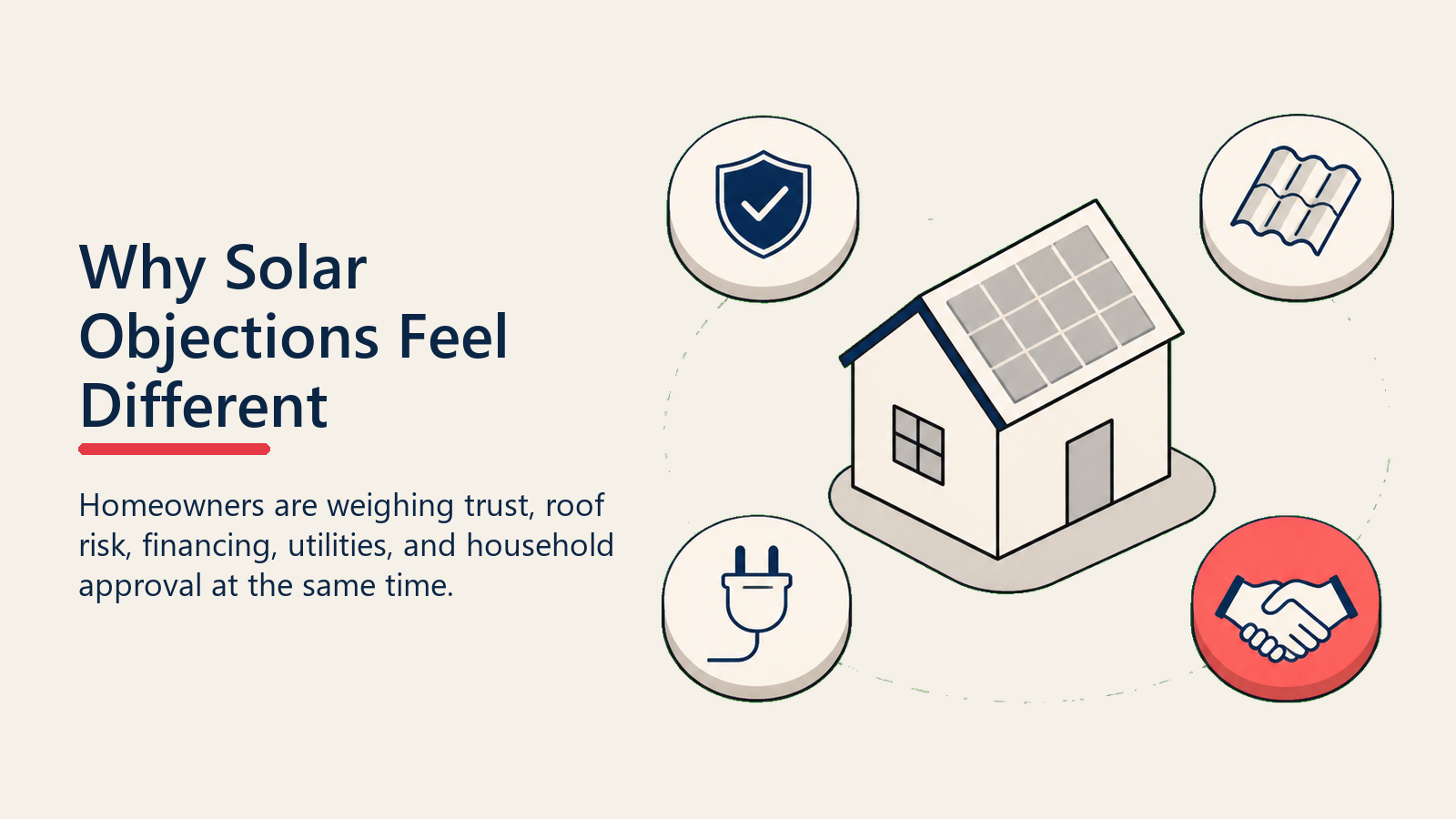
When a homeowner objects, they're usually wrestling with one of four things:
- They don't fully trust you or your company yet
- They don't understand the product well enough to commit
- They have a real logistical or financial constraint
- They need a third party (spouse, financial advisor, landlord) to weigh in
Good objection handling starts by figuring out which one you're dealing with before you respond. Answering a trust problem with more product information just makes things worse.
Key Facts
- NREL research on residential solar contract cancellations found that median cancellation rates across installers run around 33%, with some reaching 40 to 50%. Unresolved objections at the time of signing are among the top drivers of post-sale cancellation. (NREL Technical Report 80626, 2022)
- Fifty-eight percent of residential solar projects in 2023 were financed through loans. The most common objection category (loan terms and monthly payment) reflects how dominant the financing conversation has become. (CFPB Solar Financing Issue Spotlight, August 2024)
- U.S. residential electricity rates reached 18.83 cents per kWh in April 2026, up roughly 13% from mid-2024. This rate trajectory is the most durable counter to any "I'm happy with my current bill" objection. (EIA Electricity Monthly Update, April 2026)
The Core Framework: Clarify, Acknowledge, Respond, Confirm
Before getting into specific scripts, your reps need a repeatable process:
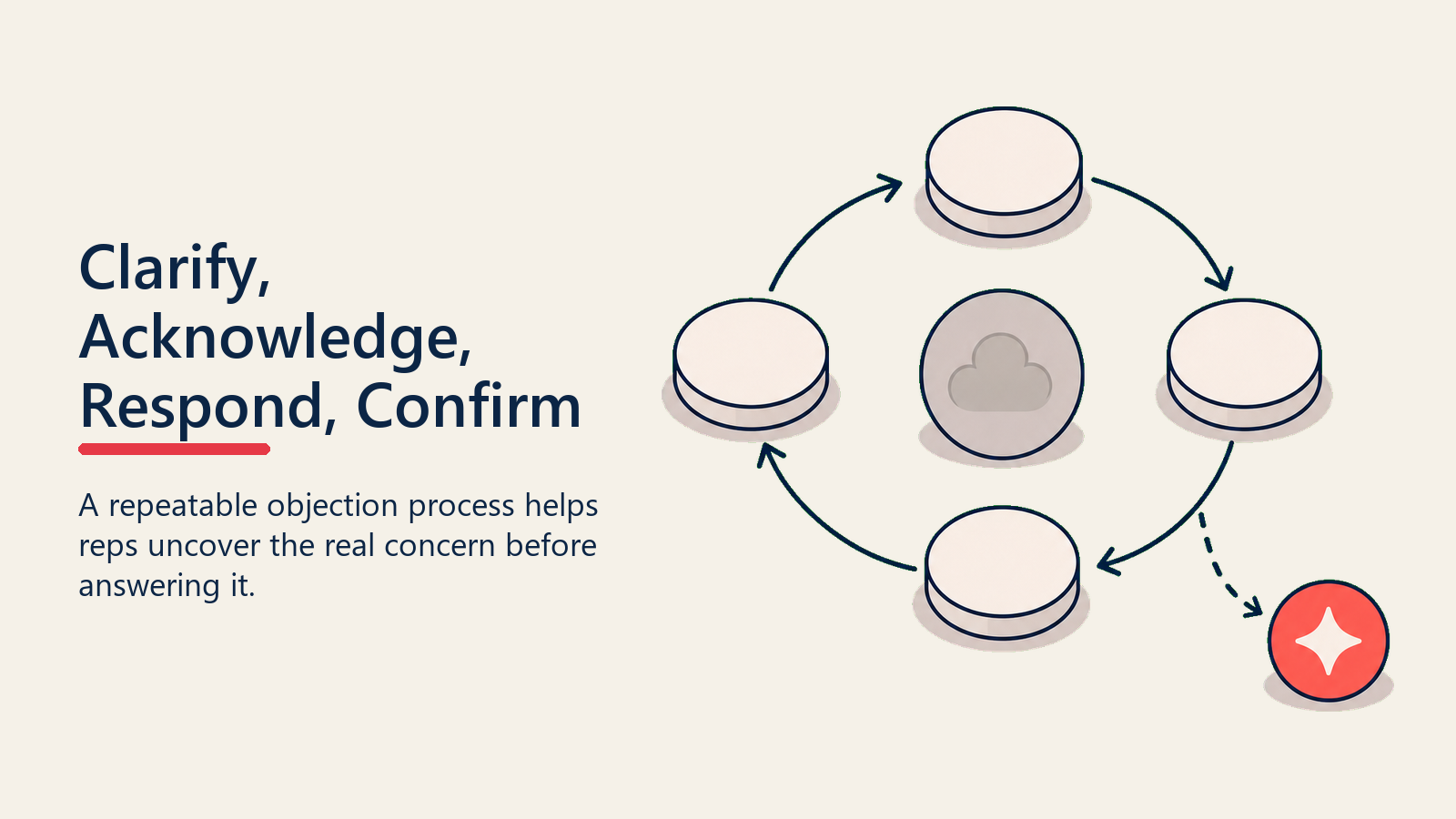
The CARC Framework: Clarify, Acknowledge, Respond, Confirm. This four-step sequence applies to every objection type.
Clarify what they actually mean. "We need to think about it" could mean six different things. Ask: "Of course. So I can make sure you have everything you need, what's the main thing on your mind?"
Acknowledge the concern without dismissing it. "That makes total sense" or "A lot of folks have the same question" signals that you heard them and that this isn't a strange thing to wonder about.
Respond to the specific concern with evidence, reframing, or a direct answer. Match the depth of your response to the depth of their concern.
Confirm that you've addressed it. "Does that help clarify things?" or "Is that the main thing that was holding you back?"
Don't rush this. Homeowners can tell when a rep is reciting a canned rebuttal versus actually listening.
"The Price Is Too High"
This is the most common objection in solar and also the most mishandled. Most reps immediately start discounting or offering financing. Neither works if the homeowner doesn't yet understand the value.
What they usually mean: They don't see the ROI clearly, or they're comparing the system cost to their current utility bill without doing the math.
The reframe:
Don't defend the price. Compare the right things.
"I hear you. Let me ask: what are you paying Edison right now, per month?" [Let them answer.] "And that goes up every year, right? Over the next 25 years, you're going to spend somewhere around $X on electricity whether you go solar or not. The difference with solar is that the $X is fixed, you own the equipment, and after the system pays itself off, your electricity is essentially free."
Then pull out the proposal and point to the payback period line.
If they're still focused on the upfront number, walk them through the financing math: "With a $0 down loan at X%, your monthly payment is $Y. You're currently paying $Z to the utility. So day one, you're actually spending less."
The price objection almost always dissolves when the comparison shifts from "cost of solar" to "cost of not going solar." The U.S. Energy Information Administration tracks average residential electricity prices and the factors that drive them, data your reps can pull directly to show how rate trends affect a homeowner's long-term cost picture. See presenting price and financing for a full breakdown of how to sequence this conversation.
"We Want to Get Other Quotes"
This one makes reps nervous because it feels like the deal is slipping away. But handled correctly, it's often a close opportunity in disguise.
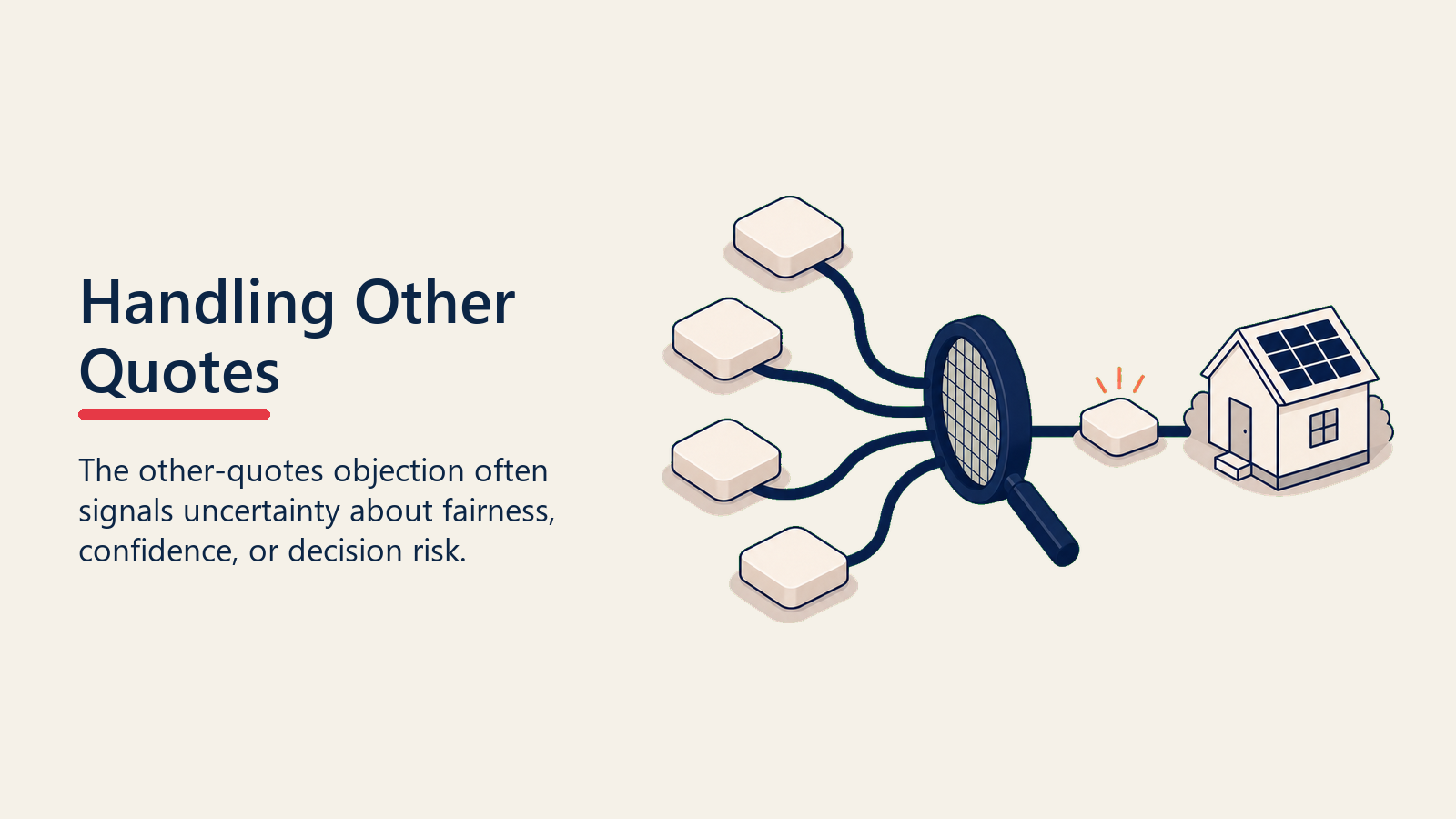
What they usually mean: They're not confident they're getting a fair deal, or they're afraid of making a mistake on a big purchase.
The response:
Validate the instinct first. "That's a totally fair thing to want to do. I'd do the same thing."
Then explain what to actually compare: "When you're comparing proposals, look at the system size in kilowatts, the panel brand and efficiency rating, the inverter type, the production estimate, and the warranty terms. A quote that's $3,000 cheaper might have lower-efficiency panels, which means the system produces less power and takes longer to pay off."
Then address timing honestly: for owner-purchased systems installed in 2026 or later, the federal residential solar credit under Section 25D has already ended, so the ITC-based urgency argument is no longer available. What remains real is the install queue: a two-week decision delay pushes the activation date back by two weeks, and every month of delay is another month of utility bills at the current rate. The Department of Energy's explanation of how the solar ITC has changed over time gives homeowners an honest picture of that legislative history without fabricating a deadline that no longer exists.
You're not pressuring them to skip due diligence. You're helping them do it faster and smarter.
"My Spouse Isn't Here"
This is a classic soft close blocker, and the best solution is preventing it from happening at all. See confirming and prepping the appointment for how to require both decision-makers before the appointment.
But when you're already in the home and one partner is absent:
First, verify what you're dealing with. Is the absent spouse genuinely co-deciding, or is the present homeowner using them as a shield? You can usually tell from context.
If they're genuinely co-deciding:
"I completely understand. When would the two of you be able to sit down together? I'd love to come back and walk through everything when you're both here, because questions always come up when you see the proposal side by side."
Then book a second appointment before you leave. A scheduled follow-up is ten times more likely to close than a "call me when you're both free."
If the absent spouse is a shield:
"What do you think would be their main concern? Let me make sure we have an answer to that before I leave." This helps the present homeowner mentally rehearse the conversation. Sometimes they realize they already know the answer and can decide.
See the one-call close vs. multi-visit approach for a deeper look at when it makes sense to push for same-day decisions versus scheduling a second visit.
"We're Not Ready to Decide Today"
This is different from needing a spouse present. It's a general reluctance to commit quickly on a big decision.
What they mean: They're worried about making a mistake. The purchase feels too permanent too fast.
The response:
Don't argue with the timeline. Instead, figure out what "ready" means to them.
"Totally fair. What would help you feel more comfortable? Is there more information you'd want to see? Or is it more about having time to sit with it?"
If they need more information, provide it. If they just need time, help them see what "time" is actually costing them.
"Here's what I'd want you to know: your spot in our installation queue isn't reserved until we have an agreement in place. Between permits and interconnection, you're probably looking at 60 to 90 days from today until your system is producing power. If you wait two or three weeks to decide, that pushes your start date back by the same amount, and in the meantime you're still paying the utility."
That's not pressure. It's an honest explanation of how the timeline works.
Objection Handling Quick Reference
| Objection | Root Cause | Core Response |
|---|---|---|
| "It's too expensive" | Doesn't see the ROI | Shift from cost of solar to cost of not going solar |
| "We need to think about it" | Fear of big decision | Ask what would help them feel comfortable |
| "My spouse isn't here" | Missing decision-maker | Book second appointment or coach them through it |
| "We're getting other quotes" | Fear of bad deal | Teach them what to actually compare, flag timing |
| "We're happy with our current bill" | Doesn't see urgency | Show 25-year utility cost projection |
| "Solar isn't worth it in our area" | Product misunderstanding | Pull production estimate specific to their address |
| "What if you go out of business?" | Trust/credibility | Walk through warranty structure, parent company, service records |
| "We heard bad things about solar" | Third-party distrust | Acknowledge specific concerns, share references |
| "I need to talk to my financial advisor" | Financial uncertainty | Offer to include the advisor in a call or provide a summary document |
"We Heard Solar Isn't Worth It"
Sometimes a neighbor had a bad experience. Sometimes they read something online. This objection requires patience because you can't logic someone out of a fear they felt emotionally.
The response:
"Tell me more about what you heard. I want to make sure I understand what happened."
Let them talk. Don't interrupt. Then address what they actually described rather than a generic defense of the industry.
"That's a real issue some people have run into, especially with companies that overpromised on production or used lower-grade equipment. The way we handle that is [specific thing your company does differently]. And if you'd like, I can give you the names of three or four customers in your neighborhood who've had their systems for two or three years so you can hear directly from them."
Referrals close skeptics faster than any argument. See referral programs in solar sales for how to build a customer reference network your reps can tap during objection handling.
"The Roof Isn't in Great Shape"
This one is half objection, half real concern. The homeowner might be right.
The response:
"That's an important thing to know upfront. Our site survey team does a full roof assessment before we design the system. If the roof needs work, we can sometimes bundle that into the financing, or we can work with a roofer you trust and time the solar install for right after. Either way, it's better to know now than six months in."
Don't dismiss the concern. Don't promise more than you can deliver. Show them a path forward.
"I'm Worried About the Loan Terms"
Financing objections deserve careful handling. Homeowners are right to read the fine print.
The response:
Walk through the loan terms line by line. Don't rush past the part about what happens with any applicable tax credits and the dealer fee. Some solar loans have a deferred interest structure that requires applying a credit (state, local, or utility incentive where applicable) within 18 months to avoid a balloon-interest event. For owner-purchased systems installed after 2025, the federal Section 25D credit is no longer available, so this conversation now centers on state and local incentives rather than the federal ITC.
"I want to make sure you understand exactly how this works before you sign. Here's the payment schedule, here's what the monthly looks like if you apply any available incentive and what it looks like if you don't, and here's the worst-case scenario if something unexpected happens."
Homeowners who feel fully informed before they sign are far less likely to cancel later.
How Do You Build Objection Handling Into Sales Training?
The reps who handle objections well aren't improvising. They've practiced specific language enough that it comes out naturally under pressure.
Build a monthly objection-handling drill into your team's rhythm:
- Pick the top three objections from last month's lost deals
- Role-play them in pairs, with one rep as the homeowner pushing back hard
- Record and replay the strongest responses
Managers can use these sessions to spot where reps are defending instead of listening, going too fast, or using language that sounds rehearsed. Small adjustments in delivery make a big difference in how homeowners receive the same information.
See coaching and ride-alongs for how to build this feedback loop into your weekly operations.
What Separates Good Objection Handling From Great
Good objection handling answers the question. Great objection handling makes the homeowner feel understood before the question is answered.
The reps who close the highest percentage of objections are the ones who slow down when a concern comes up, not speed up. They ask a follow-up question. They let silence do some of the work. They don't treat every "no" as a puzzle to solve immediately.
Homeowners can handle complex decisions. They do it all the time. What they can't handle is feeling like someone is pushing them through a decision they're not comfortable with. Give them clarity, give them honesty, and give them a reason to decide today, and most objections take care of themselves.
For how to plan the close around objections you know are coming, the close plan development framework is worth reviewing before your next in-home consultation.

Senior Implementation Consultant
On this page
- Why Solar Objections Feel Different From Other Sales
- The Core Framework: Clarify, Acknowledge, Respond, Confirm
- "The Price Is Too High"
- "We Want to Get Other Quotes"
- "My Spouse Isn't Here"
- "We're Not Ready to Decide Today"
- Objection Handling Quick Reference
- "We Heard Solar Isn't Worth It"
- "The Roof Isn't in Great Shape"
- "I'm Worried About the Loan Terms"
- How Do You Build Objection Handling Into Sales Training?
- What Separates Good Objection Handling From Great