Post-Install Customer Onboarding for Solar Companies
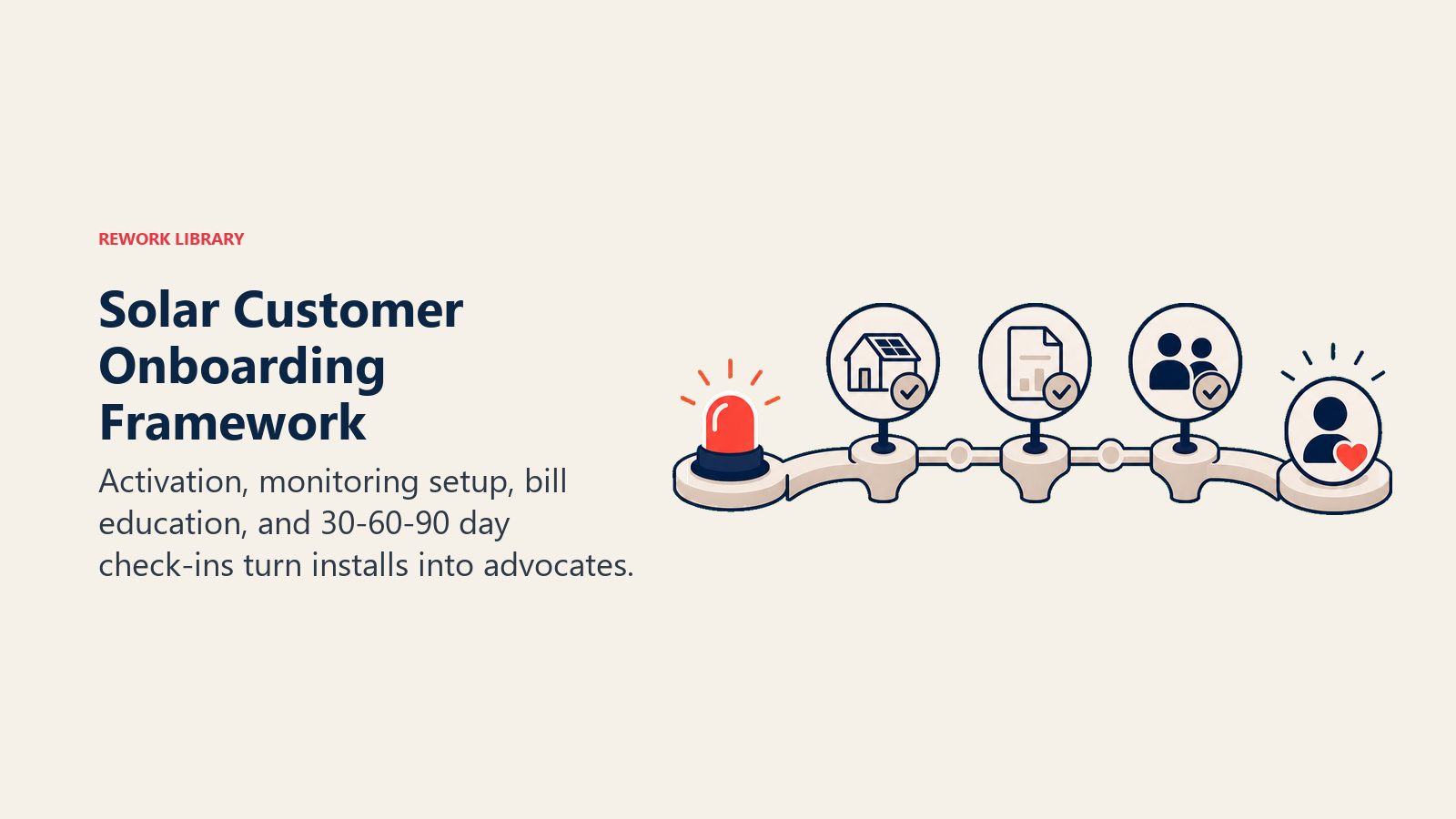
Turn this article into takeaways for your work.


Each assistant summarizes the article only for you and suggests best practices for your work.
The permit came through. The crew installed the panels. The utility issued permission to operate. Your customer's system is live.
Now what?
Most solar companies treat activation as the finish line. The project coordinator sends a generic "congratulations, your system is activated" email, closes the ticket, and moves on. Then, six months later, the customer gets an unexpected true-up bill, doesn't understand why, and calls upset. Or they mention solar to a neighbor but can't explain what they're saving or how the system works. Or they leave a 3-star review because "everything was fine but nobody really walked us through how it works."
Customer onboarding is the bridge between installation and a satisfied, loyal advocate. Done well, it turns a transaction into a relationship and sets up every future referral, review, and retention conversation you'll ever have with that customer.
What Good Onboarding Accomplishes
Before building a process, it helps to be clear on what you're actually trying to achieve in the first 90 days post-install.
Confidence: The customer understands their system, knows how to monitor it, and feels in control. They don't feel dependent on you for basic questions they should be able to answer themselves.
Accuracy of expectations: Solar production varies seasonally. Net metering credit timing differs by utility. True-up billing is common in some markets. Customers who understand these realities ahead of time don't call upset when they experience them.
Relationship: They know the name of their point of contact and feel comfortable reaching out. This is the foundation of future referral conversations.
Documentation: Warranties, monitoring access, installer contact info, and utility account details are all organized and accessible. When their neighbor asks about getting solar, the customer can actually recommend you rather than scrambling to remember who installed it.
Early problem detection: If there's a performance issue in the first weeks, you want to catch it before the customer notices it themselves and wonders if you'll fix it.
Key Facts
- According to NREL's Solar Energy Evolution and Diffusion Studies, 80% of residential solar customers made at least one referral, with a median of three referrals per customer. Onboarding is the process that creates those referral conditions.
- Solar industry NPS (Net Promoter Score) scores range from 25 to 52 on average, with top installers achieving scores above 64, according to industry benchmarking data compiled by Bodhi Solar. Structured 90-day onboarding programs are the primary differentiator between average and top-tier scores.
- Referred solar customers typically generate $15,000 to $30,000 in incremental installation revenue per referrer who sends two or three neighbors, at near-zero acquisition cost. That figure is the direct economic return on effective post-install onboarding.
The Activation Call: Your Most Important Post-Install Touchpoint
Permission to operate is the emotional peak of the customer journey. They've waited 60 to 120 days for this moment. When PTO comes through, call them the same day. Not a text. Not an email. A phone call from a real person who is genuinely happy for them.
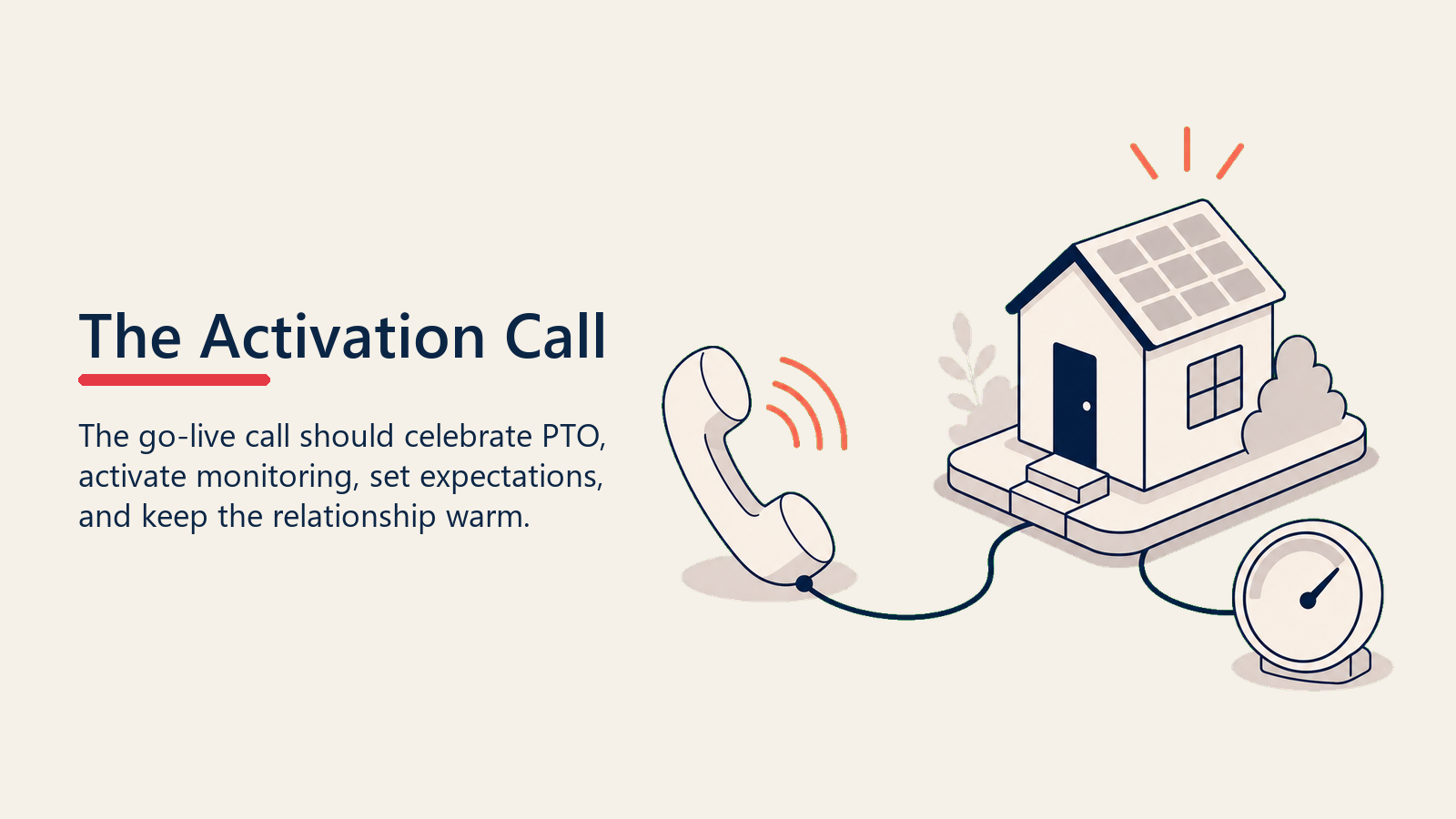
This call has a specific agenda:
Congratulate them genuinely. They made a significant financial commitment and waited patiently. Acknowledge that.
Walk them through activating their monitoring. Most solar systems include an app-based monitoring platform (Enphase Enlighten, SolarEdge, etc.). Download the app with them on the phone if needed. Show them how to read their production numbers and confirm the system is generating as expected.
Set the first-week expectation. "For the next few days, just keep an eye on daily production. You should see numbers in the range of [production estimate] on a sunny day. If anything looks off, text me directly."
Explain net metering simply. Many customers have a vague understanding of net metering but not a clear mental model. The Department of Energy's Homeowner's Guide to Solar defines net metering as an arrangement where solar owners are compensated for any excess generation they export to the grid. A simple explanation: "When your panels produce more than you're using, that excess goes to the grid and your utility credits your account. On nights or cloudy days when you're using more than you produce, you draw from the grid. Your bill reflects the net of both."
Clarify the true-up bill. In markets with annual true-up billing (California NEM 3.0, for example), make sure the customer understands this before they see it. "Once a year, your utility settles the account. In most cases you'll owe little or nothing, but we'll talk through what to expect based on your system design."
Book the 30-day check-in. Before you hang up, schedule a follow-up call for 30 days out. "I'd like to touch base in a month to make sure everything is running as expected and answer any questions. Does [date and time] work?"
The activation call takes 20 to 30 minutes. It costs almost nothing. And it sets the tone for the entire customer relationship going forward. What comes next is a phased sequence that turns that good start into a lasting one.
The First 90-Day Onboarding Schedule
Structure your post-install process as a phased sequence, not a one-and-done event.
Week 1: Activation and Setup
| Action | Owner | Method |
|---|---|---|
| PTO notification and activation call | Project coordinator | Phone |
| Monitoring app setup confirmation | Project coordinator | Phone (during activation call) |
| Welcome packet delivery | Customer success | |
| Introduction to warranty and service contacts | Customer success | |
| Document delivery (permit approval, as-built drawings, warranty certificates) | Operations | Email or customer portal |
The welcome packet should include: system specs in plain language (not engineering docs), monitoring app login and basic how-to, contact information for service questions, a brief explanation of net metering and what to expect on bills, and a note about their warranty coverage.
Day 30: First Check-In
This is a scheduled call, not a reactive touchpoint. Call the customer at day 30 to ask:
- Have you been checking your monitoring app? Are production numbers looking right?
- Have you gotten a utility bill since activation? Did it match your expectations?
- Any questions that have come up since we last talked?
- Have you shared anything about your system with neighbors or family members?
That last question is subtle but intentional. It opens the referral conversation without being pushy. If they say "actually yes, my brother-in-law is interested," you follow up with "I'd love to talk to him, would it be okay if I reached out?" That's your referral pipeline starting before you ever formally asked.
See referral generation after install for how to build this into a formal referral program.
Day 60: Mid-Point Check and First Bill Review
By 60 days, most customers have received at least one utility bill since activation. This is when confusion can peak. Call or email to review it together if needed.
Common day-60 questions:
- "My bill is still positive, why am I paying anything?" (Explain grid usage during evenings/cloudy days and how net metering credits accumulate)
- "I thought I was going to save X per month, but my first bill doesn't show that." (Walk through how to read the utility statement, distinguish between energy charges and fixed charges)
- "My monitoring shows less production than I expected." (Check for shading issues, inverter alerts, or string underperformance)
If the customer has a performance concern, this is the time to catch it. A system underperforming by 20% in month two is a service call that should happen now, not when the customer calls angrily at month six.
Day 90: The Relationship Check-In
Ninety days post-install is a relationship inflection point. The customer knows how their system works, they've seen a couple of bills, and their initial excitement has either settled into satisfaction or curdled into disappointment.
A 90-day call accomplishes three things:
Confirm satisfaction: "Now that you've had the system for three months, are you happy with how it's performing? Is it doing what we said it would?"
Catch any lingering issues: If there's something nagging at them, 90 days is often when customers finally decide to say it. Give them space to raise concerns.
Plant the referral seed explicitly: "We're really growing based on referrals from customers like you. If you know anyone thinking about solar, we'd love to talk to them."
For the broader customer success framework that underpins this kind of structured check-in cadence, see customer success check-ins.
How Do You Actually Teach Customers to Read Their Monitoring App?
One of the most common sources of post-install dissatisfaction is customers who don't understand what their system is doing. The monitoring app is a powerful tool for building confidence, but only if customers actually know how to use it.
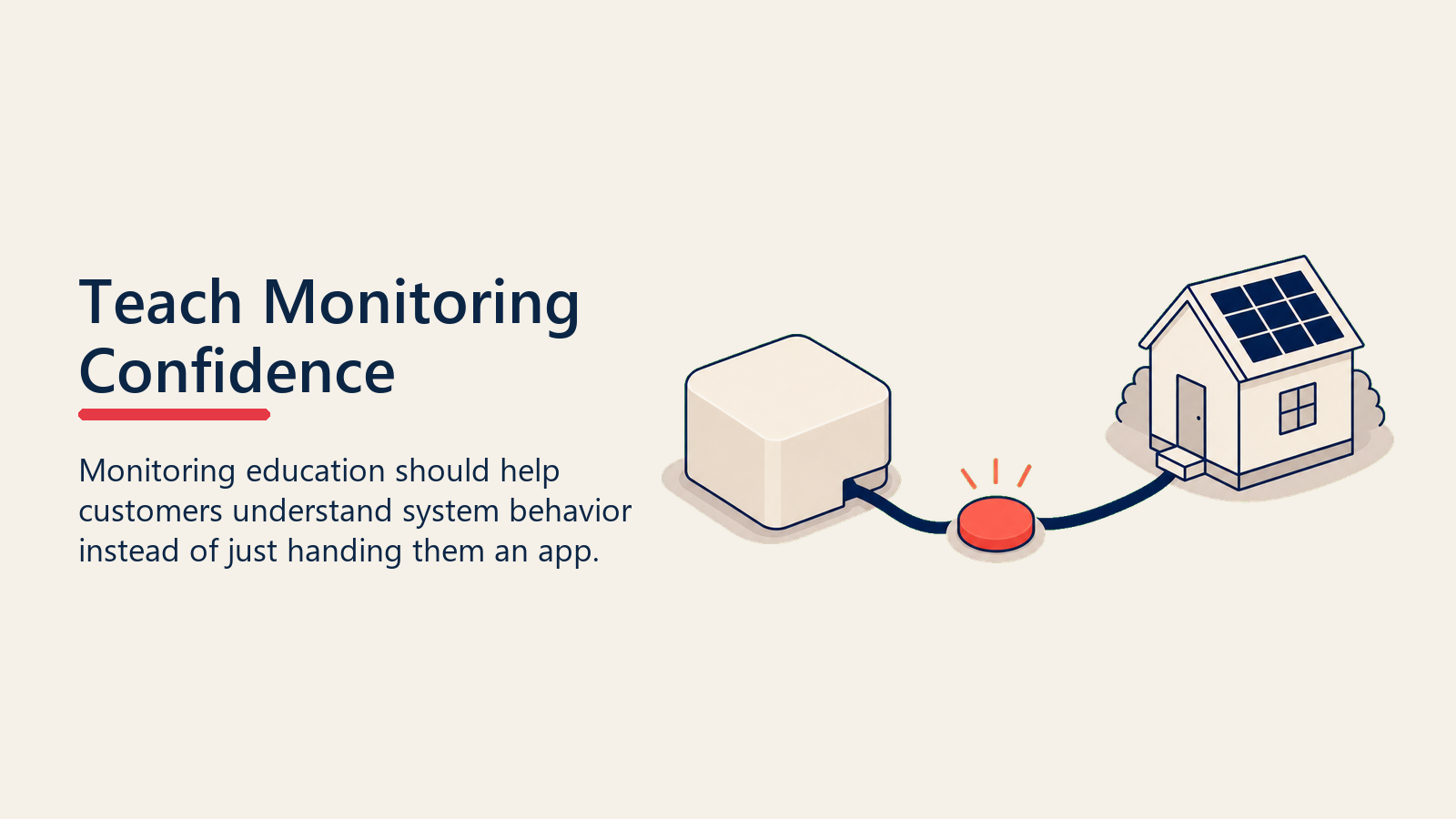
The activation call is the right time to give a brief tutorial. Walk the customer through:
Daily production view: "This is how much energy your panels produced today. On a clear day in summer, you'd expect to see about [X] kWh. In winter, production drops but your usage often drops too."
Lifetime production: "Over time, this number will grow. It represents all the clean energy you've produced from your own roof."
Monitoring alerts: "If there's ever an issue with a panel or inverter, you'll see an alert here. You can also email or call us directly and we'll investigate."
Bill vs. monitoring: "Your monitoring shows what your panels produce. Your utility bill shows what you owe based on what you used from the grid minus your net metering credits. They measure different things."
Many customers never fully understood the difference between their solar production and their utility bill until this explanation. Clearing it up in week one prevents the most common billing frustrations. That said, some customers will still be surprised by what they see on their first statement.
Handling the First Unexpected Bill
Despite your best preparation, some customers will be surprised by their utility bill after activation. This is especially common in markets with complex rate structures or in months with lower-than-expected production.
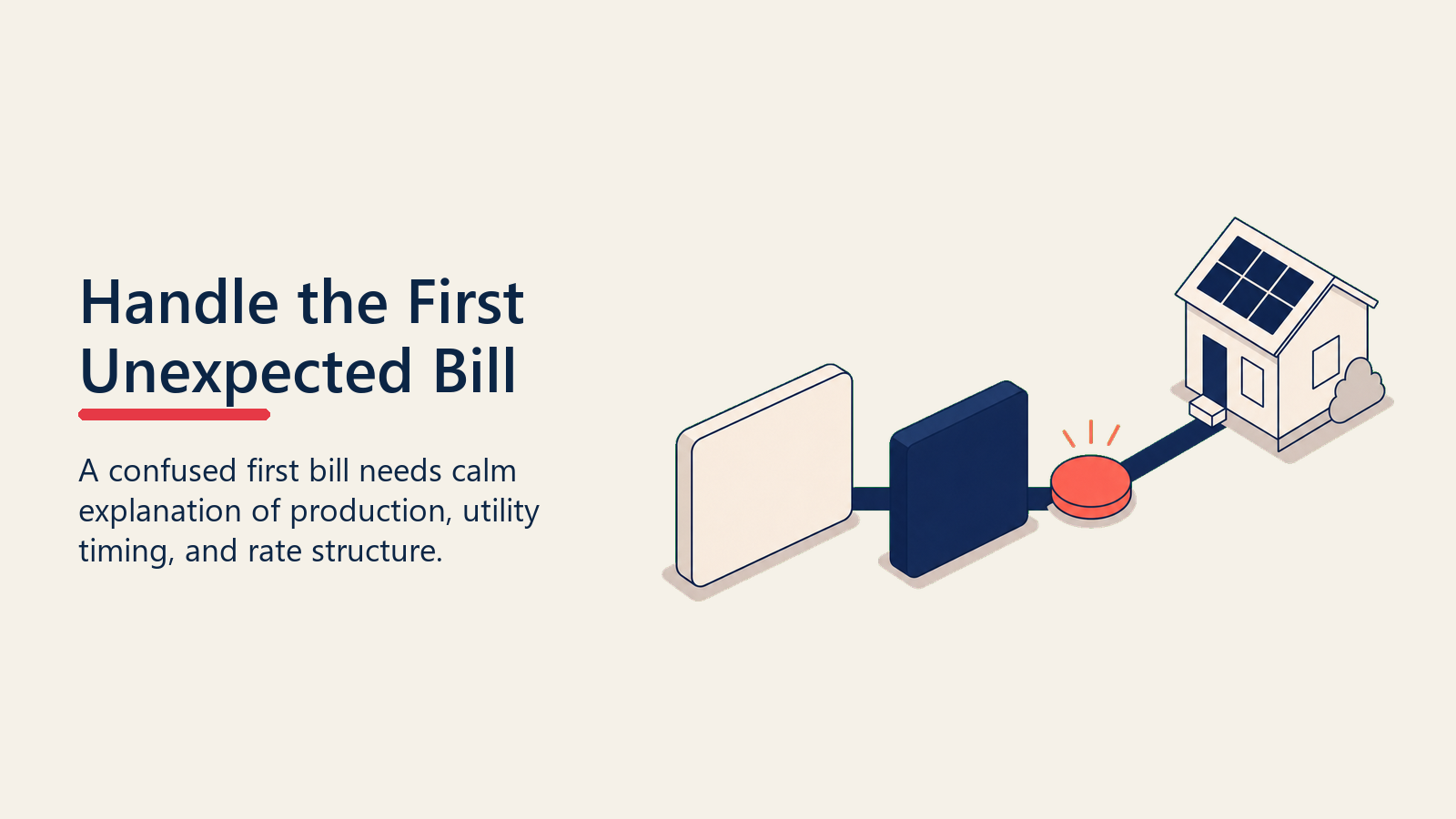
When a customer calls confused or upset about a bill, treat it as an opportunity, not a problem. Walk through the bill line by line with them. Find the solar net metering credit line. Show them what they saved vs. what they'd have paid without solar. Often the conversation ends with the customer saying "oh, I see, that actually makes sense."
If the bill genuinely indicates a performance problem, take it seriously. Pull the monitoring data for the relevant period. If production was lower than the system design predicted, dispatch a service check. Own the issue rather than explaining it away.
A customer who calls with a billing concern and gets a quick, clear, helpful response becomes one of your strongest advocates. A customer who calls and gets deflection or delay becomes a negative review.
What Goes Into the Welcome Packet
Your welcome packet doesn't have to be elaborate, but it does need to cover the essentials. ENERGY STAR's rooftop solar guidance recommends that reliable providers be fully transparent about savings, monitoring, maintenance, and all costs. Here's a checklist built around that principle:
- System overview: panel count, total wattage, inverter type, estimated annual production
- Monitoring platform login credentials and quick-start guide
- Net metering explanation specific to their utility
- True-up billing explanation if applicable in their market
- Warranty summary (panels, inverter, installation workmanship, roof penetrations)
- Who to contact for service issues (name, direct phone, email)
- Emergency contact for electrical issues
- Expected maintenance: what needs attention and when (typically just annual panel cleaning in dusty climates)
- How the system interacts with existing home systems (battery, EV charger if applicable)
Send this digitally, but also offer a printed copy or a customer portal where it's always accessible. Warranty documents especially tend to get lost in email when customers need them years later.
Connecting Onboarding to Referral Readiness
A fully onboarded customer is referral-ready. They understand their system, they can speak to their savings, and they've had enough good interactions with your company to feel comfortable recommending you.

But you still have to ask. The 30-day, 60-day, and 90-day calls each contain a natural opportunity. The sequence matters: at day 30, plant the seed lightly. At day 60, mention the referral program specifically. At day 90, make the direct ask.
By day 90, customers who are satisfied know it. They want to share their experience. Most of them just need a gentle prompt and a clear path to refer someone. "Do you know anyone who's been thinking about solar? I can send them a personal note from you." That's a referral request that doesn't feel like a sales ask.
The full referral program structure is covered in the referral generation article linked in Learn More below.
Scaling Onboarding Without Losing the Personal Touch
As your installation volume grows, you can't have your best project coordinator personally walking every customer through monitoring at activation. You need systems that maintain the quality of experience without requiring senior staff time on every account.
Approaches that scale well:
Recorded video walkthroughs: A 5-minute screen recording showing customers how to use their specific monitoring platform. Reference this in the activation email. Customers can rewatch it anytime.
Automated milestone emails: Configure your CRM to send congratulatory emails at PTO, and reminder emails at day 28 and day 58 inviting the customer to reach out or book a check-in call.
Tiered check-in by risk level: Not every customer needs three phone calls. Customers with complex systems, net metering questions, or previous concerns during the install wait need more attention. Use your CRM tags to route high-risk accounts to senior coordinators.
Customer portal: A simple portal where the customer can access their documents, see system specs, and submit service requests reduces inbound inquiry volume significantly while making customers feel more in control.
Referral request automation: A triggered email at day 60 asking satisfied customers to refer a friend, with a link to your referral form. This ensures every customer gets the ask even if they don't get a personal call.
See solar CRM and proposal tools for how to configure CRM automations that support a scalable onboarding cadence.
The goal is never to remove the human element, but to use automation for the routine so that your team has capacity for the meaningful. When a customer calls with a billing question, they should still reach a real person quickly. But the initial activation confirmation and document delivery can run without coordinator intervention.
The Onboarding Mindset Shift
Solar companies that have the best long-term economics treat onboarding not as a cost center but as a revenue engine. Every satisfied, well-onboarded customer is worth several times the lifetime value of a one-time sale. They refer neighbors. They leave strong reviews that close future deals. They upgrade systems when they add EVs or batteries. They don't churn, don't dispute, and don't demand extraordinary service time. The SEIA's Residential Consumer Guide to Solar Power underscores why post-install education matters: customers who understand their system and the interconnection process are far better prepared to be long-term advocates.
The math is straightforward. A customer who refers two or three friends in the first year generates more incremental revenue than almost any paid lead source you have. A customer who leaves a 5-star Google review helps close deals you'd otherwise lose. A customer who upgrades when their daughter buys an EV is a second sale with zero acquisition cost.
None of this happens by accident. It happens when the post-install experience is good enough that customers want to share it.
During the permitting wait that precedes activation, the same mindset applies. See managing install wait and cancellations for how to keep customers committed through that period so they arrive at activation in a positive state of mind, ready to be onboarded well.
See warranty and service monitoring for how to build the long-term service monitoring that keeps customers satisfied years after activation, and online reviews and reputation management for how to convert satisfied customers into a steady stream of 5-star reviews.
Learn More
Quotable Nuggets
"The activation call takes 20 to 30 minutes and costs almost nothing. It sets the tone for every referral, review, and retention conversation you'll ever have with that customer. Yet most solar companies replace it with a generic congratulations email and close the ticket."
"Customers who don't understand their monitoring app call with billing questions every month. Customers who do understand it become advocates who explain solar to their neighbors using real numbers from their own roof." (Principle grounded in ENERGY STAR rooftop solar guidance)
"Solar onboarding isn't a cost center. It's the input that determines whether each installed customer becomes a one-time transaction or a referral engine worth $15,000 to $30,000 in downstream revenue." (Consistent with NREL SEEDS referral data)
The 90-Day Activation Sequence: A phased, role-assigned onboarding program anchored to four named touchpoints: the Activation Call (PTO day), the Day 30 Check-In (system performance and soft referral open), the Day 60 Bill Review (first utility statement walkthrough, referral program mention), and the Day 90 Relationship Call (direct referral ask and satisfaction confirmation). Each touchpoint has a specific agenda, a specific owner, and a defined follow-up action. The sequence costs roughly 30 to 45 minutes of coordinator time per customer, spread across 90 days, and converts installation into a managed referral pipeline rather than a closed transaction.
Frequently Asked Questions

Senior Implementation Consultant
On this page
- What Good Onboarding Accomplishes
- The Activation Call: Your Most Important Post-Install Touchpoint
- The First 90-Day Onboarding Schedule
- Week 1: Activation and Setup
- Day 30: First Check-In
- Day 60: Mid-Point Check and First Bill Review
- Day 90: The Relationship Check-In
- How Do You Actually Teach Customers to Read Their Monitoring App?
- Handling the First Unexpected Bill
- What Goes Into the Welcome Packet
- Connecting Onboarding to Referral Readiness
- Scaling Onboarding Without Losing the Personal Touch
- The Onboarding Mindset Shift