One-Call Close vs Multi-Visit Solar Sales: When to Push for Tonight and When to Set a Follow-Up
Turn this article into takeaways for your work.


Each assistant summarizes the article only for you and suggests best practices for your work.
The default assumption in residential solar sales is that every deal should close on visit one. That's not wrong, but it's incomplete. Yes, the industry average close rate drops sharply when a decision goes beyond the first appointment. But pushing for a same-day close on a deal that isn't ready often loses what could have been a solid second-visit close.
The real skill is reading the difference between a customer who needs one more hour of conversation and a customer who needs to sleep on it and compare notes with their financial advisor. Getting that right, and executing the right strategy for each case, is what separates high-performing closers from reps who either give up too early or burn goodwill pushing too hard.
Why Same-Day Closes Matter More in Solar Than Most Industries
Before discussing when not to push, it's worth understanding why the one-call close matters so much in residential solar.
The data on follow-up conversion is brutal. Industry surveys consistently show that solar deals that don't close on visit one convert at roughly 20-35% of their initial rate. Every day that passes:
- The customer's memory of the savings presentation fades
- Doubt and second-guessing grow
- Competitive quotes come in, often from less rigorous competitors with artificially low prices
- Spouses or family members who weren't at the appointment become influencers without the context you built
- The customer finds something online that spooks them
None of these things make the deal better. Time is almost never the customer's friend in solar, and it's definitely not yours.
Key Facts
- NREL research on residential solar contracts found overall cancellation rates ranging from 40 to 50% at some installers, with the median installer rate around 33%. The gap between "signed" and "installed" is where deals die, and that gap grows with every week the customer goes without a committed next step. (NREL Technical Report 80626, 2022)
- Industry-reported residential solar close rates on in-home appointments typically run 25 to 35%, with the gap between top and bottom performers explained primarily by pre-sale qualification and the quality of needs assessment work, not closing technique alone. (Sunvoy Solar Lead Sources analysis; SPOTIO solar sales guide)
- Residential electricity rates rose roughly 7.3% year-over-year in April 2026, reaching 18.83 cents per kWh nationally. The urgency argument for deciding sooner rather than later is grounded in a real and accelerating cost trend. (EIA Electricity Monthly Update, April 2026)
Urgency is often real, not manufactured. Utility rates don't go down. Net metering policies get amended. Incentive rebates deplete. Install queues move. The customer who waits 60 days genuinely may be buying in a slightly worse situation than the customer who says yes tonight. For 2026 and beyond, note that the federal residential solar credit under Section 25D ended December 31, 2025. The DOE's explanation of how the solar ITC has changed documents this history accurately and is a useful resource for explaining why incentive timing has always mattered, even when the specific credit picture is now different.
The urgency and same-day close ethics topic covers how to apply legitimate urgency without fabricating it, which matters both for ethics and for your team's long-term credibility.
Reading the Room: Signals That a Same-Day Close Is Possible
Not every customer is in the same psychological position when you sit down. Some are essentially ready to buy and just need you to ask and make the paperwork easy. Others have genuine unresolved questions they need answered first.
Signs the customer is ready to close tonight:
- They're engaged and asking questions about next steps, installation timing, how the monitoring works
- They've said something that reveals they've already mentally bought ("once we get this installed, can we...")
- Both decision-makers are present and nodding together
- They haven't asked to get other quotes
- The savings story clearly resonated ("wow, we're spending $120,000 over the next 25 years?")
- They have an event coming that makes installation timing relevant, like a new car, a move, or a renovation
- Pre-qualification from the solar lead qualification and prescreening step showed strong credit and motivated buyers
Signs you may be heading for a multi-visit close:
- A key decision-maker is absent, like a spouse, partner, or parent who co-owns the home
- They've mentioned comparing to another company, and the comparison matters to them
- There are unresolved financial questions, like uncertainty about their tax situation or wanting to talk to an accountant
- They seem engaged but emotionally guarded
- They've raised concerns you haven't fully resolved yet
- The credit situation is unclear or the pre-qual showed potential issues with financing
The important distinction: a customer who's uncertain because they haven't understood the value fully is different from a customer who's understood everything and genuinely needs time to process a major financial decision. The first is a closing problem. The second might be a legitimate multi-visit situation.
So how do you actually close when the signals say tonight is the night? The next section covers exactly that.
The One-Call Close Framework
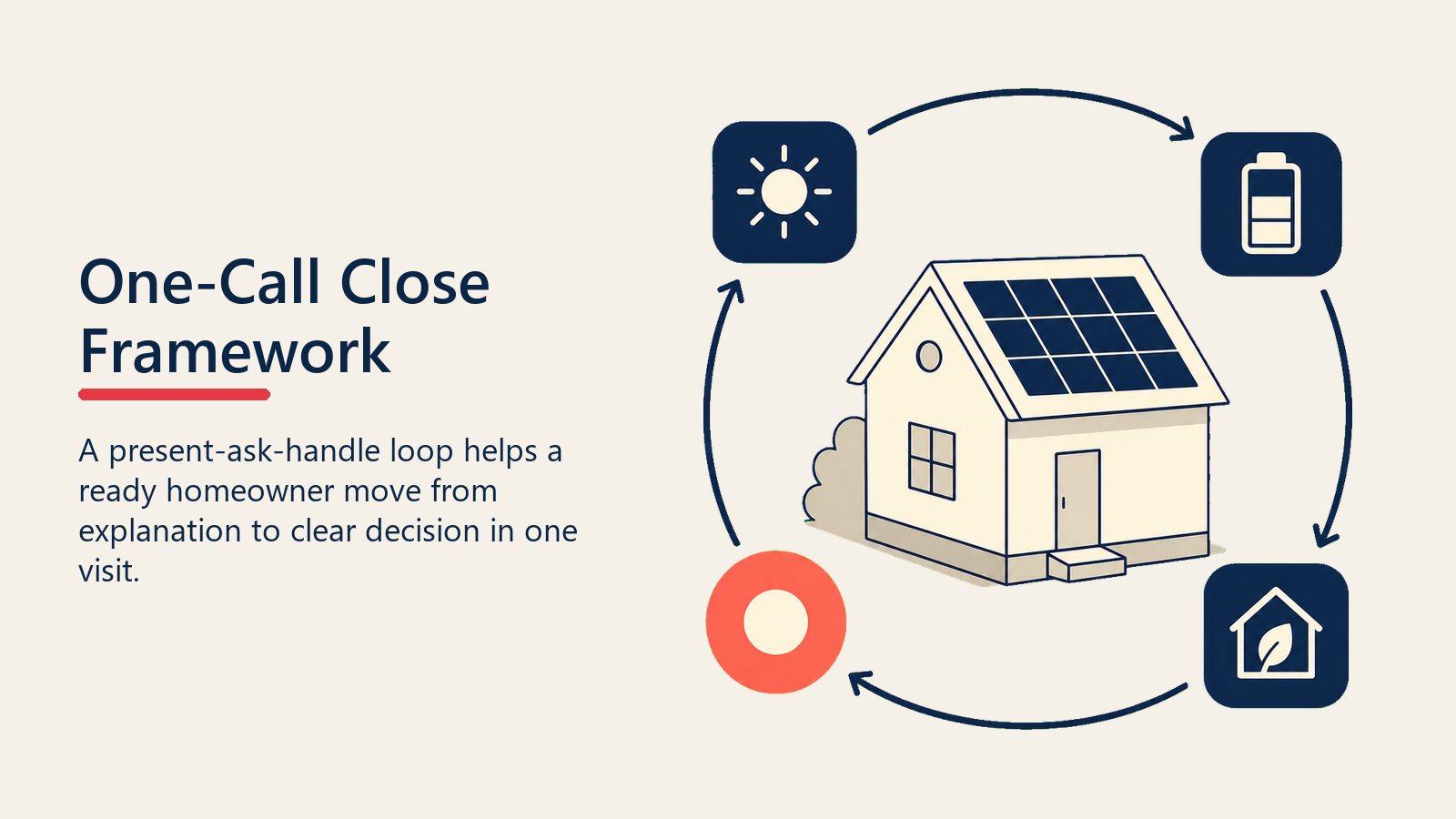
The Present-Ask-Handle Loop: when the signals say this customer is ready, the goal is a clear yes tonight through three repeating cycles: present a section fully, ask a direct closing question, handle the objection if one surfaces, then close again. Each loop either resolves the deal or surfaces the real blocker. Most deals have one or two real blockers. Reps who run three or four loops without a resolution are usually dealing with a customer who isn't ready tonight.
When the signals say this customer is ready, the goal is to get to a clear yes tonight. This doesn't mean high-pressure tactics. It means:
Completing the full presentation without cutting corners. Many reps rush because they can feel the customer is interested. Rushing signals nervousness and skips the foundations. Go through the full presenting price and financing sequence.
Asking directly. When you've finished the presentation, ask a clear closing question. Not "what do you think?" which invites fence-sitting. Instead: "Based on everything we've gone through, are you ready to get this scheduled?" or "Does this make sense as a next step for you?"
Using assumptive language. The assumptive close approach works well in solar because the purchase logic is strong. After showing the savings story, moving to "let's get your information in so we can lock in your install date" is a natural progression, not a pressure move.
Handling objections without retreating. When an objection comes up, answer it and immediately close again. Don't answer and then go quiet. Every objection response should end with a closing question: "Does that answer your concern?" followed by a beat, then "So, are you ready to move forward?"
Knowing your walk-away. If you've handled three or four objections and the customer keeps finding new ones, they may not be ready to close tonight. Read the pattern. Continuing to push past the natural stopping point burns rapport and makes follow-up harder.
The Same-Day Decision Framework (Conversation Guide)
When you've finished the proposal walk-through:
| Stage | What You Say |
|---|---|
| After savings section | "Based on what you see here, does this solve the problem you have with your energy costs?" |
| After incentives | "With the tax credit, your effective cost comes down to $29,400. Does that number work within your thinking?" |
| First close attempt | "Let's get your authorization started so we can lock in your timeline. I'll need your [SSO/ID/information]." |
| After objection | "[Answer objection.] So given that, are you ready to move forward?" |
| Second close attempt | "I want to make sure you get the install scheduled before the financing rate changes. Our queue fills up and every week adds to your payback timeline. Are you ready to move forward tonight?" |
| Natural walk-away | "I completely understand. I want you to feel good about this decision. Can we set a time to come back [specific day] so we can answer your final questions and get you started?" |
When Multi-Visit Is the Right Strategy
The multi-visit close gets a bad reputation because weak closers use "they want to think about it" as an excuse to leave without asking for the business. But there are legitimate situations where a second visit is the right move.
Situation 1: The absent decision-maker. If the spouse, partner, or co-owner wasn't present at appointment one, you have a real problem. You've built rapport and presented the value to one person, but the actual decision requires two. Coming back when both are present and walking the second person through a fresh (but shorter) presentation is far more effective than trying to have your contact sell it internally.
When this happens, don't present the full proposal to the solo decision-maker. Do a partial presentation, build the relationship, confirm their enthusiasm, and say: "I want to make sure [name] has a chance to go through this with us. When can we get everyone together?" This preserves the close energy for when it can actually land.
Situation 2: Genuine financial complexity. If the customer's tax situation is complicated, they co-own the home with a parent or sibling, or they're not sure about their credit, it's better to get clarity before pushing for a signature. A customer who signs on a financing deal they can't get approved for, or who finds out the ITC doesn't apply to them, becomes a very difficult unhappy customer. The IRS Residential Clean Energy Credit page is a clean resource to leave with the customer so they can verify eligibility with their tax preparer before the second visit.
In these cases, give them a clear set of homework: "Here's what I need you to find out before we can finalize this: your approximate tax liability this year, and whether there are any liens on the property from [situation]. Can we get together on [specific date, two to three days out] once you have those answers?"
Situation 3: Credit issues surfaced. If during the visit it becomes clear the customer may not qualify for standard solar financing, don't push for an application that will likely decline. Instead, explore alternatives, like secured loan options, PPA, or lease, and give them a path forward that doesn't start with a credit ding.
Situation 4: Unresolved competing quote. If the customer is clearly going to get another quote regardless of what you do, trying to close tonight with brute force rarely works. A better play: present your proposal fully, anchor on the quality and service differentiators, and set a specific follow-up time.
"I know you want to compare a few options, which makes sense. I'd ask that you compare apples to apples: same panel specs, same warranty terms, same installer certification. When you've done that, I'd love to sit back down and answer any questions. How's [specific time, 3-5 days out] work for you?"
This is a close on a second appointment, not an open-ended "let me know." An open-ended follow-up almost never results in a return call.
How Do You Manage the Multi-Visit Pipeline Without Losing Momentum?
Second visits are won or lost in the gap between appointments. What you do in those 3-7 days determines whether the customer comes back engaged or has been talked out of it by a competitor or an anxious spouse.
The day-after follow-up. Text or email the customer the morning after your visit. Keep it short: "Great meeting you both last night. Here's the proposal summary we went through [attach PDF]. Let me know if any questions come up as you're thinking through it." This keeps you top of mind without feeling like a push.
Mid-week check-in. Two or three days in, a brief check-in: "Hey [name], just wanted to see if any questions came up as you were looking at the proposal. Happy to answer anything before we reconnect on [date]." Brief, not pushy.
Pre-appointment confirmation. The day before the second visit, confirm it. Treat this exactly like confirming and prepping the appointment, because it functions the same way. A confirmed appointment is twice as likely to happen as an assumed one.
Second visit structure. Don't restart from scratch. Acknowledge what you covered, ask if there were any questions from the first visit, briefly recap the key savings numbers, and focus specifically on whatever was unresolved. The second visit should be 30-45 minutes, not a full repeat of the first.
Close Rate Expectations by Scenario
Understanding what's realistic by scenario helps managers coach and helps reps calibrate expectations:
| Scenario | Expected Close Rate |
|---|---|
| Both decision-makers present, strong pre-qual | 40-55% same-day |
| One decision-maker present, strong pre-qual | 20-30% same-day |
| Both present, credit concerns unresolved | 15-25% same-day |
| Explicitly comparing quotes | 25-35% on follow-up |
| No follow-up appointment set before leaving | 5-15% eventual close |
| Follow-up appointment set before leaving | 35-50% on follow-up |
The last two rows are why you never leave without a next step committed. An unscheduled follow-up isn't a pipeline opportunity. It's a maybe. And maybes don't install solar.
Why Some Reps Close Better Than Others
The difference between a 20% close rate and a 40% close rate across a rep's full book usually isn't product knowledge, financing knowledge, or even closing technique. It's the quality of the work done before the close.
Reps who run thorough needs assessments have more data to personalize the presentation. Reps who build accurate proposals have savings stories that hold up under scrutiny. Reps who confirm appointments properly show up to engaged customers, not skeptical ones.
The close is the final step in a chain that started with appointment setting and continued through the entire in-home consultation. Closers who treat the close as a standalone event separate from everything before it will always struggle. Closers who see the whole in-home visit as one continuous process of building toward a yes will close more, keep customers happier, and generate better referrals.
For the full model of how this fits together, see the residential solar sales growth model. And for what happens after the close, the churn prevention strategy shows why the tone you set on signing night directly affects whether customers stick around and refer friends.
The goal isn't to close everyone on visit one at all costs. It's to close the maximum number of deals at the highest possible conversion rate, with customers who are genuinely happy they said yes. That mix is what builds a sustainable solar business.
Frequently Asked Questions about One-Call Close vs Multi-Visit Solar Sales
What is the typical close rate for residential solar in-home appointments?
Industry-reported close rates typically run 25 to 35% for in-home appointments, with variation driven primarily by lead source quality, pre-qualification rigor, and whether both decision-makers were present. The gap between a 20% and a 40% rep close rate is usually explained by what happened before the close, not during it.
How much does a follow-up appointment set before leaving affect close rate?
Significantly. Setting a specific follow-up appointment before leaving the home produces roughly 35 to 50% close rates on the second visit. Leaving without a scheduled next step drops eventual close rates to 5 to 15%. The appointment is the commitment, not the signed contract.
When is a multi-visit close the right call?
Four legitimate scenarios: the key decision-maker was absent, the tax or financial situation needs to be confirmed before signing, the credit situation is unclear, or the customer is definitively going to get other quotes. All other "I need to think about it" situations are usually solvable in the same visit with the right questions.
What signals tell you a customer is ready to close tonight?
Both decision-makers are present and aligned, they are asking about next steps and timelines rather than questioning the fundamentals, the savings story visibly landed, and they have not raised concerns you have not resolved. Pre-qualification showing strong credit and a motivated buyer is also a strong predictor.
What is the Present-Ask-Handle Loop?
Present a section of the proposal fully, ask a direct closing question, handle any objection that surfaces, and then close again. Most deals have one or two real blockers. Three or four loops without resolution typically means the customer is not ready to close tonight and needs a genuine second visit.
Is there still urgency to close solar deals without the federal tax credit?
Yes, but the urgency argument shifts. For 2026+ installs, the Section 25D federal residential credit is gone. Real urgency now centers on the install queue (delay = pushed activation date), rising utility rates (18.83 cents per kWh nationally as of April 2026, up 7.3% year-over-year), and financing rates that can change. Do not reference the ITC as a current urgency driver for new owner-purchased systems.
What happens if the rep disappears after the first visit?
Close rates on unmanaged follow-ups are very low because all the disadvantages of waiting compound: the customer's memory of the savings presentation fades, competing quotes arrive, and family members become influencers without your context. A day-after follow-up message, a mid-week check-in, and a confirmed appointment are the three interventions that prevent this decay.

Senior Implementation Consultant
On this page
- Why Same-Day Closes Matter More in Solar Than Most Industries
- Reading the Room: Signals That a Same-Day Close Is Possible
- The One-Call Close Framework
- The Same-Day Decision Framework (Conversation Guide)
- When Multi-Visit Is the Right Strategy
- How Do You Manage the Multi-Visit Pipeline Without Losing Momentum?
- Close Rate Expectations by Scenario
- Why Some Reps Close Better Than Others