Selling Battery Storage as an Attach
Turn this article into takeaways for your work.


Each assistant summarizes the article only for you and suggests best practices for your work.
A few years ago, battery storage was a niche add-on that a handful of homeowners asked about after a wildfire-season blackout made the news. Now it's one of the fastest-growing line items in residential solar, and companies that don't have a real battery-attach strategy are leaving revenue on the table while also under-serving homeowners who'd genuinely benefit from storage.
This guide covers how to pitch battery storage as a legitimate solution to real problems (rate design, outages, backup needs) rather than a generic upsell tacked onto every proposal regardless of fit. The mechanics of how a solar-plus-storage system actually works, per the Department of Energy, are worth knowing cold before you ever sit down at a kitchen table to pitch one.
Why Battery Attach Is Growing
Three forces are converging at once, and reps should understand all three to pitch storage credibly instead of leaning on a single generic pitch for every household. The scale of the shift is real: total US battery energy storage installations reached 18.9 GW in 2025, a 52 percent increase over 2024, according to the U.S. Energy Storage Monitor report from the American Clean Power Association and Wood Mackenzie, the industry's standard quarterly benchmark for US storage deployment.
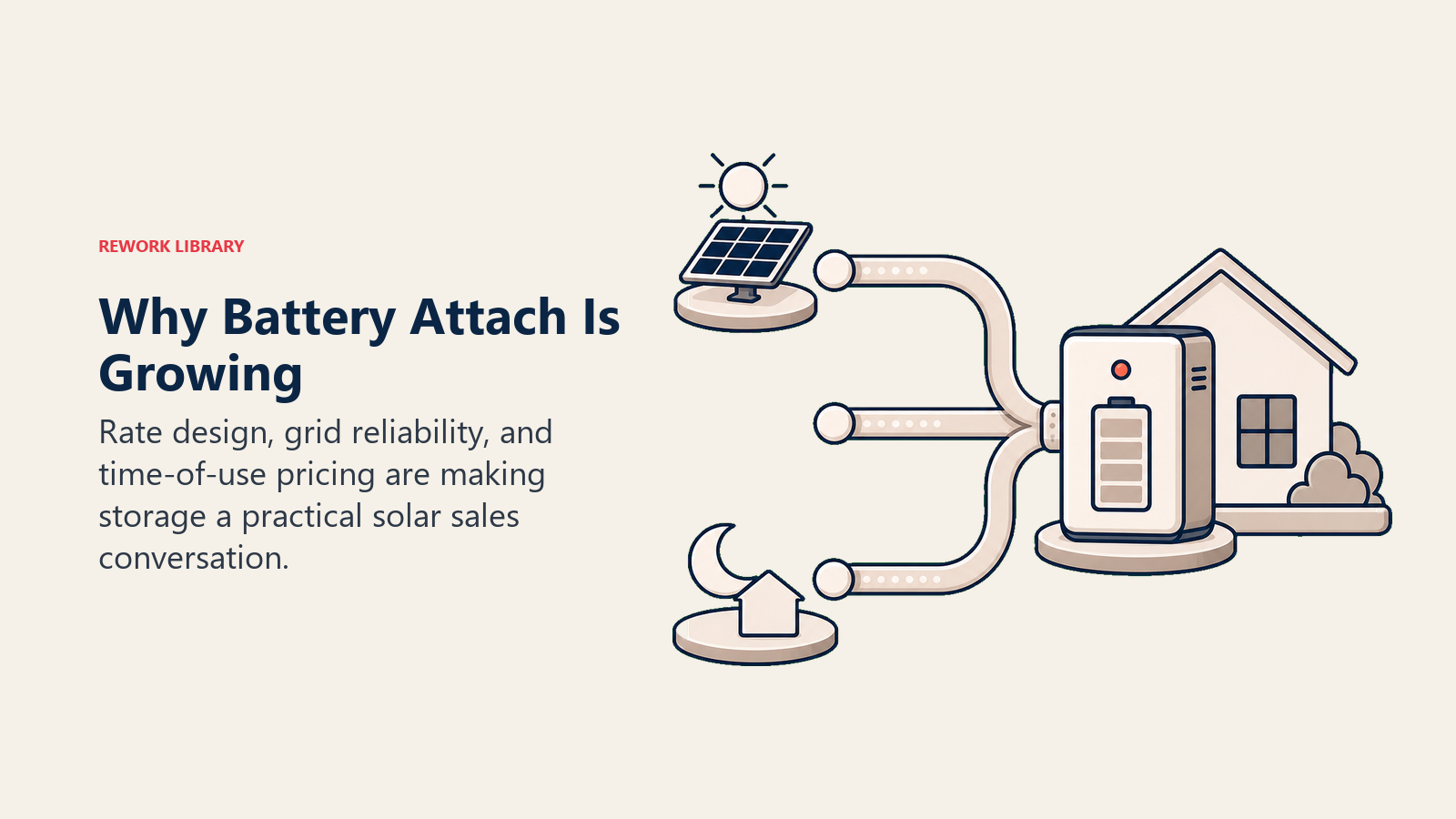
Rate design is pushing more value into self-consumption. As covered in selling solar around net metering and rate design, many utility territories have moved toward net billing structures where exported solar power is credited at a lower rate than retail. A battery lets the homeowner store excess daytime production and use it during expensive evening hours instead of exporting it for a smaller credit. That's a direct financial argument, not just a nice-to-have.
Grid reliability concerns are real and growing. Extreme weather events, utility-initiated public safety power shutoffs in wildfire-prone areas, and aging grid infrastructure have made backup power a mainstream concern rather than a fringe one. Homeowners increasingly ask about batteries unprompted.
Time-of-use rate structures reward load shifting. Where utilities charge more for electricity during peak evening hours, a battery charged by daytime solar and discharged during the peak window can meaningfully lower a homeowner's bill beyond what solar alone achieves.
Key Facts
- Battery attach has become one of the fastest-growing revenue segments in residential solar. Total US battery storage installations reached 18.9 GW in 2025, a 52 percent increase over 2024, per the ACP (American Clean Power Association) and Wood Mackenzie U.S. Energy Storage Monitor.
- Not every battery configuration provides whole-home backup; many are sized for critical circuits only, and setting this expectation clearly prevents post-install disputes and cancellations.
- The financial case for a battery is strongest for homeowners under time-of-use rates or reduced net-metering export credits, where storing solar power for later use captures more value than exporting it.
Who Actually Benefits From a Battery?
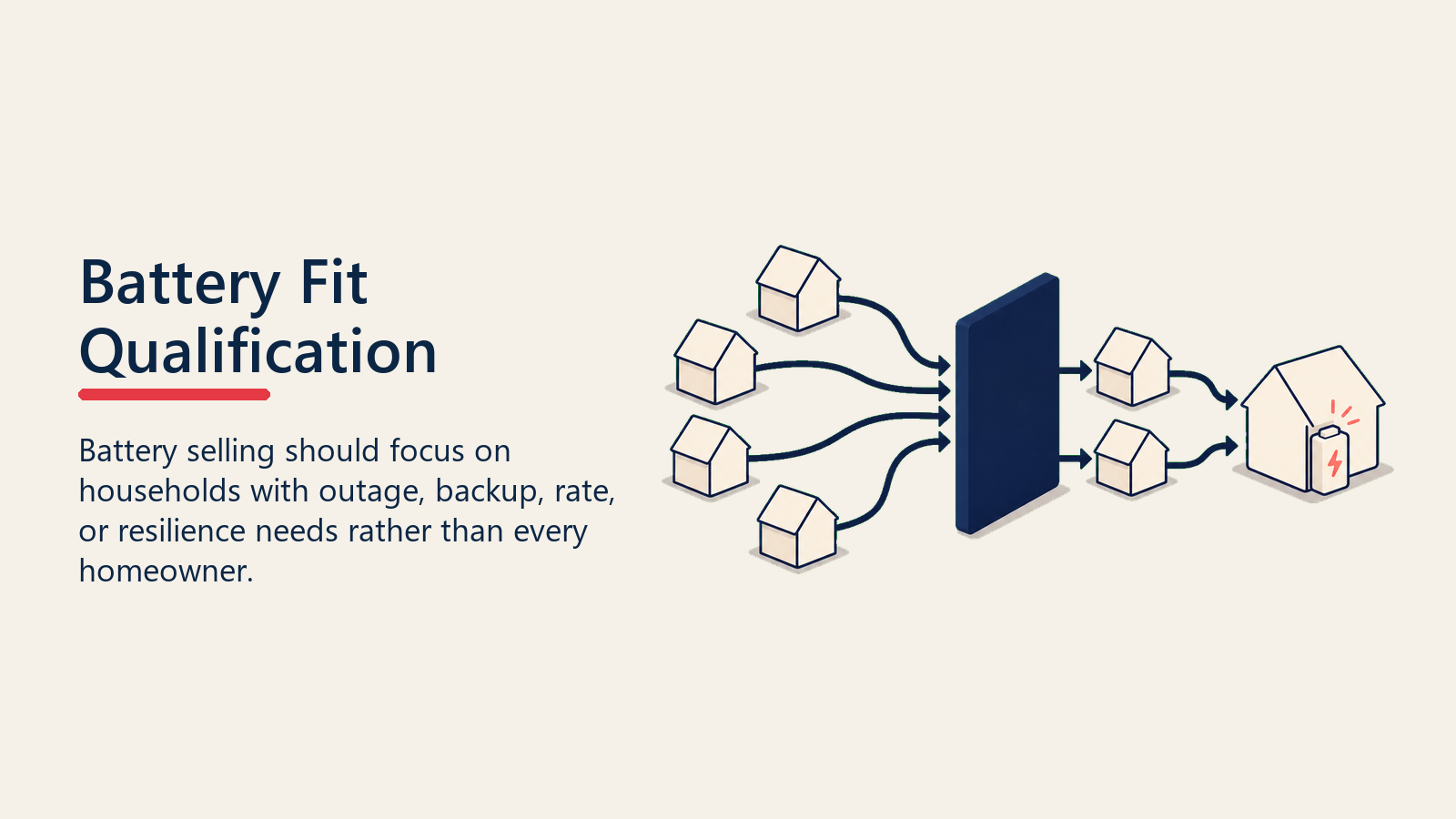
Not every homeowner needs a battery, and pitching one to everyone regardless of fit erodes trust and inflates prices unnecessarily. Use this as a rough qualification filter:
| Homeowner situation | Battery fit |
|---|---|
| Lives in an area with frequent outages or utility-initiated shutoffs | Strong fit; backup value alone often justifies it |
| On a time-of-use rate with a large peak/off-peak price gap | Strong fit; load-shifting savings can be substantial |
| Under a low export-credit net billing tariff | Good fit; captures value that would otherwise be lost to a low export rate |
| Has critical medical equipment or home office needs requiring reliable power | Strong fit; frame around resilience, not just savings |
| On a full retail net metering tariff with no time-of-use rate and rare outages | Weaker fit financially; still viable if the homeowner wants backup for its own sake |
| Very tight budget where the added system cost jeopardizes financing approval | Consider deferring the battery to a future add-on rather than risking the whole deal |
Being honest about weaker-fit cases builds more trust than pushing a battery onto every proposal. A homeowner who feels the storage recommendation was tailored to their actual situation is more likely to refer you than one who suspects it was a standard upsell script.
Teams that apply this filter consistently are running what we call the Fit-First Attach method: qualifying battery need through direct outage, rate-structure, and backup questions before a battery ever appears on a proposal, rather than defaulting storage into every quote and hoping the value story lands. The Fit-First Attach method trades a few lower-margin no-battery deals for materially higher trust and referral rates on the deals where storage genuinely belongs.
"A battery pitched to a homeowner on full retail net metering with no time-of-use rate and no history of outages is solving a problem that homeowner doesn't have, and proposals built that way tend to erode trust faster than they build attach revenue."
How to Introduce Storage in the Home Energy Needs Assessment
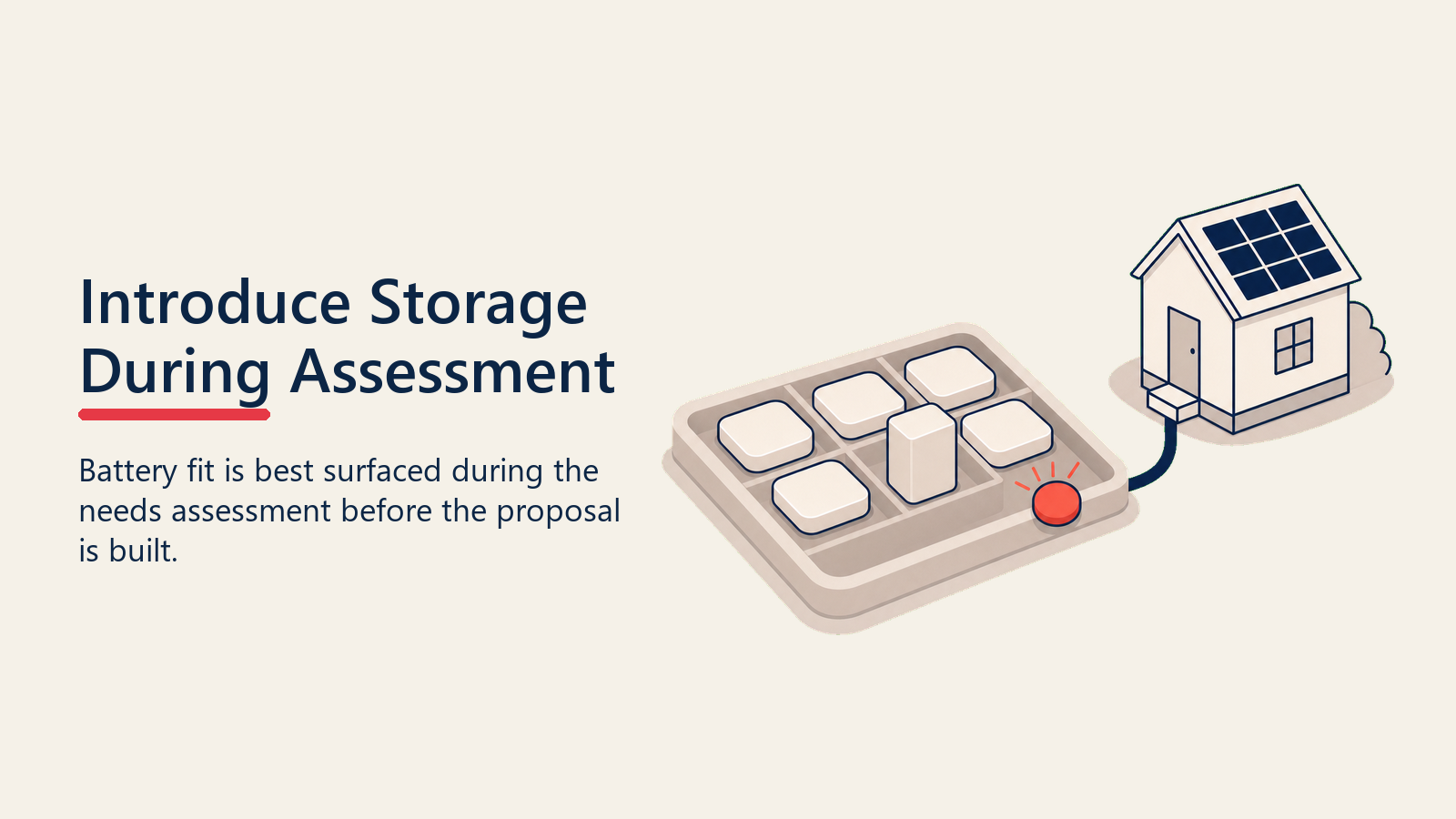
The best place to surface battery interest and fit is during the home energy needs assessment, before you've built the proposal. Ask directly:
- "Have you experienced power outages at this address in the past year or two? How often, and how long did they last?"
- "Does anyone in the home rely on powered medical equipment, work from home with equipment that needs to stay running, or have specific backup needs?"
- "Are you on a time-of-use rate plan with your utility, where electricity costs more at certain hours?"
- "How would you feel about your solar system continuing to power your home during a grid outage?"
These questions surface genuine motivation instead of guessing. A homeowner who's lived through three outages in the past year needs a very different pitch than one who's never lost power and is mostly focused on lowering their bill.
Structuring the Battery Pitch in the Proposal
Present storage as a distinct decision layered on top of the core solar decision, not bundled invisibly into one number. Homeowners should clearly understand what the system does with and without storage.
A clean structure:
- Present the solar-only system and its savings first. Let the core decision stand on its own.
- Introduce the battery as an answer to a specific need you identified in the assessment. Reference the actual conversation: "You mentioned you lost power for six hours during last winter's storm. Here's what a battery would have meant for your home during that outage."
- Show the incremental cost and incremental value separately. Don't obscure what the battery adds to total price. Homeowners who feel the number was hidden inside a bundle lose trust fast.
- Explain backup scope honestly. Not every battery configuration powers the whole home. Some are sized for critical circuits only, such as the refrigerator, a few outlets, and wifi, rather than full-home backup that includes HVAC (heating, ventilation, and air conditioning). Set this expectation clearly and in writing. A homeowner who assumes whole-home backup and discovers otherwise during their first outage will be furious and likely to leave a negative review.
- Tie savings math to their actual rate structure. Use their specific net metering, net billing, or time-of-use rate, not a generic assumption. See the rate-design guide above for how that math changes by tariff.
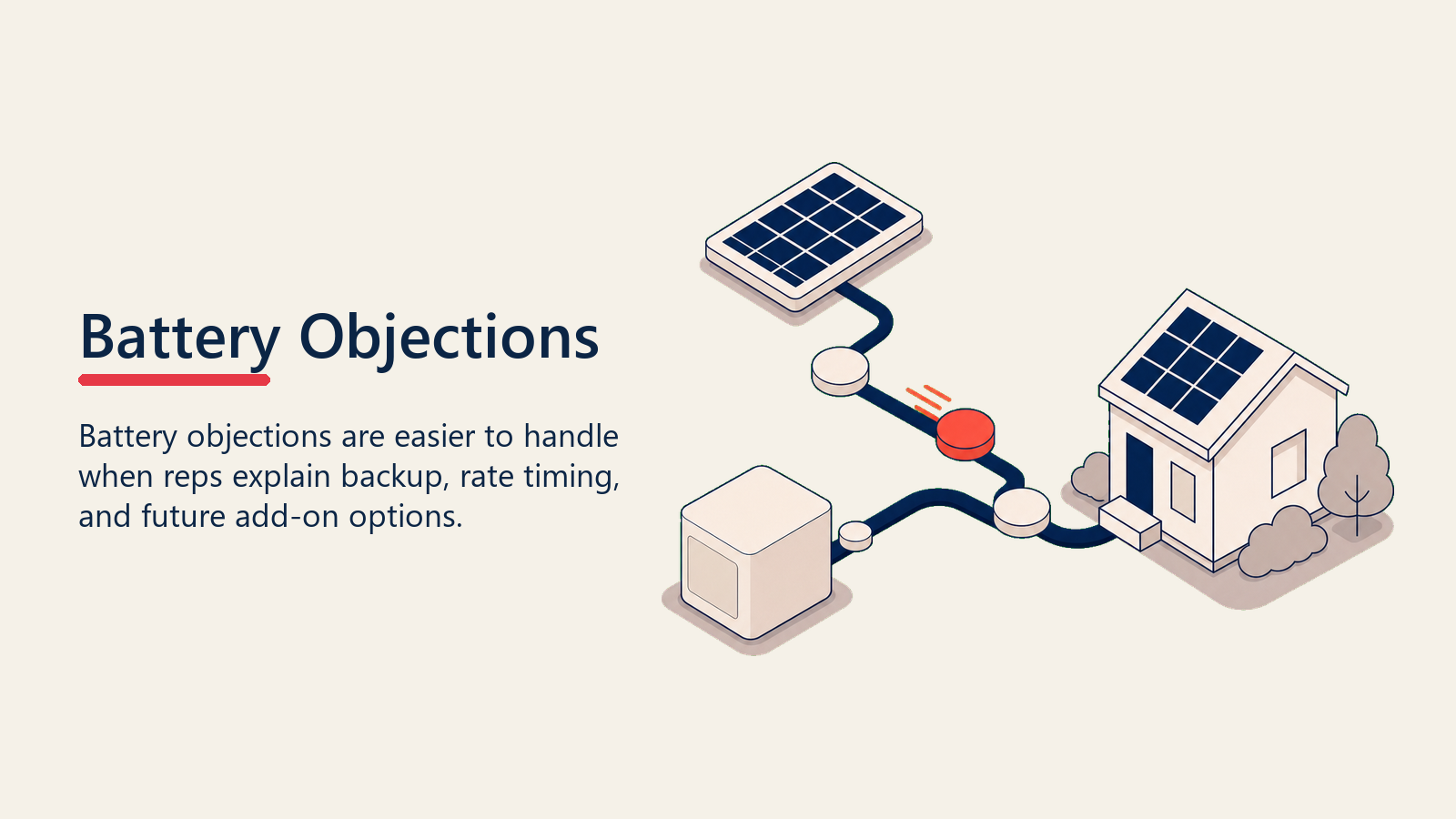
How Should Reps Handle Common Battery Objections?
"Solar already covers my bill, why do I need a battery too?"
Reframe around backup and rate optimization rather than pure bill reduction: "The solar system covers your daytime usage and offsets your bill. A battery adds two things solar alone doesn't: power during an outage, and the ability to use your own stored solar power during expensive evening hours instead of pulling from the grid." If their tariff has a meaningful peak/off-peak gap, show the specific number.
"It's too expensive to add right now."
This is a legitimate objection, not a stalling tactic, in many cases. Options: present the battery as a future add-on once the solar system is installed and paying down (most modern systems are designed to accept a battery retrofit), or show the specific backup and rate-optimization value in dollar terms so the homeowner can decide with real numbers instead of a vague sense that it's "extra."
"Will it power my whole house during an outage?"
Answer honestly based on the actual configuration being proposed. Whole-home backup typically requires a larger battery, sometimes multiple units, and may still shed high-draw loads like central air conditioning during extended outages. Critical-circuit backup covers a defined, smaller set of essentials. Never let a homeowner walk away from the appointment with an inflated assumption about backup scope.
"How long does the battery actually last during an outage?"
This depends on battery capacity, what's connected to it, and how much power those loads draw. Give a realistic range based on your specific product's specs and the homeowner's actual usage pattern, not a marketing best-case number. If your company has real customer outage data, use it. Real numbers beat manufacturer best-case claims for building trust.
Training Reps to Sell Storage Without Overselling It
The line between a well-qualified battery attach and a pushy upsell is thin, and it's a coaching problem more than a script problem. Build this into your team's development in a few specific ways:
Ride-alongs focused specifically on the assessment questions. Managers should listen for whether reps are actually asking about outages and usage patterns, or skipping straight to a generic battery pitch. See coaching and ride-alongs for how to structure this kind of targeted observation.
Compensation that doesn't over-reward battery attach regardless of fit. If commission structures create pressure to attach a battery to every deal, reps will do it even where it doesn't serve the homeowner. Review your solar commission and comp design to make sure incentives match good behavior, not just attach-rate volume.
Clear proposal templates that separate solar and storage line items. This is a solar CRM and proposal tools fix. If your software makes it easy to accidentally obscure the incremental battery cost inside a combined number, that's a trust risk waiting to surface at the kitchen table or, worse, after the contract is signed.
Qualifying Battery Fit Like Any Other Deal Qualifier
Treat battery fit as a real qualification criterion, not an afterthought. Applying solid opportunity qualification discipline here means asking the right questions early, documenting the actual need you uncovered, and building a proposal that matches what the homeowner told you rather than a standard package. Deals qualified this way close faster because the homeowner recognizes their own stated need reflected back in the numbers.
Frequently Asked Questions about Selling Battery Storage as an Attach
Is a home battery necessary with a solar system?
No, it's optional, and fit depends on the homeowner's situation. Homeowners in outage-prone areas, on time-of-use rates, or under reduced net-metering export credit tariffs tend to see the strongest case. Homeowners on favorable retail net metering with rare outages may not need one, though some still want the backup peace of mind.
Does a battery provide power to the whole house during an outage?
It depends on the system size and configuration. Some setups back up the whole home, though high-draw loads like central air conditioning may still be limited during extended outages. Other setups back up only critical circuits like refrigeration, some outlets, and wifi. This should be explained clearly and specifically before the homeowner signs.
How does a battery interact with net metering or net billing?
Where the export credit rate for solar sent back to the grid is lower than the retail rate for power pulled from the grid, storing excess solar in a battery for later use captures more value than exporting it. This makes batteries more financially attractive in net billing territories than in full retail net metering areas, though backup value is a separate consideration in either case.
How should reps qualify whether a homeowner needs a battery?
Ask direct questions during the needs assessment about outage history, medical or work-from-home power needs, and whether they're on a time-of-use rate. Build the pitch around what's actually uncovered rather than defaulting to the same battery pitch for every homeowner.
What's the biggest mistake reps make when selling battery storage?
Overpromising backup scope. A homeowner who assumes whole-home backup and discovers during an actual outage that only certain circuits are powered will be frustrated and likely to leave a negative review. Set backup scope expectations clearly, in writing, before the contract is signed.
Learn More

Senior Implementation Consultant
On this page
- Why Battery Attach Is Growing
- Key Facts
- Who Actually Benefits From a Battery?
- How to Introduce Storage in the Home Energy Needs Assessment
- Structuring the Battery Pitch in the Proposal
- How Should Reps Handle Common Battery Objections?
- Training Reps to Sell Storage Without Overselling It
- Qualifying Battery Fit Like Any Other Deal Qualifier
- Learn More