Referral Programs for Home Energy and Solar Companies
Turn this article into takeaways for your work.


Each assistant summarizes the article only for you and suggests best practices for your work.
Every homeowner who finishes a solar install knows at least a few neighbors, family members, or coworkers who could benefit from the same system. The problem is that most solar companies wait for those homeowners to spontaneously recommend them. That's not a referral program. It's wishful thinking.
A real referral program is structured. It has a defined moment of ask, a clear incentive, a follow-up system, and someone accountable for running it. Done right, referrals can generate 20-35% of a residential solar company's appointments at a fraction of the cost of digital leads, and they close at rates that make canvassing numbers look average.
This guide walks through building a referral engine that doesn't depend on hope.
Why Do Solar Referrals Convert Better Than Any Other Channel?
Think about what a referred lead already has when they walk in. They know someone who made the exact same purchase. They've probably seen the panels on a roof they drive past. They may have asked their friend or family member about their experience. And they've already self-selected as curious enough to say yes when offered a conversation.
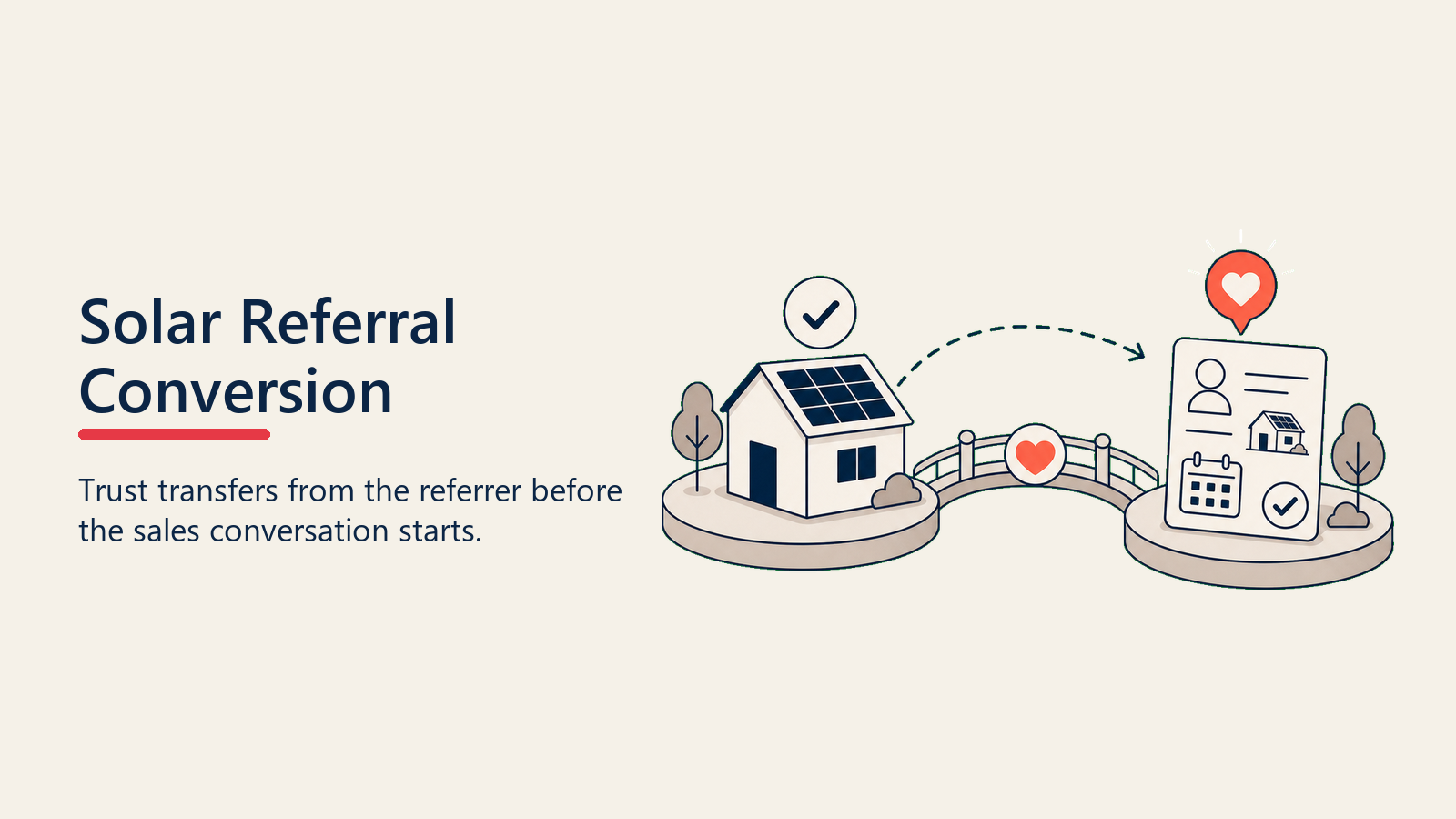
Compare that to a digital lead who clicked an ad, half-remembers filling out a form, and answers the phone suspicious of who's calling. The referred homeowner arrives at the appointment having already partially sold themselves.
Referred leads also tend to share characteristics with the referrer: similar income range, similar home type, similar neighborhood and utility territory. That makes qualification faster. And the referrer's social credibility is on the line, which means they only refer people who are genuinely likely to be interested.
In most solar markets, referral leads close at roughly 30% versus single-digit close rates for purchased digital leads, according to independent installer data tracked by Sunvoy. Their cost per acquisition is also dramatically lower since you're paying a flat incentive rather than bidding against competitors in a Google auction.
Key Facts: Solar Referral Programs
- One independent installer analysis found referral leads close at approximately 29%, compared to conversion rates of 2 to 5% for purchased digital leads. (Sunvoy solar lead source benchmarks)
- The US residential solar installed base surpassed 5 million homes as of mid-2024, giving installers a growing pool of satisfied customers who can fuel structured referral programs. (SEIA 5 Million Solar Installations)
- Wood Mackenzie found that residential solar customer acquisition costs hit a five-year low of $0.60 per watt in 2025, then surged 40% to an estimated $0.84 per watt in 2026 as the Section 25D federal credit expired, making lower-cost referral channels more valuable than ever. (Wood Mackenzie, 2026)
How do you build that structure? It starts with knowing when to ask.
The Three Referral Moments That Actually Work
Most referral requests fail because they happen at the wrong time. "Tell your friends about us!" at contract signing is too early. The homeowner hasn't experienced the product yet. A request six months post-install, buried in an automated email, is too late and too passive.
There are three windows where referral asks are most effective:
1. At the post-install onboarding call (Day 1-7 after go-live)
The homeowner just watched their system come online. They're excited. They may have already posted about it on social media. This is your highest-energy window.
During the onboarding call, after you've confirmed system performance and answered questions, you say: "Now that you're live, I want to make sure you know about our referral program. If you know anyone, a neighbor, family member, coworker, who's been complaining about their electric bill or curious about solar, we'll send you [incentive] once they install. All I need is their name and the best way to reach them. Anyone come to mind?"
That last question is critical. Don't just explain the program and wait. Ask directly. Silence is your friend here. Let them think.
2. At the six-month check-in
By six months, the homeowner has received real electric bills and seen the difference. They're believers. Another referral ask here, framed around their actual results ("You've saved about $X on electricity since go-live. Do you have anyone in mind who'd want that same result?"), connects the incentive to a concrete experience.
3. When they leave a review
Homeowners who write a positive Google or Yelp review are in a high-affinity state. They've just articulated why they're happy with you. Follow up immediately: "Thank you for the review, it really helps us. Quick question: do you have any neighbors or family who might want the same kind of experience? We'd love to give you [incentive] if they install."
See post-install onboarding and online reviews and reputation management for how to build these moments into a repeatable system.
The right incentive is what determines whether those three moments actually produce referrals.
Designing the Incentive: What Motivates Referrers
The incentive debate in solar referral programs usually circles around a few options: cash, bill credits, gift cards, or Amazon/Visa prepaid cards. Here's what the evidence from high-performing programs shows:
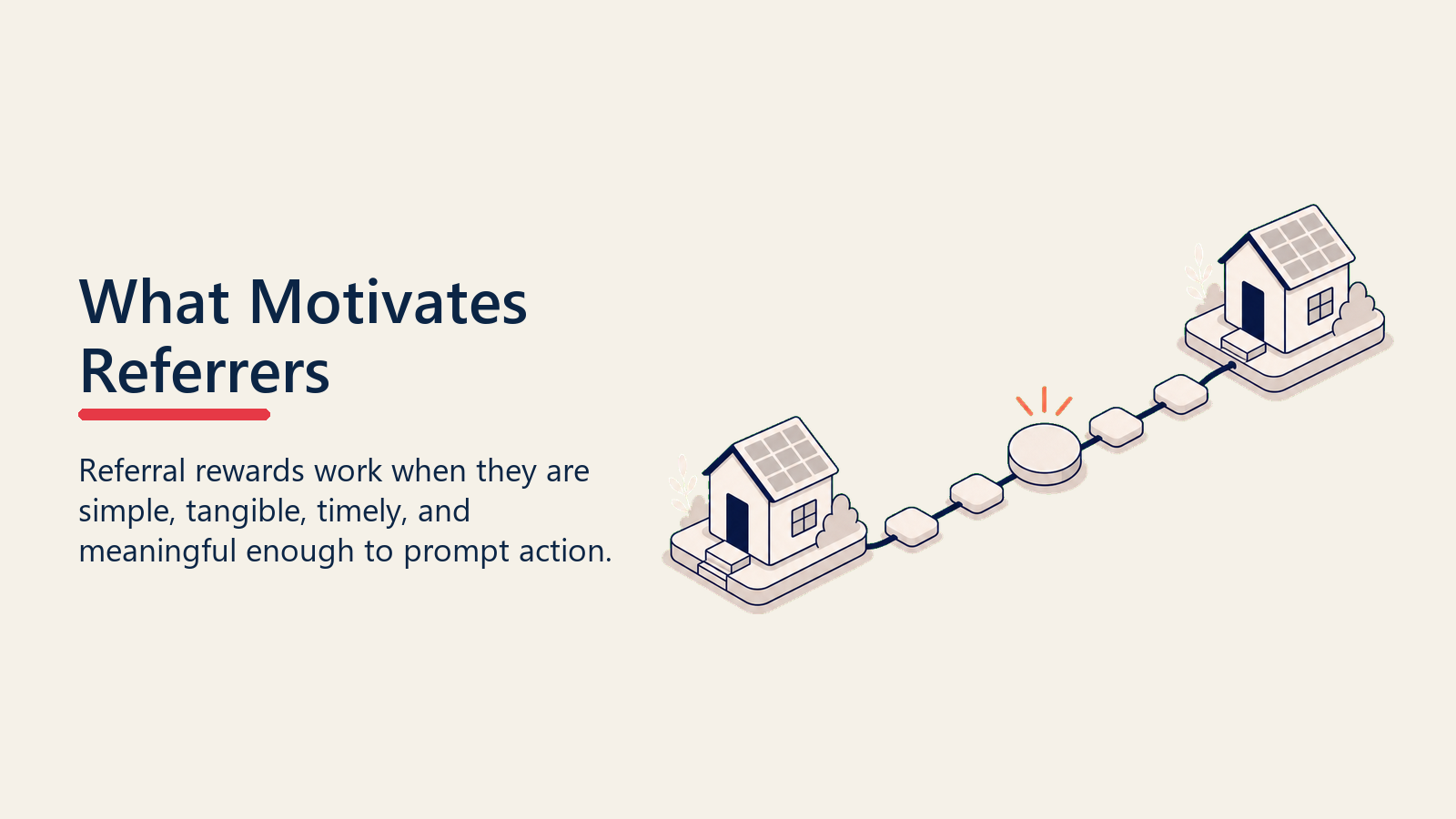
Cash or equivalent (Visa/Mastercard prepaid) is the most motivating incentive. It's simple and universally valued. The right amount varies by market but $200-$500 for the referrer at install is a common range for residential solar. Some companies split it ($150 at contract, $150 at install) to reduce risk.
Bill credits work for engaged customers but not universal ones. If the homeowner monitors their utility account closely, a bill credit is meaningful. If they don't, it feels abstract.
Higher incentives drive more referrals, with diminishing returns above a threshold. Going from $100 to $250 typically moves the needle. Going from $500 to $1,000 often doesn't. Test your market.
Dual-sided incentives (referrer and referred get something) increase conversion. If the referred homeowner knows they'll get a discount or a smaller incentive for taking the appointment, they're more likely to show up. "My friend sent me because I get $50 off my installation" is a stronger driver than altruism.
Speed of payment matters a lot. A referral incentive that takes four months to process does almost nothing for repeat referral behavior. Fast, clean payment execution is a program feature, not just a nice-to-have.
Referral Program Incentive Comparison
| Structure | Referrer Gets | Referred Homeowner Gets | Complexity | Effectiveness |
|---|---|---|---|---|
| Single-sided cash | $200-$500 at install | Nothing | Low | Good |
| Dual-sided cash | $200-$300 at install | $50-$100 off install | Medium | Better |
| Bill credit | Monthly bill reduction | Nothing | Low | Moderate |
| Tiered (volume rewards) | More for each additional referral | Nothing | High | Best for engaged customers |
| Gift card | $250 Visa prepaid | Nothing | Low | Good |
How Do You Build the Referral Ask Into Daily Operations?
A referral program only works if it's built into the workflow, not left to individual rep initiative. Here's a framework:
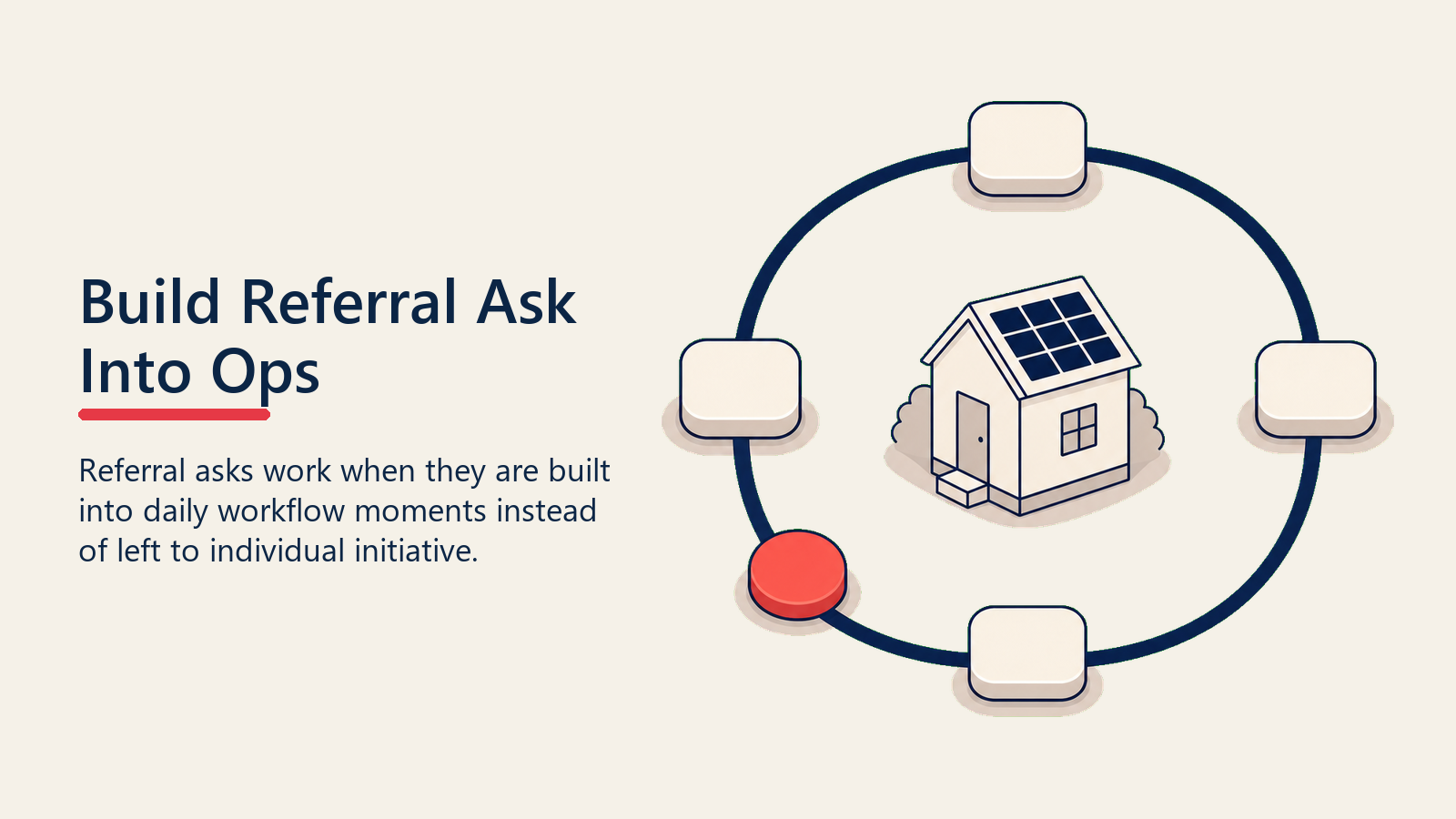
The Three-Touch Referral System: The three structured moments above (post-install call, six-month check-in, and review response) form a named cadence you can train on and track. Each touch has a specific script, a specific timing trigger, and a designated owner in your CRM. Companies that systematize all three touches consistently outperform those that rely on a single informal ask at contract signing.
Residential solar installers who activate a structured referral program report referral leads costing roughly $500 per customer versus overall industry customer acquisition averages of $2,000 to $4,000 per sale, according to NREL community research cited by Aurora Solar. That 4-to-8x cost difference compounds with every install in your base.
Step 1: Assign ownership. Who is responsible for the referral ask at each moment? Usually it's the customer success or install coordinator for the post-install ask, and either that person or an automated CRM trigger for the six-month check-in. Don't leave it to closers, who are focused on new prospects.
Step 2: Script the ask. Write the exact words. Role-play them. The referral ask should feel as natural as any part of the conversation, not like an awkward add-on at the end.
Step 3: Build the follow-up. When a homeowner says "I'll think of someone," log it in the CRM and set a follow-up for two weeks. When they provide a name, enter the referred lead immediately and trigger outreach within 24 hours.
Step 4: Track referral source. Every lead that comes in should be tagged with how it arrived. Referral leads tracked to their source let you calculate lifetime value per referrer, identify your best advocates, and build more targeted outreach to similar profiles.
Step 5: Close the loop with the referrer. When their referral converts, notify them immediately and process the incentive fast. A referrer who gets a prompt thank-you and a quick payment is far more likely to refer again than one who hears nothing for weeks.
What to Do With Customers Who Don't Refer
Not every homeowner will actively refer even if they're satisfied. Some people just aren't wired to refer, and chasing them burns relationship capital.
But there are customers who want to help but don't know how or forget to follow through. For them, make it easier:
Share a direct booking link they can text or email to a contact. "Here's a link you can send them. It books directly, and you get credit automatically." Friction is the enemy of referrals.
Give them something physical. Some programs still use referral cards that homeowners can hand to a neighbor. Old-fashioned, but it works in certain demographics, especially older homeowners.
Create a social moment. For homeowners who are comfortable on social media, give them something shareable: a before-and-after of their electric bill, a photo of their install (with permission), a short "I just went solar and saved X" template they can post. Referrals through social posts reach circles your setters would never canvass.
The Referral-to-Revenue Math
Let's make this concrete. Say you install 20 systems a month. If 25% of those customers actively refer at least one person, that's 5 referred leads per month. If referred leads close at 25% (versus 15% for digital leads), that's 1.25 additional sales per month from referrals.
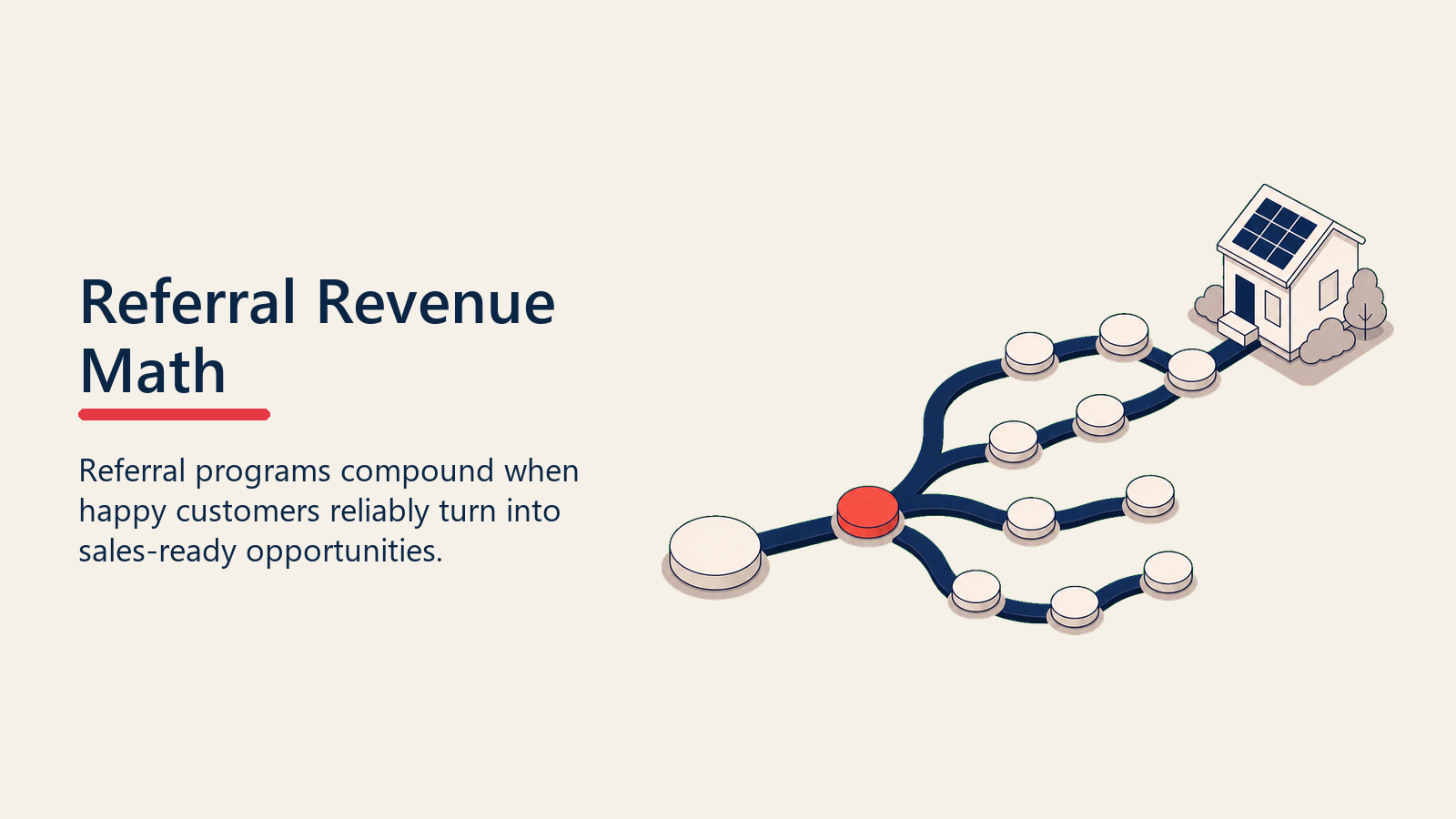
At an average contract value of $40,000, that's $50,000/month in incremental revenue from a program that costs you maybe $2,500 in incentives (5 converts x $500 each). The return is obvious.
Now scale that with a better program. Push referral rate to 40% and close rate to 30%, and you're looking at 2.4 additional sales/month, $96,000/month, for roughly the same incentive cost. This is why the best solar companies obsess over their referral program.
Track these referral metrics in your CRM and review them monthly:
- Referral rate: % of customers who refer at least one person
- Referral contact rate: % of referred leads reached within 48 hours
- Referred lead close rate: % of referred leads that become customers
- Revenue per referrer: Average contract revenue generated per customer who referred
For how referral-generated appointments connect to your overall lead flow and qualification process, see solar lead qualification and prescreening and lead nurturing programs.
Referral Programs for Commercial and Community Channels
Individual homeowner referrals are the most common structure, but they're not the only one. Two channels worth building in parallel:
Employee referral networks. Large employers in your territory may have hundreds of homeowners on staff. A lunch-and-learn at the right employer, combined with a group referral offer (employees who refer colleagues get the incentive; the employer gets recognition), can generate 10-15 leads in a single afternoon.
Contractor and realtor networks. Roofers, HVAC contractors, and realtors regularly interact with homeowners who are making large home decisions. A formal referral partner program with a per-sale incentive ($200-$500 per completed install) and a simple referral tracking link can turn these relationships into consistent lead sources.
HOA and neighborhood association partnerships. If an HOA allows a community solar presentation, you're talking to 30-50 homeowners at once, with implied endorsement from the association. This is one of the most efficient activities in certain suburban markets. See solar community event marketing for how to approach this channel.
Common Referral Program Mistakes
Paying too slowly. If the incentive takes 90+ days to process, homeowners stop referring after the first time. Build fast payment into your ops.
Only asking once. Referral ask should happen at the post-install moment, at six months, and at review time. Single-ask programs leave most of the value on the table.
Tracking referrals manually. When referral tracking is on a spreadsheet or in someone's head, referrers don't get credited, leads don't get followed up, and the program erodes. Build it into your CRM.
Making the referral process complicated. If a homeowner has to visit a portal, create an account, and fill out a form, most won't bother. The best referral systems take one text or one click.
Forgetting to close the loop. Referrers want to know what happened with the person they sent. Even a simple "your friend just signed their contract!" message keeps them engaged and makes them feel part of the company's success.
Done well, referrals are the lowest-cost, highest-quality lead source in residential solar. Companies that build referral programs into their operations from day one consistently outperform on cost per customer acquired and build a flywheel that gets stronger with every install. The flywheel depends on customers staying satisfied post-install: see retention fundamentals for how to keep the relationship strong enough that homeowners want to recommend you.
An NREL community adoption study found that 80% of residential solar customers made referrals to friends or neighbors after install, with a median of three referrals per adopter. A structured program captures that latent word-of-mouth before it evaporates.
Start with the post-install ask. Nail that moment first. Then build outward.

Senior Implementation Consultant
On this page
- Why Do Solar Referrals Convert Better Than Any Other Channel?
- The Three Referral Moments That Actually Work
- Designing the Incentive: What Motivates Referrers
- Referral Program Incentive Comparison
- How Do You Build the Referral Ask Into Daily Operations?
- What to Do With Customers Who Don't Refer
- The Referral-to-Revenue Math
- Referral Programs for Commercial and Community Channels
- Common Referral Program Mistakes