Selling Solar After the Federal Tax Credit
Turn this article into takeaways for your work.


Each assistant summarizes the article only for you and suggests best practices for your work.
For nearly two decades, the federal solar tax credit was the backbone of the in-home pitch. Reps built entire presentations around it. "30% off, act now" was the closing line in thousands of living rooms. That line no longer works. Reps who keep using it are creating a compliance problem and a trust problem at the same time.
The rule change is simple to state. If a homeowner buys a system with cash or a solar loan and it goes live in 2026 or later, there is no 30% federal credit. This guide is about how to sell in that reality, honestly and effectively, without leaning on an incentive that no longer exists for most of your buyers.
Under the One Big Beautiful Bill Act (OBBBA, a 2025 federal law formally known as Public Law 119-21), the Section 25D residential clean energy credit ended for owner-purchased solar systems placed in service after December 31, 2025.
What Changed Under the One Big Beautiful Bill Act?
Reps need one clean sentence they can say with total confidence in a homeowner's kitchen. Here it is: the 30% federal credit for people who buy and own their solar system ended for systems installed after December 31, 2025, under the One Big Beautiful Bill Act. The IRS (Internal Revenue Service) FAQ on OBBB energy credit changes is the primary source, and it's the one you should point homeowners to if they want to verify it themselves.
Here's what did and didn't change:
| Ownership structure | Federal credit status after Jan 1, 2026 |
|---|---|
| Cash purchase | Section 25D ended. No federal credit. |
| Solar loan (homeowner owns system) | Section 25D ended. No federal credit. |
| Lease (third party owns system) | Third-party owner may claim a separate commercial credit (Section 48E, the Clean Electricity Investment Credit), not passed to homeowner as a tax credit, but may be reflected in lower lease pricing |
| PPA (third party owns system) | Same as lease: commercial credit may apply to the owner, not the homeowner directly |
| System installed and placed in service before Dec 31, 2025 | Still eligible for the credit that was in effect at the time, subject to normal IRS filing rules |
Two mistakes will get your sales team in trouble here. First, don't tell a homeowner "you get 30% off" when they're buying a system that goes live in 2026, because they don't. Second, don't tell homeowners the credit doesn't exist anymore at all. Commercial-owned structures like leases and PPAs still have a credit path that indirectly affects your third-party financing pricing. The nuance matters, and homeowners can tell when a rep is guessing.
Key Facts
- The Section 25D residential clean energy credit (30%) ended for owner-purchased solar systems placed in service after December 31, 2025, under the One Big Beautiful Bill Act (Public Law 119-21). Source: IRS FAQ on OBBB energy credit changes.
- Third-party-owned systems (leases, PPAs) may still access a separate commercial credit path under Section 48E, which is distinct from the homeowner claiming a personal tax credit.
- Average US residential electricity rates rose from 16.00 cents per kWh in 2023 to 16.48 cents per kWh in 2024. Source: EIA Electric Power Monthly.
Why This Is a Bigger Deal Than It Looks Like on Paper
A 30% credit on a $35,000 system is $10,500. That's not a rounding error in a sales conversation, it's often the difference between a "yes" and a "let me think about it." Losing that lever changes three things at once:
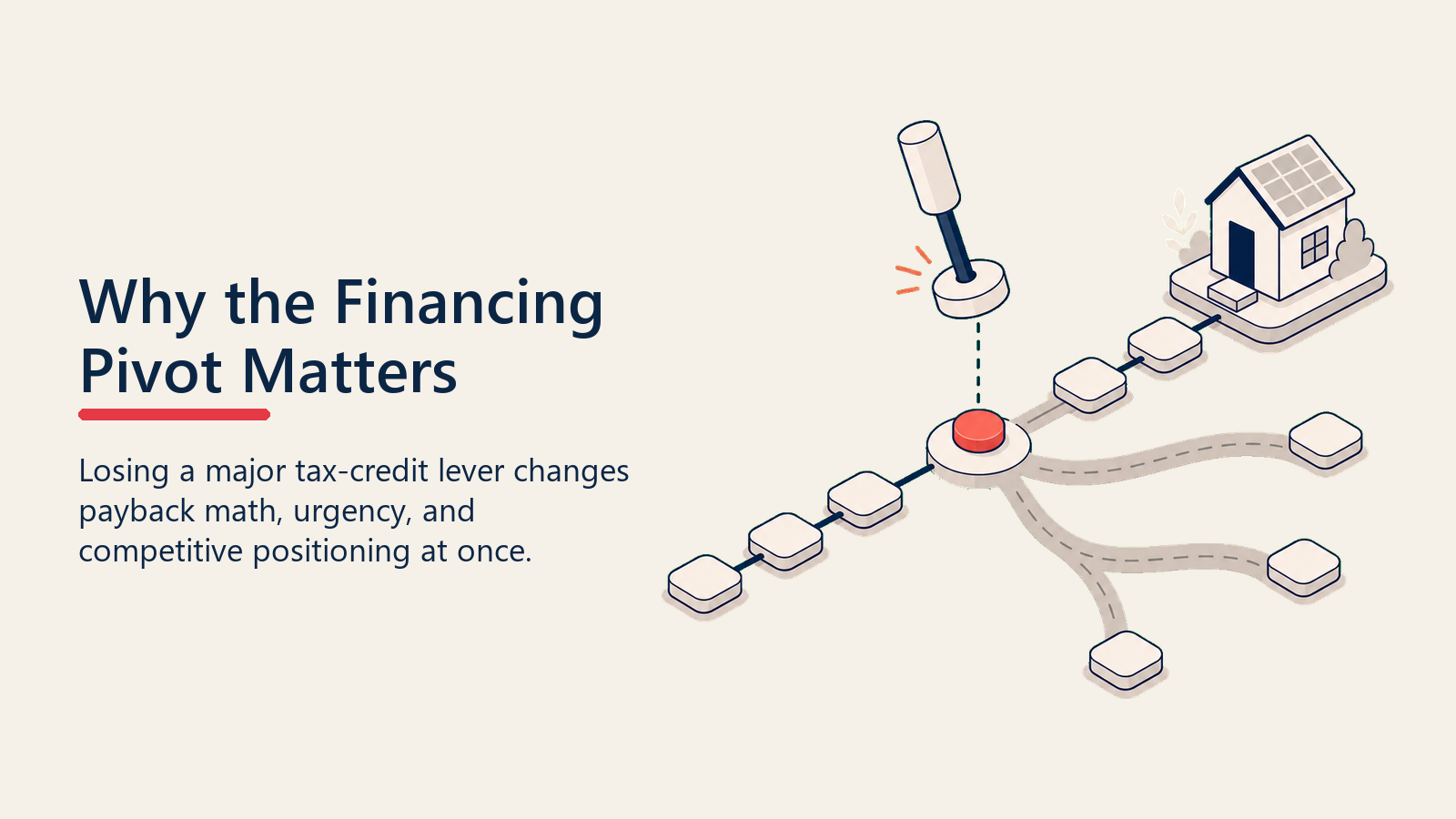
- The math changes. Payback periods get longer. A system that used to pay for itself in 7 years might now take 9-10, depending on financing terms and local rates.
- The urgency story changes. "Lock in the credit before it expires" was a legitimate, honest urgency driver for years. It's gone for owner-purchased systems. You need a new, equally honest urgency driver, or none at all.
- The competitive field changes. Every solar company in your market lost the same lever at the same time. This is not a competitive disadvantage unique to you. Reframe it that way internally and to homeowners.
See urgency and same-day close ethics for the fuller framework on building real urgency without fabricating it. That guide matters more now than it did a year ago.
The New Pitch: Bill Math, Not Tax Math
The strongest post-ITC pitch goes back to fundamentals: what does the homeowner pay now, and what would they pay with solar. That comparison was always the real driver of solar adoption. The tax credit was a bonus on top of it, not the reason solar made sense.
Build the pitch in this order:
- Anchor to the current bill, not the system price. Pull their last 12 months of utility bills or use your utility data tool. Show the annual total, not just one month.
- Show utility rate trend, not just current rate. The EIA Electric Power Monthly tracks average US residential electricity prices, which rose from 16.00 cents per kWh in 2023 to 16.48 cents per kWh in 2024. That's a real, citable trend line, not a sales talking point you invented.
- Present system cost and financing without the credit baked in. Never show a "price after incentive" number for an owner-purchased system installed in 2026 or later. Show the real price, then show the payment.
- Do the payment-to-bill swap. If the loan payment is close to or below their current bill, the math works without any credit involved. If it's meaningfully higher, be honest about that instead of hiding it.
- If leases or PPAs are part of your offering, explain the difference clearly. Since a third-party owner may still access a commercial credit path, your lease or PPA pricing might reflect that benefit passed through as a lower rate. Say so specifically. Don't say "you still get the tax credit" when you mean "our pricing reflects a credit the leasing company may claim."
How Do You Handle "But My Neighbor Got 30% Off"?
This objection is going to come up constantly for the next few years, especially in areas with high solar penetration where neighbors compare notes.
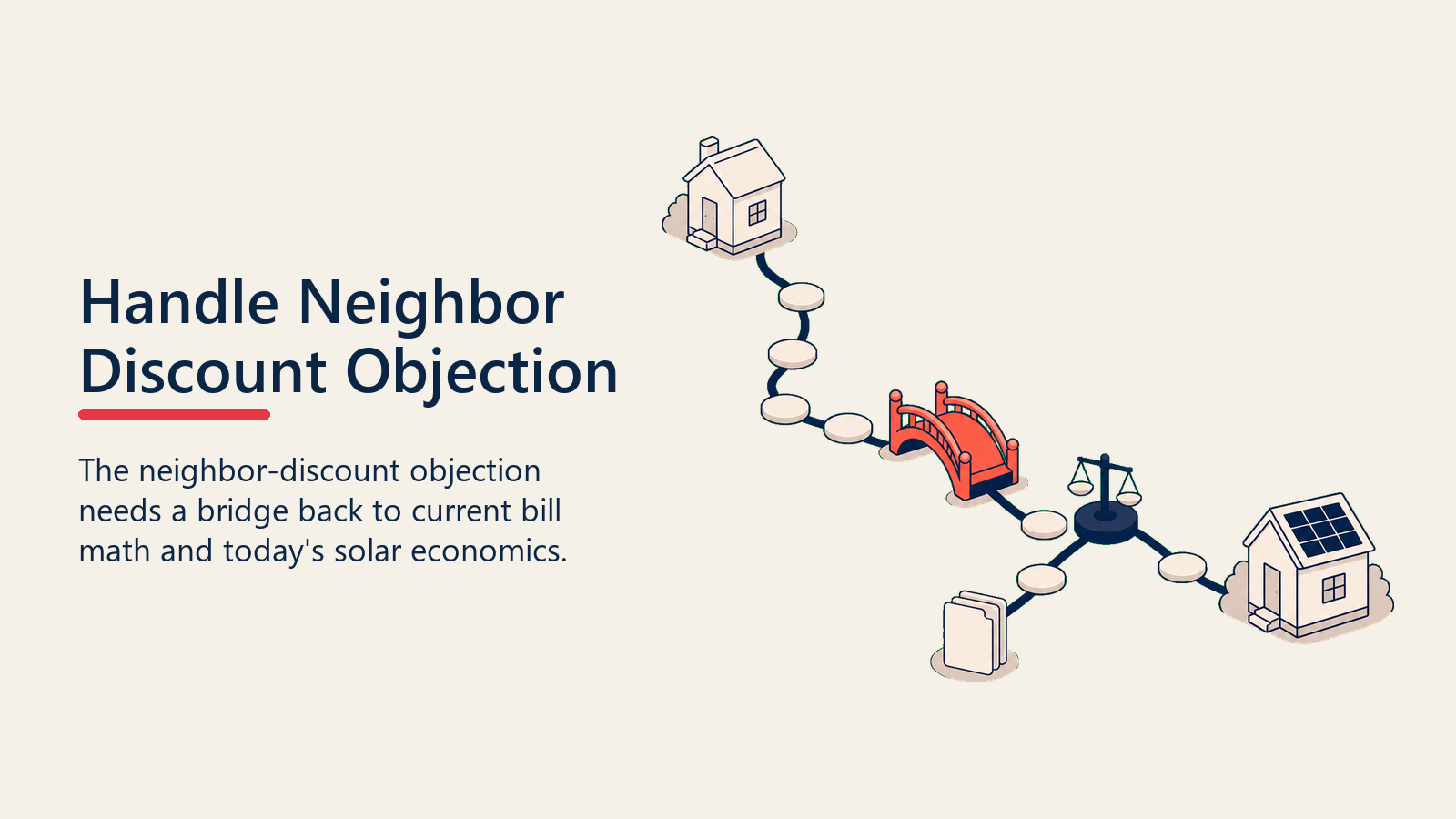
Reps who handle this well tend to lean on what we call the Bill Math Bridge: a two-step response pattern that first validates the neighbor's experience as real and legitimate, then redirects the conversation to the homeowner's own current numbers before the objection can turn into a stalling point. The bridge works because it never disputes the neighbor's story, it just moves the frame from "what they got" to "what this home's bill actually looks like now."
What's happening: The neighbor installed before December 31, 2025, and legitimately claimed the credit under the rules that applied then.
What to say: "That's right, and it's a great deal they got in under the wire. The rules changed at the start of this year under the One Big Beautiful Bill Act, so anyone installing now doesn't have that credit available for an owned system. Let's look at what makes sense for your home under the current numbers, because the bill savings are still real even without it."
Don't get defensive. Don't imply the neighbor lied or misunderstood something. The rule change is real, recent, and confusing for the public. Homeowners deserve a straight answer, and a straight answer builds more trust than a dodge.
"A 30% credit on a $35,000 system equals $10,500 in lost purchasing power for every owner-purchased deal signed after December 31, 2025, which is why financing terms now carry more of the persuasive weight in the sales conversation than they did a year ago."
Financing Structure Now Matters More, Not Less
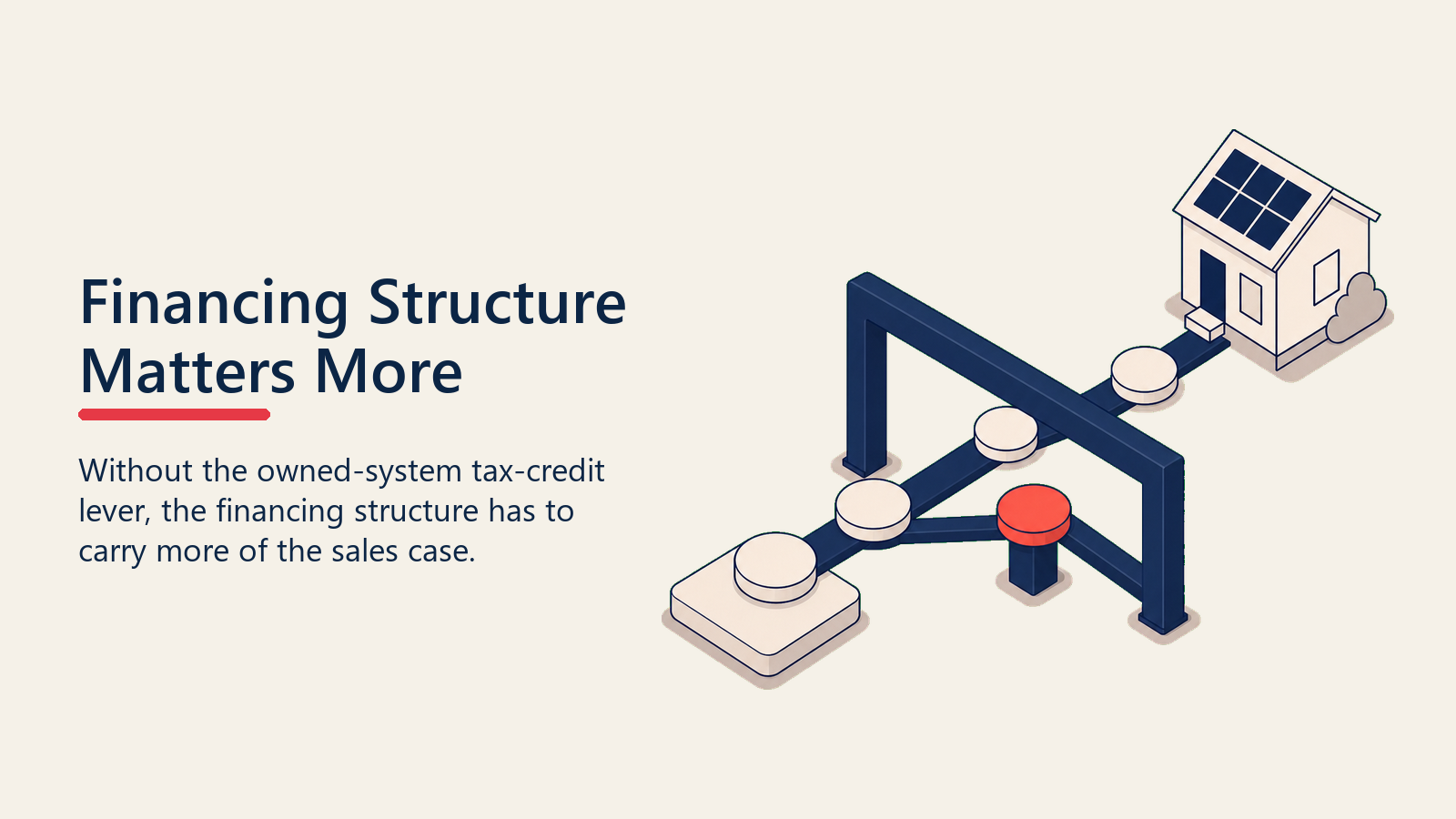
With the tax-credit lever gone for owned systems, financing structure carries more of the sales weight than it used to. This is a good moment to revisit solar financing models and the sales conversation in detail, because the choice between loan, lease, and PPA now has a bigger swing on the homeowner's total cost picture than it did when a credit was smoothing over the differences.
A few practical shifts to make:
- Push harder on rate shopping across lenders. A 1-point difference in loan APR matters more when there's no credit cushioning the total cost. The CFPB (Consumer Financial Protection Bureau), in its solar financing spotlight, found that hidden dealer fees baked into loan principals typically run 10 to 30 percent above the cash price, and can exceed 50 percent in some cases. A rep who can't clearly separate cash price from loan principal is walking a homeowner into exactly the confusion regulators have flagged.
"Hidden dealer fees baked into solar loan principals typically add 10 to 30 percent above the actual cash price of the system, and in some cases exceed 50 percent, according to the CFPB."
- Re-run every proposal without any assumed credit for owned systems. If your proposal software still has a legacy 30% line item defaulting in for 2026+ install dates, that's a compliance risk. Flag it to your ops team immediately.
- Present leases and PPAs as a legitimate first option, not a fallback. For homeowners who don't have strong tax liability or who want the lowest possible complexity, third-party ownership might now be the stronger pitch than it was when ownership came with a 30% credit attached.
What Not to Say Anymore
Some habits die hard on a sales floor. Retire these lines completely, and coach out any rep still using them:
| Old line | Why it's wrong now | Replacement |
|---|---|---|
| "You get 30% off with the federal tax credit" | False for owner-purchased systems installed in 2026+ | "The federal credit for owned systems ended January 1, 2026. Let's look at what the numbers look like without it." |
| "The credit is going away, sign today" | The credit is already gone for owned systems this isn't a future deadline | "The credit already ended for owned systems. There's no artificial deadline here, so let's take the time to get your numbers right." |
| "Everyone still gets the tax credit somehow" | Vague and inaccurate; conflates commercial credit paths with a homeowner benefit | "If you go with a lease or PPA, our pricing may reflect a credit the ownership company can claim. If you buy the system outright, that credit isn't part of the math anymore." |
Rebuilding Your Proposal Templates and Talk Tracks
This is a training and systems problem as much as a sales-skill problem. Concrete steps for sales leaders:
Audit every proposal template for outdated ITC math. Check your solar CRM and proposal tools for any hardcoded 30% credit assumption on owner-purchased quotes. This is the single highest-priority fix, because a wrong number on a printed proposal is a legal and trust problem, not just a sales miss.
Rewrite your objection-handling scripts. Your solar objection handling playbook likely has tax-credit references baked into several scripts. Update them before your next training session, not after a rep gets caught flat-footed in a home.
Retrain on the new numbers, not just the new rule. Reps need to internalize what a 9-10 year payback looks like and how to present it confidently, not just memorize the legal change. Run this through coaching and ride-alongs so managers can hear reps handle the pivot live before it happens in front of a real homeowner.
Build a one-page reference card. Every rep should carry a single card, on paper or on a phone, with the accurate cutoff date, the IRS source link, and the three or four approved talk tracks for common objections. Guessing in the moment is where compliance risk comes from.
Where This Leaves Qualification and Lead Quality
Since the math changed, your solar lead qualification and pre-screening process should change too. A homeowner motivated primarily by "free tax money" and light on genuine bill pain is a weaker lead now than in prior years. Setters should be listening for and prioritizing homeowners with real bill frustration, upcoming rate hikes in their utility territory, or genuine interest in ownership and energy independence, since those motivations hold up without a credit attached.
This connects directly to how you present price and financing in the home. If the lead came in expecting a 30% discount that no longer applies, the setter or the closer needs to correct that expectation before the appointment, not during it. A homeowner who feels misled about the credit at the door is a homeowner who won't sign, no matter how good the rest of the pitch is.
Using Value Selling to Fill the Gap
With a hard financial lever gone, the rep's ability to connect the sale to what the homeowner actually cares about matters more. Value-selling frameworks exist for exactly this moment: when the product's price point doesn't have an external subsidy doing half the selling work, the rep has to surface and connect to the homeowner's real motivations, whether that's energy independence, environmental values, resale value, or simply being done with a rising utility bill. Reps who lean into that skill will outperform reps who are still trying to find a substitute for the old tax-credit pitch.
Learn More

Senior Implementation Consultant
On this page
- What Changed Under the One Big Beautiful Bill Act?
- Key Facts
- Why This Is a Bigger Deal Than It Looks Like on Paper
- The New Pitch: Bill Math, Not Tax Math
- How Do You Handle "But My Neighbor Got 30% Off"?
- Financing Structure Now Matters More, Not Less
- What Not to Say Anymore
- Rebuilding Your Proposal Templates and Talk Tracks
- Where This Leaves Qualification and Lead Quality
- Using Value Selling to Fill the Gap
- Learn More