Confirming and Prepping the In-Home Solar Appointment
Turn this article into takeaways for your work.


Each assistant summarizes the article only for you and suggests best practices for your work.
Most solar companies treat appointment confirmation as an administrative task. Send a text, log it, move on. But the best in-home sales teams know that what happens between the booking call and the knock on the door shapes the outcome of the appointment itself.
Confirmation and preparation aren't paperwork. They're the first phase of the close.
A homeowner who walks into their own living room already understanding what the visit is for, already trusting the company, and already primed to evaluate a real proposal is a fundamentally different conversation than one who forgot why they agreed to the appointment and thinks this is probably a timeshare pitch. The EIA's 2024 data shows the average US residential electricity bill hit $144 per month with rates continuing to climb, which gives your closer real, timely context to work with when a well-prepped homeowner has their utility bill ready at the kitchen table.
This article breaks down both sides of the pre-appointment process: what the setter does to prep the homeowner, and what the closer does to prep themselves.
The Two Prep Jobs
Key Facts:
- The average US residential electricity bill was $144/month in 2024, per EIA's Electric Sales, Revenue, and Average Price data; a well-prepped homeowner who arrives with their utility bill ready will see a closer able to do real math, not estimates
- Referral appointments close at a 29% net rate vs. roughly 15% overall for purchased leads, per Sunvoy's solar lead data; the pre-appointment communication that makes a homeowner feel personally attended to mimics the trust dynamic that makes referrals convert
- The Section 25D federal residential solar tax credit was terminated for systems installed after December 31, 2025, per IRS guidance on the One Big Beautiful Bill; closers prepping materials in 2026 must have current, accurate incentive information ready
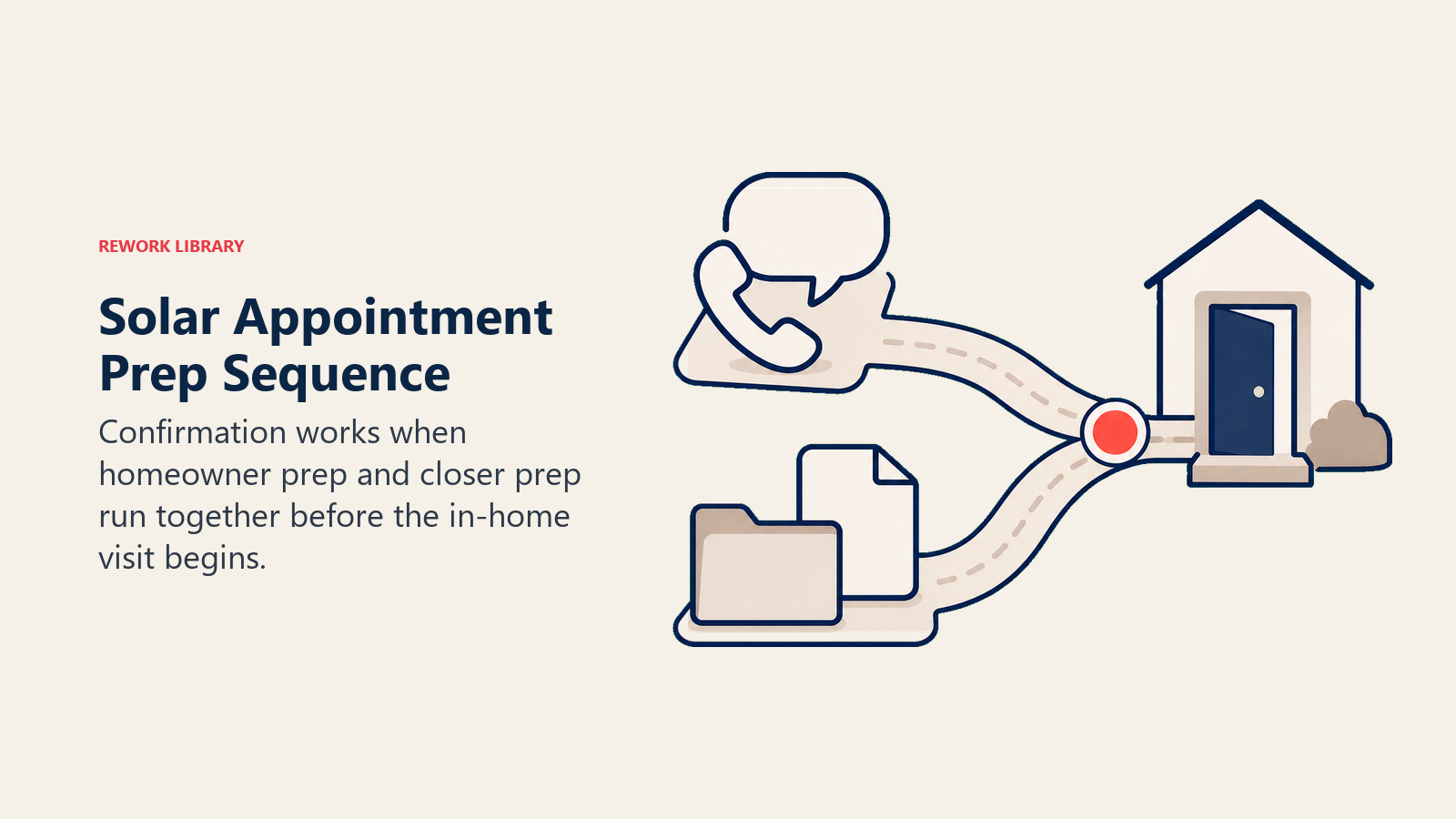
Pre-appointment work has two tracks running in parallel.
The homeowner-facing track is about managing their expectations, building their confidence in the company, and making sure they're ready for a productive conversation. If you do this well, the closer walks in to a homeowner who is engaged, curious, and not defensive.
The closer-facing track is about making sure the closer arrives knowing who they're meeting, what motivated the homeowner to agree, what concerns may come up, and what the practical situation at the property looks like. This comes from the setter's notes, the CRM handoff, and the closer's own pre-appointment review.
These two tracks run separately but they reinforce each other. When the closer is well-prepared and the homeowner is well-prepped, the appointment starts on firm ground. For more on how these tracks connect, see Setter to Closer Handoff.
The Homeowner Prep Sequence
The goal of homeowner prep is to answer the question in the homeowner's head before the closer even arrives: "Why should I spend 60-90 minutes on this?"
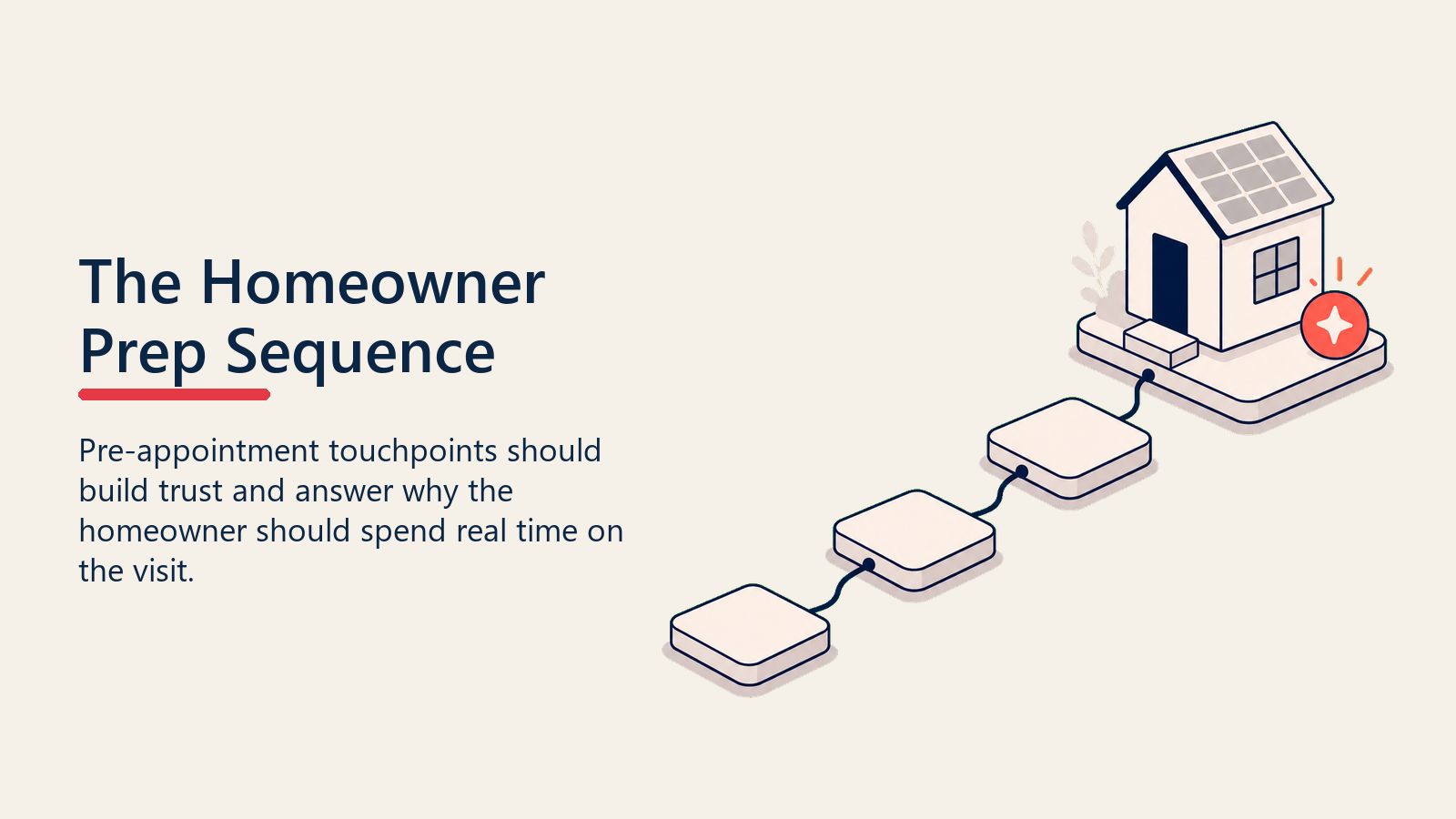
That question doesn't get answered in one confirmation text. It gets answered through a sequence of touchpoints that build anticipation and trust.
Immediately after booking: The setter sends a confirmation that includes the closer's name, the appointment time, and a plain-English description of what will happen. Not "a sales rep will visit." Something like:
"You're confirmed for [day] at [time]. [Closer's name] is a home energy specialist who's going to walk through your home's energy use, check your roof situation, and put together a custom proposal based on your actual setup. The whole thing takes about 60-90 minutes. If you have a recent utility bill, it's helpful to have it handy, but not required."
That message does several things at once. It names the person coming. It frames the visit as useful, not as a pitch. And it gives the homeowner something to do (find the bill) that increases their investment in the appointment.
24-48 hours before: A personal follow-up from the setter, ideally by call or voice note. "Hey [name], it's [setter], just confirming we're still on for [day]. [Closer's name] is looking forward to meeting you. Anything come up I should know about?" This re-establishes the human relationship and opens a channel for the homeowner to raise concerns or ask for a reschedule before the day of.
Morning of: A short text that tells the homeowner the closer's ETA window and invites a response if anything has changed. "Hey, it's [setter] again. [Closer's name] will be there between [time range]. Does that still work?" The question format is intentional. It creates a moment for the homeowner to confirm or reschedule proactively, which protects the closer's time.
Closer's own intro (optional, high value): For closers who can add this without overwhelming the homeowner, a brief text sent the morning of the appointment from their own number: "Hey [name], it's [closer's name]. Looking forward to talking through your energy options today. I'll be there around [time]." Homeowners who have heard from the closer directly before the visit are more likely to be home and engaged when the closer arrives.
For no-show reduction tactics that work alongside this sequence, see No-Show and Reschedule Reduction.
What to Tell Homeowners Before the Visit
One of the highest-impact pre-appointment moves is setting accurate expectations about what the visit will and won't be. Many homeowners who cancel or mentally check out before the closer arrives are responding to a fear that the appointment will be a hard-sell session. Address it directly.
Include something like this in the pre-appointment communication: "There's no pressure and no obligation. [Closer's name] is there to give you real information about what solar would look like for your specific home. You'll get to see actual numbers before you decide anything."
This sounds like you're giving something away. You're not. A homeowner who arrives at the appointment relaxed and curious is far easier to close than one who's defensive. Closing in solar is about building enough trust and presenting enough value that the decision feels obvious, not about overpowering objections. Setting low-pressure expectations upfront creates the conditions for that.
What to Ask Homeowners Before the Visit
Beyond expectations, there are a few things worth capturing or confirming with the homeowner before the closer arrives.
Will all decision-makers be present? This is the single biggest predictor of appointment strength. If one spouse or partner agreed to the appointment and the other doesn't know about it, you're walking into a structurally weak situation. Ask directly: "Will [partner's name] be home for the appointment too?" If the answer is no, that's worth knowing now rather than 45 minutes into a pitch.
Do they have a utility bill available? Having a recent bill on hand lets the closer do real math during the visit instead of using estimates. It makes the proposal more concrete and the numbers more real. Most homeowners can pull one up on their phone or find a paper copy. Asking them to do this before the visit increases their engagement with the appointment itself.
Any questions or concerns before [closer's name] arrives? This opens the floor for objections to surface before the appointment rather than during it. A homeowner who voices a concern in a pre-appointment text is giving you a chance to address it, which is better than hearing it cold at the kitchen table.
The Closer's Pre-Appointment Review
While the setter is running the homeowner prep sequence, the closer's job is to review everything captured about this homeowner before leaving for the appointment.
This review should happen before driving to the address, not in the driveway. By the time the closer pulls up, they should know:
| Item | Why it matters |
|---|---|
| Homeowner name(s) and relationship | So the closer can address them correctly from the door |
| What motivated the appointment | The opening of the pitch connects to this |
| Estimated utility bill / current spend | For early value anchoring |
| Objections raised during set | For prep, not avoidance |
| Decision-maker situation | Who's present and who has final say |
| Roof and property notes | So the closer isn't surprised by what they see |
| Setter confidence rating | Hot, warm, or soft |
If any of these fields are blank in the CRM, the closer should call or message the setter for a quick verbal briefing before heading out. A five-minute call is always worth it.
For the CRM fields and handoff protocols that feed this review, see Setter to Closer Handoff and Solar CRM and Proposal Tools.
Reviewing the Property Before You Knock
For closers who can spend 60 seconds doing a quick property review before walking to the door, it's worth doing. Using satellite or map imagery, check the rough roof orientation, shading from trees, and visible roof area. This isn't for the proposal, which will come from the site survey. It's so the closer can make an informed comment early in the visit that signals competence.
Something like: "I was looking at your address before I came out, and your south-facing roof looks like a great setup for this." That kind of comment, grounded in actual observation, lands very differently than a generic opener. It signals that this closer has done homework.
Preparing Materials Before the Appointment
The closer should arrive with everything needed to run the full consultation and, if the homeowner is ready, to close.
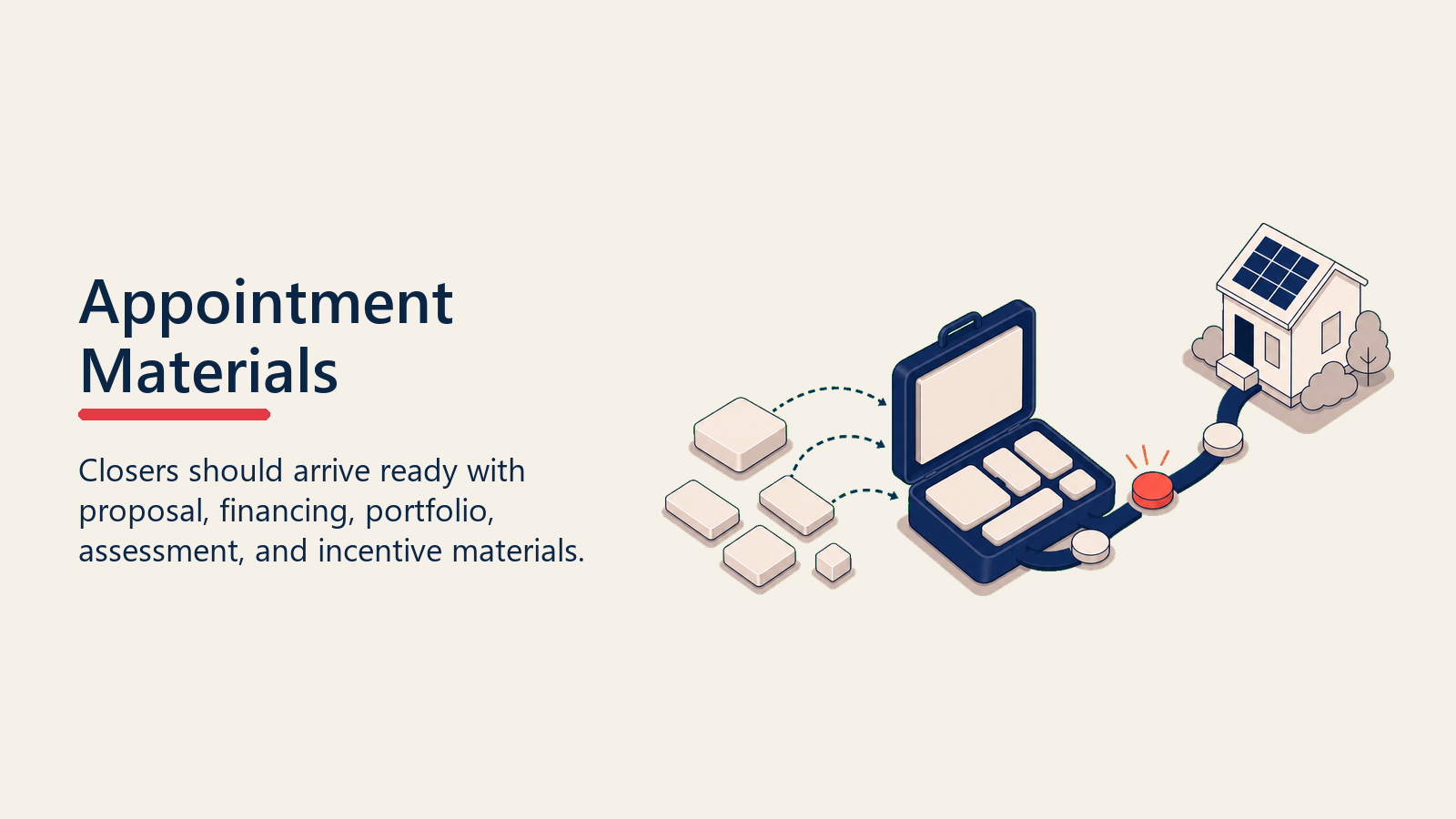
Standard materials checklist:
- Proposal tool (tablet or laptop, fully charged)
- Financing options loaded and ready to run estimates
- Company portfolio or sample installs (photos, testimonials)
- Site assessment worksheet or intake form
- Current incentive information: the federal Section 25D Residential Clean Energy Credit applied 30% to systems with installation completed by December 31, 2025; it has been terminated by the One Big Beautiful Bill (Public Law 119-21) for owner-purchased systems installed after that date, per IRS guidance. For 2026 appointments, review applicable state programs through DSIRE and confirm whether a third-party ownership (lease/PPA) structure may allow the installer to capture a separate business credit.
- Contact info for their sales manager (for any questions that need escalation)
- Business cards
Nothing undermines a homeowner's confidence faster than a closer who says "let me pull that up" and then waits 90 seconds for software to load. Everything should be ready before you knock.
For a full walkthrough of what happens once you're inside, see The In-Home Consultation Framework and Building the Custom Solar Proposal.
Quotable Nuggets
On the first message: "That message does a few things at once. It names the person coming. It frames the visit as useful, not as a pitch. And it gives the homeowner something to do (find the bill) that increases their investment in the appointment." Something-to-do before the visit is not incidental. It's a psychological commitment device.
On the low-pressure framing: "A homeowner who arrives at the appointment relaxed and curious is far easier to close than one who's defensive. Closing in solar is about building enough trust and presenting enough value that the decision feels obvious, not about overpowering objections."
On closer prep: "A five-minute call is always worth it." If any CRM field is blank before a closer drives out, the cost of a quick briefing call with the setter is trivially small compared to the cost of walking into an appointment cold.
The Dual-Track Prep System
The Dual-Track Prep System: Confirmation and preparation run on two parallel tracks simultaneously. Track 1 (homeowner-facing) manages expectations, builds confidence, and secures commitment. Track 2 (closer-facing) transfers intel, surfaces objections, and ensures the closer knows who they're meeting before they leave. Both tracks must run. Teams that only run the homeowner confirmation with no closer prep waste the trust they built by sending someone in unprepared to use it.
The First 30 Seconds at the Door
The appointment doesn't start when you sit down. It starts when the homeowner opens the door. The closer's energy, confidence, and manner in those first 30 seconds sets the tone for everything that follows.
A few things that matter:
Use their name immediately. "Hi [name], I'm [closer's name], great to finally meet you." This is warmer than a generic greeting and signals that you know who you're there to see.
Validate the appointment briefly. "I've been looking forward to this. [Setter's name] gave me a good rundown on your situation and I think we're going to find some real options for you today." This tells the homeowner that you've done your homework, and that this is a conversation with someone who already knows something about them, not a cold pitch.
Match their pace. If the homeowner wants to stand in the entryway and chat for a minute, don't immediately try to move to the kitchen table. If they want to skip the small talk and get into it, be ready. Read their energy and match it.
The difference between a closer who has done the pre-appointment prep correctly and one who walked in cold is visible in these first 30 seconds. Preparation shows, and it creates the trust that makes the rest of the appointment work.
For qualification frameworks that make every appointment stronger before the closer even arrives, see Opportunity Qualification and Lead Qualification Frameworks.

Senior Implementation Consultant
On this page
- The Two Prep Jobs
- The Homeowner Prep Sequence
- What to Tell Homeowners Before the Visit
- What to Ask Homeowners Before the Visit
- The Closer's Pre-Appointment Review
- Reviewing the Property Before You Knock
- Preparing Materials Before the Appointment
- Quotable Nuggets
- The Dual-Track Prep System
- The First 30 Seconds at the Door