Referral Generation After Solar Install: Turning Customers Into Your Best Reps
Turn this article into takeaways for your work.


Each assistant summarizes the article only for you and suggests best practices for your work.
Solar is an unusual product. Once someone installs it, everyone who visits their home notices. Neighbors walk by and look up. Friends ask about the utility bills. Family members who've been on the fence suddenly have someone to ask. The panels on the roof do a kind of passive marketing that no paid ad can replicate.
But most solar companies leave most of that potential on the table. They might have a referral program technically, but it's buried in an email the customer never reads, or it requires a complicated process the customer never completes. The result is that referrals happen by accident when they could be happening by design.
The best solar companies treat referral generation as a managed, systematic process with the same discipline they apply to their outbound lead generation or canvassing programs. When done right, a referral program produces leads that close at two to three times the rate of cold leads and at a fraction of the cost of paid acquisition. And unlike digital advertising, it scales with customer satisfaction rather than budget.
Why Post-Install Is the Right Moment
Timing is everything in referral generation. Ask too early and the customer doesn't have anything real to share yet. Ask too late and the excitement has faded and daily routine has taken over.
The window right after a positive installation experience is the single best moment to ask for referrals, for several reasons:
Emotional peak: Activation is an exciting moment. The customer just got something they've been waiting 60 to 120 days for. Enthusiasm is high.
Social proof in hand: They have real data now. Their monitoring app shows production. They've had a conversation about their next utility bill. They can speak to their experience, not just their expectation.
Visibility creates natural conversations: Within the first month of activation, most customers get at least one unsolicited question about their panels. They're already having referral conversations; they just need a path to send those conversations to you.
Trust is established: The company delivered on what it promised. The customer's willingness to refer is directly correlated with how well the install experience went. Right after a good install is the peak of that trust.
Key Facts
- NREL's Solar Energy Evolution and Diffusion Studies (2014-2016) found that 80% of residential solar customers made at least one referral, with a median of three referrals per customer, making installed customers one of the highest-density lead sources available to any solar company.
- Solar customer acquisition through paid channels costs $2,000 to $4,000 per install. A referral incentive of $300 to $500 is typically all that changes hands, a cost-per-lead that is 4 to 8 times lower, per industry data cited by NREL's Solar Energy Evolution and Diffusion Studies.
- NREL's Knock Knock, It's the Solar Influencer Next Door research found that peer influence and geographic proximity are among the strongest predictors of solar adoption, meaning a single satisfied customer in a dense neighborhood can anchor multiple future installs.
The Three Referral Moments in the Customer Journey
Rather than treating referral as a single ask, think about it as a recurring opportunity across three natural moments.
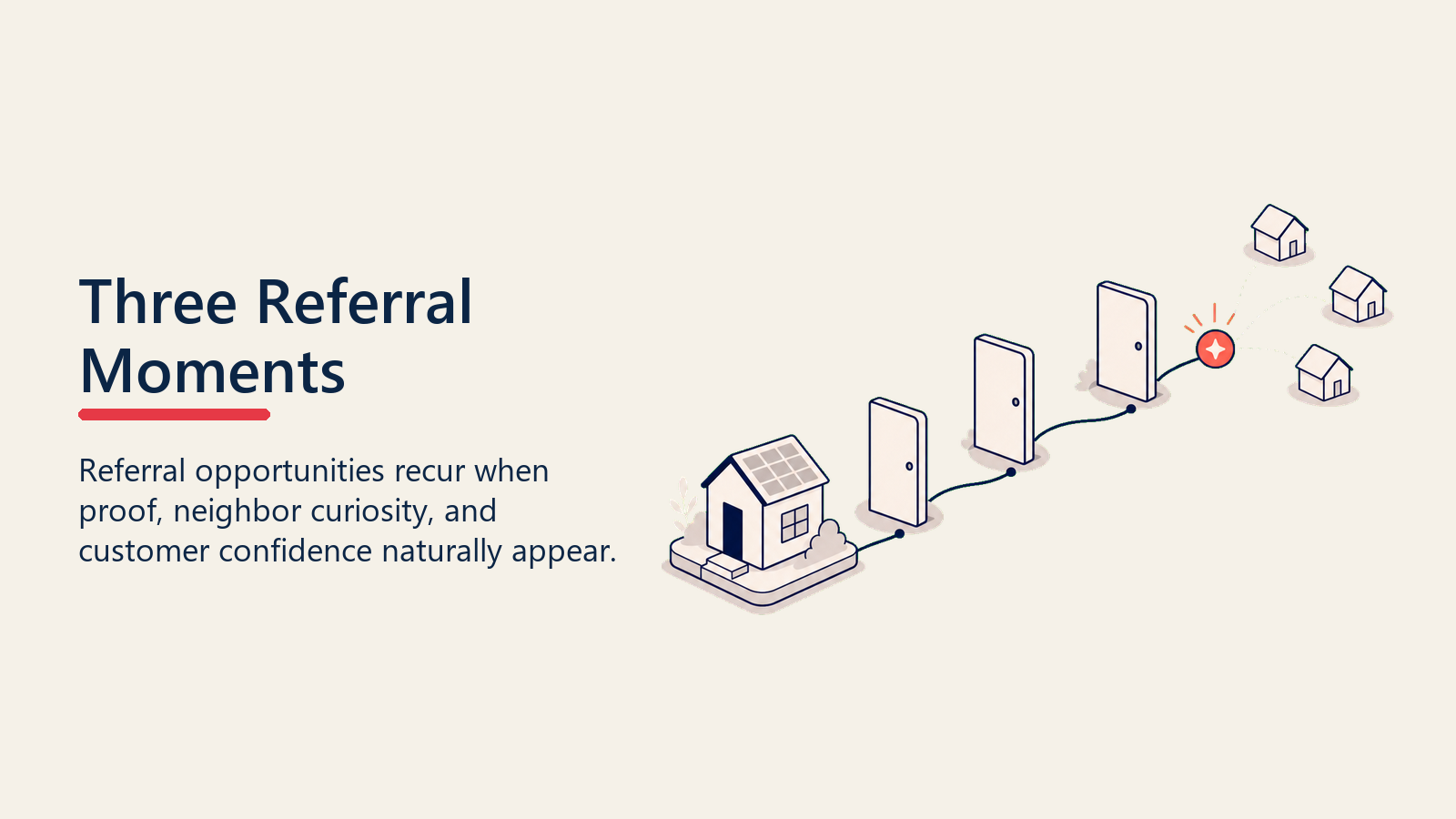
Moment 1: The 30-Day Check-In
At 30 days post-activation, your customer success team should make a scheduled check-in call (see post-install customer onboarding for the full onboarding framework). The agenda covers system performance and billing questions. At the end of that call, add one question:
"Have you had any neighbors or friends ask about your panels yet?"
This is soft. It's not a direct referral request. But it opens the door. If the customer says "actually, yes, my neighbor mentioned it," you follow with: "That's great. Would it be okay if I reached out to them directly? Or I could send you a quick link to share."
Half the time, this casual ask produces a name or contact.
Moment 2: The First Bill
When a customer sees their first significantly reduced utility bill, something clicks emotionally. This is when "I made the right decision" becomes concrete and shareable.
A triggered email or call at this moment that says "You saved $X this month with your solar system, and we'd love to help your friends and family do the same" is extremely well-timed. Include the referral link directly in that email.
Some companies build this moment into their monitoring platform integration. When the customer's cumulative savings cross a threshold (first $100, first $500 saved), they get an automated congratulations message with a referral prompt. The timing connects referral to a real financial milestone the customer is feeling good about.
Moment 3: The 90-Day Relationship Call
At 90 days, you make the direct ask. The customer has lived with the system, seen real results, and had multiple positive interactions with your team. This is the time to be explicit about your referral program.
"[Name], we've really appreciated working with you and we're glad to hear everything is going well. We grow almost entirely through referrals from customers like you. Do you know anyone who's been thinking about solar? We offer [referral incentive] for anyone you refer who moves forward, and we'll take great care of them."
This isn't a hard sales ask. It's an honest conversation between a company and a satisfied customer. Most customers who've had a good experience are happy to help. They just need to be asked clearly. And the program that receives those referrals needs to be simple enough that following through takes less than two minutes.
Designing the Referral Incentive
Referral incentives need to be meaningful enough to motivate action without being so transactional that they feel like you're paying people to sell for you. The right structure depends on your economics, but here are the models that work in residential solar.
| Incentive Model | Structure | Best for |
|---|---|---|
| Cash incentive | $200 to $500 per installed referral | Volume-focused programs, budget-conscious customers |
| Bill credit | 3 to 12 months of utility credit | Customers who prioritize ongoing savings |
| Gift card or experience | $250 to $500 in retailer gift cards | Customers who have high enough bills that a credit feels small |
| Dual-sided reward | Referrer gets $300, referred friend gets $300 off | Creates incentive for the referrer to make the introduction compelling |
| Tiered program | Increasing rewards for 2nd, 3rd, 4th referral | Building repeat referrers who become genuine brand advocates |
The dual-sided model often outperforms single-sided incentives because it gives the referrer something to offer their friend. "I'll send you my solar company's info, and you can get $300 off your system if you mention my name" is a much stronger conversation starter than "let me give them your number."
Whatever incentive you choose, the timing of payout matters. Paying at contract signing vs. at installation vs. at activation affects behavior differently. Paying at installation or activation reduces gaming but delays gratification. Consider paying a partial amount at contract and the remainder at installation. Once the incentive structure is right, the next challenge is making the referral process frictionless enough that customers actually use it.
What Makes It Easy Enough That Customers Actually Refer?
Most referral programs fail not because customers don't want to refer, but because the mechanics are too cumbersome. If referring requires filling out a form, remembering a code, or navigating a portal, most customers won't do it even if they intended to.
The easiest possible referral experience looks like this:
Unique shareable link: Each customer gets a personal link they can text, email, or share on social. When someone clicks it and submits a quote request, the referral is automatically tracked to the customer.
Name-based referral capture: On your quote form, add a simple field: "Were you referred by someone? If so, who?" Many referrals happen because someone mentioned a company by name. Capturing the referrer's name at the quote stage, even without a formal link, ensures attribution.
Text-friendly share: Most customers will refer by text. Make sure your referral link is short, loads on mobile, and contains a pre-filled message they can send without editing. "Hey, I just got solar installed and it's been great. Here's the company I used: [link]. They're offering [incentive]."
Preset social posts: For customers active on Nextdoor or Facebook, provide a pre-written post they can share with one click. Something like: "Just activated my solar system and saw my first bill. If anyone in [neighborhood] is thinking about solar, I'd highly recommend [Company Name]. Use my link for a discount: [link]."
The less friction, the more referrals. Every additional step you add to the process reduces completion by roughly half.
Building a Referral Tracking System
You can't manage what you don't measure. Your referral program needs to be tracked with the same rigor as your paid lead sources.
At minimum, track:
- Total referrals submitted per month
- Referral conversion rate (submitted to appointment, appointment to close, close to install)
- Revenue generated per referred customer
- Cost per referred lead vs. cost per paid lead
- Which customers have referred the most (your advocate list)
- Average time from activation to first referral submission
Your solar CRM and proposal tools should have a referral source field that's populated at lead creation. Every lead should be tagged with how they originated. This lets you run the ROI comparison quarterly: your referral program cost X in incentives and produced Y in revenue at a Z% close rate.
For most solar companies, this analysis shows that referred leads are the highest-ROI lead source they have. Which makes investing in the referral program not a cost of retention, but the most efficient marketing spend in the business.
For the full comparison of lead source economics, see the articles linked in Learn More below.
The Advocate Tier: Your Best Customers as Active Partners
Some customers will refer one person. Others will refer five or ten. The ones who refer repeatedly are your advocates, and they deserve special treatment.
When a customer makes their second referral, recognize it explicitly. A personal call from a manager or owner. A handwritten thank-you card. An elevated incentive that reflects the ongoing value they're creating.
Some companies create a formal advocate program with explicit tiers:
| Tier | Referral Count | Benefits |
|---|---|---|
| Neighbor | 1 referral | Standard incentive + thank-you gift |
| Champion | 3 referrals | Higher incentive + priority service support |
| Ambassador | 5+ referrals | Premium incentive + dedicated account manager + company events access |
Advocates at the Champion and Ambassador level are sometimes willing to participate in testimonials, case studies, or neighborhood events. They've become genuine brand partners, not just customers. Treat them accordingly.
Using Referrals in the Sales Process
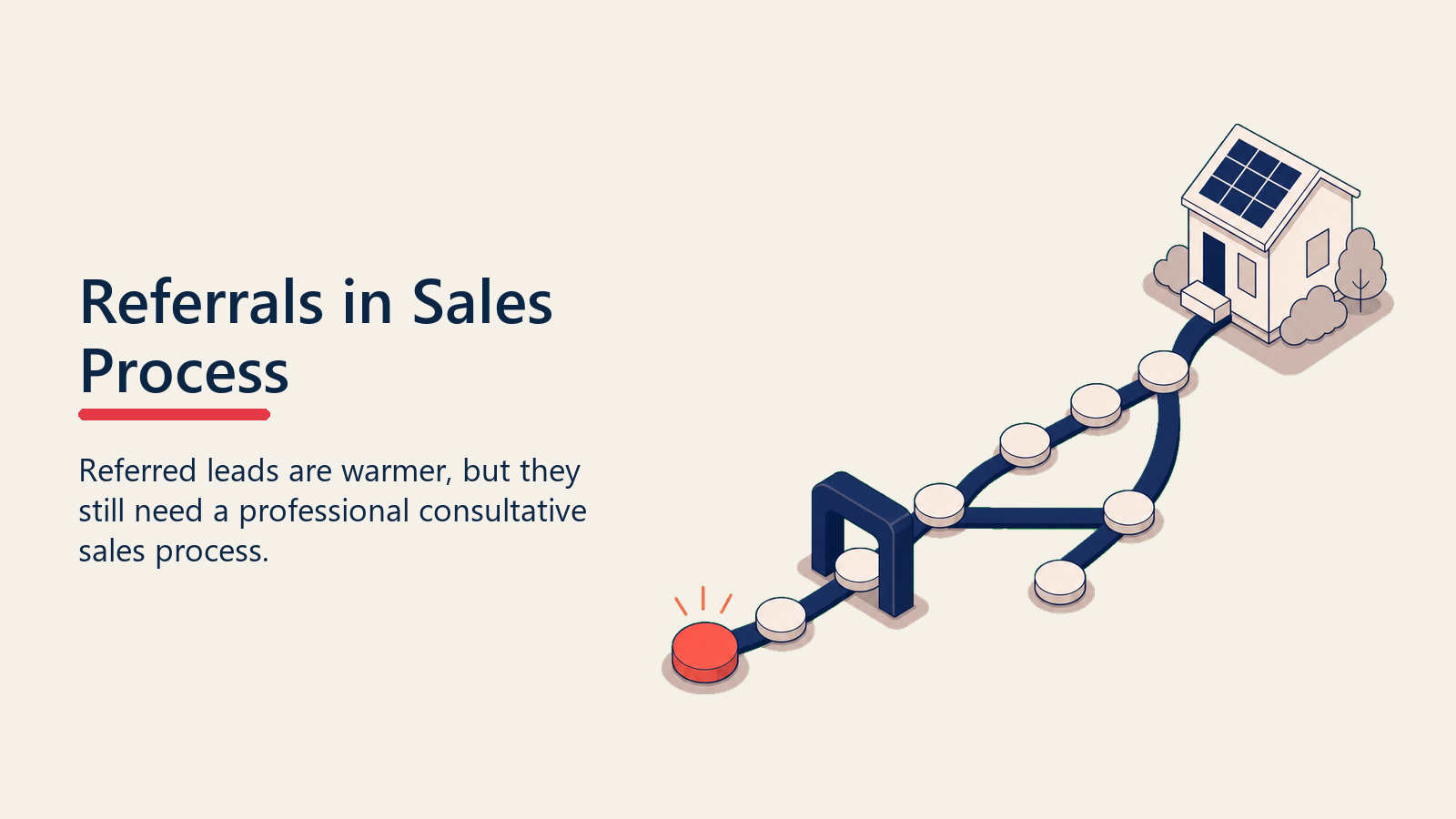
Referred leads are warmer, but they still need the same quality sales process. Don't assume a referral will close itself.
One thing that helps: when you contact a referred lead, mention the connection explicitly and personally. "Hi [Name], I'm reaching out because [Referrer's Name] suggested I call. They've had their system for three months and mentioned you'd been talking about solar. Is this a good time?"
This is not a cold call. The prospect has already heard from someone they trust. Your job is to honor that introduction with a professional, consultative approach. See in-home consultation framework for the full structure of an in-home sales call that converts referred prospects at the highest rate.
Also, loop the original referrer into the process at key moments. When their friend signs a contract, call the referrer to let them know (with permission). "I wanted you to know [Friend's Name] is moving forward. Thank you for making that introduction. We're going to take great care of them, and your [incentive] will be processed once the system is installed." This keeps the referrer engaged and makes them more likely to refer again.
Referrals from the Install Crew
Your installation crew is on the customer's property for a full day, often meeting family members, answering questions from curious neighbors, and representing your brand in the most visible way possible. They're also a significant and often untapped referral source.
Train your crews to:
- Have business cards or leave-behind materials to hand to interested neighbors who approach during the install
- Know how to direct a neighbor inquiry: "Give us a call or go to our website, mention you saw us installing at [address]"
- Never make pricing promises on the spot, but capture interest and escalate to the sales team
Some companies offer crew members a small incentive (gift card, bonus) for every lead that converts from their install day interactions. This aligns crew behavior with the company's growth interests and makes them active participants in the sales process.
Community Events and Neighborhood Leverage
Solar has a natural geographic clustering dynamic. When one home gets solar, neighbors see it and start thinking about it. When five homes on a block get solar, it becomes a conversation. NREL research on the "solar influencer next door" effect found that peer influence and proximity are among the strongest predictors of solar adoption, and that referrals from neighbors close to a prospect are especially likely to convert.
Your referral program can lean into this by creating neighborhood-scale incentives:
Neighborhood bulk discount: When two or more homes on the same street or in the same HOA sign within a certain window, each gets a discount. The first customer has a financial incentive to recruit their neighbor.
Block party or community event: Some companies sponsor events in high-conversion neighborhoods where they've already installed several systems. Satisfied customers who attend can speak to their experience organically. See solar community event marketing for how to structure these events.
Nextdoor and neighborhood Facebook groups: Encourage satisfied customers to post in these groups. A genuine positive review from a real neighbor is one of the highest-converting pieces of content in local solar marketing.
Connecting Referral Generation to Your Retention Strategy
A referral program doesn't exist in isolation. It's part of a broader strategy to turn satisfied customers into long-term assets.
The customers most likely to refer are also the most likely to upgrade when new products become available (battery storage, EV chargers, expanded systems). They're the least likely to dispute warranty claims or leave negative reviews. They're the easiest to maintain because they start from a position of trust rather than suspicion.
This is why post-install onboarding and referral generation should be planned together rather than treated as separate workstreams. The onboarding process creates the conditions for referral. The referral program creates the economic engine that funds the cost of excellent onboarding.
See retention fundamentals for the foundational principles that apply across high-value post-sale relationships, and churn prevention strategy for how to protect the customer relationships you've worked to build.
Learn More
- Solar digital lead generation
- Solar buying vs. self-generated leads
- Value selling
- Post-install customer onboarding
The best solar companies understand that the sale at contract signing is the beginning of the customer relationship, not the end of the sales process. When you treat every installed customer as a future source of growth, your acquisition costs come down, your close rates go up, and your reputation compounds over time in ways that paid advertising never can.
Quotable Nuggets
"The referrals are already happening. The question is whether your company has a system to capture them or whether they go to the next company who asks." (NREL, Solar Energy Evolution and Diffusion Studies 2014-2016)
"The panels on the roof do passive marketing that no paid ad can replicate. Every neighbor who walks by is already in the consideration stage. They just need someone to ask them."
"Most referral programs fail not because customers don't want to refer, but because the mechanics are too cumbersome. Every additional step you add to the process reduces completion by roughly half."
The Three-Moment Referral Ladder: A structured approach to referral generation anchored to three natural customer journey inflection points. Moment 1 (30-day check-in): soft open ("Have any neighbors asked about your panels?") designed to surface warm introductions without pressure. Moment 2 (first bill): financial milestone trigger. Congratulate savings and include a referral link directly in the communication. Moment 3 (90-day relationship call): direct ask with explicit incentive description and a clear, frictionless path to refer. Each moment builds on the trust established in the previous one, so the day-90 ask lands as a natural conversation rather than a sales pitch.
Frequently Asked Questions
Frequently Asked Questions about Referral Generation After Solar Install
What's the right referral incentive amount for residential solar?
Cash incentives of $200 to $500 per installed referral work well for volume-focused programs. Dual-sided incentives (e.g., $300 for the referrer and $300 off for the friend) consistently outperform single-sided ones because they give the referrer something concrete to offer in the conversation. Whatever you choose, pay at or after installation rather than at contract signing, to reduce gaming.
When is the best time to ask for a referral?
Right after a positive experience, and specifically at three structured moments: the 30-day check-in (soft ask), the first significantly reduced bill (financial milestone ask), and the 90-day relationship call (direct ask). The window right after activation is uniquely powerful because enthusiasm is high, social proof is in hand, and the customer is already fielding questions from neighbors.
What if the customer hasn't had a great experience yet?
Don't ask. A referral ask from a customer with an unresolved complaint creates resentment. Address the issue first. If the customer is satisfied after the resolution, service-visit referral asks often land well. The customer has just watched your team respond well and treat them right.
How do you prevent referral programs from being gamed?
Pay at installation or activation, not at contract signing. Require the referred customer to complete a qualifying appointment before any incentive is triggered. Tiered payout (partial at contract, remainder at install) balances immediacy for the referrer with protection against gaming.
How do you track which customers are your best referral sources?
Your CRM should tag every inbound lead with its referral source at the time of creation. Track total referrals submitted per customer, referral-to-close conversion rate, and revenue generated per referring customer. Customers who hit two or three referrals should move to your advocate tier with elevated incentives and recognition.
How do you make the referral ask without it feeling like a sales call?
Frame it honestly: "We grow almost entirely through referrals from customers like you. If you know anyone thinking about solar, we'd love the introduction." Most satisfied customers are happy to help. They just need a clear ask and an easy path. The ask feels like a sales call when it's impersonal or when it comes before the customer has experienced any results.
Can your installation crew generate referrals?
Yes, and this is one of the most underused pipelines in solar. Crews who are on a customer's property for a full day meet neighbors, answer questions, and represent your brand directly. Train them with leave-behind cards and a simple redirect ("Give us a call, mention you saw us installing at [address]"). Some companies tie a small bonus to leads that convert from crew interactions.

Senior Implementation Consultant
On this page
- Why Post-Install Is the Right Moment
- The Three Referral Moments in the Customer Journey
- Moment 1: The 30-Day Check-In
- Moment 2: The First Bill
- Moment 3: The 90-Day Relationship Call
- Designing the Referral Incentive
- What Makes It Easy Enough That Customers Actually Refer?
- Building a Referral Tracking System
- The Advocate Tier: Your Best Customers as Active Partners
- Using Referrals in the Sales Process
- Referrals from the Install Crew
- Community Events and Neighborhood Leverage
- Connecting Referral Generation to Your Retention Strategy