EPC and Installer Channel Partnerships in Solar
Turn this article into takeaways for your work.


Each assistant summarizes the article only for you and suggests best practices for your work.
Plenty of solar sales organizations don't own their own install crews. They sell, hand the job to an EPC (engineering, procurement, and construction) partner or a network of local installers, and collect their margin on origination. It's a lean model that lets a sales-focused company scale faster than one carrying full install overhead.
It's also a model with one glaring point of failure: you don't control the thing your customer actually experiences. The homeowner signed with your brand, sat through your sales presentation, and trusted your rep. Then a subcontracted crew shows up three weeks late, damages a roof tile, or takes six months to get the system permission-to-operate. The customer doesn't blame the EPC. They blame you.
Below is how to vet EPC and installer partners, structure the relationship so incentives line up, and manage it day to day so a partnership model doesn't quietly become a reputation liability.
Why Sales Organizations Choose the EPC Partner Model
Before getting into the mechanics, it's worth naming why this model exists and when it makes sense:
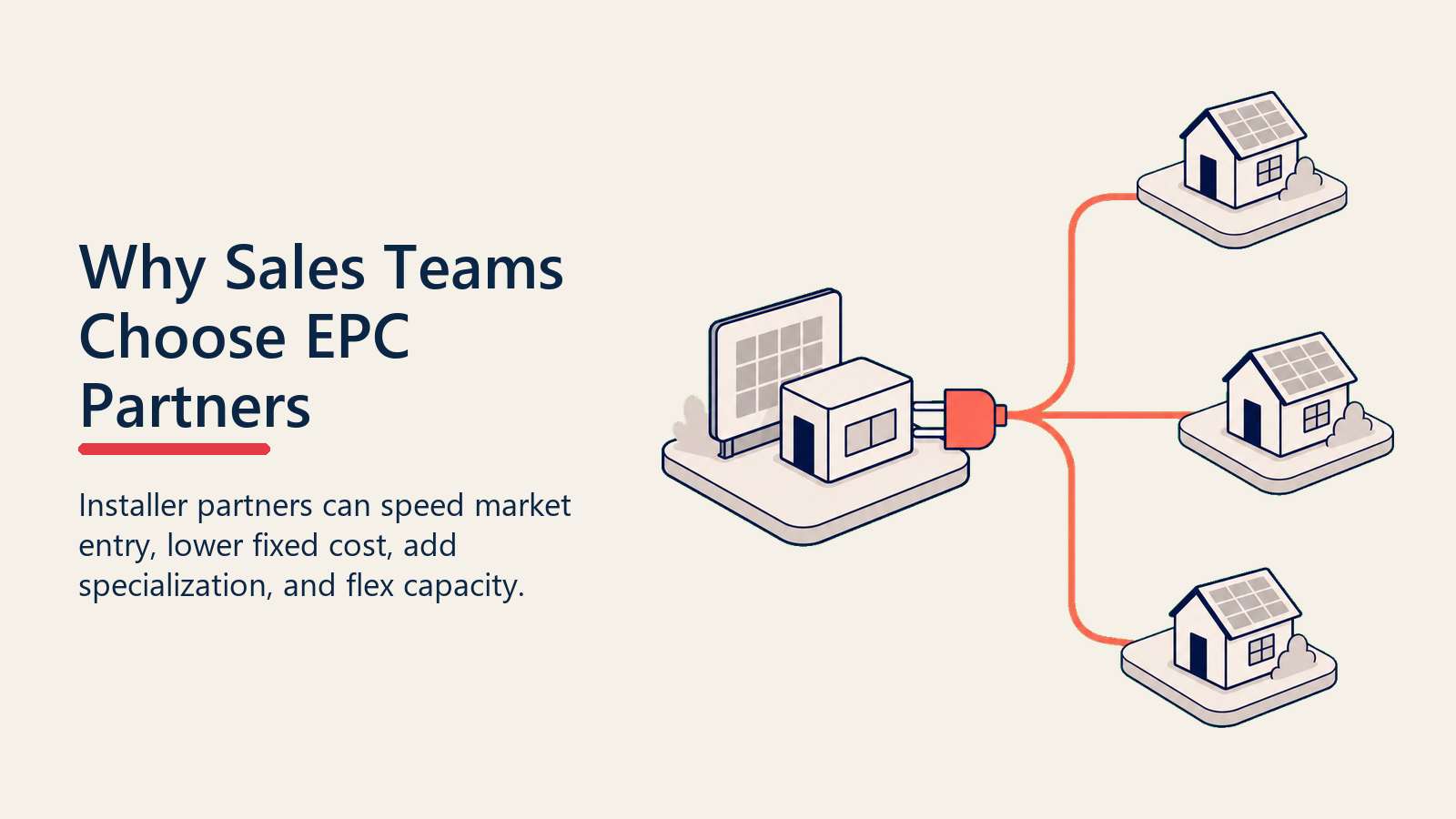
- Faster market entry. Standing up licensed, insured install crews in a new state or territory can take months. Partnering with an existing local EPC lets a sales org enter a market in weeks.
- Lower fixed cost. No crew payroll, no truck fleet, no warehouse for inventory during slow seasons.
- Specialization. Sales and installation require genuinely different operational skills. Some companies decide they're better at one than the other and partner for the rest.
- Capacity flexibility. A network of installer partners can flex up during high season and down during slow months without layoffs.
The tradeoff is direct control. Every operational decision an in-house crew would make, scheduling, material sourcing, quality checks, customer communication during install, now runs through a separate company with its own priorities, capacity constraints, and other clients to serve.
Vetting an EPC or Installer Partner: What to Actually Check
Too many sales organizations vet installer partners on price alone. That's backwards. A cheap install partner who damages roofs or misses permitting deadlines costs far more in refunds, reputation damage, and lost referrals than the margin saved on install cost.
Start with licensing and insurance. Verify active state electrical and general contractor licenses, plus liability and workers' compensation insurance. Get certificates directly, don't take a verbal confirmation.
Check NABCEP certification coverage next. Look at what percentage of their install and design staff hold NABCEP certification, the industry's recognized credential for solar installation professionals. It's not a legal requirement in most states, but it's a strong quality signal.
Track record and references matter more than most sales teams give them credit for. Ask for at least three references from sales partners they've worked with, not just homeowner references. A sales partner reference tells you about communication, timeline reliability, and how disputes get resolved, which is exactly what you need to know.
Permitting and interconnection track record is the number that actually determines how long your customers wait. Ask directly: what's their average time from signed contract to permission to operate in this specific jurisdiction? It varies enormously by installer and by local utility. See permitting and interconnection timeline for what a healthy timeline looks like so you can benchmark a partner's numbers against it.
Capacity and current workload deserve a direct question, not an assumption. An installer already stretched thin with their own direct-sale customers will deprioritize your jobs when things get busy. Ask how many crews they run and what their current backlog looks like.
Key Facts: Vetting EPC and Installer Partners
- NABCEP certification is a leading third-party credential for solar installation professionals, though it is not a legal requirement in most states, making it a quality signal to check for rather than assume.
- Projects seeking the full Section 48E clean electricity investment credit for construction beginning in 2024 or later generally must meet a 15% apprenticeship labor-hour requirement, per IRS guidance on prevailing wage and apprenticeship rules. And don't skip warranty and workmanship guarantee terms. Understand exactly what the installer warranties (typically workmanship for a set number of years) versus what's covered by equipment manufacturer warranties. This distinction matters enormously when something goes wrong two years after install. See warranty and service monitoring for how these overlapping warranty layers should be tracked and communicated to the homeowner.
If your EPC partner also handles larger commercial-scale jobs, confirm they understand prevailing wage and apprenticeship compliance too. Projects seeking the full Section 48E credit generally need to meet IRS prevailing wage and apprenticeship requirements, and an EPC that mishandles the documentation can cost a commercial client a meaningful chunk of the credit they were counting on.
EPC Partner Vetting Checklist
- Active state electrical/contractor license verified directly with the state board
- Current general liability and workers' comp insurance certificates on file
- Percentage of NABCEP-certified staff confirmed
- Minimum three sales-partner references checked
- Average permit-to-PTO timeline documented for your specific service territory
- Current crew count and backlog disclosed
- Workmanship warranty terms in writing
- Sample of at least five recently completed jobs reviewed (photos, inspection reports)
- Process for handling change orders and site complications documented
- Clear escalation contact for time-sensitive issues
Structuring the Contract So Incentives Line Up
A weak EPC contract creates misaligned incentives that surface as customer complaints months later. A strong one protects both sides, and more importantly, protects the homeowner's experience.
Define install timeline commitments with real consequences. Don't accept vague language like "installed in a timely manner." Specify a maximum number of business days from signed, permit-ready contract to install start, and from install completion to permission-to-operate submission. Attach financial consequences (credits, reduced payment) for missed timelines that aren't caused by permitting delays outside the installer's control.
Separate "installer-caused" delays from "external" delays in the contract language. Utility interconnection queues and jurisdiction permitting backlogs are often genuinely outside an installer's control. An installer's own crew scheduling failures are not. The contract should distinguish between the two so accountability is clear when a customer asks why their install is late.
Set quality inspection requirements. Require photo documentation at defined milestones (mounting, wiring, final) and, ideally, third-party inspection rights on a sample of jobs. This isn't about distrust, it's about catching problems before the customer does.
Clarify who owns the customer relationship during install. Decide explicitly whether your sales team or the EPC's project manager is the customer's primary point of contact during the install phase, and communicate that clearly to the homeowner at handoff. Ambiguity here is exactly where customer experience breaks down, because homeowners end up calling both parties and getting inconsistent answers. See sales-to-install handoff for the internal process that should mirror this in your contract language.
Build in a scorecard, not just a contract. Beyond the legal terms, track a running scorecard: average install timeline, customer satisfaction scores post-install, callback/warranty claim rate, and permitting delay rate. Review it quarterly with every partner. Contracts set the floor; scorecards drive continuous improvement above it.
The Contract-Plus-Scorecard Method: pair a written contract that sets hard timeline and quality floors with a running quarterly scorecard covering install timeline, satisfaction, callback rate, and permitting delays, so accountability doesn't rely on re-negotiating terms every time a partner underperforms.
Should You Use a Single Installer or an Installer Network?
A single exclusive EPC works best for smaller markets and early-stage expansion because it's simpler to manage, while multiple installer partners suit larger or high-volume territories that need capacity flexibility and redundancy. Most companies eventually land on a hybrid of both as volume grows.
| Approach | Pros | Cons | Best Fit |
|---|---|---|---|
| Single exclusive EPC per territory | Simpler management, stronger relationship, easier accountability | Capacity bottleneck risk, single point of failure | Smaller markets, early-stage expansion |
| Multiple installer partners per territory | Capacity flexibility, competitive performance, redundancy if one partner underperforms | More vendor management overhead, harder to keep quality consistent | Larger or high-volume markets |
| Hybrid (owned crews + overflow partners) | Control over core volume, flexibility for spikes | Requires managing both an internal team and external partners | Companies transitioning from partner-only to in-house install |
Most sales-heavy solar organizations that scale past a certain volume in a territory eventually move toward the hybrid model: enough in-house capacity to guarantee quality and timeline on a baseline of volume, with vetted overflow partners for peak season or new-market testing.
Managing the Relationship Day to Day
Vetting and contracts set the foundation. But the partnership actually succeeds or fails on operational rhythm.
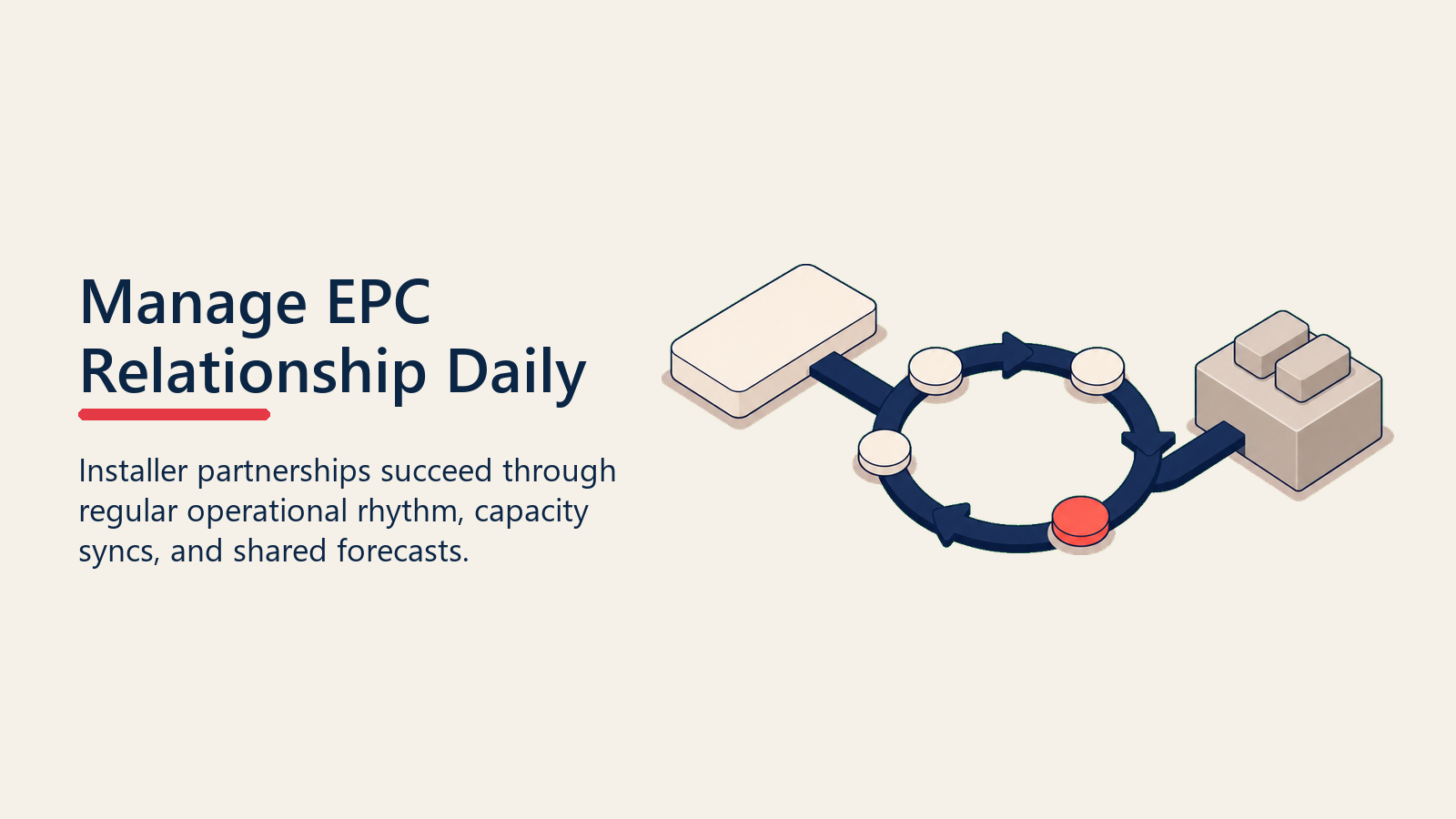
Run weekly pipeline-to-capacity syncs. Share your near-term sales volume forecast with EPC partners regularly so they can staff and schedule accordingly. Surprising an installer with a volume spike they didn't plan for is how timelines slip. This is the same forward-looking discipline behind opportunity qualification: a forecast is only useful if it reflects deals that are actually likely to close on the timeline you're sharing.
Build a joint issue resolution process. When a customer complaint comes in, have a defined process for who investigates, who communicates with the customer, and how the resolution gets documented. Don't let it become a game of hot potato between sales and the installer.
Keep shared visibility into job status. Whether through a shared project management tool or regular status reports, your sales team, especially anyone doing post-sale check-ins, should know where each customer's install actually stands without having to call the EPC every time.
And run regular quality audits, not just complaint-driven ones. Proactively sample-check completed jobs rather than only investigating after something goes wrong. This catches quality drift before it becomes a pattern of complaints.
What Happens When a Partnership Isn't Working
Sometimes, despite good vetting, a partnership underperforms. Signs it's time to reduce volume or exit:
- Consistent timeline misses that aren't explained by permitting or utility delays
- Rising customer complaint or warranty callback rates tied specifically to that partner's jobs
- Communication breakdowns where the installer stops being responsive to your team or the customer
- Capacity constraints that consistently push your jobs to the back of their queue
When exiting a partnership, plan the transition carefully. Existing customers mid-install need continuity. Don't leave a homeowner's system half-finished while you sort out a vendor dispute. Line up a transition partner or in-house capacity before formally ending the relationship, and communicate proactively with any affected customers rather than letting them discover the change when no one shows up.
How This Connects to the Sales Conversation
Reps selling on behalf of an EPC-fulfilled model need to be honest, without undermining confidence, about what happens after the signature. Homeowners increasingly ask "who actually installs this?" and a vague answer erodes trust fast.
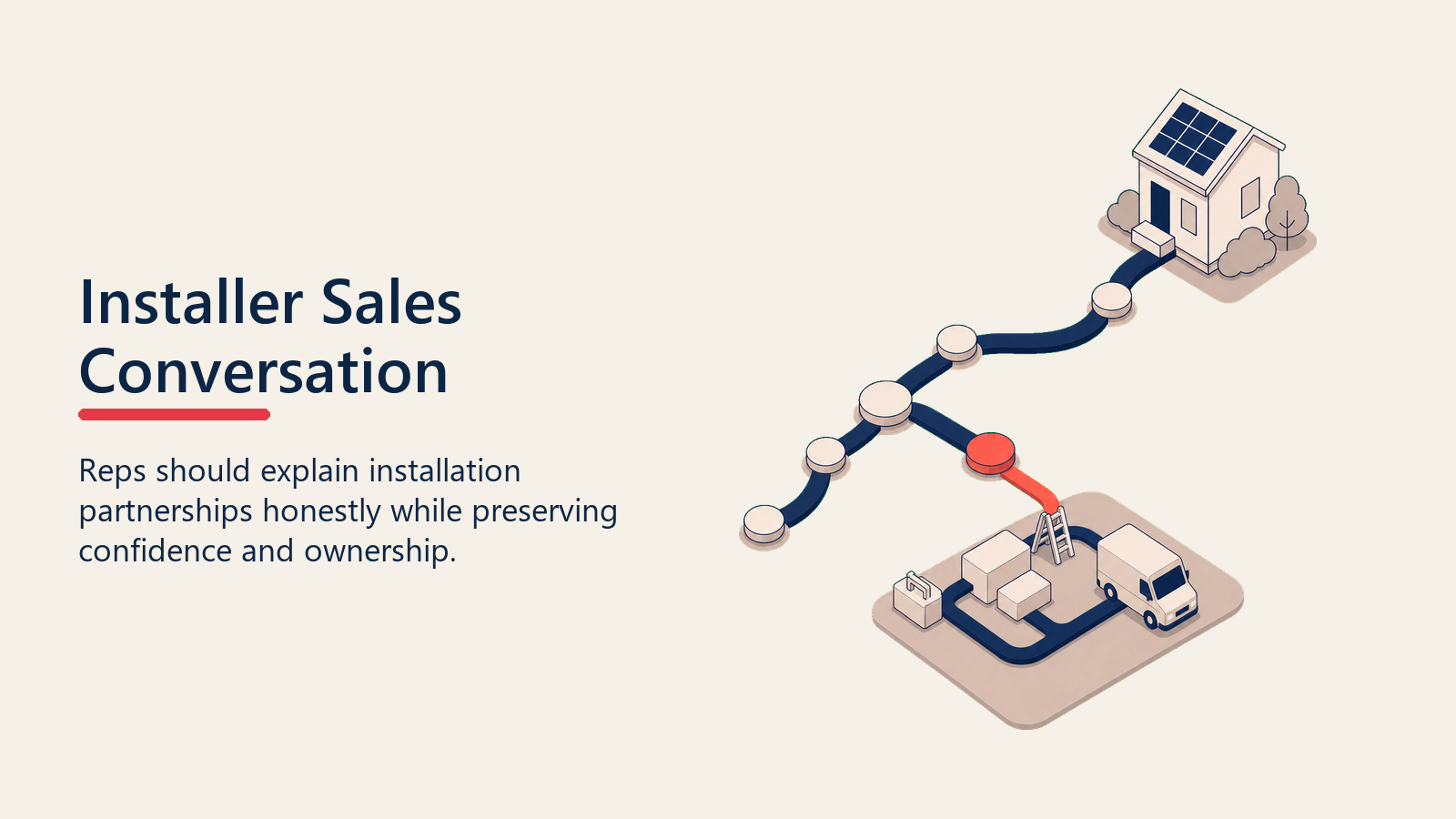
A strong answer sounds like: "We handle your design, financing, and project management. Our installation partner, [name], is licensed, insured, and has completed over [number] installs in this area. We stay involved through the entire process and you'll have a single point of contact with us throughout." That works because it's honest and specific, not because it's polished.
This is also where good lead qualification and prescreening matters. Homes with unusual roof types, older electrical panels, or structural quirks are more likely to hit install complications. Flagging that early lets your team set accurate expectations with the customer and give the EPC partner a heads-up before the crew shows up.
A rocky install experience also undoes the goodwill your team built during the sale, which makes a customer retention plan much harder to execute later. A homeowner who had a smooth, well-communicated install is far more receptive to a referral ask or a review request than one who spent three months chasing status updates.
Quotable Nuggets
"The homeowner signed with your brand, sat through your sales presentation, and trusted your rep. When the install partner underperforms, the customer doesn't blame the EPC. They blame you."
"A cheap install partner who damages roofs or misses permitting deadlines costs far more in refunds and lost referrals than the margin saved on install cost. Vetting on price alone is backwards."
Frequently Asked Questions about EPC and Installer Channel Partnerships in Solar
What does EPC stand for in solar, and why does it matter for sales organizations?
EPC stands for engineering, procurement, and construction. It refers to the company, or the division of a larger company, that designs, sources materials for, and physically installs a solar system. Sales organizations that don't run their own install crews rely on EPC partners to deliver what was sold, which means the partnership directly shapes the customer's actual experience.
How many EPC references should we check before signing a partnership?
At minimum three references from other sales partners the EPC has worked with, not just homeowner references. Sales-partner references reveal communication quality, timeline reliability, and how the installer handles disputes, which matters more for a channel relationship than individual homeowner satisfaction alone.
Should we use one EPC partner or several in the same territory?
It depends on volume. A single exclusive partner is simpler to manage and works well in smaller markets or early expansion. Multiple partners add capacity flexibility and redundancy but require more vendor management, and generally make sense once volume in a territory grows large enough to need it.
What's the biggest mistake sales organizations make with EPC partnerships?
Vetting and negotiating primarily on install cost per watt rather than on timeline reliability, quality track record, and communication practices. The cheapest installer is rarely the one that protects your brand's reputation when something goes wrong.
Who should own communication with the customer during the install phase, sales or the EPC?
This should be decided explicitly and communicated to the homeowner at handoff, not left ambiguous. Many sales organizations keep their own team as the customer's single point of contact throughout install, even when the EPC's project manager is doing the day-to-day coordination, to avoid the customer getting inconsistent answers from two parties.

Senior Implementation Consultant
On this page
- Why Sales Organizations Choose the EPC Partner Model
- Vetting an EPC or Installer Partner: What to Actually Check
- EPC Partner Vetting Checklist
- Structuring the Contract So Incentives Line Up
- Should You Use a Single Installer or an Installer Network?
- Managing the Relationship Day to Day
- What Happens When a Partnership Isn't Working
- How This Connects to the Sales Conversation
- Quotable Nuggets