Site Survey and Design Confirmation in Solar: What Happens After the Sale
Turn this article into takeaways for your work.


Each assistant summarizes the article only for you and suggests best practices for your work.
A rep closes a deal based on satellite imagery, a utility bill, and a conversation. Then a technician goes to the house and finds out what's actually there: a tree that shades the south-facing section from 2pm on, a panel box that needs upgrading, a roof with 8-year-old shingles that are fine but will require documentation. The gap between what the proposal assumed and what the site reveals is the site survey problem.
How you handle that gap determines whether you keep the deal and the customer. The Department of Energy's Solar Photovoltaic Specification, Checklist and Guide provides a federally developed framework for what a thorough residential solar assessment should capture, a useful baseline when building or auditing your own survey process.
This guide covers what a thorough site survey captures, how to communicate findings when they change the original proposal, and how to confirm the final design in a way that sets realistic expectations before permitting begins.
Why the Site Survey Matters More Than Most Companies Treat It
The site survey is often treated as a technical logistics step. It's actually a critical customer-facing event.
From the homeowner's perspective, they signed a contract for a specific system at a specific price that will produce a specific amount of power. If the site survey changes any of those three things, they're going to feel like something went wrong, even if everything is operating exactly as it should.
From the operations perspective, a sloppy site survey leads to design revisions after permit submission, which means delays, rework fees, and homeowners who've been waiting longer than expected with no good explanation.
Getting the site survey right the first time isn't just about technical accuracy. It's about protecting the deal and the customer relationship.
Key Facts
- NREL's analysis of residential solar project cancellations found that permitting delays and changes in customer finances rank as the top two drivers. Site survey findings that change the original proposal (unexpected costs, roof issues, shading problems) trigger exactly the kind of financial reconsideration that converts into a cancellation. Getting survey findings in front of the homeowner early is the primary prevention strategy. (NREL Technical Report 80626, 2022)
- NREL's solar resource data tools provide satellite-derived baseline production estimates before a technician steps on the roof. On-site shading and usable area measurements can diverge significantly from satellite assumptions, particularly in markets with mature tree canopy. (NREL Solar Resource Data Tools and Maps)
- The DOE's Solar Photovoltaic Specification, Checklist and Guide provides a federally developed framework for what a thorough residential solar site assessment should capture. (DOE PV Guide)
Who Conducts the Site Survey
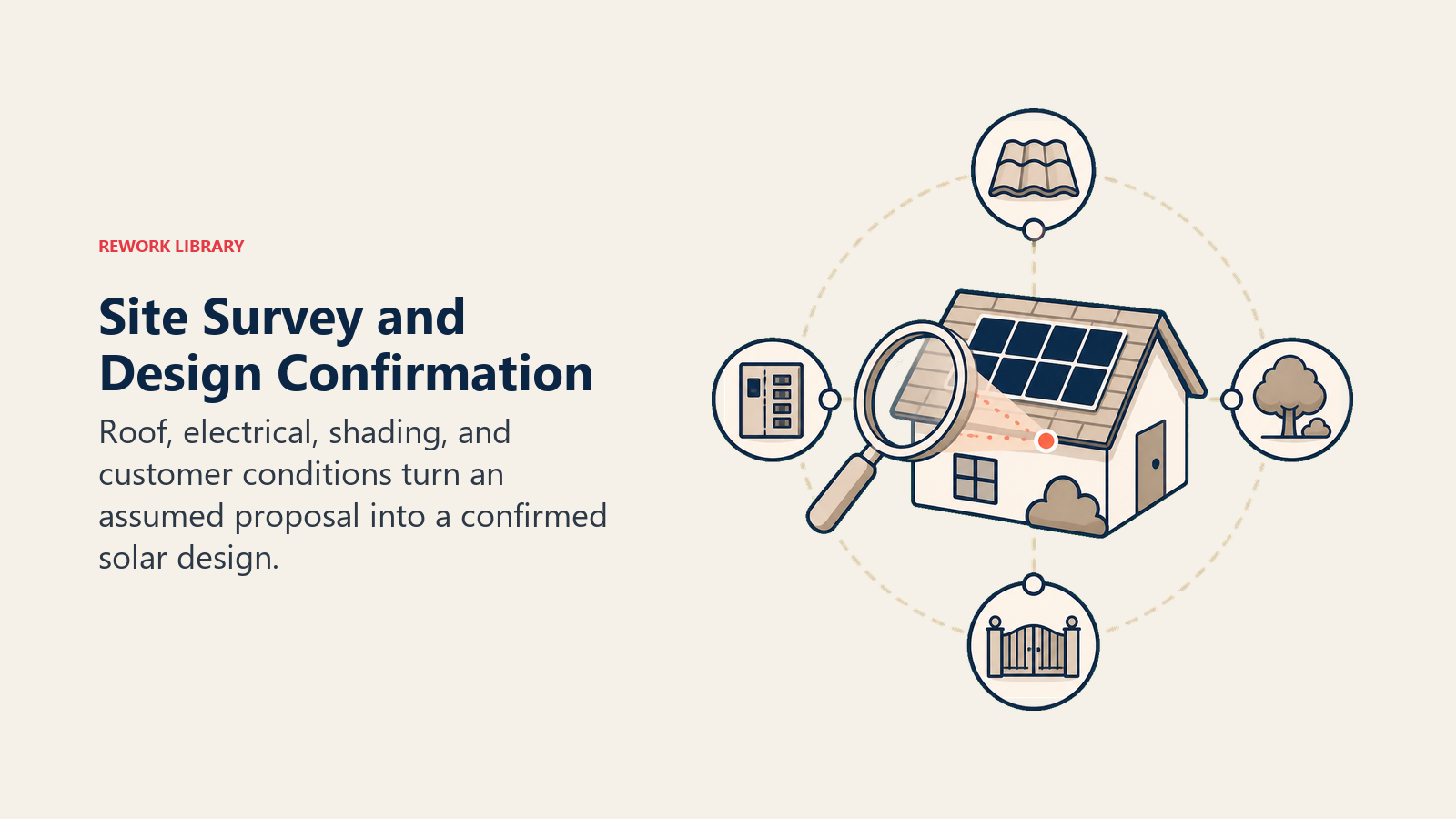
Site surveys are conducted by dedicated technicians, installation crew leads, third-party subcontractors, or virtual drone assessments (almost always supplemented by an in-person visit). Whoever does the survey needs to capture information across four categories: roof, electrical, shading, and customer-specific conditions. Treat these as a checklist, not a memo.
What a Site Survey Captures
The Four-Category Checklist: every site survey must capture findings across four categories: roof condition and structural capacity, electrical panel and meter assessment, shading analysis with on-site measurements, and customer-specific conditions (HOA restrictions, pet and access logistics, specific preferences the rep documented during the sale). Treat each category as a non-negotiable. Surveys that skip the customer-specific conditions category consistently generate the post-install complaints that damage referral rates.
Roof Assessment
Physical condition: Age, material type, visible damage, soft spots, existing penetrations. If the roof is within 5 to 7 years of its expected end of life, the conversation about replacement needs to happen now, not after permits are filed.
Structural capacity: Rafter spacing, truss layout, and attic access limitations that affect how mounts can be installed.
Pitch and azimuth: Actual roof angle and compass orientation, confirmed with a measurement tool.
Usable surface area: After accounting for setbacks from ridge, eave, rake, hip lines, and any skylights, vents, or HVAC units, what is the actual panel-ready surface? NREL's solar resource data tools and maps give installers satellite-derived baseline estimates before a technician steps on the roof.
Roof type details: Shingle type, tile pattern, or membrane type affects which racking system is specified and can affect cost.
Electrical Assessment
Panel capacity and condition: Is the existing panel large enough to handle the new solar system plus battery storage if applicable? What's the current capacity, and is there available breaker space?
Meter location and type: Location relative to the proposed inverter placement matters for wiring runs. Net metering configurations vary by utility and need to be confirmed.
Sub-panels: Any detached structures (garage, pool equipment) on separate sub-panels affect design if the homeowner wants to power those from the solar system.
Upgrade requirements: If the panel needs a main breaker upgrade, a panel replacement, or a meter upgrade requested by the utility, the homeowner needs to know this before installation day.
Shading Analysis
This is the area where satellite-based proposals most often diverge from reality.
A physical shading assessment captures what obstruction sources exist and how they affect the roof at different times of day and across seasons. Trees are the most common variable. A tree that looks small from a satellite image may shade 40% of the south-facing roof during afternoon hours.
If your company uses shading analysis software (Solargraf, Aurora, etc.), the site survey technician should update the model with on-the-ground measurements before the design is finalized.
When shading is worse than the proposal assumed, the production estimate will need to be revised. This is an important conversation with the homeowner, and it's better to have it at the site survey stage than after the system is installed and producing less than expected.
Customer-Specific Conditions
This category is consistently under-documented and consistently the source of post-install complaints.
- HOA restrictions on panel placement or aesthetics
- Neighbor proximity that might affect shading from future construction
- Pets or security systems that the crew needs to know about for install day
- Any accessibility issues (narrow gates, low-clearance areas, no-parking restrictions)
- Customer preferences the sales rep noted but may not have fully documented (homeowner wants panels out of the front yard view, homeowner is specifically concerned about roof leaks, etc.)
Get this in writing before the design phase begins.
Common Site Survey Findings That Change the Original Proposal
The Tree Problem
You designed a 10kW system on the south-facing section. The site survey reveals a mature oak that shades that section from noon onward in fall and winter. Options:
- Redesign to use the east and west faces at lower efficiency
- Reduce system size to match the available unshaded surface
- Add microinverters or power optimizers to mitigate shading losses
- Have a conversation about tree trimming if the homeowner is open to it
There's no single right answer. The right answer depends on the homeowner's priorities and the economics of each option. But this conversation can't wait until installation day.
The Panel Upgrade Requirement
The existing electrical panel is a 100-amp service from 1987. To safely interconnect a solar system, it needs to be upgraded to 200-amp service. This adds cost and often requires coordination with the utility for a meter upgrade.
If this wasn't identified during the consultation (and it often isn't, because the rep saw a panel and didn't go deep on specs), the homeowner is now facing an unexpected cost.
How you handle this determines whether you keep the deal:
"During our site survey, the technician confirmed that your current electrical panel will need to be upgraded before we can install the solar system. This is a pretty common requirement for older homes. The upgrade runs about $X and the utility typically needs two to three weeks to schedule the meter change once we submit the request. What I want to make sure is that you understand the full cost before we file permits, so there are no surprises."
Be direct. Be honest. Don't minimize it. Homeowners who feel like the company is hiding cost changes become cancellations.
Roof Condition Issues
If the roof has 5 years of life left, installing solar now creates a problem: the homeowner will need to remove and reinstall the panels when the roof is replaced, at significant cost.
Options:
- Pause the solar install and coordinate with a roofing partner
- Bundle a roof replacement into the solar project financing
- Proceed with full documentation that the homeowner understands the future removal/reinstall cost
Some solar companies have roofing partnerships specifically for this scenario. If yours does, now is the time to use them. See sales and install operations alignment for how coordinating these handoffs across trades affects customer experience.
Design Changes from Usable Area
The proposal assumed 14 panels on the south roof. After accounting for actual setbacks and vent locations, there's room for 11. The system is now smaller than proposed, the production estimate needs revision, and the price may need to change.
This is where clear change-order documentation and a design confirmation step protect everyone.
The Design Confirmation Step
After the site survey, before permits are filed, every homeowner should receive a design confirmation that:
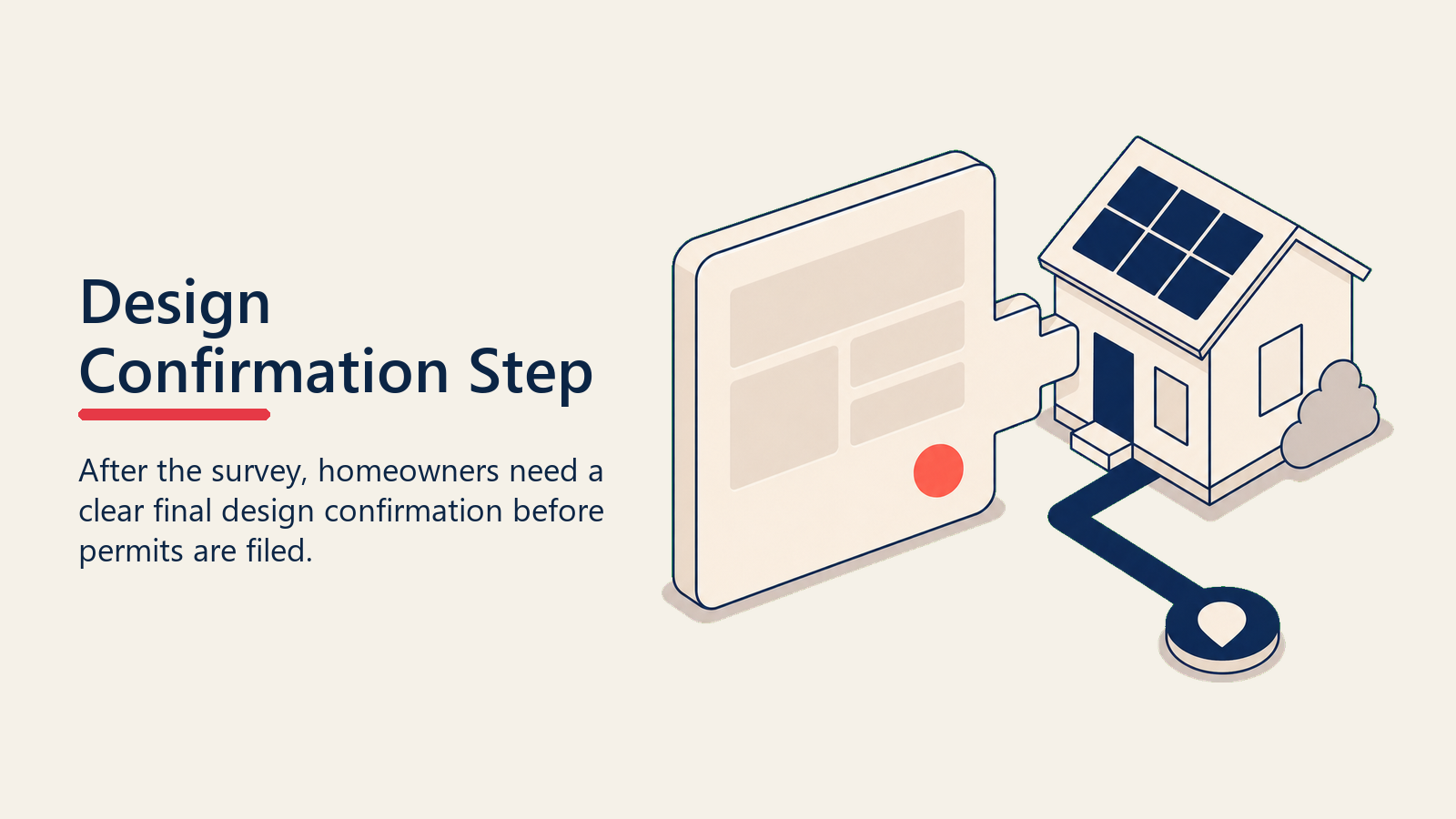
- Shows the final panel layout (a rendered system design image, not just a spec sheet)
- States the final system size in kilowatts
- States the revised production estimate based on confirmed shading and roof orientation
- Lists any changes from the original proposal and the reason for each
- States the final price after any adjustments
- Requests a written acknowledgment (a digital signature or email confirmation) before permits are submitted
This step serves two purposes. First, it creates a documented record that the homeowner understood and accepted the final design. Second, it gives homeowners who have had second thoughts a natural checkpoint to ask questions before the company incurs permitting costs.
Design Confirmation Template Framework
| Item | Detail |
|---|---|
| System size | [X.X kW DC] |
| Panel quantity and model | [14 panels, Q CELLS Q.PEAK DUO G11] |
| Inverter | [Enphase IQ8A microinverters] |
| Estimated annual production | [X,XXX kWh based on confirmed site conditions] |
| Changes from original proposal | [System reduced from 10kW to 9.2kW due to roof setback requirements; production estimate revised from X,XXX to X,XXX kWh] |
| Reason for changes | [On-site measurement confirmed actual usable roof area differs from satellite estimate] |
| Final system price | [$XX,XXX] |
| Approval needed by | [Date, to maintain current install queue position] |
Send this via your CRM or project management system, and follow up by phone the same day. Don't send the document and wait. Call to walk through it.
How Do You Communicate Survey Findings That Change the Deal?
The most difficult conversations happen when the site survey reveals something that significantly changes what the homeowner expected. A few principles for handling them:
Lead with transparency, not apology. "Our site survey found something we need to update you on" is better than leading with "I'm sorry but there's bad news." The former communicates competence. The latter communicates uncertainty.
Explain why the original estimate was different. Homeowners understand that satellite-based estimates have limitations. What they don't understand is why nobody mentioned that limitation during the consultation. If your sales process doesn't explain this, train reps to do so upfront so that design changes feel like expected refinement, not surprises.
Give options, not ultimatums. When the site survey reveals a problem, present at least two paths forward. Homeowners who feel they have agency are far less likely to cancel than homeowners who feel like something is being done to them.
Set a timeline for their decision. "I'd like to know by [date] so I can either hold your install slot or open it up for another customer." That's honest and fair.
For significant changes, loop in the rep who closed the deal. The homeowner has a relationship with them, and a familiar voice reduces the emotional impact of unexpected news.
See sales to install handoff for how ops and the original rep coordinate during this phase.
After Design Confirmation: What Happens Next
Once the homeowner has signed off on the confirmed design, the project moves to permitting and utility interconnection. The coordinator should communicate this clearly:
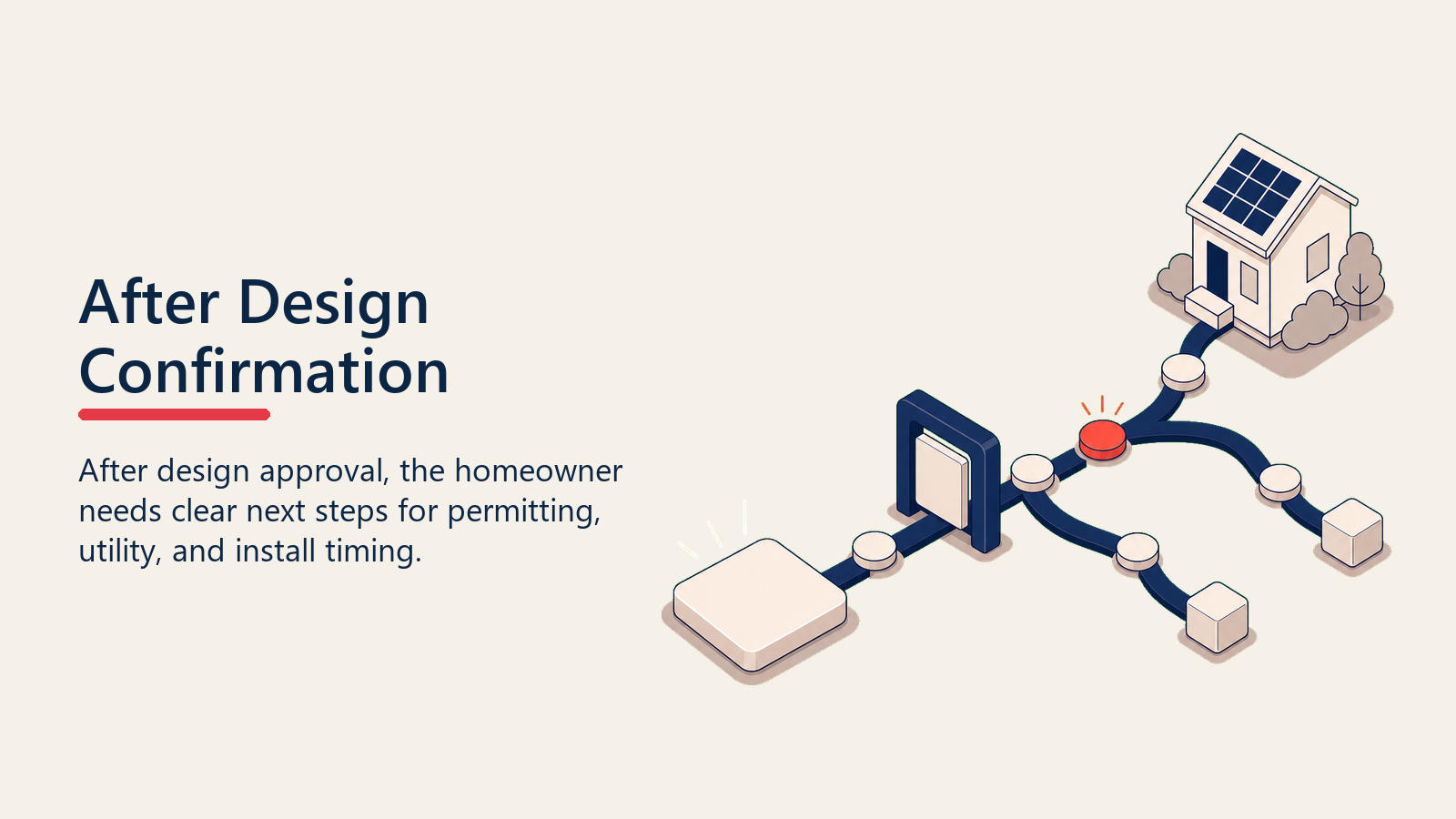
"We have your design approval. We're submitting the permit package to [County] today. The typical review window is three to five weeks. While that's in process, we'll also submit the interconnection application to [Utility]. I'll reach out as soon as we have permit approval and can lock in your install date."
That sentence does three things: it confirms the action taken, it sets a timeline, and it gives the homeowner a clear sense of what to expect next.
See permitting and interconnection timeline for a jurisdiction-by-jurisdiction breakdown of what drives permit timelines and how to set accurate expectations.
Quality Control on Site Surveys
The most common quality failures in site surveys:
- Incomplete roof documentation (missing photos of specific sections, no note on shingle condition)
- No shading analysis update when trees are present
- Electrical panel photos without capacity documentation
- No notes on HOA status or restrictions
Run a monthly audit of survey packages against a standard checklist. Pull 10 random surveys and score them for completeness. Track which technicians have the most complete packages and which generate the most design revisions.
Survey quality is a leading indicator of installation delays and warranty claims. The savings from avoided rework more than cover the training investment.
The Site Survey as a Customer Experience Moment
Most homeowners have never been through a solar installation before. When a professional technician arrives, explains what they're doing and why, and follows up with a clear summary of findings, that experience builds confidence. When a rushed technician leaves without saying anything to the homeowner, that experience introduces doubt.
Train your survey technicians to treat the homeowner as a customer who just made a significant decision and needs reassurance. A brief introduction, a quick explanation of what the survey covers, and "we'll follow up with everything we found by end of week" takes five minutes and pays off through the entire permit wait.
The survey is also an opportunity to address the value of what the customer signed up for. A technician who says "this is a really solid south-facing roof, you're going to get great production" reinforces the purchase decision at exactly the moment when doubt can creep in. This is part of the same retention fundamentals principle that applies post-install: customers who feel confident early cancel less and refer more.
Frequently Asked Questions about Site Survey and Design Confirmation in Solar
What are the four categories a site survey must cover?
Roof condition and structural capacity, electrical panel and meter assessment, shading analysis with on-site measurements, and customer-specific conditions (HOA restrictions, access logistics, preferences the rep noted during the sale). Every category is required. The customer-specific category is the most commonly skipped and the most consistent source of post-install complaints.
What happens when the site survey changes the original proposal?
Communicate changes directly and immediately. Lead with transparency, not apology. Explain why the original estimate differed: satellite-based proposals have inherent limitations that reps should mention upfront. Give the homeowner at least two paths forward. Set a clear timeline for their decision. Loop in the original rep for significant changes, because the homeowner trusts the rep's voice and that trust reduces the emotional impact of unexpected news.
How should site survey findings be communicated to the homeowner?
A design confirmation document after the survey, before permit submission, covering: final system size, panel model and quantity, inverter type, revised production estimate, a list of changes from the original proposal with explanations, the final price, and a request for written acknowledgment before permits are filed. Follow up by phone the same day the document goes out.
What is the biggest quality failure in site surveys?
Incomplete documentation. The most common gaps are missing roof photos from specific sections, no shading analysis update when trees are present, electrical panel photos without capacity documentation, and no notes on HOA status. A monthly audit of 10 random survey packages against a standard checklist catches these before they turn into rework and installation delays.
When should the conversation about roof replacement happen?
At the site survey stage, not after permits are filed. If the roof is within 5 to 7 years of its expected end of life, the homeowner needs to know now. Options include pausing the solar install to coordinate with a roofing partner, bundling a roof replacement into the solar project financing, or proceeding with full documentation that the homeowner understands the future removal and reinstall cost.
How do shading findings from a site survey affect the savings estimate?
Meaningfully. A tree that looks small in satellite imagery can shade 40% of the south-facing roof during afternoon hours. If on-site shading is worse than the proposal assumed, the production estimate needs revision before permitting. This conversation is far better to have at survey than after installation, when the system produces less than expected and the homeowner has no good explanation for why.
Why does technician behavior during the site visit affect cancellation rates?
Because the homeowner is in a state of committed optimism immediately after signing, and that state is fragile. A professional technician who explains what they are doing and follows up with clear findings reinforces the purchase decision. A rushed technician who leaves without saying anything introduces doubt at exactly the moment when doubt can compound into cancellation.

Senior Implementation Consultant
On this page
- Why the Site Survey Matters More Than Most Companies Treat It
- Who Conducts the Site Survey
- What a Site Survey Captures
- Roof Assessment
- Electrical Assessment
- Shading Analysis
- Customer-Specific Conditions
- Common Site Survey Findings That Change the Original Proposal
- The Tree Problem
- The Panel Upgrade Requirement
- Roof Condition Issues
- Design Changes from Usable Area
- The Design Confirmation Step
- Design Confirmation Template Framework
- How Do You Communicate Survey Findings That Change the Deal?
- After Design Confirmation: What Happens Next
- Quality Control on Site Surveys
- The Site Survey as a Customer Experience Moment