Buying Leads vs Self-Generation in Solar: How to Build the Right Lead Mix
Turn this article into takeaways for your work.


Each assistant summarizes the article only for you and suggests best practices for your work.
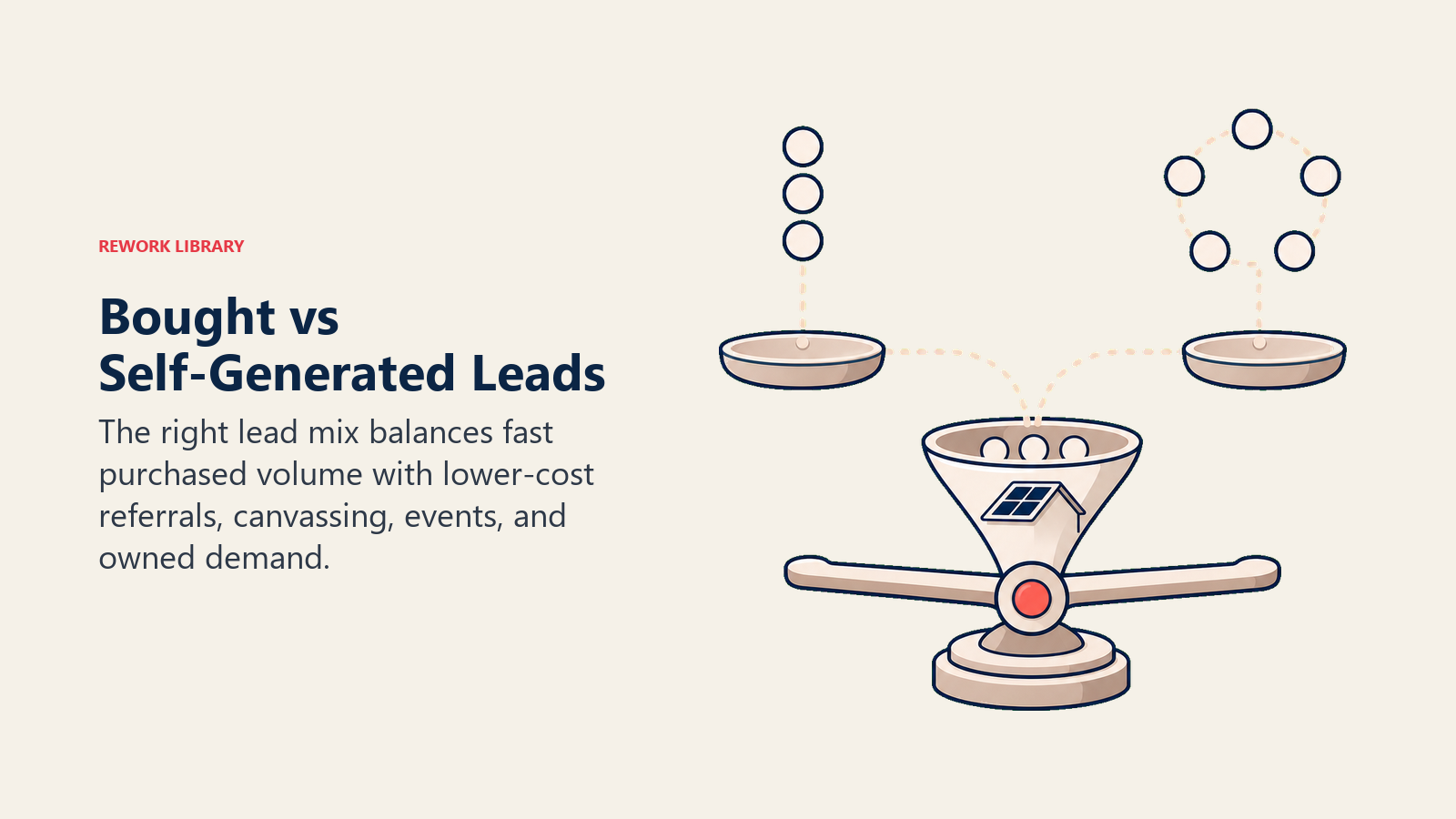
Every solar sales leader has stood at this fork in the road: do we buy leads to scale faster, or do we invest in building channels that generate our own?
The honest answer is that most successful solar companies do both, but the ratio matters enormously. Too dependent on purchased leads and your margins get eaten alive. Too slow to build self-gen channels and you starve the pipeline while competitors scale past you.
This guide breaks down how to evaluate both options objectively, how to calculate what you're actually spending per installed watt from each channel, and how to build a lead strategy that gives you short-term volume without sacrificing long-term economics.
The Basic Tradeoff
Before getting into the math, it helps to understand what you're actually trading between these two models.
Purchased leads give you volume on demand. You pay a vendor (or run your own digital ads), leads show up in your CRM, your setters work them. Speed to market is the main advantage. The disadvantages: higher cost per close, shared leads (the same homeowner may have filled out forms for two or three solar companies), and quality that varies enormously depending on your source.
Self-generated leads take longer to build but perform better. Referrals from existing customers, canvassing in target neighborhoods, community events, your own digital presence: these take months to build into reliable volume. But when they do, the leads close at higher rates, cost less per acquisition, and produce better-quality installs. The homeowner chose you specifically, not just "a solar company."
The fundamental tension: solar sales organizations need pipeline now AND better unit economics over time. Purchased leads solve the "now" problem. Self-gen solves the "over time" problem. You need both working simultaneously.
But to know which to lean on, you first need to understand what purchased leads actually cost, not at the vendor's quoted CPL, but at the closed deal.
Key Facts: Buying vs. Self-Generated Solar Leads
- NREL community research found that referral leads in residential solar cost roughly $500 per customer, compared to industry-wide customer acquisition averages of $2,000 to $4,000 per sale, a 4-to-8x cost advantage for referral channels. (Aurora Solar citing NREL SEEDS study)
- Wood Mackenzie found residential solar customer acquisition costs hit $0.84 per watt in 2026, up 40% from the 2025 five-year low of $0.60 per watt, driven by expiration of the Section 25D federal credit and a contracting market. (Wood Mackenzie, 2026)
- One installer's CRM data showed referral leads converting at a 29% net close rate versus roughly 15% for Google Ads leads and 2 to 5% for purchased marketplace leads, confirming that the economics of self-gen improve dramatically as the funnel deepens. (Sunvoy solar lead source analysis)
What Purchased Leads Actually Cost
Lead vendors will quote you a price per lead. But that number is almost meaningless without understanding your downstream funnel metrics. The U.S. Department of Energy's Q1 2024 solar cost benchmarks put the modeled market price for a residential rooftop system at roughly $3.15 per watt DC, or about $25,000 for a typical 8 kW installation, which means every percentage point of conversion efficiency in your lead funnel translates directly into thousands of dollars of margin.
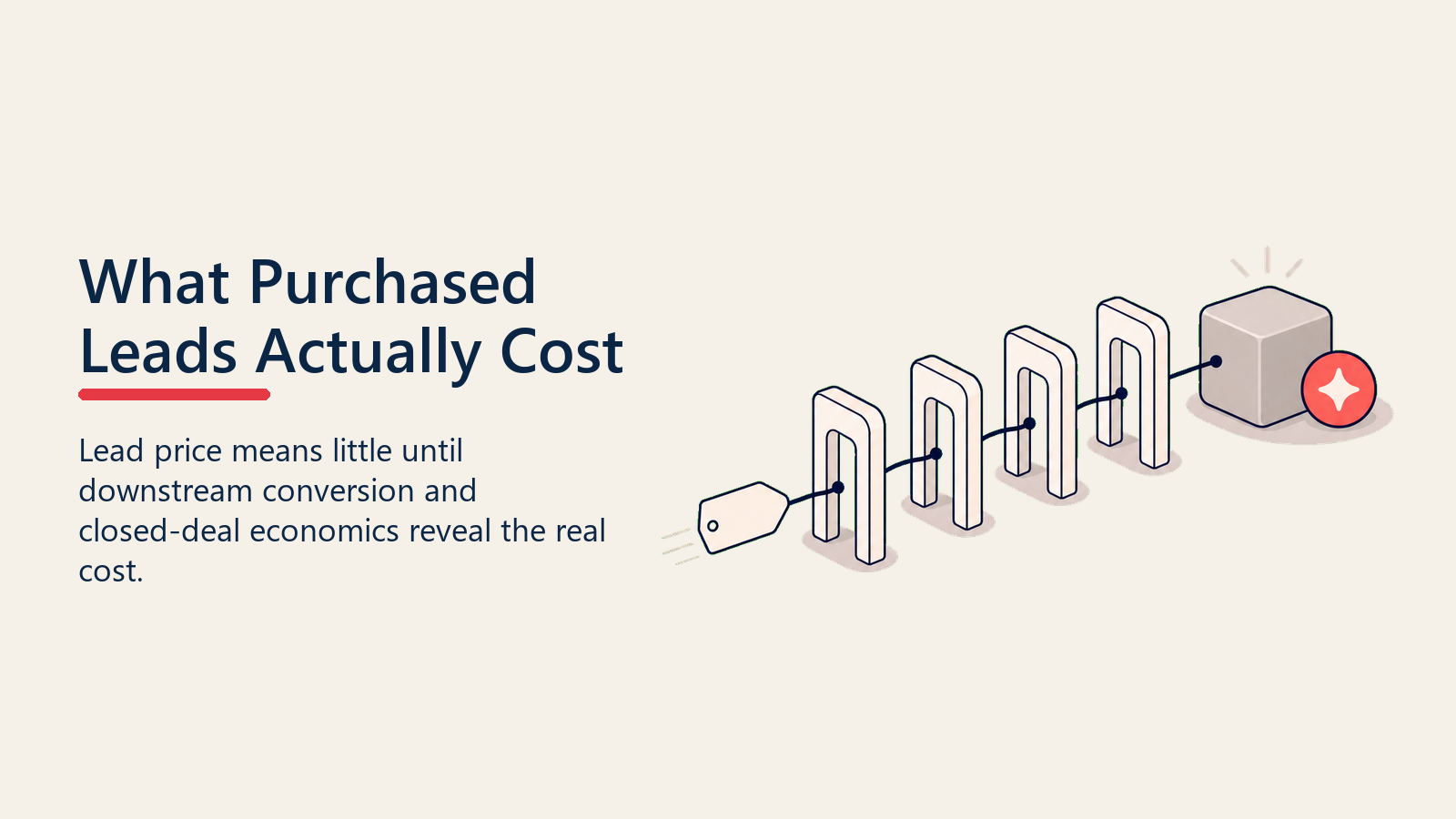
Here's how to calculate true cost per closed deal from purchased leads:
Example: Facebook lead campaign
| Metric | Figure |
|---|---|
| Cost per lead (CPL) | $35 |
| Contact rate (reached within 48 hrs) | 55% |
| Appointment rate (of contacts) | 28% |
| Show rate | 62% |
| Close rate (of appointments run) | 22% |
| Effective close rate on raw leads | 55% x 28% x 62% x 22% = 2.1% |
| Cost per closed deal | $35 / 0.021 = $1,667 |
That's a very different number than $35. Now add your setter's time (roughly 3 to 5 hours of calling per appointment set), your closer's drive and consultation time (2 to 3 hours per appointment run), and your ops overhead, and the real cost per acquisition from Facebook leads in a mediocre campaign can easily exceed $2,500.
Compare that to a referral:
| Metric | Figure |
|---|---|
| Cost per referral (program incentive) | $400 to $800 |
| Contact rate | 90%+ (they gave their info willingly) |
| Appointment rate (of contacts) | 65% |
| Show rate | 82% |
| Close rate (of appointments run) | 38% |
| Effective close rate on raw referrals | 90% x 65% x 82% x 38% = 18.2% |
| Cost per closed deal | $600 / 0.182 = $3,297 (before incentive savings from batch efficiency) |
Wait, referrals look more expensive? Not when you account for the incentive at cost (not retail) and the fact that referral customers themselves become referring customers at a much higher rate. The lifetime value math changes the picture entirely.
The lesson: never compare lead sources on cost per lead. Always compare them on cost per closed deal and, ideally, cost per watt installed. And within purchased leads, quality signals tell you which ones are worth working hard before you ever run the math.
Lead Quality Signals That Predict Conversion
Not all purchased leads are equally bad. And not all self-gen leads are equally good. Within each category, lead quality varies significantly. Here are the signals that predict whether a lead will convert:
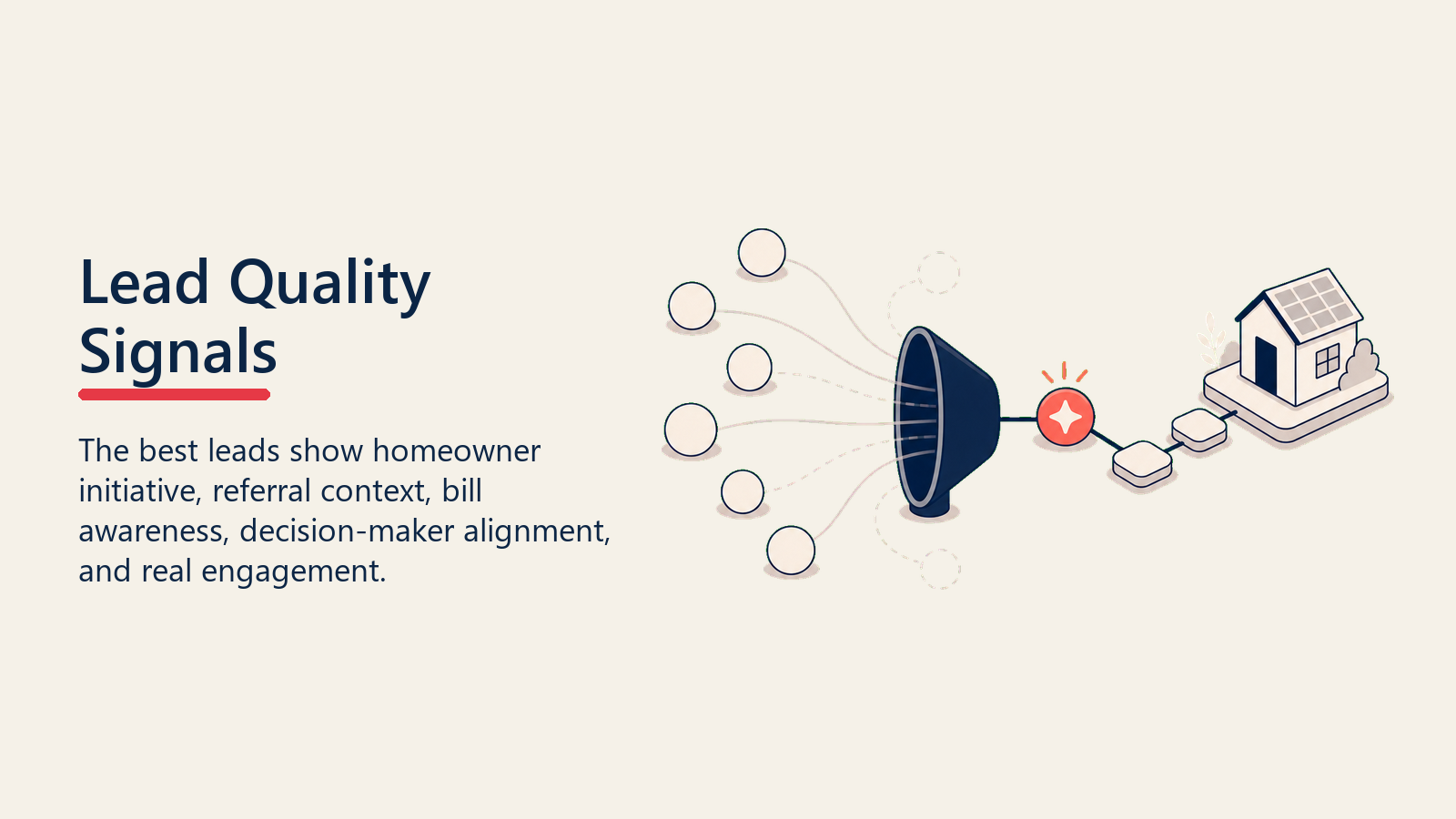
Positive quality signals:
- Homeowner initiated contact (inbound, not outbound)
- Lead is from a referral, even a loose one ("a neighbor mentioned you")
- Homeowner can state their utility bill within a range
- Both decision makers are aware of the inquiry
- The lead came from a channel where the homeowner had extended engagement (watched a video, read a blog post) before filling out a form
Negative quality signals:
- Lead came from a sweepstakes or lead gen site unrelated to energy ("Win a free iPad!")
- Homeowner doesn't remember filling out the form
- Shared lead sold to multiple companies simultaneously
- No specific question asked, just a generic "get a quote" form submission
- Contact information partially wrong (sign of hurried or spam form fills)
Build these signals into your solar lead qualification and pre-screening process. When a lead comes in, your setter should be capturing quality signals in the first 60 seconds and updating the lead record accordingly.
Evaluating Lead Vendors
If you're buying leads, your vendor relationships are as important as any other business partnership. Here's how to evaluate them:
Exclusivity. Will this lead be sold to other solar companies at the same time? Shared leads are worth half as much because you're competing for the homeowner's attention. Exclusive leads cost more per unit but perform substantially better. Ask specifically and get it in writing.
Return policy. Can you return leads for obvious disqualifiers (renters, duplicate contacts, wrong geography)? A reputable vendor offers returns or credits for clearly invalid leads.
Freshness. How old is the lead when it reaches you? A homeowner who filled out a form 30 minutes ago is very different from one who filled it out 72 hours ago. Real-time lead delivery is the standard you should demand.
Source transparency. Where is this vendor generating the leads? Facebook ads, Google search, comparison sites, sweepstakes? This tells you a lot about the likely quality and intent level.
Volume guarantees vs. quality guarantees. Vendors who promise guaranteed volume are easy to find. Vendors who stand behind quality with a replacement or credit policy for low contact rates are the ones worth working with long-term.
Run a pilot before committing volume. Buy 50 to 100 leads from a new vendor, track contact rate, appointment rate, and close rate carefully, and then calculate the true cost per deal before scaling up. Once you know a vendor produces acceptable economics, the question shifts: how do you reduce your dependence on them over time?
The 3-Stage Lead Mix Model: Early-stage companies (under 20 installs/month) should lean 70 to 80% on purchased leads while building self-gen infrastructure. Growth-stage companies (20 to 60 installs/month) should target 50/50. Scale-stage companies (60+ installs/month) should aim for 60 to 70% self-generated. This staged transition protects cash flow in the early phase while systematically reducing long-term dependence on vendors whose pricing you can't control.
Building Your Self-Generation Engine
Self-generated leads take more infrastructure to build, but each channel you add compounds over time.
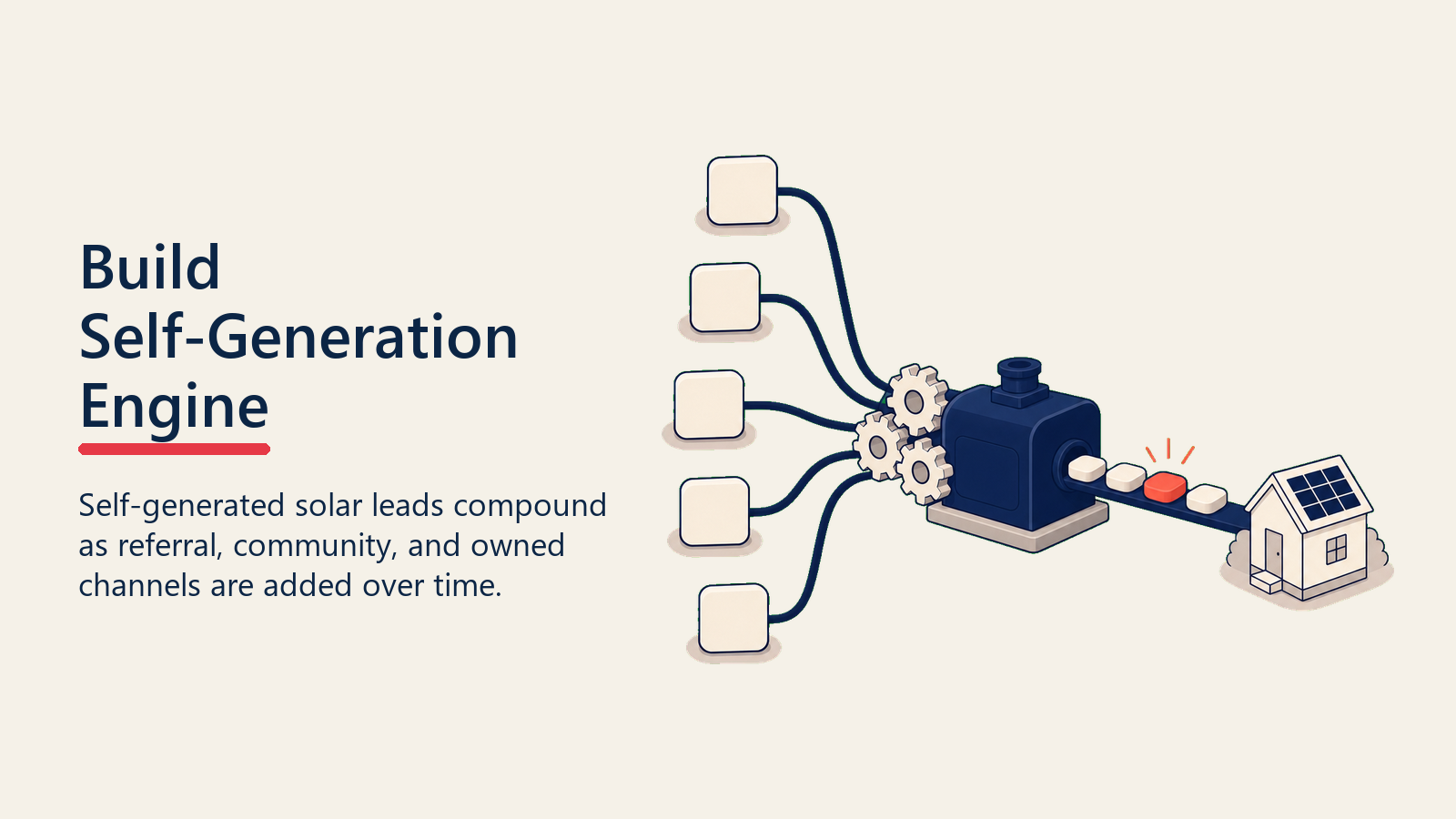
Referral programs. This is the highest-ROI self-gen channel in residential solar. An installed customer who refers a neighbor produces a lead that costs a fraction of a purchased lead and closes at two to three times the rate. See solar referral programs for how to structure incentives and make the ask systematically rather than hoping customers mention you on their own.
Canvassing. Targeted neighborhood canvassing, especially in zip codes where you have installs, is a strong self-gen play for companies that have the team for it. The economics require training and management overhead but produce leads that have had a human interaction before the setter call. See solar canvassing and door-to-door for execution detail.
Community and event marketing. Booths at home shows, sponsorships at neighborhood events, library workshops. High trust, lower volume than digital, but excellent conversion rates because the prospect met a real person. Covered in solar community event marketing.
Organic digital presence. Blog content targeting solar questions your prospects actually ask, Google Business Profile management, and local SEO take 6 to 12 months to build meaningful volume but produce inbound leads with high intent. See solar digital lead generation.
Installer-to-installer pipelines. If you do roofing or HVAC, your field crews can surface solar opportunities. If you don't, building relationships with roofing contractors who encounter homeowners with aging roofs creates a referral pipeline that costs you a small kickback per closed deal.
The Right Ratio for Your Stage
The right mix of purchased vs. self-generated leads changes based on where your company is in its growth curve.
Early stage (0 to 18 months, under 20 installs/month): Lean heavily on purchased leads, 70 to 80 percent of pipeline, to get volume while you build self-gen channels. You don't have enough installed customers for referrals to be significant yet, and your canvassing team is probably small. Accept the higher cost per acquisition as the price of speed.
Growth stage (18 to 36 months, 20 to 60 installs/month): Start shifting the ratio. You should have enough installed customers to drive a real referral program. Double down on canvassing in neighborhoods where you have installs. Event marketing should be running consistently. Target 50/50 or better on self-gen vs. purchased.
Scale stage (36+ months, 60+ installs/month): Best-in-class operators aim for 60 to 70 percent self-generated leads. Not because purchased leads don't work, but because the economics of self-gen at scale make the whole business more profitable. Your pipeline is less dependent on vendor quality and pricing fluctuations.
What Happens When Lead Vendors Get Expensive or Scarce?
Residential solar lead costs have climbed significantly as more companies compete for the same digital inventory. In competitive markets, Facebook CPLs that were $25 to $35 two years ago are now $60 to $90. Shared lead quality has also declined as more vendors enter the space.
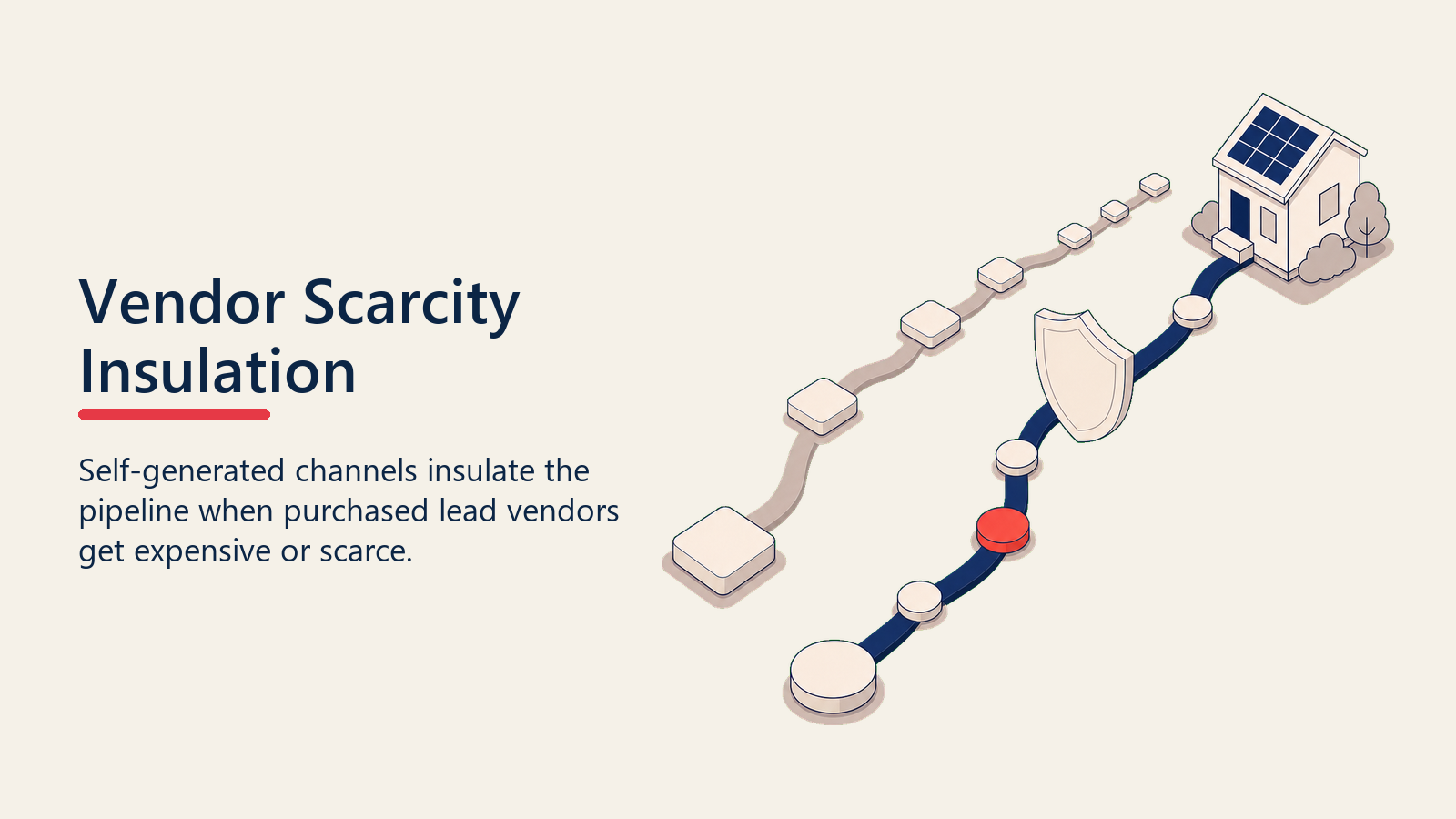
Companies that are heavily dependent on purchased leads feel this immediately. Margins compress. They have to either raise prices, cut rep compensation, or accept lower profitability.
Companies with strong self-gen channels have insulation against this. Their referral and canvassing pipelines don't get repriced by a vendor. Their community reputation keeps producing leads even when digital costs spike.
This is the strongest strategic argument for investing in self-gen early, even when purchased leads seem like the easier path. Think of your self-gen engine as an asset you're building, not just a channel you're running. Every install you do correctly, every referral program you run well, every relationship you build in a neighborhood, adds permanent value to that asset.
Tracking Lead Source Performance Over Time
To make rational decisions about your lead mix, you need consistent data. Set up your CRM to track:
- Lead source on every record (Facebook, Google, referral, canvassing, event, etc.)
- Contact rate by source
- Appointment rate by source
- Show rate by source
- Close rate by source
- System size (kW) by source (some channels skew toward small systems)
- Financing type by source (cash vs. financed varies by channel)
- Cancel rate post-sign by source (some channels produce higher cancellations)
- Referral rate from installed customers by original lead source
Review this data monthly at the sales manager level. The insights you'll find are often counterintuitive. A "cheap" lead source may produce low-quality installs that cancel more often and refer at lower rates, making it actually more expensive than it looks. A "expensive" source like door-to-door may produce better-quality customers who refer and stick.
This connects to the broader topic of solar sales KPIs and metrics. For leads that don't close immediately from any channel, a nurture program keeps them in the pipeline until the timing is right.
Solar companies that concentrate too heavily on purchased leads are building on a vendor's pricing model, not their own. When acquisition costs spike (as they did in 2026 following the Section 25D expiration), companies with strong self-gen channels have insulation. Those that don't feel every price increase directly.
An independent analysis of one established installer's CRM found that Facebook leads produced the weakest conversion of any channel tracked, while referral leads and community-organized Solarize campaigns produced the strongest net close rates. (Source: Sunvoy solar lead source analysis)
Practical Guidance for the Next 90 Days
If you're trying to improve your lead strategy this quarter, here's where to start:
Audit your current lead source mix. What percentage of your closed deals came from each channel last quarter? Most teams are surprised by how dependent they are on one or two sources.
Calculate true cost per deal by channel. Don't accept vendor CPL numbers. Run the full funnel math.
Identify your best-converting channel. Then ask what it would take to double its volume. If it's referrals, invest in the program. If it's canvassing, hire setters. If it's a specific event, do it more often.
Set a 12-month self-gen ratio target. If you're at 30 percent self-gen today, target 45 percent in 12 months. Specific, measurable, achievable.
Diversify across at least three channels. Single-channel dependency is an operational risk. Build redundancy.
The lead strategy question isn't "buy or build?" It's "what's the right blend right now, and what investment do we need to shift the mix toward better economics?" Answer that question with data and a time horizon, and you'll make consistently better decisions about where your lead budget goes.
Related reading:

Senior Implementation Consultant
On this page
- The Basic Tradeoff
- What Purchased Leads Actually Cost
- Lead Quality Signals That Predict Conversion
- Evaluating Lead Vendors
- Building Your Self-Generation Engine
- The Right Ratio for Your Stage
- What Happens When Lead Vendors Get Expensive or Scarce?
- Tracking Lead Source Performance Over Time
- Practical Guidance for the Next 90 Days