Digital Lead Generation for Solar Companies
Turn this article into takeaways for your work.


Each assistant summarizes the article only for you and suggests best practices for your work.
A solar company that runs digital lead generation well can turn ad spend into predictable appointments. One that runs it poorly burns through budget on leads that never answer the phone, won't qualify, and forget they ever filled out a form.
The difference comes down to the funnel. Digital lead generation isn't just about ads. It's the combination of targeting, landing page, lead form, speed of follow-up, qualification, and appointment setting that determines whether digital leads turn into revenue.
This guide covers the full picture, from channel selection to the moment a setter books the in-home appointment.
The Digital Lead Funnel for Residential Solar
Most residential solar digital funnels follow this shape:
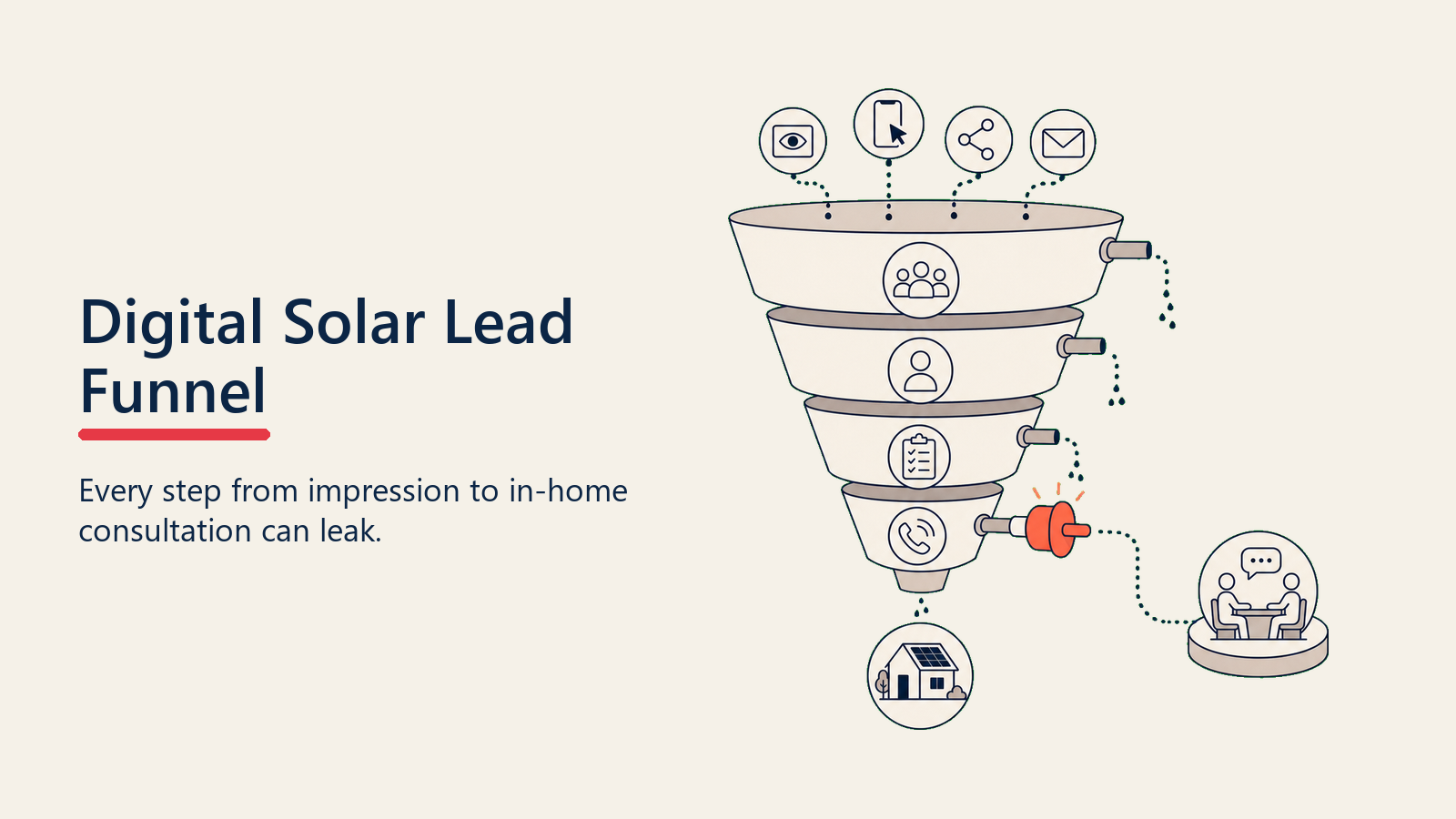
- Ad or organic impression (Google Search, Facebook/Instagram, YouTube, or organic search)
- Click to landing page
- Lead form submission or phone call
- Immediate response and qualification
- Appointment set
- Appointment confirmed
- Closer arrives for in-home consultation
Each step has its own conversion rate, and each step is a place the funnel can leak. A campaign with a 2% click-through rate, a 20% form-fill rate, a 60% phone-answer rate, and a 40% appointment-set rate from qualified contacts isn't broken. It's average. Know your numbers at every step so you know where to fix it.
Key Facts: Solar Digital Lead Generation
- The US average residential electricity bill reached $144 per month in 2024, up from $137 in 2023, giving the financial case for solar more urgency in every sales conversation. (EIA, May 2025)
- The odds of contacting a lead drop 100x when a company waits 30 minutes to call versus 5 minutes, according to the MIT/InsideSales.com Lead Response Management study by Dr. James Oldroyd (2007, 15,000+ leads analyzed).
- Wood Mackenzie found residential solar customer acquisition costs hit a five-year low of $0.60 per watt in 2025 then surged an estimated 40% to $0.84 per watt in 2026 as the Section 25D federal credit expired, making efficient digital funnel management critical to margin. (Wood Mackenzie, 2026)
Before spending on ads, get your response system right. Speed of follow-up will determine whether those leads ever turn into appointments.
Paid Search: Your Highest-Intent Channel
Homeowners who search "solar panels for my home" or "how much does solar cost" are already thinking about it. They're not browsing, they're researching. That's why Google Search ads convert better than most other digital channels in solar: you're intercepting intent.
Keyword strategy for solar PPC:
High-intent buying terms:
- "solar installation [city]"
- "residential solar company near me"
- "solar panels cost [city]"
- "best solar company [city]"
- "home solar [city]"
Research terms (lower intent but higher volume):
- "how does solar work"
- "solar panel cost 2026"
- "is solar worth it"
The highest-converting campaigns focus budget on the buying terms. Research terms can feed top-of-funnel retargeting but shouldn't carry most of your spend.
Match types matter more than most solar marketers think. Broad match can pull in irrelevant traffic fast. Phrase and exact match on your highest-intent terms, combined with a strong negative keyword list (commercial solar, solar wholesale, solar jobs, RV solar), keeps your spend clean.
Local Service Ads (LSAs) have become important in home services, including solar. If your license is verified and your reviews are strong, LSAs appear above standard paid search and can deliver calls directly from the search results page. Worth testing alongside standard PPC.
If paid search is where you capture intent, social media is where you create it in the first place.
Facebook and Instagram: Where You Create Demand
On Google, you capture intent. On Facebook and Instagram, you create it. These platforms let you reach homeowners who haven't searched for solar yet but match the profile of someone who should consider it.
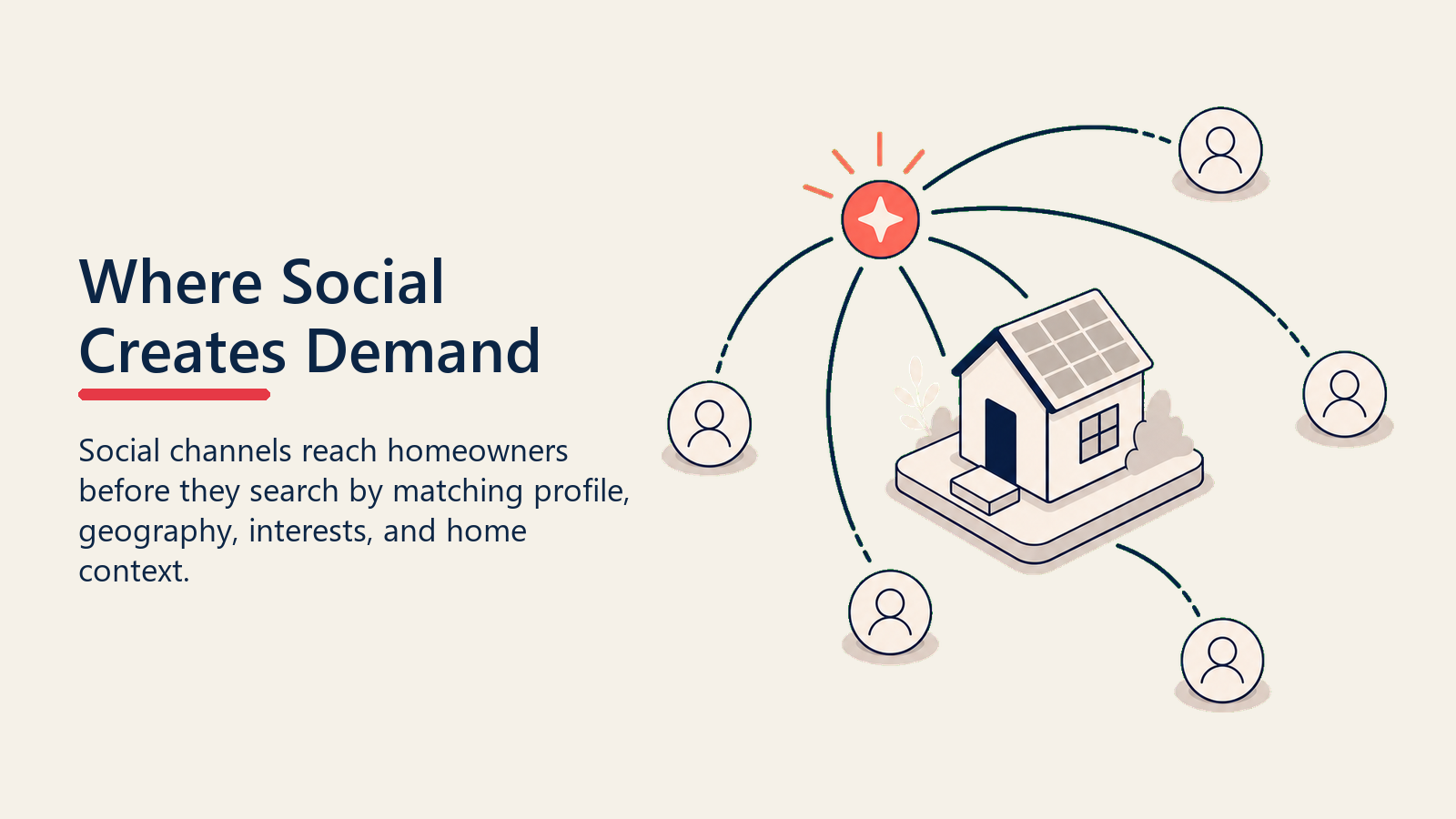
Targeting for residential solar:
- Homeownership status (Facebook's interest and demographic signals)
- Geography restricted to your service area
- Income range (target $65,000+ household income)
- Age range (35-65 tends to convert better for big-ticket home decisions)
- Interest signals: home improvement, energy, sustainability
What works on Facebook:
- Before/after electric bill content ("$280 bill to $22 bill after solar")
- Social proof video featuring a real customer on their property
- Short educational videos (60 seconds or less) explaining how solar financing works
- Neighborhood-specific creative ("Homeowners in [City] are switching to solar")
What doesn't work:
- Stock photo ads with generic headline copy
- Lead forms that ask for too much information upfront
- Ads that send traffic to your homepage rather than a dedicated landing page
Facebook native Lead Ads (forms that fill in contact info from the user's profile) reduce friction but sometimes produce lower-quality leads because it's too easy to submit. Test both native Lead Ads and click-to-landing-page campaigns and measure the downstream quality, not just the form submission rate. And wherever you send that traffic, the landing page will make or break you.
Landing Pages: Where Campaigns Win or Lose
Most solar ads that don't convert have a landing page problem, not an ad problem. Homeowners click, land on a page that looks like a brochure, don't see what they came for, and leave.
A high-converting solar landing page for a homeowner audience has these elements:
Above the fold:
- Clear headline connected to the ad they clicked ("Find out how much solar saves in [City]")
- Specific value statement (not "go green," but "most homeowners in your area cut their electric bill by 70%+")
- Simple form or phone number, visible without scrolling
- Trust signals: company license number, years in business, Better Business Bureau badge
Below the fold:
- How it works in 3-4 steps (simple and non-technical)
- Real customer reviews with names and locations
- Example bill comparison (before and after)
- Answer to the most common first objection ("Is this worth it if I plan to move?")
Form design:
- Ask for minimal information at first: name, phone, email, zip code, and one qualifying question (home ownership is critical)
- Progressive profiling: get more detail after initial submission
- Skip the average monthly bill on the first form. Ask it on the phone instead
Call tracking:
- Use call tracking numbers on every landing page so you know which campaigns drive phone calls versus form fills
- Record calls with consent (check your state law) so you can review quality
All of that landing page work means nothing if the lead sits in your CRM for 30 minutes before anyone calls. Speed of response is where most solar companies lose the funnel.
Speed of Lead Response: The Variable That Controls Everything
The research on lead response time is clear and harsh. Contact rates drop precipitously after five minutes. A lead that doesn't get called within five minutes of submitting a form is dramatically harder to reach than one called immediately. With average monthly electricity bills running $144 in 2024 according to the EIA, homeowners who show interest in solar are genuinely motivated buyers.
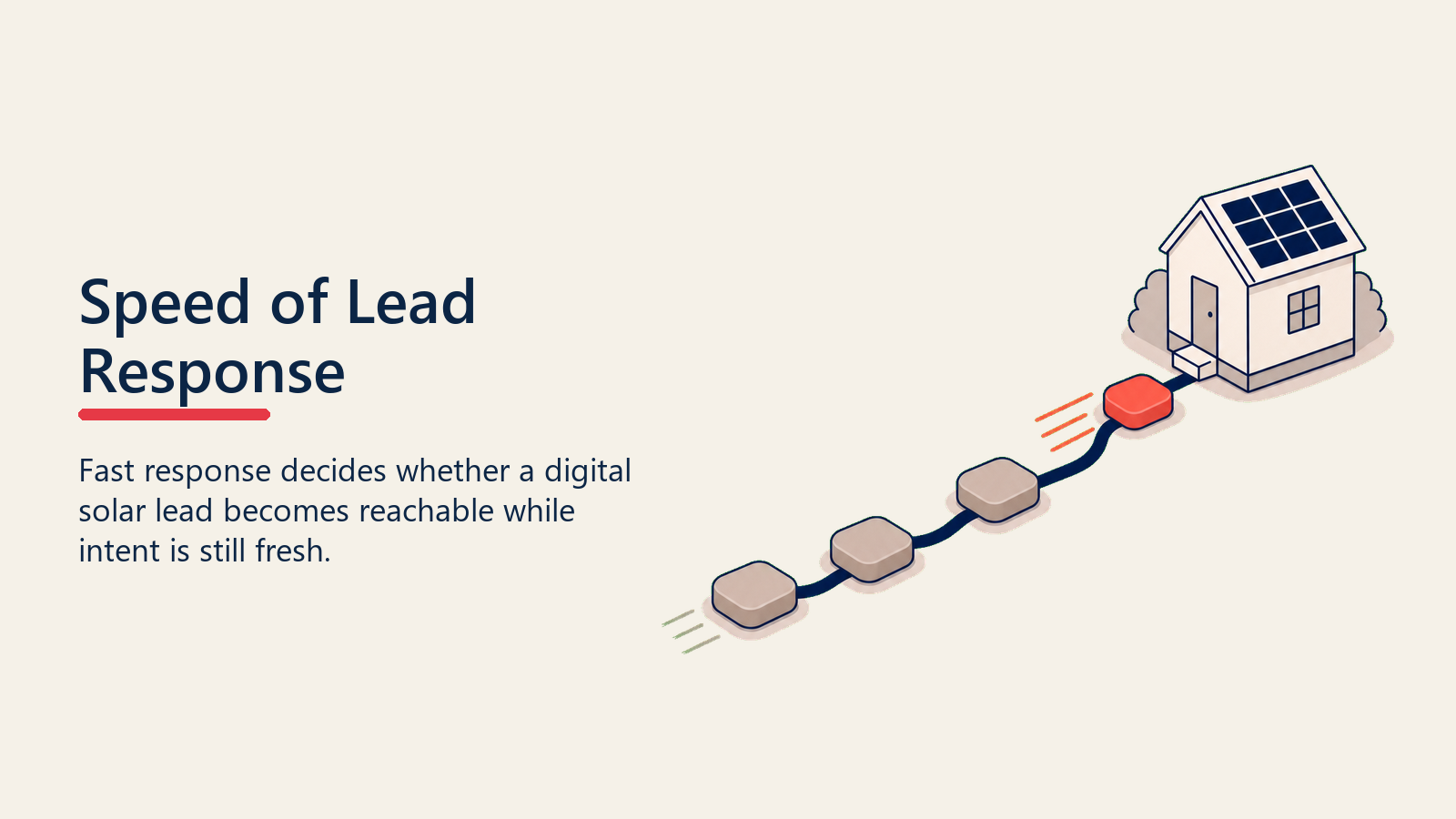
In solar specifically, many homeowners fill out forms during work breaks or after seeing a neighbor's install and their curiosity peaks in that moment. That window is short.
Build your lead response system around this reality:
Immediate auto-response: The moment a form submits, the homeowner gets a text and email confirming you received their information and someone will call within a few minutes. This buys goodwill and keeps them from submitting to a competitor.
Instant call trigger: Your CRM or lead distribution system should alert your call center or setter team within 60 seconds of submission. Automated dialer systems can connect the call automatically.
Multiple contact attempts within the first hour: If the first call doesn't connect, text immediately, call again in five minutes, and call again in twenty minutes. Most lead response systems are too passive in the first hour.
Dedicated first-contact team: Don't rely on closers or field reps to handle digital lead intake. They're busy and inconsistent. Build a team (even if it's two people) whose only job is first contact on inbound leads.
The 5-Minute Response Loop: Auto-confirm (text + email within 60 seconds of form submit) + first call within 5 minutes + second call within 20 minutes if no answer + CRM handoff to setter. Every solar company that builds this four-step loop into their operations converts significantly more digital leads than those relying on ad-hoc follow-up, because the MIT/InsideSales.com study showed that the odds of qualifying a lead drop 21x between the 5-minute mark and the 30-minute mark.
For how to manage lead flow and prioritize follow-up when volume spikes, see lead scoring systems and lead qualification frameworks.
Qualifying the Digital Lead Before Setting the Appointment
Not every digital lead should get a closer's time. Sending a closer to an appointment with a renter, a homeowner with 20% shading, or someone whose bill is $60/month wastes everyone's time and demoralizes your sales team.
The qualification call (or qualifying questions via text) should confirm:
| Qualifier | What to Ask | Minimum Threshold |
|---|---|---|
| Ownership | "Do you own your home?" | Yes (or decision-maker for landlord) |
| Electricity bill | "What's your monthly electric bill usually run?" | $100+/month (varies by market) |
| Roof condition | "Has your roof been replaced in the last 20 years?" | No major damage, 7+ years life |
| Decision making | "Is there anyone else who would need to be part of this conversation?" | Invite all to appointment |
| Credit | "Are you comfortable if we do a soft credit check before the appointment?" | Varies by program |
See solar lead qualification and prescreening for full screening criteria and disqualification protocols.
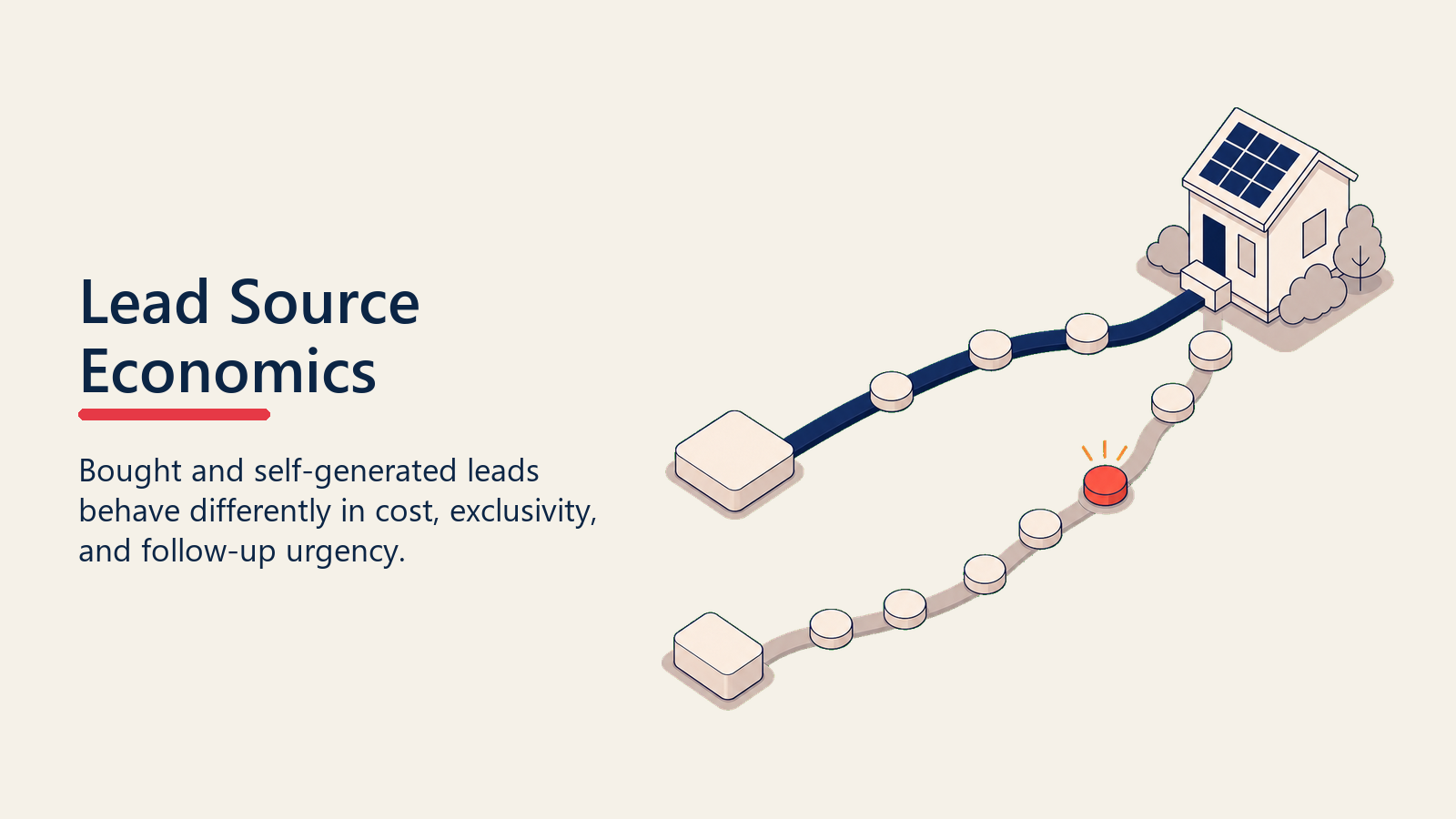
Bought Leads vs. Self-Generated: The Economics
Many solar companies supplement their own digital efforts with purchased leads from aggregators (EnergyPal, EnergySage, Solar-Estimate, etc.). Understanding the difference matters for how you build your pipeline.
Self-generated leads:
- Higher upfront cost (you're paying for all the creative, management, and platform fees)
- Exclusively yours (no competitors calling the same lead)
- Requires in-house expertise or an agency relationship
- Typically close at higher rates because the homeowner engaged with your brand specifically
Purchased leads:
- Lower apparent cost per lead
- Often sold to 3-5 companies simultaneously
- Requires extremely fast follow-up to be first in line
- Lower close rates because the homeowner shopped around
- Easy to scale volume quickly
Neither model is wrong. Most companies at meaningful scale run both. The risk with over-relying on purchased leads is margin compression. If your CPL from aggregators is $50-$80 but your close rate is 8% versus 20% on self-gen, the cost per sale from purchased leads can be 2-3x higher than it looks.
Track cost per appointed lead and cost per closed deal separately for each source. See buying vs. self-generated leads for a full comparison framework.
Does Organic Search Actually Generate Solar Leads?
Paid search gives you immediate volume. Organic search builds a moat. A homeowner who finds you through a blog post answering their question, reads your content, and comes in through an organic form fill is often more qualified and more trusting than one who clicked a paid ad.
Organic solar content that drives leads includes:
- "How much does solar cost in [City/State]?"
- "Is solar worth it in [City]?"
- "Best solar companies in [City]"
- "Solar panel installation process explained"
- "[Utility name] solar incentives"
These are high-intent searches with commercial intent. Ranking for them takes time (6-18 months of consistent content production and link building) but once you rank, the traffic is essentially free.
Don't let the timeline discourage you from starting. A company that invested in SEO two years ago is ranking now and cutting their paid search budget. The right time to start is as early as possible. The DOE's Homeowner's Guide to Solar is one of the top-ranking pages homeowners land on during their research phase, and it lists key terms and questions that closely mirror the queries your content should target.
Retargeting: Re-Engaging the Homeowners Who Left
Most homeowners who visit your landing page don't submit a form on the first visit. They're doing research, comparing options, or just not ready yet. Retargeting brings them back.
Retargeting audiences to build:
- Landing page visitors who didn't submit: Show ads reminding them about the offer, featuring social proof or answering a common objection
- Blog readers: Warmer than cold traffic, retarget with educational content or a soft offer
- Quote page visitors: These are the highest intent. Retarget with urgency-appropriate messaging (incentive deadlines, availability)
- Previous lead list: Upload your existing lead list to Facebook to create a custom audience and serve ads to people you're already in follow-up with
Retargeting CPMs are low (you're targeting a small, already-engaged audience) and conversion rates are high. It's often the most efficient spend in a solar digital budget.
Building Your Digital Lead Dashboard
You can't manage what you don't measure. Build a weekly reporting view that covers:
| Metric | Track It | Target Range |
|---|---|---|
| CPL (cost per lead) | By channel and campaign | Varies by market |
| Contact rate | % of leads reached within 1 hour | 50-70% |
| Qualification rate | % of contacted leads who qualify | 30-50% |
| Appointment set rate | % of qualified leads who book | 50-70% |
| Sit rate | % of appointments that show | 65-85% |
| Close rate | % of sits that sign | 15-35% |
| Cost per appointment | CPL / appointment set rate | Track vs. canvassing |
| Cost per sale | Total spend / sales | Know your ceiling |
The metrics you care most about aren't at the top of the funnel. They're at the bottom. A campaign that has a low CPL but a terrible sit rate and close rate is costing you more per sale than a higher-CPL campaign with better downstream quality.
The metrics you care most about aren't at the top of the funnel. They're at the bottom. Build reporting that connects digital lead quality to closed revenue, and pair it with a feedback loop between your marketing team's lead definitions and your sales team's qualification experience in the field.
When Your Digital Lead Volume Drops
Digital lead generation is sensitive to platform algorithm changes, competitor activity, seasonality, and budget fluctuations. When volume drops, run through this diagnostic before making changes:
- Budget: has anything changed? Reduced spend obviously reduces volume. Check if budgets were adjusted.
- Quality score and ad ranking: Google penalizes landing pages with poor user experience. Check your Quality Scores.
- Competitor entry: New competitors bidding on the same keywords drive up CPL. Check the auction data in Google Ads.
- Seasonality: December and January tend to be slower in most solar markets. Summer is peak season in most regions.
- Landing page changes: Any recent change to your landing page can tank conversion rates. Test changes in isolation.
Digital lead generation is part of a diversified lead mix. A single channel disruption shouldn't stop your pipeline. The solar companies with the most resilient pipelines run at least three channels, optimize each continuously, and never let one channel grow to more than 60% of total volume.
Solar companies that respond to inbound digital leads within five minutes and sustain a structured multi-touch follow-up sequence consistently out-convert companies that rely on a single call attempt, because 80% of sales in the broader B2B context require five or more follow-up touches before closing. (SPOTIO, citing widely cited industry data from GrowthList at spotio.com/blog/sales-statistics)
Learn More: Solar sales KPIs and metrics | Lead setter performance dashboards | Marketing and sales lead quality alignment | Canvassing | Referral programs

Senior Implementation Consultant
On this page
- The Digital Lead Funnel for Residential Solar
- Paid Search: Your Highest-Intent Channel
- Facebook and Instagram: Where You Create Demand
- Landing Pages: Where Campaigns Win or Lose
- Speed of Lead Response: The Variable That Controls Everything
- Qualifying the Digital Lead Before Setting the Appointment
- Bought Leads vs. Self-Generated: The Economics
- Does Organic Search Actually Generate Solar Leads?
- Retargeting: Re-Engaging the Homeowners Who Left
- Building Your Digital Lead Dashboard
- When Your Digital Lead Volume Drops