The In-Home Sales Funnel: How Residential Solar Deals Actually Get Closed
Turn this article into takeaways for your work.


Each assistant summarizes the article only for you and suggests best practices for your work.
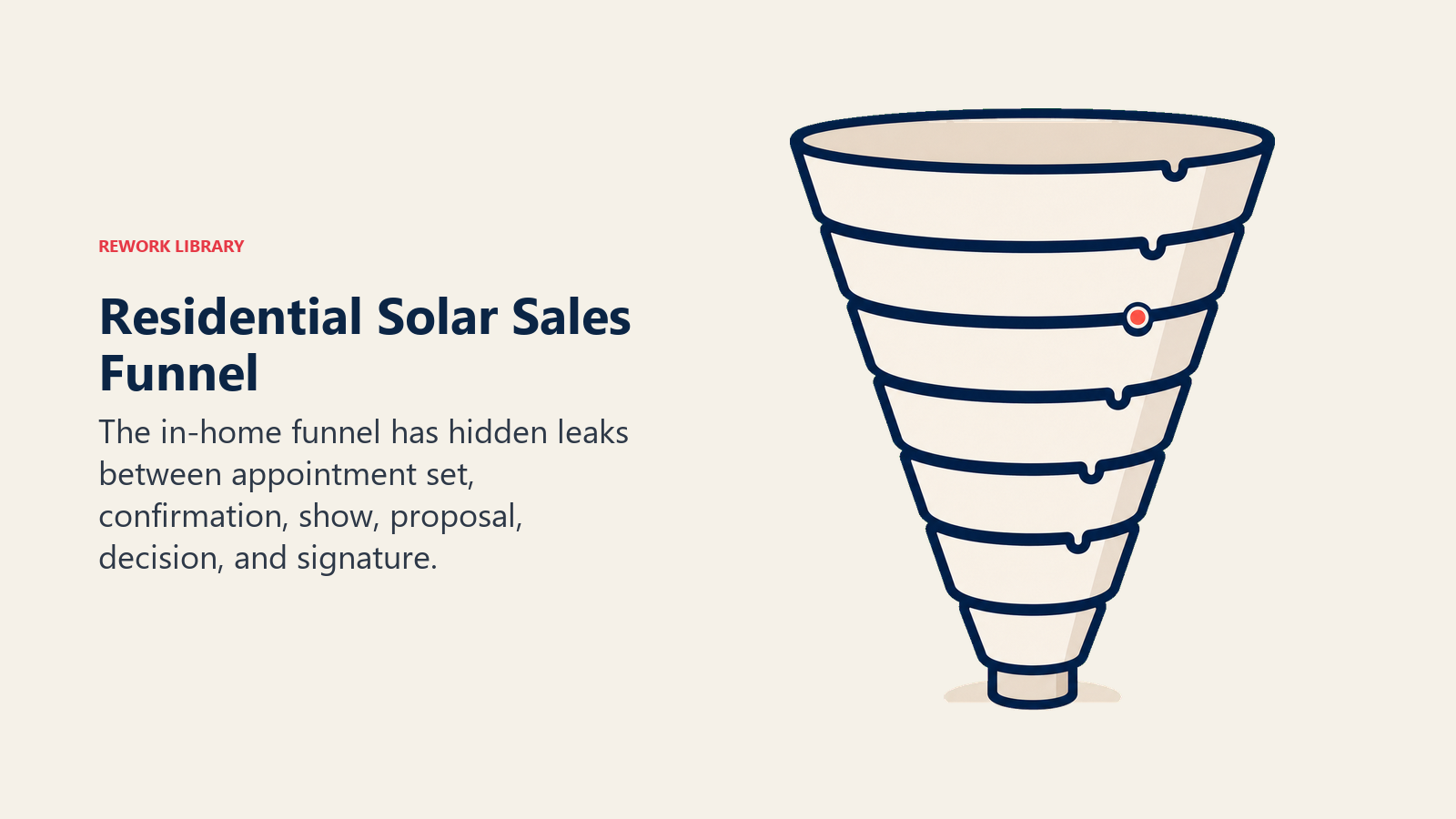
The residential solar in-home sales funnel looks simple on a whiteboard: generate leads, set appointments, run consultations, close deals. In practice, it has seven distinct conversion points, and most sales managers only track the first and the last.
That's why companies with good closer talent still plateau. They fix close rate while the funnel leaks at confirmation, at no-shows, and at the proposal presentation handoff. You can't optimize what you don't measure, and most teams measure two things when they should be measuring seven.
This article maps every stage of the in-home solar funnel, the benchmarks for each conversion, and the specific fixes for the most common leak points.
Why Does the In-Home Solar Funnel Have So Many Hidden Leaks?
Most teams track two numbers: appointments booked and deals signed. Everything between those two points is a black box. The stages in between are where a third to half of potential revenue disappears without anyone noticing.
The Seven-Stage In-Home Solar Funnel
Key Facts
- The EIA reports the average US residential electricity bill was $144 per month in 2024, with wide state-by-state variation. Source: EIA Electricity Sales, Revenue, and Average Retail Price data.
- LBNL's Tracking the Sun 2024 report covers 3.7 million distributed PV installations, the deepest public dataset on US residential solar adoption patterns and system design trends.
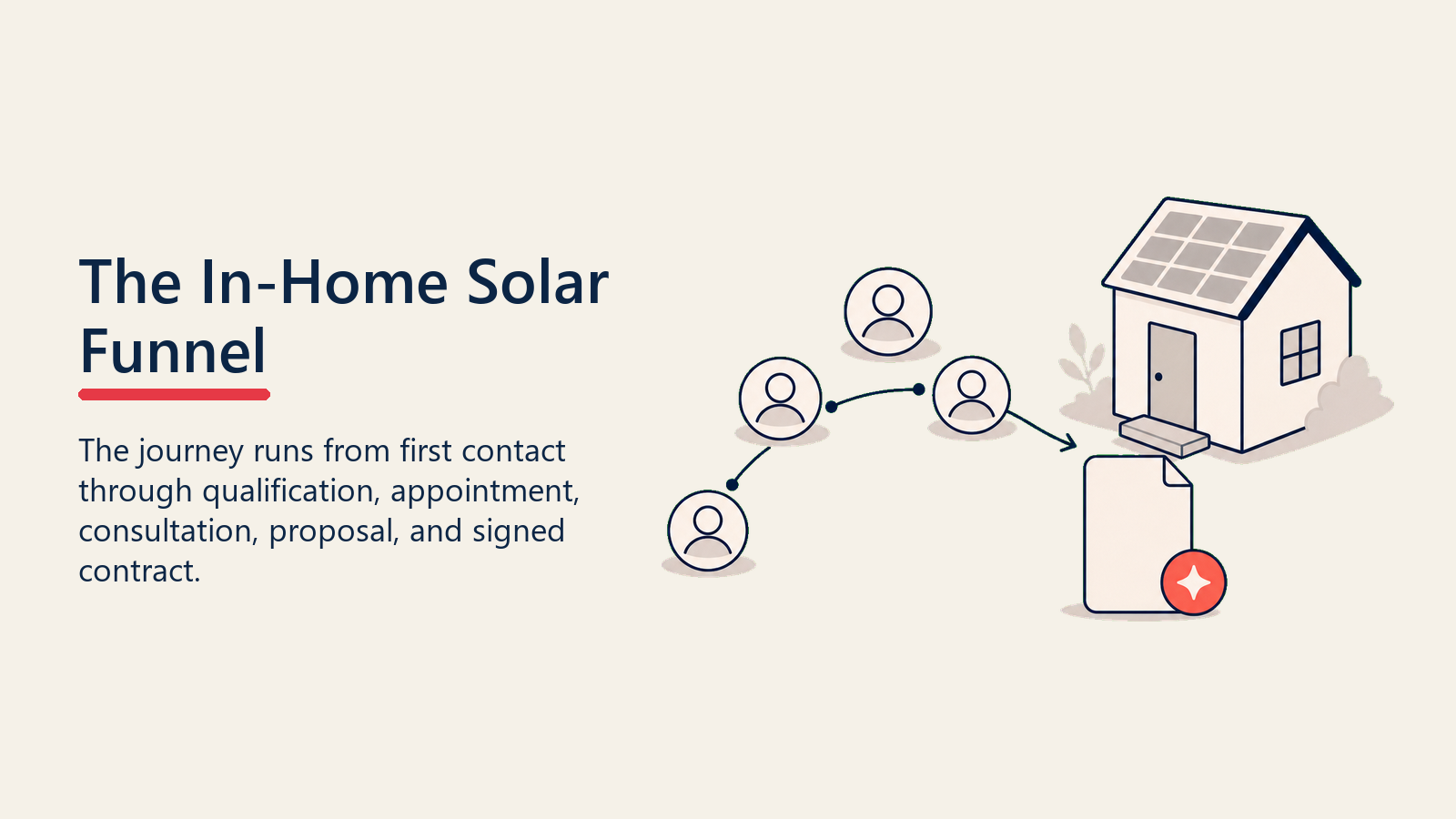
Here's how the full funnel actually works, from initial contact to signed contract:
| Stage | Definition | What it measures |
|---|---|---|
| 1. Lead contact | Raw lead reached and qualified by a setter | Lead quality + initial qualification |
| 2. Appointment set | Homeowner agrees to in-home consultation | Setter skill + lead source quality |
| 3. Appointment confirmed | Homeowner confirms 24-48 hrs before visit | Confirmation process effectiveness |
| 4. Appointment kept (show) | Closer arrives and consultation happens | No-show reduction and prep quality |
| 5. Proposal presented | Closer completes full needs assessment and presents custom proposal | Closer execution quality |
| 6. Decision reached | Homeowner makes a yes or no decision same day | One-call close discipline |
| 7. Contract signed | Deal won and sent to operations | Close rate and financing approvals |
Most companies measure stage 2 (appointment set) and stage 7 (signed contract). The three stages in between are where deals disappear without anyone noticing.
Stage 1: Lead Contact and Initial Qualification
The funnel starts the moment a lead is generated, whether from a door knock, a digital form, a referral call, or a community event. Not every contact is an appointment. Your setter needs to qualify before booking.
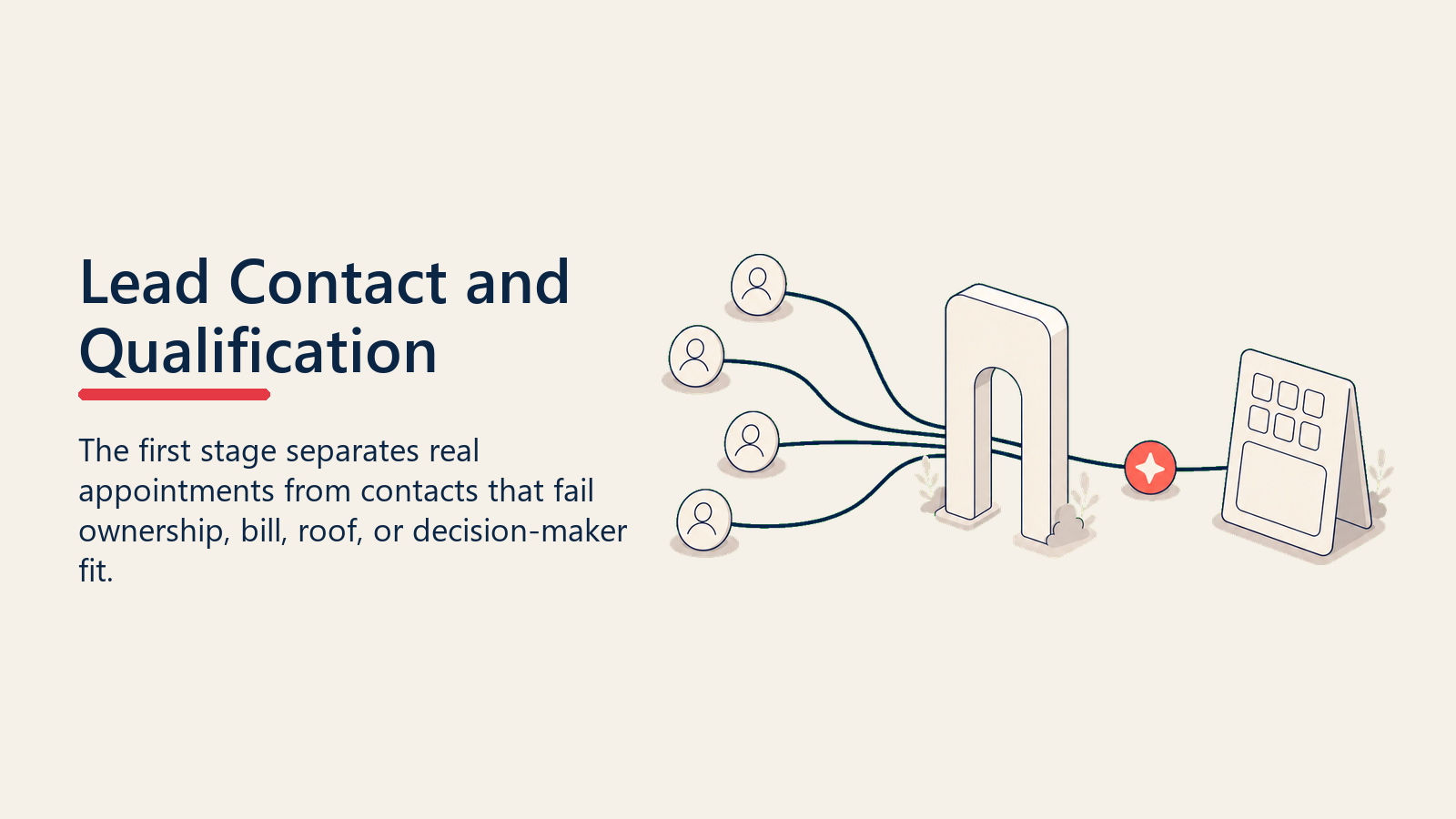
The core qualification questions at this stage:
- Does the homeowner own the property?
- What is their average monthly electricity bill? (Below $100-$120 is usually a red flag for solar economics. The EIA reports the national average residential electricity bill at $144/month in 2024, with significant state-by-state variation that affects whether solar pencils out.)
- Is their roof newer than 15 years? (Older roofs may need replacement first, which changes the deal)
- Will all decision-makers be available for the appointment?
- Are there obvious credit issues that would make financing impossible?
The contact-to-appointment-set rate benchmark for well-qualified channels is 40 to 60 percent for canvassing and referral leads, and 25 to 45 percent for digital leads. If your setter is booking 70 to 80 percent of every contact, they're almost certainly not qualifying, and you'll see it in show rates downstream.
For a full prescreening framework, see solar lead qualification and prescreening.
Stage 2: Appointment Set
When a homeowner agrees to a consultation, the setter should immediately:
- Lock a specific date and time (not "sometime this week")
- Confirm who will be home and that decision-makers will be present
- Set expectations for the visit duration (typically 60-90 minutes)
- Capture email and cell phone for confirmation sequences
- Send an immediate booking confirmation text and/or email
The appointment-set quality largely determines everything downstream. A setter who books any warm body for Tuesday at 6pm is setting up the closer for failure. A setter who books the homeowner and their spouse for Wednesday at 7pm, having confirmed they own the home, have a $180 monthly bill, and understand this is a solar consultation, is feeding the funnel correctly.
Setter to closer handoff explains what information needs to transfer so the closer walks in prepared, not cold.
Stage 3: Appointment Confirmation
This is the most underestimated stage in the funnel. The gap between "appointment set" and "appointment kept" is where a third to half of deals disappear at under-performing companies.
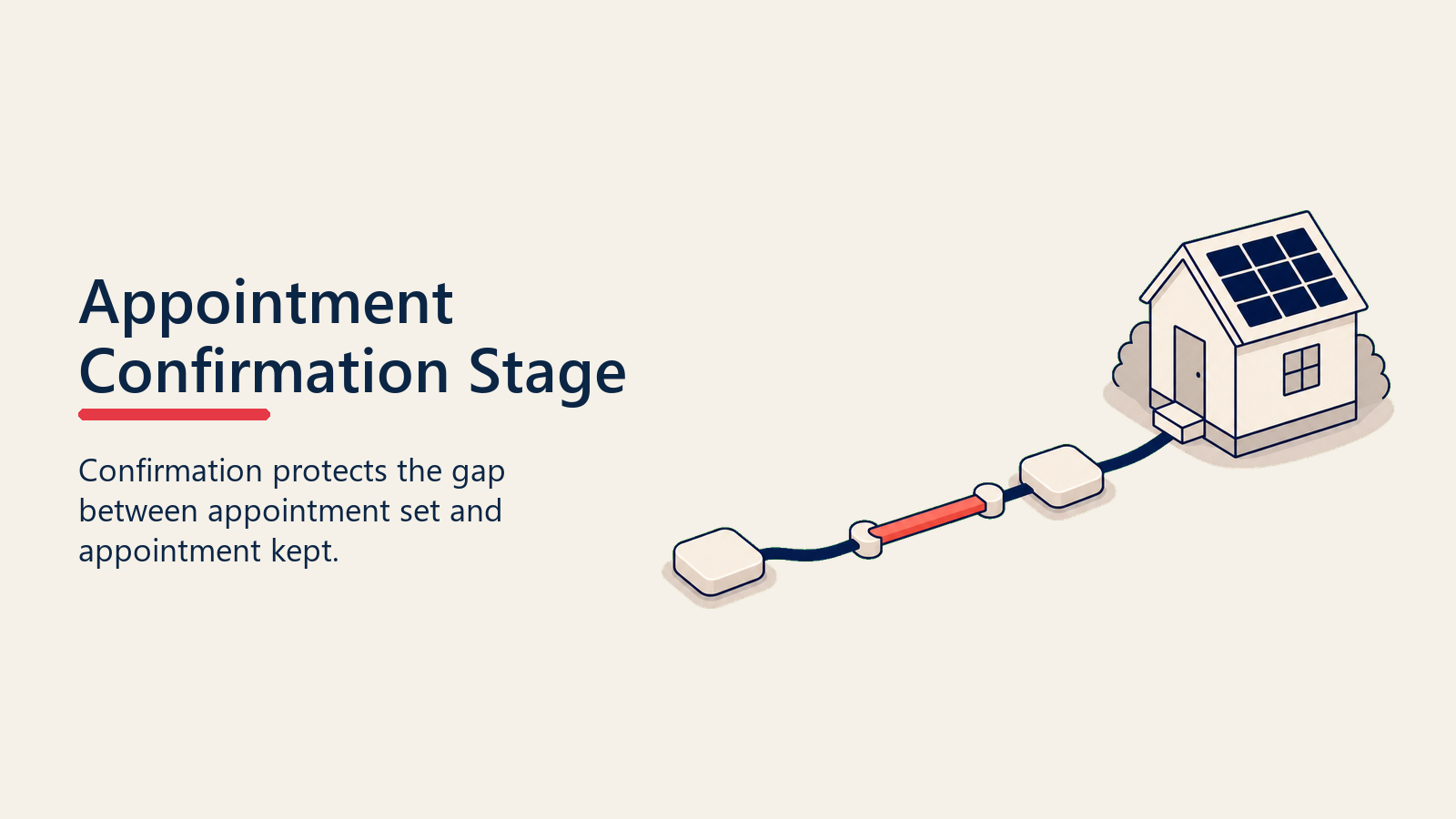
The confirmation process has two goals: give the homeowner a chance to reschedule if their situation changed, and re-engage their interest so the appointment stays top of mind.
A standard confirmation sequence looks like:
- T-48 hours: Personalized text from the closer or from a confirmation team. "Hi [Name], this is [Closer] from [Company] confirming your solar consultation on [Day] at [Time]. Will you and [Spouse] be home?"
- T-24 hours: Follow-up call or second text if no response to the first. Rebook immediately if the homeowner reschedules rather than losing the slot.
- T-2 hours: Quick reminder text. "Heading your way at [Time] today. See you soon!"
- Day-of no response: Attempt a call before driving out. A closer driving 45 minutes to a no-show is expensive. A quick phone check saves the trip.
Companies that run structured confirmation sequences see show rates of 68 to 80 percent. Companies without confirmation processes see show rates of 40 to 55 percent. On a team running 80 appointments a month, that gap is 16 to 20 additional consultations.
Get the confirmation sequence right and your closer walks into a room where the homeowner expected them. What happens in the first ten minutes of that room is Stage 4.
Stage 4: The Consultation (Show Rate)
The closer arrives. The show rate benchmark for well-run residential solar teams is 65 to 80 percent of set appointments. Under 60 percent signals a qualification or confirmation problem. Over 80 percent is excellent and usually indicates strong setter quality.
What happens in the first 10 minutes of the consultation matters as much as the closing technique:
- Greet all decision-makers. If the spouse isn't home, a closer who proceeds anyway is probably wasting two hours. The decision-maker objection ("I need to talk to my husband") kills more deals than any other single factor.
- Set the agenda. "Here's what we're going to cover today and how long it'll take." It reduces anxiety and keeps the closer in control.
- Ask questions before talking. The closer who starts with a 20-minute product pitch loses the homeowner by the time they get to price. The closer who spends the first 15 minutes asking about the homeowner's energy bills, their goals, and what they know about solar is gathering the ammunition for a targeted proposal.
Stage 5: Proposal Presentation
The proposal is the pivot point of the consultation. A great proposal is custom, not generic. It uses the homeowner's actual utility bills, shows the specific offset percentage for their home, includes a 25-year savings projection, and presents financing options in plain language.
The most common presentation failures:
- Leading with system size or panel specs. Homeowners don't buy kilowatts. They buy bill savings and energy independence.
- Generic savings projections. "Most homeowners save 20-30 percent" is not a proposal. "Based on your $210/month bill, this system will offset about 94 percent of your usage, saving you roughly $1,900 in the first year at your current utility rate" is a proposal.
- Presenting price before value. Price lands well only after the homeowner understands what they're getting and why it matters to them. Presenting system cost before building the savings case triggers sticker shock and objections.
The best closers treat the proposal presentation as a value selling exercise, not a spec sheet review. That means connecting system benefits to the specific motivations the homeowner revealed earlier in the conversation.
The proposal presentation stage conversion should be near 100 percent: if the closer got into the home and ran a needs assessment, they should present a proposal every time. If closers are leaving without presenting, it's a training issue or a qualification issue.
Once the proposal lands, the funnel splits. Some companies push for the decision in the same room. Others plan for a second visit. The two models have very different math.
How Does the Decision Stage Differ Between One-Call Close and Multi-Visit Models?
This is where the funnel logic diverges most sharply between companies. Some teams push hard for same-day close. Others plan for a two-visit model. Both can work, but each has a different funnel shape:
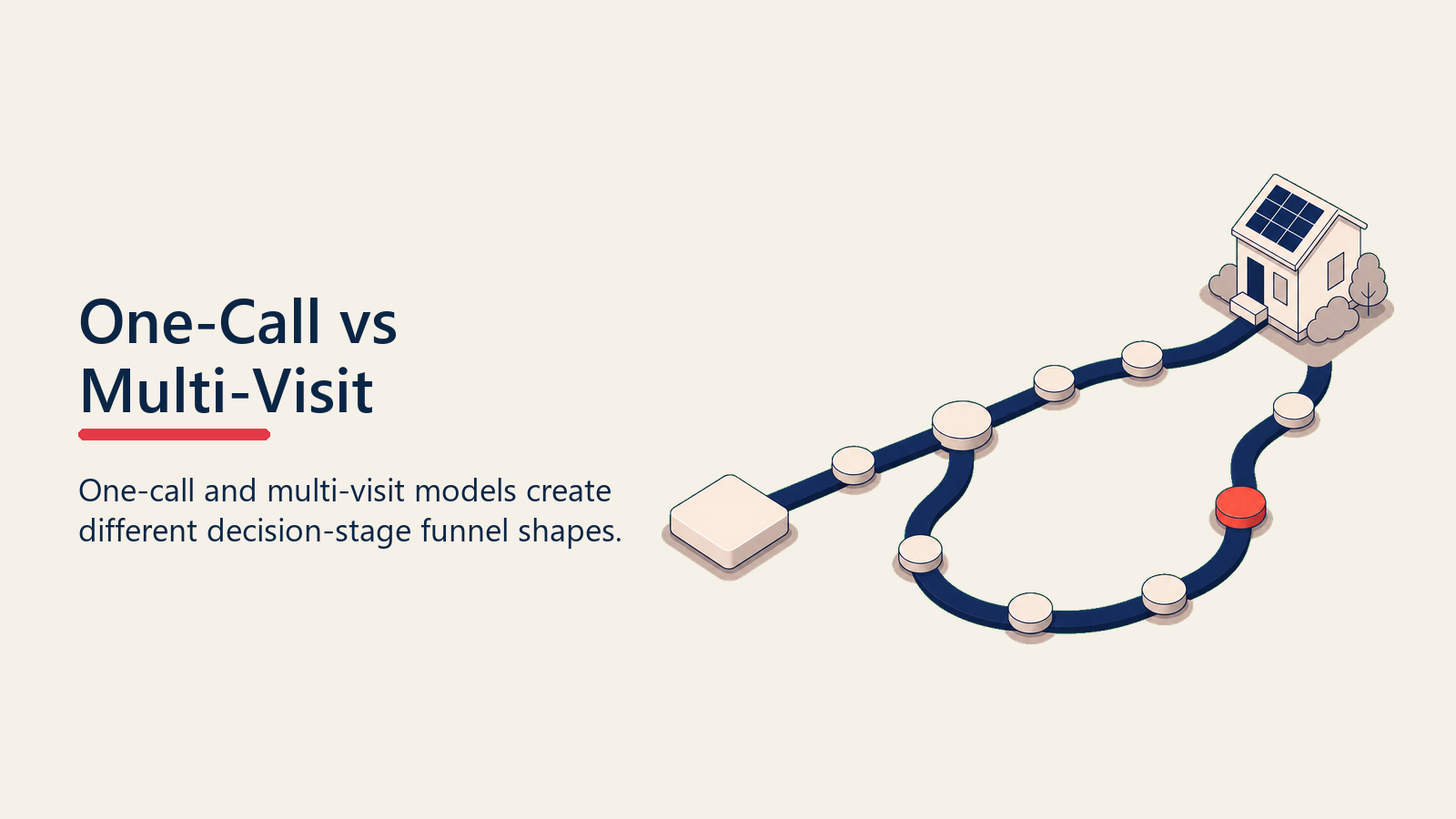
| Model | Stage 6 (decision) rate | Stage 7 (signed) rate | Notes |
|---|---|---|---|
| One-call close | 70-85% of presented | 25-40% of presented | Higher attrition between visits is avoided |
| Two-visit | 30-50% same day | 15-30% same-visit, 10-20% on second visit | Better for complex situations; slower cycle |
The one-call close is the industry default for residential solar because the longer the gap between consultation and decision, the more likely the homeowner is to talk themselves out of it, get a competing quote, or just lose momentum.
Urgency tactics are common at this stage, but they carry reputation risk if they're manufactured. The ethical version of same-day urgency is real: utility rate increases that are scheduled, incentive programs with actual deadlines, or financing promotions that end at a specific date. See urgency and same-day close ethics for where the line is.
The one-call close versus multi-visit comparison, with conversion benchmarks and team structure implications, is linked in the Learn More section.
Stage 7: Contract Signed
Winning a verbal "yes" is not a closed deal. The contract has to be signed, the financing application has to be submitted, and the credit decision has to come back approved.
The common failure points at this final stage:
- Financing denials: If a homeowner is pre-qualified during setting but then denied at final application, it's usually because the setter's credit check was too shallow. Credit-aligned setters who use a soft pull screening tool upstream reduce this. See sales and finance credit alignment.
- Scope creep and buyer's remorse: A homeowner who signed under pressure and wakes up uncertain is a cancellation. The confirmation call the day after signing, not 48 hours later, is the fix.
- Paperwork and DocuSign friction: Every minute of friction between verbal close and signed contract is a window for doubt. Closers who use mobile proposal tools and complete the DocuSign on-site have higher contract completion rates than closers who email the paperwork later.
What Does Typical Funnel Conversion Math Look Like?
The Seven-Stage Solar Funnel Model: a diagnostic framework that names and tracks every discrete conversion point from lead contact to signed contract in a residential solar in-home sale. The seven stages are: Lead Contact, Appointment Set, Appointment Confirmed, Appointment Kept (Show), Proposal Presented, Decision Reached, and Contract Signed. Each stage has a benchmark conversion rate; the widest gap between your actual rate and the benchmark identifies the highest-leverage fix.
Here's what the math looks like at a mid-sized solar company running 200 leads per month:
| Stage | Conversion rate | Volume |
|---|---|---|
| Leads generated | 100% | 200 |
| Appointments set | 45% | 90 |
| Appointments confirmed | 85% | 77 |
| Appointments kept (show) | 72% | 55 |
| Proposals presented | 97% | 53 |
| Decisions reached (same-day) | 75% | 40 |
| Contracts signed | 32% close rate on shows | 18 |
18 deals from 200 leads is a 9 percent lead-to-close rate. That's a typical benchmark for a mid-performing team.
Now improve show rate to 80 percent and same-day decision rate to 82 percent (both achievable with process):
| Stage | Improved rate | Volume |
|---|---|---|
| Leads generated | 100% | 200 |
| Appointments set | 45% | 90 |
| Appointments confirmed | 88% | 79 |
| Appointments kept | 80% | 63 |
| Proposals presented | 97% | 61 |
| Decisions reached | 82% | 50 |
| Contracts signed | 35% | 22 |
22 deals. A 22 percent increase without a single additional lead. That's what funnel optimization buys.
Quotable Nuggets
"Most companies measure two things when they should be measuring seven. You can't optimize a stage you don't track, and the stages between set and close are exactly where deals disappear."
"Improving show rate from 72% to 80% and same-day decision rate from 75% to 82% on 200 leads produces 22 deals instead of 18. That's a 22 percent lift without adding a single lead or rep."
"The confirmation process has two goals: give the homeowner a chance to reschedule, and re-engage their interest so the appointment stays top of mind. Structured confirmation sequences produce show rates of 68 to 80 percent versus 40 to 55 percent for teams without one."
Where to Fix First
When diagnosing your funnel, run the numbers at each stage and find the biggest percentage gap versus benchmark. That's your fix:
- Set rate below 40%: Setter quality or lead source mismatch
- Confirmation rate below 80%: No structured confirmation sequence
- Show rate below 60%: Qualification failures, confirmation gaps, or wrong demographic targeting
- Proposal-to-decision below 60%: Weak close training, missing urgency, price presented before value
- Close rate below 20%: Proposal quality, financing knowledge, or objection handling gaps
Fix the largest gap first. It compounds fastest.
The in-home solar funnel rewards precision. You don't need to generate twice as many leads to close twice as many deals. You need to find and fix the stage where your volume is disappearing.
Learn More
- Solar pipeline and funnel analytics
- Lead qualification frameworks
- Confirming and prepping the appointment
- No-show and reschedule reduction
- In-home consultation framework
- Building a custom solar proposal
- One-call close versus multi-visit
Frequently Asked Questions about The In-Home Sales Funnel
What is the in-home solar sales funnel?
It is a seven-stage conversion model that tracks a residential solar lead from first contact through signed contract. The stages are: lead contact, appointment set, appointment confirmed, appointment kept, proposal presented, decision reached, and contract signed. Each transition has a measurable conversion rate.
What is a good show rate for residential solar appointments?
A well-run team with strong qualification and a structured confirmation sequence should hit 65 to 80 percent. Below 60 percent points to a qualification failure, a confirmation gap, or both. Above 80 percent is excellent and usually reflects tight setter screening.
What is a realistic close rate for residential solar?
Industry benchmarks run 22 to 38 percent of completed consultations. Referral leads typically close at 35 to 55 percent. Door-to-door self-gen leads fall at 25 to 35 percent. Purchased digital leads land at 15 to 25 percent. Tracking close rate by lead source, not just overall, is essential.
Why do solar companies struggle with no-shows?
The most common causes are unqualified bookings (renters, low electric bills, absent decision-makers), no structured confirmation sequence, and setters paid per appointment set rather than per sit. All three are fixable with process, not just better setters.
What happens between verbal yes and signed contract?
This is where financing denials, buyer's remorse, and DocuSign friction kill deals. The best closers complete the contract on-site with mobile tools rather than emailing paperwork, and make a confirmation call the morning after signing rather than waiting 48 hours.
How many leads does a mid-performing team need to close 18 deals a month?
At a 9 percent lead-to-close rate (typical for a mid-performing team), you need roughly 200 qualified leads. Improving show rate and same-day decision rate to high-performing benchmarks lifts that to 22 deals from the same 200 leads.
What causes close rates to drop without any change in lead volume?
The most common culprits are new reps ramping slowly, a change in lead source mix toward lower-quality channels, a financing change that makes proposals harder to present clearly, or the loss of a high-performing closer whose volume was masking the team's actual average.

Senior Implementation Consultant
On this page
- Why Does the In-Home Solar Funnel Have So Many Hidden Leaks?
- The Seven-Stage In-Home Solar Funnel
- Stage 1: Lead Contact and Initial Qualification
- Stage 2: Appointment Set
- Stage 3: Appointment Confirmation
- Stage 4: The Consultation (Show Rate)
- Stage 5: Proposal Presentation
- How Does the Decision Stage Differ Between One-Call Close and Multi-Visit Models?
- Stage 7: Contract Signed
- What Does Typical Funnel Conversion Math Look Like?
- Quotable Nuggets
- Where to Fix First
- Learn More