Setter to Closer Handoff: How Solar Teams Stop Losing Deals Between the Call and the Door
Turn this article into takeaways for your work.


Each assistant summarizes the article only for you and suggests best practices for your work.
A setter books an appointment. A closer drives out to run it. Somewhere between those two moments, the deal loses momentum before anyone even knocks on the door.
This is the handoff problem. It's quiet, it's costly, and most solar companies don't measure it at all. They track leads booked and deals closed, but not what happens in between. The result: closers walk into appointments with missing context, homeowners who don't remember why they agreed to the visit, and pitches that start from scratch instead of building on what the setter already learned.
The setter-to-closer handoff isn't a soft process issue. It's a revenue issue. Fix it and your show rate goes up, your one-call close rate improves, and your closers spend less time recovering and more time advancing.
Why the Handoff Breaks Down
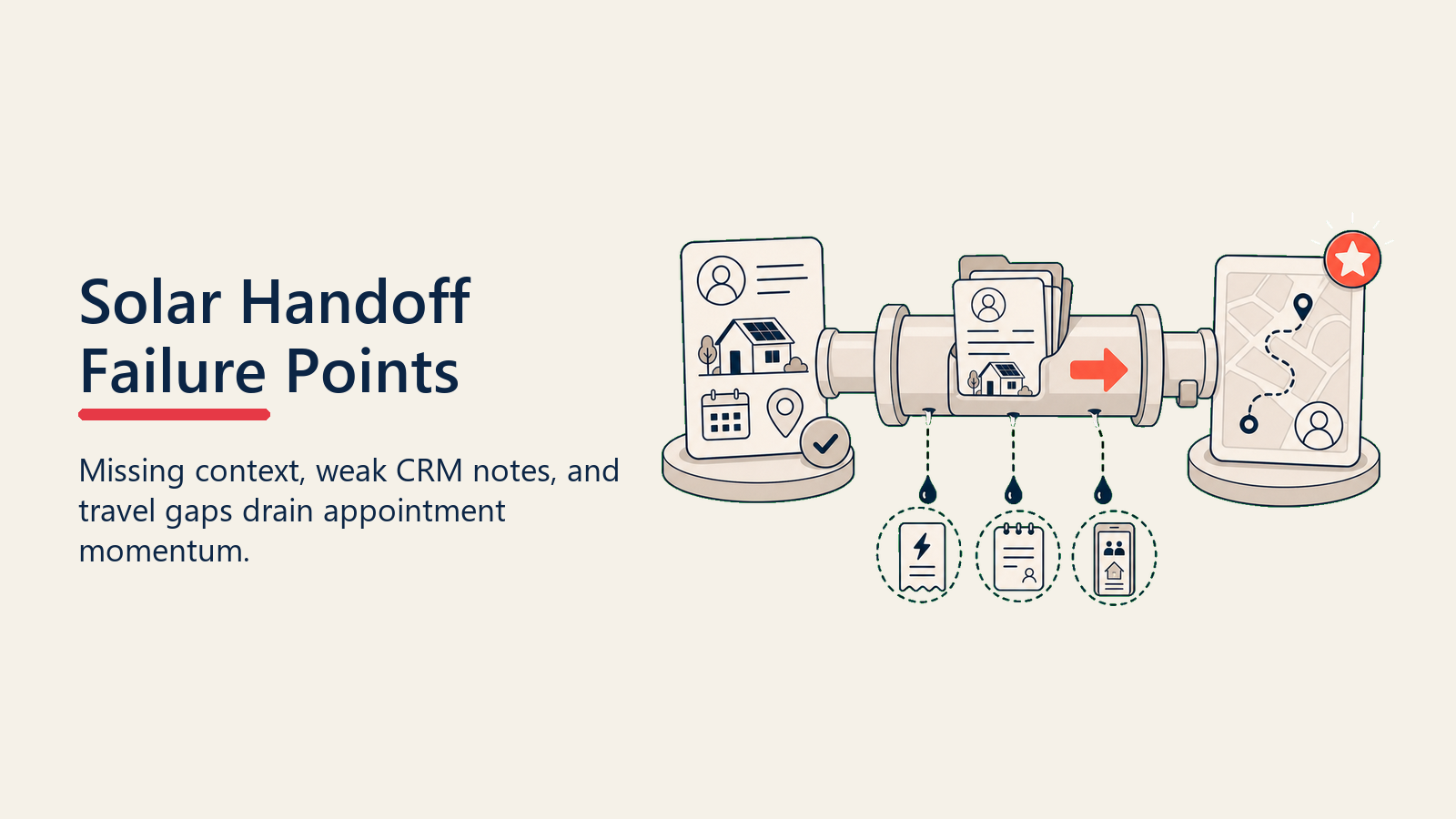
Most handoff failures come from one of three sources.
Key Facts:
- Field sales reps spend just 44% of their working hours on active selling; the rest goes to admin, CRM updates, and travel, according to SPOTIO's State of Field Sales 2026
- The average US residential electricity bill was $144/month in 2024, per EIA's 2024 Average Monthly Bill data, a figure that anchors the bill-pain conversation setters surface on every booking call
- Referral appointments close at roughly 29% net vs. roughly 15% for purchased lead appointments, per Sunvoy's solar lead source analysis, meaning context the setter captures about why a homeowner agreed directly predicts the close
Speed over substance. Setters are often compensated on appointments booked, so there's structural pressure to get off the phone fast. Intel that matters, like whether the homeowner mentioned a tight budget, a skeptical spouse, or a neighbor who already went solar, doesn't make it into the CRM because there's no field for "things to watch out for." SPOTIO's field sales research found that field reps spend just 44% of their time on active selling, with CRM data entry and administrative overhead consuming the rest. That imbalance pushes setters to shortcut documentation rather than protect the handoff.
CRM that wasn't built for this. Generic CRM fields (name, address, appointment time) tell the closer who they're visiting. They don't tell them what the setter learned about motivation, decision-making authority, current utility bill size, or prior solar conversations. That context lives in the setter's head, and it evaporates.
No formal handoff moment. When a setter books an appointment and moves on to the next call, there's no transfer of ownership. The closer gets a calendar invite, maybe a note, and is expected to figure out the rest. That's not a handoff. It's a drop.
What Does a Closer Actually Need Before the Appointment?
Before a closer walks through someone's door, they need four categories of intel.
Homeowner profile. Who lives there, who makes the financial decisions, and whether the other decision-maker will be present. If a spouse or partner was mentioned during the set call but won't be home, the closer needs to know that before driving 40 minutes out. A one-legged appointment is a hard close.
Motivation and pain points. Why did this homeowner agree to the appointment? Was it the utility bill? A neighbor's system? Environmental reasons? Concern about rising electricity rates? The EIA reports the average U.S. residential electricity bill reached $144 per month in 2024, and rates continue rising, which means utility cost anxiety is a genuine and common motivator that the closer can speak to directly when they know it was raised during the set call. The closer who knows "she mentioned her last bill was $340 and she's furious about it" walks in with a completely different opening than one who knows nothing.
Objections already surfaced. If the homeowner raised concerns during the set call, whether about financing, the company's track record, or roof condition, the closer needs that on record. Hearing an objection for the first time at the kitchen table is worse than hearing it in a briefing note.
Practical logistics. Roof type, estimated age, shading situation, whether there's an HOA, and any specifics the homeowner mentioned. This isn't just useful for the proposal. It tells the closer what to look for when they pull up to the house.
The Intel Capture Framework
The fix starts with a structured intake during the set call. Setters shouldn't be reading a checklist aloud, but they should be working through a set of questions that surfaces the right information naturally.
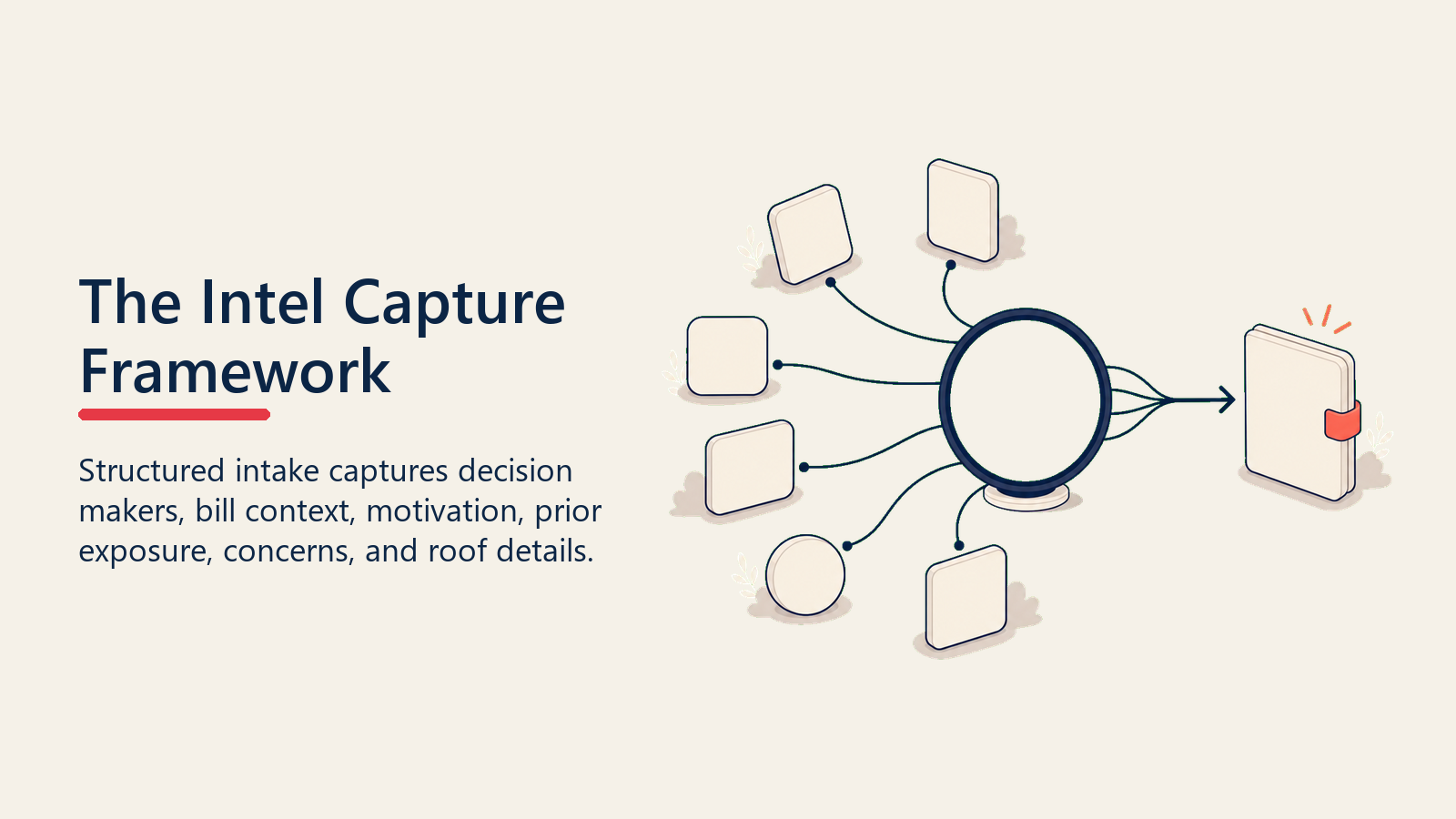
| Category | What to Capture |
|---|---|
| Decision makers | Who owns the home? Will all decision-makers be present at the appointment? |
| Utility bill | Approximate monthly bill, provider, any recent spikes |
| Motivation | What prompted them to agree? What's their primary concern? |
| Prior solar exposure | Have they talked to other companies? What happened? |
| Objections/concerns | Anything that came up on the call that could slow the close |
| Roof and home details | Roof age, type, any known issues, HOA status |
| Soft signals | Tone, level of engagement, any skepticism from a third party on the call |
The best setters treat the last two minutes of a booking call like a debrief. They restate what they heard, confirm the appointment, and then add to the CRM immediately before moving to the next dial. Not after the shift. Immediately.
CRM Handoff Fields That Actually Work
Most CRM setups for solar companies have the basics: name, address, phone, appointment time. That's not enough for a real handoff.
Build a dedicated handoff section in your CRM with these fields:
- Primary motivation (free text, 1-2 sentences)
- Decision-maker situation (all present / one missing / unclear)
- Estimated monthly utility spend
- Objections raised during set (dropdown or free text)
- Prior solar conversations (yes / no / details)
- Setter confidence level (hot / warm / uncertain)
- Closer notes field (for post-appointment feedback to the setter)
The last field matters. When closers can leave notes after running an appointment, setters start to see what intel was useful, what was missing, and what they should capture differently next time. It turns the handoff from a one-way drop into a feedback loop.
For more on CRM structure for pipeline visibility, see Solar CRM and Proposal Tools and Solar Pipeline and Funnel Analytics.
The Warm Intro Protocol
Beyond CRM notes, the handoff should include a live or async warm intro between setter and closer whenever possible. This doesn't need to be a long conversation. It needs to cover four things:
- Who this homeowner is and why they agreed to the appointment
- What the setter learned that isn't in the CRM
- Any concerns the closer should be ready for
- Whether the appointment feels strong, soft, or needs confirmation
For smaller teams running a same-day or next-day book-to-run cycle, this can happen as a 90-second voice note or a quick message. For larger teams with setters and closers who never overlap, it happens through the CRM handoff fields and a short async update.
What it can't be is silence. A closer who receives nothing but a calendar invite is flying blind.
The Homeowner-Facing Handoff
There's a second handoff that most companies ignore: the one the homeowner experiences.
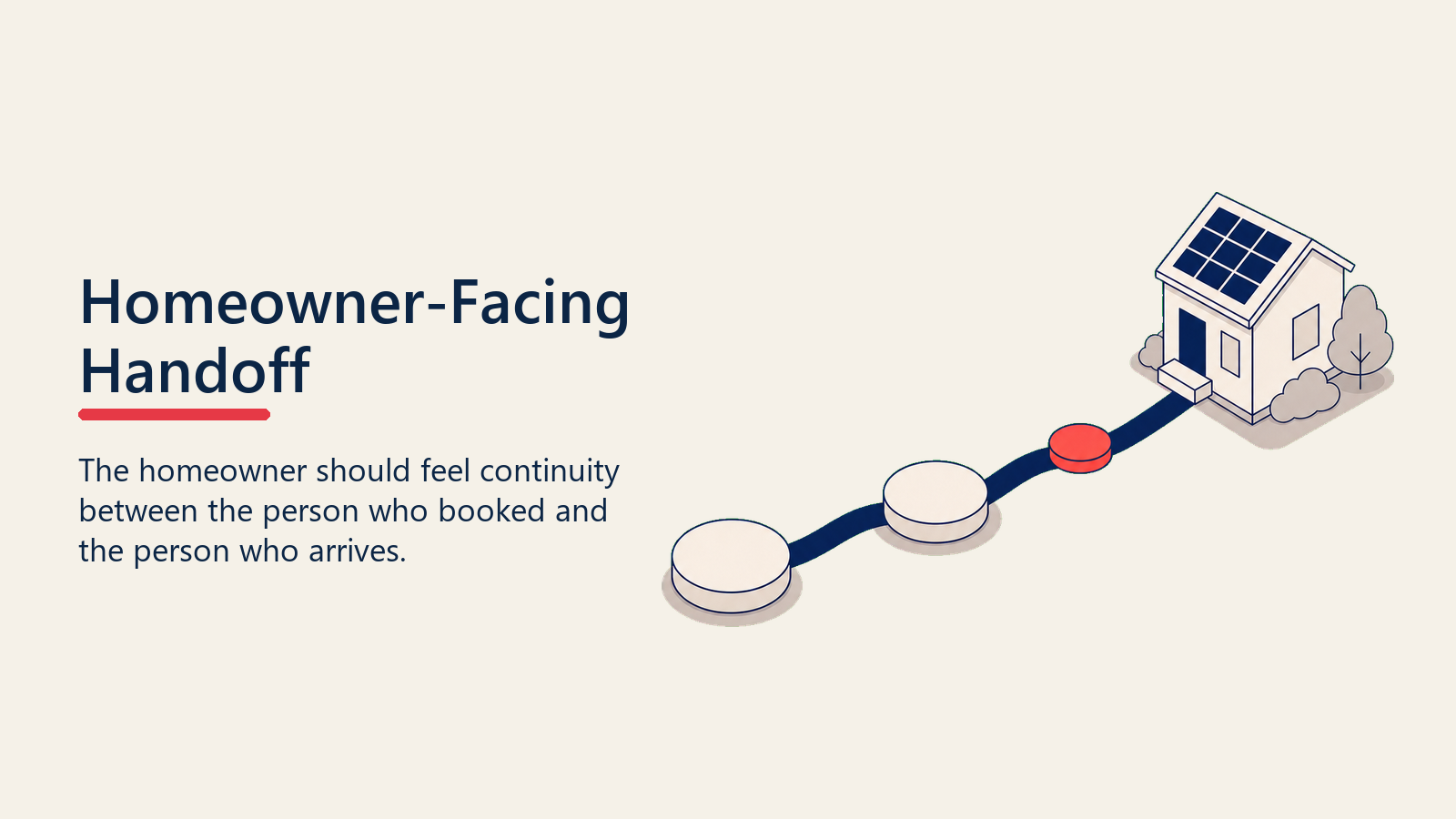
From the homeowner's perspective, they spoke to one person on the phone and now a different person is showing up at their house. If that transition feels disjointed, it introduces doubt before the closer has said a single word.
The fix is a confirmation process that creates continuity. The setter sends a message (text or email) after booking that says something like:
"I've got you scheduled for [day/time] with [closer's name]. He's going to walk through your home's energy use, run a quick assessment, and show you exactly what a system would look like for your house. He's been doing this for [X years] and he'll take care of you. Any questions before then?"
That message does a few things. It introduces the closer by name. It sets expectations for what the visit will involve. And it gives the homeowner a chance to ask questions before the appointment rather than canceling quietly. For more on preparing the homeowner effectively, see Confirming and Prepping the In-Home Appointment.
Closer Accountability in the Loop
A handoff process only sticks if closers participate in it. That means two things.
First, closers need to review the CRM notes before every appointment. Not in the driveway. Before they leave. A closer who pulls into a neighborhood and then reads the handoff notes is already behind. A closer who walks into an appointment having reviewed the homeowner's profile, motivation, and objections is set up to advance the conversation, not restart it.
Second, closers need to close the loop after every appointment, whether it ran or didn't. What actually happened? Did the homeowner match the setter's read? Were there objections that weren't in the notes? Did someone else turn out to be a decision-maker? That feedback makes setters better over time.
For context on the broader qualification picture, see Solar Lead Qualification and Prescreening and the general Lead Qualification Frameworks.
What Setter-Closer Alignment Looks Like at Scale
As teams grow, the setter-to-closer relationship becomes more formal but the core principles stay the same.

Top-performing solar companies run weekly setter-closer alignment meetings where both sides review what's working and what's breaking. They look at show rates by setter, close rates by closer on different setter-sourced appointments, and patterns in the objections that keep appearing.
They also pair setters and closers intentionally. When a setter and closer work together consistently, they develop shorthand. The setter knows what the closer cares about. The closer trusts the setter's reads. That relationship compounds over time and shows up in performance numbers.
For more on building these team dynamics, see Setter and Closer Alignment and Coaching and Ride-Alongs.
You can also apply the broader principles from Opportunity Qualification to help setters make sharper qualification calls before the handoff ever happens.
Quotable Nuggets
The Intel Gap: "A closer who walks into an appointment having reviewed the homeowner's profile, motivation, and objections is set up to advance the conversation, not restart it." The intel gap between setter and closer is the single most correctable driver of lost appointments.
The Feedback Loop Rule: "When closers can leave notes after running an appointment, setters start to see what intel was useful, what was missing, and what they should capture differently next time." The handoff stops being a one-way drop and becomes a compounding system.
The SPOTIO Insight: Field reps spending 44% of their time actively selling means the remaining 56% (including CRM entry and handoff documentation) either gets done right or quietly kills the next appointment before it starts. (SPOTIO State of Field Sales 2026)
The Five-Field Handoff Protocol
The Five-Field Handoff Protocol: Every setter note that transfers to the closer should answer five questions: (1) Who decided? (2) Why now? (3) What's the bill? (4) What objection came up? (5) How hot does the setter rate it? Any CRM that captures these five fields gives the closer a real foundation. Any that doesn't is logging contact information, not running a handoff.
Measuring Handoff Quality
You can't manage handoff quality without measuring it. These are the metrics that matter:
| Metric | What it reveals |
|---|---|
| Show rate by setter | Which setters are booking strong appointments vs. weak ones |
| Close rate by setter-closer pair | Whether certain combinations outperform |
| CRM completeness score | Are setters filling in the handoff fields? |
| Closer pre-appointment review rate | Are closers reading the notes before going out? |
| Post-appointment feedback completion | Are closers closing the loop? |
When a closer has a bad run of appointments, the first question shouldn't be "what's wrong with this closer?" It should be "what did the handoff look like?" Bad handoffs produce bad appointment experiences. Strong handoffs put closers in a position to win.
The setter-to-closer handoff is a short moment in a long sales process, but it carries a disproportionate amount of weight. Every piece of context that transfers cleanly is a piece the closer doesn't have to recover on the doorstep. And in a financed, in-home, one-call-close environment, there's no room for that kind of recovery.
Frequently Asked Questions about Setter to Closer Handoff
What is the setter-to-closer handoff in solar sales?
It's the structured transfer of information between the rep who books an in-home appointment (the setter) and the rep who runs it (the closer). A proper handoff includes homeowner motivation, objections raised on the set call, decision-maker situation, utility bill size, and the setter's confidence rating. Without it, closers walk in cold.
Why do setter-to-closer handoffs fail?
Three patterns account for most failures: setters are paid per appointment so they rush off the phone without capturing context; CRM fields were built for contact data, not sales intel; and there's no formal moment of ownership transfer, just a calendar invite. The result is a closer with a name, an address, and nothing else.
What information should be in a setter-to-closer CRM handoff?
At minimum: primary motivation (why the homeowner agreed), decision-maker situation (who will be present), estimated monthly utility spend, objections raised during the set call, any prior solar conversations, and the setter's confidence rating (hot/warm/uncertain). A notes field for closer feedback after the appointment completes the loop.
How does a warm intro between setter and closer help show rates?
A 90-second voice note or quick message covering who the homeowner is, what motivated them, and what concerns came up gives the closer context that isn't in the CRM. It also flags soft appointments early, so the team can tighten confirmation before the closer drives out.
How should closers use handoff notes before an appointment?
Before leaving the office, not in the driveway. By the time the closer pulls up, they should know the homeowner's name, motivation, bill size, objections, who will be present, and the setter's read on appointment strength. Reviewing notes on-site is already too late to adjust the approach.
What is a one-legged appointment and why does the handoff matter?
A one-legged appointment is one where a key decision-maker won't be present. The setter should flag this during booking so the closer can decide whether to proceed, adjust their strategy, or request a reschedule. Without a handoff, the closer only finds out when the missing spouse doesn't come home.
How should closers give feedback to setters after an appointment?
A brief post-appointment note in the CRM: did the homeowner match the setter's read, were there objections not in the notes, was anyone a surprise decision-maker? Consistent closer feedback makes setters measurably better over time and converts the handoff from a one-way drop into a feedback loop.

Senior Implementation Consultant
On this page
- Why the Handoff Breaks Down
- What Does a Closer Actually Need Before the Appointment?
- The Intel Capture Framework
- CRM Handoff Fields That Actually Work
- The Warm Intro Protocol
- The Homeowner-Facing Handoff
- Closer Accountability in the Loop
- What Setter-Closer Alignment Looks Like at Scale
- Quotable Nuggets
- The Five-Field Handoff Protocol
- Measuring Handoff Quality