Building the Custom Solar Proposal: Sizing, Savings, and Storytelling That Closes
Turn this article into takeaways for your work.


Each assistant summarizes the article only for you and suggests best practices for your work.
A bad solar proposal is a spreadsheet with a price tag. A good one tells the customer's story back to them, shows exactly what they'll save, and gives them every reason to say yes tonight.
The proposal is the bridge between your assessment and your close. If the home energy needs assessment is where you gathered the customer's situation, the proposal is where you translate it into a system that solves their problem. This guide covers system sizing, savings modeling, proposal structure, and the details that separate proposals that close from ones that go into a "we'll think about it" drawer.
Start With What You Know, Not What You Assume
Key Facts:
- NREL models the representative 2024 residential solar system at 7.9 kWdc with an installed cost of roughly $3-$4 per watt, translating to approximately $24,000-$32,000 before incentives, per NREL's 2024 Annual Technology Baseline; that is the number a homeowner needs to see made sense before they sign
- Residential electricity rates rose roughly 3.3% per year in nominal terms from 2013 to 2023 (12 cents/kWh to 16 cents/kWh), per EIA retail electricity price data; use 2-3% as a conservative savings-model escalation rate, as claims above 5% are not supported by the 10-year EIA record
- The federal Section 25D Residential Clean Energy Credit was terminated for owner-purchased systems with installation completed after December 31, 2025, per IRS guidance on the One Big Beautiful Bill; do not include a federal ITC line item for 2026 owner purchases
Every proposal should be custom-built from the specific data you collected. That means actual 12-month kWh consumption, actual roof measurements, actual shading conditions, actual rate plan.
If you're building a proposal based on a quick bill scan and a guess, customers can tell. They don't always know exactly why it feels off, but they feel it. The proposal seems generic. The numbers don't match what they're experiencing. And you lose credibility at exactly the wrong moment.
The principle behind strong proposal building is the same one that drives value selling: the customer needs to see themselves in the solution. A proposal with their actual consumption numbers, their utility's specific rate schedule, and references to things they told you during the assessment does that. A template with placeholder assumptions does not.
System Sizing: The Right Offset for the Right Customer
System sizing is both a technical and a strategic decision. Getting it wrong in either direction costs you.
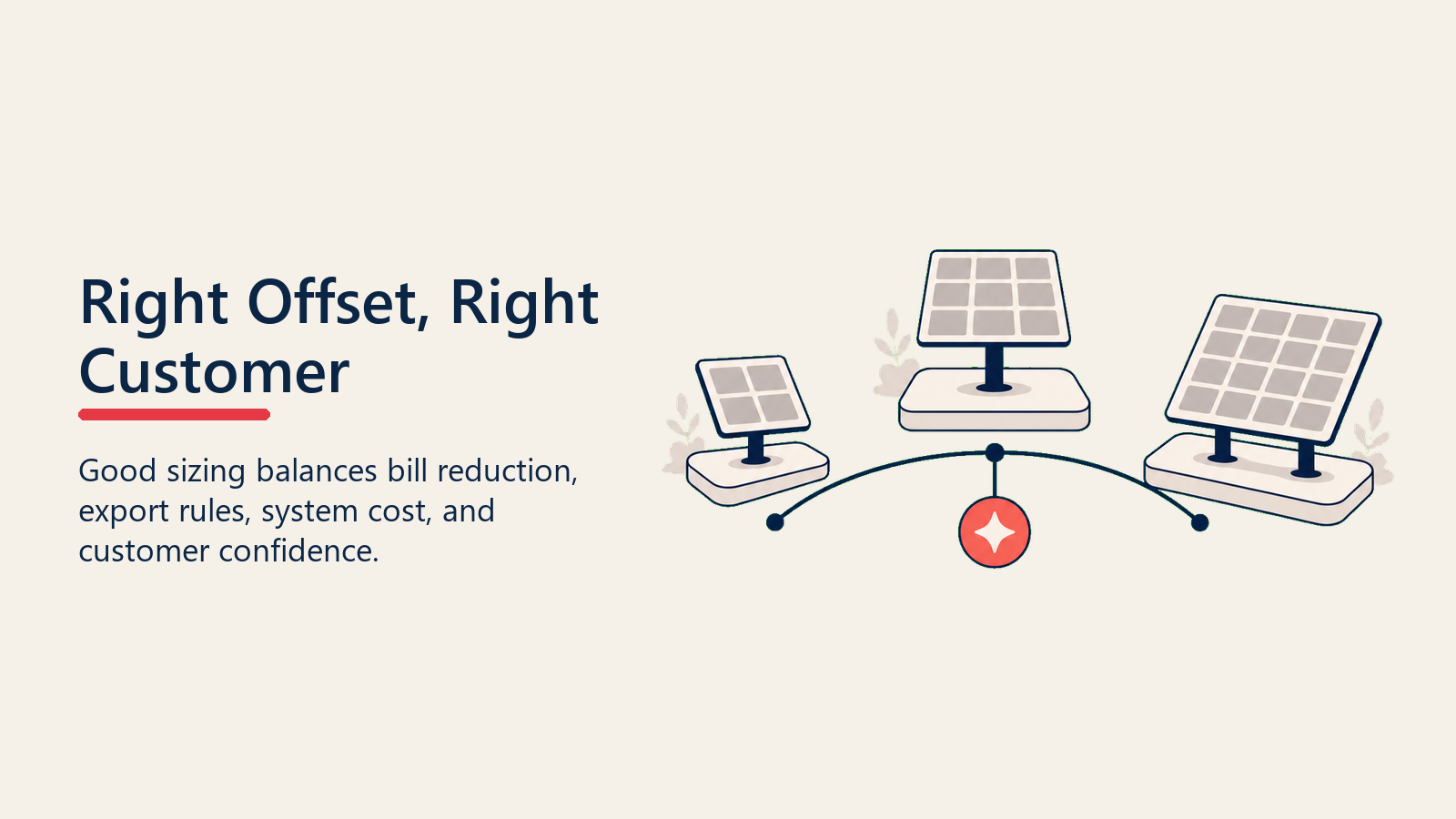
Undersizing means the customer still has a significant utility bill, which undermines the "eliminate your bill" narrative and leads to post-install disappointment.
Oversizing means higher upfront cost, potentially excess production the utility won't credit fairly, and a more skeptical customer who wonders why you're recommending more than they need.
The Production Math
Most proposal tools automate this, but you should understand the underlying logic:
Annual kWh target. Start with their 12-month consumption. Decide what offset percentage you're targeting. Most customers want 90-100% offset. Some with net metering or EV plans want 100-110%.
Production estimate. Your design tool uses solar irradiance data (how much sun hits that location) plus the specific roof faces, pitch, and shading you measured. The output is an estimated annual kWh production per kW of installed capacity. NREL's PVWatts calculator is the industry-standard free tool for generating location-specific production estimates; it pulls from NREL's National Solar Radiation Database and is what most professional proposal platforms use under the hood.
System size calculation. Divide the annual kWh target by the expected production per kW. That gives you the target system size in kW.
Panel count. Divide total kW by the wattage of the panels you're specifying. Round up to the nearest panel that fits the available roof space.
Example:
| Parameter | Customer Data |
|---|---|
| Annual consumption | 14,400 kWh |
| Target offset | 100% |
| Production factor (sun hours x efficiency) | 1,450 kWh/kW/year |
| System size needed | 14,400 / 1,450 = ~9.9 kW |
| Panel wattage | 400W panels |
| Panel count | 9,900W / 400W = ~25 panels |
Sanity-check this against roof availability before committing to a size. If the roof can't fit 25 panels due to shading or space constraints, you need to either reduce the target offset or discuss adding a battery or optimizing which roof faces you use.
When Should You Recommend Battery Storage?
Battery storage isn't right for every customer, but certain situations make it a strong add:
- Time-of-use (TOU) rate plan where grid power is expensive in the evening
- Net metering credits less than retail rate (their utility doesn't give them full value for exported power)
- Frequent outages or customer anxiety about power reliability
- Whole-home backup desired for medical equipment, work-from-home, or general peace of mind
- Future EV charging that could be powered from stored solar rather than grid
When battery is appropriate, include it in the primary proposal rather than presenting it as an add-on. An add-on feels like upselling. A complete solution designed for their situation feels like expertise.
Savings Modeling: Credibility Is Everything
The single most scrutinized part of any solar proposal is the savings projection. Customers who've been burned by inflated promises, or who've heard stories about neighbors who aren't saving what they were told, come in skeptical.
Your savings model needs to be defensible, specific, and honest.
The Savings Stack
Solar savings come from multiple sources. Know which ones apply to this customer:
| Savings Source | Description | Notes |
|---|---|---|
| Avoided utility consumption | kWh produced by solar x current rate | Primary savings driver |
| Net metering credits | Excess production exported to grid | Check current utility rate for exported power |
| Rate escalation protection | Projected utility rate increases over time | Use 2-3% annual escalation; EIA 10-year nominal average is ~3.3% |
| Federal ITC (25D) | Applied at 30% for systems installed by Dec 31, 2025 | Terminated for 2026 owner purchases; check state incentives via DSIRE instead |
| State/local incentives | Varies by state and utility | Pull current data, not year-old numbers |
What not to include:
- Inflated rate escalation assumptions (using 7-8% when the verified historical average is closer to 3%). The EIA's analysis of retail electricity prices over the past decade shows nominal residential rates rose roughly 3.3% per year from 2013 to 2023. Any assumption above that needs explicit justification, and 7-8% figures will be challenged by an informed homeowner.
- Net metering credits at retail rate if the utility uses avoided-cost credits
- The federal 25D Residential Clean Energy Credit for 2026 owner purchases. The credit was terminated by the One Big Beautiful Bill (P.L. 119-21, signed July 4, 2025) for systems with installation completed after December 31, 2025. Including it in a proposal for a 2026 homeowner is inaccurate. State and local incentives still apply; check DSIRE for current programs in each state.
Run the savings conservatively. If the system performs better than projected, the customer is delighted. If it underperforms projections you inflated, you get a review that reads "they promised $300/month savings and I'm only seeing $200."
The 25-Year Summary
Every proposal should include a lifetime value summary. Solar systems are warranted for 25 years. The cumulative savings over that period make the upfront investment look very different.
A simple version:
- Year 1 estimated savings: $2,400
- Conservative rate escalation: 3%/year
- 25-year cumulative savings: ~$85,000
Compare this to the total system cost and the financed payment. The customer is evaluating a monthly payment, not a lump sum. When they see that a $189/month solar loan replaces a $280/month utility bill with a lifetime savings of $85,000, the math makes a strong case.
Proposal Structure: What Goes Where and Why
A well-structured proposal walks the customer through a logical sequence. They should be able to follow the story even before you present it verbally.
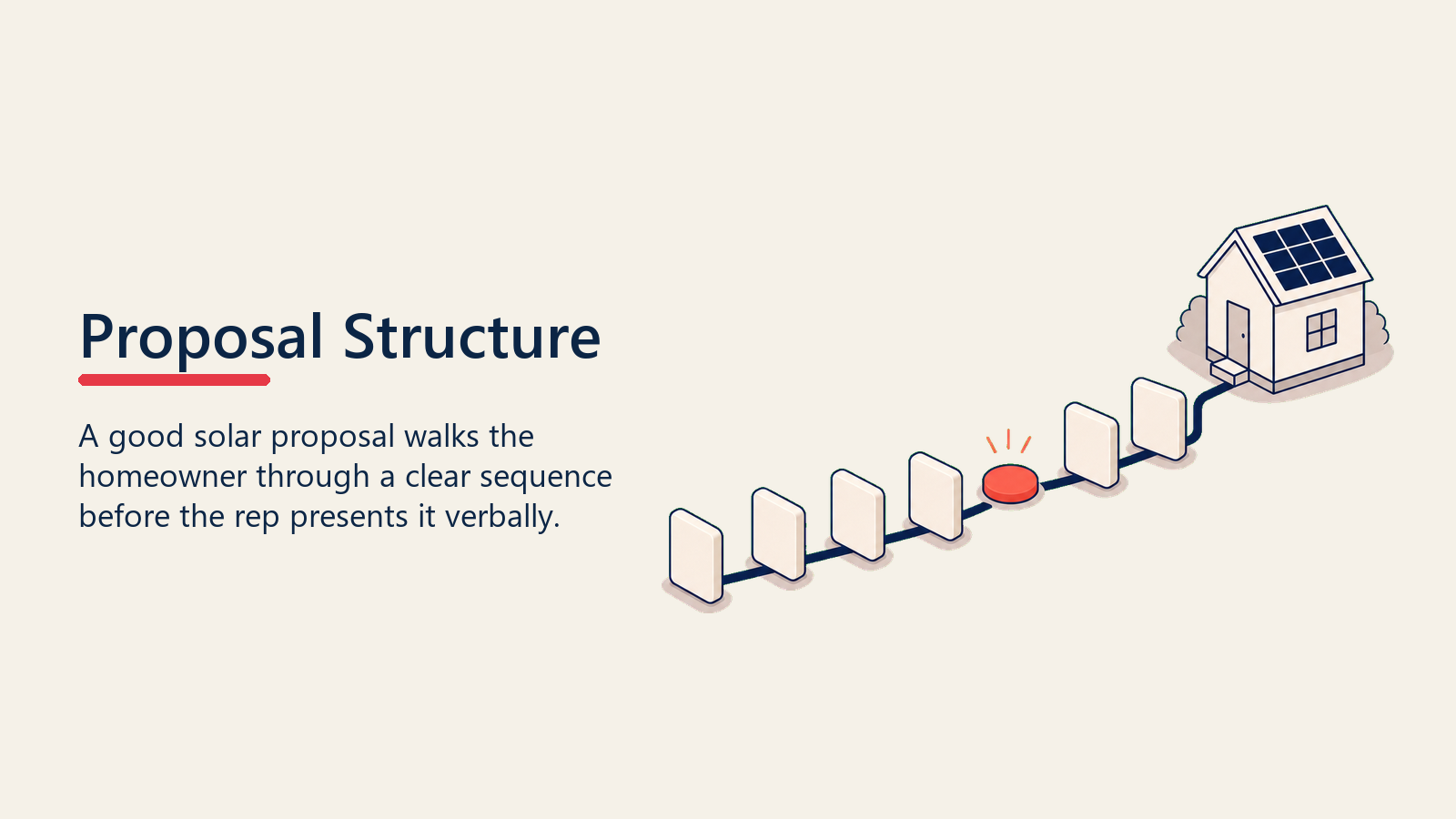
Recommended Proposal Sections
1. Your Energy Situation This section reflects back what you learned in the assessment. Their 12-month consumption, their average bill, their rate plan. It should feel personal, not generic.
Including this section signals: "I was paying attention. This proposal is for you, not a template."
2. Your Custom System Design System size, panel count, equipment specs, production estimate. Keep this visual if your software supports it. A rendering of panels on their actual roof is worth more than a table of specs.
Emphasize equipment quality briefly. Customers don't know module efficiency ratings in detail, but they do understand warranties and brand reputation.
3. Your Estimated Savings Year 1 savings, monthly savings comparison (old utility bill vs. new solar payment plus any remaining utility bill), and the 25-year summary.
Show the monthly cash flow clearly:
| Current Situation | With Solar |
|---|---|
| Average utility bill: $285/month | Solar loan: $192/month |
| Annual cost: $3,420 | Remaining utility bill: ~$25/month |
| 25-year cost at 3% escalation: ~$121,000 | 25-year cost: ~$64,000 |
The gap is the value story.
4. Available Incentives For 2026 proposals: state and local incentives, net metering details, and any utility rebates. The federal Section 25D Residential Clean Energy Credit (30% of system cost) was terminated for owner-purchased systems installed after December 31, 2025, under the One Big Beautiful Bill. Do not include it in proposals for 2026 purchases. If your company offers lease or PPA options, note that a separate business credit (Section 48E) may still be available through the installer through 2027. Be specific about what applies to this customer and leave nothing ambiguous.
5. Investment Summary Total system cost. Incentive-adjusted cost. Financing options with monthly payment and terms.
This section should come last. Leading with price before the customer understands value is the most common proposal mistake in solar. By the time they reach the investment summary, they should already understand what they're getting and why it's worth it.
Using the Assessment Data Inside the Proposal
The best closers reference specific things the customer said during the assessment. This takes deliberate effort but pays off significantly.
If the customer said "I hate opening that bill every month," your proposal should include language like: "Based on our conversation, your main goal is predictable, lower monthly costs. Here's exactly what that looks like..."
If they mentioned an EV purchase coming next year, the proposal should include a note: "We've sized this system to cover your current usage plus approximately 3,000 additional kWh/year for EV charging."
These details tell the customer you were listening. And they make the proposal feel like it was built for them, which it was. This is fundamentally the same principle described in opportunity qualification: a properly qualified opportunity has a solution matched specifically to discovered needs, not a generic product pitched at whoever's in front of you.
Proposal Software and Tools
Manual proposals built in Word documents are slow to produce and hard to update. For solar specifically, the solar CRM and proposal tools category covers the purpose-built platforms (Aurora Solar, OpenSolar, Scoop Solar, Solargraf, etc.) that automate most of the technical work.
These tools pull in irradiance data, auto-shade analysis, permit data, and utility rate schedules. They let you build a proposal during or immediately after the site assessment, which is critical for same-day close attempts.
Whatever tool you use, the output should be something you can walk through on a tablet or laptop with the customer sitting next to you.
What a Strong Proposal Does Before You Start Talking
The proposal document itself does pre-selling work before you open your mouth. A proposal that:
- Shows their actual consumption data
- Shows their specific roof with panels on it
- Shows a clear month-by-month savings comparison
- Itemizes available incentives with dollar amounts
- Shows a simple year 1 / year 10 / year 25 summary
...gets the customer intellectually aligned before you've said a word. You're not selling them, you're showing them something they can see clearly.
A proposal that shows generic numbers, uses round figures that don't match their bill, and leads with the total price does the opposite. It creates skepticism you then have to overcome verbally.
Quotable Nuggets
On custom vs. template proposals: "A bad solar proposal is a spreadsheet with a price tag. A good one tells the customer's story back to them, shows exactly what they'll save, and gives them every reason to say yes tonight." The difference isn't design polish. It's whether the numbers on the page match what the customer told you about their life.
On the savings model rule: Run the savings conservatively. "If the system performs better than projected, the customer is delighted. If it underperforms projections you inflated, you get a review that reads 'they promised $300/month savings and I'm only seeing $200.'" A conservative, defensible proposal protects the relationship long after the close.
On proposal sequencing: "Leading with price before the customer understands value is the most common proposal mistake in solar." The investment summary belongs last. By the time the customer reaches it, they should already understand what they're getting and why it's worth it. Price without context is just a number to push back on.
The Situation-System-Savings-Story Framework
The Situation-System-Savings-Story Framework: Every solar proposal that closes follows the same four-part arc. Situation: reflect the customer's actual energy data back to them (their 12-month usage, their rate, their bill). System: show the specific equipment and production estimate for their roof. Savings: present the year-over-year math conservatively, using verified EIA rate escalation data (2-3% annually) rather than inflated assumptions. Story: tie it to what the customer told you they want, whether predictable payments, independence from rate increases, or environmental reasons. Proposals that skip Situation feel generic. Proposals that skip Story feel like math homework. Both will lose to a competitor whose rep was listening.
Proposal QA Before You Present
Before sitting down to present, run through this checklist:
- kWh numbers match actual 12-month data
- System production estimate uses actual roof conditions, not default assumptions
- Savings calculation uses actual current utility rate
- Incentive section reflects current programs only (no 25D federal ITC for 2026 owner purchases; state incentives verified via DSIRE)
- Financing options match what this customer is likely to qualify for (credit tier from prescreening)
- Any roof replacement or panel upgrade costs included or explicitly noted
- 25-year summary uses conservative (not best-case) escalation rate
- Proposal includes their name and address (not a generic template)
- You can walk through it in under 20 minutes, not 45
If anything is off, fix it before you present. Catching an error mid-presentation is recoverable if handled well. But catching it after the customer asks a sharp question is much harder.
The Handoff: From Proposal to Presentation
When you move from building the proposal to presenting price and financing, you're shifting from preparation to persuasion. The quality of your preparation determines how much work the presentation has to do.
A well-built proposal that accurately reflects the customer's situation requires minimal persuasion. You're mostly confirming what they can see is true. A generic or inflated proposal requires you to do a lot of defensive talking, which is a hard place to close from.
The best solar reps treat proposal building as a creative and analytical act, not a checkbox. They think about the customer's specific situation, find the strongest legitimate savings story, and present it in the clearest possible way. That's what separates reps with 20% close rates from reps with 40%.
See also the setter-to-closer handoff for how to ensure the data gathered before the appointment arrives in usable form for the closer who builds and presents the proposal.

Senior Implementation Consultant
On this page
- Start With What You Know, Not What You Assume
- System Sizing: The Right Offset for the Right Customer
- The Production Math
- When Should You Recommend Battery Storage?
- Savings Modeling: Credibility Is Everything
- The Savings Stack
- The 25-Year Summary
- Proposal Structure: What Goes Where and Why
- Recommended Proposal Sections
- Using the Assessment Data Inside the Proposal
- Proposal Software and Tools
- What a Strong Proposal Does Before You Start Talking
- Quotable Nuggets
- The Situation-System-Savings-Story Framework
- Proposal QA Before You Present
- The Handoff: From Proposal to Presentation