Online Reviews and Reputation Management for Solar Companies
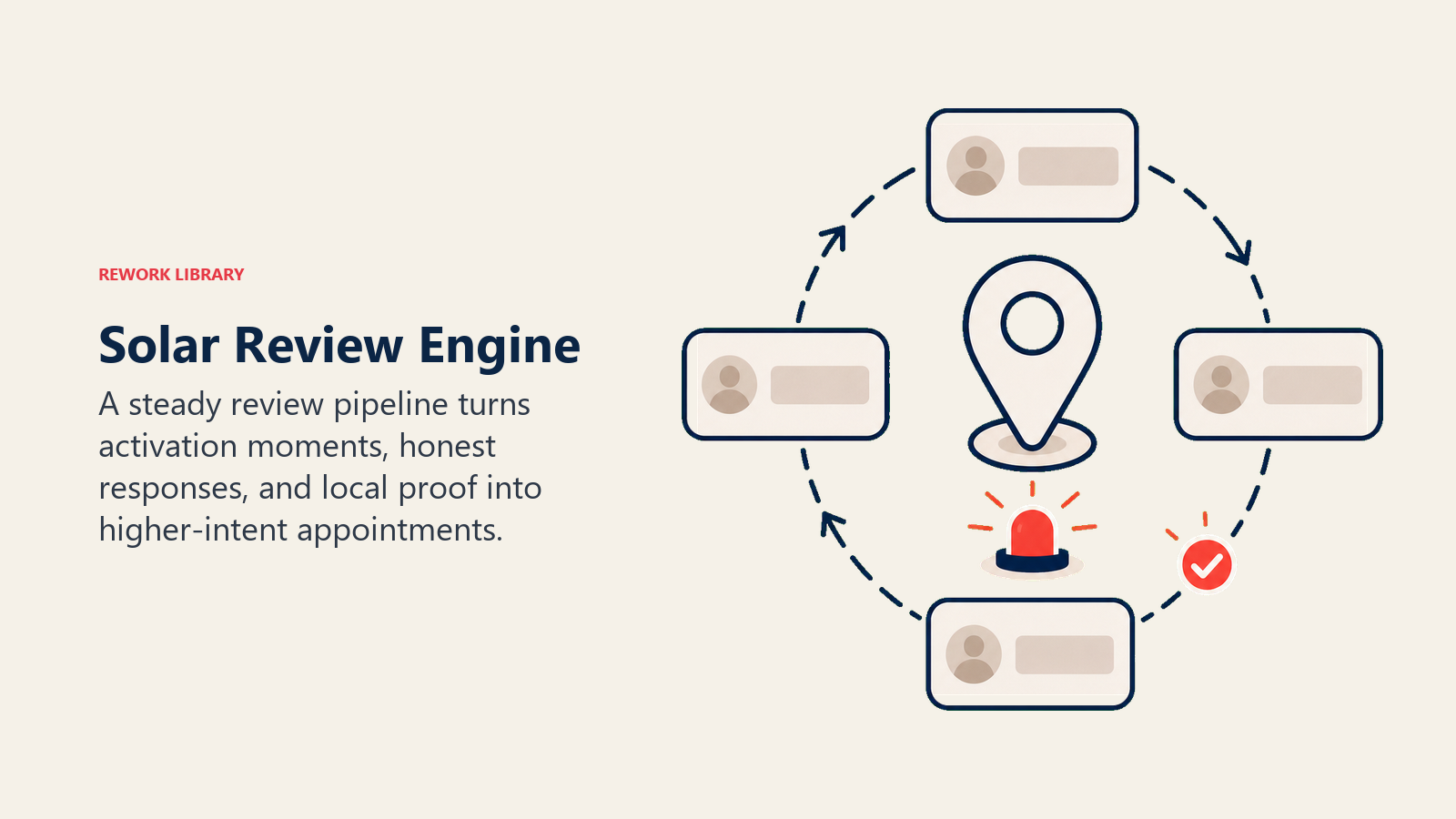
Turn this article into takeaways for your work.


Each assistant summarizes the article only for you and suggests best practices for your work.
A homeowner considering a $30,000 solar purchase doesn't call the first company they see. They read reviews. Then they read more reviews. Studies put the average at 10 or more before a high-ticket buyer contacts a vendor, and for solar, that number skews higher because the product sits on their roof for 25 years. Google's own guidance for business profiles confirms that more reviews and positive ratings directly improve a business's local search ranking, making your review count a literal driver of inbound traffic.
Your reputation online isn't a marketing nice-to-have. It's a pre-qualification filter that determines whether leads convert to appointments in the first place. A company with 4.7 stars and 200 reviews closes more deals than the same sales team working against a 3.9-star profile, even with identical pricing and products.
This guide covers how to build a review pipeline that generates consistently, how to respond to negative reviews without making things worse, and how to use reputation signals to lift close rates in the field.
Why Reviews Hit Different in Solar
Most industries deal with review pressure. Solar deals with it at a uniquely high volume because of three structural facts.
First, the ticket price is high. Homeowners treat a solar purchase the same way they treat buying a car or hiring a contractor for a major renovation. They do research, they compare options, and they weight peer opinions heavily because the stakes feel personal.
Second, the sales process starts before the appointment. When a setter books an in-home consultation, the homeowner often spends the gap between booking and the visit looking up your company name. What they find shapes whether they answer the door in a buying mindset or a skeptical one. A strong review profile warms that gap. A thin or negative one cools it.
Third, word of mouth is the industry's primary referral channel. Happy solar customers talk. But they also post. A homeowner who saves $150 a month on their electricity bill wants to tell their neighbors, and increasingly that telling happens on Google, Yelp, Facebook, and Nextdoor. If your review pipeline captures that goodwill at the right moment, it compounds into a referral engine. If you miss the window, that enthusiasm dissipates.
Key Facts
- Google's own guidance for business profiles confirms that review count and star rating directly influence a business's local search ranking and visibility, making your review pipeline a literal driver of inbound call volume.
- The FTC's Trade Regulation Rule on Consumer Reviews and Testimonials, which took effect October 21, 2024, sets civil penalties of up to $51,744 per violation for businesses that buy, create, or disseminate fake reviews. Soliciting honest reviews from real customers is encouraged; compensating for a specific sentiment is not.
- NREL's Solar Energy Evolution and Diffusion Studies (2014-2016) found that 80% of solar customers made at least one referral. For most of those referrals, a prospect's next step is reading your online reviews. Your review profile is the direct bridge between referral intent and booked appointment.
Where Your Reviews Actually Live
Not all platforms matter equally. Here's how to prioritize:
| Platform | Priority | Why it matters |
|---|---|---|
| Google Business Profile | Critical | Shows in Maps, local search, and on your business panel. Influences SEO. |
| Yelp | High | Strong for residential services. Homeowners in many markets check it reflexively. |
| High | Social proof that travels inside networks. Neighbors see neighbor reviews. | |
| Nextdoor | Medium-High | Hyper-local. A 5-star post in a neighborhood can generate multiple leads. |
| Better Business Bureau | Medium | Older homeowners check it. Important in markets with higher median buyer age. |
| Trustpilot / SolarReviews | Medium | Category-specific. SolarReviews pulls buyers who are deep in research. |
| Houzz / Angi | Low-Medium | Lower solar search volume but useful for home improvement cross-traffic. |
Most companies can't actively manage every platform. Focus first on Google, then Facebook, then one or two secondary platforms that your specific market uses. Monitor the others for problems.
Building a Review Pipeline That Generates Consistently
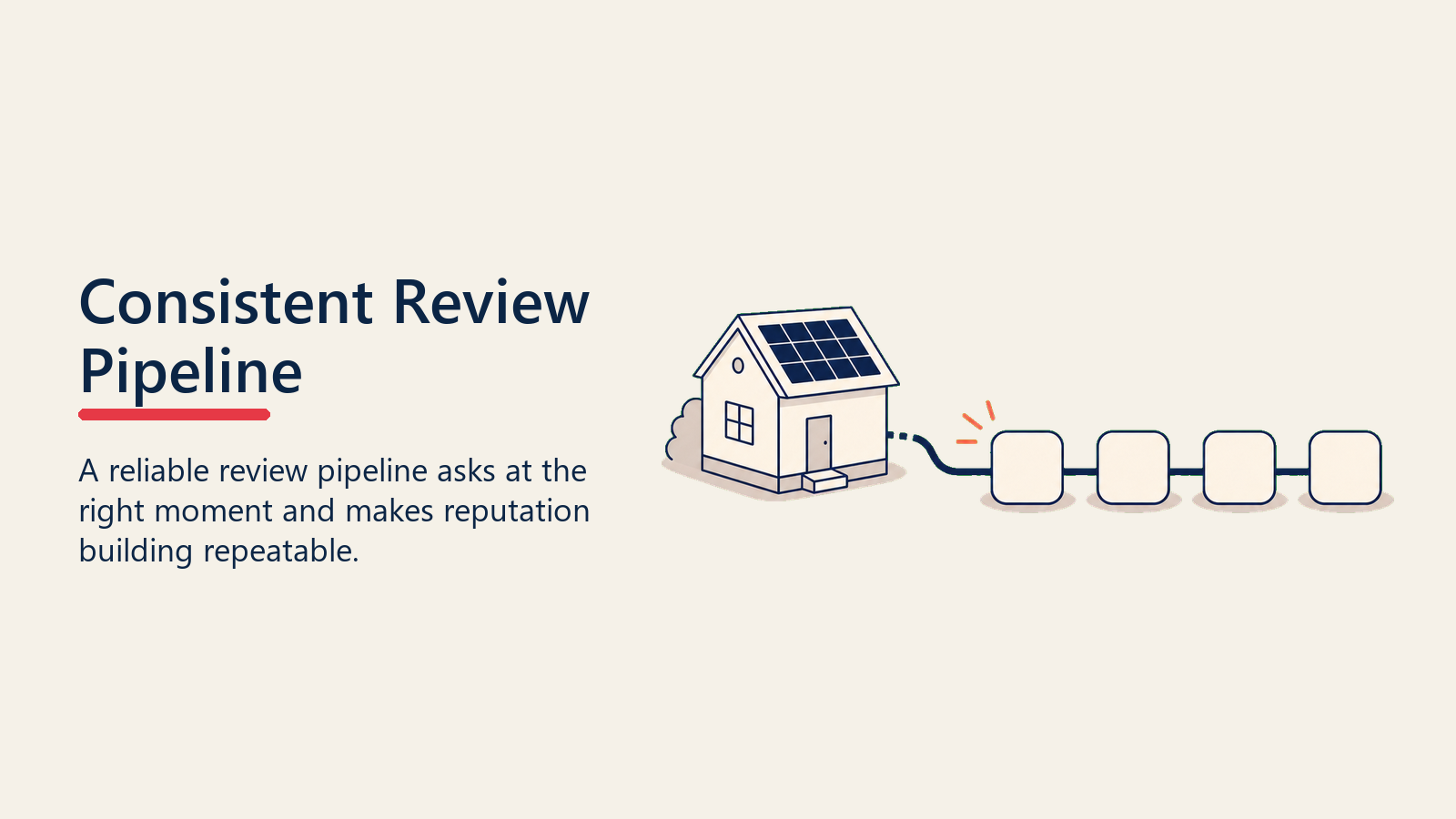
The companies with 400+ Google reviews didn't get there from word of mouth alone. They built a process.
The timing window
The best moment to ask for a review is 3 to 7 days after the system turns on. That's when the homeowner has seen their first production numbers, the excitement is fresh, and they haven't yet cycled through their first electric bill. Ask too early (like at install handoff) and you get shrug responses because nothing has happened yet. Ask too late and daily life has taken over.
Build two touchpoints into your post-install sequence:
- A personal call from the project coordinator at activation, congratulating the homeowner and flagging the review ask as a "quick favor."
- An automated text or email 48 hours later with a direct link to your Google review page. The link should go straight to the review form, not to your profile.
Who asks matters
Homeowners are much more likely to leave a review when a real person they interacted with makes the ask. The installation lead, the project manager, or the customer success rep who managed their project has more pull than a generic company text. When your install team wraps a job, coach them to say something like: "We really appreciate you choosing us. If you have five minutes to leave us a review on Google, it helps more than you know."
Then follow up with the automated message. The personal ask plants the intent; the message gives them the frictionless path.
Review request templates
Keep it short. Long ask messages get ignored.
Text version:
"Hi [First Name], it's [Rep Name] from [Company]. Your system is live and we hope you're loving it! Would you mind leaving us a quick Google review? It only takes 2 minutes and helps families in your area find us. [Direct link]"
Email subject:
"How's the solar system treating you?"
Email body:
"[First Name], we're thrilled your system is up and running. If you have a moment, a quick review on Google would mean a lot to our team. Here's the direct link: [link]. Thanks for trusting us with your home."
Volume and consistency
One hundred reviews gathered over three years looks different than 100 reviews in the last 12 months. Google's algorithm weights recency. You need a steady drip, not bursts followed by silence. Set a team target, track it monthly, and review it in your ops meeting the same way you review install volume.
A rough benchmark: shoot for one review per 8 to 10 installed jobs. If you install 30 systems a month, you should be generating 3 to 4 new reviews a month minimum. Volume matters, but so does how you respond to what comes in.
Responding to Reviews: The Rules
How you respond to reviews, especially negative ones, is part of your public pitch. Prospective customers read responses.
Positive reviews
Reply to every one. Keep it short, warm, and specific. Avoid copy-paste responses that read like a bot wrote them.
Good response:
"Thanks so much, Maria! We're glad the installation went smoothly and that you're already seeing your production numbers climb. Welcome to the solar family!"
Weak response:
"Thank you for your review! We appreciate your business."
The first response signals that a real person read it. The second signals a template.
Negative reviews
Respond within 24 hours. Go slow. Don't be defensive.
The three-part framework:
- Acknowledge what happened without disputing the customer's experience
- Apologize for the inconvenience, even if you believe the complaint is unfair
- Move the conversation offline with a direct contact
Example:
"Hi James, we're sorry to hear your permitting timeline took longer than expected. We know how frustrating that is when you're eager to see your system running. Our customer success manager would like to connect with you directly to sort this out. Please reach out to [name] at [email or phone]. We want to make this right."
What not to do:
- Don't dispute facts publicly. Even if the customer is wrong, a public argument looks bad to everyone reading.
- Don't offer refunds or credits in the public response. Take that offline.
- Don't let a 1-star review sit without a response. Silence reads as indifference.
Handling fake reviews
If you believe a review is fake (from a competitor or someone who never used your services), you can flag it in Google's portal. Don't respond angrily. If you do respond before flagging, keep it neutral:
"We searched our records and don't have any record of working with you. We'd like to connect to understand your experience. Please reach out to [contact]."
Proactive Reputation Management
Reviews are reactive. Reputation management includes proactive steps that reduce the likelihood of negative reviews getting posted in the first place.
The satisfaction checkpoint
Build a satisfaction check into your post-install process at 30 days. A short SMS survey asking two questions: "How would you rate your overall experience?" and "Is there anything we could have done better?" works better than a long NPS form.
Customers who report a problem at the 30-day check give you a chance to fix it before they post a public complaint. Customers who report a great experience are primed for a review ask at the same touchpoint.
Monitor your brand mentions
Set up a Google Alert for your company name and watch for complaints that appear on platforms you don't actively manage. Nextdoor is a common one. A neighbor posts a negative experience on Nextdoor and it can generate multiple lost leads before you even know it happened.
Assign someone on your team to check Nextdoor, local Facebook groups, and Reddit (if your market has an active local subreddit) at least weekly.
The canceled project problem
Canceled jobs generate a disproportionate share of negative reviews. Homeowners who went through the sales process, signed a contract, and then had their install delayed or canceled are frustrated and vocal.
Build a cancellation process that includes a personal call from a manager, a clear explanation of what happened, and a straightforward path forward. This doesn't eliminate negative reviews from canceled customers, but it reduces them significantly.
See the article on managing install wait times and cancellations for the operational side of this problem. Once the reactive risks are managed, your review profile can start doing active work in the sales process.
Using Reviews to Lift Sales Close Rates
Your online reputation can do active work during the sales process, not just passively.
Pre-appointment confirmation
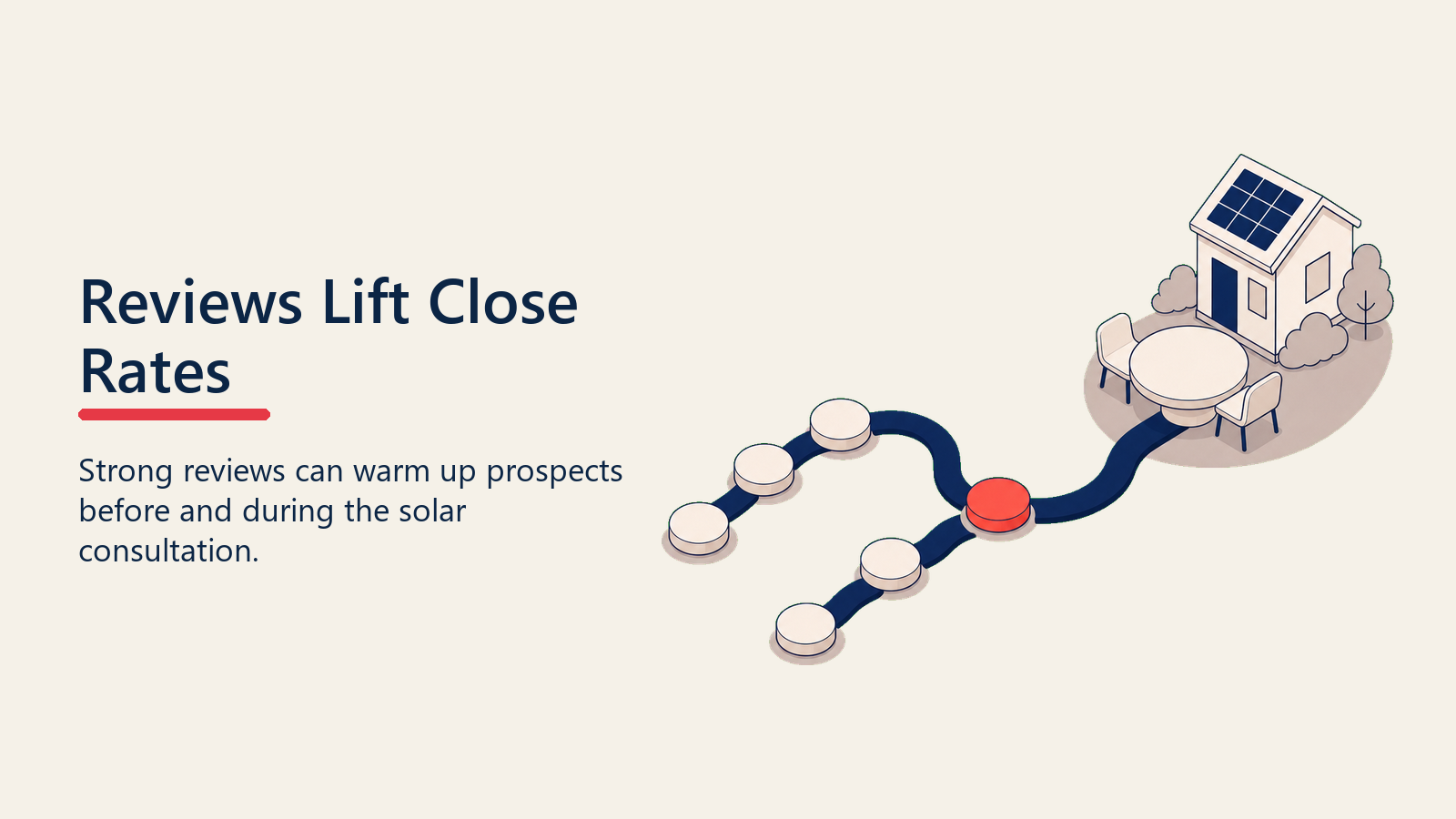
When your confirmation sequence goes out before the in-home visit, include a link to your Google or Facebook reviews. Something like: "While you're waiting, here's what your neighbors are saying about us." A homeowner who reads positive reviews in the 48 hours before the appointment walks into that consultation warmer. See confirming and prepping the appointment for the full confirmation sequence.
In the consultation
When homeowners raise the "I want to shop around" objection, your rep can pull up your review profile on a tablet or phone. "Here are 300 Google reviews from families who made this same decision. Would you like to look through a few?" This is more credible than any sales claim your rep can make about the company.
Referral ask at the close
When the homeowner signs, train your closers to make the review and referral ask at the same time. "The best thing you can do to help us and help your neighbors is leave us a Google review after your system turns on. We'll remind you, but keep it in mind." Seeding the intention at signing increases follow-through.
For the full referral program structure, see referral generation after install.
Measuring Your Reputation Engine
Track these metrics monthly:
| Metric | What it tells you | Target |
|---|---|---|
| New reviews per month | Pipeline health | 1 per 8-10 installs |
| Average star rating | Overall health | 4.6+ |
| Review response rate | Operational discipline | 100% on 1-3 star; 90%+ overall |
| Review conversion rate | How often asks convert | 15-25% of ask attempts |
| Negative review resolution rate | How often complaints close positively | 60%+ |
If your average rating drops below 4.5, investigate the cause before running any new review collection campaigns. More reviews won't fix a service problem. They'll document it.
Common Mistakes Solar Companies Make
Waiting until the end of install to ask. Activation is the right moment. Install day is too early.
Using generic ask templates. A text that reads like a mass send gets ignored. Personalize even slightly.
Not responding to positive reviews. Every response is a signal to future buyers.
Letting negative reviews stack up without responses. Three unanswered 1-star reviews look worse than five answered 1-star reviews.
Ignoring Nextdoor. In residential solar, this platform drives more neighbor-to-neighbor conversations than any other. Monitor it actively.
Buying reviews. Google removes fake reviews and can penalize your profile. The risk far outweighs any short-term gain. The FTC's rule on consumer reviews and testimonials treats fake reviews as deceptive conduct, and the civil penalties are severe. Soliciting honest reviews from real customers is encouraged; paying for them is not.
Tying It Together
Your review pipeline and your sales funnel are the same thing seen from two angles. Buyers research before they call, so your reputation determines who calls. Buyers confirm what they've read during the consultation, so your reputation shapes the close. Buyers share their experience after installation, so your reputation seeds the next wave of leads.
Companies that treat reviews as a passive byproduct of good service plateau at 50 or 100 reviews and wonder why their close rate isn't higher. Companies that treat reviews as a managed pipeline build a compounding asset that does selling work 24 hours a day.
The post-install experience is the input that drives reviews. See post-install customer onboarding for how to structure the first 90 days so customers arrive at the review ask in a positive state of mind. And for the ongoing service quality that keeps customers satisfied enough to recommend you months after activation, see warranty and service monitoring.
The same customers who leave your best reviews are the ones who send you their neighbors. A reputation management program and a referral program, run together, are a compounding growth machine.
The principles that drive long-term customer loyalty are the same across high-value service businesses. Retention fundamentals covers the structural habits that keep customers engaged and vocal.
Learn More
Quotable Nuggets
"More reviews won't fix a service problem. They'll document it. If your average rating drops below 4.5, investigate the cause before running any new review collection campaigns."
"Your review pipeline and your sales funnel are the same thing seen from two angles. Buyers research before they call, so your reputation determines who calls. A company with 4.7 stars and 200 reviews closes more deals than the same sales team working against a 3.9-star profile, even with identical pricing and products."
"Compensating for a specific sentiment, positive or negative, is deceptive conduct under the FTC's Consumer Reviews and Testimonials Rule. The penalties are significant, but the reputational damage from a Google-flagged profile lasts longer." (FTC, Final Rule announcement)
The Review Pipeline Framework: Treat online reviews as a managed pipeline, not a passive byproduct of good service. The pipeline has three components: Generation (the personal coordinator ask at activation plus the 48-hour automated follow-up with a direct review link), Monitoring (weekly checks of Google, Facebook, Nextdoor, and local Facebook groups for your company name), and Response (100% response rate on 1-3 star reviews within 24 hours, 90%+ overall). Set a monthly team target of one review per 8 to 10 installed jobs, and track it in your ops meeting the same way you track install volume. Steady drip beats burst-and-silence every time, because Google weights recency.

Senior Implementation Consultant
On this page
- Why Reviews Hit Different in Solar
- Where Your Reviews Actually Live
- Building a Review Pipeline That Generates Consistently
- The timing window
- Who asks matters
- Review request templates
- Volume and consistency
- Responding to Reviews: The Rules
- Positive reviews
- Negative reviews
- Handling fake reviews
- Proactive Reputation Management
- The satisfaction checkpoint
- Monitor your brand mentions
- The canceled project problem
- Using Reviews to Lift Sales Close Rates
- Pre-appointment confirmation
- In the consultation
- Referral ask at the close
- Measuring Your Reputation Engine
- Common Mistakes Solar Companies Make
- Tying It Together