Solar Lead Qualification and Pre-Screening: Stop Wasting In-Home Appointments
Turn this article into takeaways for your work.


Each assistant summarizes the article only for you and suggests best practices for your work.
In residential solar, the most expensive mistake you can make isn't a bad close. It's sending a closer to a house that never had a chance.
An unqualified in-home appointment costs anywhere from $150 to $400 when you factor in the closer's drive time, the time inside, and the opportunity cost of an appointment slot that could have gone to a real buyer. Multiply that by 15 to 20 percent of your appointment volume (the typical rate for companies without strong pre-screening), and you're looking at tens of thousands of dollars in wasted field hours every month.
Lead qualification and pre-screening is the gate between your lead sources and your appointment calendar. Done well, it dramatically improves show rates, close rates, and rep morale. Done poorly, or skipped entirely, it sends your best closers to houses where the roof is shaded, the homeowner rents, the credit won't work, or the decision maker isn't home.
This guide gives you the complete pre-screening framework: what to ask, when to ask it, how to handle pushback, and how to track disqualification data so you can improve lead source quality over time.
The Four Gates of Solar Qualification
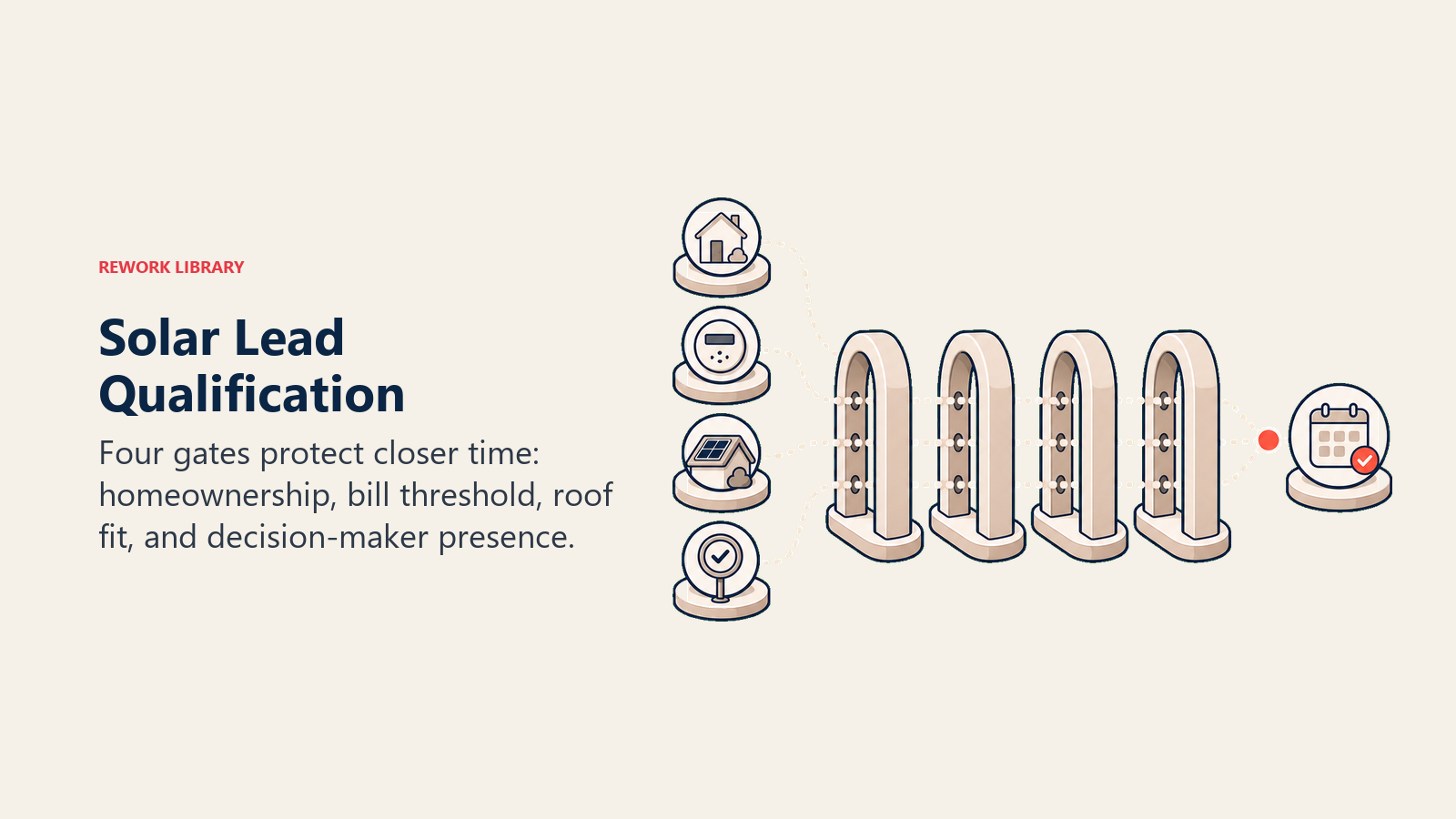
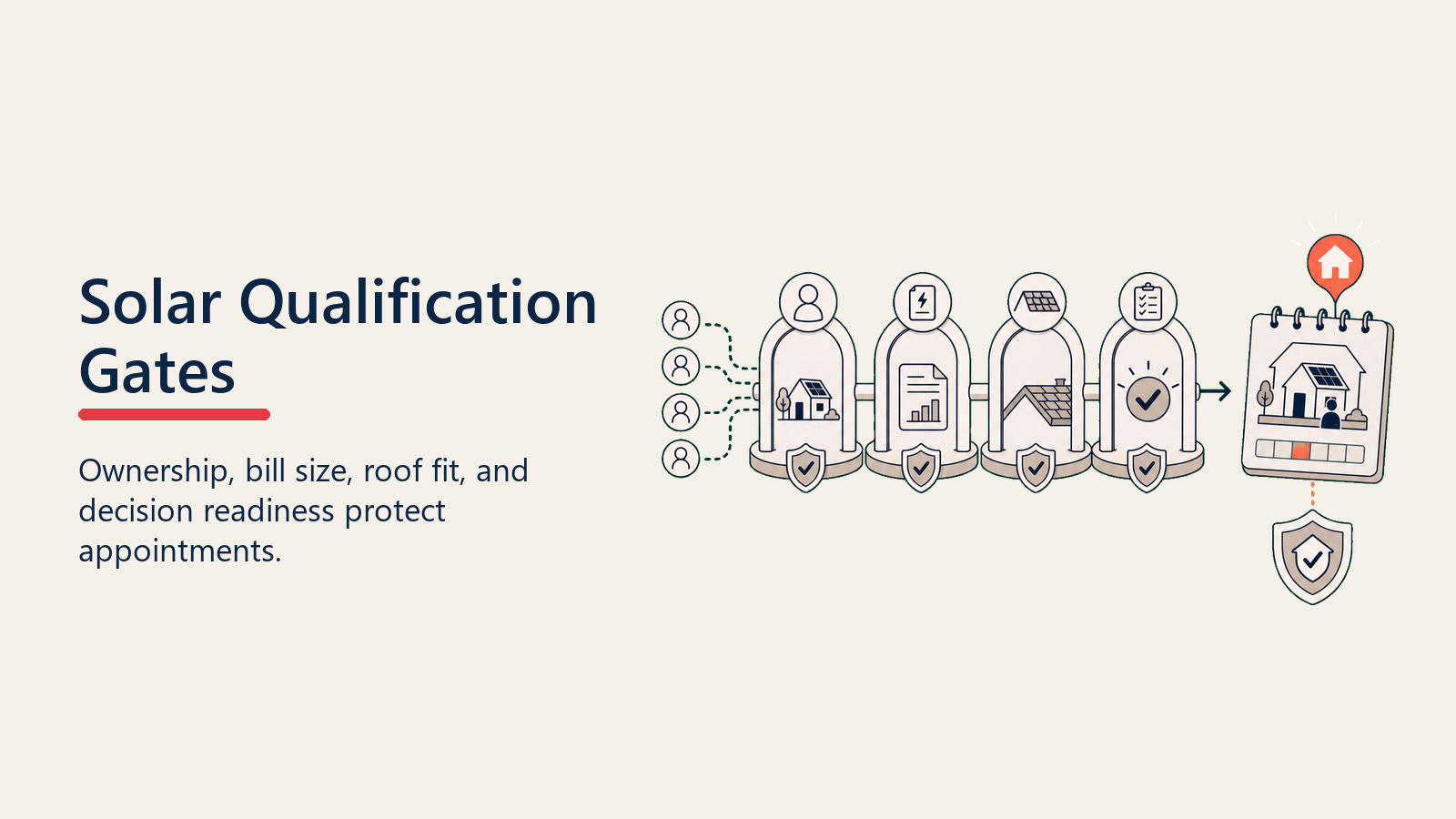
Every residential solar lead needs to pass through four qualification filters before you schedule an in-home appointment. Think of these as gates: a lead that fails any gate should be redirected, nurtured, or released, not booked.
Gate 1: Homeownership
Solar requires homeownership. Renters can't sign a solar contract. Tenants-in-common situations need all decision makers present. This seems obvious, but plenty of lead sources don't verify it, and plenty of setters don't ask.
Script: "Just to make sure this makes sense for your situation, are you the homeowner at that address?"
If yes, proceed. If renting, add to a nurture list and release the slot. Renters who plan to buy a home in the next two years are soft disqualifications worth revisiting later.
Gate 2: Utility Bill Threshold
Solar's financial case depends on the homeowner having a meaningful electricity bill. Below a certain threshold (typically $100 to $125 per month, depending on your market and financing products), the monthly savings won't exceed the loan payment by enough to make the pitch compelling. Most homeowners already clear this bar: the EIA's 2024 data puts the national average monthly bill at $144.
Script: "Quick question about your electricity costs, roughly what's your average monthly bill? Is it closer to $100, $150, $200, or higher?"
You're looking for $125 or above in most markets. Some companies set this at $150. Know your number and hold to it. A homeowner with a $70 average bill either has a small roof, already has solar, or has efficiency measures that limit your system's financial case.
Gate 3: Roof and Property Suitability
This is harder to pre-screen by phone, but you can catch obvious disqualifiers before the appointment:
- Heavy tree coverage (ask directly: "Do you have a lot of shade from trees on your property?")
- Roof age over 20 years. A re-roof required before install can kill the deal
- HOA restrictions. Some neighborhoods prohibit solar installations
- Manufactured or mobile homes. Most financing products don't cover them
Homeowners unsure about their HOA can be directed to DSIRE to look up any state-level solar access laws that may override HOA restrictions. Many states have enacted protections that limit HOA authority to block solar installations, and knowing that before the appointment removes a common objection.
Script: "Before we send someone out, I want to make sure it's worth both our time. Do you have any big trees that shade most of your roof, or are there any HOA rules about solar in your neighborhood?"
Most homeowners will tell you honestly. Flag any concerns in the lead record for the closer to address in the consultation.
Gate 4: Decision-Maker Presence
Solar is a large financial decision. Getting a signed contract requires the person (or people) who control that decision to be present. If the homeowner's spouse or partner is typically involved in financial decisions, they need to be at the appointment.
Script: "Is there a partner or spouse who'd want to be part of the conversation? We've found the appointment goes a lot better when both decision makers can be there, so we can answer everyone's questions at once."
This isn't just about the close. It's about respecting the homeowner's time. If you run a full consultation and the partner wasn't there, you often have to start over. The prospect needs to "check with my spouse" and you've lost the room.
Book the appointment only when all decision makers are confirmed present, or the homeowner explicitly states they make this type of decision independently.
With all four gates in place, the next job is turning them into a conversation that doesn't feel like an interrogation.
The Four-Gate Filter: Homeownership, Bill Threshold, Roof Suitability, and Decision-Maker Presence are the four mandatory checkpoints before any in-home appointment is confirmed. Each gate is a separate conversation moment, not a rapid-fire interrogation. A lead that clears all four gates is genuinely qualified; one that fails any gate should be triaged, not forced into the calendar to satisfy a set-rate metric.
Key Facts: Solar Lead Qualification
- The US average monthly residential electricity bill reached $144 in 2024, meaning most homeowners already meet the financial threshold for solar to pencil out. (EIA, May 2025)
- Wood Mackenzie estimated that residential solar customer acquisition costs surged roughly 40% to $0.84 per watt in 2026 as the Section 25D federal credit expired, making wasted field appointments more costly than ever. (Wood Mackenzie, 2026)
- An industry analysis from Touchstone BPO estimates that 30 to 40% of solar site visits go to homeowners who never had a realistic path to closing, suggesting that a large share of field hours in under-screened operations are systematically wasted. (Vendor estimate; verify against your own disqualification rate.)
What Should a Pre-Screening Script Sound Like?
A qualification script for solar leads doesn't need to be long. It needs to be consistent. Here's a working structure your setters can adapt:
Opening (warm and human): "Hi, is this [name]? Great, this is [setter name] from [company]. I'm reaching out because you [expressed interest / came through our website / were referred by a neighbor] about potentially saving on your electricity bill with solar. Do you have just a couple minutes?"
Homeownership check: "To make sure this is a fit, are you the homeowner at [address]?"
Bill check: "And roughly what's your monthly electric bill running these days? I want to give you an honest idea of whether the savings would actually be worth it for your situation."
Roof and shade check: "One last quick question, do you have significant shade on your roof from trees or a neighboring building? That can affect how well a system performs, so I just want to flag it."
Decision maker check: "Would your spouse or partner want to be part of this conversation? We usually recommend having whoever's involved in financial decisions there so they can ask questions directly."
The appointment offer: "Based on what you've told me, it sounds like your home could be a really good candidate. What we'd do is send one of our energy consultants out to take a look at your roof and utility bill and show you exactly what a system would save you, with real numbers specific to your house. It takes about an hour. Would [day] or [day] work better for you?"
Keep the tone conversational. You're not interrogating. You're having a conversation about whether it makes sense to meet, and you're respecting their time by doing a bit of homework first.
Even with a solid script, homeowners will push back. Here's how to handle the most common objections without losing the lead.
How to Handle Common Pushback
Some leads will push back on qualification questions. Here's how to handle the most common objections:

"I'm not sure what my bill is." "That's totally fine, do you know roughly if it's over $100 a month? Even a ballpark helps."
"I'm just gathering information, I'm not ready to make a decision." "Completely understand, that's exactly what the appointment is for. We're not there to sell anything on the spot. It's just a free assessment so you can see the numbers and decide if it makes sense. No pressure at all."
"My spouse isn't available on those days." "Let's find something that works for both of you. What does [spouse's] schedule typically look like? We're pretty flexible."
"My HOA might be an issue." "That's worth checking. Some HOAs have restrictions, some don't. If you can find out before we come out, that'd help. But if you're not sure, our consultant can also help you figure out what your HOA allows, since they deal with this a lot."
"My roof is older." "Good to know. Our consultant will take a look and give you an honest assessment. If the roof needs work before solar makes sense, they'll tell you that. We'd rather you have the full picture."
Scoring Leads, Not Just Filtering Them
Beyond hard disqualification, a scoring model helps your setters prioritize which leads to pursue most aggressively. Not all qualified leads are equal.
Consider a simple scoring approach:
| Criteria | Points |
|---|---|
| Bill over $200/month | +3 |
| Bill $150 to $200/month | +2 |
| Bill $125 to $150/month | +1 |
| Homeowner with no HOA restrictions | +2 |
| Both decision makers confirmed available | +2 |
| Referral source (vs. paid digital) | +2 |
| Homeowner initiated contact (inbound) | +3 |
| Self-generated lead (canvassing, event) | +2 |
| Purchased lead | +1 |
| Has asked specific questions about financing | +2 |
A lead scoring 8 or above gets priority follow-up from your best setters. A lead scoring 4 to 7 goes to standard follow-up. A lead below 4 goes to a lower-touch nurture sequence.
This approach is consistent with broader lead scoring systems used across B2B sales contexts, adapted for the residential solar buying journey.
The Difference Between Soft and Hard Disqualification
Not every failing lead should be discarded. Categorize them.
Hard disqualification (remove from pipeline now):
- Confirmed renter
- Manufactured home with no financing options
- HOA prohibition that's been verified
- Bill under $80 with no signs of change
- Active bankruptcy or credit situation that eliminates all financing products
Soft disqualification (nurture, don't discard):
- Renter who expects to buy in the next two years
- Bill just below threshold but rising
- Decision maker unavailable for two weeks
- Roof over 20 years but hasn't been inspected yet
- Expressed interest but too early in research phase
Soft disqualifications should go into a nurture sequence, not the trash. A homeowner whose bill is $110 today may be at $160 after they buy an EV. A renter who closes on a house in 18 months is a future lead. Stay in touch without burning resources.
How Does Pre-Screening Connect to Lead Source Quality?
One of the underused benefits of a rigorous pre-screening process is the data it generates about your lead sources.
If you're tracking disqualification reasons consistently, you'll start to see patterns:
- Facebook leads disqualify for renter status 35 percent of the time
- Event leads disqualify for low bills 12 percent of the time
- Referral leads disqualify for any reason only 8 percent of the time
This data informs decisions about buying leads versus self-generating them, about which canvassing territories to prioritize (see solar canvassing and door-to-door), and about how to structure your lead qualification frameworks more broadly.
The sales manager who reviews disqualification data monthly has a much clearer picture of lead source ROI than the one who only tracks closed deals.
What Good Pre-Screening Does for Your Team
The downstream effects of solid pre-screening go beyond wasted appointments. When your closers consistently show up to genuinely qualified homes:
Close rates improve. Not because your closers got better, but because they're working with better raw material.
Morale improves. Nothing demoralizes a high-performing closer faster than six straight appointments where the homeowner can't qualify for financing or the roof is 90 percent shaded.
Show rates improve. Homeowners who went through a real qualification conversation feel more committed to the appointment. They understood what they were agreeing to and why it made sense for their situation.
Referrals improve. A homeowner who had a clear, respectful, no-pressure appointment experience, even if they didn't buy, is still more likely to refer friends than one who felt pressured or confused.
This connects directly to the overall in-home sales funnel. The funnel's health at every stage depends on what enters at the top. Pre-screening is how you control that input quality.
Setting Up Your Pre-Screening Operation
Here's what you need to operationalize this:
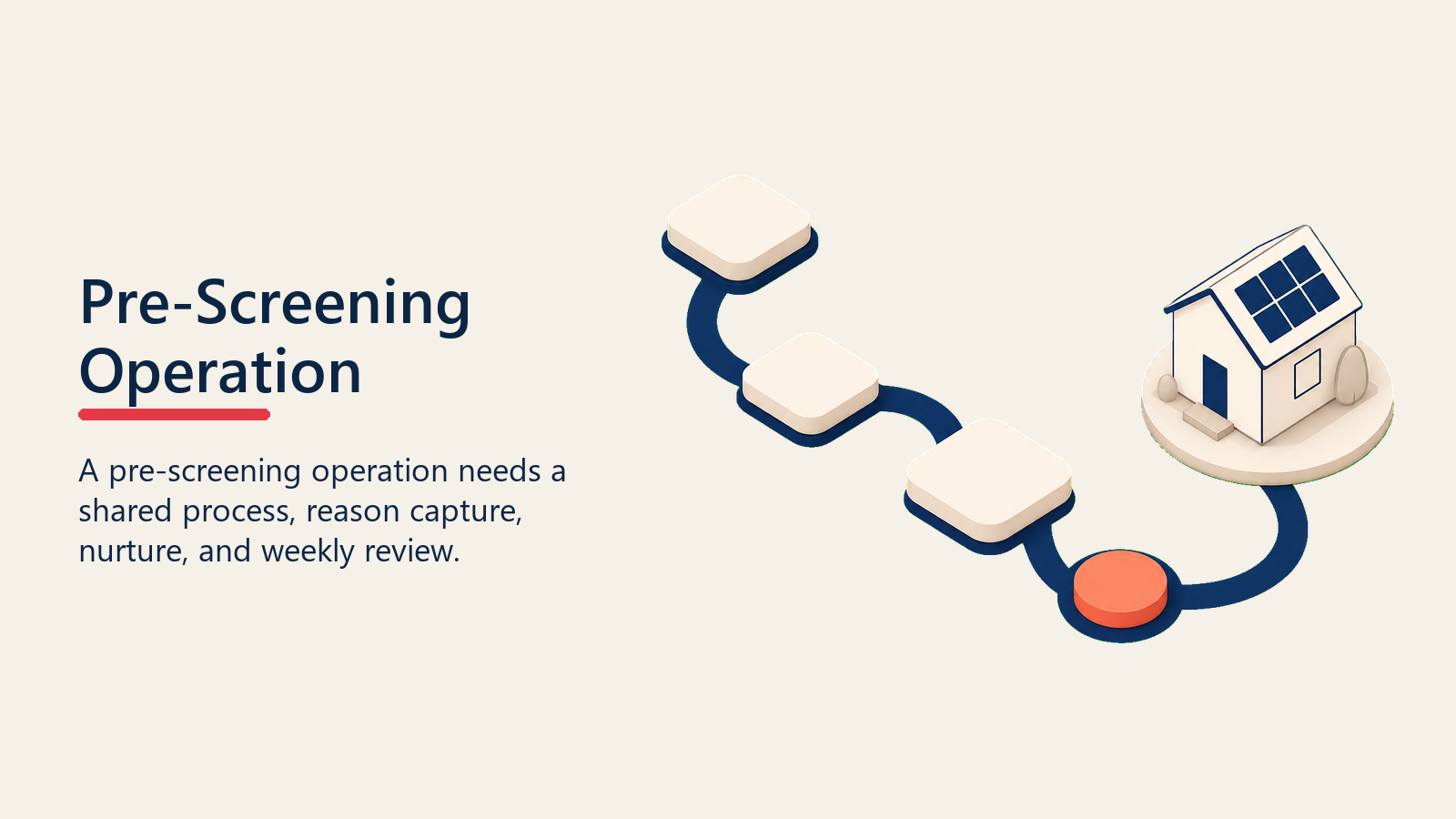
A documented qualification checklist that every setter uses for every lead. Non-negotiable. If different setters apply different standards, you can't measure anything.
CRM fields for disqualification reason. When a lead is removed from active pipeline, you need to record why. Categories: renter, low bill, credit/financing, HOA, roof, shade, wrong number/spam, not interested.
A soft-disqualification nurture sequence. Email or text campaign that stays in touch with leads that aren't ready now but might be in 6 to 18 months.
Weekly setter review. Go through disqualification rates by setter. High disqualification rates may mean a setter is being too aggressive. Very low rates may mean a setter is too lenient and booking unqualified appointments.
Lead source reporting by qualification rate. Track which channels produce the cleanest leads and adjust spend accordingly.
Pre-screening isn't a gatekeeping exercise. It's a quality control process that makes your entire sales machine more efficient. The homeowners who make it through deserve a great consultation experience. The leads that don't fit right now deserve respect and a graceful exit. And your closers deserve to spend their time with people who can actually say yes.
Referral leads disqualify at significantly lower rates than purchased digital leads, with practitioner data showing referral leads failing pre-screening for any reason only about 8% of the time compared to 35% or higher for cold Facebook leads, because the referrer self-selects contacts who are genuinely likely to convert. (Practitioner benchmark from solar sales operations data; calibrate against your own pipeline.)
Related reading:

Senior Implementation Consultant
On this page
- The Four Gates of Solar Qualification
- Gate 1: Homeownership
- Gate 2: Utility Bill Threshold
- Gate 3: Roof and Property Suitability
- Gate 4: Decision-Maker Presence
- What Should a Pre-Screening Script Sound Like?
- How to Handle Common Pushback
- Scoring Leads, Not Just Filtering Them
- The Difference Between Soft and Hard Disqualification
- How Does Pre-Screening Connect to Lead Source Quality?
- What Good Pre-Screening Does for Your Team
- Setting Up Your Pre-Screening Operation