Sales to Install Handoff in Solar: How to Protect the Deal You Just Closed
Turn this article into takeaways for your work.


Each assistant summarizes the article only for you and suggests best practices for your work.
A signed solar contract isn't a closed deal. It's a committed prospect who has agreed to go through a process that takes two to four months and involves their roof, their utility, their local government, and their money. A lot can go wrong between "yes" and "the system is on and producing." The SEIA Solar Business Code sets industry standards for how companies should handle post-sale communication, contract disclosures, and the handoff process. It's worth reviewing to benchmark your own practices against what the industry expects.
The sales-to-install handoff is the moment where most of that risk gets introduced or managed. Companies that do it well protect their margins and their reputation. Companies that do it poorly watch cancellation rates climb and spend a disproportionate amount of ops capacity cleaning up messes that started in the first 48 hours after the sale.
This guide covers what needs to happen, who owns each step, and how to prevent the breakdowns that consistently show up between sale and install.
Why the Handoff Is So High-Risk
When a rep closes a deal, the homeowner is in a state of committed optimism. They've made a decision, they feel good about it, and they're thinking about future savings. That emotional state is fragile.
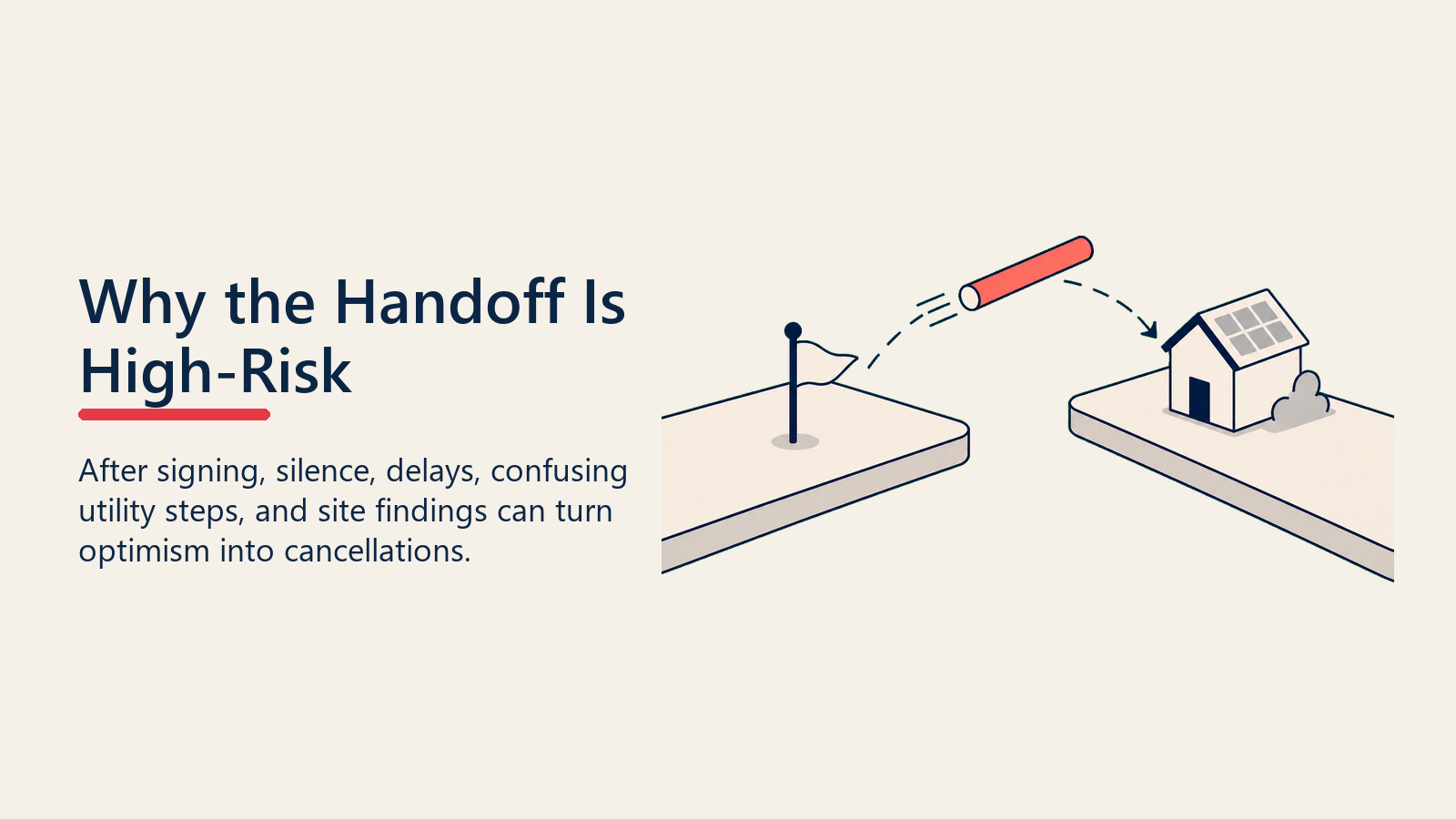
Over the next few weeks, several things can disrupt it:
- The homeowner hears nothing from the company for two weeks and starts to wonder if they made a mistake
- A neighbor or family member questions the decision ("Did you read the fine print on that loan?")
- The utility sends a confusing letter about interconnection
- The permit takes six weeks instead of two
- The site survey discovers the roof has more issues than the rep noticed during the consultation
Each of these is a cancellation risk. None of them is avoidable by selling better. They're managed by running a tight post-sale process.
Key Facts
- NREL research found overall residential solar contract cancellation rates reaching 40 to 50% at some installers, with permitting delays and changes in customer finances as the top two drivers. A strong handoff process is the primary lever ops teams have to address both. (NREL Technical Report 80626, 2022)
- Solar installations typically take 60 to 120 days from signed contract to energized system. That gap is where cancellation risk peaks, and proactive communication is the primary defense against it. (Industry operations standard)
- The SEIA Solar Business Code sets industry standards for post-sale communication, contract disclosures, and customer handoff process. (SEIA Solar Business Code)
What Needs to Be Handed Off
The handoff isn't just paperwork. It's a transfer of context and ownership.
Documents and Data
At minimum, the operations team needs:
- Signed contract and financing agreement
- Roof age, material type, and any known issues the rep noted
- Utility account number and current bill (for interconnection)
- HOA information if applicable (some HOAs have approval processes)
- Photos of the roof, electrical panel, and meter from the consultation visit
- Any specific customer preferences or concerns the rep noted during the consultation (the homeowner mentioned they're nervous about roof penetrations, or they have a specific date-sensitive reason for wanting to be installed before December)
That last category is critical and consistently under-documented. When the installation team shows up knowing only the system specs and nothing about the customer, they walk into conversations blind.
The Customer's Expectations
What did the rep promise during the consultation? What timeline did they communicate? What did they say the process would look like?
This doesn't mean auditing every word the rep said. It means capturing the commitments:
- Estimated installation window
- Who the customer's point of contact will be post-sale
- Any specific accommodations (customer works from home and needs advance notice before crews arrive, or customer requested a specific installation crew because their neighbor used them)
When operations doesn't know these expectations and then communicates differently, the homeowner experiences it as the company not talking to each other. That's a trust breakdown that can turn into a cancellation even when nothing substantive has gone wrong.
The Handoff Sequence
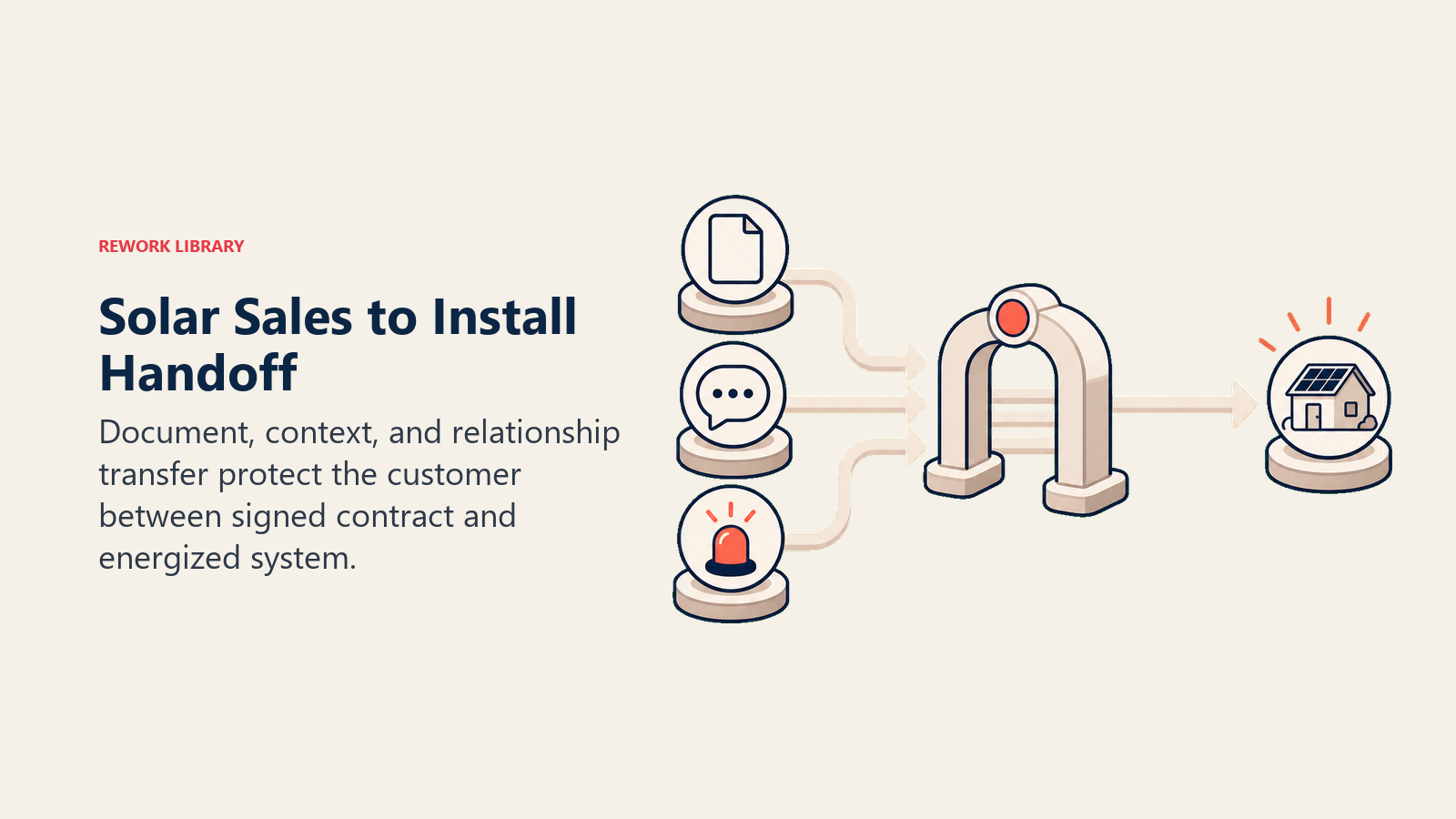
The Three Transfers: every successful solar handoff completes three transfers simultaneously. First, the document transfer: all signed contracts, financing agreements, roof photos, utility account data, and HOA status move to ops within 24 hours. Second, the context transfer: the customer's specific expectations, the rep's verbal commitments, and any sensitivity the customer expressed during the consultation follow the docs. Third, the relationship transfer: a named coordinator replaces the rep as the primary contact, introduced by name within 72 hours. Companies that complete all three transfers in the first 48 hours see materially lower cancellation rates in the permit wait phase.
Within 24 Hours of Signing
The rep's job: Submit all documentation to the ops system. Send a personal thank-you message to the homeowner. This isn't optional. A brief message that says "You're officially in the queue, here's what happens next, and here's how to reach me if anything comes up" dramatically reduces early cancellation risk.
The ops team's job: Assign a project coordinator to the account. This person becomes the homeowner's primary contact from signature through installation completion.
Within 48 to 72 Hours
Project coordinator outreach: The coordinator contacts the homeowner to introduce themselves and confirm next steps. This call or message should:
- Confirm the customer's contact information and preferred communication method
- Explain the process: site survey, permit filing, interconnection application, install scheduling
- Give a realistic timeline (not a best-case timeline)
- Set expectations for what the homeowner will and won't hear from the company during the waiting periods
Homeowners who understand the process are far less likely to panic when permits take longer than expected. Homeowners who were never told what to expect interpret silence as neglect.

Site Survey Scheduling
Schedule the site survey within the first week after signing. Even if the survey date is two or three weeks out, having it on the calendar gives the homeowner a concrete next step.
If the site survey reveals issues (shading problems, structural concerns, panel placement limitations), communicate them directly and immediately. Don't wait for the operations meeting. See site survey and design confirmation for how to handle survey findings that affect the original proposal.
Permit Filing and Interconnection
These processes run largely without homeowner involvement, but homeowners should be told they're happening and given rough timelines.
"We've submitted your permit to [County] and the interconnection application to [Utility]. Permit approvals in this county typically take three to six weeks. Once we have both approvals, we'll schedule your installation."
If there are delays, communicate them proactively. A message saying "Your permit is taking a bit longer than average; here's where things stand" is far better than a homeowner calling to ask why it's been four weeks and nobody has reached out.
See permitting and interconnection timeline for a full breakdown of what drives delays and how to set expectations accurately by jurisdiction.
What Are the Most Common Handoff Failure Modes?
The Rep Disappears
Some reps treat the signed contract as the end of their involvement. That's a mistake for two reasons.
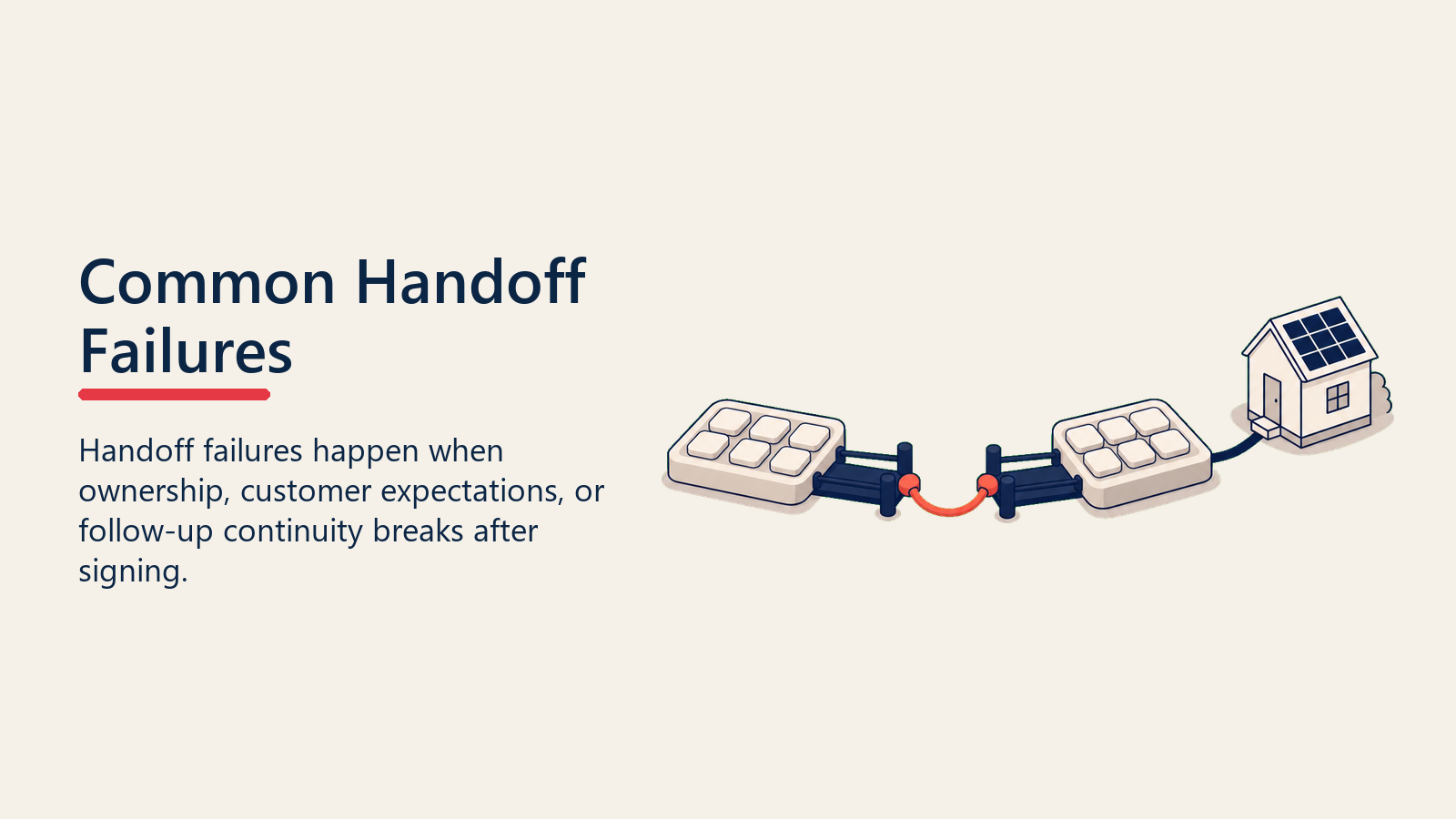
First, homeowners often have questions in the first few days after signing that they'd rather ask their rep than a stranger in the ops team. If the rep is unreachable, those questions fester.
Second, the rep has information about the customer that the handoff documentation may not fully capture. When issues come up during ops (a customer is upset about the timeline, a neighbor is spreading misinformation), the rep who built the relationship is often the fastest path to resolution.
A clean handoff doesn't mean the rep disappears. It means the rep transitions ownership while staying available as a relationship resource.
Ops Changes What Sales Promised
This is the most dangerous failure mode. If a rep promised a certain install window and operations books the customer two months later, or if a rep described the system a certain way and the site survey result changes the design, the homeowner experiences this as being misled.
Some of this is unavoidable. Permits take longer than expected. Site surveys reveal real issues. What's avoidable is promising specifics during the sale that operations can't reliably deliver.
Train reps to promise outcomes, not timelines. "You'll be producing power before the end of the year" is usually safer than "we'll be installed in September." And when ops needs to change something the rep committed to, have the ops coordinator loop in the rep to help with the customer conversation.
See sales and install operations alignment for a framework on closing the gap between what sales commits and what operations delivers.
No Single Point of Contact
When a homeowner has to re-explain their situation every time they call because there's no assigned coordinator, they lose confidence in the company. This is especially true for older homeowners or anyone who isn't comfortable navigating a corporate support structure.
Assign a named coordinator to every account at the point of handoff. That person's name, phone number, and email should be in every communication the homeowner receives after signing.
Managing Cancellation Risk During the Wait
The interval between signing and installation is where cancellations happen. Here's what drives them:
- Silence from the company (feels like abandonment)
- Family members who second-guess the decision
- Online research that turns up negative reviews about the company
- Utility or HOA communications that confuse or alarm the homeowner
- A competing rep who cold-calls and offers a lower price
Proactive communication is the primary defense. A sequence of touchpoints through the permit and design phase keeps the homeowner engaged and informed:
| Week | Communication |
|---|---|
| Week 1 | Welcome message from coordinator, confirm site survey date |
| Week 2 | Site survey confirmation and next steps |
| Week 3-4 | Permit filed, expected timeline |
| Week 5-6 | Design finalized, installation window confirmed |
| Week 7-8 | Installation reminder, what to expect on install day |
This doesn't have to be high-effort. A templated message sequence in your CRM that a coordinator personalizes takes five minutes per customer and prevents a disproportionate number of cancellations.
See managing install wait and cancellations for a deeper look at the specific intervention points where cancellation risk peaks.
The Ops Team's Role in Protecting the Sale
Operations teams sometimes think of cancellations as a sales problem. They're not. They're a company problem, and ops owns a large part of the solution.
When an ops coordinator treats the homeowner well during the permit wait, answers questions promptly, and proactively flags delays before the homeowner has to ask, they're directly protecting the margin on that deal.
Track coordinator-level metrics alongside sales metrics:
- Days from contract to site survey scheduled
- Days from site survey to design submission
- Homeowner-initiated contact attempts during permit phase (a leading indicator of engagement problems)
- Cancellation rate by coordinator
NREL research on residential solar contract cancellation rates found that overall project cancellation rates can reach 40 to 50 percent at some installers, with permitting delays and changes in customer finances ranking as the top two drivers. That data makes the case for investing in coordinator-level touchpoints as directly as any sales metric.
These numbers tell you where the handoff process is breaking down and which coordinators are building the most durable customer relationships.
What a Good Handoff Looks Like in Practice
Here's what best-in-class looks like from the homeowner's perspective:
The rep follows up the morning after signing with a thank-you and a brief note on what to expect. Two days later, a coordinator named Sarah calls to introduce herself, confirm the site survey for Tuesday, and walk through the three-phase process: survey, permits, install. She gives a 90-day estimate and explains that she'll reach out proactively if anything changes.
The site survey happens on Tuesday. Sarah sends a message on Wednesday: design came back clean, permitting the system now, expect approval in three to four weeks. Three weeks later, permit is in. Sarah emails with the install window: October 14-16, they'll confirm the specific day one week prior.
The homeowner never had to chase anyone. They always knew where things stood. They told two neighbors about their experience before the system was even installed.
That's not just good operations. It's the front end of your referral engine. See referral generation after install and retention fundamentals for how to turn a great post-sale experience into a systematic source of new leads.
The Handoff Is Part of the Sale
The most important mindset shift for solar companies trying to improve their handoff process: the handoff isn't where the sale ends. It's where the customer relationship begins.

Everything that happens between signature and energization shapes whether that homeowner stays a customer, refers their neighbors, and leaves a review that helps your next rep walk into a warmer consultation.
Companies that treat post-sale retention as purely an operations function miss how directly the handoff experience feeds back into acquisition costs. The churn prevention strategy covers how a poor handoff raises the risk of both contract cancellation and early account termination after install, and how ops and sales need to share accountability for those outcomes.
Invest in the handoff process the same way you invest in the closing process, and you'll find that cancellation rates drop, installer utilization improves, and your cost per installed kilowatt goes down. The math on a strong handoff is at least as good as the math on a strong close.
Frequently Asked Questions about Sales to Install Handoff in Solar
What are the three transfers that define a successful solar handoff?
Document transfer (contracts, financing agreements, photos, utility data), context transfer (the rep's verbal commitments, customer sensitivities, and specific expectations), and relationship transfer (a named coordinator introduced to the homeowner within 72 hours). Companies that complete all three within 48 hours see lower permit-phase cancellation rates.
When should the rep contact the homeowner after signing?
Within 24 hours. A brief thank-you message that confirms what happens next and gives the homeowner a way to reach the rep dramatically reduces early cancellation risk. The rep should not disappear at signature. They are the relationship the homeowner trusts, and that trust extends into the post-sale phase.
How quickly does the project coordinator need to reach out?
Within 48 to 72 hours of signing. The coordinator introduces themselves, confirms the homeowner's preferred contact method, explains the process (site survey, permit filing, interconnection, install), and gives a realistic timeline. Homeowners who understand the process do not panic when permits take four weeks instead of two.
What causes most cancellations in the permit wait period?
NREL research found permitting delays and changes in customer finances as the top two drivers of cancellation. But the third factor that compounds both is silence from the company. Homeowners who hear nothing for two weeks interpret it as neglect. A simple proactive update message resolves the silence problem with five minutes of coordinator time.
Should the rep stay involved after the handoff?
Yes, in a relationship capacity. The rep should not be the customer's operational contact, but should remain reachable for questions the homeowner would rather ask a familiar face. When something goes wrong during ops, the rep who built the relationship is often the fastest path to resolution.
What metrics should ops teams track alongside sales metrics?
Days from contract to site survey scheduled, days from site survey to design submission, homeowner-initiated contact attempts during the permit phase (a leading indicator of disengagement), and cancellation rate by coordinator. These tell you where the handoff process is breaking down before the cancellation rate rises.
What is the SEIA standard for post-sale customer communication?
The SEIA Solar Business Code sets industry standards for post-sale communication, contract disclosures, and handoff processes. It is worth reviewing your own practices against this framework as a baseline for what the industry expects from professional installers.

Senior Implementation Consultant
On this page
- Why the Handoff Is So High-Risk
- What Needs to Be Handed Off
- Documents and Data
- The Customer's Expectations
- The Handoff Sequence
- Within 24 Hours of Signing
- Within 48 to 72 Hours
- Site Survey Scheduling
- Permit Filing and Interconnection
- What Are the Most Common Handoff Failure Modes?
- The Rep Disappears
- Ops Changes What Sales Promised
- No Single Point of Contact
- Managing Cancellation Risk During the Wait
- The Ops Team's Role in Protecting the Sale
- What a Good Handoff Looks Like in Practice
- The Handoff Is Part of the Sale