Warranty, Service and System Monitoring for Solar Companies
Turn this article into takeaways for your work.


Each assistant summarizes the article only for you and suggests best practices for your work.
A homeowner who goes three months without noticing their system has been offline is not an edge case. It happens at companies that install and move on, treating the customer relationship as complete at activation. By the time that homeowner looks at their electric bill and realizes they've been paying full rate, they're angry, and the reviews they leave reflect that.
Post-install service is where solar companies lose the referral machine they spent the whole sales process building. But it's also where companies that do it well create advocates who sell for them. This article covers how to structure warranty coverage, set up monitoring that catches problems before customers do, and build a service response process that turns problems into positive outcomes.
The Warranty Stack in Residential Solar
Before you can manage warranty service, your team needs to know exactly what's covered, by whom, and for how long. This is a common source of internal confusion and customer dissatisfaction when it's not clearly documented.
A typical residential solar installation carries three distinct warranty layers. ENERGY STAR's rooftop solar guidance notes that string inverters typically carry a 10-year warranty, micro-inverters can extend to 25 years, and solar panels usually carry a 20-year warranty. Understanding this stack before a customer call prevents confusion on the most common service questions.
| Layer | What it covers | Typical term | Who backs it |
|---|---|---|---|
| Panel manufacturer warranty | Power output degradation (usually 80-90% at year 25) | 25 years | Panel manufacturer |
| Inverter warranty | Inverter performance and failure | 10-25 years depending on brand | Inverter manufacturer |
| Installation workmanship | Roof penetrations, wiring, mounting | 5-10 years, sometimes 25 | Your company |
| Monitoring system | Monitoring hardware and software | 1-5 years | Monitoring provider |
The customer almost never understands this stack. They see one company that sold and installed the system, and they hold that company responsible for every failure regardless of where it sits in the chain. Your team needs to be prepared to own the customer experience even when the underlying issue is a manufacturer defect, because navigating warranty claims on a customer's behalf is part of the service you're delivering.
Key Facts
- NREL research on PV panel failure rates found that systems installed after 2000 have a median failure rate of just 5 panels per 10,000 per year, and roughly 85% of systems produce 90% or more of predicted output annually. Proactive monitoring exists to catch the 15% that don't.
- Solar panels degrade at a median rate of approximately 0.5% per year, according to NREL analysis, meaning a panel in year 20 is still producing roughly 90% of its original rated output. String inverters typically carry a 10-year warranty; microinverters can extend to 25 years, per ENERGY STAR's rooftop solar guidance.
- A solar company doing 100 installs per month accumulates roughly 1,200 active systems from the prior year alone. At a 3 to 5% annual service rate, that translates to 36 to 60 service events per year from a single year's installed base. That number compounds as the fleet grows and makes a formal monitoring protocol a business necessity, not a differentiator.
What Goes Wrong and When
Understanding the failure pattern in residential solar lets you build a monitoring and service protocol that catches problems at the right time.
Year 1: Most failures are installation-related. Wiring issues, communication problems between inverter and panels, monitoring setup errors. These surface within weeks of activation if you're watching. The NREL failure rate data is encouraging overall, but it only reflects companies that are actively monitoring. The 15% that underperform don't announce themselves.
Years 2-5: Inverter issues start appearing. Microinverters and string inverters have different failure rates and failure modes. Monitoring software becomes critical here because many performance issues aren't visually obvious.
Years 5-10: Some roof-penetration issues from original installation begin to appear. Flashing, sealant, and mounting hardware. These often surface after weather events.
Years 10+: Panel degradation is measurable. Inverters may need replacement. This is largely manufacturer territory, but your relationship with the homeowner should still be active enough that you're the first call. The only way to stay that close across a fleet of hundreds of systems is a proactive monitoring program.
How Do You Build a Proactive Monitoring Program That Actually Catches Problems First?
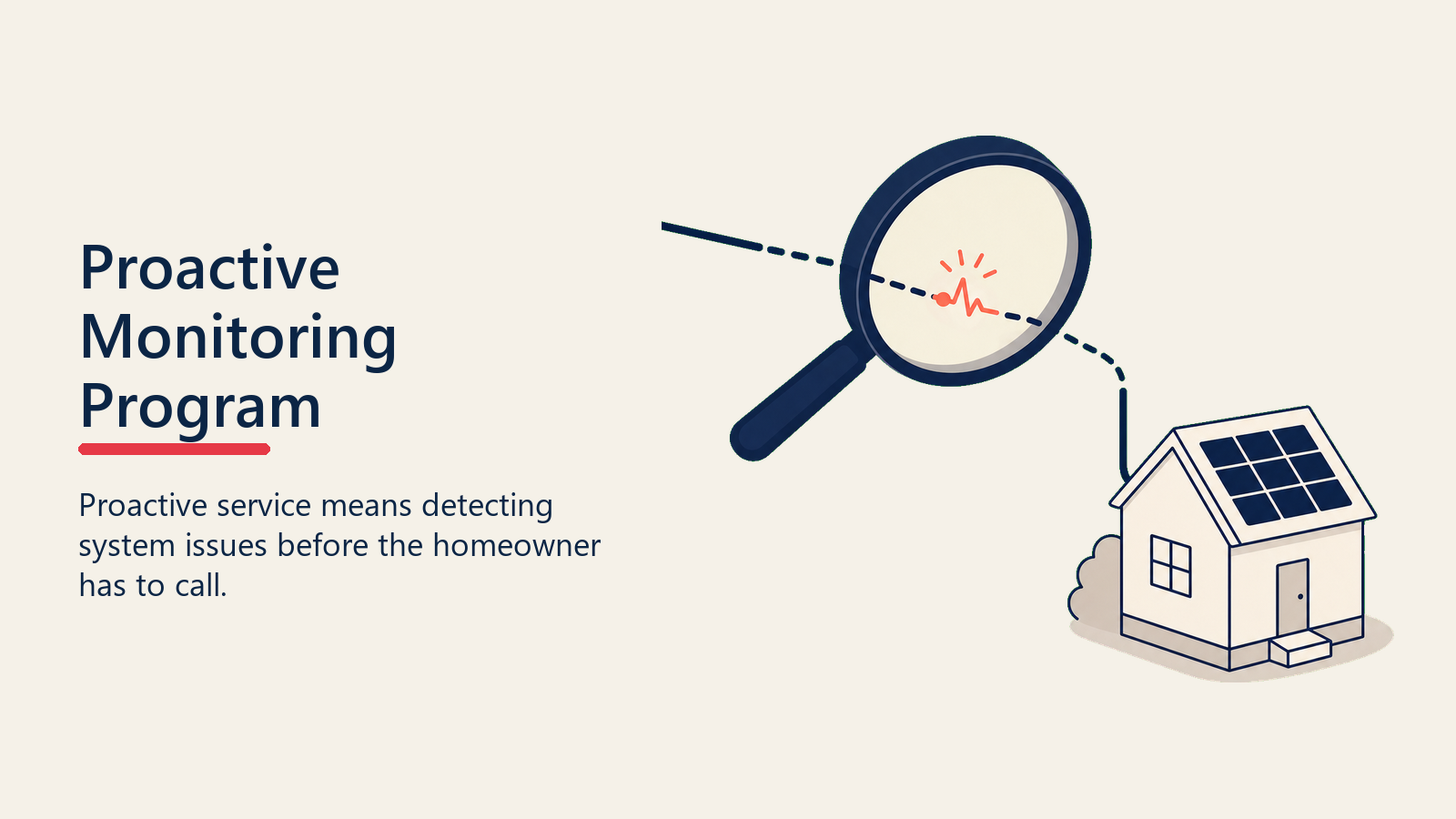
The shift from reactive to proactive service is the most important operational change a solar company can make in its post-install program. Reactive means you wait for the customer to call. Proactive means you see the problem first.
Monitoring platform selection
Most major inverter brands include monitoring software. Enphase Enlighten, SolarEdge monitoring, SMA Sunny Portal, and similar platforms all provide production data that your team can access remotely. The question isn't whether to use monitoring software. It's whether anyone is actually watching it.
Many companies activate monitoring at install and then never look at it unless a customer calls. This is the equivalent of having a car alarm and never telling anyone the code to turn it off.
Assign monitoring oversight to a specific role. Some companies use a customer success rep. Others use a service coordinator. The point is that someone owns it, has a daily or weekly check-in process, and has a defined threshold for when to escalate.
Alert thresholds that matter
You can't monitor every data point manually at any meaningful scale. Configure your monitoring software to alert when:
- System production drops more than 20% below projected output for the trailing 7 days
- An individual panel or microinverter drops offline entirely
- Communication between the inverter and monitoring platform is lost for more than 24 hours
- Production is zero for two consecutive days (excluding days with less than 2 peak sun hours)
These thresholds will vary based on your system designs and the monitoring platform you use. The key principle is that the alert should come to your team, not wait for the customer to notice.
What proactive outreach looks like
When your monitoring system flags an issue, your team contacts the customer before they notice. This single behavior, done consistently, is the biggest differentiator between solar companies with strong retention and those with churn problems.
A sample outreach script for a monitoring alert:
"Hi [Customer Name], this is [Name] from [Company]. We were reviewing your system monitoring and noticed your production numbers have been running lower than expected this week. We want to get someone out to check on that before it becomes a bigger issue. Can we schedule a service visit?"
The homeowner's response to this call is almost always positive. You called them. You caught it. You're handling it. Compare that to the call you get when they've been on the phone with their utility company for an hour trying to figure out why their bill jumped.
Service Response Protocols
When something needs to be fixed, how your team responds matters as much as whether you fix it.
Triage levels
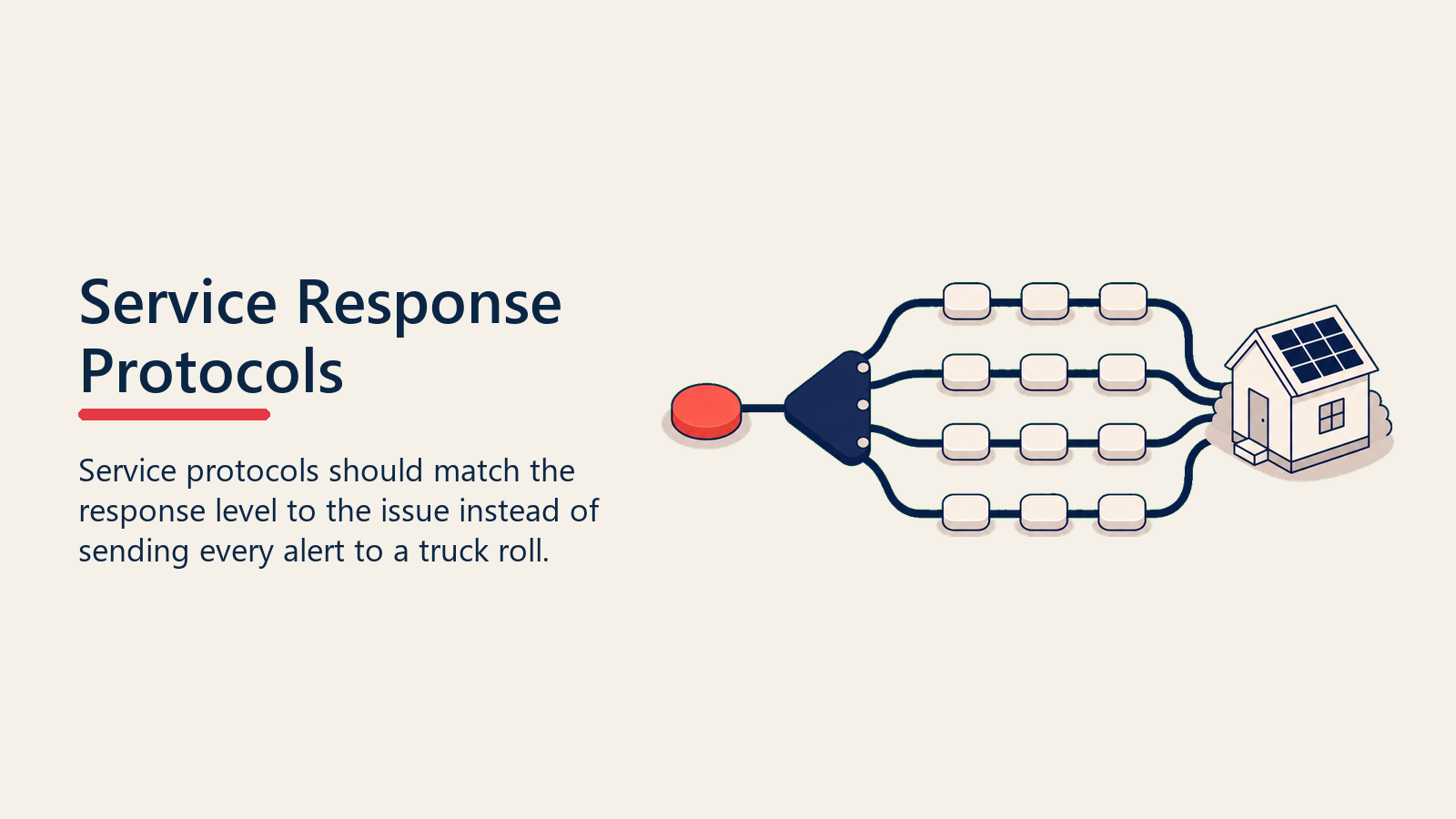
Not every alert needs a truck roll. Build a triage process that matches the response to the issue.
| Issue type | First response | Target response time |
|---|---|---|
| Communication outage (monitoring offline, system may be fine) | Remote diagnostic, check router/modem | Same business day |
| Single panel or microinverter offline | Remote diagnostic, schedule service if confirmed hardware | 5-7 business days |
| Inverter offline, no production | Remote diagnostic, emergency escalation if not resolved remotely | 24-48 hours |
| Physical damage (storm, roof issue) | Photo documentation, insurance coordination, priority scheduling | 24-48 hours initial contact |
| Customer complaint about production | Review monitoring data, contact customer, schedule if warranted | Same business day contact |
Service ticket ownership
Every service request should have a named owner and a defined close date. This sounds obvious, but service teams at growing solar companies frequently lose tickets in shared inboxes or informal handoffs.
Use your CRM to create a service ticket for every issue, assign it to a rep or coordinator, and set an escalation rule if the ticket isn't closed within the target window. The customer should receive an update at minimum every 3 business days while a ticket is open.
Parts and inventory
One of the most common service delays in solar isn't scheduling. It's waiting for parts. A microinverter that fails in month 18 needs to be replaced under manufacturer warranty, but the warranty process for parts retrieval can take weeks if your company doesn't stock common components.
Carry a small inventory of your most common inverter models and replacement components. The carrying cost is minor compared to the customer satisfaction cost of telling someone their system will be down for 6 weeks while you wait for parts. Once you're actually handling a claim, communication becomes the next battleground.
Warranty Claims: Managing the Process
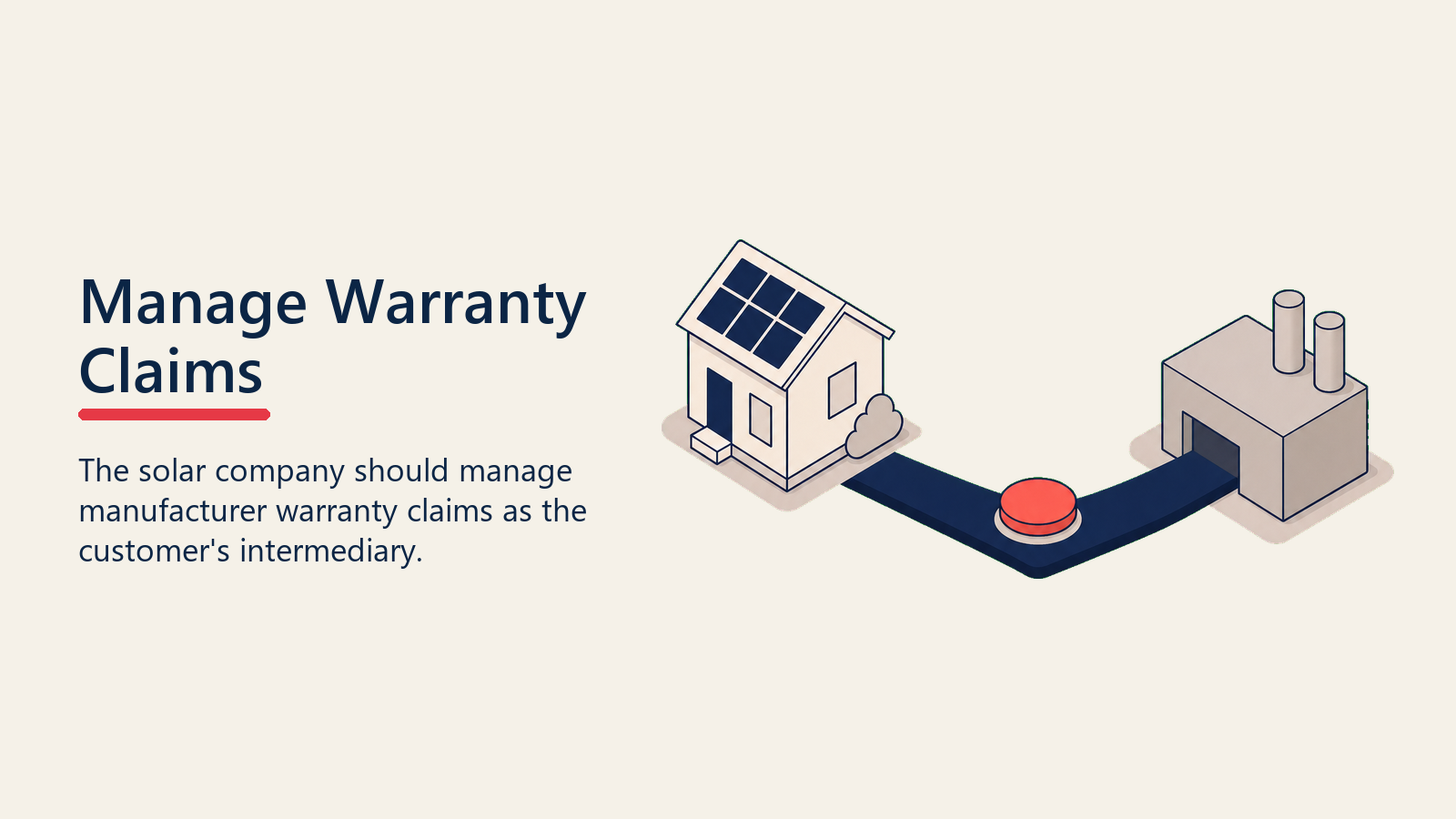
When a manufacturer warranty claim is needed, your company serves as the intermediary. The customer doesn't want to deal with Enphase or SolarEdge directly. They want you to handle it.
Build an internal playbook for each major manufacturer warranty claim process:
- What documentation is required (photos, monitoring logs, serial numbers)
- How to submit the claim
- Expected turnaround time for replacement parts
- Who at your company owns the follow-up
This playbook should be accessible to any service coordinator, not just the one person who's done it before. Companies that rely on institutional knowledge for warranty claims create service delays whenever that person is on vacation or leaves the company.
Managing customer expectations during claims
The hardest part of warranty service is the wait. Customers who understand the process accept delays better than customers who feel like something has gone wrong.
When you open a warranty claim, send the customer a brief explanation:
"We've opened a warranty claim with [Manufacturer] for your [component]. Claims like this typically take [X] days for part fulfillment. In the meantime, [portion of their system] is still operational/offline. We'll update you as soon as we have an estimated resolution date."
Proactive communication during the claim process turns a frustrating wait into a manageable inconvenience. A claim that takes 3 weeks with regular updates generates a neutral or even positive review. The same claim with silence generates a 1-star post.
For the broader picture of how service quality affects retention, see the principles in retention fundamentals and churn prevention strategy. There's one more service scenario that catches companies off guard: when the system technically works but produces less than promised.
Performance Guarantees and Production Shortfalls
Some solar companies offer production guarantees as a sales tool. "If your system doesn't produce X kilowatt-hours in year one, we cover the difference in your electric bill." These are powerful close tools but create a service obligation that many companies aren't prepared to fulfill.
If you offer production guarantees, build the monitoring process that lets you catch shortfalls before the annual review. A system that underproduces by 15% in year one is a contract liability if you guaranteed 100% production. The monitoring alerts you already have for general service can double as your production guarantee tracking mechanism.
When a shortfall is real, contact the customer proactively. Don't wait for them to come to you at the 12-month mark. Identify the shortfall, explain the cause, and calculate the credit before they ask. Companies that handle this transparently get referrals out of it. Companies that wait to be challenged about it get disputes.
Turning Service into Referrals
A service call that goes well is a referral opportunity. Most solar companies never use this.
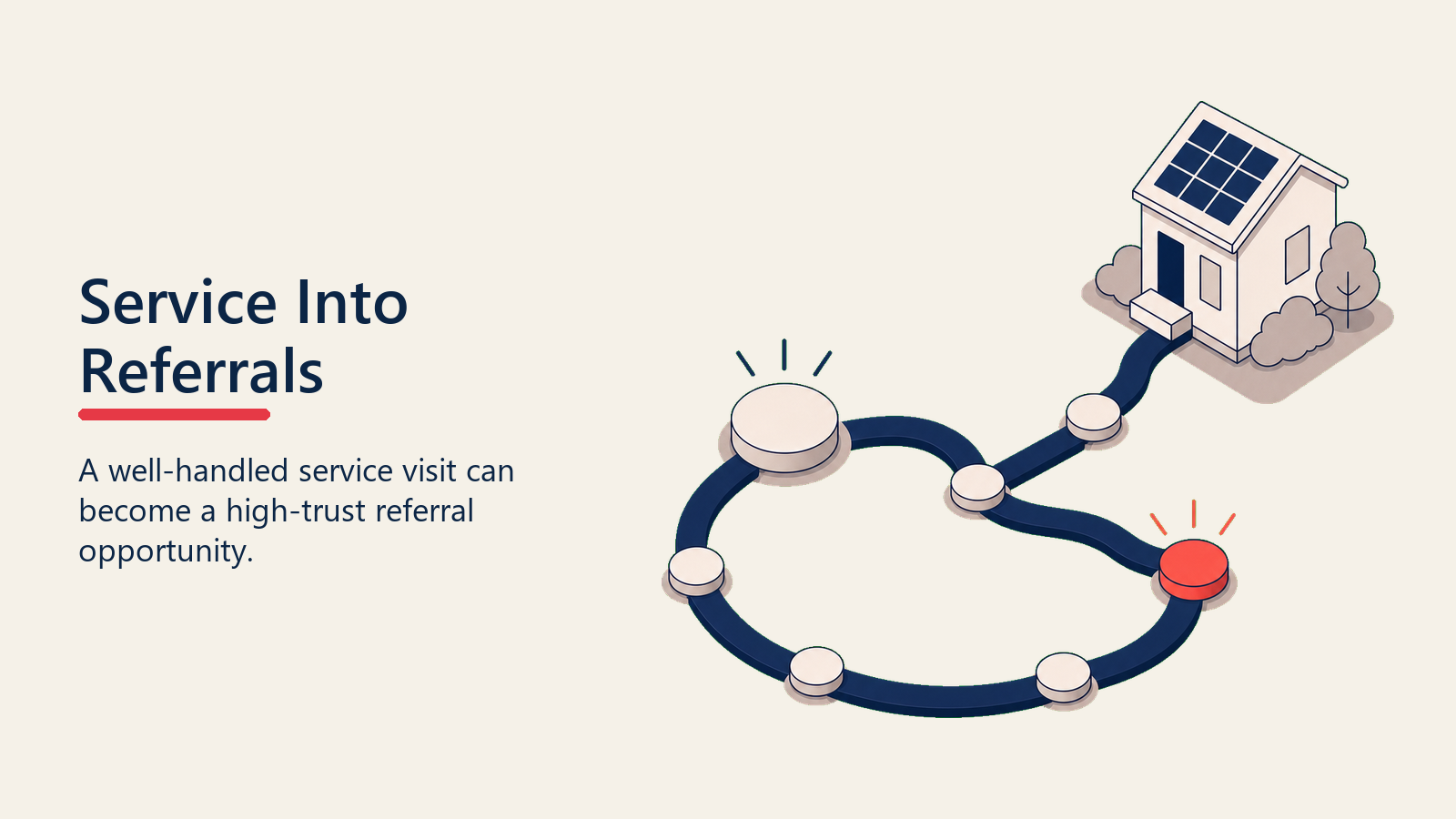
When your technician closes a service visit and the homeowner is satisfied, the tech should make the referral ask on the spot:
"We're glad we caught that and got it sorted for you. If you know anyone else thinking about solar, we'd love the introduction. We take great care of our customers, and you've seen that firsthand."
This ask lands well after a service visit because trust is high. The homeowner has just watched your team respond quickly, fix a problem, and treat them well. That's the moment they're most willing to advocate for you.
Log service-visit referral asks in your CRM the same way you track sales referral asks. It's a secondary pipeline that most solar companies leave untapped. For the full referral framework, see referral generation after install.
The connection between service quality and customer satisfaction is tightest in the first year. The onboarding period sets the foundation that service interactions either reinforce or undermine. And for how reviews flow from service quality, see online reviews and reputation management.
Building the Internal Service Team
As you grow, the question shifts from whether to have a service process to who owns it and how it scales.
Roles you need
Customer Success Coordinator: Owns monitoring alerts, service ticket creation, customer communication during open tickets. This person is the homeowner's single point of contact.
Field Service Technician: Handles truck rolls for physical inspections and repairs. In early stages this is often the install team doing double duty. At scale, dedicated service techs are faster and cheaper.
Warranty Claims Specialist: Manages manufacturer warranty submissions, parts ordering, and status tracking. Can be the same person as the coordinator at small scale.
Service level agreement (SLA) targets
| Event | Internal SLA target |
|---|---|
| Monitoring alert acknowledged | 4 business hours |
| Initial customer contact after alert | Same business day |
| Service visit scheduled | Within 5 business days of confirmed need |
| Warranty claim submitted | Within 24 hours of confirmed defect |
| Ticket closed and customer notified | Within 2 business days of resolution |
Post your SLAs internally and track them in your ops meeting. Service teams without SLAs default to whatever pace feels comfortable, which is never the pace customers expect.
What This Looks Like at Scale
A solar company doing 100 installs a month has a service tail of roughly 1,200 operational systems from the past year alone. At 3 to 5% annual service rate, that's 36 to 60 service events per year from just one year of installs. As the installed base compounds, so does the service volume.
Companies that don't build their service infrastructure ahead of that growth find themselves overwhelmed at 18 to 24 months. The monitoring alerts pile up, tickets get lost, customers post reviews, and what should be a referral machine becomes a source of churn.
The investment in a proper monitoring and service protocol pays for itself in three ways: fewer angry reviews, higher referral rates from customers whose problems got solved well, and a service reputation that becomes a sales differentiator in competitive markets. Some homeowners explicitly ask about post-install service before signing. Your answer to that question closes deals.
For the connection between service quality and sales team alignment, see sales and install operations alignment. The promises made during the sale set customer expectations that the service team has to live up to.
The check-in cadence that keeps your best customers from quietly drifting toward a competitor's upgrade offer is covered in the Learn More section below.
Learn More
Quotable Nuggets
"A homeowner who goes three months without noticing their system has been offline is not an edge case. It happens at companies that install and move on. The proactive monitoring call ('we saw your production was down and we're already on it') is the single most effective trust-building interaction a solar company can have with a post-install customer."
"Most residential solar systems perform as expected. The ones that don't won't announce it. Proactive monitoring is the only tool that catches underperformance before it becomes a warranty dispute and a 1-star review." (NREL, Failures of PV Panels and Degradation)
"A service call that goes well is a referral opportunity. The homeowner has just watched your team respond quickly, fix a problem, and treat them well. That's the moment they're most willing to advocate for you, and most companies never ask."
The Proactive Monitoring Protocol: Assign explicit ownership of monitoring oversight to a named role (a customer success coordinator or dedicated service coordinator) with a defined daily or weekly check-in process. Configure monitoring software to alert on four specific thresholds: production down more than 20% vs. projected for the trailing 7 days; any individual panel or microinverter offline; communication lost for more than 24 hours; zero production for two consecutive days excluding low-sun days. When an alert fires, contact the customer before they notice. Triage remotely first, resolving communication outages and minor issues without a truck roll, and reserve field visits for confirmed hardware failures. Track every service ticket in the CRM with a named owner, a close date, and an escalation rule if the ticket isn't resolved within the SLA target.
Frequently Asked Questions

Senior Implementation Consultant
On this page
- The Warranty Stack in Residential Solar
- What Goes Wrong and When
- How Do You Build a Proactive Monitoring Program That Actually Catches Problems First?
- Monitoring platform selection
- Alert thresholds that matter
- What proactive outreach looks like
- Service Response Protocols
- Triage levels
- Service ticket ownership
- Parts and inventory
- Warranty Claims: Managing the Process
- Managing customer expectations during claims
- Performance Guarantees and Production Shortfalls
- Turning Service into Referrals
- Building the Internal Service Team
- Roles you need
- Service level agreement (SLA) targets
- What This Looks Like at Scale