Weather, Timing and Density Planning for D2D Sales
Turn this article into takeaways for your work.


Each assistant summarizes the article only for you and suggests best practices for your work.
Two reps. Same script. Same territory. One closes four deals on Tuesday. The other closes one on Wednesday. The difference isn't skill. It's timing. One knocked during the two-hour window when homeowners are home, alert, and not in the middle of dinner. The other knocked during school pickup, when households are empty or chaotic. One worked a tight subdivision with 12 houses per block. The other got assigned a rural stretch with driveways 400 feet apart.
Weather, timing, and density aren't soft variables. They're hard inputs that determine how many real conversations a rep gets each day. Plan them well and your team's numbers go up without changing a single line of the pitch.
Why These Three Variables Compound
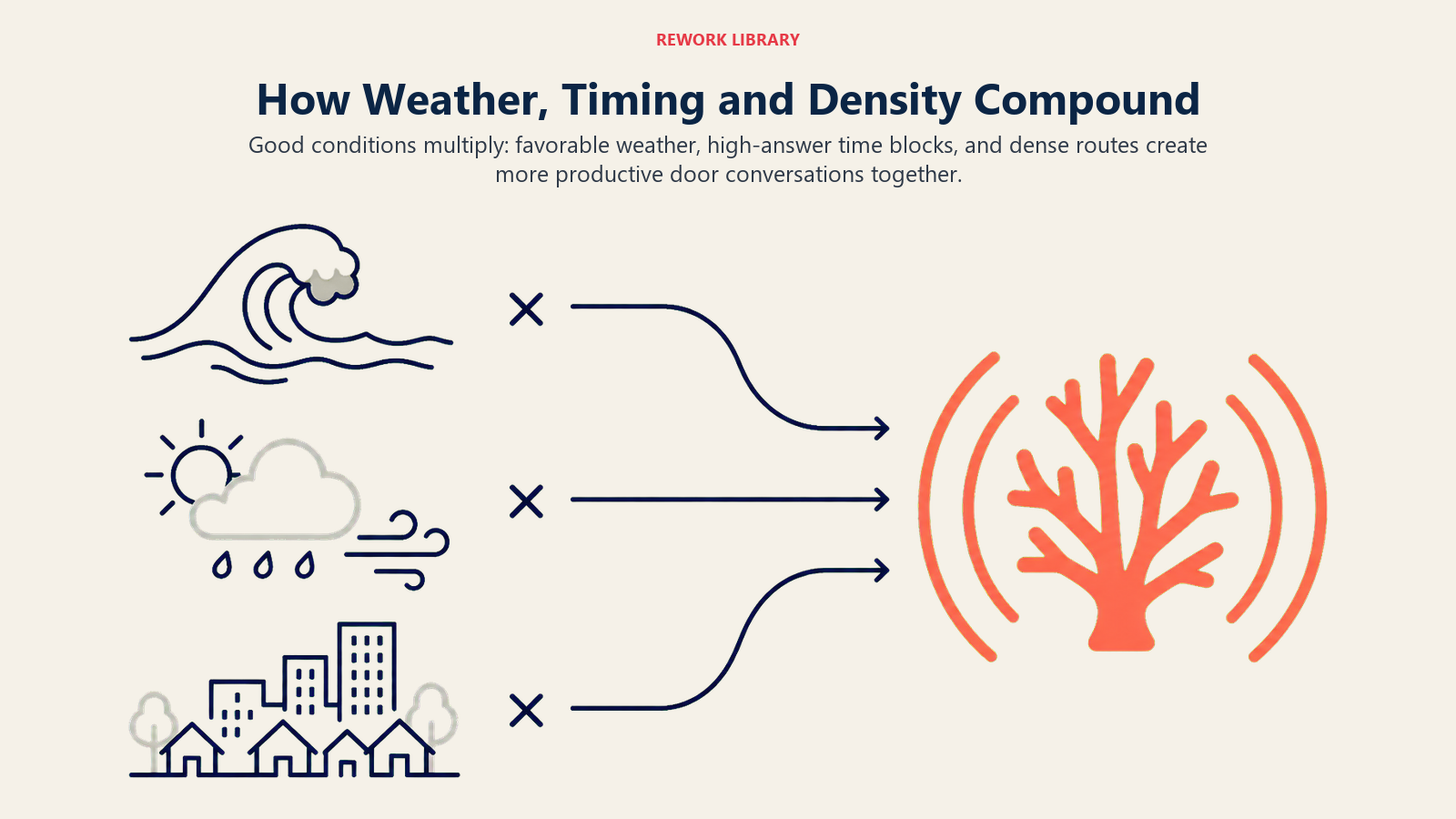
Weather, timing, and density each affect your results independently. But they compound. A cold drizzly day in a low-density rural territory on a Tuesday morning is almost a write-off. A sunny late afternoon in a tight suburban subdivision on a Thursday is as good as it gets. Most door-to-door, or D2D, sales organizations plan around none of these variables and then wonder why daily results swing wildly from rep to rep. Controlling for weather, timing, and density doesn't mean chasing perfect conditions. It means making deliberate tradeoffs. If Thursday afternoon is your best weather window and Friday looks rough, that's the day you save your best high-density territory. If you have to work a low-density route, you slot it into off-peak hours so you're not sacrificing peak knocking time.
Key Facts: D2D Environmental Planning
- D2D teams convert at 2-5% of doors knocked, making door volume the primary lever managers can control. (Source: SPOTIO)
- 65% of field sales reps spend 5 or more hours per week on manual CRM data entry, time that competes directly with peak knocking windows. (Source: SPOTIO 2026 State of Field Sales)
- 68% of field sales teams report 30% or more annual turnover, meaning most reps never build enough local environmental pattern knowledge to self-optimize. (Source: SPOTIO 2026 State of Field Sales)
Weather: Which Conditions Are Worth Working?
Most D2D managers just tell reps to work through the weather unless it's dangerous. That's leaving money on the table. Weather doesn't just affect rep comfort. It changes homeowner behavior and open-door rates significantly.
Ideal conditions
The best knocking weather is a mild, partly cloudy day with temperatures in the 60-75°F range. Homeowners are outside more. Windows and doors are open. People are in a better mood. In pest control, a recent rain event often primes conversations because mosquitoes, ants, and rodents are more active after wet weather. The National Pest Management Association documents how cold snaps push rodents indoors, while warm wet springs create ideal breeding conditions for ants and mosquitoes, which translates directly into stronger homeowner receptivity after weather events.
For lawn care, a dry week following recent rain is when homeowners notice their grass looking patchy or uneven. For fiber internet, weather doesn't affect the pitch itself, but homeowners who've been stuck inside on a rainy day are more likely to be thinking about their home setup.
Weather conditions to work around
| Condition | Impact | Adjustment |
|---|---|---|
| Heavy rain | Low open rates, wet reps look unprofessional, homeowners irritated | Push to next day, do admin/training instead |
| Extreme heat (95+) | Reps fatigue quickly, homeowners don't want door open, pitches shorten | Shift to early morning or evening blocks only |
| Hard freeze / snow | No one answers, rep safety risk | Cancel field work, run call campaigns instead |
| High wind | Reps arrive disheveled, outdoor pitches uncomfortable | Work shorter blocks, move car more often |
| Mild overcast | Fine to work, similar to sunny | No change needed |
The sweet spot for a full day in the field: 58 to 80°F, no precipitation, light wind. Build your calendar around protecting these windows.
Using weather forecasts operationally
Most D2D managers don't look at a five-day forecast as a planning tool. They should. Here's a simple weekly planning process:
On Sunday evening, pull a five-day forecast. Identify which days have ideal or near-ideal windows. Assign your best density territories to those days. Schedule admin, training, and ride-alongs on the worst weather days. This alone can increase field output by 20-30% without changing headcount.
For seasonal businesses like lawn care and pest control, also track historical weather patterns by zip code for your territory. You'll find patterns: certain months are more reliable, certain microclimates in your territory are windier or rainier than others. That's the kind of intelligence your territory design should factor in.
Timing: When Do Homeowners Actually Answer?
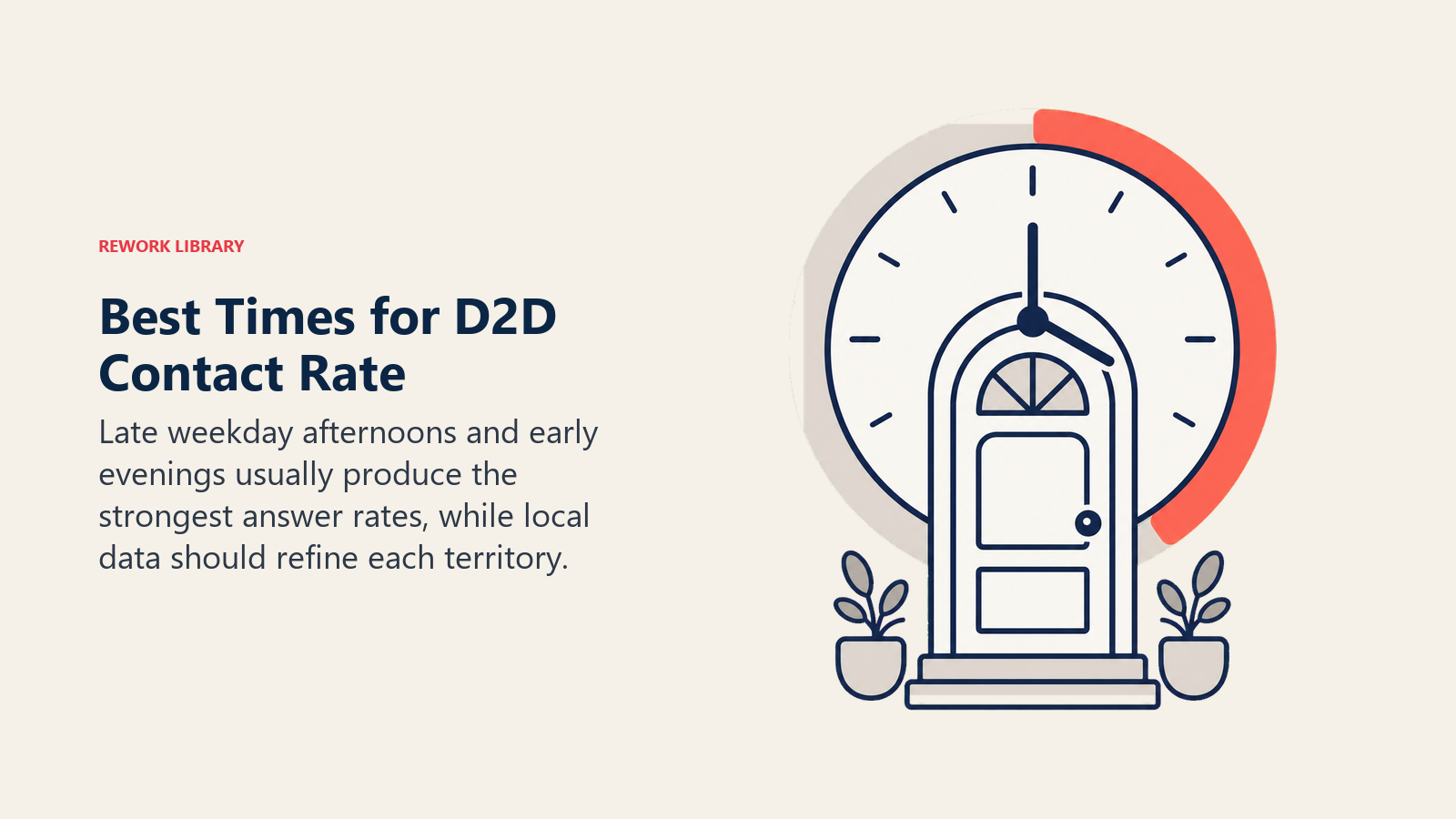
Contact rate is the percentage of knocked doors where someone answers and you get a real conversation. It's one of the most important numbers in D2D, and it swings dramatically by time of day. According to SPOTIO's canvassing research, a healthy contact rate for residential D2D is 30 to 40 percent, and teams that hit the same area across three different time blocks reach roughly 90 percent of homeowners.
Answer rate by time block
Based on field patterns across residential D2D verticals, these are typical contact windows for a standard suburban territory:
| Time Block | Contact Rate | Notes |
|---|---|---|
| 8:00-10:00 AM | 20-30% | Retirees, stay-at-home parents, remote workers answer; most adults out |
| 10:00 AM-12:00 PM | 25-35% | Better than early morning; some household activity increases |
| 12:00-1:30 PM | 30-40% | Lunch hour; remote workers step away; some households active |
| 1:30-3:30 PM | 20-28% | Afternoon lull; families out for school pickup |
| 3:30-5:30 PM | 45-60% | First peak; people home from work before dinner prep starts |
| 5:30-7:30 PM | 50-65% | Best overall window; most households occupied |
| 7:30-8:30 PM | 35-45% | Acceptable but shorter pitch window; households settling in |
| After 8:30 PM | Under 20% | Very low; also raises comfort and legal concerns in some areas |
These aren't universal. Urban apartments knock differently than suburban single-family homes. Neighborhoods with high concentrations of shift workers or two-income households with no remote work will behave differently. Your territory knock analytics should track contact rates by time block for your specific zip codes so you're working off local data, not averages.
What this means for scheduling
If your team's primary close window is 4:30-7:30 PM, and it takes 45 minutes to drive to your territory and set up, your reps should leave the office by 3:45. Reps who start at 4:00 and knock at 5:00 are burning 30 minutes of their best window.
Morning blocks are not wasted time, but use them differently. Morning is good for:
- Working territories near the office to minimize drive
- Doing canvassing passes to map the neighborhood without expecting high contact
- Following up with homeowners who asked you to "come back in the morning" (retirees often prefer this)
For summer programs with seasonal reps, the best structure is a split shift: afternoon warm-up block (2:00-4:00 PM in lower-density zones) followed by the core evening push (4:30-7:30 PM) in your best neighborhoods. See running a summer sales program for how this works with a larger team.
Day-of-week patterns
Weekday evenings perform better than weekends for most residential verticals. Here's why: on weekends, families are out running errands, kids have activities, and homeowners are less likely to stop and have a 15-minute conversation with a stranger at the door. They're busy with their weekend.
The exception: Saturday mornings from 9:00 AM to noon. This is an underrated window. People are home, awake, and not yet out for the day. This window is especially good for lawn care, pest, and security pitches because homeowners have often just noticed a problem that weekend (a dead patch of grass, an ant trail in the kitchen, a neighbor mentioning crime).
Friday evenings tend to be the weakest weekday evening because people are going out, cooking celebratory dinners, or decompressing from the week. If you have to skip a day, Friday evening is the lowest-cost day to take off.
Density: Choosing Where to Maximize Door Count
Density refers to how many knockable doors exist within a walkable distance. High density means more doors per hour of walking time, which means more contacts with less transit waste.
How to categorize your territory by density
A simple three-tier density model works for most D2D organizations:
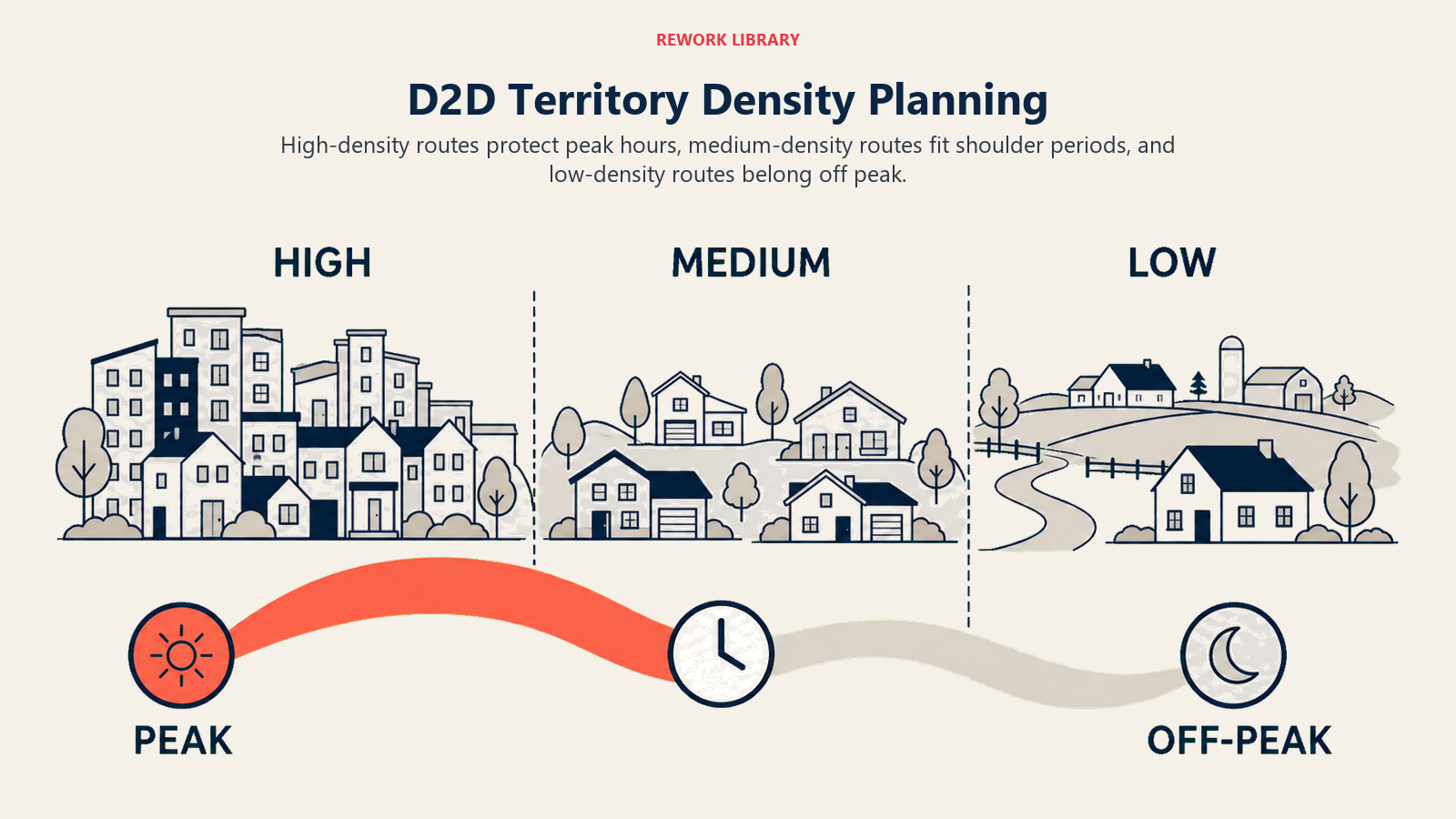
Tier 1 (High density): 10+ homes per block, consistent sidewalks, driveways under 30 feet These are traditional subdivisions, older suburbs, tract home neighborhoods. A rep can knock 12-15 doors per 30 minutes here if the contact rate is good. Best for peak knocking hours. Most efficient use of an afternoon.
Tier 2 (Medium density): 6-9 homes per block, mixed sidewalks/paths, driveways 30-80 feet Semi-rural neighborhoods, newer construction with larger lots. A rep can knock 7-10 doors per 30 minutes. Work these during shoulder hours (late morning or early evening).
Tier 3 (Low density): Under 6 homes per block, no sidewalks, driveways over 100 feet Rural routes, estate neighborhoods, homes on acreage. A rep can knock 3-5 doors per 30 minutes. Reserve these for off-peak hours only. The upside is that contact rates can be higher in some low-density rural areas because homeowners are more trusting and curious, but the volume is never there.
Matching density to timing
Here's the planning matrix to use:
| Peak Hours (4:30-7:30 PM) | Off-Peak Hours (Morning / Early Afternoon) | |
|---|---|---|
| High density | Priority assignment | Acceptable, good volume even at lower contact rates |
| Medium density | Good second choice | Solid for morning blocks |
| Low density | Avoid (volume too low to justify premium time) | Best slot for this tier |
The Density-Timing Matrix: a territory assignment tool that maps each density tier (high, medium, low) against each time-of-day category (peak, off-peak) so managers can deliberately stack advantages instead of randomly assigning routes.
This matrix is the core of smart territory assignment for managers. When you align density with timing, you're stacking advantages. When you misalign them, you're giving your reps the worst of both worlds.
Sending a rep to a low-density rural route during your peak evening window is not a bad luck outcome. It's a planning failure. The doors were always going to be 400 feet apart.
Density and service fit
Density also affects which services make sense to pitch in a given area.
Fiber internet: needs proximity to existing fiber infrastructure. High-density urban/suburban neighborhoods often have it. Rural low-density zones often don't. Check coverage maps before assigning reps.
Pest control: high-density neighborhoods near green space, water features, or construction zones are premium targets. Dense suburban neighborhoods also mean that when one house has a problem, neighbors often do too.
Lawn care: medium-density suburban neighborhoods with clear lot lines and visible lawns are ideal. High-density urban areas with no lawns or purely apartment buildings are a mismatch. Low-density rural areas may have lawn needs but low conversion due to lifestyle differences.
Security: high-density neighborhoods with crime activity or with neighbors who recently had incidents. Check the local crime data for your territory. Neighborhoods where break-ins have happened in the last 90 days have naturally elevated interest.
Putting It Together: A Weekly Planning Template
Here's a simple weekly planning structure that integrates all three variables: Sunday: Pull the forecast, map the week
- Identify best weather days (target: 3-4 field days)
- Assign high-density territories to the best weather days with peak-hour scheduling
- Assign admin, training, or low-density work to the worst weather day
Daily pre-shift: Confirm conditions
- Check current weather vs. forecast (update if needed)
- Confirm which blocks are pre-planned in the canvassing app
- Set door and contact targets for today based on territory type
During the shift: Stay on the plan
- Resist the urge to improvise territory mid-shift unless there's a clear reason (neighborhood is gated, previously knocked, etc.)
- Track contacts and doors in real time so you can adjust if you're running behind
Post-shift: Log the data
- Record weather conditions, time blocks worked, doors knocked, contacts made
- Over time, this builds a local intelligence layer that territory knock analytics can use to refine future plans
If your reps convert at 3% of doors and you lose 90 peak-window minutes to bad route planning, that's roughly 6-9 knocks lost before the shift even starts. Fix the calendar before you fix the pitch.
A well-designed D2D sales funnel depends on consistent contact volume at the top. Weather, timing, and density are the three levers that determine whether that contact volume shows up or not.
For teams running seasonal programs, this kind of structured planning is critical. Summer programs that staff up quickly and then scatter reps across a territory without an environmental plan see huge variance in rep performance that has nothing to do with ability. Solving for weather, timing, and density first creates a floor that the whole team benefits from.
The Mindset Shift: Environment Is Part of the Job
Some managers treat weather delays and bad-timing days as excuses. That's a mistake. But the opposite extreme, where reps are sent out in driving rain to knock doors no one will open, is also wasteful. The goal is clear-eyed planning that maximizes productive field time.
Reps who understand that environment is a variable they can plan around become more strategic about their time. They don't feel like failures on a bad weather day because they understand why the day was harder. And they don't waste their best knocking windows doing paperwork in their car because no one planned for the peak timing.
Learn more: Solar canvassing and door-to-door · Solar lead qualification and prescreening

Senior Implementation Consultant
On this page
- Why These Three Variables Compound
- Weather: Which Conditions Are Worth Working?
- Ideal conditions
- Weather conditions to work around
- Using weather forecasts operationally
- Timing: When Do Homeowners Actually Answer?
- Answer rate by time block
- What this means for scheduling
- Day-of-week patterns
- Density: Choosing Where to Maximize Door Count
- How to categorize your territory by density
- Matching density to timing
- Density and service fit
- Putting It Together: A Weekly Planning Template
- The Mindset Shift: Environment Is Part of the Job