Onboarding and Ramping New Reps for Door-to-Door Sales
Turn this article into takeaways for your work.


Each assistant summarizes the article only for you and suggests best practices for your work.
Most door-to-door sales companies lose new reps before they ever get good. The rep shows up, shadows someone for a day or two, gets handed a territory map, and is told to "go knock." Two weeks later they've quit, telling their friends the job is impossible. But it was the onboarding that failed them, not the job.
A structured ramp program changes the math. Pest control companies running multi-week onboarding with role-plays and ride-alongs report that reps who make it through the full program are far more likely to still be producing after 90 days. Security dealers who treat the first week as a training investment rather than a productivity drain see ramp time cut in half. The field rewards preparation. Every rep who leaves before they hit their productivity ceiling is a net cost, not a net contributor.
This guide covers how to build a rep onboarding program that works for the realities of D2D: high turnover pressure, seasonal peaks, 1099 workforce complexity, and the fact that the product is sold on a stranger's doorstep in under five minutes.
Why Does Most D2D Onboarding Fail?
The typical onboarding for a new D2D rep looks like this: one day of paperwork, a product overview, a quick ride-along, and then they're on their own. The gap between what they learned and what they face at the door is massive.
Key Facts: D2D Rep Onboarding
- SPOTIO's 2026 State of B2C Field Sales report found that field sales teams who ramp reps to full productivity in under two months retain those reps at 72%, compared to 51% retention for teams where ramp takes longer. (SPOTIO, 2026)
- HubSpot data puts the average sales rep tenure at 18 months, meaning most reps leave before reaching the two-to-three year mark where peak field sales performance typically arrives. (HubSpot via Xactly)
- The BLS Occupational Outlook for sales occupations covers wage benchmarks across sales roles useful for calibrating first-month earning expectations when explaining D2D compensation to new hires. (BLS, 2024)
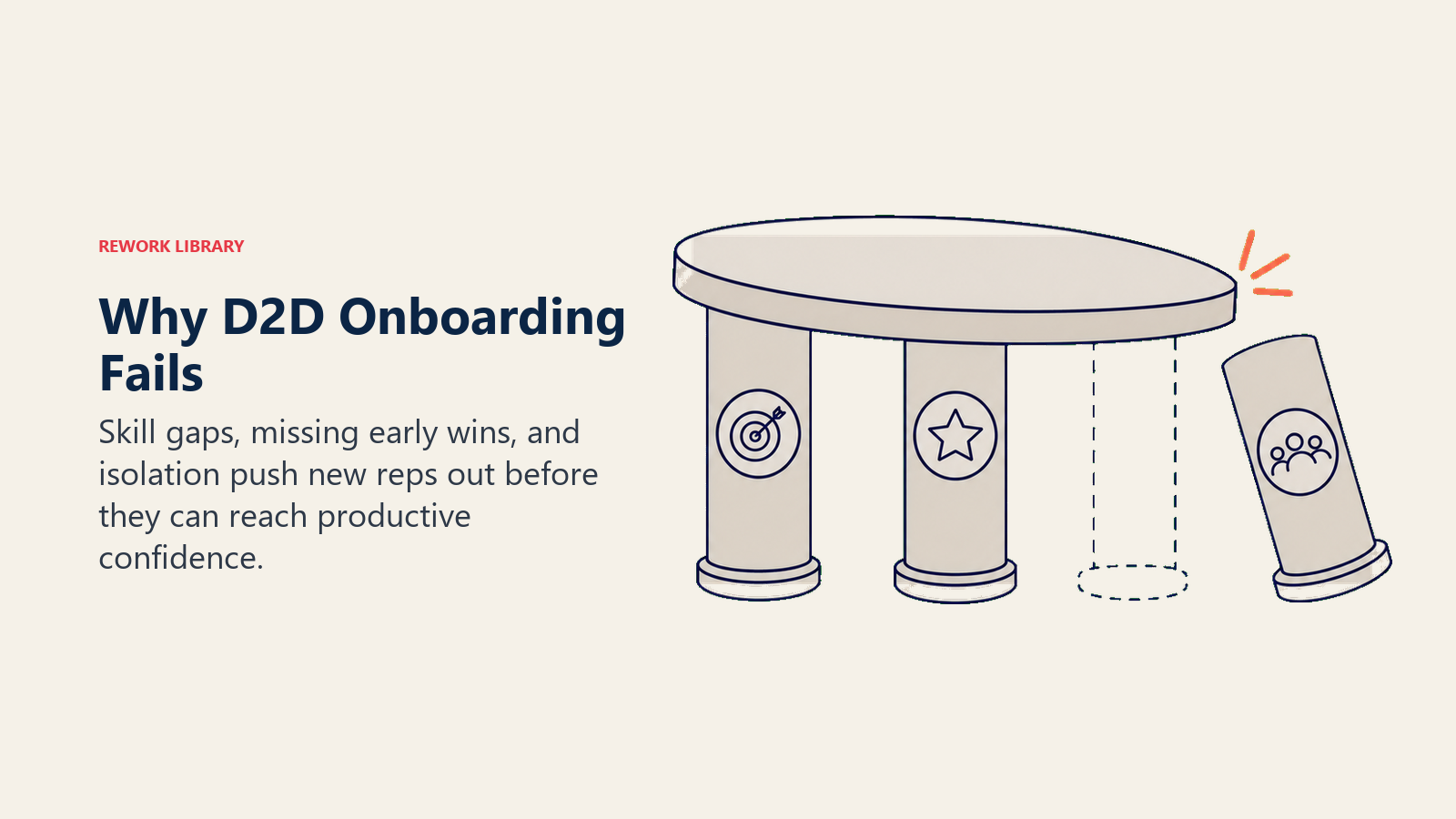
Three things break new reps early:
Skill gaps under pressure. Talking to a stranger at their front door, without a script they've practiced, is genuinely hard. Reps who haven't drilled their opening line, their qualifying questions, and their first objection response freeze up when it actually happens. Freezing at the door kills confidence fast.
No early wins. Commission-only or draw-against environments punish slow starters harshly. If a rep doesn't make a sale in week one, the financial pressure and self-doubt combine quickly. Onboarding needs to manufacture early wins, even if that means putting new reps in your best territory with your best manager on day three.
Isolation. D2D work is physically and emotionally isolating. You're outside for hours, getting rejection after rejection, often alone. New reps who don't feel connected to a team early see no reason to come back after a rough day.
Good onboarding addresses all three. It closes skill gaps through deliberate practice, creates the conditions for early success, and builds team connection before the rep is left alone on a street.
Quotable Nuggets "In D2D sales, it takes 6 to 12 months for a new rep to reach full productivity, yet the average sales rep stays only 18 months. That gap means a rep who quits during ramp generates zero return on the training investment. (SPOTIO; HubSpot via Xactly)"
"Reps who close their first sale faster stay longer. Protecting territory quality during ramp, giving new reps fresh ground rather than saturated neighborhoods, is the single highest-leverage management decision in the first two weeks."
"The end-of-day script read-aloud on Day 1 is non-negotiable: saying words out loud is completely different from reading them on a page. New reps who discover the awkwardness in training handle it; the ones who discover it at a stranger's door often never come back."
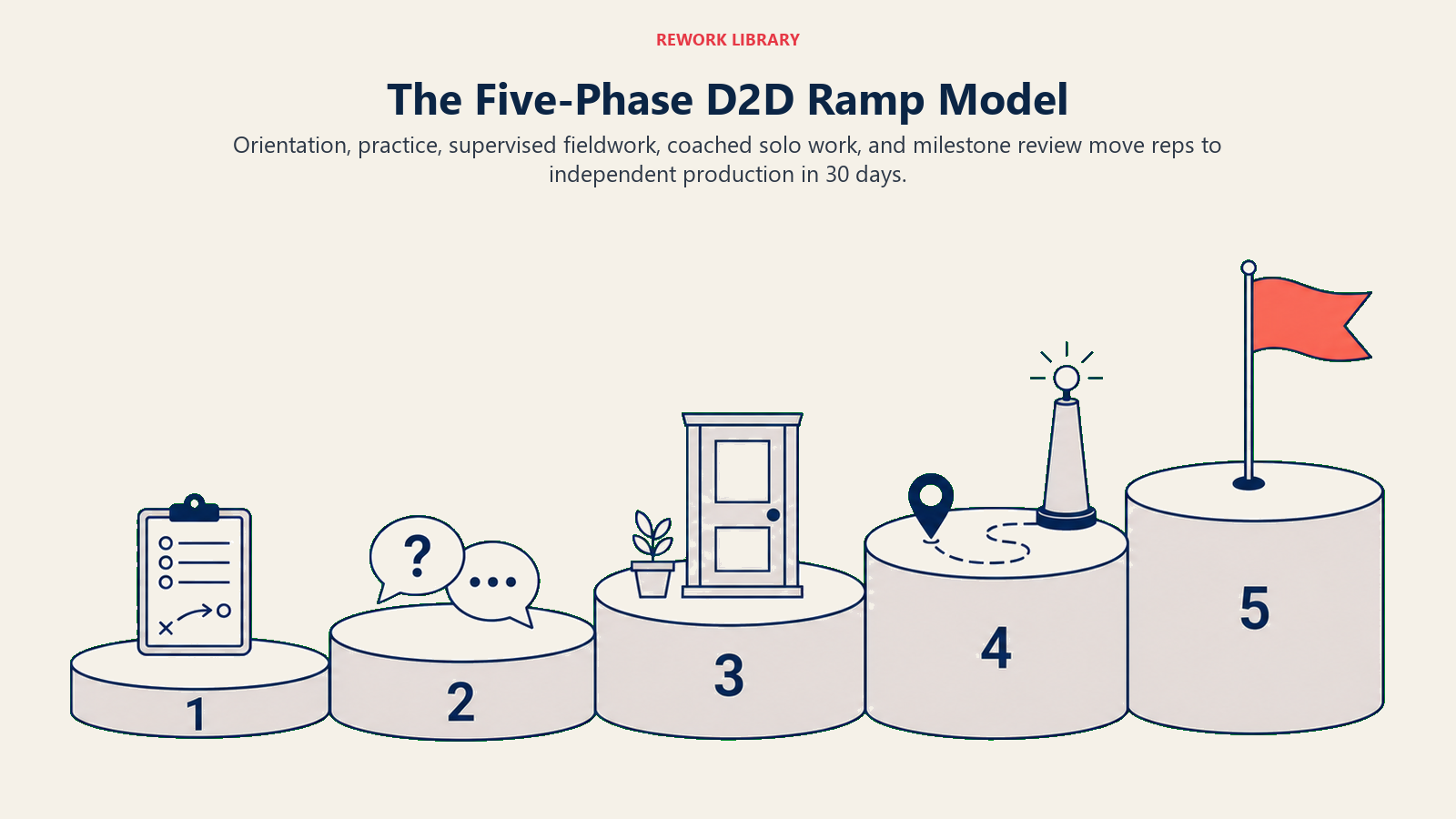
The Five-Phase D2D Ramp Model: A structured onboarding sequence that moves reps from classroom to solo production in 30 days through five discrete phases: orientation (Day 1), skill-building and role-play (Days 2 to 3), supervised field work (Days 4 to 5), solo field with daily coaching (Weeks 2 to 3), and independent production with milestone reviews (Days 15 to 30). Each phase has specific completion criteria before the rep advances.
The Five Phases of D2D Rep Onboarding
Phase 1: Pre-Work and Orientation (Day 1)
Before a rep ever knocks a door, they need context. This isn't about overwhelming them with product specs. It's about answering the questions every new rep has but won't ask: How does this job actually work? When do I get paid? What does a good week look like?
Day 1 agenda:
| Block | Topic | Time |
|---|---|---|
| Morning | Company overview, the recurring revenue model, what customers are buying and why | 90 min |
| Mid-morning | Compliance and legal basics: licensing, Do Not Knock registries, disclosure requirements | 60 min |
| Lunch | Team lunch or meet-the-team call (remote reps) | 45 min |
| Afternoon | Product deep-dive: what the service does, common customer problems it solves, service start process | 90 min |
| End of day | First script read-through: the rep reads the door approach script out loud, alone, before going home | 30 min |
The end-of-day script read-through is non-negotiable. Saying words out loud is completely different from reading them on a page. New reps are often shocked by how awkward it feels. That's exactly the point: better to discover that at home than at someone's door.
See canvassing fundamentals and knock strategy for the territory context that pairs with this orientation.
Phase 2: Skill-Building and Role-Play (Days 2 and 3)
These two days are where onboarding earns its keep. The entire focus is skill repetition in a low-stakes environment before real doors are knocked.
Role-play structure that works:
Morning: 90-minute role-play session. Manager plays the homeowner. New rep runs through the full sequence: door approach, first 30 seconds, qualifying questions, pitch, objection response, close. Manager gives immediate feedback after each attempt.
Do at least four complete run-throughs per rep per morning. Don't let reps settle for "good enough." Push them to run it until it feels natural, not scripted.
Scenario bank (build these into every rep's training):
- Friendly homeowner who's interested but busy
- Skeptical homeowner who says "I'm not interested" at the door
- Homeowner who already has a competitor's service
- Homeowner who says "I need to talk to my spouse"
- Homeowner who asks about price before you've built any value
Each scenario teaches a different skill. The price-before-value scenario alone is worth 30 minutes of practice because it's one of the most common things new reps face.
Product and objection written test:
Give reps a written test at the end of day 2. Not because you're trying to fail them, but because preparing for a test forces active learning rather than passive absorption. Questions should cover product features, common objections and responses, compliance basics, and the subscription terms they'll be presenting to customers.
Reps who score below 75% do another role-play session before moving to phase 3. This isn't punitive. It's protecting them from failing at the door.
Phase 3: Supervised Field Work (Days 4 and 5)
Now the rep knocks doors, but not alone. This phase pairs them with an experienced rep or manager for two full field days.
Day 4: Observation mode. The manager knocks doors while the new rep watches and listens. After each interaction, whether a sale or a no, the manager debriefs: "Did you notice how I changed my tone when she crossed her arms? Here's why." Real-time debrief is what makes ride-alongs valuable. Without it, you're just carpooling.
Day 5: Transition mode. The new rep knocks. The manager stands back, watching but not intervening unless the rep is visibly in trouble. After each door, the manager gives one piece of specific feedback. Not three things. One thing, clearly stated.
At the end of day 5, run a structured debrief:
- What felt natural?
- What felt awkward?
- Which objection hit you hardest?
- What would you do differently tomorrow?
This conversation is more valuable than most training managers realize. It surfaces the real blockers before the rep goes solo, and it signals to the rep that their perspective matters.
Phase 4: Solo Field with Daily Coaching (Weeks 2 and 3)
Week 2 is the hardest week. The rep is knocking doors alone for the first time. The rejection is real. The support is less immediate. This is when most attrition happens.
The answer is daily check-ins, not just weekly ones. Five-minute end-of-day calls covering:
- How many doors knocked?
- How many conversations?
- How many sales?
- What's the hardest part right now?
Track these numbers every day. Not to pressure the rep, but to catch problems before they become quitting decisions. A rep who knocked 80 doors on Monday and 40 on Tuesday without any sales is sending a signal. Call them before they call you to say they're done.
Week 2 metrics benchmarks by vertical:
| Vertical | Doors per day (target) | Conversations per 100 doors | Sales per week (week 2 goal) |
|---|---|---|---|
| Pest control | 80-120 | 30-40 | 3-5 |
| Home security | 60-90 | 25-35 | 2-4 |
| Lawn care | 80-120 | 35-45 | 4-6 |
| Fiber/internet | 70-100 | 30-40 | 2-3 |
If a rep is well below these ranges in week 2, something specific is wrong. Either their territory is poor, their approach is breaking down before they get to a conversation, or they're not actually knocking the number of doors they're reporting. Each has a different fix. The BLS Occupational Employment and Wage Statistics program tracks performance and wage benchmarks across sales occupations, which is useful context when setting realistic first-month targets and explaining earning expectations to new hires.
For more on how to set individual targets that drive performance, see D2D sales KPIs and metrics.
Phase 5: Independent Production with Milestone Reviews (Days 15 to 30)
By the start of week three, reps should be operating independently with less frequent but more structured check-ins. Weekly one-on-ones replace daily calls. The focus shifts from "are you okay?" to "how are you improving?"
30-day milestone review checklist:
- Rep has achieved at least 80% of their week 2 and week 3 sales targets
- Rep can articulate the three most common objections and their responses without prompting
- Rep has made at least one referral ask from a new customer
- Rep understands the service start handoff process and what happens after the sale
- Manager has observed at least one full sales interaction in weeks 3 or 4
- Rep has been introduced to their commission and comp structure and understands how accelerators work
Reps who clear this milestone with strong numbers are ready for territory expansion and more advanced training on closing and upsell. Reps who clear it with weaker numbers need targeted coaching on specific gaps. Reps who don't clear it at all need a direct conversation about fit.
See qualifying at the door for the skill-specific training content that reinforces weeks 3 and 4.
What Must Managers Do to Build a Productive Ramp Environment?
Great onboarding doesn't happen because you have good materials. It happens because managers do specific things consistently during the ramp period.
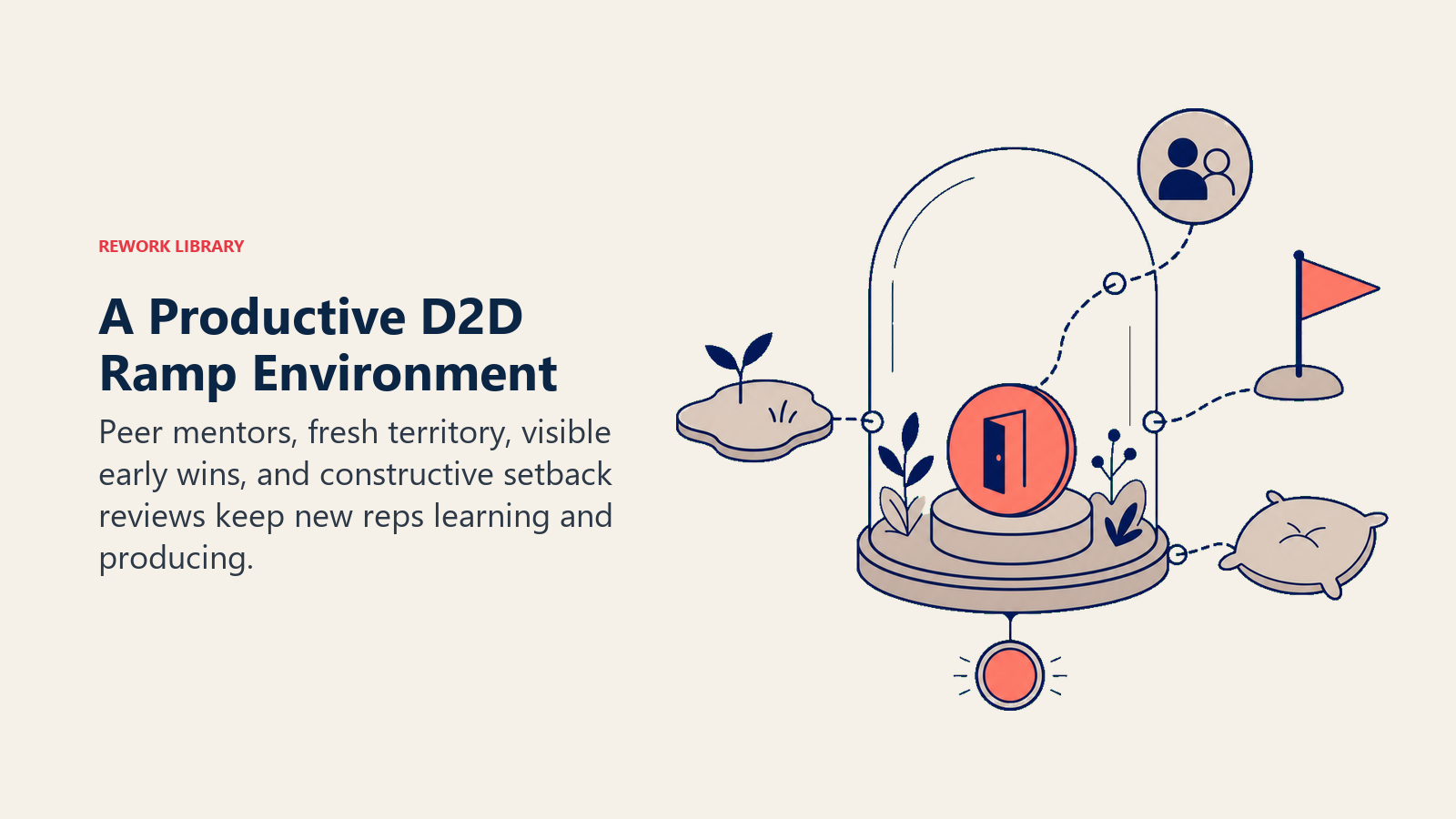
Assign a peer mentor. Not a formal training role, just a productive rep who agrees to be the new rep's go-to for the first two weeks. Text questions, a call after a hard day, someone who remembers what week one felt like. This single intervention reduces early attrition significantly.
Protect territory quality during ramp. Don't send new reps into worn-out territory where the doors have been knocked three times this season. Set them up for early success by giving them fresh ground, even if that means temporarily redirecting one of your producers. The data is clear: reps who close their first two sales faster stay longer.
Celebrate early wins visibly. Post first sales in the team chat. Call out the rep by name in the morning huddle. This sounds obvious, but most managers skip it when they're busy. Public recognition in the first two weeks does more for retention than any other single act.
Run a structured debrief after the first cancellation. Every rep will have a customer cancel within their first 30 days. This is the moment when new reps either learn to process setbacks and move on, or spiral into self-doubt. Managers who treat the first cancellation as a teaching moment, rather than a performance problem, get very different outcomes.
For the team culture piece that makes this environment sustainable, see coaching, ride-alongs, and culture.
Onboarding for 1099 Summer Reps
Summer programs bring a different kind of ramp challenge. You're often onboarding 20 or 50 reps at once. Many are college students who've never worked in sales. They'll be 1099 contractors, so your formal training investment needs to be weighed against that structure.
Key adjustments for summer 1099 onboarding:
Compress the timeline. Full-time summer reps can complete a compressed version of the five phases in five to seven days. The role-play and field observation components stay intact. What gets compressed is the solo ramp period: expect your managers to stay closer during weeks 2 and 3 for summer teams.
Use group training sessions. With large summer cohorts, individual ride-alongs aren't always feasible on day one. Run group role-plays with rotating homeowner/rep pairings. The group energy can actually accelerate skill development, and it builds team cohesion faster.
Set weekly group benchmarks, not just individual. Summer reps respond to team competition. A leaderboard updated daily and shared in a group chat does more for summer rep motivation than almost anything else you can do.
Build in a mid-summer checkpoint. Around week six, run a formal check: who is on track to hit their summer goal, who needs intervention, and who is ready to be promoted to a trainer role for the last wave of summer hires. Mid-summer promotions motivate your top performers and give them a development path even in a temporary structure.
For the full management playbook on running these large seasonal teams, see managing seasonal 1099 teams.
Common Onboarding Mistakes That Kill Ramp Time
Skipping role-play because it feels awkward. It IS awkward. That's why it works. Managers who avoid role-play because it creates discomfort in the training room are trading five uncomfortable minutes for months of underperformance in the field.
Too much product, not enough process. New reps don't need to know every feature of your pest control service plan. They need to know how to open a door, how to qualify in 60 seconds, and how to ask for the sale. Front-load the process skills. Product knowledge can be built over time.
No tracking during the first 30 days. If you're not counting daily doors, conversations, and sales from day one, you won't know which new reps need help until they've already decided to leave.
Assuming the rep is fine if they don't complain. New reps often won't tell you when they're struggling. They assume they're supposed to figure it out. The daily check-in call exists specifically to surface what the rep won't volunteer.
Waiting until week four to introduce comp mechanics. Reps who don't understand how they earn accelerators and bonuses can't aim at them. Walk through the commission and comp design structure in week one, even briefly, so reps know what they're working toward.
Recruiting door-to-door reps covers how to select candidates who will actually succeed in this onboarding program, which is the upstream lever that makes everything else easier.
For organizations managing distributed field teams, connecting your onboarding tracking to a CRM or canvassing app helps managers see rep activity in real time rather than waiting for end-of-day reports.
What Good Looks Like at Day 30
A rep who has been properly onboarded at day 30 can do the following without significant coaching:
- Walk up to any door with a confident, natural opener
- Qualify a homeowner in under 90 seconds and decide whether to continue the pitch
- Handle the top three objections in your vertical without losing momentum
- Present the subscription terms and close on the same visit
- Complete the post-sale documentation and set expectations for service start
- Ask for a referral from every new customer
That's the finish line for phase one of rep development. Everything after day 30 is about refining, accelerating, and expanding on a foundation that onboarding built.
The reps who make it to day 30 with that skill set don't quit. They produce. And they become the managers and mentors who make the next cohort's onboarding better.
Learn more: Pipeline management and opportunity qualification covers how the broader sales funnel connects to the rep-level skills built here. Retention fundamentals picks up where the rep's job ends, covering how accounts are kept after the first service. Recruiting door-to-door reps covers the upstream hiring step. D2D CRM and canvassing apps covers the tools that support real-time onboarding tracking.
Frequently Asked Questions about Onboarding and Ramping New Reps for Door-to-Door Sales
How long does it take a new D2D rep to reach full productivity?
SPOTIO's 2026 State of B2C Field Sales report (n=452 sales professionals) found that 56% of field sales teams ramp new reps in under three months, 29% take three to six months, and 15% take six months or longer. Teams that achieve faster ramp (under two months) retain reps at 72%, compared to 51% for teams where ramp extends further. Structured onboarding with role-play, supervised field days, and daily coaching in weeks 2 to 3 is the primary driver of faster ramp.
Why do most new D2D reps quit in the first 30 days?
The three dominant failure patterns are: skill gaps that surface at the first real door (the rep never practiced their script out loud), no early wins (commission structure and territory quality make the first week financially punishing), and isolation (the rep has no team connection to come back to after a rough day). Addressing all three in the first week (scripted practice before day one, fresh territory on day three, and peer mentor assignment) reduces early attrition significantly.
What should a D2D onboarding program include?
A complete D2D onboarding program runs five phases over 30 days: Day 1 orientation (company context, compliance basics, first script read-aloud), Days 2 to 3 role-play and skills drilling, Days 4 to 5 supervised field work with ride-along debrief, Weeks 2 to 3 solo field with daily coaching check-ins, and Days 15 to 30 independent production with a structured milestone review. Each phase has defined completion criteria before the rep advances.
How do 1099 summer reps require different onboarding?
Summer 1099 cohorts run the same five phases in five to seven compressed days rather than 30. Role-play and field observation stay intact; the solo ramp period gets more manager coverage because the timeline is shorter. Group training replaces individual ride-alongs in large cohorts, which also builds competitive energy. A mid-summer checkpoint at week six identifies who needs intervention, who is on track, and who is ready for a trainer role.
What is the 30-day milestone review for a D2D rep?
The 30-day review checks whether the rep can walk up to any door with a natural opener, qualify a homeowner in under 90 seconds, handle the top three objections in the vertical without losing momentum, close on the same visit, complete post-sale documentation, and make a referral ask. Reps who clear this milestone are ready for territory expansion. Reps who fall short need a specific coaching gap identified, not a vague "keep working at it" conversation.
Should managers track rep activity before week two?
Yes. Daily tracking of doors knocked, conversations, and sales from day one is not about pressure. It is about catching problems before they become quitting decisions. A rep whose door count drops sharply on day three is sending a signal. Daily check-in calls in weeks 2 and 3 surface what the rep will not volunteer: fear of a specific objection, a territory problem, or discouragement after a string of hard days. These are solvable if caught early. They become attrition if left until the weekly report.
Why does onboarding quality affect recruiting cost?
When onboarding fails and early attrition runs high, the company spends recruiting and training budget on the same headcount repeatedly. DePaul University's sales leadership research estimated the average total cost to replace a sales rep at over $114,000 when training, hiring, and lost-productivity costs are combined. A structured onboarding program that moves 90-day retention from 40% to 65% cuts that recurring replacement cost significantly, making onboarding one of the highest-ROI investments in the D2D operating model.

Senior Implementation Consultant
On this page
- Why Does Most D2D Onboarding Fail?
- The Five Phases of D2D Rep Onboarding
- Phase 1: Pre-Work and Orientation (Day 1)
- Phase 2: Skill-Building and Role-Play (Days 2 and 3)
- Phase 3: Supervised Field Work (Days 4 and 5)
- Phase 4: Solo Field with Daily Coaching (Weeks 2 and 3)
- Phase 5: Independent Production with Milestone Reviews (Days 15 to 30)
- What Must Managers Do to Build a Productive Ramp Environment?
- Onboarding for 1099 Summer Reps
- Common Onboarding Mistakes That Kill Ramp Time
- What Good Looks Like at Day 30