Referral Generation from Subscribers: Turning Happy Customers Into Your Best Reps
Turn this article into takeaways for your work.


Each assistant summarizes the article only for you and suggests best practices for your work.
There's a version of door-to-door growth that doesn't require knocking a single new cold door. It runs through your existing subscriber base. Most D2D companies leave it almost entirely untapped.
Picture a pest control customer in a quiet neighborhood. Their neighbor asks who handles their yard treatments. They vouch for you by name. That neighbor calls in already sold, already trusting you, before a rep ever knocks. That's the entire referral engine in one moment, and most companies never engineer it on purpose.
Referred customers in home services subscription businesses close at an estimated two to four times the rate of cold-knocked leads (Rework Analysis, directionally consistent with Friendbuy's referral marketing research showing 3 to 5 times higher conversion rates for referral channels generally). They have a shorter sales cycle, lower acquisition cost, and substantially higher 12-month retention. The math behind this is straightforward and covered in detail in subscription unit economics and LTV. What's less straightforward is building a referral program that actually generates volume, consistently, across a distributed field sales operation.
Why Do Most D2D Referral Programs Underperform?
The default "referral program" at most D2D companies is a line in the closing paperwork: "Refer a friend and get $25." Then nothing else. No system, no follow-up, no rep training, no measurement. It generates a trickle of occasional referrals from customers who happen to remember the offer when a neighbor asks about their lawn. That's not a program. That's wishful thinking with a gift card attached.
Structured referral programs in this industry generate an estimated two to four referrals per 100 active subscribers per month (Rework Analysis, based on reported D2D referral program benchmarks). That sounds modest, but compounded across a base of 2,000 subscribers, that's 40 to 80 warm, pre-sold leads monthly. Even at a conservative 40% close rate for referrals, that's 16 to 32 new subscribers per month from a channel that costs almost nothing per lead.
The companies hitting those numbers are doing several things the low performers aren't.
Key Facts: Referral Program Performance
- 84% of consumers across 58 countries trust recommendations from friends and family above all other advertising formats (Nielsen, 2013).
- Referral marketing generates 3 to 5 times higher conversion rates than non-referral acquisition channels, according to Friendbuy's referral marketing research.
- 86% of companies with formalized referral programs reported revenue growth over the prior two years, versus 75% of those without a referral program (Friendbuy, 2024).
The Three Conditions for Referral Generation
Customers refer when three conditions are met simultaneously.
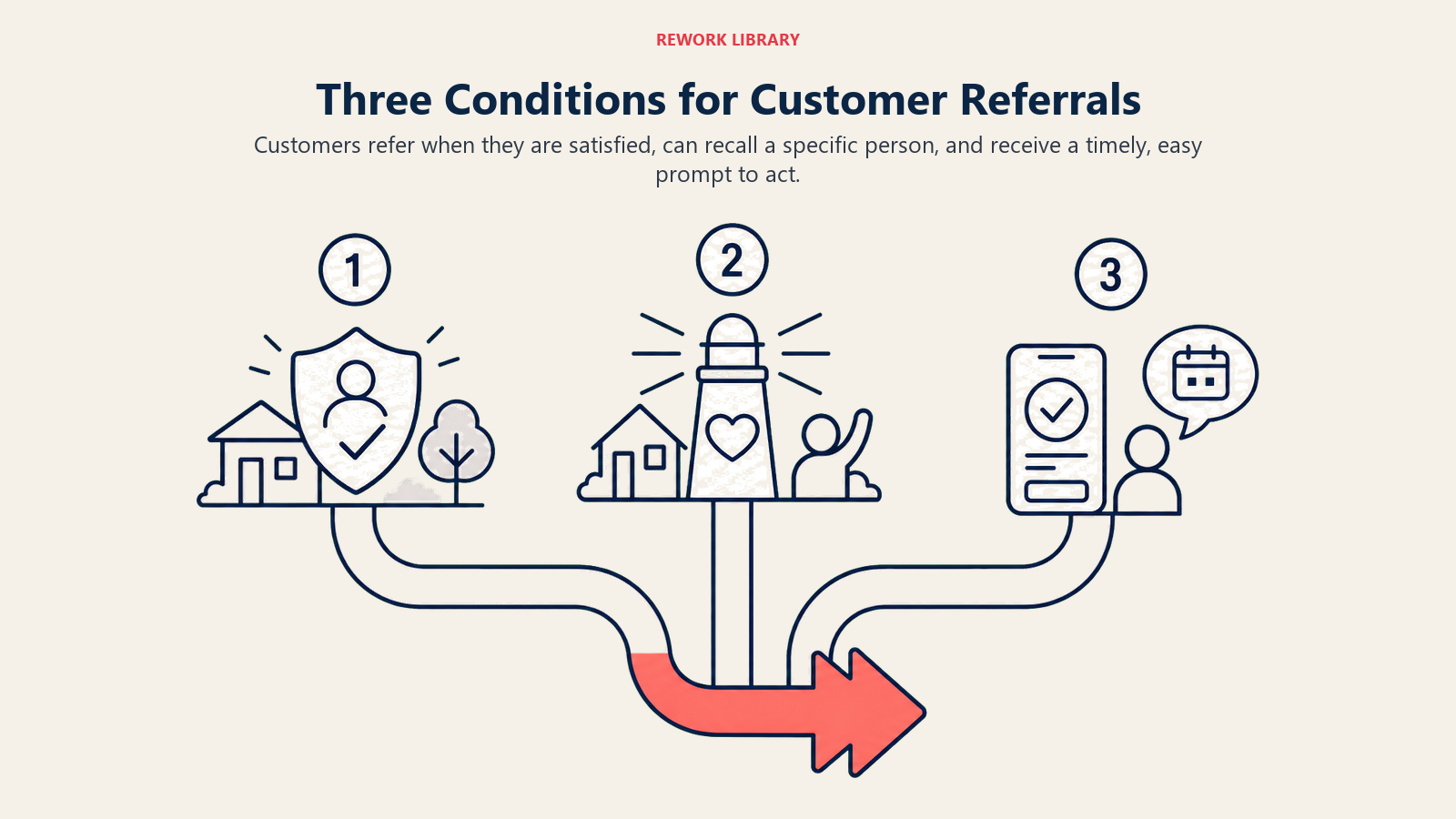
The Three-Condition Referral Model: A referral generation framework that identifies the three simultaneous conditions required for a subscriber to refer: satisfaction (they're in a positive moment), awareness (they know you want referrals and how to make one), and ease (the referral process requires minimal effort). Most D2D programs fail because they address only the incentive without engineering all three conditions.
Condition 1: They're satisfied. This sounds obvious, but timing matters. A customer who just had a service call resolved correctly is in a much better mindset to refer than a customer who hasn't interacted with you in four months. Referral asks land when the customer is in a positive moment.
Condition 2: They know you want referrals. Most customers assume their provider isn't interested in referrals or would find it awkward to ask. You have to make the ask explicit. Rework's analysis of referral program performance suggests that customers who were directly asked for referrals provide them at an estimated four to five times the rate of those who weren't. Nielsen's global consumer research finds that 84% of respondents across 58 countries trust recommendations from friends and family above all other advertising forms, which means the referral you generate carries far more credibility than any campaign you can buy.
"In service subscription businesses, customers who were directly asked for a referral provide one at an estimated four to five times the rate of those who were not asked (Rework Analysis). The ask itself is the program."
Condition 3: The process is easy. If referring requires the customer to fill out a form, remember a code, or explain your pricing to a neighbor, most won't bother even if they intended to. The path to a referral needs to be frictionless: a text link, a shareable digital card, or simply "give them my number and I'll call them."
Your referral program is responsible for creating conditions 2 and 3. Condition 1 comes from your service quality and renewal work.
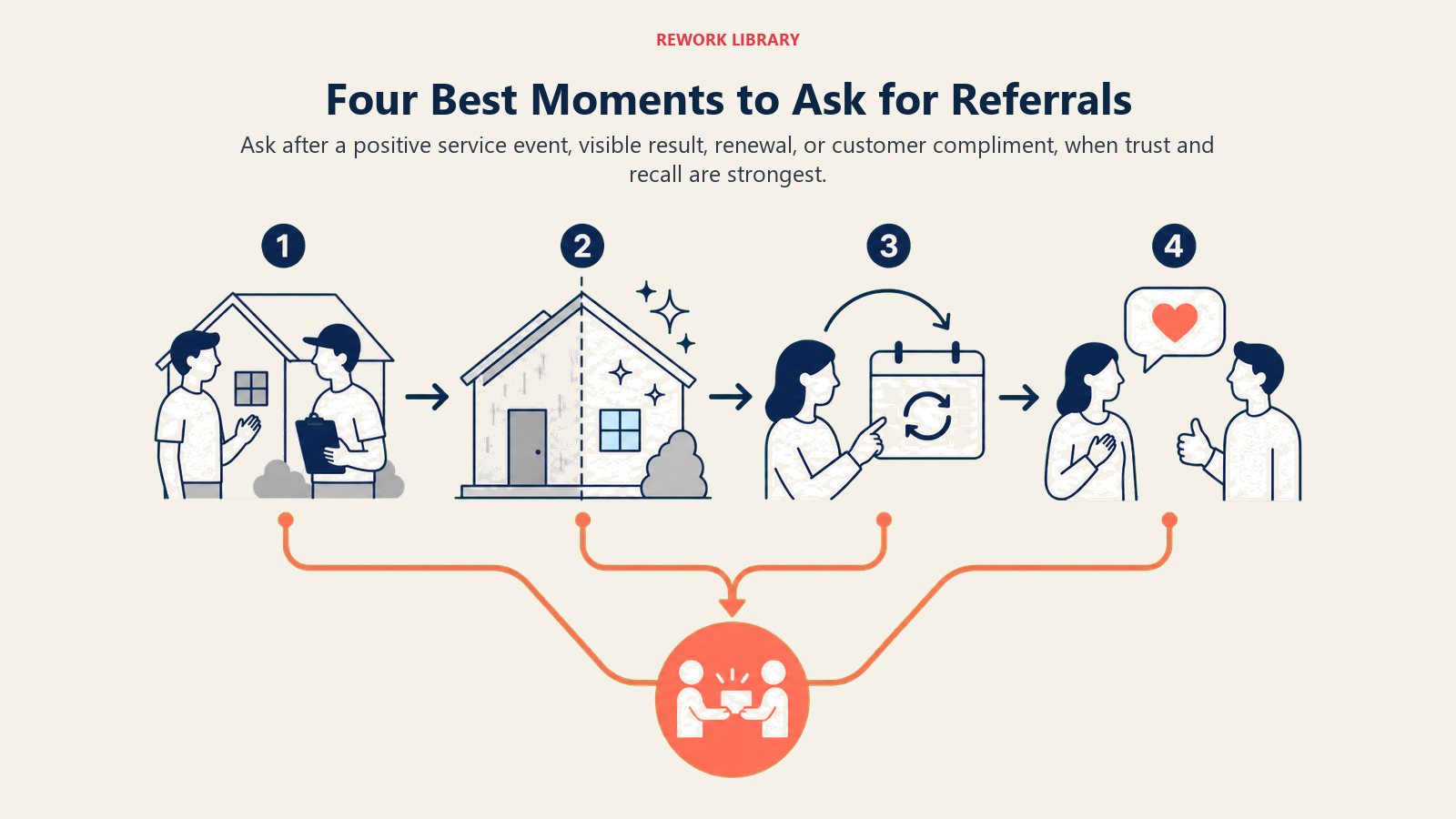
When to Ask: The Four High-Conversion Moments
Referral asks work best at specific moments in the customer lifecycle. A generic ask at account setup converts poorly. An ask at the right moment converts much better.
Moment 1: After the First Successful Service
The first service visit is when the customer decides whether they made a good decision. If the technician does excellent work, leaves the property clean, and the customer is visibly satisfied, that's your first referral window. Reps or technicians should be trained to close this moment: "I'm really glad we got this done for you. Do you have any neighbors you think might benefit from this too? I'd love to help them out."
A personal ask from the person in front of them converts better than any automated message.
Moment 2: Right After a Problem Gets Resolved
Counter-intuitive but true: customers who had an issue handled well are among your most enthusiastic referral sources. They experienced that you show up when things go wrong. That story is far more compelling to a neighbor than "they do a good job."
Train your service managers and customer support team to make a referral ask after closing a resolution: "I'm so glad we got that sorted out for you. We don't do a lot of advertising, so we rely on customers like you to help us grow. Is there anyone in your neighborhood you think might appreciate this kind of service?"
Moment 3: At the 3-Month Mark
The 90-day check-in call, already a best practice in customer success check-ins, is a natural referral opportunity. The customer has had enough experience to form a real opinion and you have enough relationship to ask.
Structure it as a value review first: "You've had three services so far. Have you noticed a difference?" Let them affirm the value themselves, then make the ask naturally: "I'm really glad to hear that. If you have any friends or neighbors dealing with the same issues, I'd love to help them. Do you have someone in mind?"
Moment 4: At Renewal
A customer who just renewed their subscription is explicitly signaling satisfaction. They chose to keep paying you. This is a warm moment to ask: "Thank you for renewing with us. That really means a lot. The best way people find out about us is through customers like you. Do you know anyone who might be a good fit for what we do?"
Designing the Referral Offer
The incentive structure matters, but not for the reason most people think. Customers don't refer primarily for the reward. They refer because they trust you and want to help someone they know. The incentive signals that you value the gesture and lowers the psychological barrier to making the ask.
For the Referring Customer
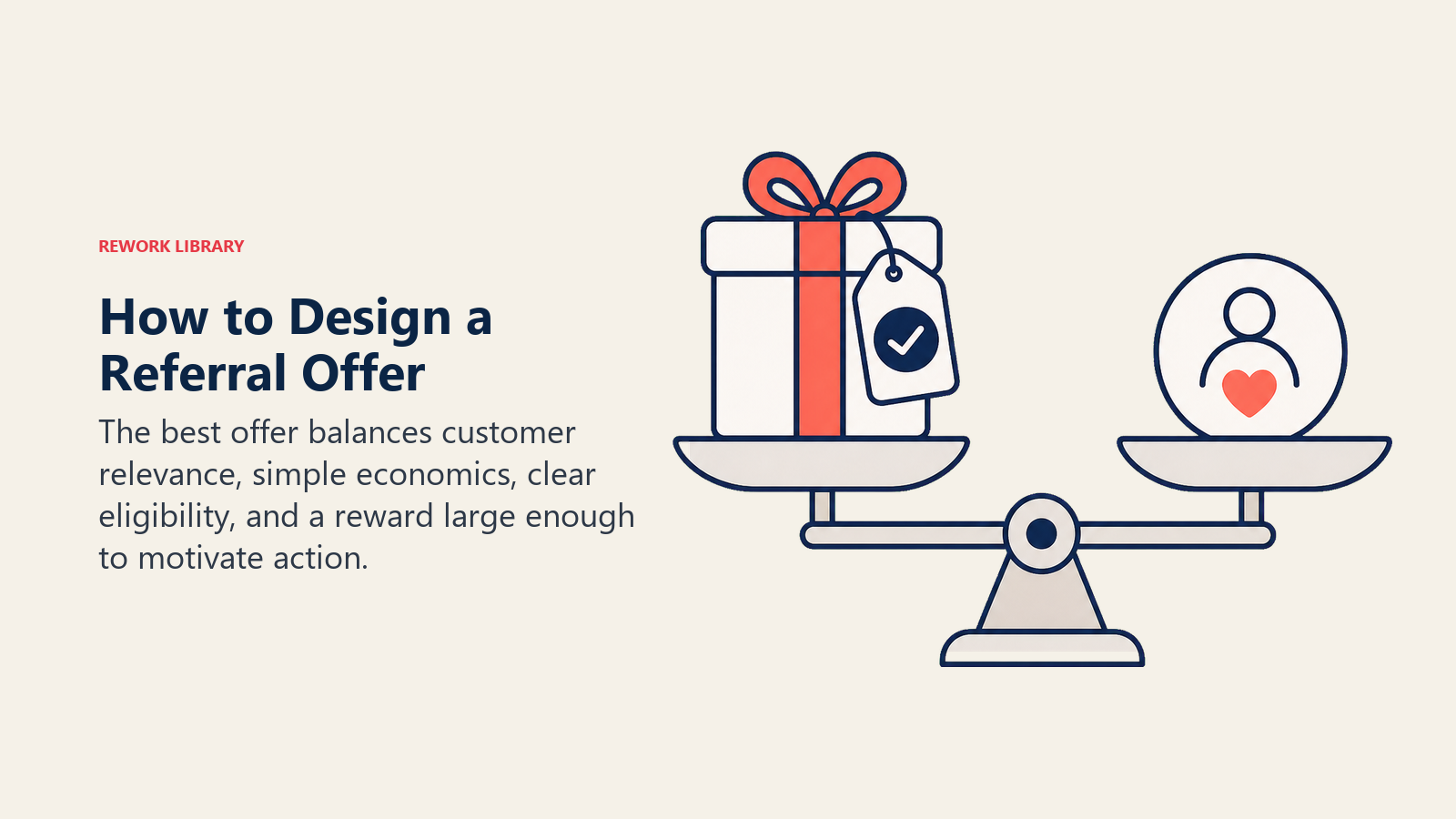
The best incentive is one that enhances the existing relationship rather than just cutting a check. Options ranked by effectiveness in home services:
- Free service credit: A month of service, an extra treatment, or an upgrade. This keeps the value inside the relationship and feels generous without being transactional.
- Cash credit on account: $25 to $50 applied to the next invoice. Simple to understand, easy to administer.
- Gift card: Works, but feels more transactional. Less preferred than account credit in most surveys.
- Donation in their name: Works for environmentally-conscious customers in lawn/pest categories. Niche but effective with the right audience.
Avoid setting the incentive so high that it attracts purely mercenary referrers who push service on friends who aren't genuinely interested. A $200 referral bonus will generate referrals, but the quality and conversion rate will be lower than a $50 credit that attracts genuine recommendations. The FTC's endorsement guidance is also worth knowing here: when a customer receives a reward for a referral, that relationship is a "material connection" that must be disclosed if the referred prospect is likely to find it relevant to their decision. For most D2D programs where the referral is personal and verbal, this is low-risk, but written or social referral programs warrant a quick compliance check.
For the Referred Customer
The referred prospect should also receive an offer, but frame it as a benefit from their referrer: "Your neighbor Maria thought you might want to try this. They asked us to extend the first month free to you as a welcome."
This framing does two things. It reinforces the social proof (Maria vouched for us) and makes the offer feel personal rather than promotional.
Making It Easy: The Mechanics of Referral Capture
The referral moment happens in real life, usually in a conversation between neighbors. Your system needs to capture it at the moment of intent, not ask the customer to remember to do something later.
Text-to-Share Links
When a rep or technician makes a referral ask in person, they should be able to pull up a unique shareable link on their phone right then. The customer can forward it to the neighbor via text, email, or whatever app they use. The link ties back to the customer's account for credit tracking.
This is a CRM and canvassing app feature that most modern D2D platforms support. If yours doesn't, a simple Bitly link tied to a form is a workable stopgap.
The "Give Them My Number" Option
Not every customer is comfortable with digital flows. Some just want to tell their neighbor to call. Support this: "If your neighbor calls us and mentions your name, I'll make sure you get the credit." Then actually track it on the inbound call by asking every new prospect "How did you hear about us?"
Referral Cards
Physical cards still work in home services. A small card with the customer's name pre-written (or their unique referral code) that they can leave with a neighbor feels intentional. Include the offer clearly: "Mention this card and [Customer Name] gets a free month." Print them inexpensively and leave a small stack at service completion.
Scaling Referrals Across a Field Sales Team
A referral program only runs at scale if your field reps and technicians are bought in and trained. This is where most programs break down: great design, zero execution.
Training the Ask
Reps and technicians need a concrete script for the referral ask, not just awareness that the program exists. Role-play it in team meetings. The ask should feel natural, not salesy:
"We don't do much advertising. We grow mostly through people like you who tell their neighbors. Is there anyone on your street who's been dealing with [pest issue / overgrown lawn / slow internet]? I'd love to help them out."
That phrasing is conversational, specific, and opens a real dialogue rather than making a pitch.
Rep Incentives
If reps aren't rewarded for referral conversions, they won't prioritize making referral asks. The customer conversion matters more immediately. Structure a small bonus for every referral that closes, separate from the main commission structure. Even $15 to $25 per closed referral is enough to keep it visible on their mental scorecard.
Pair this with visibility: recognize reps who generate high referral volume in team meetings. Include referral rate in the rep performance dashboards alongside close rate, retention, and cancellation rate.
Technician Enablement
Service technicians are often better referral generators than reps because they see the customer repeatedly and build genuine relationships. But they're rarely trained or incentivized to ask.
A simple briefing at team meetings: "If a customer seems really happy with today's service, here's what to say..." and a small incentive for every referral that converts. Technicians who are uncomfortable selling anything will often make a comfortable referral ask because it doesn't feel like sales. It feels like helping a neighbor.
Measuring Referral Program Performance
Track these metrics monthly:
| Metric | Definition | Target |
|---|---|---|
| Referral rate | Referrals received / active subscribers | 2-4 per 100 |
| Referral close rate | Referrals closed / referrals received | 35-50% |
| Referral CAC | Total program cost / closed referrals | 30-50% below D2D CAC |
| Referral retention | 12-month renewal rate of referral customers | 10-15% above average |
| Top referral generators | Accounts generating 3+ referrals | Track and reward |
"In most D2D subscriber bases, an estimated 10 to 15% of customers generate 60 to 80% of all referrals (Rework Analysis). Identifying and treating this group as VIPs, with extra service attention and higher incentives, disproportionately improves total program output."
The last metric is worth special attention. In most subscriber bases, an estimated 10 to 15% of customers generate 60 to 80% of referrals (Rework Analysis). Identifying these people and treating them as VIPs, with extra service attention, personal outreach, and higher incentives, disproportionately improves program output.
Referral-generated leads also tend to be higher quality coming in. A quick look at how lead scoring systems work makes clear why: referred prospects arrive pre-qualified by someone who already trusts your service. They need less convincing and commit faster than cold-knocked prospects at the same intent level.
How Do Referrals Connect to the D2D Growth Flywheel?
Referrals don't operate in isolation. They interact with the full subscription growth model. A subscriber base that's actively managed for retention and proactive service quality is a subscriber base capable of generating referrals. Churned customers don't refer. The companies that understand this build a compounding flywheel: great service leads to retention, retention leads to referrals, referrals convert at high rates and stay longer, which expands the base of people who can generate more referrals.
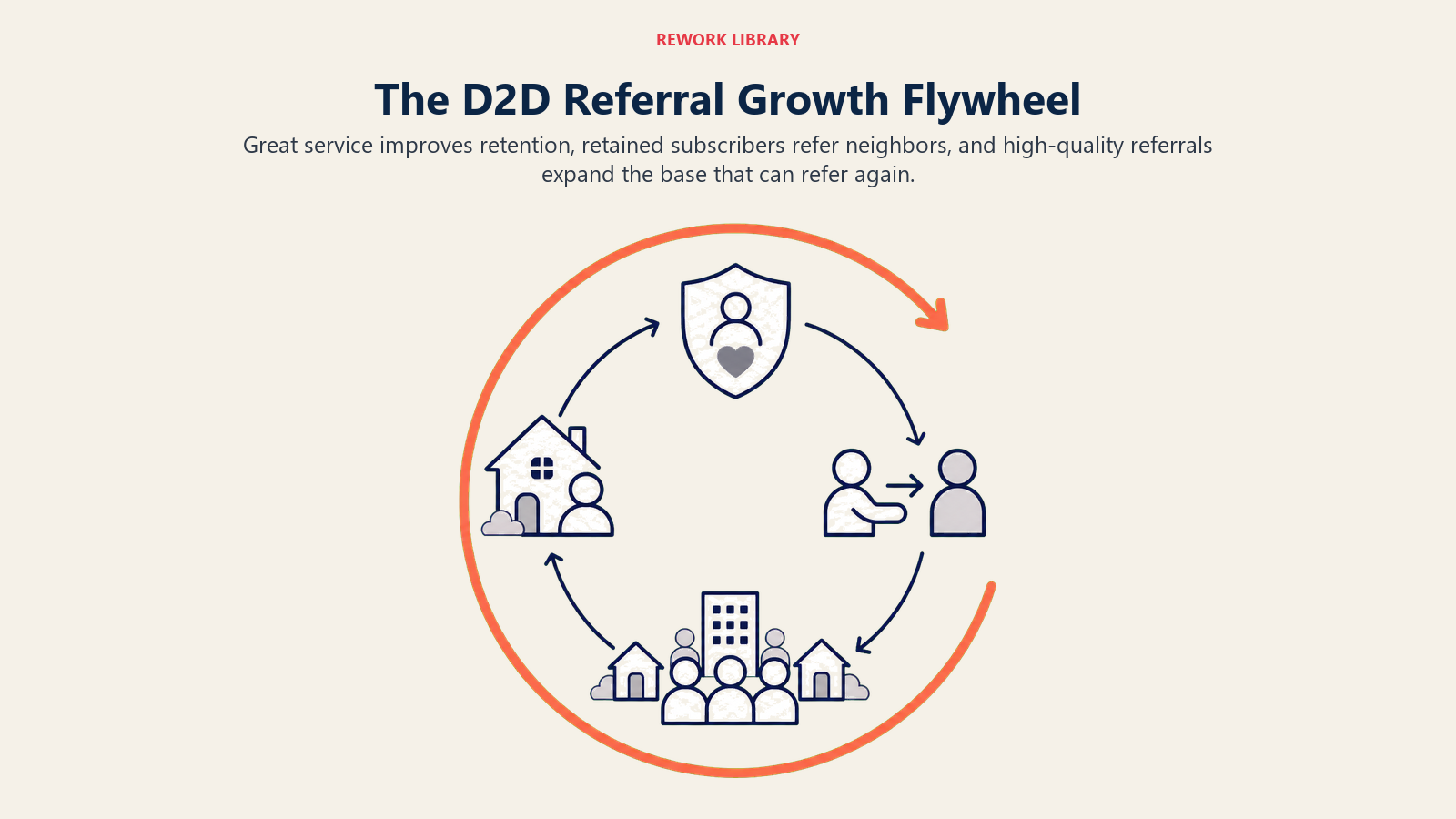
"Referral customers arrive pre-sold on your brand and pre-screened by someone who trusts you. Their 12-month retention rates consistently run 10 to 15 percentage points above the subscriber base average in home services operations that track it."
Cold door knocking is still necessary to seed new territories and scale quickly. But in mature markets, the D2D companies with the lowest customer acquisition costs and the highest revenue per rep are the ones where referrals now do a significant share of the work. None of that compounding happens, though, if the subscriber base is leaking customers faster than referrals can replace them.
You built the relationship at the door. The referral is where it compounds.
Learn More
Frequently Asked Questions about Referral Generation from Subscribers
What is a referral program for D2D subscription companies?
A D2D referral program is a structured system for generating new subscriber leads from your existing customer base. Rather than relying on customers to spontaneously recommend your service, a formal program trains field reps and technicians to ask at specific high-conversion moments, makes the referral process frictionless, and tracks results by rep, technician, and customer cohort.
What referral rate should a D2D subscription company target?
A well-run D2D referral program should generate an estimated 2 to 4 referrals per 100 active subscribers per month (Rework Analysis). That translates to 40 to 80 warm leads monthly for a base of 2,000 subscribers. Programs below 1 per 100 are typically missing either systematic asks, trained field staff, or a frictionless sharing mechanism.
Do customers refer more for cash or service credits?
In home services, service credits (a free month, an extra treatment, or an upgrade) outperform cash in most surveys. Cash feels transactional. A service credit enhances the relationship the customer already values and is cheaper to deliver than its perceived worth. Set the reward high enough to signal appreciation, but not so high that it attracts low-quality mercenary referrals from people pressuring friends who are not genuinely interested.
When is the best time to ask a subscriber for a referral?
Four moments convert highest: immediately after the first successful service visit, right after a problem gets resolved well, at the 90-day relationship check-in, and at renewal. These are moments when the customer's satisfaction is high and they're already thinking about their relationship with your company. Generic asks made at account setup or invoice time convert poorly.
How do you make referrals easy to capture in the field?
The most practical approach is a text-to-share link the rep or technician can pull up on their phone at the moment of ask. The customer forwards it to a neighbor via text or any messaging app, and the link ties back to their account for credit tracking. For customers who prefer low-tech options, a physical referral card with their name or code pre-printed works well in home services contexts.
Why do referred customers stay longer than cold-knocked leads?
Referred customers arrive pre-qualified by someone who trusts your service and pre-sold on the brand through a conversation they trust. That social proof reduces buyer's remorse, sets accurate expectations, and creates an emotional stake in the relationship succeeding. In most D2D operations that track it, referred customers renew at 10 to 15 percentage points above the average subscriber.
How should technicians be trained to ask for referrals?
Technicians need a concrete script that feels like a natural conversation, not a sales pitch: "We don't do much advertising. We grow mostly through customers like you who tell their neighbors. Is there anyone on your street dealing with [the problem you just fixed]? I'd love to help them out." Role-play it in team meetings. A small incentive per closed referral, and recognition in team reporting, keeps it front of mind.

Senior Implementation Consultant
On this page
- Why Do Most D2D Referral Programs Underperform?
- The Three Conditions for Referral Generation
- When to Ask: The Four High-Conversion Moments
- Moment 1: After the First Successful Service
- Moment 2: Right After a Problem Gets Resolved
- Moment 3: At the 3-Month Mark
- Moment 4: At Renewal
- Designing the Referral Offer
- For the Referring Customer
- For the Referred Customer
- Making It Easy: The Mechanics of Referral Capture
- Text-to-Share Links
- The "Give Them My Number" Option
- Referral Cards
- Scaling Referrals Across a Field Sales Team
- Training the Ask
- Rep Incentives
- Technician Enablement
- Measuring Referral Program Performance
- How Do Referrals Connect to the D2D Growth Flywheel?
- Learn More