The Door Approach and First 30 Seconds: How to Open D2D Conversations That Don't Get Shut Down
Turn this article into takeaways for your work.


Each assistant summarizes the article only for you and suggests best practices for your work.
The door opens. You have about 30 seconds before the homeowner decides whether to engage with you or shut things down. Not 30 seconds before you finish your intro. Before they've decided anything at all. The first impression you make at a door forms before you've said a full sentence.
That's the reality of door-to-door, or D2D, selling. Homeowners develop pattern recognition fast. They've seen reps before. They've been pitched before. And within moments of opening the door, they're reading signals: your posture, your first words, your energy, whether you look like someone who respects their time or wastes it.
Most reps lose the door not because their product is bad or their price is wrong. They lose it because their first 30 seconds trigger the "I need to get rid of this person" reflex. This article is about understanding that reflex, and building an approach that sidesteps it entirely.
What Homeowners Are Actually Evaluating in the First 30 Seconds
The moment a homeowner opens the door to a stranger, a set of automatic assessments kicks in. Princeton psychologists Willis and Todorov found that people form judgments about a stranger's trustworthiness, competence, and likeability in as little as a tenth of a second from a single glance, and longer exposure doesn't significantly change those snap assessments. These aren't conscious decisions on the homeowner's part. They happen before you've said a word they can process. Know what they're checking for and you can build your approach around it.
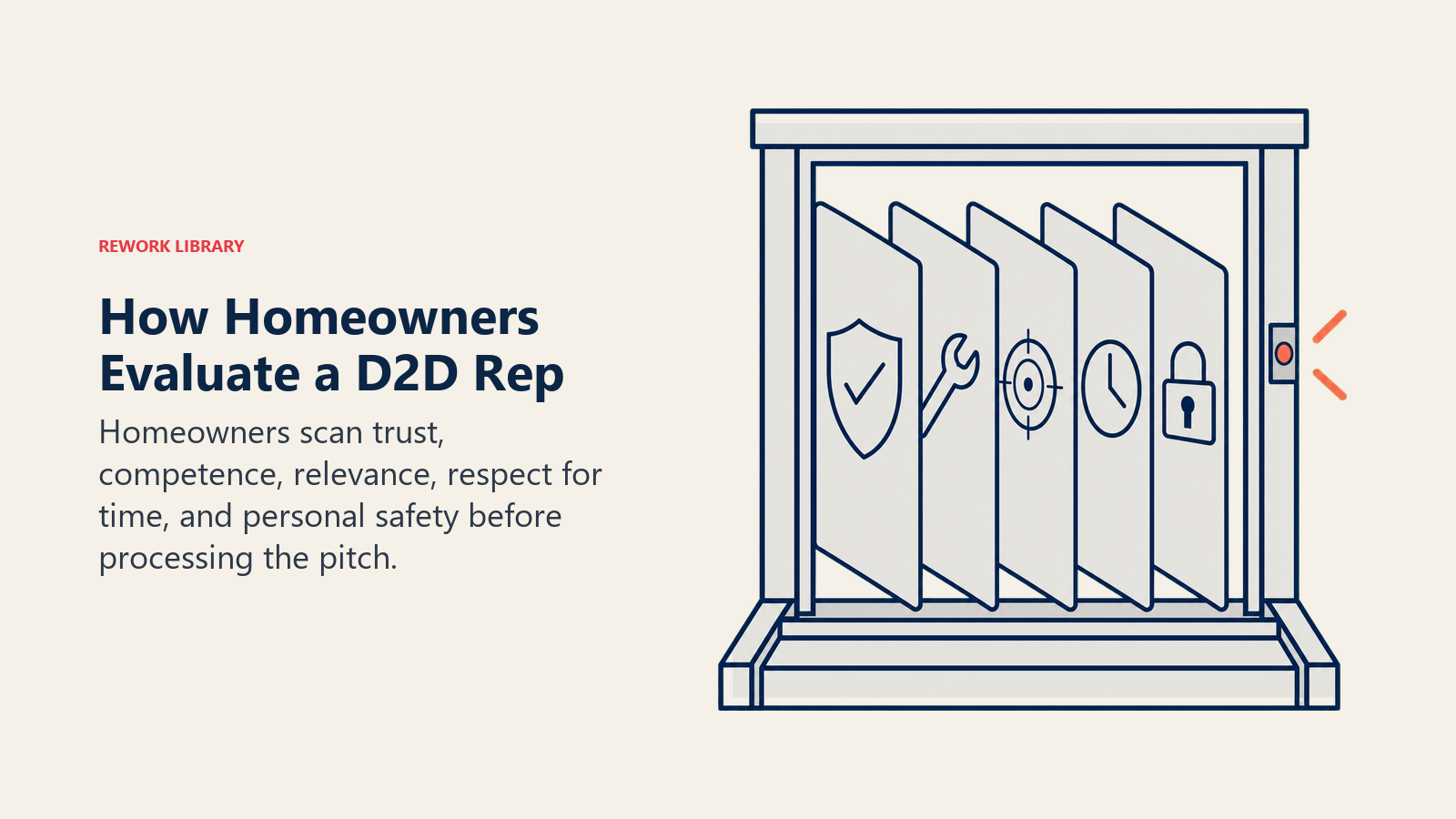
Am I safe? The first assessment is physical. Is this person a threat? Your posture, your distance from the door, your hands, your energy level all feed this assessment. Stand too close and you trigger a threat response. Stand too far and you read as uncertain. The right position is about one body-length back from the door, open stance, relaxed shoulders, hands visible.
Is this a trick or a scam? Most homeowners have been burned by high-pressure sales before, and D2D specifically has a reputation. Under the FTC's Cooling-Off Rule, buyers have a federally protected right to cancel any door-to-door sale of $25 or more within three business days, and sellers must disclose this right in writing at the time of the sale. Reps who mention this upfront ("you have three full days to change your mind, no questions asked") often defuse the scam reflex faster than any other line in their opener. The moment you trigger "this is a sales pitch" before you've created any connection, defenses go up. Reps who lead with company name and product category lose here. Reps who lead with something relevant to the specific homeowner or neighborhood change the frame.
How much is this going to cost me in time? Even if a homeowner is open to listening, they're calculating the time cost. An unclear, rambling opener signals "this is going to take a while." A crisp, confident opener signals "I'll get to the point." People are more willing to engage when they believe the engagement has a clear end.
Is this person like me? Social mirroring is real. Homeowners are more likely to stay engaged with someone who matches their communication register: calm with a calm homeowner, warmer with a friendly one. This is why a scripted opener delivered at the same pace and tone to every homeowner regardless of their response fails. It doesn't allow for mirroring.
Key Facts: First Impressions in D2D
- D2D sales teams convert at 2-5% of doors knocked, making every qualified engagement significantly more valuable than a raw volume approach. (SPOTIO)
- A healthy D2D contact rate is 30-40% of doors knocked. (SPOTIO)
- Field sales teams report 30%+ annual turnover, meaning most homeowners have likely encountered inexperienced or poorly trained reps. (SPOTIO, 2026 State of Field Sales)
What Does Body Language at the Door Actually Signal?
Your approach to the door communicates before your mouth opens. Here's what matters:
Pace: Walk toward the door at a purposeful but relaxed pace. Hurrying reads as anxious. Dawdling reads as uncertain. Purpose with ease is the target.
Hands: Keep them visible and unoccupied. A clipboard or tablet in your hand is fine, but don't hold it to your chest as a physical barrier. Let it hang at your side or hold it open. Hands in pockets signal discomfort. Crossed arms signal defensiveness.
Smile timing: Don't smile before the door opens. It reads as performative. The smile that works is the one that arrives naturally when the door opens, as genuine acknowledgment of a person you're pleased to meet. Reps who practice a held, waiting smile look like they've been standing outside rehearsing for ten minutes.
Eye contact: Meet their eyes when the door opens. Not a stare; natural eye contact. Looking down or away at the moment of first contact reads as evasion.
Position: Stand to the side of the door, not dead center. This reduces the instinctive sense that you're blocking the doorway and makes it easier for the homeowner to see you in full. It also removes the confrontational face-to-face geometry of a head-on approach.
These physical signals take about three to five seconds to register. And they can determine whether the door stays open before a single word lands.
The Opening Line: What Works and What Kills the Conversation
The single most common mistake in D2D opening lines is leading with the company name and service category. "Hi, I'm James with PestGuard, and we provide pest control services in your area." This triggers the sales-pitch pattern-match instantly and puts the homeowner on the defensive.
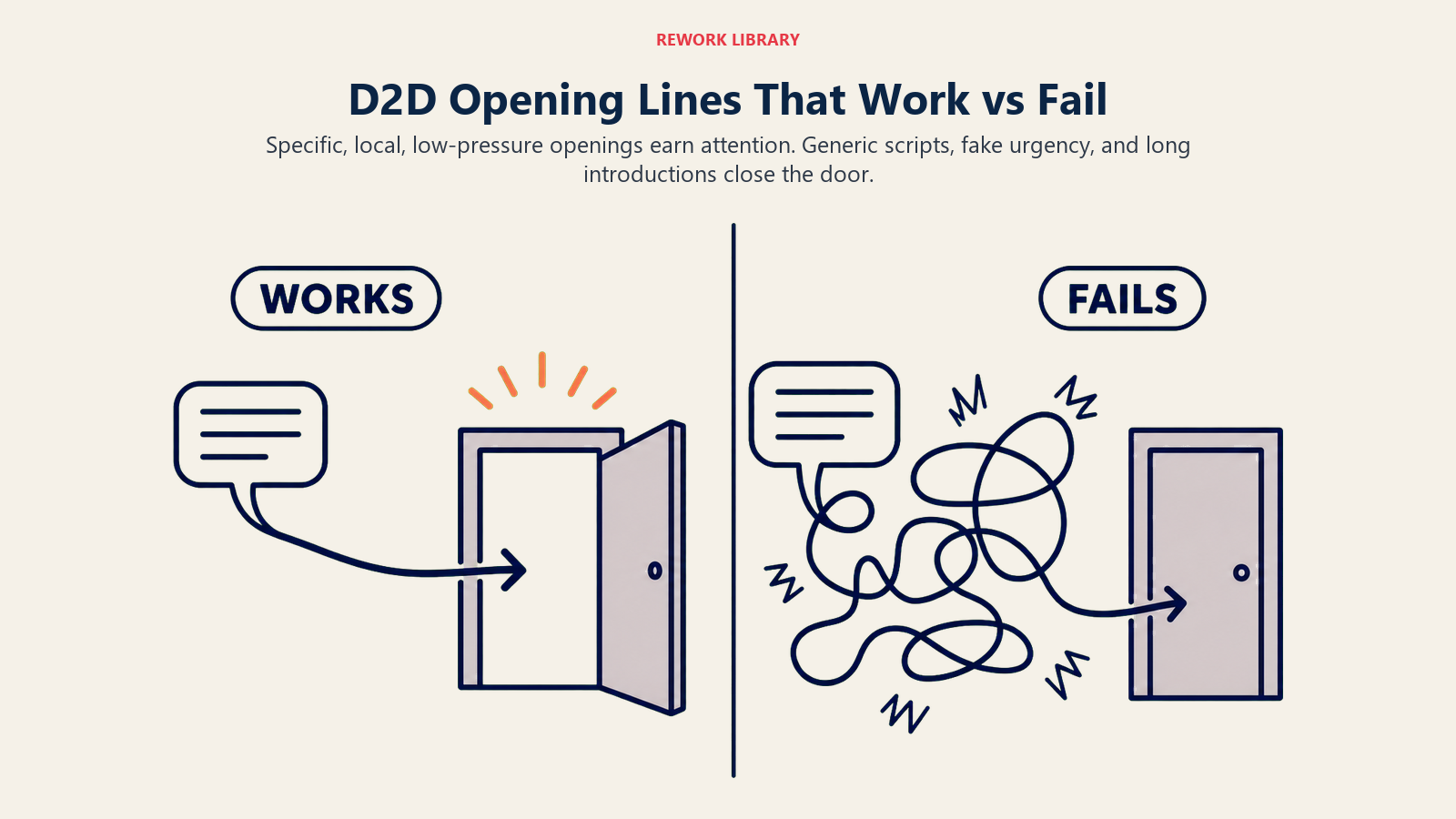
What works is an opener that establishes a local context, creates curiosity, and signals brevity.
Structural elements of an effective D2D opener:
- A natural greeting (not a scripted one)
- Something neighborhood-specific or context-relevant that shows you're not just running a generic script
- A brief, clear statement of why you're there without leading with the product name
- A question that pulls them into a short, low-commitment conversation
Examples by home services category:
Pest control: "Hey there, I'm visiting a few homes on this block. A couple of your neighbors just signed up for our pest prevention program after they mentioned seeing increased activity around the foundations this season. Can I ask, have you noticed anything like that around your place?"
Home security: "Hi, sorry to bother you. I've been working with a handful of homeowners on your street this week. We're helping people get a security system set up before the back-to-school season, which is when property incidents tend to pick up in this zip code. Quick question for you: do you currently have anything in place for the house?"
Lawn care subscription: "Hey, hope I'm not catching you at a bad time. I've been talking with some of your neighbors about a lawn program we just launched in this area, a monthly service that handles fertilization and weed control so the yard just keeps looking good without the fuss. Is the lawn something you manage yourself, or are you looking for a service?"
Fiber/internet: "Hi there. I'm with [Company], and we just expanded fiber service to this block. Your neighbors at [specific nearby address or street] just got connected last week. I wanted to stop by and let you know you're eligible now. Quick question: are you happy with your current internet, or has it been giving you headaches?"
Notice what each of these does. They establish local social proof without name-dropping specific neighbors. They ask a relevant question that invites engagement. They don't lead with a price, a product name, or a feature list. And they frame the rep as helpful and relevant, not as someone running a quota.
With D2D teams converting at just 2-5% of doors knocked (SPOTIO), the opener isn't just a nicety: it's the lever that determines whether the next 15 minutes go to someone with genuine potential or to a conversation that was over before it started.
How Do You Read a Homeowner's Response in the First 10 Seconds?
Once the homeowner responds to your opener, you have about ten seconds to read their state and adjust. This is where reps who've internalized a rigid script fail. The script keeps running regardless of signals.
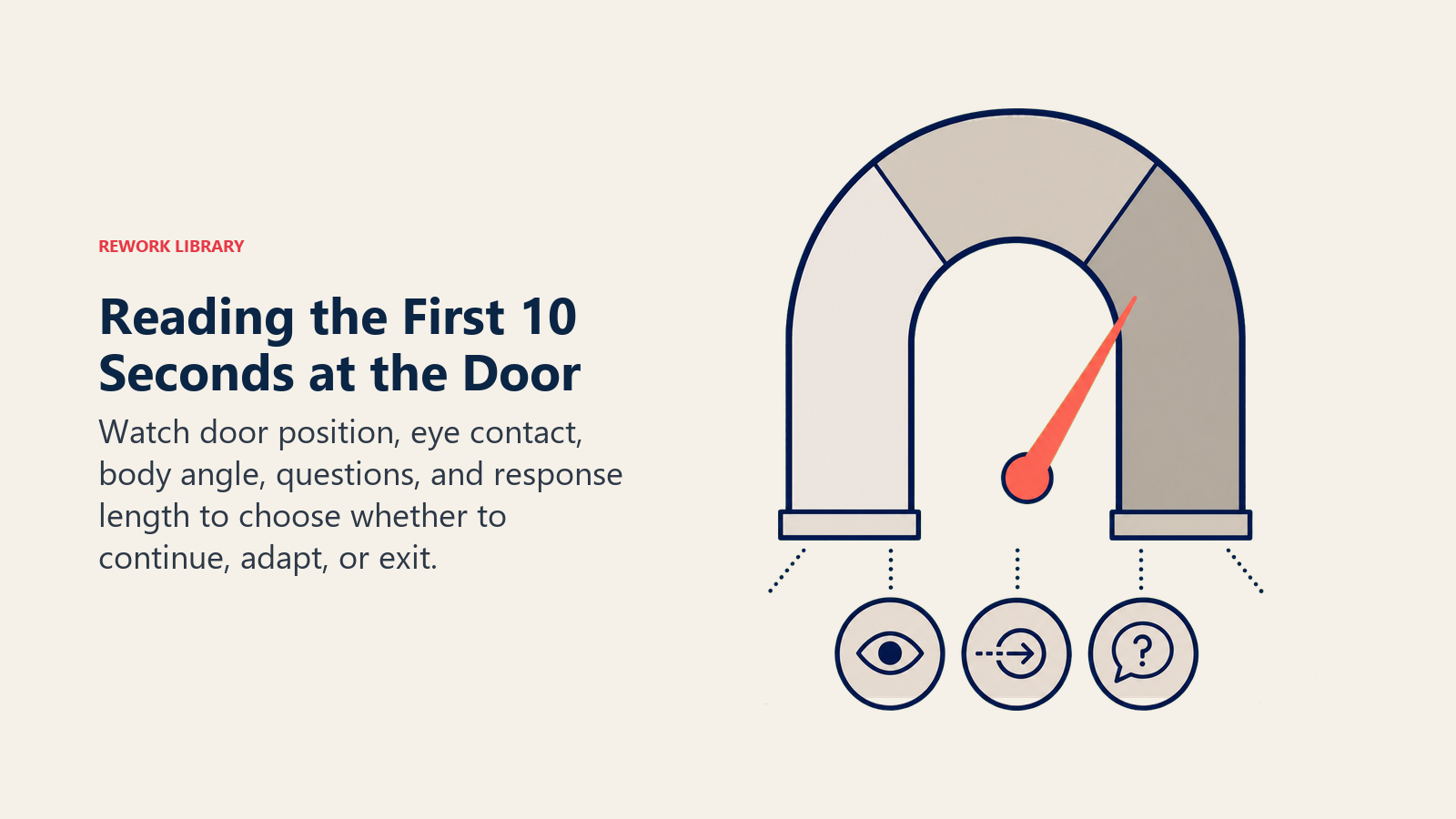
Read these signals:
| Signal | What it means | How to respond |
|---|---|---|
| Stays in doorway, arms uncrossed, direct response | Open and engaged | Continue conversation, ask your second question |
| Answers but holds door partly closed | Cautious but not closed | Keep energy low and conversational, don't push forward physically |
| "I'm actually pretty busy right now" | Timing issue, not a no | Offer a specific brief timeframe: "I just have one quick question for you" |
| "I'm not interested" with door still open | Reflex dismissal, not a considered no | Don't panic. "That's totally fair, I'll be quick." Then ask the engagement question anyway |
| Door starts to close | Physical signal to close down | Don't fight it. "Completely understand. I'll leave this with you" and hand over a door hanger |
| Aggressive or hostile | Genuine no | "No problem at all, have a good one." Exit cleanly. |
The key insight is that "I'm not interested" said within five seconds of the door opening is almost never a considered rejection of your offer. The homeowner hasn't heard enough about your offer to reject it. What they're rejecting is the generic category of "someone at my door trying to sell me something." That category rejection is reversible with the right next move.
The wrong next move is to defend your product. The right move is to acknowledge the reaction without validating it as final, then ask a question that's about them, not about you.
"That makes sense. Can I ask just one quick question before I let you go? Have you been happy with your current [service category], or is it something you've been meaning to look into?"
This reframe, moving from your agenda to their experience, is what qualifying at the door is built on. If they say "actually, yes, we've had some issues," you have a live prospect. If they say "nope, totally happy with what we have," you have genuine data and can exit without wasting either party's time.
Handling the "I'm Not the Decision Maker" Opener
In home services subscription sales, a common early response is: "You'd need to talk to my husband/wife. They handle that." This isn't always deflection. Sometimes it's literally true that the household has a division of decision authority.
The mistake is to say "okay, when can I come back to speak with them?" and leave without getting any further. That's a lost opportunity with the person who's actually in front of you.
A better path:
"Of course, I'd want to include them in any conversation. Can I ask, though, is this something your household has been thinking about at all? Because if there's zero interest, I don't want to waste your time or theirs."
This does two things. It respects the decision-making structure. And it opens a qualifying question that surfaces whether there's real interest in the household, regardless of who holds the decision authority. If the person at the door says "actually we have been thinking about it," you now have a warm lead you can re-approach at a better time. See needs discovery at the doorstep for how to develop that thread.
The First 30 Seconds as a Qualification Engine
The Context-Mirror Method: a two-step opener framework where the rep leads with something specific to the homeowner's block or neighborhood (context), then adjusts pace, tone, and energy to match the homeowner's initial response (mirror). It replaces the generic pitch pattern with one that signals relevance before the homeowner has time to pattern-match "salesperson."
Here's a reframe that changes how most reps think about the door approach: the first 30 seconds aren't just about keeping the door open. They're about qualifying quickly so you invest your next 15 minutes with the right people.
A homeowner who gives you a short, flat response and starts to close the door isn't just a lost sale. They're a door you don't need to spend 20 minutes on. A homeowner who leans out to answer your second question, who mentions their current provider by name, who says "well, since you're here" is signaling genuine potential.
The goal of the first 30 seconds isn't to sell. It's to earn the conversation that leads to same-visit close techniques. You can't compress a pitch into 30 seconds. But you can run a filter in 30 seconds that tells you who deserves your full pitch.
For a structured framework on what "qualified" means in a D2D context, lead qualification frameworks and opportunity qualification both offer transferable principles that apply directly to field selling.
The Assumptive Energy That Sets the Tone
One principle underlies all of the above. The reps who convert at the highest rates at the door aren't the most aggressive. They're the most assumptive. Not assumptive about the sale; assumptive about the conversation.
They approach with the energy of someone who fully expects the homeowner to be interested in a relevant topic, not the energy of someone braced for rejection. That internal expectation leaks into every physical signal and vocal cue. Homeowners can't explain what they're picking up, but they pick it up.
The biggest thing separating top D2D performers from average ones isn't their product knowledge or their close technique: it's that they expect the door to stay open. That expectation is readable before a single word lands.
The assumptive approach, covered in depth at the assumptive close, starts before you ever say a word. It's the posture, the pace, the opening question asked with genuine curiosity, and the confidence that you're there because you have something worth five minutes of anyone's time.
That's the first 30 seconds done right. Not a pitch. A conversation that the homeowner almost chose to walk into.
Related reading: Qualifying at the Door covers how to move from a warm open into genuine discovery. Canvassing Fundamentals and the Knock covers the field mechanics that get you to this moment in the first place.

Senior Implementation Consultant
On this page
- What Homeowners Are Actually Evaluating in the First 30 Seconds
- What Does Body Language at the Door Actually Signal?
- The Opening Line: What Works and What Kills the Conversation
- How Do You Read a Homeowner's Response in the First 10 Seconds?
- Handling the "I'm Not the Decision Maker" Opener
- The First 30 Seconds as a Qualification Engine
- The Assumptive Energy That Sets the Tone