Closing the Service Agreement: How to Finalize D2D Subscription Sales
Turn this article into takeaways for your work.


Each assistant summarizes the article only for you and suggests best practices for your work.
The close doesn't start when you pull out the paperwork. It starts the moment the door opens. Every qualifying question, every benefit you named, every objection you worked through has been building toward one outcome: the homeowner picks up the pen or taps "Sign" on the tablet. What separates reps who close 25% of doors from those who close 40% isn't a magic phrase. It's a structured, pressure-free process that makes signing feel like the obvious next step.
This guide walks through the complete service agreement close for recurring home-service subscriptions, from confirming intent to handling last-second hesitation.
Why Is the Agreement Close Different for Subscription Services?
One-time purchases are simple: the customer pays once and you leave. Subscription closes are more involved because the homeowner is making an ongoing commitment. They're agreeing to let your company show up repeatedly, charge them each billing cycle, and maintain access to their property.
That changes how you frame the close. You're not just asking them to buy something today. You're asking them to start a relationship with your business. The paperwork isn't a hurdle to get past. It's where you formalize that partnership, and how you handle it signals everything about how your company will treat them going forward.
Reps who rush the paperwork tend to generate more early cancellations. Reps who walk through it clearly tend to generate customers who stay and refer. The retention math behind that gap is stark, and it's worth two extra minutes at the paperwork stage (see the Key Facts below).
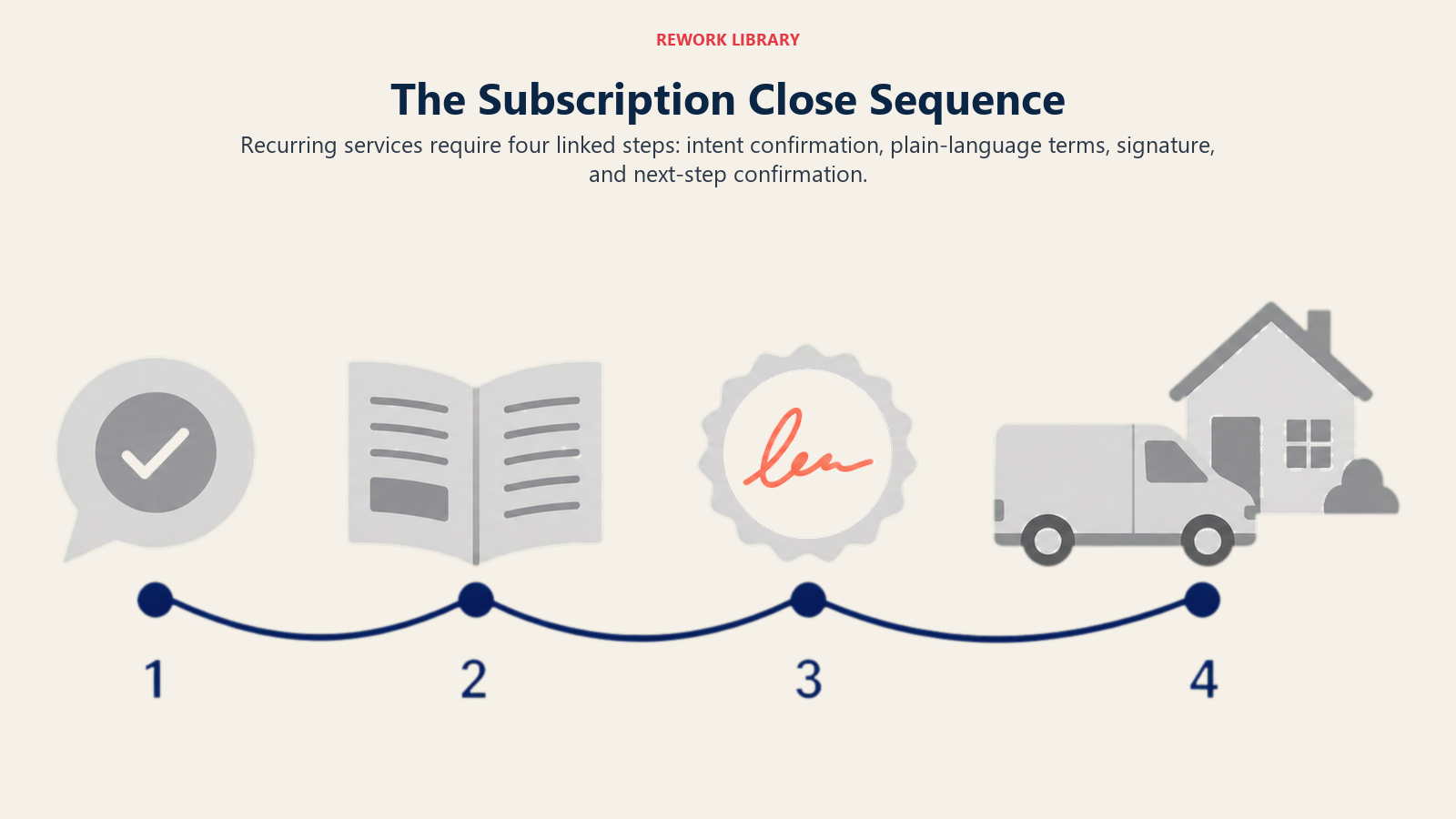
The Transparent Close Sequence: The right service agreement close follows this order: pre-close verbal summary to confirm intent, agreement walk-through section by section in plain language, signature ask with no drama, post-close next-steps confirmation. Skipping any step, especially the intent check and the terms walk-through, is where early cancellations originate.
Key Facts: Closing the Service Agreement
- A 5% improvement in customer retention rates can increase profits by 25% to 95%, according to research by Frederick Reichheld of Bain and Company, cited in Harvard Business Review (hbr.org/2014/10/the-value-of-keeping-the-right-customers, October 2014). The paperwork moment is where retention is either protected or undermined.
- Under the FTC's Cooling-Off Rule (16 CFR Part 429), door-to-door sales over $25 require sellers to provide two completed cancellation notice forms and verbally disclose the homeowner's 3-business-day right to cancel at the time of signing. Failure to comply is an unfair and deceptive act under Section 5 of the FTC Act. (ftc.gov/legal-library/browse/rules/cooling-period-sales-made-home-or-other-locations)
- D2D sales generates approximately $34.7 billion annually in the US, per the Direct Selling Association's 2025 Growth and Outlook Study (2024 data), with subscription home services among the highest-retention categories when the close is handled transparently.
The Pre-Close Confirmation
Before you pull out any paperwork, do a verbal summary to confirm the homeowner is still aligned. This is sometimes called the "intent check" and it only takes about 30 seconds.
Here's a clean way to deliver it:
"So just to recap before we get you set up: you're getting [Service Tier] coverage for [specific scope], starting on [approximate date]. The first visit handles [specific service action]. After that, we come back every [frequency]. You'll be billed [amount] on [billing cycle]. Does that sound right?"
If they say yes, you've already gotten a verbal commitment before the pen comes out. That makes the physical signing feel like a natural continuation rather than a pressure moment.
If they hesitate here, stay curious rather than pushing forward. Ask what's on their mind. It's better to surface a concern now than to have them sign and cancel two days later.
What Goes Into a Service Agreement (and Why Reps Should Know It Cold)
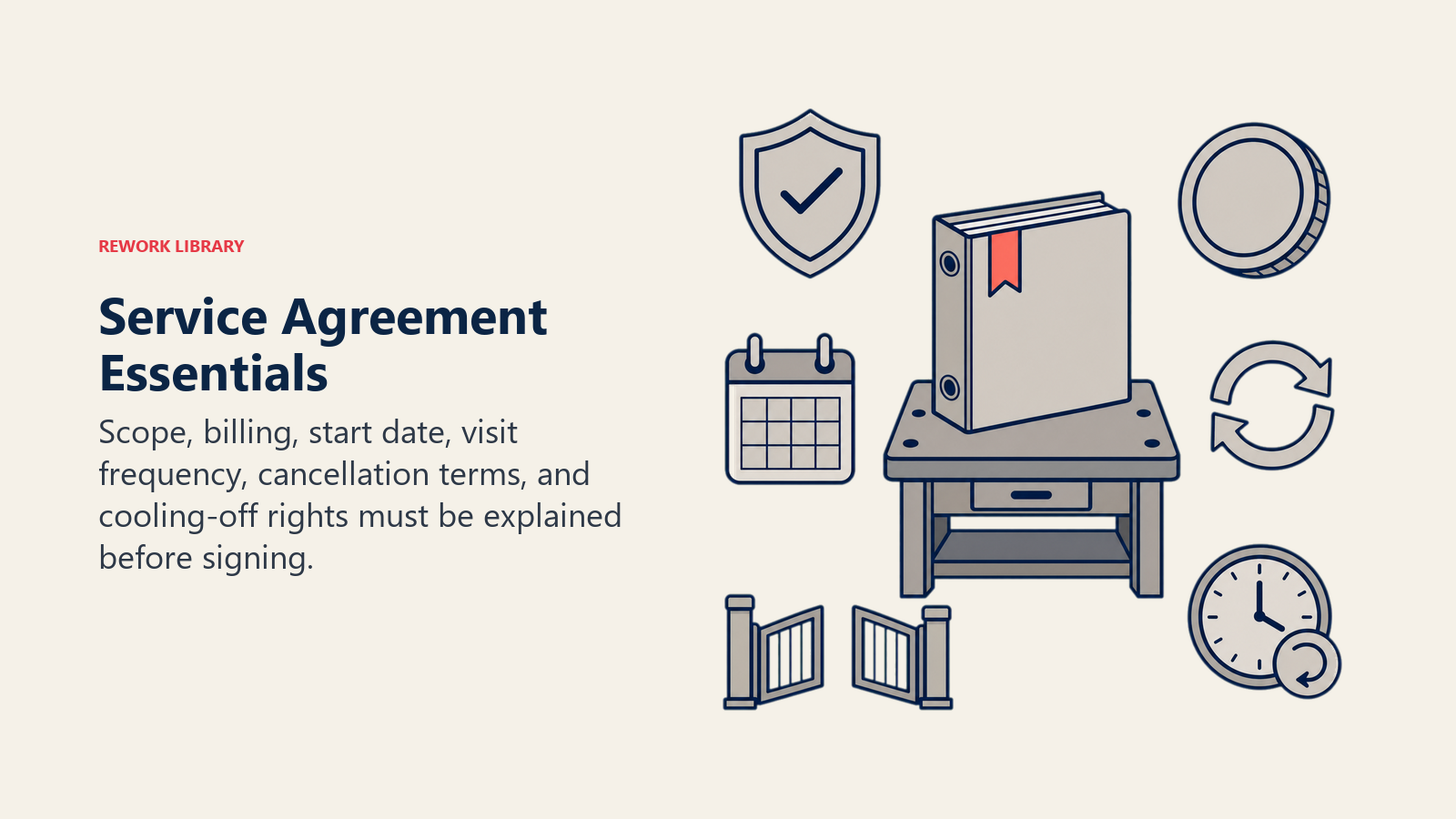
A homeowner who doesn't understand what they're signing will either refuse to sign or sign and regret it. Either outcome costs you. Walk through the key sections clearly, and invite questions at each one.
| Agreement Section | What to Explain Simply |
|---|---|
| Service scope | Exactly what is covered, what isn't, and what triggers an extra visit |
| Billing schedule | When the first charge hits, how often after that, and what triggers a price change |
| Start date and initial visit | When the first service happens and what the tech will do |
| Service frequency | How often recurring visits occur and whether the customer can adjust |
| Cancellation policy | How to cancel, any notice period, and whether early cancellation has fees |
| FTC Cooling-Off / Right of Rescission | The 3-day right to cancel without penalty (required by law for in-home sales above $25). See the FTC consumer guide on the Cooling-Off Rule and the full rule text (16 CFR Part 429) for the exact disclosure requirements. |
Don't gloss over the cancellation policy or the cooling-off notice. Explaining them builds trust and reduces the chance the homeowner feels trapped later. There's more on what's legally required for in-home contracts in the Learn More section below.
How to Present the Contract Without Creating Anxiety
Most homeowners have a low-level wariness about signing anything at the door. That's normal and healthy. Your job isn't to override it. It's to make the document feel transparent.
Three practices that work:
Read the headline aloud, then summarize in plain language. Don't hand over the tablet and wait silently. That puts all the cognitive load on them and gives anxiety a chance to build. Instead, walk through each section and say what it means in one sentence.
Point to the cancellation and cooling-off section first. Counterintuitive, but it works. Showing the homeowner they have exit options makes them feel safer committing. They know they're not trapped.
Leave room for questions before asking for the signature. After walking through the document, say: "Any questions before I get your signature?" That pause does a lot of work. It signals that you're not in a rush, you're not hiding anything, and you actually want them to understand what they're agreeing to.
The Signature Moment
Once they've confirmed they understand the agreement, the ask for signature should be direct but low-pressure. Something like:
"Great. If you want to go ahead, I just need your signature right here, and we'll get your start date locked in."
That's it. No drama, no countdown, no theatrical pausing. Just a clear, calm invitation.
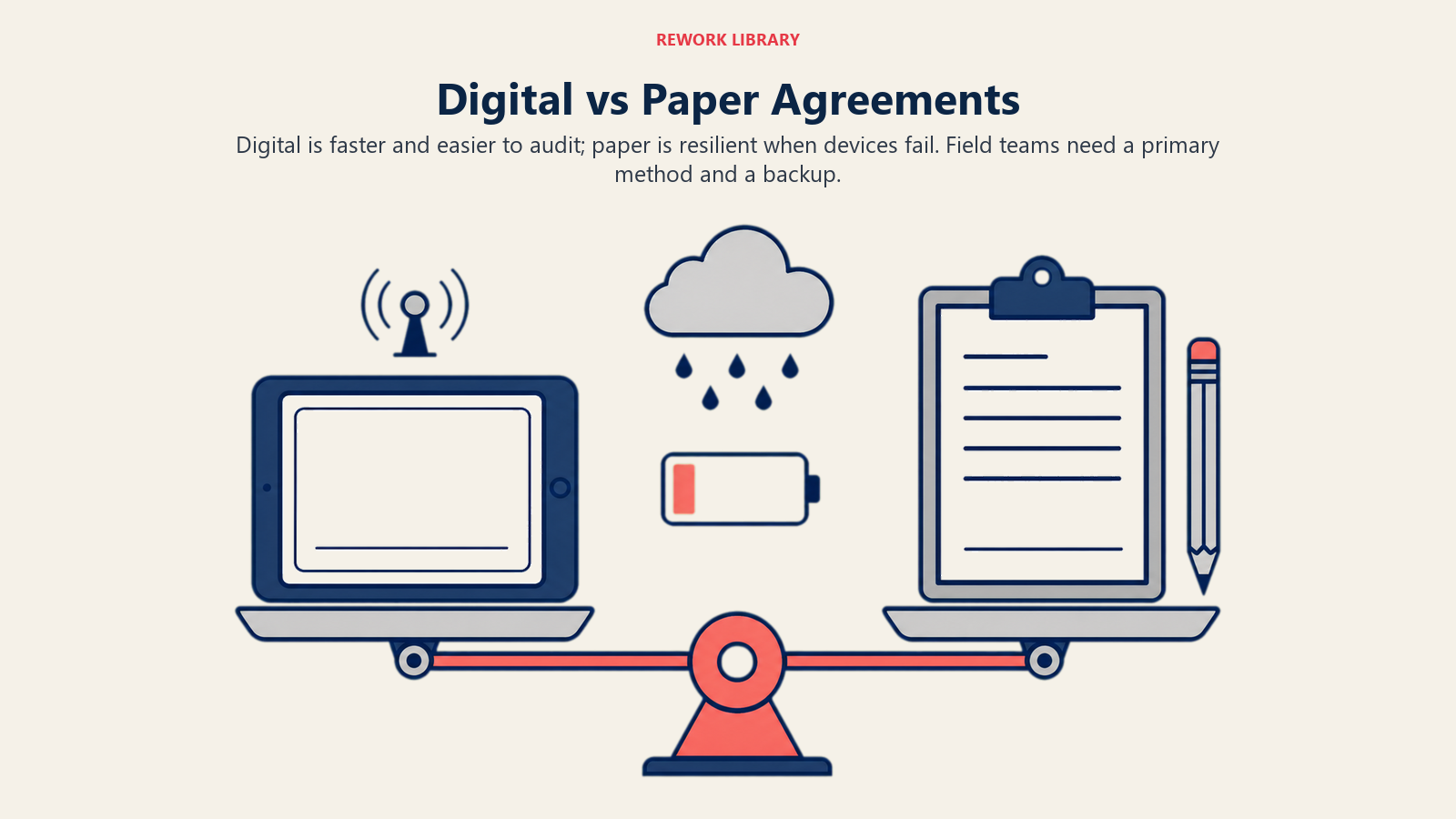
If you're using a tablet or mobile app, make sure you've tested the signing flow before the day starts. A glitchy screen at the signature moment is a trust-killer. Some reps keep a paper backup exactly for this reason.
Handling Last-Second Hesitation
Even after a great conversation and a clean walk-through, some homeowners hesitate at the signature line. These are the most common moments and how to handle them:
"I just want to think about it overnight." Don't argue. Do say: "That makes sense. Quick question: is there anything specific you'd want to think through? I want to make sure you have everything you need." Often the hesitation is about one specific thing (price, timing, the recurring commitment), and naming it turns a vague delay into a solvable problem.
"I want to check with my spouse." Legitimate. If the spouse is home, ask if you can include them in a 2-minute recap. If not, offer to come back or offer a call-in close where you can explain the plan to both of them together.
"What if I change my mind?" This is your opening. Walk them back to the cancellation policy and the 3-day cooling-off right you already explained. "You have three days from today to cancel without any obligation. And even after that, our cancellation process is straightforward." That often resolves it.
For more on resolving late-stage objections without pressuring the customer, see Objection Handling at the Door and Same-Visit Close Techniques.
Confirming the Start Date Before You Leave
Signing the agreement is the close. But confirming the start date is what converts that signature into a relationship. Before you leave the door:
- Tell the homeowner when their first service is scheduled. If the date is still flexible, give them a range and tell them dispatch will call to confirm the window.
- Confirm the best contact method for scheduling and service reminders.
- Tell them what to expect on the day of the first service.
- Give them a copy of the agreement, whether digitally (email confirmation) or a paper copy if your system requires it.
That last step is legally required in many states. And even where it isn't, giving the homeowner their copy is simply the right thing to do. It's also one of the simplest ways to prevent early cancellations, because customers who have their paperwork are less likely to feel uncertain or misled about what they agreed to.
Digital vs. Paper Agreement: What Works Better in the Field
Most modern D2D operations use tablet-based digital agreements, but there are trade-offs in each scenario:
| Factor | Digital (Tablet/App) | Paper |
|---|---|---|
| Copy delivery | Instant via email | Rep must leave physical copy |
| Speed | Faster, auto-fills details | Slower to complete |
| Professionalism | Polished, tech-forward | Can feel outdated |
| Backup risk | App crash = lost signature | Paper doesn't glitch |
| Audit trail | Timestamped, IP-logged | Harder to dispute |
Most reps benefit from running digital as the primary method and keeping a paper backup in the sales bag. If your CRM or canvassing app integrates with the agreement workflow, make sure the signed document auto-syncs to the customer record. Manual entry after the fact is where mistakes happen.
See D2D CRM and Canvassing Apps for how to set up a field-ready agreement workflow tied to your sales pipeline.
The Handoff: What Happens Right After the Signature
Once signed, the interaction shifts from "salesperson at the door" to "new customer in the system." That shift needs to feel smooth and immediate.
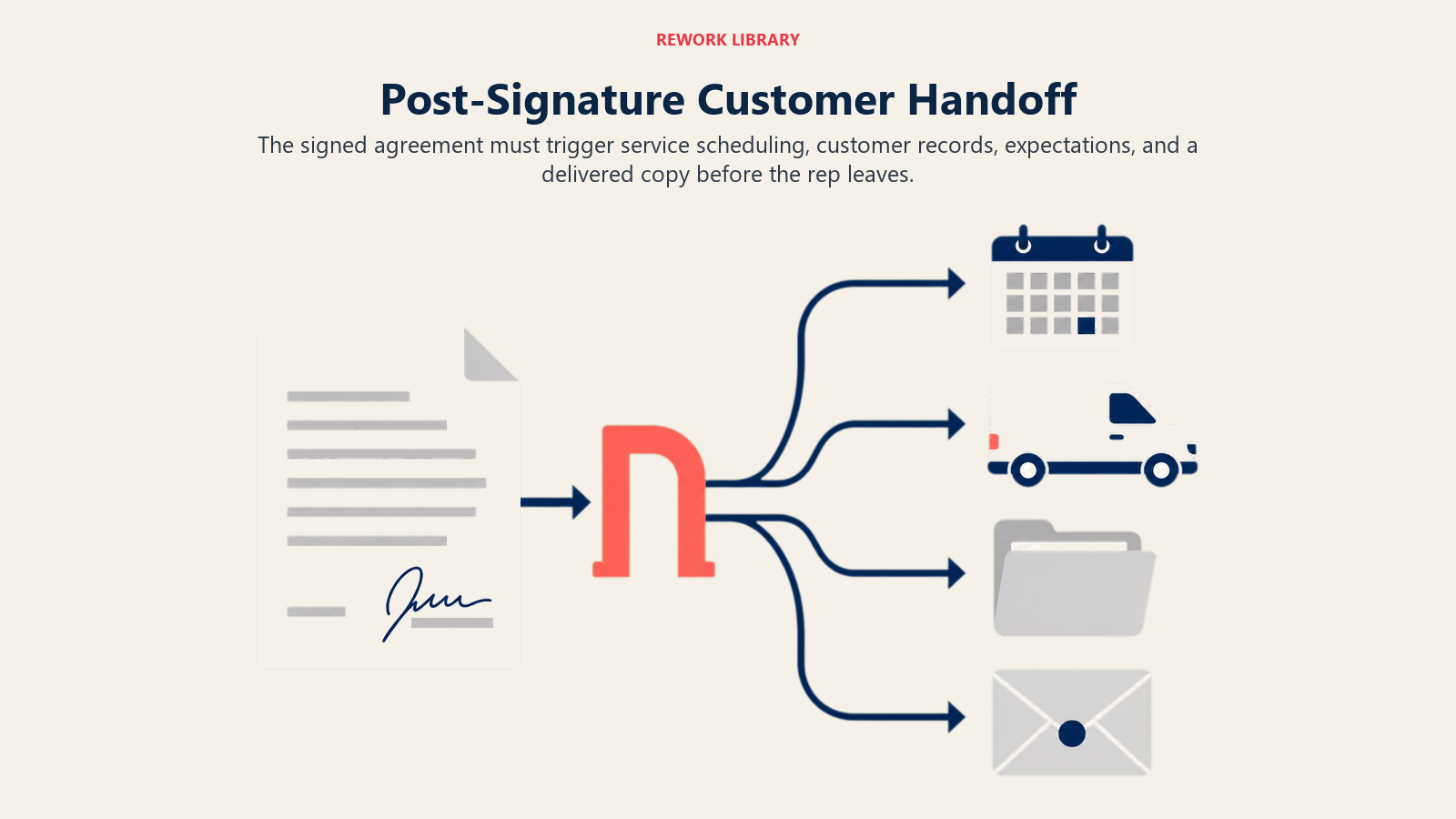
Your close checklist before leaving:
- Agreement signed and customer copy delivered
- Start date confirmed or dispatch notification triggered
- First service details explained ("The tech will need access to your garage" or "You'll get a call 30 minutes before arrival")
- Customer has your contact info for questions
- Customer record created or updated in CRM
- Any referral or promotion bonus explained if relevant
If your company has a formal sale-to-service handoff process, now is also the time to set expectations about how operations will take it from here. Customers who know what happens next don't cancel out of uncertainty.
For the full handoff process between sales and service teams, see Sale to Service-Start Handoff.
Close Rate Benchmarks by Service Type
Knowing what's realistic helps managers coach toward the right standard rather than comparing against an imaginary perfect number.
| Service Type | Average Door-to-Close Rate | Top Rep Range |
|---|---|---|
| Pest control | 18-22% of qualified conversations | 30-38% |
| Security / alarm systems | 12-18% | 25-32% |
| Lawn care (subscription) | 15-20% | 28-35% |
| Fiber / internet | 10-15% (often in active-promo zones) | 20-28% |
Note: These are practitioner benchmarks from field experience, commonly cited in D2D training literature. They reflect pitch-to-close rates on qualified conversations, not knock-to-sale rates. Overall knock-to-sale conversion across D2D channels runs 2-3%, per data aggregated by SPOTIO and Zety (2026).
These benchmarks assume reps are knocking qualified territory, not cold neighborhoods. Close rates in premium neighborhoods with proper targeting run higher. Rate drops sharply when reps are working wrong-fit doors.
Track your close rate from "door opens" as well as from "gets to pitch," because both metrics tell different stories about where in the funnel the leakage is happening. Your KPI dashboard should separate these.
Building the Signing Habit
The best closers treat the agreement process as a standard part of every pitch, not a separate "closing move" they switch into. When signing feels like a natural conclusion to a transparent conversation, customers are more comfortable, cancellation rates drop, and referral rates go up.
Practice the agreement walk-through during ride-alongs and role plays until it's as natural as the opening knock. Reps who stumble at the paperwork stage almost always skipped practicing it and only drilled the pitch.
For building a pipeline and close-plan mindset that supports consistent performance, see close plan development and value selling.
Learn more: D2D Legal and Licensing Compliance covers what's legally required for in-home contracts beyond the cooling-off disclosure. D2D Sales KPIs and Metrics walks through separating door-opens from gets-to-pitch close rates on your dashboard.
The Retention Math: Frederick Reichheld's research across more than 100 companies found that a 5% improvement in retention increases profits by 25% to 95%. Reps who walk through the service agreement clearly and disclose terms proactively are doing more than completing paperwork. They're protecting the margin that comes from customers who stay.
The Verbal Intent Check: Reps who confirm verbal alignment before showing the agreement ("So just to recap: you're getting X coverage starting on Y...") surface last-second concerns before the paperwork stage rather than after signing, which is exactly when concerns become cancellations.
The Two-Document Rule: Under the FTC's Cooling-Off Rule (16 CFR Part 429), sellers in D2D transactions over $25 must provide two completed copies of a cancellation notice form at the time of signing. Presenting this proactively as a consumer-friendly feature, rather than burying it, builds trust and reduces early cancellations because homeowners who feel respected are less likely to exercise the right.
Frequently Asked Questions about Closing the Service Agreement
What is a service agreement close in door-to-door sales?
A service agreement close is the final step in a D2D subscription sale, where the homeowner signs a written contract that formalizes the scope, billing schedule, visit frequency, and cancellation terms of the service. It differs from a one-time purchase close because the homeowner is committing to an ongoing relationship, not a single transaction. How the close is handled directly affects whether that customer stays subscribed or cancels within 30 days.
What is the pre-close intent confirmation and why does it matter?
The intent confirmation is a 30-second verbal summary delivered before pulling out the paperwork: "Just to recap before we get you set up: you're getting X coverage starting on Y, billed at Z. Does that sound right?" If the homeowner confirms, you've collected a verbal commitment that makes the physical signing feel like a natural continuation. If they hesitate, you surface the concern before it becomes a post-signing cancellation.
What are the three sections every rep must cover in the agreement walk-through?
The three required points are what they're agreeing to (service scope and visit frequency), what they're protected by (the guarantee and re-treatment policy), and how it works going forward (billing cycle, renewal terms, and cancellation process). These three points answer the questions homeowners are most likely to have, before they ask them. Covering them proactively prevents "I didn't know that" cancellations.
What does the FTC Cooling-Off Rule require at the time of signing?
Under 16 CFR Part 429, door-to-door sales over $25 require sellers to verbally disclose the homeowner's right to cancel within three business days (excluding Sundays and federal holidays). Sellers must also provide two completed copies of a "Notice of Cancellation" form at the time of signing, and must include a bold notice of cancellation rights in the contract itself. Violating these requirements is an unfair and deceptive act under the FTC Act.
What should a rep do when a homeowner hesitates at the signature line?
Stay curious rather than pushing. Ask: "Is there anything specific you'd want to think through? I want to make sure you have everything you need." Most last-second hesitations trace to one specific concern: price, the recurring commitment, or uncertainty about what happens after they sign. Naming the concern turns a vague delay into a solvable problem. If the concern is about commitment, walking them back to the cooling-off right often resolves it: "You have three business days to cancel at no charge if you change your mind."
Is a digital or paper agreement better for D2D sales?
Digital agreements are faster, generate an automatic audit trail, and deliver the customer's copy instantly via email, but require a working device and a stable app. Paper agreements don't rely on technology and can be completed anywhere, but require the rep to leave a physical copy with the customer at the time of signing, which is a legal requirement under the FTC Cooling-Off Rule regardless of format. Most field teams use digital as primary and keep paper as backup.
How quickly should a rep confirm the start date after the homeowner signs?
Before leaving the door. Confirming the start date, the first visit logistics, and the contact method for service reminders immediately after signing converts the signature into a real relationship rather than a transaction that might feel abstract by tomorrow. Customers who don't know when to expect the first service visit are more likely to second-guess the decision. Set the expectation on the spot.

Senior Implementation Consultant
On this page
- Why Is the Agreement Close Different for Subscription Services?
- The Pre-Close Confirmation
- What Goes Into a Service Agreement (and Why Reps Should Know It Cold)
- How to Present the Contract Without Creating Anxiety
- The Signature Moment
- Handling Last-Second Hesitation
- Confirming the Start Date Before You Leave
- Digital vs. Paper Agreement: What Works Better in the Field
- The Handoff: What Happens Right After the Signature
- Close Rate Benchmarks by Service Type
- Building the Signing Habit