Running a Summer Sales Program for Door-to-Door Sales Teams
Turn this article into takeaways for your work.


Each assistant summarizes the article only for you and suggests best practices for your work.
For pest control, home security, lawn care, and fiber companies, summer is not just another quarter. It's the quarter. The window when homeowners are outside, neighbors are talking, and a well-run D2D program can add more accounts in 10 weeks than the rest of the year combined.
But summer programs are also where the most operational mistakes happen. Companies recruit fast and onboard poorly. They oversell territories until rep density kills conversion rates. They hire managers who were great producers but have no idea how to lead 25 people. And they don't plan the season-end until the last two weeks, when half their reps have mentally already left.
The companies that run great summer programs aren't necessarily the ones with the best product or the best territory. They're the ones that plan with detail, staff with intention, and manage the 1099 workforce with a structure that keeps people producing from June through August.
This is the operating guide for doing that.
Quotable Nuggets "A summer D2D program's account output depends almost entirely on decisions made in March: recruiting targets, territory mapping, team leader selection, and comp finalization. Companies that start those decisions in May are already behind."
"Fresh territory converts at 2x to 3x the rate of a neighborhood that's been knocked quarterly for three years. Territory assignment is one of the highest-leverage decisions in a summer program, and most companies make it based on logistics rather than value."
"For 1099 summer reps, the reporting threshold that determines who gets a 1099-NEC changes for 2026 payments. Collecting W-9s on day one, not in August, is the only reliable way to have the information you need by January 31."
The March-to-August Planning Arc: A six-phase summer program operating model that works backward from account targets to headcount, organizes comp and curriculum in April, closes recruitment and sets up systems in May, launches with a structured first-week curriculum in June, manages the predictable three-phase program arc (weeks 1 to 3 high energy / weeks 4 to 7 peak production / weeks 8 to 10 retention) through August, and closes with a season-end recognition event and return-rep recruiting push. Each phase has specific deliverables that must be complete before the next phase starts.
What Does a Summer Program Timeline Look Like?
Key Facts: Summer D2D Programs
- The US Direct Selling Association's 2024 data shows 5.4 million Americans engaged in direct selling full-time or part-time, generating $34.7 billion in retail sales, a channel where seasonal programs account for a significant share of new account volume. (DSA 2025 Growth and Outlook Study)
- The 1099-NEC reporting threshold is $600 for calendar year 2025 payments and rises to $2,000 for payments made after December 31, 2025. Summer programs that fail to collect W-9s on day one face an end-of-August tracking problem when reps are hard to reach. (IRS 1099-NEC guidance)
- SPOTIO's 2026 State of B2C Field Sales report found that 41% of field sales teams report annual rep turnover above 50%, with highest concentration in telecom/fiber and home services, the core summer D2D verticals. (SPOTIO, 2026)
A successful summer program doesn't start in June. It starts in March. Here's the full planning arc:
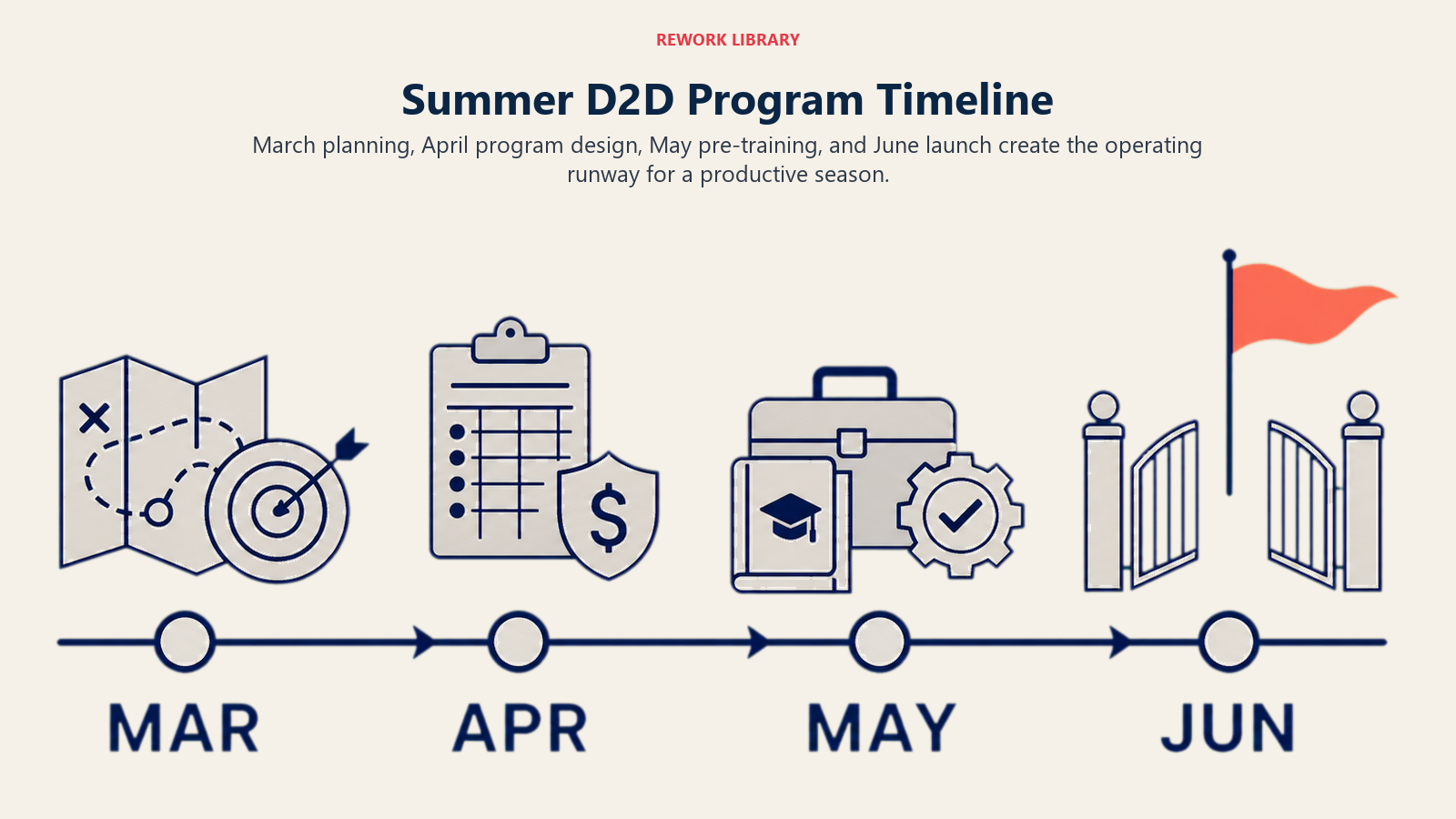
March: Recruiting and Territory Planning
Recruiting goals: Decide how many accounts you want to close this summer. Work backward: if your average rep closes 4 accounts per week and works 12 weeks, each rep generates roughly 48 accounts. Divide your summer account target by 48 and you know how many producing reps you need. Then recruit for 30% to 40% more than that number, because not every recruit will make it through onboarding and ramp.
Territory planning: Map the summer territories before hiring. Don't assign reps to wherever there's empty space. Look at your historical conversion data by neighborhood type, existing customer density, and how recently the area was knocked. Fresh territory converts at 2x to 3x the rate of a neighborhood that's been knocked quarterly for three years.
Run territory value assessments: how many viable households per square mile, what's the saturation rate, and how far are the most productive territories from your base of operations? For more on this, see territory design and assignment.
Housing logistics (if applicable): Programs that bring reps from out of market need housing and transportation figured out in March, not May. Company-provided housing for out-of-state summer reps is common in pest control and security. The logistics of housing 20 people and getting them to territory every morning are real operational costs that need to be in the summer program budget before you commit to a rep count.
April: Program Design and Comp Finalization
Lock in the comp structure. Reps make go/no-go decisions on programs based on what they can earn. Your summer comp needs to be final, fully documented, and clear enough for a 20-year-old with no sales experience to understand before they quit their regular job to join your program. See commission and comp design for D2D for the structural options and benchmarks.
Set program rules in writing. What are the daily attendance expectations? What happens if a rep misses a day? What's the chargeback window? What does "season completion" mean for the completion bonus? What are the grounds for dismissal? Every rule that isn't written and communicated before the first day becomes a conflict after.
Build the training curriculum. Don't improvise training. Write the onboarding curriculum in April so your team leaders can run it consistently in June regardless of your personal involvement on any given day. The curriculum should cover: product and service basics, door approach and script, qualifying and objection handling, the contract and consent process, and tools/apps the rep will use daily.
Hire and confirm team leaders. Ratio: one team leader per 8 to 12 reps. In a 30-rep summer program, you need at least 3 experienced team leaders on the ground. These are not the same as your best producers. You need people who can coach, manage conflict, and stay consistent when a rep is having a rough week. Confirm these roles and their summer comp in April.
May: Recruiting Final Push and Pre-Training
Close the recruiting pipeline. Your summer cohort should be signed, screened, and confirmed by mid-May. Hold a virtual pre-summer orientation session in May: walk through the program structure, comp plan, and expectations before arrival. Reps who arrive knowing what to expect onboard faster and quit less.
Pre-training assignment. Send recruits a pre-work packet before day one: product overview, script to memorize, FAQ about the job. Reps who arrive having read and thought about the material cut your onboarding time significantly. The ones who don't complete pre-work are often signals of low commitment.
Set up the tools and systems. Your CRM, canvassing app, contract management system, and rep communication channels need to be ready before 30 reps show up expecting to use them. Test everything in May. See D2D CRM and canvassing apps for the tools commonly used in summer programs.
Secure compliance and licensing. Many jurisdictions require specific licenses or permits for D2D sales. Some require individual rep registration. Do this early: licensing bureaucracies don't move on your timeline. See D2D legal and licensing compliance for the checklist.
June: Launch and First-Week Execution
Week one sets the tone for the entire program. The decisions you make in the first five days echo through the rest of the summer.
Day 1 onboarding structure:
| Block | Content | Duration |
|---|---|---|
| Morning | Welcome, program overview, comp plan walkthrough with examples | 2 hours |
| Mid-morning | Product deep-dive and competitive context | 90 minutes |
| Lunch | Team lunch (all reps, all team leaders together) | 1 hour |
| Afternoon | Script read-through and first role-play session | 2 hours |
| End of day | Territory map overview, what tomorrow looks like | 30 minutes |
Day 2 and 3: Extended role-play and field observation. Team leaders demonstrate; reps observe and debrief. This is the bridge between classroom and field.
Day 4 and 5: First solo knocks with team leader present. For more on the ramp structure, see onboarding and ramping new reps.
The week-one numbers you must track:
- How many reps completed the full onboarding?
- How many have knocked at least one door by Friday?
- How many have their first sale by end of week one?
- Which team leaders are struggling to hold their group together?
These numbers are leading indicators of your summer trajectory. If 40% of your reps haven't knocked a door by Friday of week one, you have a motivation problem, a fear problem, or a territory problem. Find out which and fix it before week two.
Managing the 1099 Summer Workforce
Most summer D2D programs run on 1099 contractor agreements. This creates specific management challenges that W-2 employers don't face.
Behavioral control limits. As a 1099 contractor, the rep retains control over how they work. You can set expected production outcomes and provide tools and training. But requiring a rep to follow a specific daily schedule or be in a specific location at a specific time is harder to enforce and, if overdone, creates misclassification risk. The practical effect is that you're managing through incentives and culture rather than directives and mandates.
No guaranteed income floor. 1099 reps don't have a minimum wage backstop in the same way W-2 employees do, though state laws vary. But the practical reality is that reps who don't earn money leave. If your program structure makes it hard for new reps to earn in weeks 1 and 2, you'll see dropout rates that kill your summer production plan. Draw structures, territory quality management, and early-win bonuses exist to solve this problem.
Documentation requirements. You need signed contractor agreements before a rep knocks a single door. The agreement should cover: scope of work, comp structure including chargebacks, IP and customer data ownership, non-solicitation terms (where enforceable), and the clear contractor vs. employee language. Have employment counsel review this once and update it as laws change.
Tax forms. Any 1099 rep who earns at or above the applicable reporting threshold in a calendar year needs a 1099-NEC form from you by January 31 of the following year. The IRS 1099-NEC reporting guidance covers what qualifies as nonemployee compensation, the current threshold, and the conditions that trigger reporting. Get W-9s from every rep on day one, not at the end of the summer when tracking people down is nearly impossible.
For the broader management framework for this workforce, see managing seasonal 1099 teams.
Week-by-Week Program Management
Summer programs have a predictable arc. Knowing the arc lets you anticipate problems instead of reacting to them.
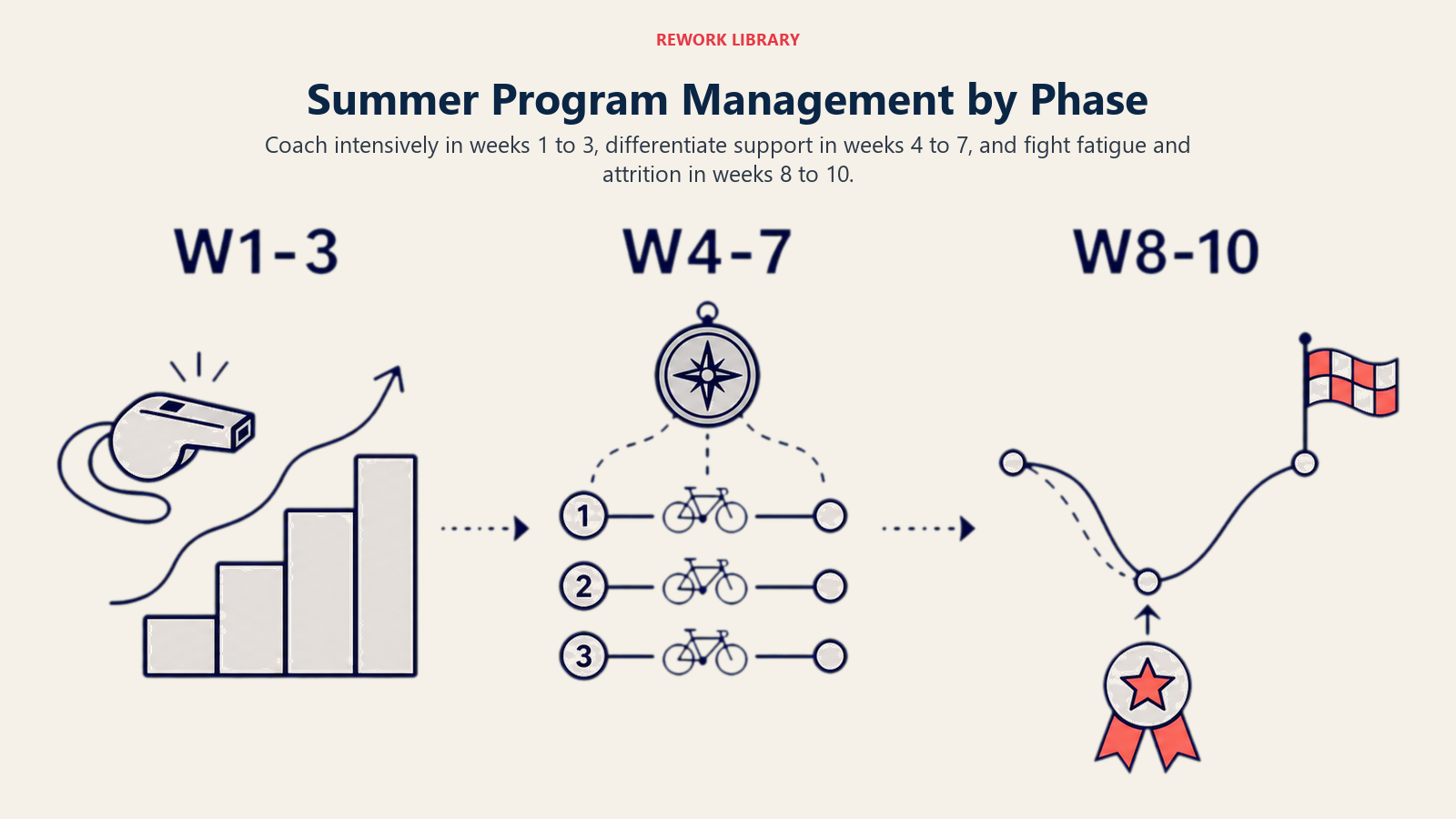
Weeks 1 to 3: High energy, variable production, significant dropout risk.
This is the learning phase. Reps are excited and nervous. Production is low because skills aren't yet built. Attrition risk is highest here because reps who don't sell in week one sometimes never come back for week two.
Manager focus: daily check-ins, maximum coaching time, manufacturing early wins, and visible leadership presence. Run a first-week leaderboard that celebrates any sale, not just top producers.
Weeks 4 to 7: Stabilization and differentiation.
By week four, your cohort has separated into three groups: strong producers who are on pace, developing reps who are improving but inconsistent, and low producers who haven't found their rhythm. Your job is to accelerate the strong ones, close the gap for the developing ones, and make honest decisions about the low producers.
This is also the peak summer window for most D2D verticals. Pest season is full. Security conversions are highest in summer. Lawn care customers are thinking about their yards. Maximize territory density and production pace now.
Manager focus: ride-alongs for developing reps, territory expansion for strong producers, and performance conversations for anyone who's consistently below your minimum productivity threshold.
Weeks 8 to 10: Retention phase.
Fatigue sets in. Reps start thinking about school starting, fall plans, other opportunities. The reps who were on the edge of quitting in week two will have a second attrition wave here.
Tactics that help:
- Mid-summer bonus structure that pays out at week 8 for hitting a cumulative account target
- Season-completion bonus announcement reminder: remind reps what they're earning if they finish through the final date
- Visible countdown to summer goal: "We're 87 accounts from our summer target" posted daily
- One team event or activity during this phase to reinvigorate energy
- Conversations with your top performers about what's next: return next summer? Year-round role? This is the recruiting conversation for next summer disguised as a development conversation.
Territory Management During Summer
Territory management is one of the highest-leverage decisions in a summer program and one of the most commonly mishandled.
The mistake: assigning territories based on geography (who lives where) rather than territory value. The rep who happens to live 20 minutes from your best suburban territory shouldn't be the only one working it. Your best reps should have access to your best territory.
A working framework for territory rotation:
| Week | Territory Assignment Principle |
|---|---|
| 1 to 2 | New reps get fresh territory with moderate density (not your best, which they can't yet leverage) |
| 3 to 4 | Top week-2 performers get access to higher-value areas; low producers stay in moderate areas |
| 5 to 8 | Full rotation: reps rotate between 3 to 4 pre-defined territory zones weekly to reduce saturation |
| 9 to 10 | Best remaining fresh territory reserved for sprint finish |
Track doors knocked per territory and conversion rate by area. If a territory's conversion rate is dropping, rotate reps out before it collapses entirely. A territory knocked every single week by rotating teams produces fewer accounts in week 10 than a territory that was skipped for three weeks and then returned to.
Which Program Metrics Should You Actually Act On?
Summer programs produce a lot of data. The question is which metrics to act on and which to monitor. Harvard Business Review research on finding the right metrics for your sales team makes the same point: tracking too many numbers dilutes focus; a tight set of leading indicators outperforms a dashboard full of noise.
Act on these daily:
- Accounts sold by rep (individual and team)
- Doors knocked by rep (self-reported; verify with spot-checks and canvassing app data)
- Conversations per 100 doors (this is your approach quality indicator)
- Conversion rate (conversations to sales)
Review weekly with team leaders:
- Rep retention (who's still active vs. dropped off)
- Average accounts per active rep
- Territory saturation indicators
- New rep progress vs. ramp benchmarks
Review monthly:
- 30-day cancellation rate by rep (this is your quality indicator)
- Revenue per account (are reps selling the right package tiers?)
- Projected season-end account total vs. original goal
When you see a rep whose door count is high but conversion is low, the issue is the approach or the pitch. When you see a rep whose conversion is reasonable but door count is low, the issue is effort or territory problems. Each has a different fix, and confusing them wastes coaching time.
For a dashboard approach to tracking this at scale, lead and rep performance dashboards and D2D sales KPIs and metrics cover the infrastructure side of this in more depth.
Season-End Execution
How you close out a summer program determines the quality of accounts you keep and the reputation you build with reps for next year.
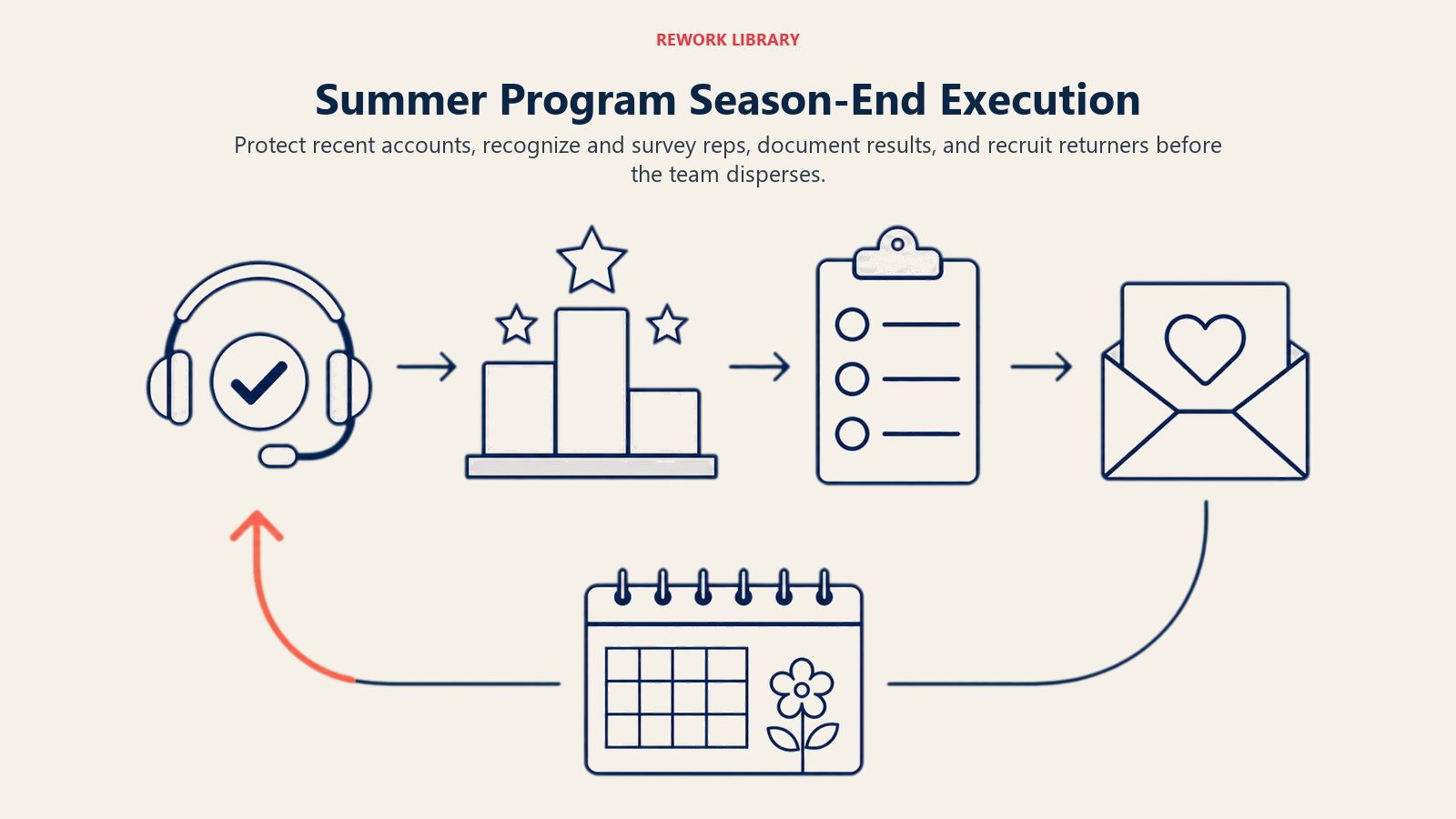
Last two weeks: cancellation prevention sprint. New customers who haven't had their first service yet are at higher cancellation risk. Confirm first service dates for every account sold in the last three weeks of the program. Reps who are still in the field can make a quick confirmation call to their recent customers, which reduces churn and builds the relationship.
Final week: rep recognition and closeout. Run a season-closing team event. Share final numbers. Recognize your top performers in a way that's detailed enough to be meaningful. Collect exit feedback from every rep via a short survey: what worked, what didn't, what would make them come back next summer.
Post-season analysis: Before the summer program is two weeks in the rearview, document:
- Final account count vs. goal
- Rep retention rate (how many of your opening-day cohort finished?)
- Average accounts per rep over the season
- Which territories produced best and why
- Which team leaders performed best and why
- What should be done differently next year
This document becomes the foundation of next March's planning. The companies that iterate on their summer program year over year build an enormous advantage because they're compounding institutional knowledge that new entrants don't have.
Return rep recruiting: During the last week, directly ask your best reps about next summer. The cost of re-recruiting and re-onboarding a strong rep is zero compared to finding and developing a replacement. Get verbal commitments where you can, send formal offers in October, and stay in touch through the winter.
A well-executed summer program isn't just about the accounts you close in June through August. It's about the team you're building, the territory data you're gathering, and the operational muscle you're developing for the seasons to come. The programs that run smoothly in year three do so because someone ran them badly in year one and took detailed notes.
The accounts your summer program produces also need to survive the post-season to be worth anything. That's where the handoff to service and retention takes over.
Learn more: Churn prevention strategy covers the handoff protocols that keep summer customers through the fall. Retention fundamentals covers the mechanics that apply from the moment of first service forward. Territory knock analytics and weather, timing, and density planning cover the operational detail behind territory rotation. Sale-to-service-start handoff and welcome and onboarding new customers cover the season-end cancellation prevention sprint in more depth. Lead and rep performance dashboards and D2D sales KPIs and metrics cover the reporting infrastructure behind the daily and weekly metrics above.
Frequently Asked Questions about Running a Summer Sales Program for Door-to-Door Teams
When should summer D2D program planning start?
March. A well-run summer program requires recruiting goals set in March (worked backward from account targets), territory mapping done before hiring, housing logistics confirmed for out-of-market reps, comp structure finalized in April, and onboarding curriculum written before any reps arrive. Programs that start planning in May are behind before the first rep knocks a door. The companies with the best summer programs are typically running on a fixed March-to-August operating calendar that has become institutional.
How many reps should you recruit for a summer program?
Work backward from your account target. If the average producing rep closes 4 accounts per week over 12 weeks, each rep generates roughly 48 accounts. Divide your summer account goal by 48 to find the number of producing reps needed. Then recruit 30% to 40% more than that number, because not every recruit will make it through onboarding and ramp. A program targeting 1,200 summer accounts needs roughly 25 producing reps, so recruiting should target 32 to 35 signed offers by mid-May.
What is the right team leader ratio for a summer program?
One team leader per 8 to 12 reps. In a 30-rep summer program, that means at least 3 experienced team leaders on the ground. These are not your highest producers. They are people who can coach, manage conflict, and stay consistent when a rep is struggling. Confirm team leader roles and summer comp in April, before the recruiting push closes, so the infrastructure exists before the reps arrive.
How does 1099 status affect summer program management?
1099 contractors retain control over how they work. You can set production outcomes and provide training, but requiring specific daily schedules or fixed locations creates misclassification risk if overdone. The practical effect is that summer D2D programs run on incentives and culture rather than mandates. This makes comp design, territory quality, early-win bonuses, and team rituals more important than they would be in a W-2 structure. It also means signed contractor agreements must be in place before the first door is knocked, covering comp including chargebacks, data ownership, and non-solicitation terms.
What is the 1099-NEC reporting threshold for summer reps?
For 2025 calendar year payments, the threshold is $600. For payments made after December 31, 2025, it rises to $2,000. Any rep who earns at or above the applicable threshold in a calendar year must receive a 1099-NEC from the company by January 31 of the following year. Collecting completed W-9s from every rep on day one, before any earnings, is the only reliable way to have tax identification information available at filing time. Tracking people down in January after a 12-week summer program is operationally painful and avoidable.
When is attrition highest in a summer D2D program?
Attrition concentrates in two windows. The first is weeks 1 to 3, when new reps face real rejection for the first time without the skills or early wins to sustain confidence. The second is weeks 8 to 10, when fatigue sets in, school starts approaching, and reps who were on the edge in weeks 1 to 3 have a second wave of doubt. Managing the first window requires daily coaching check-ins and manufactured early wins. Managing the second requires visible countdown to the season goal, mid-summer bonus payout around week 8, and direct conversations with top performers about returning next summer.
How do you close out a summer program to protect account quality?
Two actions matter most. First, run a cancellation prevention sprint in the last two weeks: confirm first service dates for every account sold in the final three weeks of the program, and have reps still in the field make a brief confirmation call to recent customers. New accounts without a confirmed first service date are at high cancellation risk after the rep leaves the market. Second, collect exit feedback from every rep via a short survey before they disperse. This institutional knowledge about what worked and what didn't is the foundation of next March's planning.

Senior Implementation Consultant
On this page
- What Does a Summer Program Timeline Look Like?
- March: Recruiting and Territory Planning
- April: Program Design and Comp Finalization
- May: Recruiting Final Push and Pre-Training
- June: Launch and First-Week Execution
- Managing the 1099 Summer Workforce
- Week-by-Week Program Management
- Territory Management During Summer
- Which Program Metrics Should You Actually Act On?
- Season-End Execution