Pricing and Contract Presentation for Door-to-Door Subscription Sales
Turn this article into takeaways for your work.


Each assistant summarizes the article only for you and suggests best practices for your work.
The pricing moment is where most deals die or live.
Not because the price is too high. Because the rep hasn't built enough value before revealing it. They lead with the number, the homeowner hears "$129" and immediately starts calculating whether they want to spend that, and the whole conversation pivots to cost rather than outcome.
This article covers how to structure the pricing and contract presentation for D2D subscription services so that by the time you say the number, the homeowner is already asking where to sign.
Why Is Pricing Presentation a Sequence, Not a Reveal?
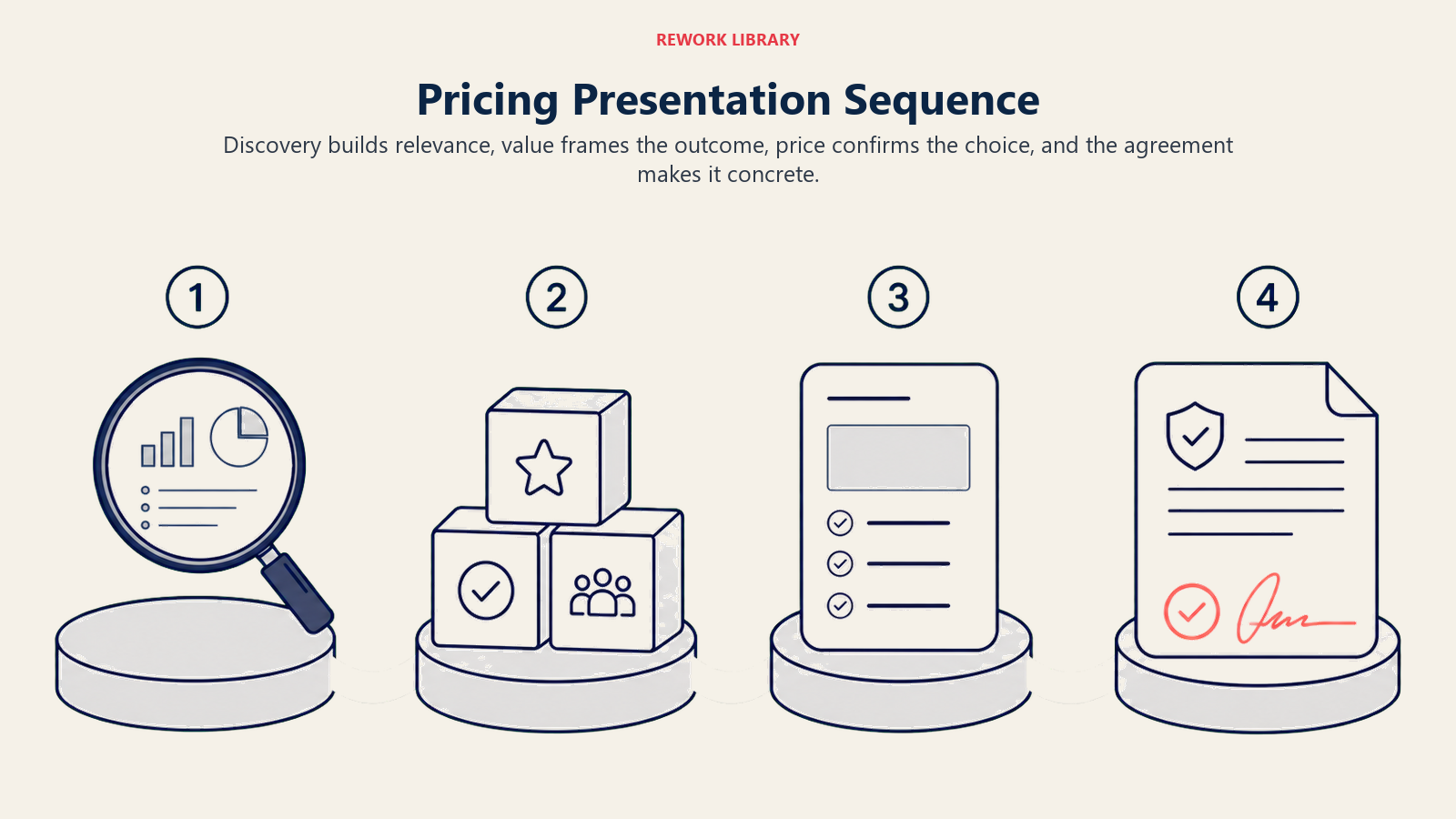
In a door-to-door close, the pricing moment isn't a single event. It's a sequence. You build value through discovery and presentation, then introduce pricing as the natural conclusion to a conversation about the homeowner's specific situation.
When the sequence is right, pricing feels like a confirmation of something the homeowner was already planning. When it's wrong, it feels like a demand.
The Value-First Sequence: The right order for a D2D subscription pitch is: complete discovery (understand their situation and pain), present the solution tied to their specific need, introduce pricing in the context of value delivered, walk through the agreement terms with transparency, then ask for the close.
Most reps collapse steps two and three, jumping from a brief overview straight to cost. The homeowner then evaluates price in a vacuum, with no emotional anchor to the problem the service solves.
See needs discovery on the doorstep for how to run the discovery that makes your pricing presentation land.
Key Facts: Pricing Presentation
- Research on three-tier "good-better-best" pricing shows that approximately 66% of customers select the middle option when given three choices, making the recommended tier nearly self-selecting. (Price anchoring and Goldilocks principle research via multiple sources, including the Williams-Sonoma bread machine example documented in behavioral economics literature)
- A 5% improvement in customer retention can increase profits by 25% to 95%, according to research by Frederick Reichheld of Bain and Company, cited in Harvard Business Review (October 2014, hbr.org/2014/10/the-value-of-keeping-the-right-customers). Every pricing presentation that builds trust pays compound dividends.
- The US door-to-door industry generates approximately $30 billion annually, per Grand View Research (2022), concentrated in subscription home services where recurring pricing structures are the primary revenue model.
Building Value Before You Open the Folder
Before you quote a dollar amount, the homeowner needs to feel the weight of the problem you're solving. This is where you tie the on-site sales presentation back to what you learned in discovery.
A brief value bridge sounds like this:
"So you mentioned you've had ants in the kitchen twice this year and the store sprays didn't hold. What we do is treat the perimeter and entry points quarterly, which eliminates the active colonies and prevents new ones from establishing. Most of our customers see results after the first treatment and don't think about pests again. Based on what you've described, this is exactly what you need."
That's not a pitch. It's a confirmation of the solution to a problem the homeowner already acknowledged. Now when you introduce pricing, it's in context.
This is the same principle behind value selling: the customer needs to understand the cost of inaction before the price of your service makes sense. A homeowner who's spent $200 on ineffective store treatments over 18 months will see a $49/quarter subscription very differently than one who's never thought about the problem.
Pricing Presentation Techniques That Work
Anchor to Outcomes, Not Service Features
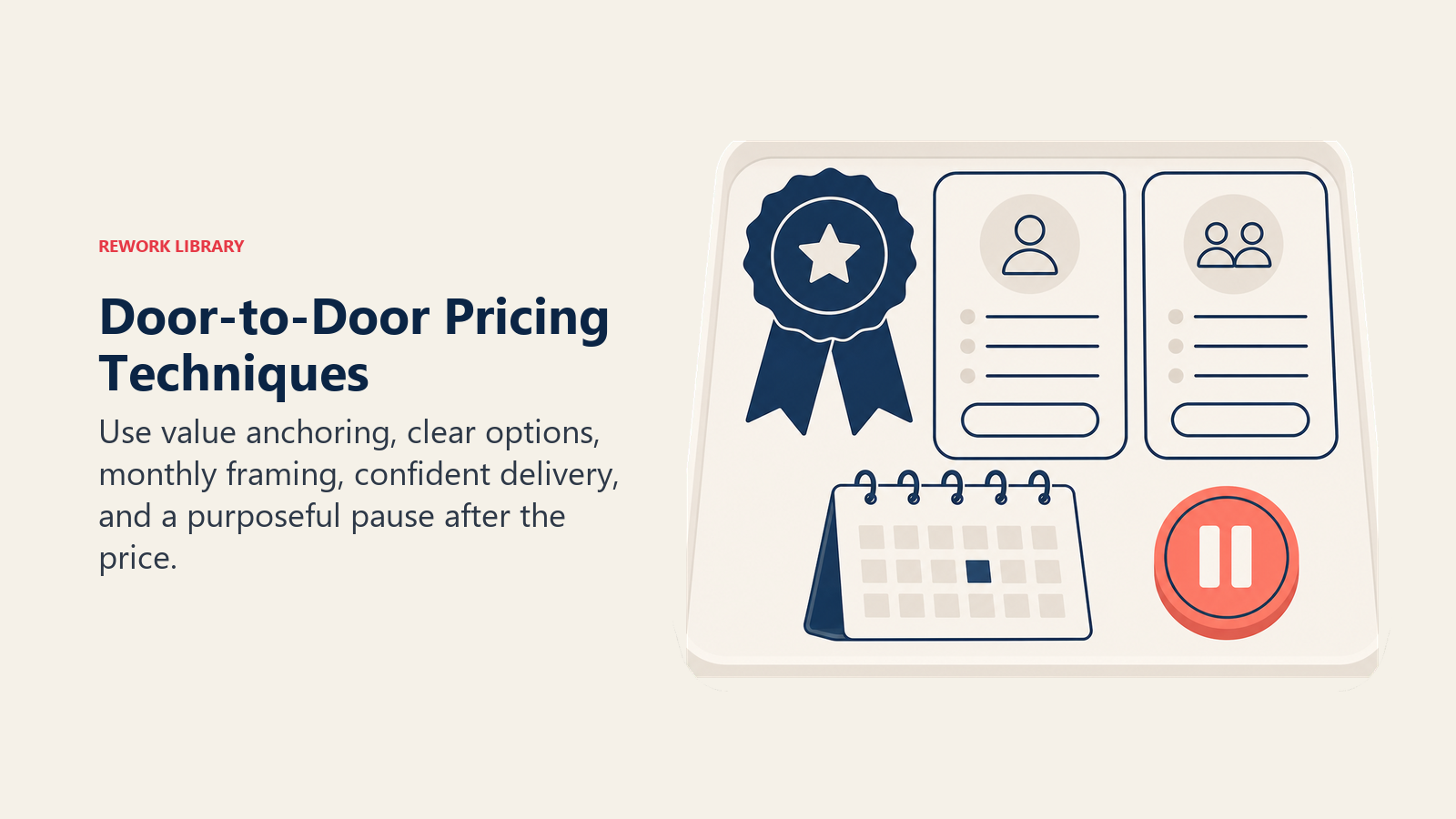
Weak presentation: "We offer quarterly treatments for $49 per visit." Strong presentation: "For $49 a quarter, roughly $16 a month, your home stays pest-free year-round. No callbacks, no re-treatments needed, guaranteed."
Same price. Different frame. The first tells them what they're buying. The second tells them what they're getting. Always anchor to the outcome.
Use the Monthly Breakdown
Annual and quarterly subscriptions can look large in isolation. Break them down to a daily or monthly equivalent.
"It's $196 a year, which comes out to about $16 a month. Less than a couple of coffees."
This isn't a gimmick. It's a genuine reframe that makes the cost feel proportionate to the benefit. A homeowner who values a pest-free home at $200 annually won't balk at $16 monthly once you've made the connection explicit. Harvard Business Review's research on pricing psychology found that people are more likely to act when they're aware of a cost's relationship to a specific benefit, making the monthly breakdown more effective than quoting an annual total in isolation.
Offer Three Tiers When Possible
Where your product line allows it, present three options: a basic tier, a recommended tier, and a premium tier. This anchoring effect (sometimes called the Goldilocks principle) shifts the mental frame from "should I buy?" to "which one is right for me?" Research on good-better-best pricing shows that introducing a premium option often causes the middle tier to nearly double in sales, because buyers use the premium as an anchor that makes the recommended option feel proportionate.
| Tier | What's included | Price |
|---|---|---|
| Basic | Quarterly exterior treatment | $39/quarter |
| Recommended | Quarterly interior + exterior, free re-treatments | $59/quarter |
| Premium | Monthly treatment, indoor/outdoor, same-day re-treatments | $89/month |
Most closers at the door will see the homeowner gravitate toward the middle tier. That's intentional. You've given them the sense of choice while making the recommended option feel like the obvious decision.
For the security and fiber categories where tiering is built into the product, this step is already done. Walk through the packages with the same outcome-framing, and let the homeowner ask questions that reveal which tier fits.
Walking Through the Service Agreement
The contract is where reps get nervous, and homeowners can feel that. If you rush through it or seem uncertain, the homeowner will look for reasons to stall.
Confidence here comes from knowing your agreement cold and presenting it as straightforward transparency, not a legal obstacle.
The Three-Sentence Agreement Walk
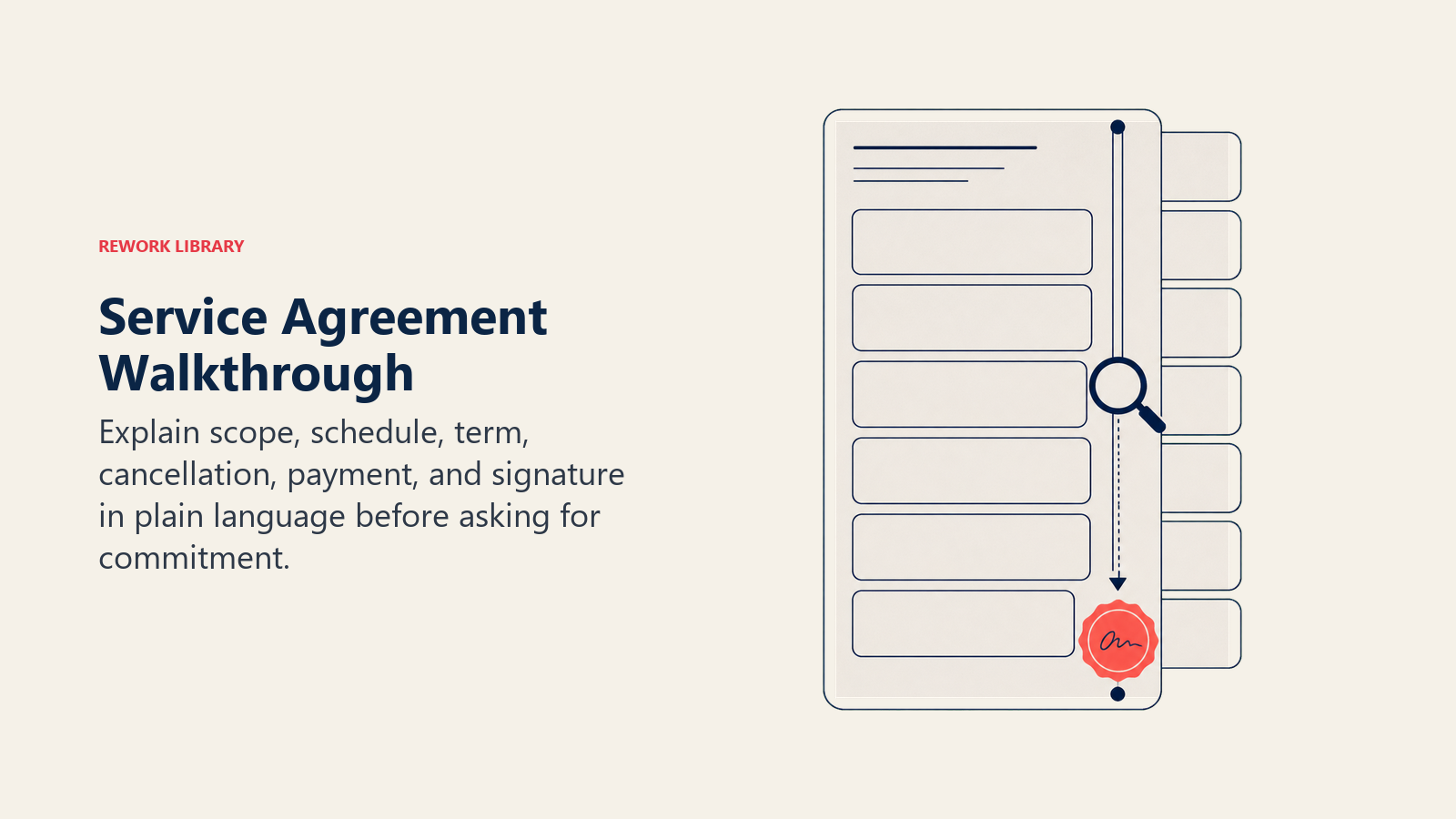
For a same-visit close, you don't read every line of the contract. You hit three things:
What they're agreeing to: "This is a quarterly subscription agreement. We'll come out four times a year on a schedule that works for your household."
What they're protected by: "If you ever see activity between visits, you call us and we come back at no charge. That's the guarantee built into your service plan."
How it works going forward: "We auto-renew each year, and you can cancel with 30 days' notice. You'll get a reminder before renewal so you're never surprised."
That's it. No legalese, no buried terms, no speed-reading. Three clear points that answer the questions the homeowner has before they ask them.
If your agreement has a cancellation fee or a minimum term, say it plainly. "There's a 12-month minimum term on this plan. If you cancel early, there's a [dollar amount] early termination fee." Then explain why: "That's what allows us to do the initial treatment at a reduced rate."
Transparency on terms builds trust. Homeowners who feel misled about the contract cancel early, hurting your retention numbers, and they generate charge-backs. The short-term gain of glossing over terms is almost never worth it. It's also a legal requirement: the FTC's Cooling-Off Rule mandates that D2D sellers disclose the homeowner's right to cancel within three business days, and reps must provide two copies of a cancellation form at the time of signing.
Digital vs. Paper Agreements
If you're using a CRM or canvassing app, you'll likely be presenting the agreement on a tablet. This actually works in your favor: the digital flow prompts you through the required fields and keeps the homeowner engaged as they scroll and sign.
For paper agreements, keep the folder clean and organized. A messy folder or a form that's half-filled out before you start signals disorganization, which undermines the homeowner's confidence in the company they're about to subscribe to.
Handling the "Can I Think About It?" Moment
The most common derailment between pricing and close isn't a hard objection. It's a soft deflection: "Let me think about it." Or "Can I talk to my spouse first?" Or "Can you leave me some information?"
These aren't nos. But they're not yeses either, and if you pack up your folder at this point, you've lost the close. Same-visit subscriptions require same-visit momentum.
The right response to a soft deflection is to surface the real concern:
"Of course. Before I go, can I ask what part of it you'd want to think through? Is it the price, the service itself, or something about the timing?"
Most homeowners will tell you what's actually holding them back. Maybe the price feels high relative to their budget. Maybe they had a bad experience with a service company before. Maybe they genuinely need to check with their spouse.
Each of those is workable. But you can't handle a concern you haven't identified. This is where the skills in objection handling at the door come in.
If the concern really is spousal, offer a joint decision path: "Would it be easier if we had a quick call with your spouse right now? I can walk them through it in two minutes." A surprising number of homeowners take you up on it.
Price Objections: Framing, Not Discounting
The worst thing you can do when a homeowner says "that's a bit expensive" is immediately offer a discount. It signals that the original price wasn't real, which destroys trust and sets a precedent that negotiation always works.
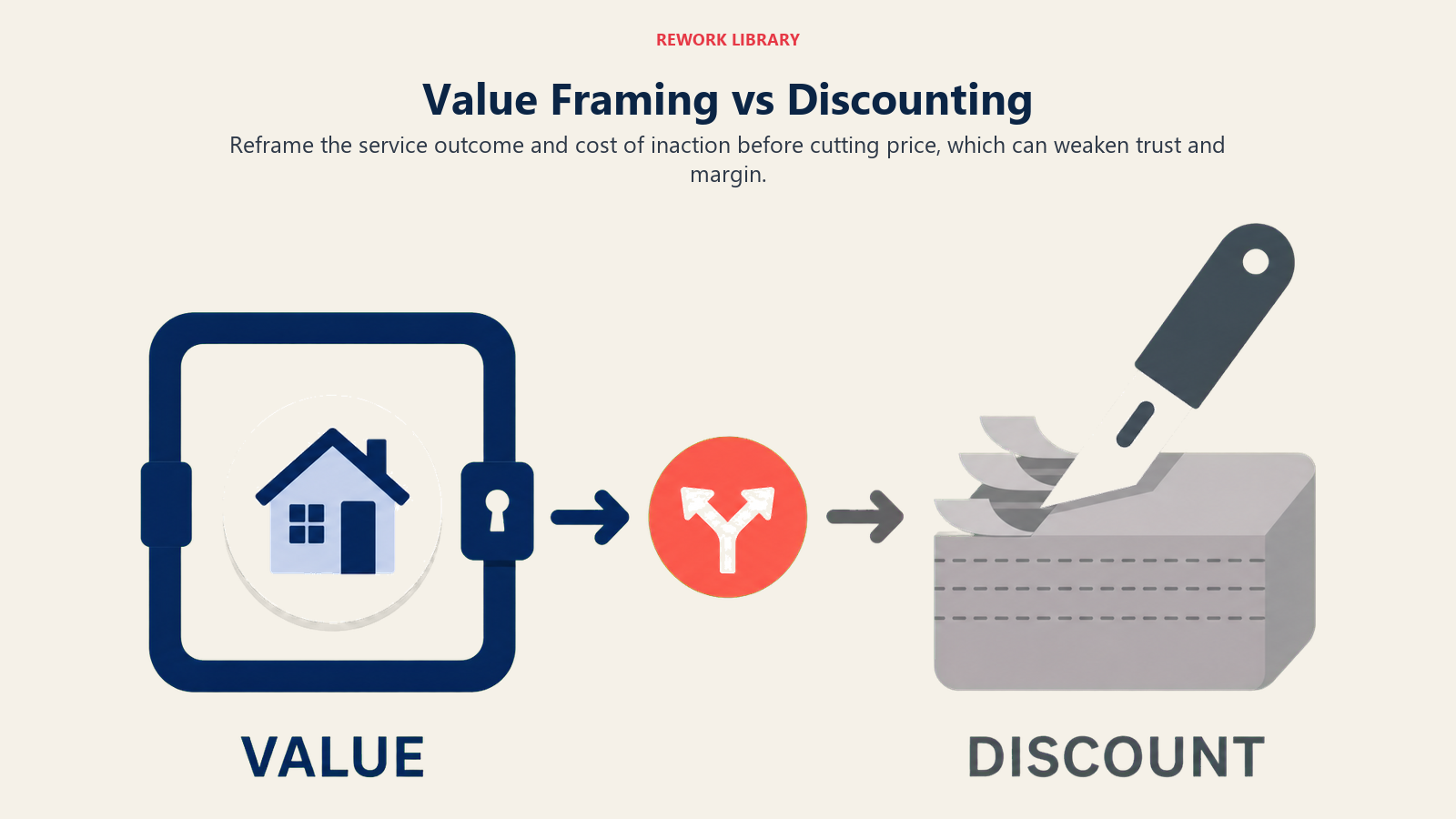
Instead, reframe value:
"I hear you on the price. Let me ask you this: how much have you spent in the last year on [store treatments / pest control / internet upgrades]?"
Most homeowners either don't know or realize the number is higher than your subscription rate. That reframe, done calmly and without pressure, often resolves the price objection without you dropping a dollar.
If you do have the authority to offer an introductory discount or a first-treatment reduction, save it for after the reframe. Use it as a genuine sweetener, not a reaction to pushback.
Refer to negotiation fundamentals for a deeper treatment of how to handle price conversations without racing to the bottom.
Building a Pricing Presentation Checklist
Before each pitch, run through this checklist mentally:
- Do I know this homeowner's specific pain from discovery?
- Can I name the outcome they care about in one sentence?
- Am I ready to anchor price to that outcome before saying the number?
- Do I know the monthly equivalent of the annual cost?
- Do I have three tiers to present if applicable?
- Am I confident walking through the three key contract points (what they're getting, the guarantee, renewal/cancellation)?
- Do I know what terms need to be said plainly (minimum contract, early termination fee)?
If you can check all of these, you're ready to present. If you can't, your pricing moment will feel like a reveal rather than a confirmation.
What Great Pricing Presentations Have in Common
Across pest control, lawn care, home security, and fiber, the best pricing presentations share a few traits:
They're confident, not apologetic. The rep doesn't flinch at the price. They say it clearly and then wait. Silence after the price is normal and healthy. Don't fill it.
They're specific to the homeowner. "Based on what you told me about the ant situation in the kitchen, this quarterly plan is exactly what addresses that" is far more persuasive than "most people find this plan works well."
They make the subscription feel obvious. By the time the number comes out, the homeowner should already understand why the service solves their problem. The price is the last piece of information, not the first.
They're transparent about terms. No surprises. Everything said plainly. The homeowner may push back on a term, but they won't cancel two weeks later claiming they were misled.
If you want to see how the pricing moment connects to the close mechanics, same-visit close techniques picks up exactly where this presentation ends.
Key Takeaways
- Pricing is a sequence, not a reveal. Build value before you introduce the number.
- Anchor every price to a specific outcome tied to what the homeowner told you in discovery.
- Break annual costs down to monthly or daily equivalents for better perspective.
- Use three-tier presentation to shift the question from "should I buy?" to "which one fits me?"
- Walk through the service agreement with three clear points: what they're getting, the guarantee, renewal terms.
- Say hard terms plainly. Transparency prevents early cancellations and charge-backs.
- Don't discount first. Reframe value. Save any incentive as a genuine closer, not a reaction to pushback.
Done right, the pricing and contract presentation isn't a barrier to the close. It's the bridge to it.
Learn more: Reducing early cancellations covers how contract transparency at signing affects your retention numbers down the line. D2D CRM and canvassing apps walks through setting up the tablet-based agreement flow referenced above.
The Monthly-Frame Rule: Homeowners instinctively anchor to the annual number when they hear it first. A $196 yearly subscription feels large. "$16 a month" framed against a tangible equivalent (a couple of coffees, one restaurant lunch) feels proportionate. Always translate annual to monthly before you say the annual total.
The Trust-Retention Link: Research by Frederick Reichheld of Bain and Company, cited in Harvard Business Review, found that a 5% improvement in customer retention can increase profits by 25% to 95%. The two-minute investment in transparent contract walk-through, including saying the early termination fee out loud, is one of the most direct levers a D2D rep has on that retention number.
The Three-Tier Effect: When customers are given three pricing options, approximately 66% choose the middle tier, according to behavioral economics research on the compromise effect. Presenting only one option forces a yes/no decision. Presenting three turns the question into "which one?"

Senior Implementation Consultant
On this page
- Why Is Pricing Presentation a Sequence, Not a Reveal?
- Building Value Before You Open the Folder
- Pricing Presentation Techniques That Work
- Anchor to Outcomes, Not Service Features
- Use the Monthly Breakdown
- Offer Three Tiers When Possible
- Walking Through the Service Agreement
- The Three-Sentence Agreement Walk
- Digital vs. Paper Agreements
- Handling the "Can I Think About It?" Moment
- Price Objections: Framing, Not Discounting
- Building a Pricing Presentation Checklist
- What Great Pricing Presentations Have in Common
- Key Takeaways