Win-Back Campaigns: Recovering Cancelled D2D Subscribers
Turn this article into takeaways for your work.


Each assistant summarizes the article only for you and suggests best practices for your work.
Cancelled customers are not lost customers. They're warm leads with a history.
Think about what a cancelled subscriber already did. They let a stranger knock their door. They listened to a pitch. They signed a contract. They let your team into their home. That's a lot of trust to give a company. When they cancel, most of that trust is still there. The brand isn't the problem. Something specific pushed them out, a bad appointment, a price they didn't expect, a life change that had nothing to do with you.
Most companies treat that cancelled account as dead. It isn't. But most win-back attempts fail because they're built wrong from the start.
A well-run win-back campaign can recover an estimated 15 to 25% of cancelled subscribers in pest control, lawn care, home security, and fiber, with the cost per recovered customer running 30 to 50% lower than acquiring an equivalent new subscriber (Rework Analysis, based on reported D2D win-back benchmarks). That math makes win-back one of the highest-ROI activities available to a D2D subscription operator. HBR research on win-back strategy confirms that firms spending heavily to replace defectors often miss the higher-value play of systematically reactivating former customers.
The Three-Segment Win-Back Model
Most D2D win-back programs fail before the first message goes out because they treat all cancelled subscribers as one group. The Three-Segment Win-Back Model is a structured framework that separates former customers into three distinct action tracks based on exit reason:
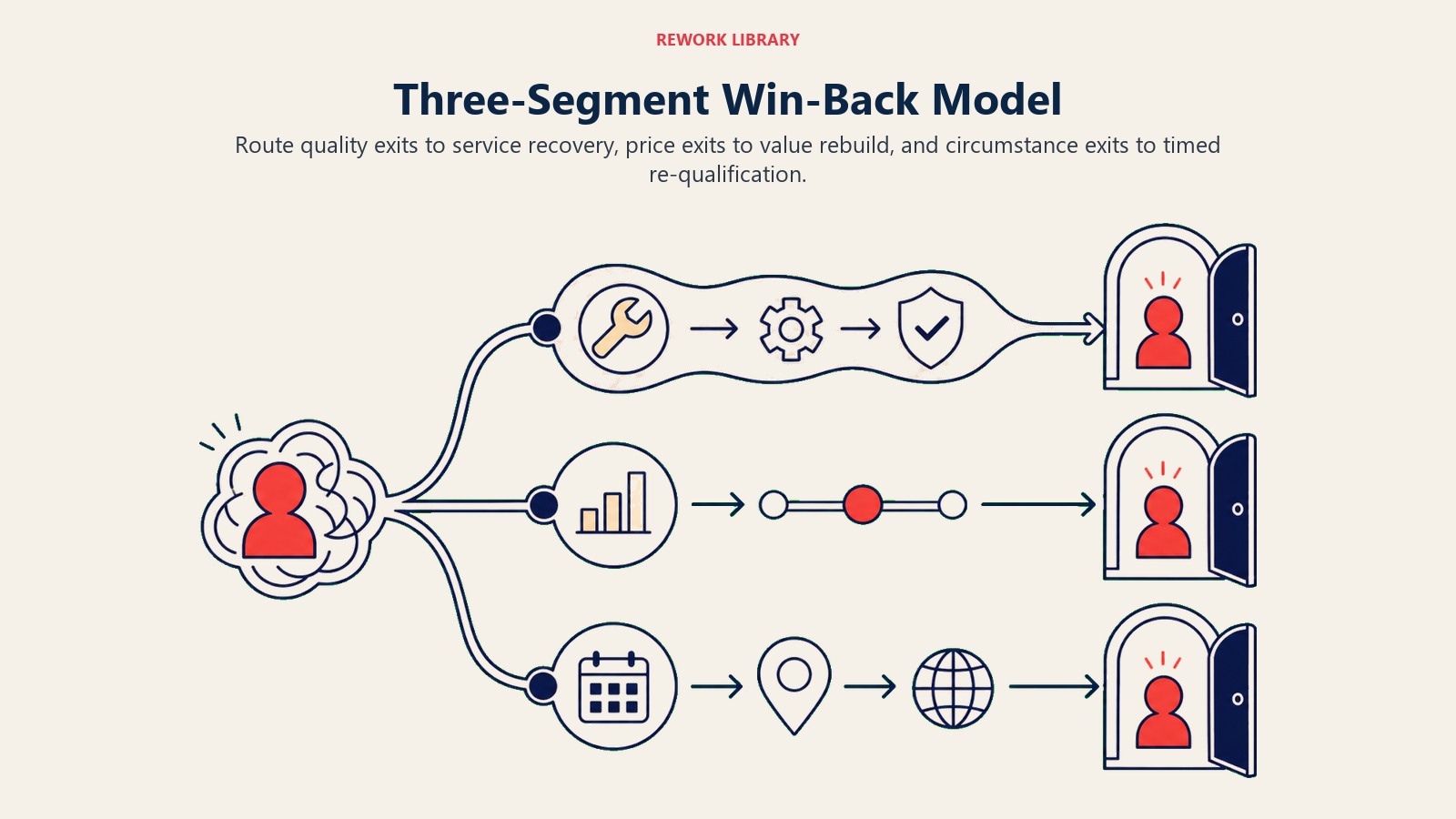
- Service Recovery track (for customers who left due to quality complaints): These subscribers need acknowledgment and a specific remedy before any price conversation.
- Value Rebuild track (for customers who left over price or found a competitor): These need a reframing of value, not an immediate discount.
- Re-Qualification track (for movers, seasonal cancellations, and circumstance changes): These need timing-aware re-approach, not urgency.
Each track uses different sequencing and incentive structures. Generic win-back campaigns underperform because they apply a single message and offer to all three groups simultaneously, which is why the segmentation step in the next section is foundational, not optional.
Why Do Most Win-Back Attempts Fail?
The typical win-back "strategy" is an automated email sent 30 days after cancellation offering a discount. It converts at an estimated 2 to 3% (Rework Analysis). That number isn't the ceiling for win-back performance. It's what happens when you treat cancelled subscribers as a homogeneous group and lead with price.
Win-back fails when:
You wait too long. 30 days after cancellation, the customer has often moved on mentally, signed with a competitor, or simply stopped thinking about the service. The highest-probability win-back window is the first 7 to 21 days.
You lead with a discount. Price was rarely the real reason they cancelled. Leading with a discount signals desperation and trains customers to cancel whenever they want a deal.
"Cancelled subscribers who were offered a service recovery (free re-service or a specific fix for their complaint) before any price incentive re-subscribe at higher rates and re-churn at lower rates than those who receive a discount as a first response."
You use generic messaging. "We miss you! Come back!" is noise. A message that references why they cancelled, what has changed, and what you can specifically offer converts far better.
You only try once. One email isn't a campaign. Win-back sequences that include three to five touchpoints across multiple channels consistently outperform single-touch attempts by two to three times.
Key Facts: Win-Back Campaign Performance
- 1 in 4 new subscriptions now comes from a previously cancelled subscriber, according to Recurly's 2025 subscription data.
- Reducing monthly churn by just 50 basis points generates roughly $240 million in additional lifetime value over 18 months for a company with 5 million subscribers, according to Bain research.
- 75% of subscribers who use a pause or hold option eventually return to active billing, compared to much lower rates for those who fully cancel, per Recurly 2025 data.
Step One: Segment Your Cancelled Subscribers by Exit Reason
Before any outreach, segment your cancelled customers by cancellation reason. Most CRMs and cancellation flows capture this, but many companies never analyze it. If yours doesn't, add it now. The reasons matter because each one requires a different response.
Common D2D Cancellation Reasons and What They Actually Mean
| Cancellation Reason | What It Usually Means | Win-Back Approach |
|---|---|---|
| Price / too expensive | Often a proxy; the value didn't feel worth it | Address value, not price |
| Moving / relocating | Genuine, but they may need the service again | Offer service at new address; keep them in file |
| Service quality issue | A specific bad experience | Acknowledge, explain what changed, offer free service |
| No longer needed the service | Seasonal or situation change | Re-approach when circumstances shift |
| Competitor offer | They found a better-looking deal | Focus on what competitors don't offer |
| Financial hardship | Genuine budget pressure | Pause option, reduced plan, or timed re-approach |
This segmentation is the foundation of the churn prediction and save offers framework. Win-back is the downstream version of that same logic applied after the customer has already left.
The Win-Back Sequence
A structured win-back sequence runs across three to five touchpoints over 45 to 60 days. The channel mix matters: email alone underperforms because many people filter or ignore it. Combining email with a direct text and, in some cases, a return door knock dramatically improves results.
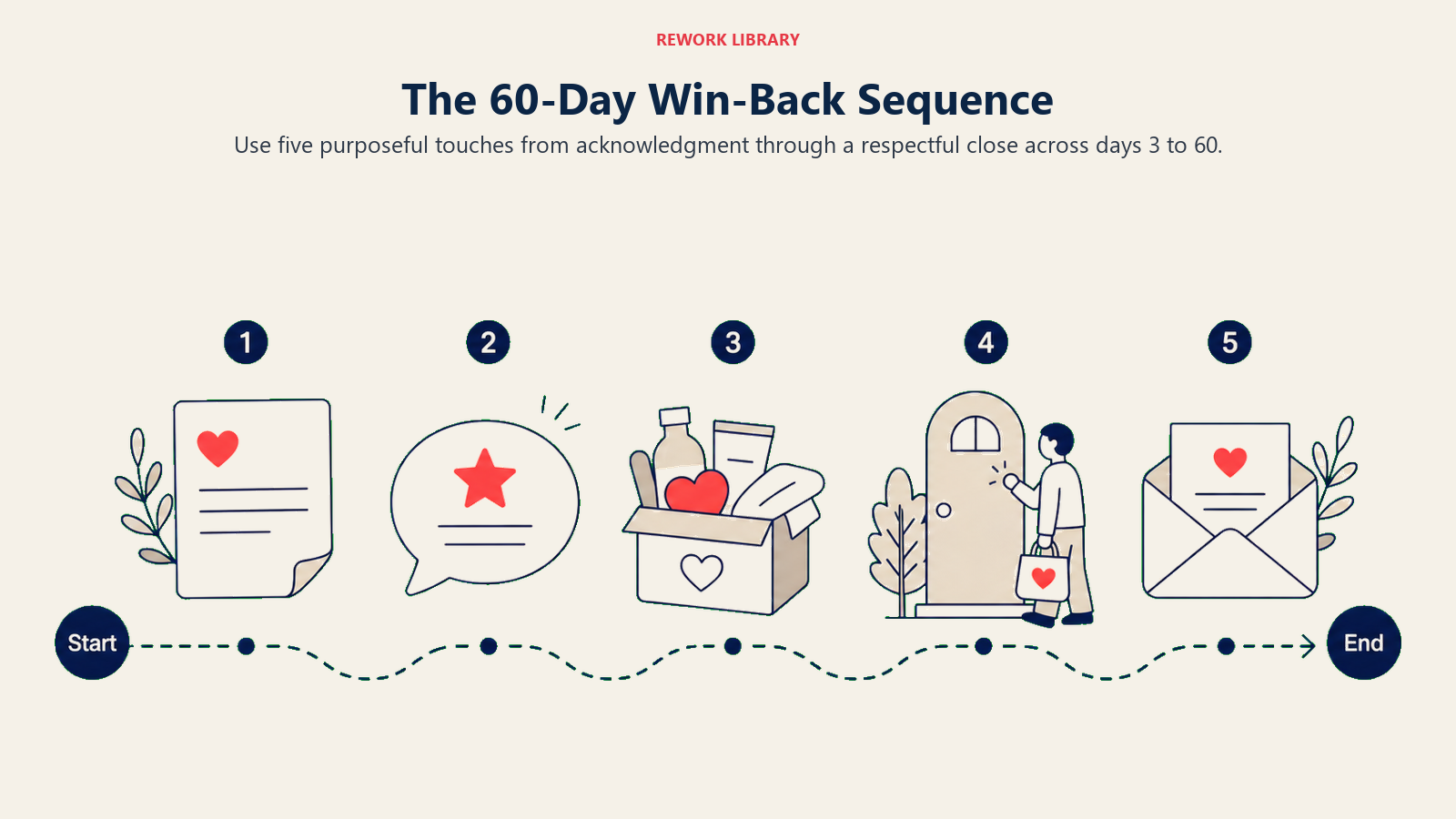
Touch 1: The Acknowledgment (Days 3-5)
Don't open with a sales pitch. Open with acknowledgment.
"A personal acknowledgment message in the first 5 days after cancellation, one that asks what happened rather than offering a deal, converts more cancelled subscribers than a discount sent at 30 days, because it addresses the emotional dimension of leaving before the commercial one."
"Hi [Name], I saw your account was cancelled and I wanted to reach out personally. I'm sorry we didn't deliver what you were expecting. Can I ask what happened?"
This message serves two purposes. It gathers information if the customer responds, and it signals that you're paying attention. In a world of automated everything, a message that sounds human stands out. Keep it short. No offer yet.
Touch 2: The Specific Value Message (Days 10-14)
This message should reference the cancellation reason if known. Examples:
For a service quality cancellation: "I looked into your account and saw the callback issue you had in March. Our technician on that route was retrained in April. I'd like to offer you a complimentary first-month return visit so you can see the difference."
For a competitor offer: "I know you mentioned another company offered you a lower rate. I can't always match every deal, but I can tell you what [Company] doesn't do: [specific differentiator]. If you're open to it, I'd love 10 minutes to walk through what your account looked like."
Specificity converts. Generic messages don't.
Touch 3: The Offer (Days 21-28)
This is where you introduce an incentive, but frame it correctly. The offer should feel like a genuine make-right or loyalty gesture, not a desperation discount.
Good framing: "Because of the issues you experienced, I want to offer you the first two months back at no charge. That gives you time to see the service the way it should have been from the start."
Bad framing: "Come back and get 30% off!"
The first is a restoration of trust. The second is a coupon. Customers read the difference.
Touch 4: The Door Knock (Days 30-45, where possible)
In D2D businesses, you already have teams in the field. Use them. A personal visit to a cancelled subscriber costs very little marginal effort if the technician or a rep is already in that territory.
The knock isn't a hard pitch. It's a check-in: "I was in the neighborhood and wanted to drop by in person. We've made some changes to how we handle [their specific issue]. I'd love to earn your trust back." Leave a card if they're not home.
This approach uses the same assets as canvassing fundamentals but applied to a warmer audience.
Touch 5: The Close or the Goodbye (Days 50-60)
If the customer hasn't re-engaged after four touchpoints, one final message. This one uses a low-pressure close: "I don't want to keep reaching out if it's not helpful. If you ever want to revisit service in the future, I'll personally make sure it starts the right way. No pressure either way."
This message has two functions. It converts some fence-sitters who were waiting for permission to say yes, and it removes you gracefully for the rest. Customers who get this message without converting should move to a long-term nurture cadence (quarterly or annually), not continued active outreach.
Matching Offers to Cancellation Segments
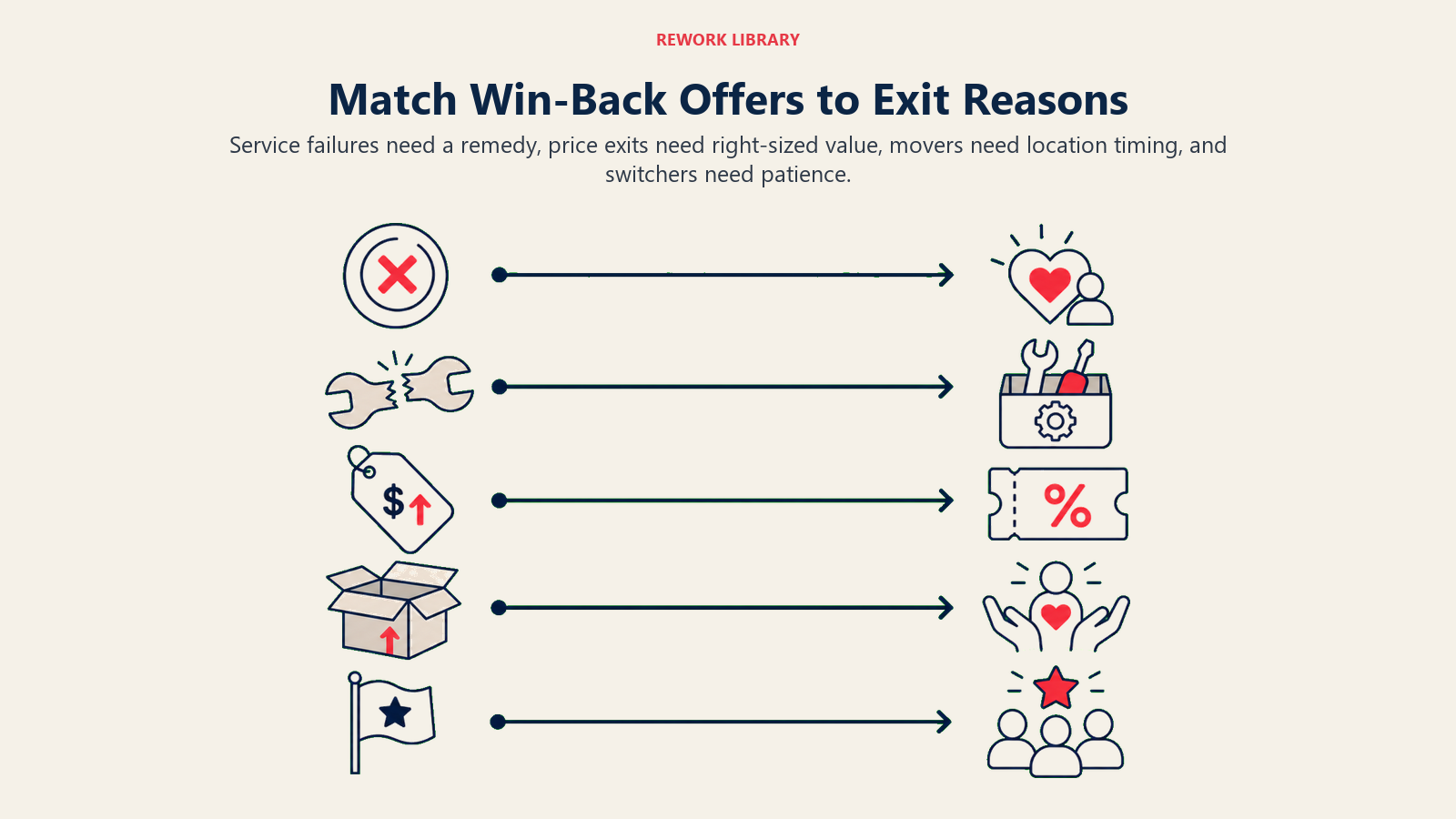
Not every cancelled customer deserves the same offer. Segmenting the incentive by cancellation reason improves conversion and protects margin.
Service Quality Exits
These customers left because you failed them. Offering a discount is the wrong message. It implies the problem was price. Instead, offer a service recovery: free re-service, a complimentary add-on, or a commitment from a specific technician they can request.
The goal is to address the actual failure. See subscription retention fundamentals for the principles behind recovery-first retention.
Price-Sensitive Exits
Be careful here. Many customers who cite price are actually citing value. If you discount immediately, you confirm their suspicion that your original price was inflated. Before going to price, probe for the real issue.
If price genuinely was the driver, a reduced-tier option (fewer services, smaller coverage area) preserves the relationship without destroying margin. A paused subscription that auto-resumes in three months is another option worth offering.
Movers
Customers who cancelled because they moved are a special case. If you operate in their new area, this is a nearly effortless win-back. They're already familiar with your service. A quick "We cover your new zip code too" message at cancellation time, and again 30 days after they move, converts at surprisingly high rates.
If you don't serve their new area, keep them in a file. People move again. And they talk to friends. A gracious exit message can generate a referral even if you can't win the customer back directly.
Competitor Switchers
This is the hardest segment to win back quickly. The customer made an active decision to try someone else, and they probably told themselves a story about why the new option is better. Rushing the win-back conversation while they're in honeymoon mode with the competitor tends to generate defensiveness.
The better play: a light-touch acknowledgment now, then a re-approach at 90 to 120 days. By that point, the initial enthusiasm has faded and real-world service quality has set in. If the competitor has disappointed them, they're now open to conversation.
Measuring Win-Back Performance
A win-back program that isn't tracked is just goodwill marketing. Track these metrics:
| Metric | Definition | Target |
|---|---|---|
| Win-back rate | Recovered / total cancelled | 15-25% |
| Win-back CAC | Total campaign cost / recovered customers | 30-50% below new-customer CAC |
| Recovered LTV | Average contract value of won-back customers | Should match or exceed new-customer LTV |
| Re-churn rate | Win-back customers who cancel again within 12 months | Under 30% |
| Recovery time | Average days from cancellation to re-subscription | Track by segment |
"Win-back programs that track re-churn rate within 12 months consistently find that recovered customers who received service recovery outperform those won back by price. They stay longer and refer more."
Re-churn rate is the metric most companies overlook. If 40% of your won-back customers cancel again within a year, the underlying service or expectation problem wasn't fixed. Win-back bought you time, but not loyalty. Use won-back customer behavior as a quality signal, not just a revenue number. Bain's research on subscription churn shows that reducing churn by even 50 basis points generates hundreds of millions in lifetime value for companies of meaningful scale, which makes re-churn prevention as important as the initial win-back.
Integrating Win-Back Into the D2D Operation
Win-back works best when it's not a separate function but integrated into the existing field and customer success operation.
CRM routing: Cancelled accounts should automatically flow into a win-back queue with a structured follow-up schedule. This is a basic CRM and canvassing app configuration, but many operators haven't set it up.
Territory alignment: Field reps doing door knocks in a territory should have visibility into cancelled customers in that area. A rep who knocks a cancelled subscriber's door as part of a win-back sequence should know the cancellation reason before they knock.
Comp structure: If reps aren't compensated for win-back conversions, they'll prioritize new doors. Decide whether win-back credit counts toward quota, and at what rate. Many operators credit win-backs at 75% of a new sale to reflect the lower acquisition cost.
The connection between acquisition and retention is explored more deeply in retention fundamentals and lead nurturing programs. Win-back sits at the intersection of both: it's a retention play that uses acquisition skills.
Can Former Customers Become Referral Sources?
Even customers you can't win back are assets. A subscriber who cancelled due to moving but had a great experience for two years before that is a referral waiting to happen. Their neighbor, coworker, or family member is a potential new subscriber who comes in warmer than any cold door.
The exit experience matters. A company that handles cancellation gracefully, follows up professionally, and makes it easy to come back gets word-of-mouth from former customers. One that makes cancellation difficult or ignores former subscribers loses that asset entirely.
When win-back fails, the follow-up ask should be: "Is there anyone you know in our service area who might benefit from what we do?" It doesn't always land, but when it does, it costs nothing.
Win-back isn't just about the revenue from recovered accounts. It's about closing the loop on every customer relationship, however it ends.
Frequently Asked Questions about Win-Back Campaigns
What is a win-back campaign for D2D subscribers?
A win-back campaign is a structured outreach sequence designed to recover cancelled subscribers. Unlike a one-time email blast, an effective win-back program segments former customers by cancellation reason and uses three to five touchpoints across 45 to 60 days, with different messaging and offers for each exit type.
What win-back rate should a D2D subscription company target?
Rework's analysis of reported D2D win-back benchmarks suggests recovery rates of 15 to 25% of cancelled subscribers for well-run programs, compared to an estimated 2 to 3% for generic single-email campaigns. The gap comes from segmentation, timing, and offer design, not just outreach volume.
How soon after cancellation should a win-back sequence start?
The highest-probability win-back window is the first 7 to 21 days after cancellation. Waiting 30 days or more allows the customer to mentally move on, sign with a competitor, or simply stop thinking about the service category. A personal acknowledgment within the first 5 days, before any commercial offer, is the strongest opening move.
Should you offer a discount to win back cancelled customers?
A discount should not be the first move. Leading with price signals desperation and confirms the customer's suspicion that the original price was inflated. For service quality exits, a free re-service or specific remedy works better. For genuine price-sensitive exits, a reduced-tier option or service pause preserves the relationship without destroying margin.
What is re-churn rate and why does it matter for win-back programs?
Re-churn rate is the percentage of won-back customers who cancel again within 12 months. If more than 30% of recovered subscribers leave again within a year, it signals that the underlying service or expectation issue was not resolved. Win-back bought revenue, but not loyalty. Re-churn rate is the most honest measure of whether your win-back program is fixing real problems.
How should win-back be integrated into D2D field operations?
Cancelled accounts should automatically route into a win-back queue in your CRM with a structured follow-up schedule. Territory reps should have visibility into cancelled subscribers in their area, including the cancellation reason, so door-knock win-back attempts are personalized, not cold.
What offer works best for customers who switched to a competitor?
Competitor switchers are in a honeymoon phase with their new provider in the first 60 days. Rushing the win-back conversation generates defensiveness. The better approach is a light acknowledgment now and a re-approach at 90 to 120 days, when early enthusiasm has faded and real-world service quality has set in.

Senior Implementation Consultant
On this page
- The Three-Segment Win-Back Model
- Why Do Most Win-Back Attempts Fail?
- Step One: Segment Your Cancelled Subscribers by Exit Reason
- Common D2D Cancellation Reasons and What They Actually Mean
- The Win-Back Sequence
- Touch 1: The Acknowledgment (Days 3-5)
- Touch 2: The Specific Value Message (Days 10-14)
- Touch 3: The Offer (Days 21-28)
- Touch 4: The Door Knock (Days 30-45, where possible)
- Touch 5: The Close or the Goodbye (Days 50-60)
- Matching Offers to Cancellation Segments
- Service Quality Exits
- Price-Sensitive Exits
- Movers
- Competitor Switchers
- Measuring Win-Back Performance
- Integrating Win-Back Into the D2D Operation
- Can Former Customers Become Referral Sources?