Recruiting Door-to-Door Sales Reps for Recurring Service Companies
Turn this article into takeaways for your work.


Each assistant summarizes the article only for you and suggests best practices for your work.
A sales manager posts a job ad on a Monday. By Friday, she has hired five reps. By the following Friday, three of them are gone. She posts the ad again. This cycle repeats every few weeks, all year, and nobody on the team questions it anymore. It's just how door-to-door hiring works.
Except it doesn't have to work that way. Most D2D companies respond to high turnover by recruiting harder and faster: hire 30, lose 25, keep 5. It's a volume game. Some companies even budget for it as a fixed cost of doing business.
But there's a better model. The companies that build durable D2D sales teams recruit more carefully, screen for specific traits that correlate with staying, and set honest expectations upfront about what the role actually is. They don't hire fewer reps. They hire reps who are more likely to become productive members of the team rather than expensive short-timers.
Why Is D2D Attrition So High?
Before building a better recruiting process, it helps to understand why reps leave in the numbers they do.
Key Facts: D2D Rep Recruiting
- Across sales roles broadly, annual rep turnover averages around 35%, nearly three times the rate of other industries. In door-to-door programs, turnover frequently runs 150% to 300%, meaning companies replace their entire team one to three times per year. (Xactly, 2024)
- The IRS uses a three-factor framework (behavioral control, financial control, and type of relationship) to determine whether a worker is a true independent contractor or a misclassified employee. Worker classification at the offer stage affects both attrition risk and legal exposure. (IRS.gov)
- For 1099 reps, the 1099-NEC reporting threshold is $600 for calendar year 2025 payments and rises to $2,000 for payments made after December 31, 2025. W-9 collection on day one avoids end-of-year tracking problems. (IRS 1099-NEC guidance)
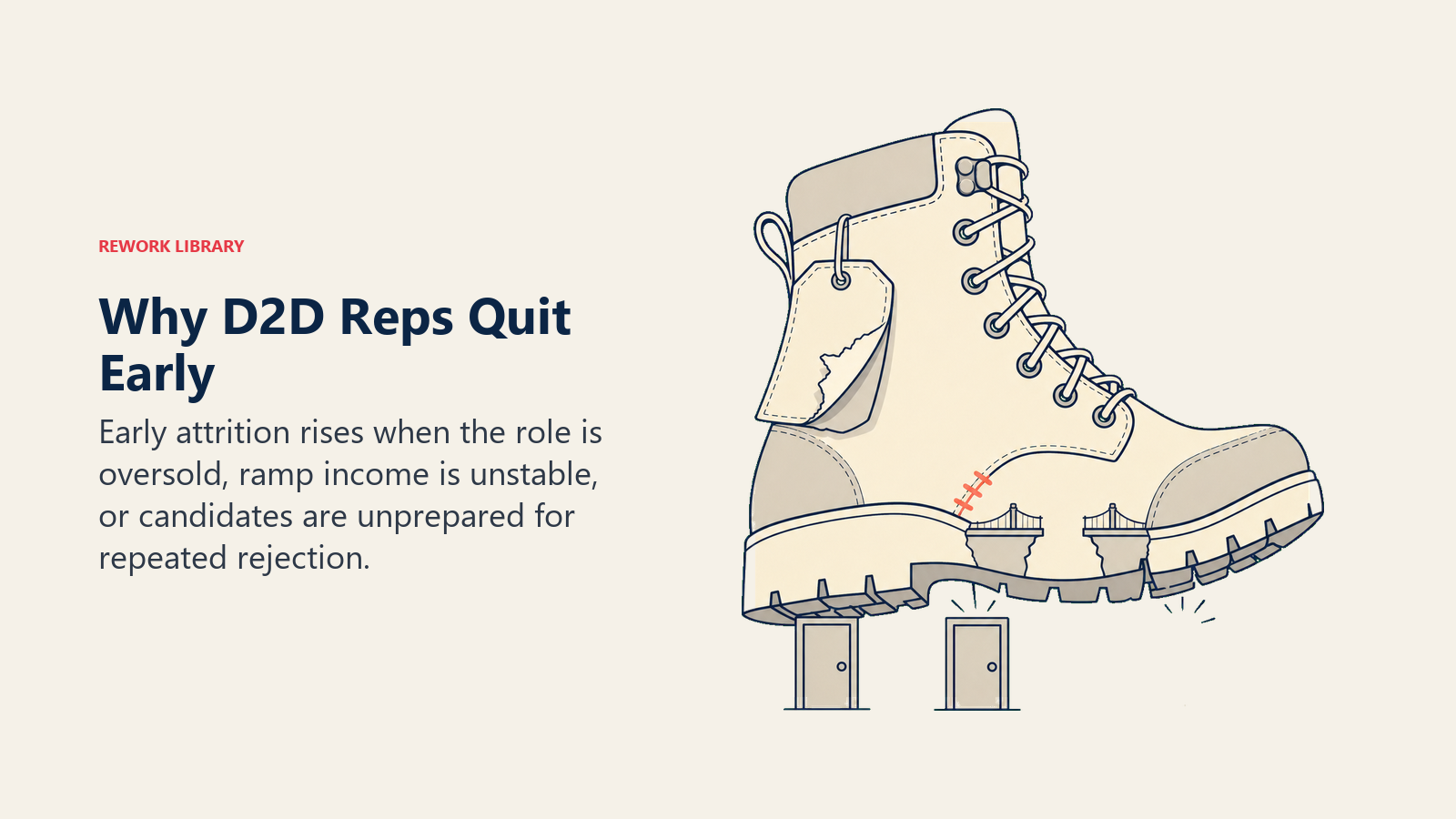
The three dominant reasons reps quit within 60 days:
The job was misrepresented. They were told the earning potential is $80,000 to $120,000. They weren't told that hitting that number requires working 8-hour field days in August heat, handling rejection 95% of the time, and not earning much during the first three weeks of ramp. When reality doesn't match the pitch, people leave.
The income gap was too wide. Especially for reps supporting families or with real financial obligations, the weeks between starting and getting to a consistent earning rate are unsustainable. Commission-only or heavily commission-weighted structures that don't pay a meaningful base during ramp cause financial pressure that accelerates quitting.
They didn't have the constitution for rejection. Door-to-door sales involves a lot of doors that don't open, a lot of polite declines, and occasional hostility. This isn't a role for someone who needs external validation to feel good about their workday. Some people can handle the rejection math; many can't. If you're not screening for this trait, you're hiring a portion of people who will discover it the hard way.
A better recruiting process addresses all three upfront.
Quotable Nuggets "D2D companies that run 200% annual turnover on a 20-rep team spend approximately $120,000 per year recruiting and ramping replacements, before counting the accounts that were never sold while seats sat empty. (Planning estimate; your cost depends on training hours, draw payments, and manager time allocated per hire)"
"A D2D recruiting ad that honestly describes 6 to 8 hours of daily field work and a 95% rejection rate generates fewer applications than a vague 'unlimited potential' posting. But a far higher proportion of those applicants will still be producing at 90 days."
"Referred hires arrive with a realistic preview of the job because they heard it from someone doing it. That pre-qualified expectation is why referral bonuses in D2D companies often generate the lowest-cost, highest-retention hire in the pipeline."
The Honest-Ad Funnel Framework: A four-part job posting structure designed to self-select candidates before the first screen, covering realistic earning ranges (not maximums), the physical daily reality, the compensation structure, and who specifically thrives in the role. Smaller applicant volume with much higher qualified conversion, cutting training costs and improving 90-day retention.
Where to Find D2D Sales Candidates
Before screening, you need candidates. The channels that work best for D2D recruiting differ somewhat from standard sales hiring.
University and community college job boards. Younger candidates, often willing to take commission-heavy roles, physically active, not yet anchored by mortgage and family financial pressure. The energy that comes with 22-year-olds who are competitive and need money is real. Many D2D organizations build their summer programs entirely from this pool. See running a summer sales program for the specific model.
Indeed and ZipRecruiter for outside sales roles. Use job titles that are honest: "Outside Sales Representative," "Field Sales Rep," not "Brand Ambassador" or "Marketing Consultant." Misleading titles attract the wrong candidates and increase early attrition. Be specific in the ad about what the job involves: field work, door-to-door, subscription products, commission structure.
Internal referrals from current reps. This is underutilized by most D2D companies. A rep who refers a successful hire should receive a meaningful bonus, not a token one. Your current reps know who from their social circle has the personality for the work. And referred candidates usually have a more realistic picture of the job because they heard it from someone doing it.
Former military recruits. Veterans often have the discipline, physical tolerance, and comfort with structured daily routines that D2D success requires. Organizations like Hiring Our Heroes or reaching out to base transition assistance programs can be productive. This isn't a stereotype; it's a pattern many D2D managers report seeing consistently.
Social media, especially LinkedIn and local Facebook groups. Targeted ads for "outside sales" roles in a specific metro area can generate volume. Facebook ads in local buy/sell or job groups work surprisingly well for D2D recruiting in mid-size markets.
Writing a Recruiting Ad That Attracts the Right People
The single most impactful change most D2D companies can make to their recruiting is writing honest job ads.
Most D2D job ads look like this: "Unlimited earning potential! Motivated individual who loves people and wants to make $100K+ in their first year. No experience needed. Full training provided!"
This ad attracts everyone. And it keeps the wrong ones long enough to cost you training time before they leave.
A better ad structure:
Lead with the realistic earning range. "Our reps earn between $42,000 and $85,000 in their first year, with top performers reaching $100K+. New reps typically earn $600 to $900 per week during their first four weeks of ramp."
Describe the actual daily experience. "You'll spend 6 to 8 hours per day in residential neighborhoods, walking door-to-door and presenting our service. You'll hear 'no' much more than 'yes.' You'll work in all weather conditions. You'll be on your feet most of the day."
State the structure. "This is a base plus commission role. Your base is $[X] per week. Commission is paid weekly. New reps receive [X] weeks of paid training before full commission structure begins."
Specify who thrives here. "This role works best for people who are competitive, enjoy working independently, handle rejection without taking it personally, and are motivated by financial goals they can control."
This ad will generate fewer applicants. But the applicants it generates will have a far higher proportion of reps who will actually stick. The candidate who reads that ad and applies has self-selected. They know what they're getting into.
The Screening Process: What to Look For
Phone screen and interview questions for D2D reps should probe for four core traits.
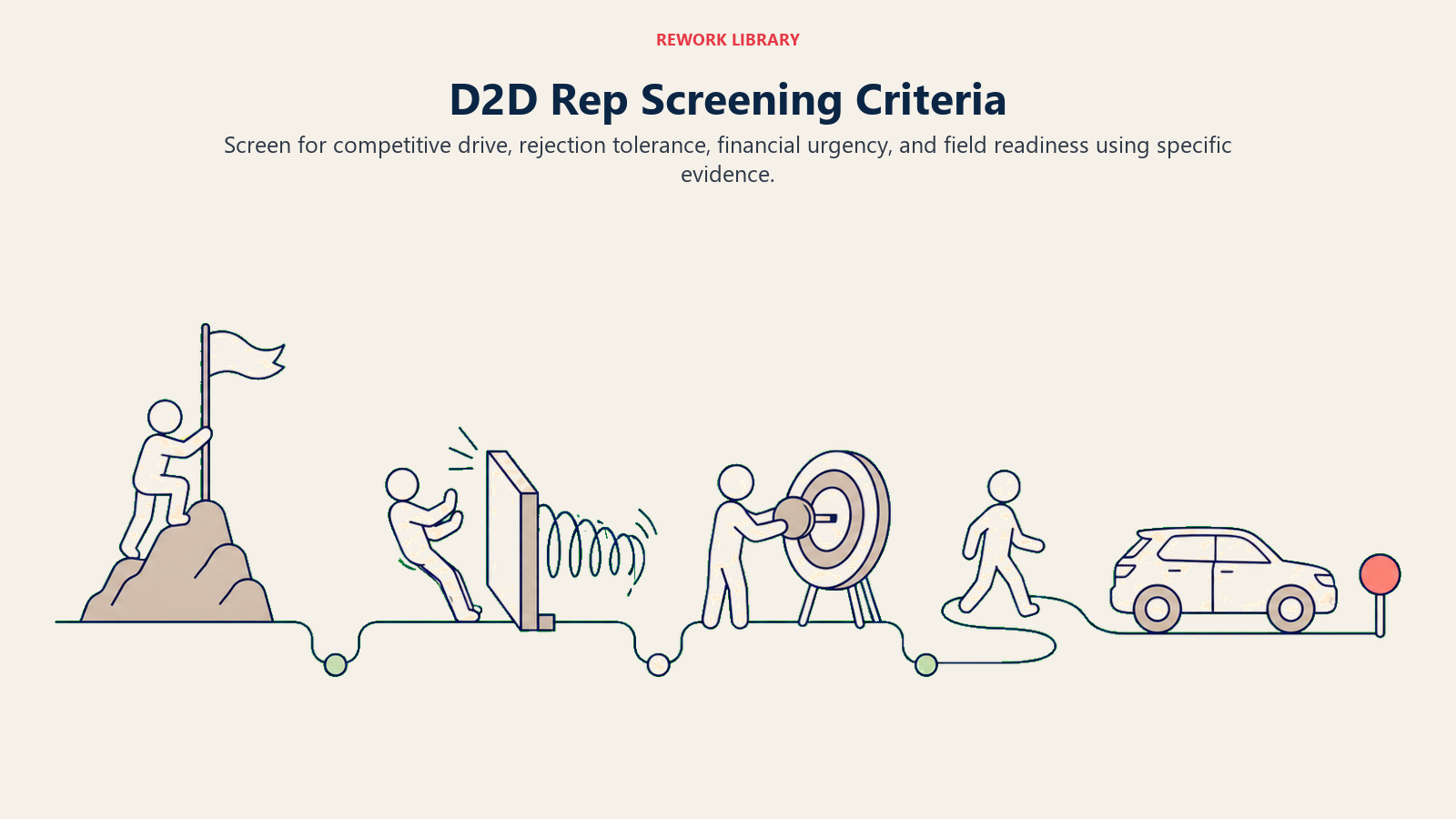
Competitive drive. Not just ambition in the abstract, but evidence that the person has pursued something difficult and tracked their own performance. Sports history is one signal. Sales history with visible quota-tracking is another. But also ask: "Tell me about a time you set a personal goal that was hard to hit and what you did to hit it." Listen for ownership language versus luck language.
Rejection tolerance. Ask directly: "In this role, you'll approach 60 to 100 doors a day and close maybe 2 to 5 of them. How do you think you'd handle that ratio psychologically?" Listen for people who have a genuine framework for processing rejection: it's a numbers game, each no gets me closer to a yes, I don't take it personally. Watch for people who seem surprised by the ratio or who explain that they're "really good with people" as if that inoculates them against rejection.
Financial motivation with some urgency. The D2D rep who performs best usually has a specific financial goal they're working toward, not just a vague interest in making money. "Why do you want a commission-heavy sales role?" is a simple version of this. A rep paying off debt, saving for a house, or supporting a family has a concrete reason to get out of bed and knock the 70th door of the day.
Physical and logistical readiness. Do they have reliable transportation? Are they comfortable standing and walking for extended periods? Do they understand that this role involves direct sun, humidity, cold depending on season? These aren't trick questions. A rep whose car breaks down or who doesn't realize they'll be walking for hours is a turnover risk on week two.
A simple screening matrix:
| Trait | Green Signal | Yellow Signal | Red Signal |
|---|---|---|---|
| Competitive drive | Specific examples, numbers, personal accountability | General positive statements | Blames external factors for past failures |
| Rejection tolerance | Reframes rejection, has a process for it | Unfazed but no clear framework | Visibly uncomfortable with the ratio |
| Financial motivation | Specific goal, some urgency | "I'd like to make good money" | No clear reason to work hard |
| Physical readiness | Has done outdoor or field work before | Understands the requirement but untested | Surprised by the physical demands |
Setting Honest Expectations in the Offer Stage
If you've done the first two steps well, you've attracted candidates who read an honest job description and passed a screen for the right traits. The offer stage is where expectations get locked in.
Be explicit in the offer about:
The ramp period. How many weeks before a rep is expected to hit their stride? What does the company provide during that period, such as training, ride-alongs, and manager support? What does a successful ramp look like in numbers?
Commission structure, in writing, with examples. Walk through three scenarios: a slow week, an average week, and a strong week. Show the actual math. Don't let reps accept an offer based on "you could make $80K" when the realistic average is $52K.
Territory assignment. Where will they be working? Is it assigned or do they choose? Can it change?
Summer vs. year-round status. If this is a seasonal 1099 team situation, be explicit about it. A rep who thinks they're accepting a permanent W2 role and discovers otherwise in October is a churn statistic and a potential legal problem. The IRS uses behavioral control, financial control, and type of relationship to determine whether a worker is truly an independent contractor. Misrepresenting the nature of the role at the offer stage creates classification risk beyond just the attrition problem.
Performance expectations. What are the weekly minimums? What happens if a rep consistently underperforms? What does the progression path look like if they overperform?
Reps who accept an offer with full information about all of these are far more likely to stay past 90 days than reps who felt surprised by any of them.
How Do You Build a Recruiting Pipeline Instead of Just a Hire?
High-performing D2D companies don't recruit when they're short-staffed. They recruit continuously. There's always a pipeline of qualified candidates at various stages of the process. When a rep leaves, the replacement is already in ramp rather than still being sourced.
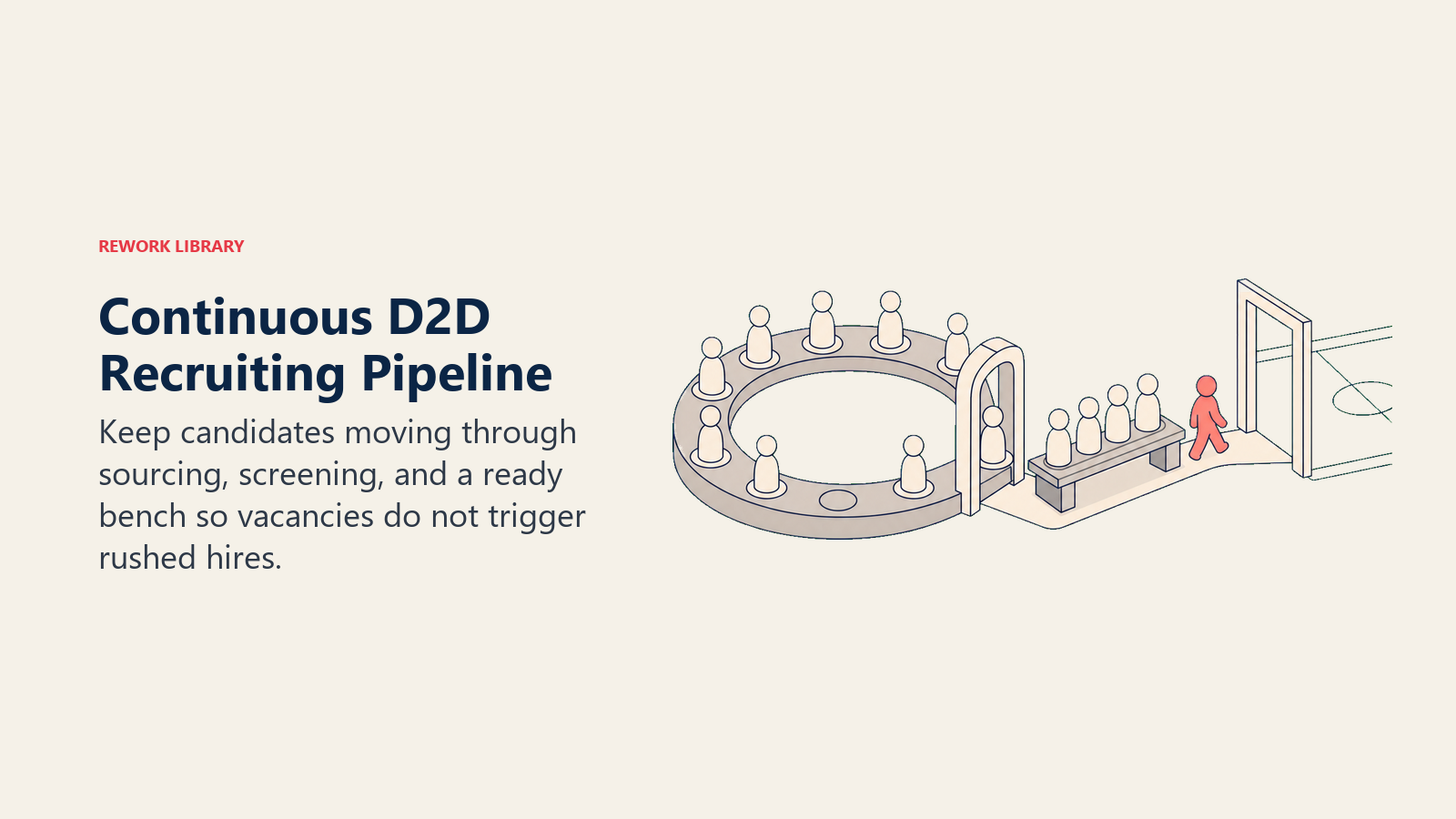
This requires treating recruiting as an ongoing operation, not a reactive event. For companies with 15 or more D2D reps, this often means one person, an internal recruiter or operations manager, has recruiting as a formal part of their job. They're always posting ads, always doing phone screens, always maintaining a bench of candidates who are two weeks from starting.
The pipeline approach also allows for quality standards. When you're recruiting from scarcity and need someone to start Monday, you lower standards. When you have a bench, you can decline candidates who don't screen well even if it's inconvenient.
Track these recruiting metrics to know if your pipeline is healthy:
| Metric | What Healthy Looks Like |
|---|---|
| Time to fill (open role to start date) | Under 14 days with a pipeline, under 21 without |
| Screen-to-hire ratio | 6:1 to 10:1 (higher is fine; signals you're being selective) |
| 90-day retention of hires | Target 60%+ for D2D roles |
| Referrals as % of hires | 20%+ signals strong rep culture |
The Link Between Recruiting and Onboarding
A well-recruited rep who hits a poorly designed onboarding experience still churns. The two processes are connected. Recruiting builds the foundation. Onboarding either builds on it or burns it down.
The most common onboarding failure mode: throwing new reps into the field too quickly, before they have the product knowledge, script comfort, and objection handling to succeed. They have a string of bad days, decide the role isn't for them, and leave before they've had a chance to find their footing.
The other failure mode: over-training before field exposure. Reps sit in a conference room for a week before seeing a real door. They have knowledge but no feel for the rhythm. Their first field day is still a shock.
The best onboarding for D2D reps combines classroom and field from day one or two. A morning of product training. An afternoon doing ride-alongs with a senior rep. Classroom on day two for objection handling. Field again on day two afternoon. Back and forth until they're ready to solo.
See onboarding and ramping new reps for the full curriculum structure. But the recruiting takeaway is simple: when you tell candidates about the ramp period during the offer stage, tell them exactly what it will feel like. Remove the surprises. Surprised reps quit.
Recruiting for the Role They'll Actually Do
One nuance worth stating clearly: the traits that make a great summer canvasser are not identical to the traits that make a great year-round D2D rep who manages a subscriber base and generates referrals.
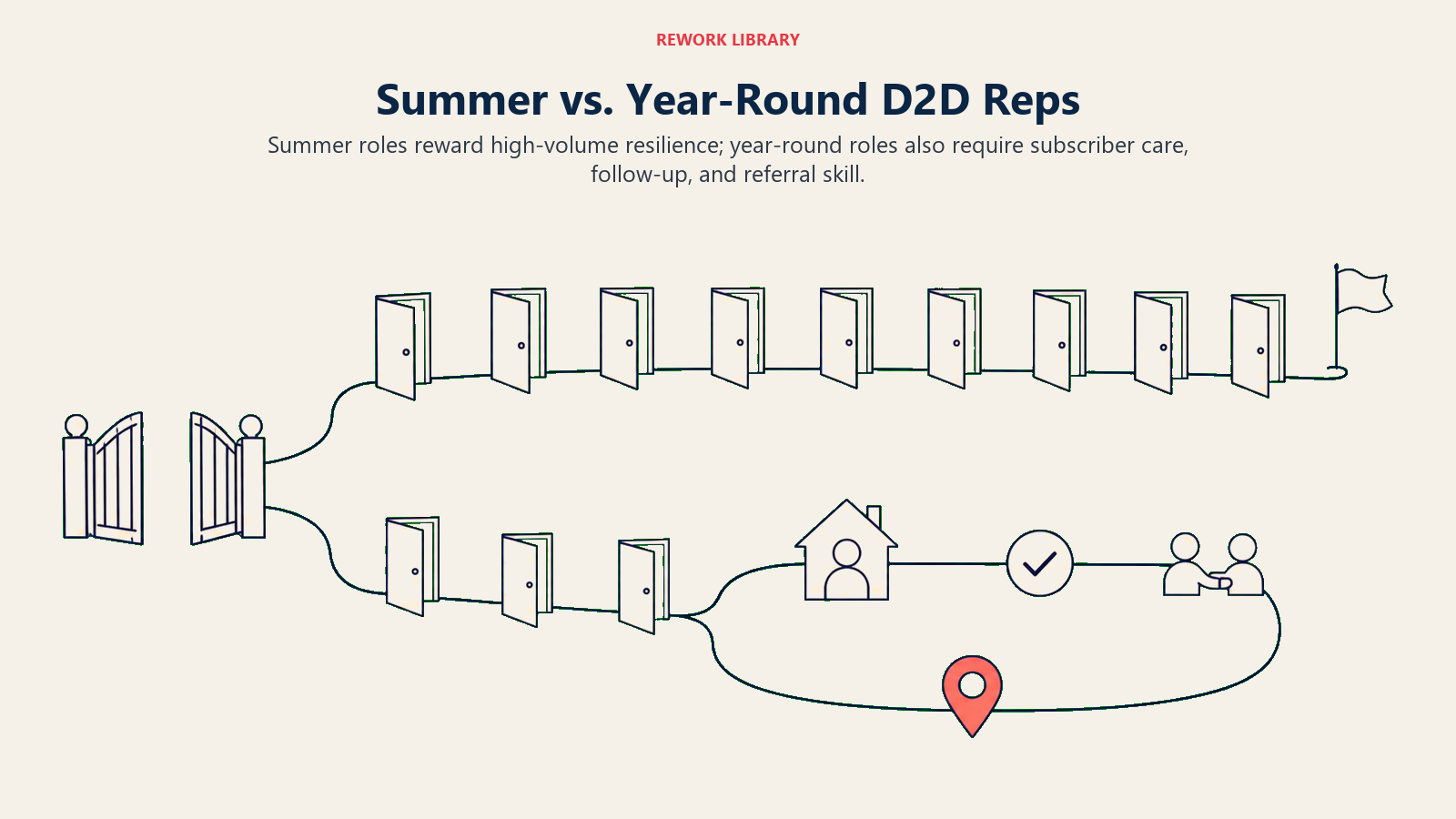
The summer canvasser model, high volume, 1099, transactional, rewards hustle and tolerance for the grind. The year-round rep model is relationship-based: recurring contact with subscribers, referral generation, account retention. It also rewards those traits, but adds patience, relationship skill, and a more deliberate touch.
If you're hiring for a year-round role and you're recruiting from a pool of summer transactional canvassers, you'll get some reps who transition well and many who don't. Screen for the customer relationship capacity that referral generation from subscribers requires, not just the raw drive to knock.
Ask candidates: "How would you think about staying in contact with a customer 60 days after they signed up to make sure they're happy?" The summer canvasser says "that's not my job." The year-round rep says "I'd schedule a quick check-in call and look for a referral opportunity."
That difference is detectable in an interview. Build it into your screen.
The companies that solve D2D turnover aren't the ones who recruit hardest. They're the ones who recruit most honestly, screen most rigorously, and set expectations that match reality. They hire fewer people per quarter and retain more of them. Their training costs drop. Their average rep tenure climbs. And their subscriber base grows because experienced reps close better, handle objections better, and generate more referrals from existing subscribers than the constant stream of week-three newcomers ever could.
For a look at how commission and comp structures tie into retention and recruiting, the compensation design article walks through how to build pay plans that attract the right candidates and keep them motivated past their ramp period.
The solar industry solved a version of this same recruiting challenge: many of its screening approaches translate directly to pest, security, and lawn care programs.
Learn more: Recruiting and ramping solar reps covers the parallel D2D vertical. Opportunity qualification offers a framework for applying similar rigor to sales pipeline decisions.
Frequently Asked Questions about Recruiting Door-to-Door Sales Reps for Recurring Service Companies
What is the typical turnover rate for door-to-door sales reps?
In pest control, home security, and lawn care D2D programs, annual rep turnover commonly runs 150% to 300%, meaning companies replace their entire team once to three times per year. Across all sales roles, Xactly research puts average annual turnover at around 35%, already nearly three times the rate of other industries. D2D runs well above even that benchmark. Structured recruiting and honest job ads are the most reliably effective tools for pushing turnover below the industry average.
What should a D2D job ad include to attract reps who stay?
Effective D2D job ads lead with a realistic earning range rather than an aspirational maximum, describe the physical daily experience honestly (hours on foot, rejection frequency, all weather conditions), spell out the comp structure and training period, and specify who thrives in the role. This self-selection approach generates fewer applicants but a far higher proportion of people who will still be working at 90 days, because they knew what they were signing up for.
What traits should D2D recruiters screen for in phone interviews?
The four traits most predictive of D2D success are competitive drive (evidence of pursuing difficult goals and tracking personal performance), rejection tolerance (a genuine framework for processing "no" without taking it personally), financial motivation with urgency (a specific goal they are working toward, not just a general interest in income), and physical and logistical readiness (reliable transportation, comfort with extended walking in variable conditions). Each maps to a specific question format that surfaces real examples rather than hypothetical answers.
How does misrepresenting a 1099 role at the offer stage create legal risk?
If a rep accepts what they believe is a permanent W-2 role and later discovers it is a seasonal 1099 position, the company faces both an attrition problem and a potential worker classification dispute. The IRS evaluates contractor status across behavioral control, financial control, and type of relationship. Misrepresenting permanency at the offer stage weakens the type-of-relationship argument. Being explicit about 1099 status, contract duration, and the classification rationale before a rep signs prevents this exposure.
What is a healthy screen-to-hire ratio for D2D recruiting?
A ratio of 6:1 to 10:1 (screening calls to hires) is a practical target for D2D roles. A lower ratio usually means the job ad is under-qualifying candidates or that hiring managers are lowering standards because of headcount pressure. A higher ratio is generally acceptable: it typically signals the screening process is maintaining quality standards even when urgency is high.
What is the 90-day retention benchmark for D2D hires?
Targeting 60% or better 90-day retention is a reasonable benchmark for D2D roles, given the structural turnover pressure of commission-based field work. Programs that combine honest job ads, rigorous screening, and a structured first-30-day onboarding experience often achieve rates in the 65% to 75% range. Programs that hire reactively from broad job postings with minimal screening rarely exceed 40%.
How does the 1099-NEC reporting threshold work for summer D2D reps?
For 2025 calendar year payments, the 1099-NEC reporting threshold is $600. For payments made after December 31, 2025, the threshold rises to $2,000. Any rep who earns at or above the applicable threshold in a calendar year must receive a 1099-NEC by January 31 of the following year. Collecting a W-9 from every rep on day one (before they start earning) is the only reliable way to have the information needed when January arrives.

Senior Implementation Consultant
On this page
- Why Is D2D Attrition So High?
- Where to Find D2D Sales Candidates
- Writing a Recruiting Ad That Attracts the Right People
- The Screening Process: What to Look For
- Setting Honest Expectations in the Offer Stage
- How Do You Build a Recruiting Pipeline Instead of Just a Hire?
- The Link Between Recruiting and Onboarding
- Recruiting for the Role They'll Actually Do