Service Quality and Renewal: How D2D Companies Keep Subscribers Long-Term
Turn this article into takeaways for your work.


Each assistant summarizes the article only for you and suggests best practices for your work.
A rep knocks a door once. Then they're gone. What happens after that knock decides whether the customer stays for one season or five years.
That's the door-to-door model in a sentence. You can close a customer once, but you can only keep them if the service actually delivers. In security, pest control, lawn care, and fiber, the technician who shows up on service day matters more than the person who signed the contract. Most D2D operators still obsess over acquisition. They track doors knocked, conversions, installs scheduled. But renewal rates tell the real story of the business.
This article focuses on the operational side: what service quality actually means in a recurring D2D context, how to measure it, and what you can do to systematically push renewals higher. A company hitting 60% year-one renewal on an $80/month pest control contract is leaving real lifetime value on the table compared to one running 80%, and the gap between those two numbers is rarely about price.
What "Service Quality" Really Means in D2D Subscriptions
Quality isn't just whether the technician showed up. In a subscription model, customers evaluate quality across several dimensions every time they interact with your company.
Reliability: Did you come when you said you would? Missed appointments or vague arrival windows destroy trust faster than almost anything else. A lawn customer who had to cancel a family cookout because your crew showed up three hours late won't renew.
Effectiveness: Did the service actually work? A pest control subscriber who still sees roaches after four treatments isn't renewing. This sounds obvious, but many companies track completion rates, meaning the technician checked in and marked the job done, rather than outcome rates, meaning the customer's actual problem got solved.
Communication: Did the customer know what was happening, when, and why? A fiber customer who lost internet for four hours with no proactive notification is a cancellation risk even if the outage was unavoidable.
Respect and professionalism: Did the technician treat the home and the customer with care? In home services especially, people are letting strangers into their space. A rep who leaves gates unlatched, walks through flower beds, or seems dismissive of questions will trigger cancellations.
These four dimensions map directly onto the reasons customers give when they cancel. If your save-offer team is hearing the same objection repeatedly, that's your service quality gap.
Key Facts: D2D Subscription Renewal
- Recurring revenue represents 74% of total pest control industry income, based on aggregated data from 246 firms with $584 million in combined revenue (NPMA/PCO Bookkeepers, 2025).
- Loyalty leaders using structured customer feedback grow revenues more than twice as fast as competitors, according to Bain & Company research.
- A 5% increase in customer retention rates increases profits by 25 to 95%, according to Reichheld's research at Bain (published in HBR, 2014).
How Do You Build a Service Quality Measurement System?
You can't improve what you don't measure. The challenge in D2D home services is that quality happens in the field, often without any management visibility.
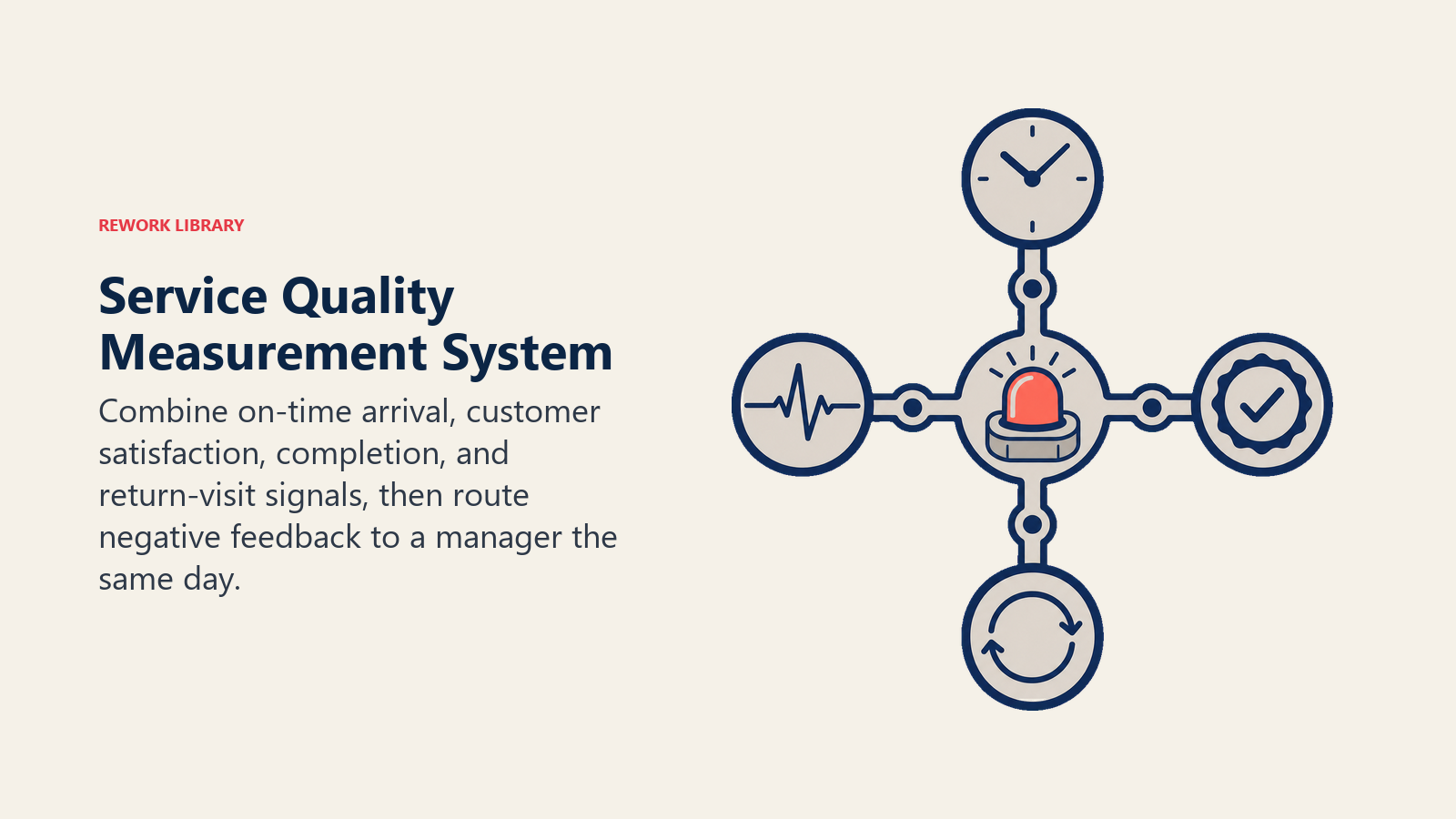
The Four-Signal Quality System is a D2D subscription quality measurement approach that tracks four leading indicators simultaneously: on-time arrival rate, customer satisfaction score, service completion rate, and return visit rate. When all four signals are visible to management weekly, quality gaps surface at the technician level before they appear in renewal data.
Post-Service Touch Points
The simplest and most reliable quality signal is a short customer survey sent within 24 hours of each service visit. Keep it to three questions:
- Did we arrive within our scheduled window? (Yes/No)
- Did the service meet your expectations today? (Yes/No)
- Is there anything we should know for next time? (Open text)
A two-question binary survey gets far better response rates than a five-point scale with six categories. You want signal volume, not survey precision. Bain & Company's Net Promoter System research shows that loyalty leaders using structured customer feedback grow revenues more than twice as fast as competitors, in part because satisfied customers reduce per-account service cost and drive referrals.
Route negative responses directly to a service manager within the same business day. Not the following week. Same day. A customer who had a bad experience and gets a personal call that afternoon is recoverable. One who waits a week is not.
Technician Scorecards
Each technician should have a monthly scorecard that includes:
| Metric | Target | Weight |
|---|---|---|
| On-time arrival rate | 90%+ | 30% |
| Customer satisfaction score | 85%+ | 30% |
| Service completion rate | 98%+ | 20% |
| Return visit rate (re-dos) | Under 5% | 20% |
Return visit rate is particularly telling. If a technician has a 12% return rate while the team average is 4%, they're either rushing jobs or lacking skill. Either way, it's fixable, but only if you see it.
Renewal Correlation Analysis
Quarterly, pull a cohort analysis: customers who received service from technician A versus technician B, then compare 12-month renewal rates. In most operations, there's a 10 to 20 percentage point difference between the best and worst performers. That gap is your training opportunity.
"In most D2D operations, renewal rates vary by 10 to 20 percentage points between the best and worst-performing technicians in the same service area, a gap attributable entirely to service consistency, not pricing."
The Renewal Conversation: Timing and Framing
Most D2D companies treat renewal as a passive event. The contract auto-renews, or an automated email goes out 30 days before expiration. This is a mistake.
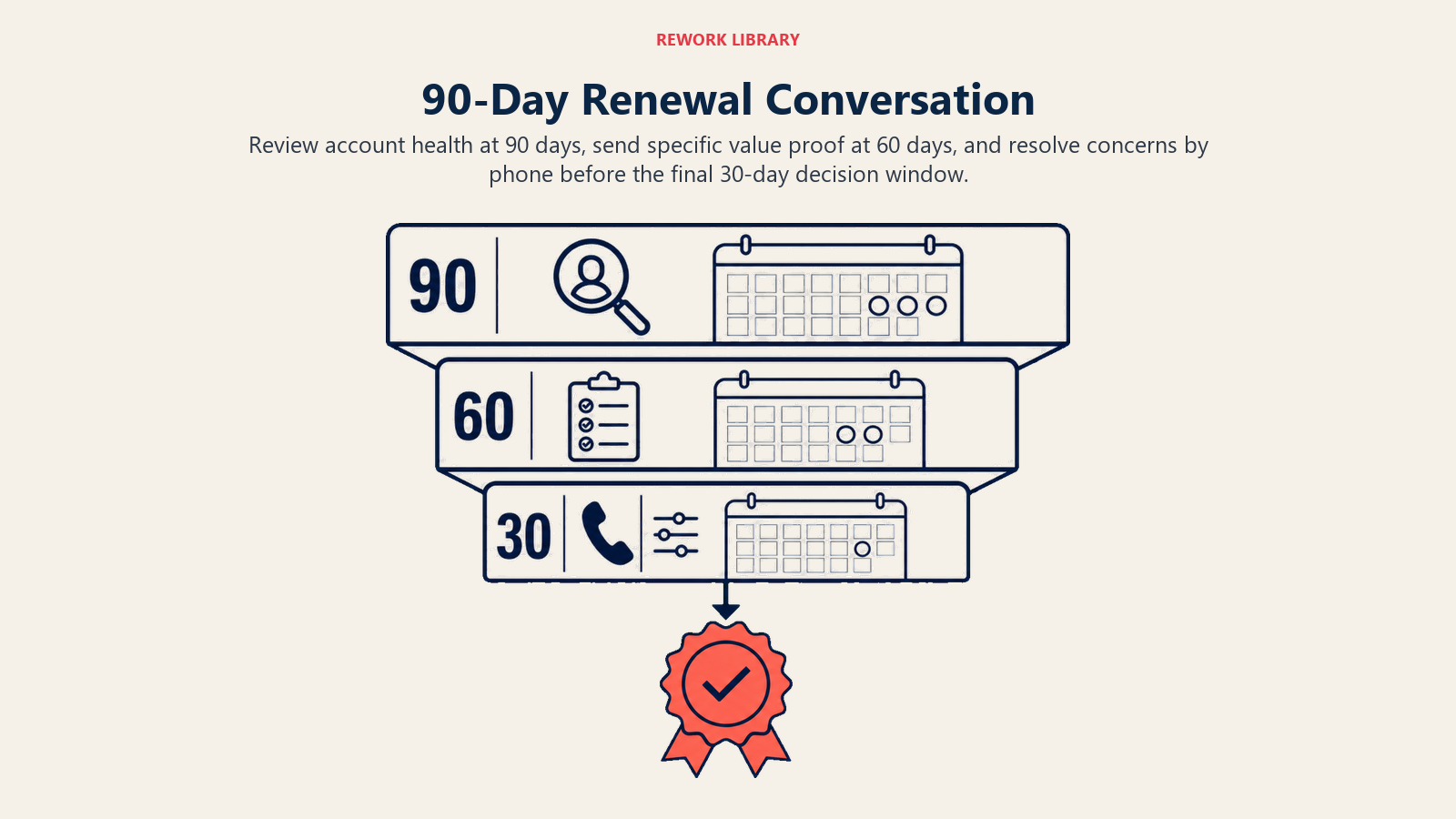
Renewal should be a proactive conversation, and it should start well before the contract end date.
The 90-Day Renewal Window
"Pest control, lawn care, and home security companies that implement a 90-day proactive renewal window consistently report fewer last-minute cancellations than those relying on auto-renewal or 30-day notices."
Start the renewal process 90 days before the subscription anniversary. Here is a practical sequence:
90 days out: A service manager or customer success rep reviews the account. Have there been complaints? Missed appointments? How many services have been completed? If the account looks healthy, a brief outreach call to check in is enough. If there are red flags, escalate to a save conversation now, not when cancellation is already in motion.
60 days out: Send a personalized renewal notice. Not a form letter. Something that references what the customer has actually received: "You've had 8 quarterly treatments this year. We haven't had any callbacks, which tells us the perimeter program is working." Specificity signals attentiveness.
30 days out: If there's been no response or the customer has raised concerns, a direct phone call from someone with authority to offer a loyalty discount or service upgrade. This isn't the time for a script. It's a real conversation.
The principles behind this sequence connect directly to what works in customer success check-ins and churn prevention strategy more broadly.
What to Offer at Renewal
Renewal conversations fail when the only lever is a discount. Price reduction erodes margin and trains customers to expect it every year. Before going to price, offer:
Service upgrades: "We can add interior treatments quarterly for no additional charge this year." Upgrades increase perceived value without reducing revenue.
Loyalty acknowledgment: A small gift, a free add-on service, or a handwritten card from the original rep. This sounds small, but customers remember it.
Flexibility: Adjusting service frequency or scheduling to better fit how the customer actually uses the service. A lawn customer who travels frequently might prefer bi-weekly visits on a flexible schedule rather than a rigid weekly slot.
Price should be your last lever, not your first. And when you do discount, make it specific and time-limited: "10% off your renewal rate for the next 12 months" rather than an open-ended price reduction.
Service Quality as a Retention Driver: Industry Benchmarks
Here's what the data looks like in mature D2D subscription verticals:
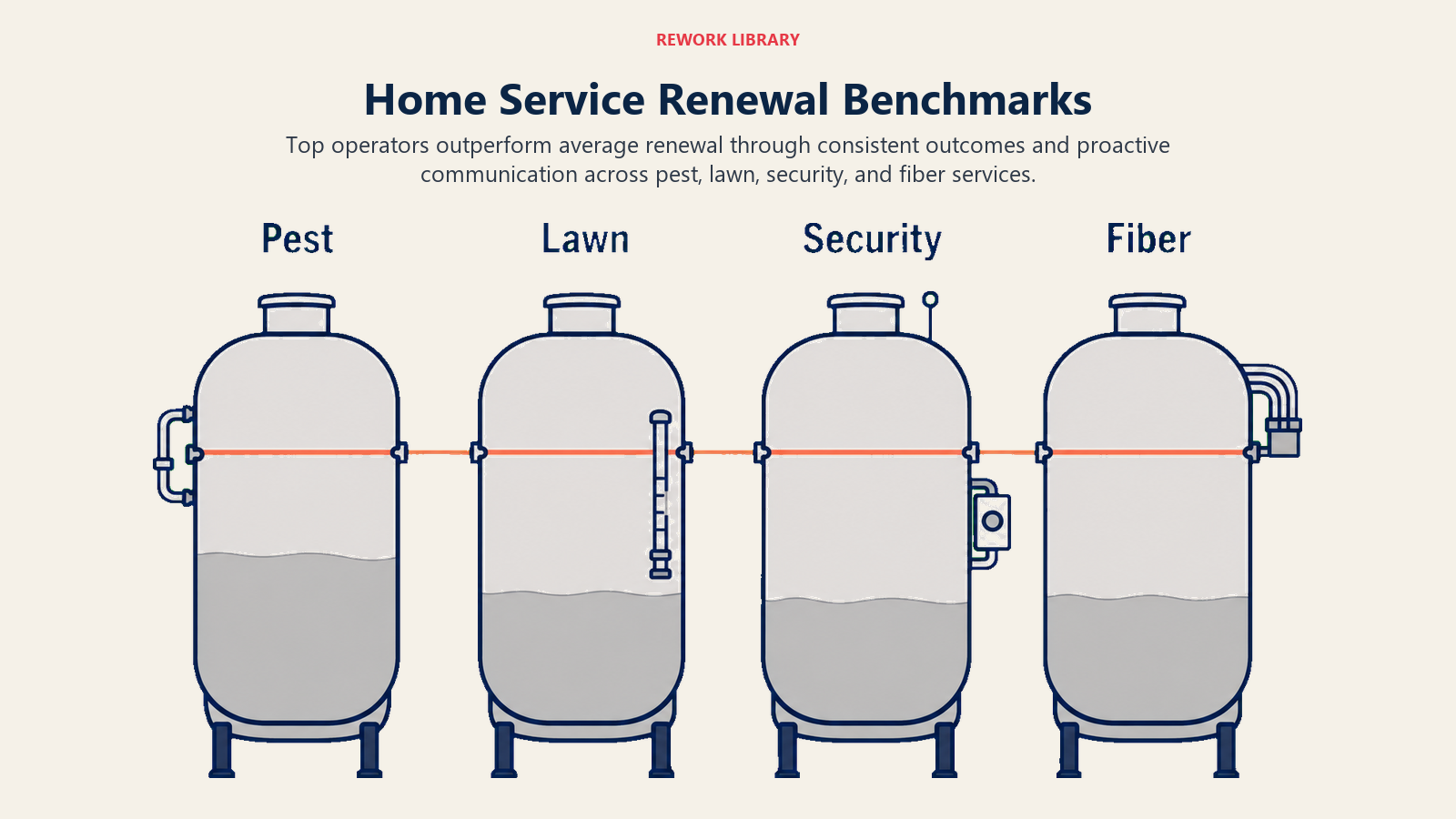
| Vertical | Average Year-1 Renewal | Top-Quartile Renewal | Primary Quality Driver |
|---|---|---|---|
| Pest control | 65-70% | 80-85% | Effectiveness (no pests) |
| Lawn care | 55-65% | 75-80% | Reliability + appearance |
| Home security | 70-80% | 88-92% | False alarm rate + response time |
| Fiber/internet | 75-85% | 90-95% | Uptime + support responsiveness |
The gap between average and top-quartile is almost never explained by price. It's explained by service consistency and proactive communication. The NPMA and PCO Bookkeepers 2025 Pest Control Industry Cost Study, which aggregated data from 246 firms with $584 million in combined revenue, found that recurring revenue represents 74% of total industry income, underscoring how heavily the sector's economics depend on retaining the accounts already won.
Common Quality Failures and How to Fix Them
The Invisible Technician Problem
In pest control and lawn care especially, service often happens when the customer isn't home. The technician does the work, but the customer has no evidence it happened. Over time, customers start to wonder whether they're getting value.
Fix: Every service visit should leave a physical or digital service report. A door hanger that says "We were here today. We treated the perimeter, garage, and kitchen area. No activity found. Next visit: September 15." Digital alternatives work fine too, but something tangible improves perceived quality dramatically.
Appointment Window Drift
Companies start with tight two-hour windows and gradually drift toward all-day windows as scheduling pressure builds. Customers notice.
Fix: Build routing software into the scheduling process. Tools that optimize technician routes by density make tight windows operationally feasible. The investment pays back in retention. This connects directly to the principles in route and time management for field teams.
The Handoff Gap
The rep who sold the subscription made promises during the pitch. The service team has no idea what those promises were. The customer notices the gap.
Fix: The sale-to-service-start handoff process needs to include a summary of commitments made during the sale. If the rep promised quarterly interior treatments, that needs to be in the service order. If it's not documented, it won't happen.
Building a Culture of Quality
Systems matter, but culture matters more. Technicians who take pride in their work deliver better quality than those who are simply completing tasks to get paid.
"Technicians who complete their own return visits, rather than handing re-dos to another crew, reduce repeat callback rates faster because accountability is direct and immediate."
Recognition programs: Highlight technicians with the highest customer satisfaction scores in team meetings. Post rankings. Most technicians are competitive and respond to visibility.
Callback accountability: When a service requires a return visit, the original technician should complete it, not a different crew. This creates natural accountability. A technician who has to drive back to fix their own work learns faster than one who never sees the consequence.
Customer feedback loops: Share customer comments with technicians, both positive and negative. A specific compliment ("Maria said your team was the most professional she's ever had") is more motivating than a generic "good job."
The coaching, ride-alongs, and culture practices that apply to sales reps apply equally to service teams.
What Do Renewal Rates Actually Signal About Your Business?
Renewal rates are your most honest signal about service quality. A company that hits 85% renewal is doing something right in the field. One stuck at 55% has an operational problem, a service quality problem, or both.
Track renewal rates by technician, by service line, by acquisition channel, and by geography. Patterns in that data will tell you where to invest. And when you combine strong renewal rates with an active referral generation program, the economics of the D2D model compound in ways that no acquisition push can match.
The close is where revenue starts. The service visit is where it compounds. What that compounding looks like in practice is the subject of the next piece in this series.
Learn More

Senior Implementation Consultant
On this page
- What "Service Quality" Really Means in D2D Subscriptions
- How Do You Build a Service Quality Measurement System?
- Post-Service Touch Points
- Technician Scorecards
- Renewal Correlation Analysis
- The Renewal Conversation: Timing and Framing
- The 90-Day Renewal Window
- What to Offer at Renewal
- Service Quality as a Retention Driver: Industry Benchmarks
- Common Quality Failures and How to Fix Them
- The Invisible Technician Problem
- Appointment Window Drift
- The Handoff Gap
- Building a Culture of Quality
- What Do Renewal Rates Actually Signal About Your Business?
- Learn More