Needs Discovery on the Doorstep: How to Uncover What Makes a Prospect Buy
Turn this article into takeaways for your work.


Each assistant summarizes the article only for you and suggests best practices for your work.
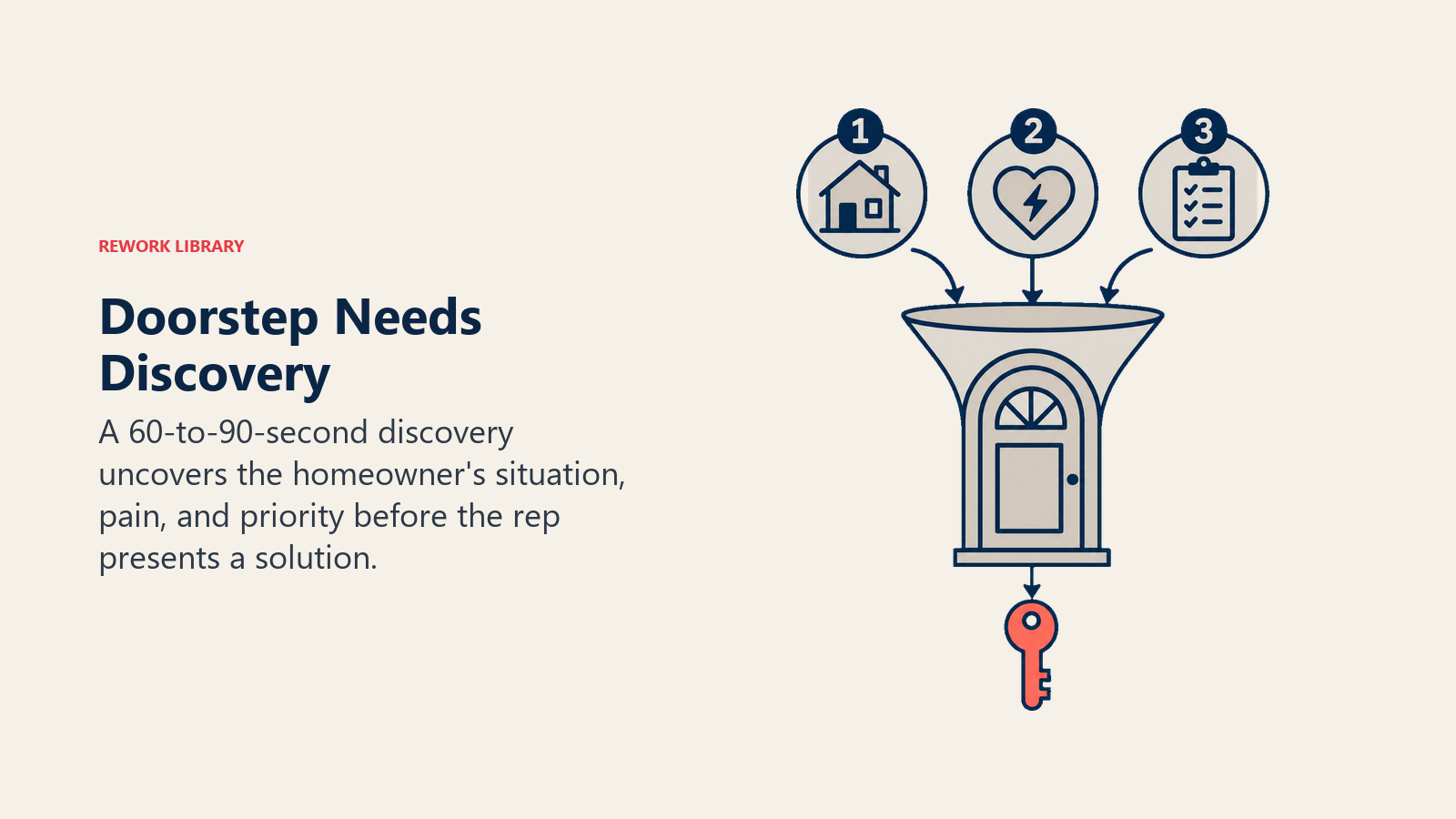
Most door-to-door reps spend their first 60 seconds pitching. The top closers spend it listening.
That's the whole difference. When you knock, you know almost nothing about the person in front of you. You don't know if they've had a pest problem before, if they're already locked in with a competitor, or if they're three weeks from moving out. The only way to find out is to ask the right questions in the right order and actually pay attention to the answers.
This article covers that process: structured doorstep discovery that fits your approach window, surfaces real pain, and adapts across pest control, lawn care, home security, and fiber internet.
Why Does Discovery Beat Pitching at the Door?
When a rep leads with the pitch, a few things go wrong. They hand the homeowner a reason to object before the homeowner's felt any need. "We offer quarterly pest treatments starting at $49" lands flat if they haven't thought about pests in six months. And the rep misses what would actually motivate this particular person to sign.
Discovery flips the order. You ask a few targeted questions, the homeowner starts talking, and they remind themselves of the problem they have. By the time you open your folder, they're already partway convinced.
It's the same principle behind value selling in pipeline management: understand the problem before you present the solution. Sales researcher Neil Rackham found the same pattern in his landmark study, detailed in the Key Facts below: reps who lead with purposeful discovery questions and guide buyers to articulate their own needs outperform reps who pitch first, because the homeowner's own words become the case for buying.
For D2D subscriptions, discovery has two jobs. First: qualify the person (do they have a real need and the authority to sign?). Second: collect the emotional ammunition for your close. A homeowner who mentions ants in the kitchen last spring is telling you exactly what to say when you name your service.
See qualifying at the door for the threshold questions that determine whether it's worth running a full discovery at all.
Key Facts: Doorstep Discovery
- Door-to-door sales generates roughly one qualified lead per 50 doors knocked, making every warm conversation a high-value asset worth protecting with good discovery. (SPOTIO / Zety, via spotio.com/blog/sales-statistics, 2026)
- Neil Rackham's research across more than 35,000 sales calls found that reps who ask purposeful discovery questions, not pitch-first openers, consistently outperform peers in close rate and deal size. (SPIN Selling, Huthwaite Research Group)
- The US door-to-door industry generates approximately $30 billion in annual revenue, concentrated in verticals where in-person discovery is the primary conversion lever: pest control, home security, telecom, and lawn care. (Grand View Research, 2022, via SPOTIO)
The Three Layers of Doorstep Discovery
The Situation-Pain-Priority Stack: Think of discovery as three nested layers that build on each other: situation, pain, and priority.
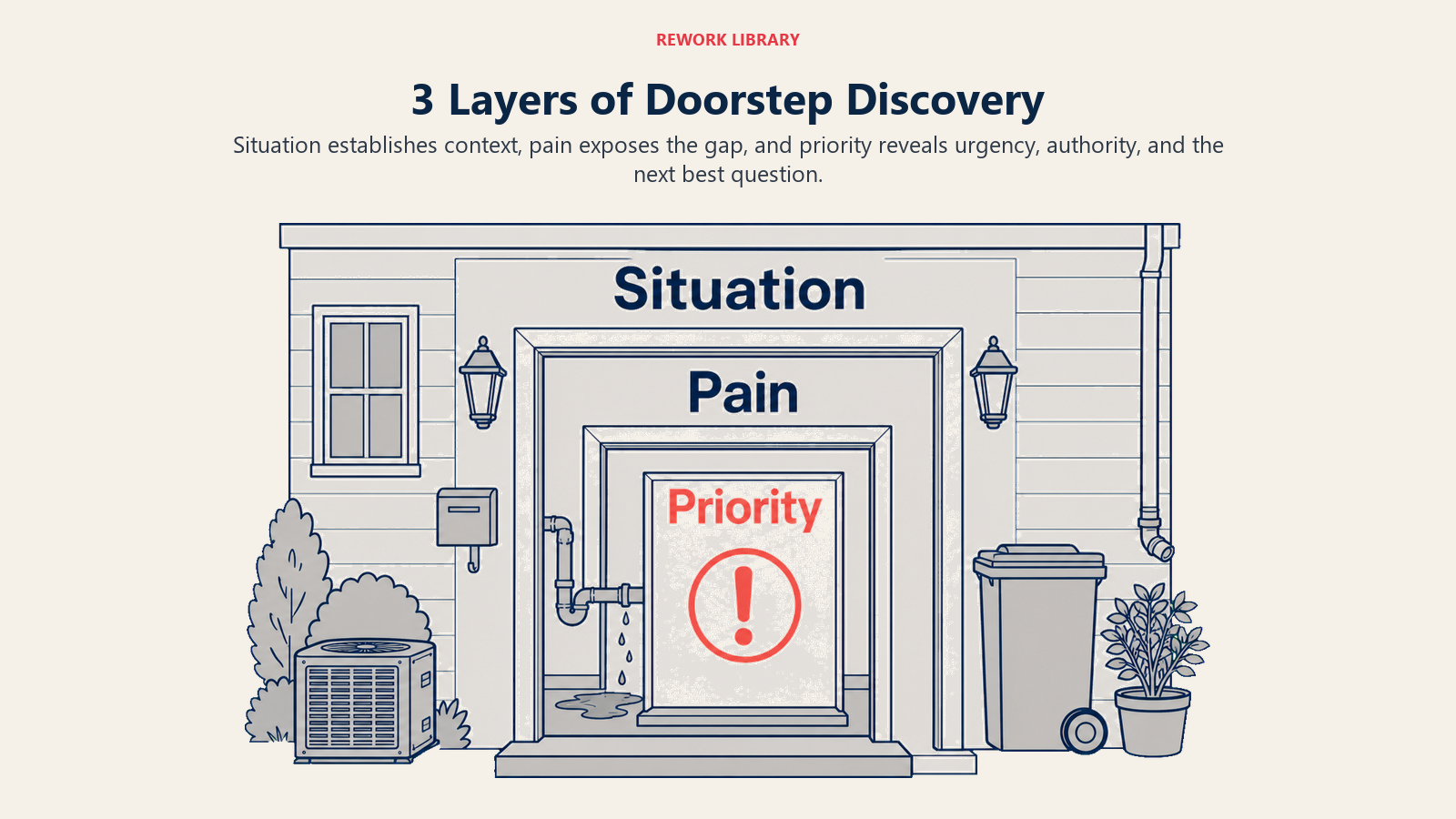
Situation questions establish context. What does their current setup look like? Are they already using a service? How long have they lived here?
Pain questions surface the gap between where they are and where they want to be. When did they last see evidence of pests? How does their lawn look in late summer? Have they had any packages stolen or any incidents that concerned them?
Priority questions clarify urgency and ownership. Is this something they've been meaning to address? Who else in the household would want to weigh in?
You don't ask all three layers every time. But you need to know which layer a homeowner is at so you can meet them there.
A Discovery Framework That Works at the Door
Here's a framework that fits within a 90-second window. You've already delivered your door approach and first-30-seconds opener (see door approach and first 30 seconds). The homeowner is still at the door. Now you shift from attention-getting to learning.
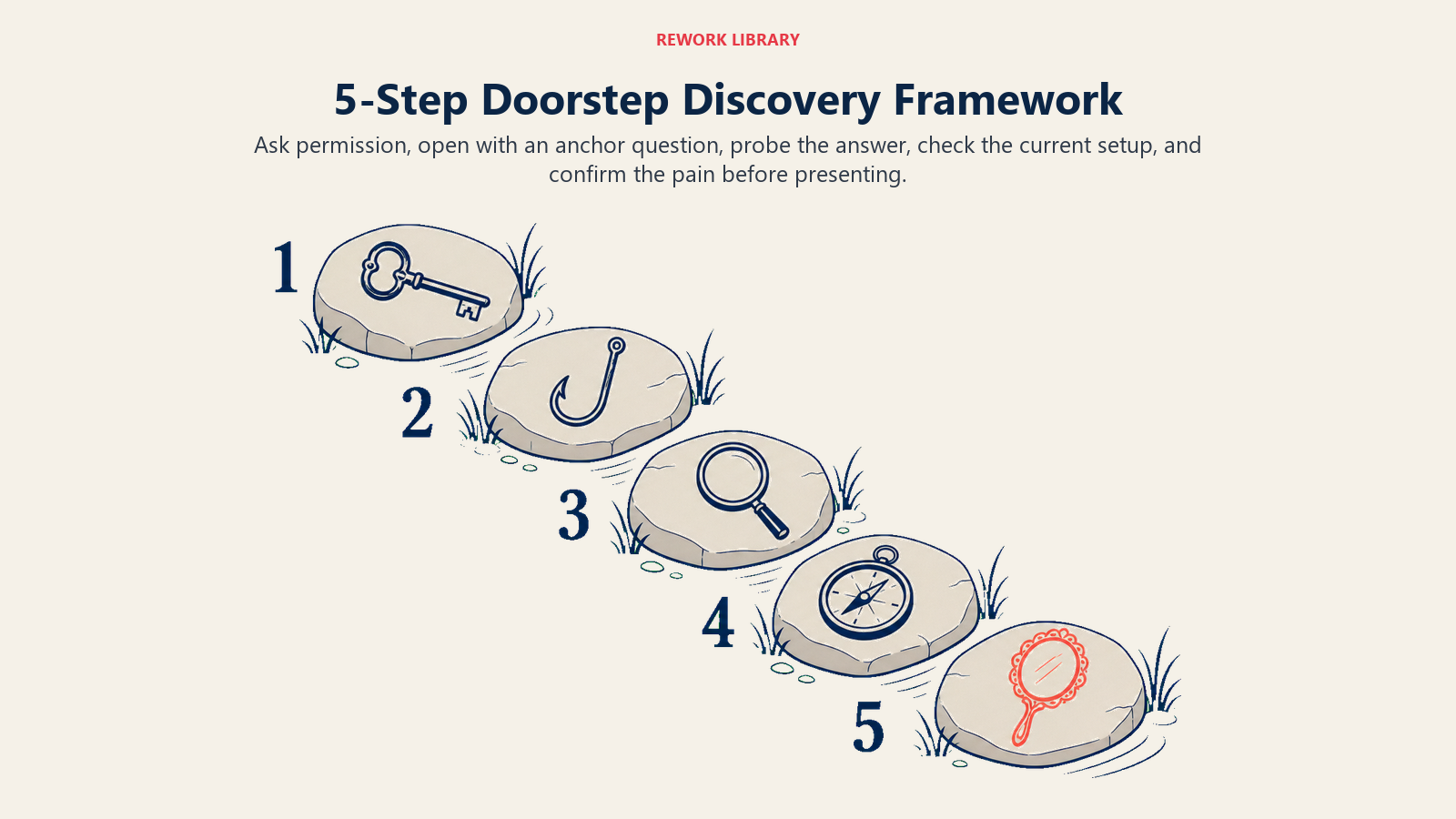
Step 1: Permission to Ask
"Mind if I ask you a quick question about your home?"
This micro-permission request signals that you're about to listen, not pitch. Most people say yes. It also subtly shifts the conversation from "salesperson at door" to "brief consultation."
Step 2: The Anchor Question
Lead with a question tied to the category you're selling. Keep it open-ended but narrow enough to get a useful answer.
| Service | Anchor Question |
|---|---|
| Pest control | "Have you noticed any ant activity, rodents, or anything like that around the house this season?" |
| Lawn care | "How's the lawn been keeping up for you? Any areas you've been fighting with?" |
| Home security | "Have there been any incidents in the neighborhood lately that you're aware of?" |
| Fiber internet | "How's your internet setup working out? Any dead zones in the house or slowdowns?" |
The anchor question does two things. It opens the door to a real conversation and it immediately tells you whether there's a live need. If the homeowner says "actually, yeah, we had carpenter ants all spring," you have your hook. If they say "no, everything's fine," you're in a different conversation.
Step 3: The Follow-Up Probe
Whatever they say, go one level deeper.
"When did that start?" "How bad did it get?" "What did you end up doing about it?" "Did that fix it, or is it still a thing?"
This is where the gold is. The homeowner isn't just answering your question anymore. They're re-living the problem. A homeowner who describes watching ants march across their kitchen counter is already in the emotional state that makes a solution compelling.
Step 4: The Current Situation Check
"Are you currently using any kind of pest service, or have you been handling it yourself?"
This tells you whether you're selling against nothing, against DIY, or against a competitor. Each one has a different path forward. No service and no action = easiest close. DIY = they've already acknowledged a need, they just haven't found a professional solution they trust. Competitor = you need to understand the gap between what they have and what they want.
For the competitor scenario, competition objections covers how to handle that conversation once you're in it.
Step 5: The Pain Confirmation
Before you move into your presentation, confirm what you heard.
"So it sounds like you've been dealing with [specific issue] for a while and [action they took] didn't fully solve it. Is that right?"
Two things happen when you do this. The homeowner feels heard, which builds trust. And they confirm the pain out loud, which makes it real to them, not just to you.
Reading Non-Verbal Discovery Signals
Spoken answers are only part of the picture. Experienced reps read the environment and the person at the same time.
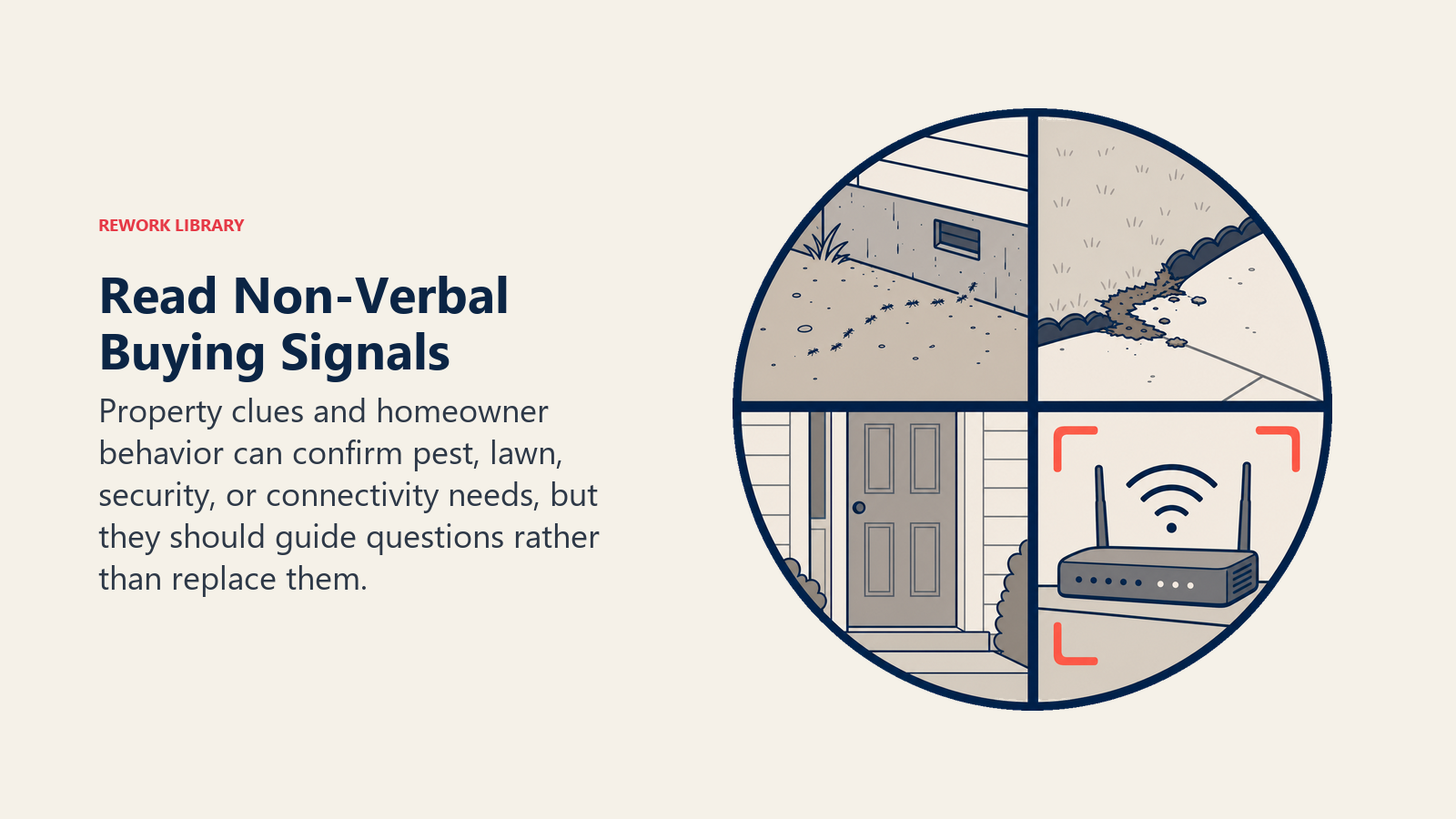
At the door, look for:
- Pest evidence: mud tubes near the foundation, ant trails, wasp nests under eaves, grubs in the lawn visible near the porch. The National Pest Management Association's (NPMA) Bug Barometer tracks regional pest pressure by season, useful context for knowing which pest types are most active in your territory at any given time.
- Lawn condition: yellow patches, weed coverage, thin turf near edges
- Security indicators: no visible cameras, door camera missing, signs of recent package theft. Maybe a neighbor even mentioned it.
- Tech environment: old router or cable box visible, complaint about slow speeds when they answer. Maybe they're on a video call and you can hear the buffering.
None of this replaces asking questions. But it gives you confirmation and sometimes surfaces a need the homeowner hasn't consciously registered yet.
"I noticed you've got some grub damage along the front edge there. Is that something you've been dealing with?"
That's a much stronger opener than "Do you have any lawn issues?"
Handling Short Discovery Windows
Not every homeowner gives you time for a full five-step discovery. Some people are heading out. Some are wary. Some just want you to get to the point.
For time-pressed situations, compress to two questions:
- The anchor question ("Have you had any [category] issues this season?")
- The situation check ("Are you currently using a service for that?")
That's enough to know whether you have a prospect worth a full presentation or someone to follow up on later. Don't try to squeeze in the full framework on a homeowner who's clearly got one foot out the door. You'll lose them entirely. Better to get two good answers and set up a return visit.
Common Discovery Mistakes and How to Fix Them
Asking closed questions too early. "Are you happy with your current pest control?" gets a yes/no and shuts down the conversation. Lead with open questions, then narrow.
Talking over the answer. The homeowner starts describing their ant problem and the rep jumps to "oh, we handle that." Stop. Let them finish. The more they talk, the more they're selling themselves.
Skipping discovery when the conversation feels easy. An approachable homeowner doesn't mean you can skip straight to the pitch. You still need to know their situation. Reps who skip discovery on "easy" conversations close at much lower rates because they guess at pain instead of confirming it.
Treating discovery as a checklist. The framework is a structure, not a script. If the homeowner says something unexpected, follow it. The goal is a real conversation, not a perfect sequence.
Forgetting to tie discovery back in the close. If you spend 90 seconds on discovery and then give a completely generic pitch, you've wasted it. Everything you learned goes into the close. "You mentioned the ants in the kitchen last spring. Our quarterly treatment specifically handles that species. Let me show you what that looks like."
That direct tie-in is the payoff for doing discovery well. It's also what separates a same-visit close from a "let me think about it." For how to build on this in the close itself, see same-visit close techniques.
Discovery Across Different Homeowner Types
One framework, but different applications depending on who opens the door.
The Skeptic: Quiet, arms crossed, clearly not excited you're there. Don't push for deep discovery. Ask one situation question, listen carefully, reflect back what they said. Build micro-trust before you go deeper. The skeptic's pain is real; it's just buried under distrust of salespeople.
The Talker: Gives you more than you asked for. Let them go. These homeowners reveal pain freely, and they'll usually tell you exactly what it would take to get their business. Your job is to listen, stay curious, and redirect back to their service situation when they wander.
The Busy One: Already half out the door. Two questions maximum. Use what you get. Set a specific return time if needed.
The Researcher: Has questions of their own, wants to compare options, seems like they've thought about this before. Lean into their engagement. This homeowner responds well to a fuller discovery because they appreciate the conversation. They're also worth the extra time: a researcher who decides to buy tends to stay subscribed for years.
Connecting Discovery to the Presentation
When you've finished discovery and move into your on-site sales presentation, you should be able to complete this sentence:
"Based on what you've told me, the thing that's going to matter most to you is [specific benefit] because [their specific pain]."
If you can't complete that sentence, go back and ask one more question. Because without that connection, you're giving the same pitch you'd give anyone. And anyone can say no.
Discovery done right means the presentation feels inevitable, not generic. The homeowner recognizes their own problem in what you're describing. That's when subscription closes happen same visit.
Key Takeaways
- Lead with questions, not features. The homeowner's pain is more persuasive than your pitch.
- Use the five-step discovery framework: permission, anchor question, follow-up probe, situation check, pain confirmation.
- Read the environment for silent signals: pest evidence, lawn condition, security setup, tech indicators.
- Compress to two questions for time-pressed situations, then come back.
- Tie everything you learned back into the close. Discovery without integration is wasted.
- Adapt your approach by homeowner type: skeptic, talker, busy, researcher.
Doorstep discovery is a skill, not a script. The reps who get it right treat every conversation as genuinely different, because it is. They ask real questions, listen for real answers, and use what they learn to make the close feel like a natural conclusion rather than a hard sell.
That's how you sign subscribers the same visit, and keep them coming back.
The Quotable Rep: "A homeowner who describes their own problem out loud is already halfway to buying the solution. Your job at the door isn't to pitch. It's to ask the question that starts that description."
The 1-in-50 Reality: D2D sales generates roughly one qualified lead per 50 doors knocked, according to data from Zety and SPOTIO. That means every homeowner who stays in the conversation is worth protecting with good discovery. Rushing to the pitch and losing a warm lead isn't a minor inefficiency. It's a significant cost in an already low-margin channel.
The Specificity Rule: Neil Rackham's research across more than 35,000 sales calls found that vague situation questions ("Are you happy with your current service?") performed worse than specific implication questions that helped buyers feel the weight of a real problem. At the door, "Have you noticed ant activity this season?" outperforms "Do you have any pest issues?" every time.
Frequently Asked Questions about Needs Discovery on the Doorstep
What is needs discovery in door-to-door sales?
Needs discovery is the process of asking targeted questions at the start of a D2D conversation to understand a homeowner's current situation, pain points, and urgency before presenting your service. It replaces pitch-first selling with a brief consultation that surfaces the specific need your service solves, making the subsequent pitch feel relevant rather than generic.
How long should doorstep discovery take?
A full five-step discovery runs 60 to 90 seconds. For time-pressed homeowners, a compressed version using just the anchor question and situation check takes under 30 seconds and still yields enough information to qualify the prospect and tailor the pitch. Discovery length should match the homeowner's engagement level, not a fixed script.
What is the anchor question in doorstep discovery?
The anchor question is the first open-ended question tied to the category you're selling. For pest control: "Have you noticed any ant activity or rodents around the house this season?" For lawn care: "How has the lawn been keeping up?" It opens the conversation, signals genuine curiosity, and immediately tells you whether there's a live need worth pursuing.
Why do reps skip discovery on approachable homeowners?
Reps skip discovery when a homeowner seems warm and they assume enthusiasm means readiness. But an approachable homeowner hasn't confirmed they have a need, the authority to sign, or the urgency to act today. Reps who skip discovery on "easy" conversations still close at lower rates because they guess at the pain point rather than confirming it. Discovery is especially valuable when the homeowner seems open, because there's more time to run it well.
What are the three layers of doorstep discovery?
The three layers are situation (what does their current setup look like?), pain (what gap exists between where they are and where they want to be?), and priority (is this something they're actively trying to solve, and who makes the decision?). You don't always cover all three, but knowing which layer the homeowner is at helps you ask the right question next.
How do you handle a homeowner who won't engage with discovery questions?
Start with a single permission request ("Mind if I ask you one quick question?") and lead with the most specific anchor question you can. If the homeowner stays disengaged, compress to one situation check and exit cleanly. Some homeowners need a different day or a neighbor's referral before they'll engage. Respect that and move on rather than forcing a discovery they're not ready for.
What is the pain confirmation step and why does it matter?
The pain confirmation is a brief summary you deliver after discovery: "So it sounds like you've been dealing with [specific issue] and [what they tried] didn't fully solve it. Is that right?" Two things happen when you do this: the homeowner feels genuinely heard, which builds trust, and they confirm the pain out loud, which makes it real to them rather than just to you. Skipping this step leaves the bridge between discovery and pitch unbuilt.

Senior Implementation Consultant
On this page
- Why Does Discovery Beat Pitching at the Door?
- The Three Layers of Doorstep Discovery
- A Discovery Framework That Works at the Door
- Step 1: Permission to Ask
- Step 2: The Anchor Question
- Step 3: The Follow-Up Probe
- Step 4: The Current Situation Check
- Step 5: The Pain Confirmation
- Reading Non-Verbal Discovery Signals
- Handling Short Discovery Windows
- Common Discovery Mistakes and How to Fix Them
- Discovery Across Different Homeowner Types
- Connecting Discovery to the Presentation
- Key Takeaways