Canvassing Fundamentals and the Knock: A D2D Home Services Field Guide
Turn this article into takeaways for your work.


Each assistant summarizes the article only for you and suggests best practices for your work.
Sales training in door-to-door home services tends to focus on the pitch. How to handle objections, how to close, how to present pricing. What it underweights is everything before the pitch. How many doors a rep actually knocks. How they choose which doors to approach. How they hold energy and discipline across a six-hour field shift.
Canvassing fundamentals aren't glamorous. But they're the mechanical foundation everything else depends on. A rep with a world-class pitch who knocks 40 doors a day will always be outperformed by a disciplined canvasser who knocks 90 doors a day with a solid, not perfect, close rate. Structure and timing matter as much as the pitch itself.
This guide covers door-to-door, or D2D, canvassing: knock discipline, route patterns, contact rate management, and the daily habits that separate productive field reps from ones who waste half their shift driving and taking breaks.
What Actually Drives D2D Sales? The Knock Equation
Before covering how to canvass, it helps to understand the math. Every D2D rep is working a conversion funnel that looks roughly like this:
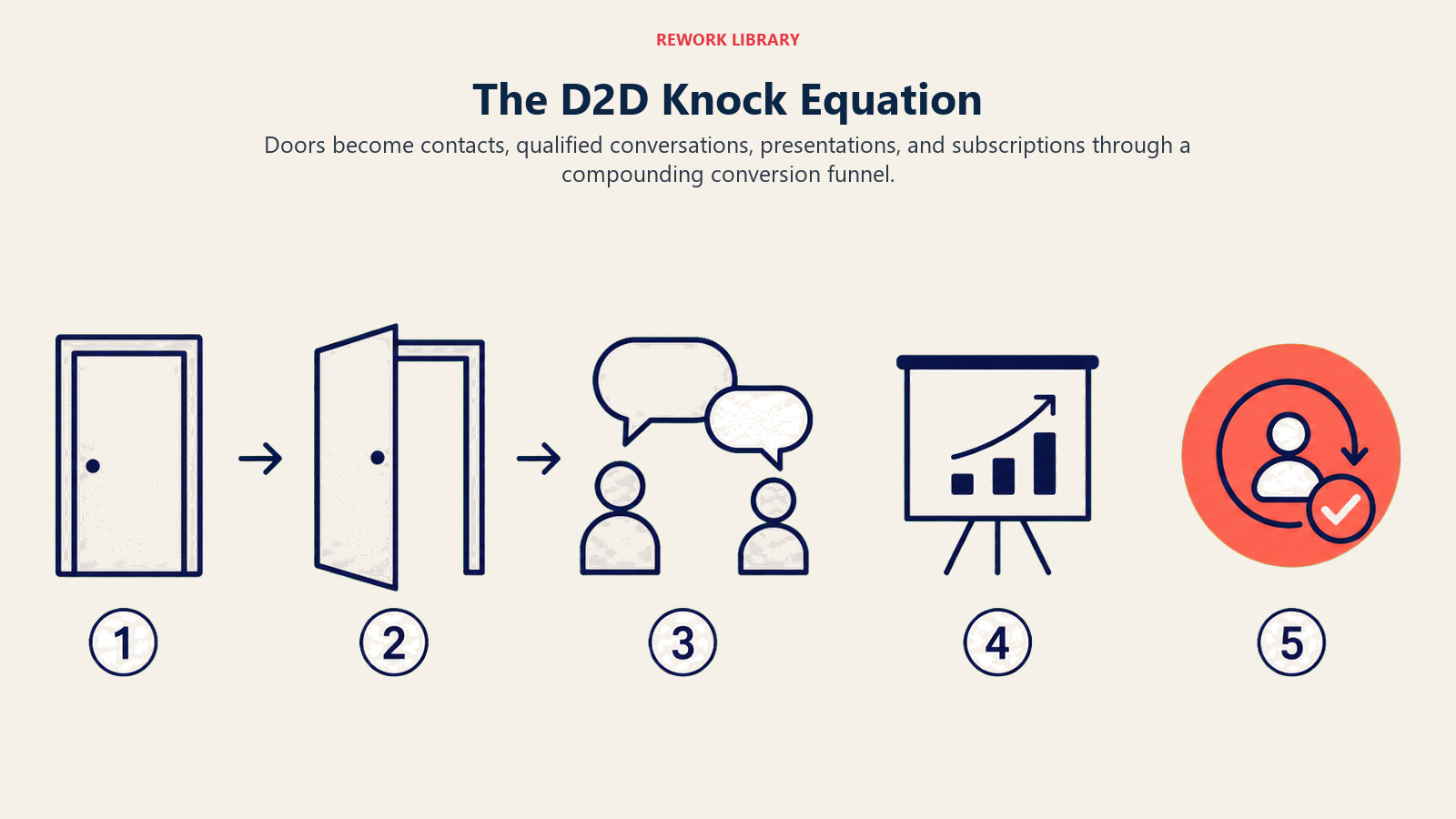
Doors knocked > Contacts made (doors opened) > Qualified conversations > Presentations given > Subscriptions closed
Each stage has a conversion rate, and those rates compound. A rep who improves their contact rate from 35% to 45% by knocking during better hours doesn't just get 10% more conversations. Because subsequent stages also benefit, their closed subscriptions can increase by 25 to 35%.
Benchmark conversion rates by stage:
| Stage | Low performer | Average | Strong performer |
|---|---|---|---|
| Doors knocked per day | 40 to 55 | 60 to 80 | 85 to 110 |
| Contact rate (door opened) | 25 to 35% | 35 to 50% | 50 to 65% |
| Qualified conversation rate | 40 to 55% | 55 to 70% | 70 to 85% |
| Presentation to close | 15 to 25% | 25 to 35% | 35 to 50% |
The difference between a low performer and a strong performer isn't just close rate. It's the entire funnel. And the top of that funnel, doors knocked and contact rate, is almost entirely within a rep's control through discipline, timing, and mechanics.
Key Facts: D2D Canvassing
- D2D teams convert at 2 to 5% of doors knocked, which means funnel volume is the primary lever for revenue growth. (SPOTIO)
- Field sales reps spend 37% of their workweek in face-to-face selling, according to SPOTIO's 2026 State of Field Sales report. (SPOTIO)
- 65% of field reps spend 5 or more hours per week on manual CRM data entry, time that could otherwise go toward additional door attempts. (SPOTIO)
How Should Reps Move Through a Territory? Route Discipline
The most common time-killer in D2D canvassing isn't bad conversations. It's unstructured movement. Reps who wander a territory inefficiently, doubling back, skipping streets, driving between clusters, can lose an hour or more of productive knocking time per shift. The box pattern: Start at one corner of your territory and work in a systematic box. Down one side of a street, cross at the end, work back up the other side, advance one block, repeat. This ensures full coverage with no backtracking.
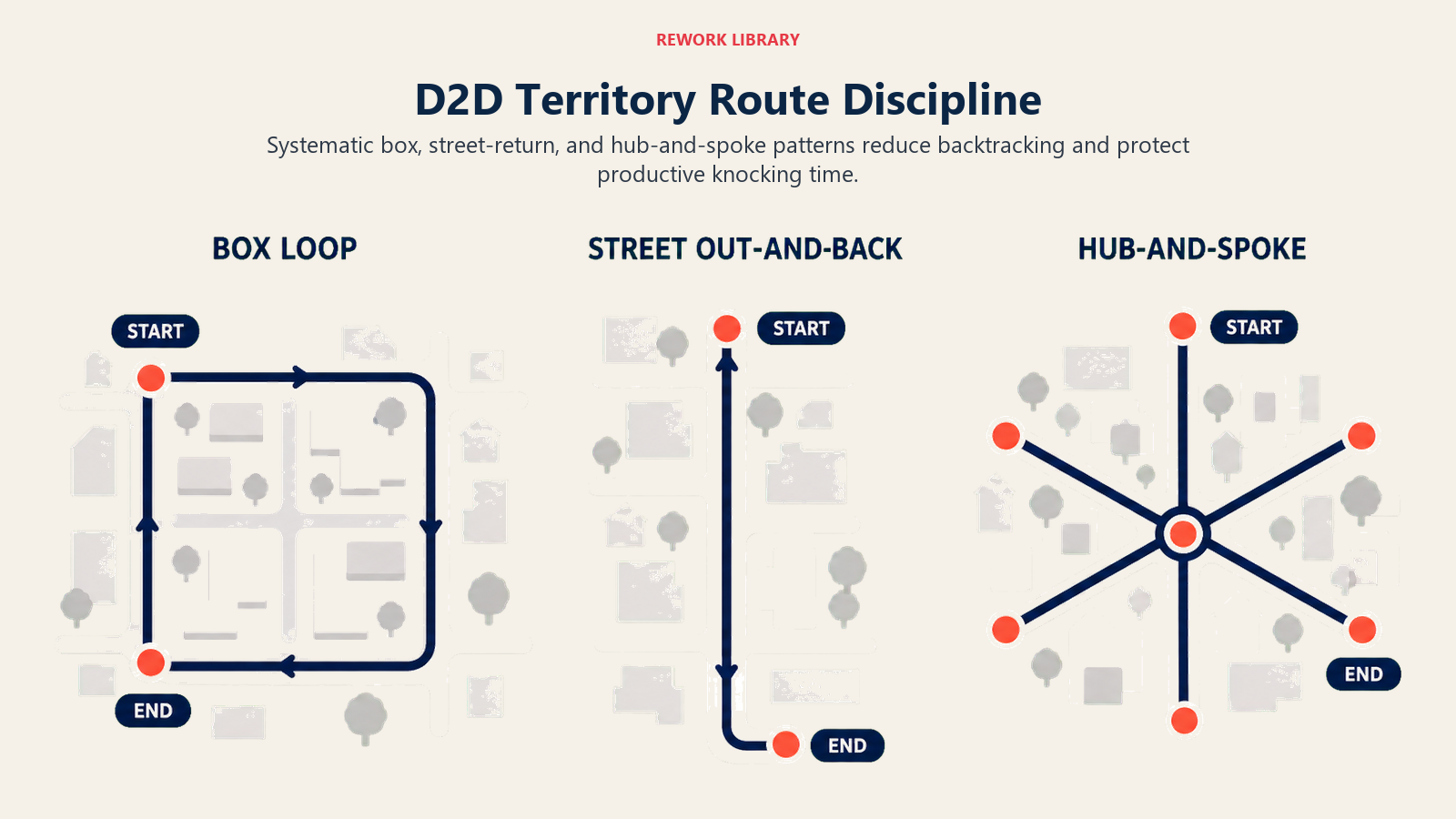
Street-then-return: Work one side of a street fully, then cross and work back toward your starting point on the other side. Efficient for long streets, but requires discipline to not skip the return pass when energy dips late in a shift.
Hub-and-spoke from a parking anchor: Park centrally, then walk out in patterns from the hub. Good for dense neighborhoods where walkability is high. Minimizes car moves. Poor for spread-out neighborhoods where hub-to-door distances get long.
What most strong canvassers actually do: A hybrid approach where they establish a parking anchor and work the walkable zone around it before moving the car. The key is defining the anchor before stepping out, not deciding on the fly.
The Anchor-and-Expand Framework: park at a central point, saturate the walkable zone around that anchor before relocating, then repeat. Each anchor zone should yield a predictable door count before the car moves, making per-shift output measurable and coachable.
The discipline piece is specific: log your position in the canvassing app every hour. Not just each door attempt, but your physical location. This creates accountability data that managers can use during coaching and ride-alongs and helps you reconstruct where time actually went on underperforming days.
What to Log at Each Door
Every door attempt, regardless of outcome, should get a log entry in your canvassing app. This isn't bureaucracy. It's the data that makes territory rotation, knock analytics, and performance coaching possible.
Minimum log fields per door:
- Address
- Timestamp of attempt
- Outcome: No answer / Not home / Came to door / Short conversation / Full presentation / Closed
- Notes: Dog, gate, posted "no soliciting" sign, asked to return
The "asked to return" note is particularly important for recurring subscription sales. Unlike transactional D2D, where a single visit either converts or doesn't, subscription canvassing often involves a warm prospect who wants to think it over. A logged callback request, with the preferred time, is a qualified lead. Reps who don't log these leave real money on the table.
What NOT to skip even on a busy day: The no-answer log. Many reps only log contacts, meaning doors that opened, and skip the no-answers. This makes contact rate data impossible to calculate accurately. It also hides the difference between a low-contact territory that's genuinely hard to find people home in and a low-effort rep who simply isn't knocking enough.
Contact Rate Management: Getting More Doors to Open
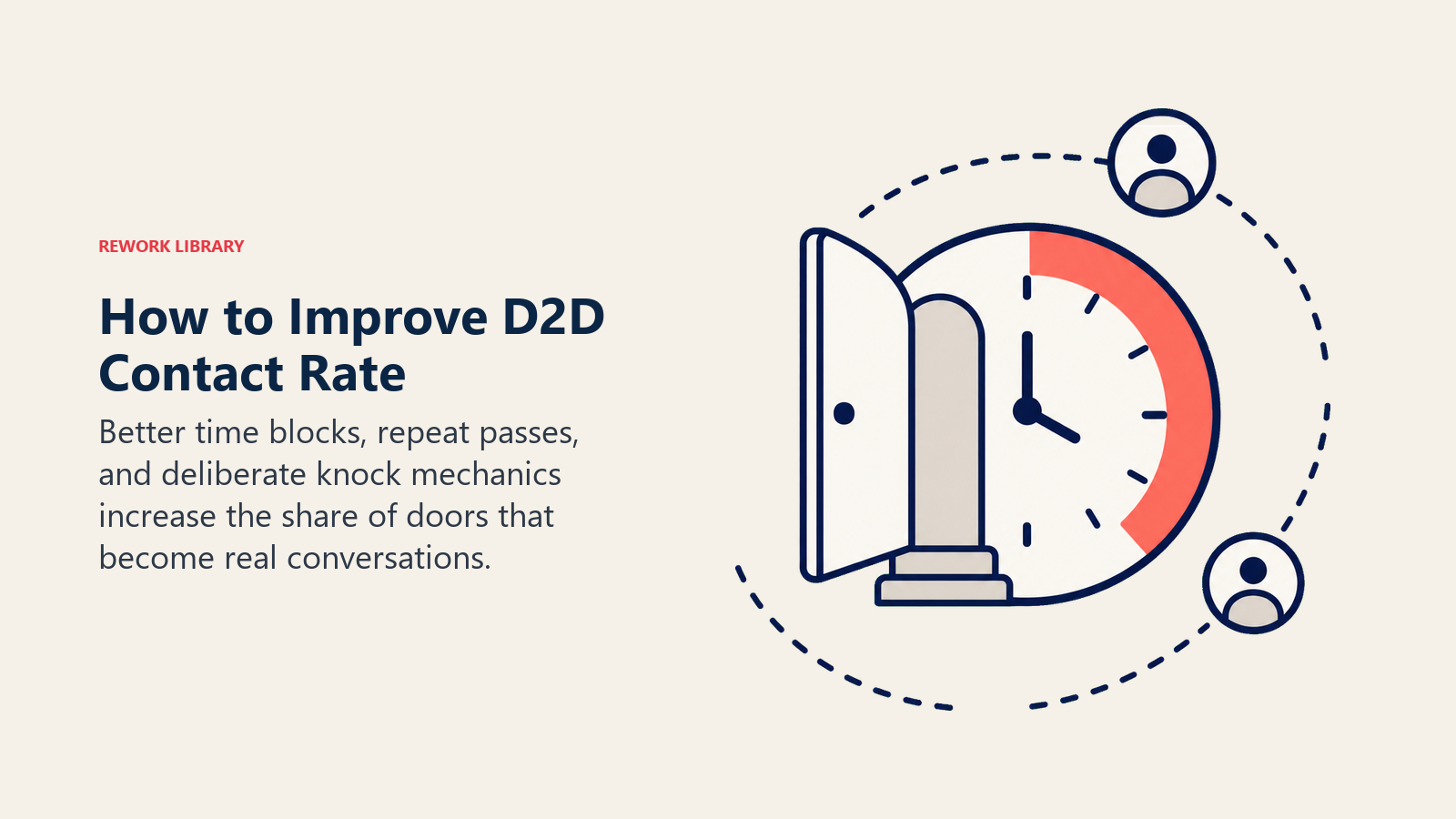
A locked screen door is not a no. It's a "nobody's home right now." Contact rate, the percentage of knocked doors where someone answers, is heavily influenced by when and how you knock, not just how many doors you approach. Timing by day part:
| Time window | Typical contact rate | Who's home |
|---|---|---|
| 9:00 to 11:30 AM | Low (25 to 35%) | Retirees, work-from-home |
| 11:30 AM to 1:00 PM | Medium (30 to 40%) | Lunch-hour, early returns |
| 4:00 to 7:30 PM | High (45 to 65%) | After work, family dinner hours |
| Saturday 10:00 AM to 5:00 PM | High (45 to 60%) | Weekend availability |
Most full-time D2D reps in home services get the most out of their field time by starting in the late morning to work through a first wave of contacts, breaking mid-afternoon for admin and training, then returning for the high-contact evening window. See weather, timing, and density planning for how to adjust this cadence by season and geography.
The mechanics of a knock that gets answered:
How you knock matters more than most reps realize. A timid tap gets ignored. An aggressive pound reads as threatening. The mechanics of a productive knock:
Approach with purpose. Walk directly to the door with a relaxed but upright posture. Don't slow down or look hesitant near the driveway. Hesitation signals uncertainty and draws curtains shut.
Stand to the side, not directly in front. Many homeowners check through a peephole or window before opening. Standing slightly to the side of the door frame makes you less imposing and easier to see fully. It also signals you're not blocking the exit.
Knock three times, firmly, with a pause. Three solid knocks with a brief pause between each. Not a doorbell and nothing. Not five rapid knocks. Three deliberate knocks signal a purposeful but respectful visitor.
Wait 10 full seconds before assuming no answer. Ten seconds feels long in the field. But homeowners are often in a back room, on a call, or coming from upstairs. Most reps cut this short and miss contacts.
If no answer, ring the doorbell if one exists. Different households respond to different stimuli. Some never hear a knock; others ignore the bell. Use both if available.
Do not knock twice in quick succession. Homeowners who hear knocking while already walking to the door will open it. Those who hear rapid re-knocking before they get there often don't open at all. Patience is contact rate.
Managing Energy Across a Full Shift
Canvassing is physically and mentally demanding in a way that office sales roles aren't. Reps are walking several miles per day, often in heat or cold, managing repeated social interactions, absorbing rejection, and trying to bring genuine energy to the 80th door after a run of no-answers. Energy management is a skill, not just a personality trait.
D2D canvassing turnover runs high: 68% of field sales teams report 30% or more annual rep turnover, according to SPOTIO's 2026 State of Field Sales. Teams that invest in energy management and daily structure see meaningfully lower attrition than those that treat canvassing as a pure numbers game. (SPOTIO)
Physical habits that matter:
- Wear comfortable shoes. This sounds obvious. Many reps in their first season underestimate how much foot discomfort degrades their attitude and posture by mid-afternoon.
- Bring water and eat before high-effort windows. Hunger and dehydration affect emotional regulation. A rep who skips lunch and hits a string of rejections at 4 PM is in a bad state for the evening contact window.
- Use car breaks productively. Five minutes sitting in the car scrolling your phone resets nothing. Five minutes of deliberate relaxation, or a review of your notes from the last hour, resets your pitch energy.
Mental habits that matter:
Adopt a per-block goal rather than a per-day goal. "I'm going to work this street well" is more actionable than "I need 5 closes today." The per-block goal is achievable every hour and produces a continuous sense of progress. Per-day goals front-load pressure and make reps more likely to quit mentally after a slow morning.
Rejection reframing is essential in subscription D2D specifically. Unlike transactional sales, a no at the door often isn't about the product. It's about timing, trust, or the homeowner's current attention. Many subscriptions close on a second or third contact. A rep who treats every no as final is leaving future revenue on the table. See qualifying at the door for how to distinguish a "no for now" from a "no, full stop."
The Role of Canvassing Apps in Field Discipline
Modern D2D teams use canvassing apps (such as SalesRabbit, Spotio, or similar) to manage territory pins, log door outcomes, and track real-time rep location. These tools shift canvassing from a discipline that relies entirely on rep self-management to one that has structural accountability built in.
What the best canvassing app setups do:
- Auto-populate the route based on assigned territory, so reps don't decide what to knock on the fly
- Require a door outcome log before advancing the pin (makes skipping a door a conscious, logged decision)
- Surface do-not-knock (DNK) registry addresses as blocked pins that reps can't log as knock attempts
- Give managers a live view of rep position and door count without requiring check-in calls
The goal isn't surveillance. It's the same thing that scoreboard data does in any sport: it makes performance visible and creates natural accountability. Reps who know their door count is being tracked knock more doors. That's a behavioral reality, not a criticism of anyone's character. And it raises the next question: what does that tracked door count actually translate to in dollars?
The Relationship Between Canvassing Volume and Subscription Revenue
In recurring subscription models, the math between canvassing volume and long-term revenue is striking. The National Pest Management Association reports that recurring revenue now represents 85.2% of residential service revenue across the industry, which means every subscription a rep closes at the door is building a compounding revenue stream, not just a one-time transaction. Consider a security company with a $50/month subscription and a 24-month average customer lifetime:
- Each closed subscription is worth $1,200 in revenue (before churn adjustments)
- A rep who closes 2 subscriptions per day over a 20-day month generates $48,000/month in committed future revenue
- That same rep with 10% better contact rate and 5% better close rate generates closer to $65,000/month
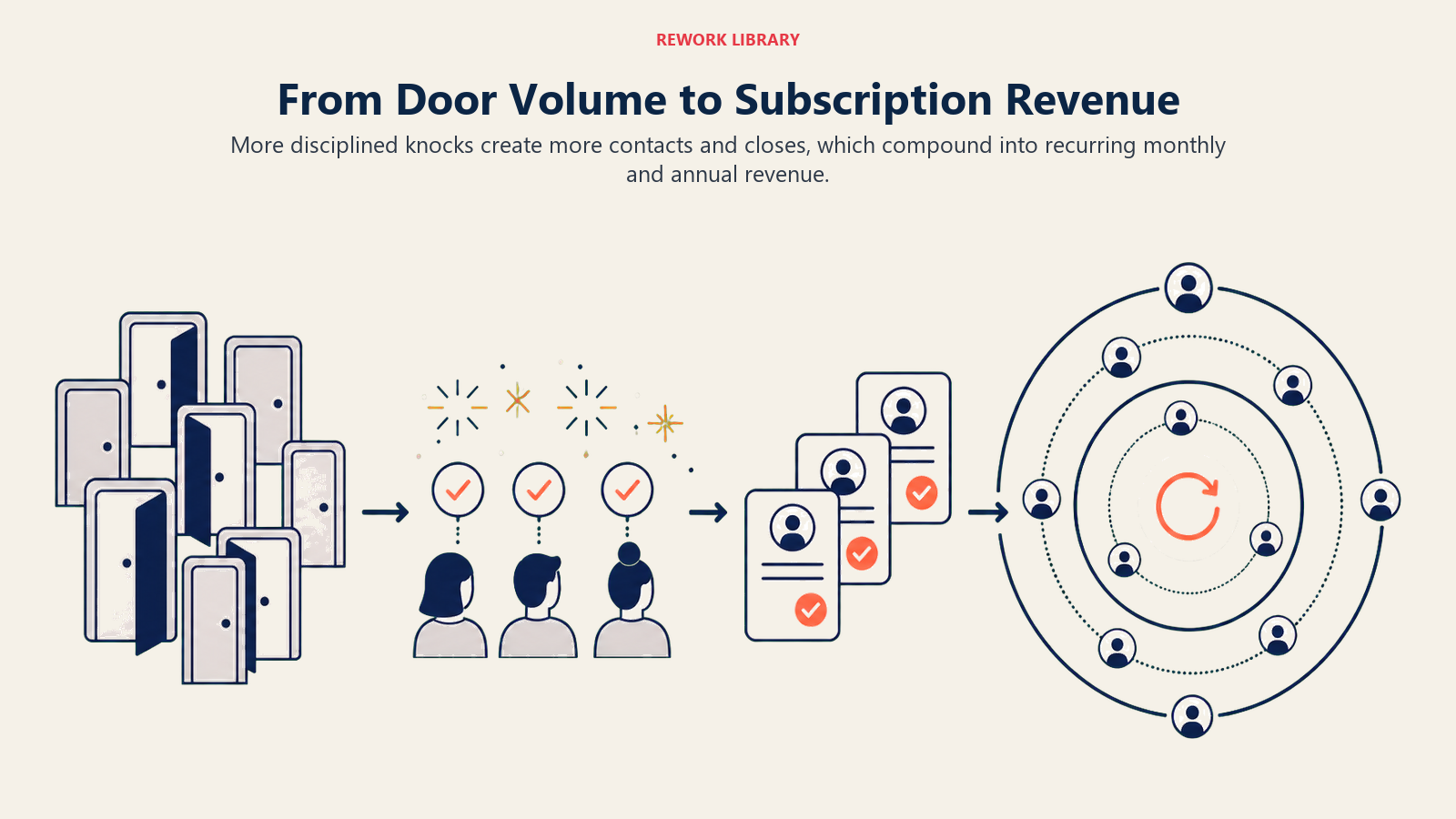
The compounding effect of small canvassing improvements, measured over the lifetime value of a subscription, is why subscription unit economics and LTV should be part of every rep's training context.
The US door-to-door industry generates approximately $30 billion in annual revenue, which means even a single-digit improvement in field rep productivity across a team translates to meaningful competitive advantage at scale. (SPOTIO)
When reps understand what each door is worth in lifetime value terms, not just commission terms, their approach to knocking the 85th door at 6:30 PM changes. The next question most reps have never been asked is exactly what happens at that door in the first 30 seconds, and why that window decides so much of the outcome.
Frequently Asked Questions about Canvassing Fundamentals and the Knock
What is a healthy contact rate for door-to-door canvassing?
A healthy D2D contact rate is 30 to 40%, meaning 3 to 4 out of every 10 doors knocked result in someone answering, according to SPOTIO research. Strong performers push this to 50 to 65% by concentrating knocks in the late afternoon and evening window (4:00 to 7:30 PM) when residents are most likely to be home.
How many doors should a D2D rep knock per day?
Average D2D reps knock 60 to 80 doors per day, while strong performers reach 85 to 110. The gap usually comes from route structure, not physical speed: reps with an organized pattern (box or anchor-and-expand) spend far less time walking back to cars or doubling over streets they've already worked.
What conversion rate should D2D teams expect at the door?
Industry benchmarks put D2D conversion at 2 to 5% of total doors knocked, according to SPOTIO data. That range sounds narrow, but it compounds significantly with volume: a rep knocking 100 doors per day at 4% conversion closes 4 subscriptions, while a rep knocking 60 doors at 3% closes fewer than 2.
Does the FTC have rules that apply to door-to-door sales?
Yes. The FTC's Cooling-Off Rule gives buyers a federally protected right to cancel D2D sales of $25 or more within three business days of purchase. Reps and companies must notify customers of this right at the time of sale, and failure to do so can invalidate the contract entirely. Full details are at the FTC's consumer site.
Why do D2D canvassing teams have high turnover, and what helps?
SPOTIO's 2026 State of Field Sales report found that 68% of field sales teams experience 30% or more annual turnover. D2D canvassing is physically demanding, involves high daily rejection, and often lacks structured energy management training. Teams that reduce turnover tend to invest in daily coaching rhythms, clear per-block performance targets, and realistic ramp expectations for new reps rather than expecting full productivity in the first weeks.
What should reps log at every door, including no-answers?
Every door attempt should get an entry: address, timestamp, outcome (no answer, short conversation, presentation, closed), and any relevant notes such as gate, dog, or callback request. No-answers are especially important to log because they are what makes contact rate calculable. Skipping them makes it impossible to distinguish a low-contact territory from a low-effort rep.
How does canvassing volume affect subscription revenue over time?
Because recurring subscription revenue compounds, even small canvassing improvements have outsized long-term impact. The National Pest Management Association reports that recurring revenue represents 85.2% of residential service revenue in the pest control industry alone. A rep who closes one additional subscription per day, at a $50 per month rate over a 24-month customer lifetime, adds $1,200 in committed future revenue per extra close: across a full month, that single incremental daily close adds $24,000 in recurring revenue commitments.
Related reading: The Door Approach and First 30 Seconds covers what happens the moment a homeowner opens the door. Territory Design and Assignment explains how good zones set reps up for canvassing success.
Learn more: D2D sales KPIs and metrics · Lead and rep performance dashboards · Solar canvassing and door-to-door · Solar lead qualification and prescreening

Senior Implementation Consultant
On this page
- What Actually Drives D2D Sales? The Knock Equation
- How Should Reps Move Through a Territory? Route Discipline
- What to Log at Each Door
- Contact Rate Management: Getting More Doors to Open
- Managing Energy Across a Full Shift
- The Role of Canvassing Apps in Field Discipline
- The Relationship Between Canvassing Volume and Subscription Revenue