Legal and Licensing for Door-to-Door Sales: What Every Home Services Company Must Know
Turn this article into takeaways for your work.


Each assistant summarizes the article only for you and suggests best practices for your work.
Most door-to-door sales managers think about legal compliance the same way they think about a car's spare tire: they know it exists, but they hope they never need it. That's a costly mistake in home services D2D. A single compliance violation can wipe out weeks of subscription revenue through forced cancellations, kill your ability to canvass an entire municipality, or expose your company to five-figure FTC penalties.
The good news is that the framework isn't complicated once you understand its three layers: federal rules, state-level licensing, and local ordinances. Each layer has teeth. And each one is entirely manageable with the right systems.
This guide covers the key legal obligations every pest control, home security, lawn care, and fiber/telecom D2D company should have locked down before a single rep knocks a door.
The FTC Cooling-Off Rule: Your Most Important Federal Obligation
The Federal Trade Commission's Cooling-Off Rule (16 CFR Part 429) is the foundational federal law for door-to-door sales. It applies to most sales of $25 or more made at a buyer's home or at locations other than the seller's normal place of business.
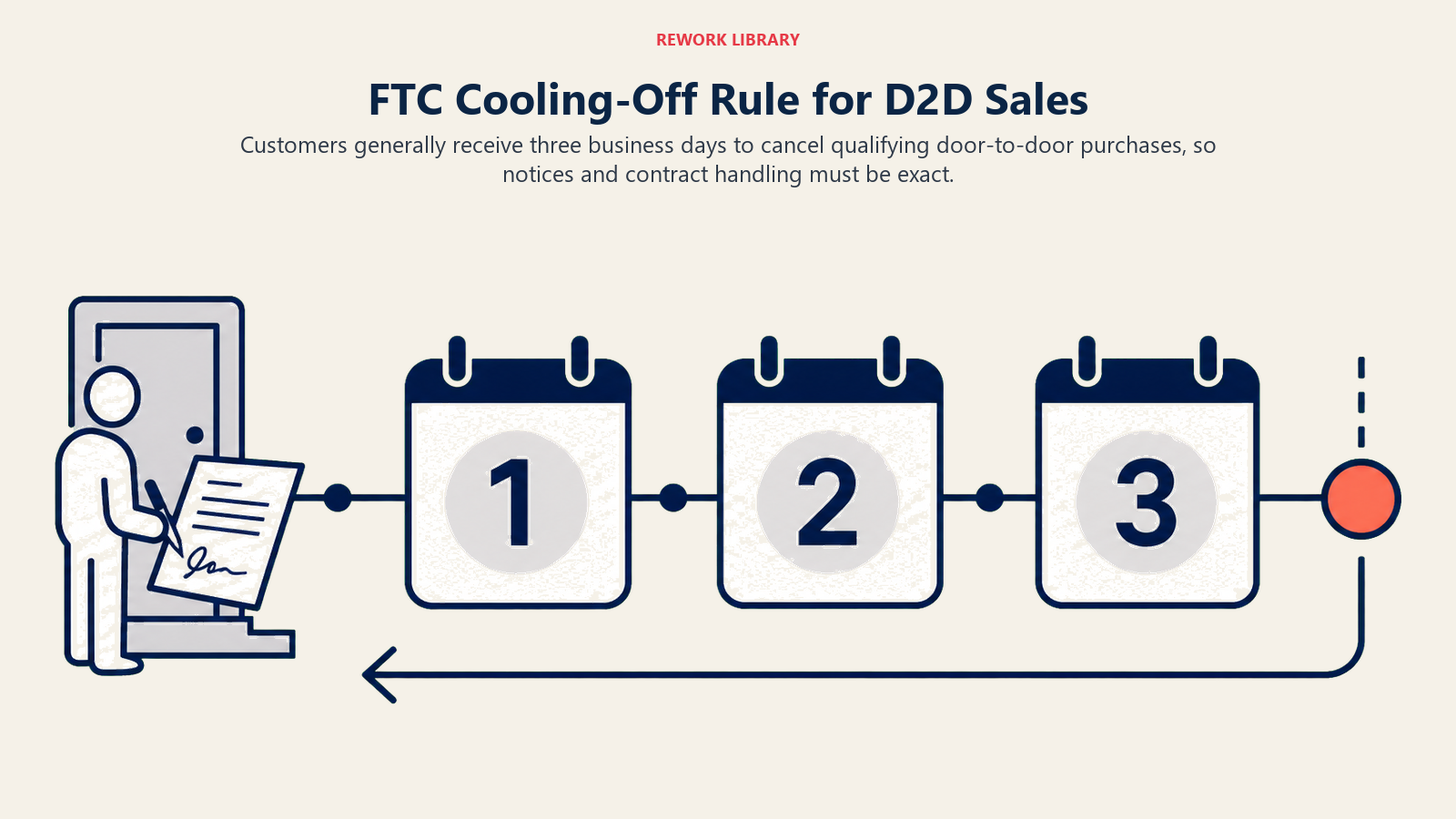
Under this rule, customers have three business days to cancel any qualifying door-to-door sale without penalty. "Business days" include Saturdays but exclude Sundays and federal holidays. The clock starts on the day the customer signs the contract, not on the day service begins.
What you must do at the point of sale:
| Requirement | Details |
|---|---|
| Provide a written cancellation notice | Two copies, in the same language as the contract |
| Include a cancellation form | Pre-addressed to your company, ready to mail or hand-deliver |
| State the cancellation deadline explicitly | "You may cancel this transaction without any penalty or obligation within three business days from the date of this transaction" |
| Inform the customer verbally | The rep must tell the customer about the right to cancel at the time of sale |
Failing to provide this notice doesn't just expose you to FTC enforcement. It actually extends the customer's right to cancel indefinitely. A customer who never received proper notice can legally cancel weeks or months later and demand a full refund. The FTC's consumer-facing Buyer's Remorse guide explains exactly what buyers are told about their rights, which is worth reading so your reps understand precisely what they're disclosing and why customers take it seriously.
What happens when a customer cancels:
You must refund all payments within 10 business days and return any traded-in goods or down payments. If you provided any services before cancellation, you can't charge for them if you failed to provide proper notice.
For recurring subscription contracts, the three-day window applies to the initial agreement. Make sure your contracts distinguish clearly between the "initiation" of a recurring subscription and the ongoing service relationship.
The practical implication for your sales team: build the cancellation disclosure into the closing script. Reps who rush past it or bury the forms in paperwork create legal exposure and, ironically, more cancellations down the line when customers feel tricked. Transparent disclosure actually reduces buyers' remorse. See ethical selling and buyers' remorse for how to frame this conversation well.
Key Facts
- The FTC Cooling-Off Rule (16 CFR Part 429) requires sellers to give buyers three business days to cancel any door-to-door sale of $25 or more. Failure to provide proper written notice extends the cancellation right indefinitely. (FTC)
- Failure to honor a Cooling-Off cancellation on time means the seller must refund all payments within 10 business days and cannot charge for any services delivered during the window, even if notice was not provided. (FTC Buyer's Remorse Guide)
- Starting with payments made after December 31, 2025, the IRS 1099-NEC reporting threshold for independent contractors rises from $600 to $2,000 (enacted under Section 70433 of the One Big Beautiful Bill Act). D2D companies paying reps as independent contractors must update their reporting workflows accordingly. (IRS)
Federal compliance is only the first layer. States add their own rules on top.
State-Level Licensing: It Varies More Than You Think
Beyond federal rules, most states require door-to-door sellers to carry a state-issued solicitor's license or seller's permit. The specifics vary widely.
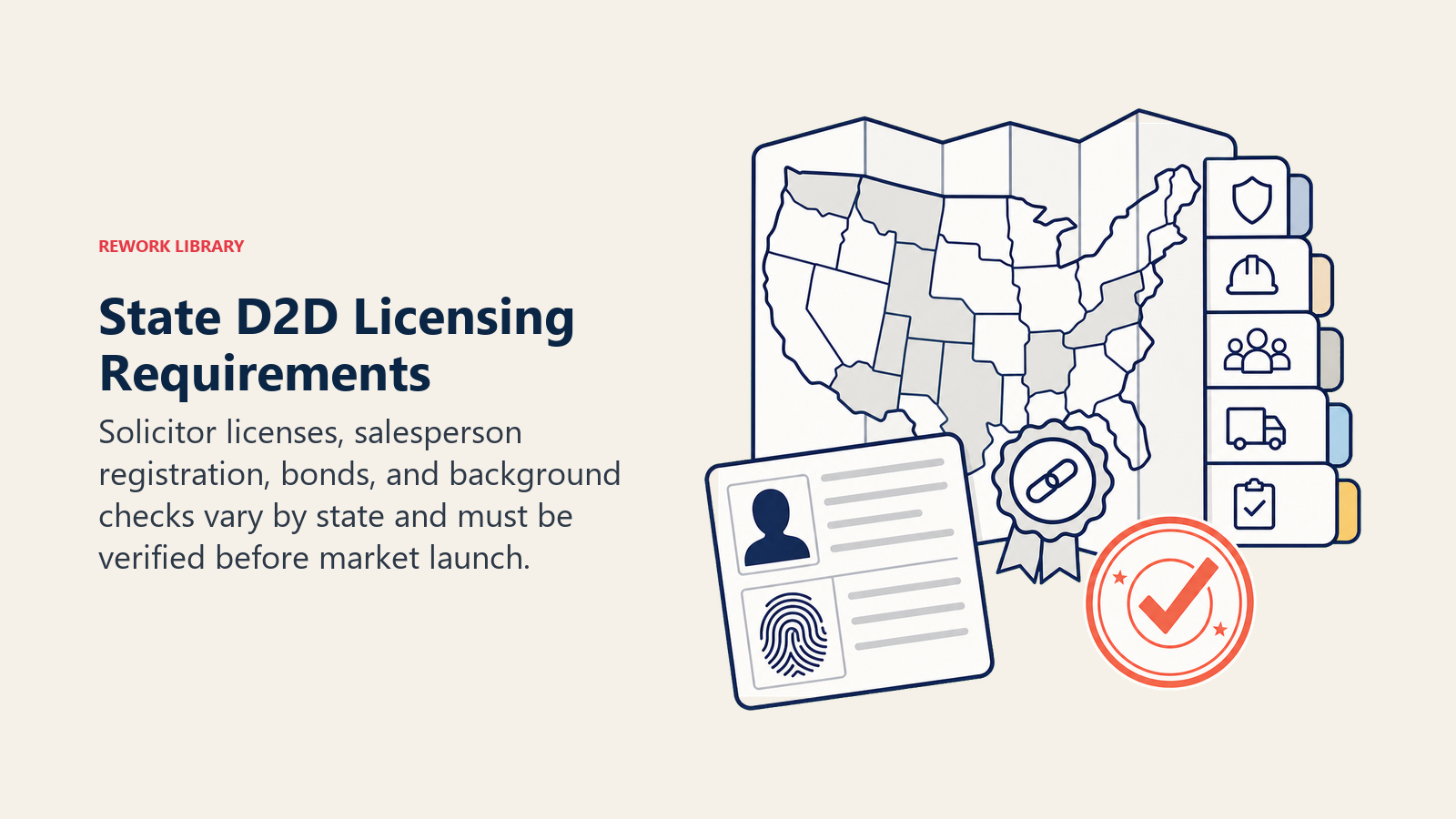
Common state-level requirements:
- Background check: Most states require solicitors to clear a criminal background check before receiving a license. Some states require reps to carry the license on them while canvassing.
- Surety bond: Several states require a surety bond (typically $5,000 to $25,000) as financial protection for consumers. If your company fails to honor a cancellation or refund, the bond covers it.
- Disclosure on identification: Some states mandate that reps wear visible identification badges showing their name, the company name, and their license number.
- Registration of the employing company: Many states require the company, not just individual reps, to register as a direct-selling organization.
Industry-specific overlays add another layer. Pest control companies typically need separate pesticide applicator licenses in every state they operate. Home security companies must often hold alarm company licenses at the state level, a requirement tracked and advocated for by the Electronic Security Association, the primary trade body for alarm and monitoring companies in the U.S. Fiber and telecom providers may need to register with state public utilities commissions.
Practical checklist before expanding to a new state:
- Confirm state solicitor licensing requirements
- Check industry-specific licensing (pest, alarm, telecom as applicable)
- Confirm bonding requirements and secure a bond if needed
- Verify whether your company, your reps, or both need licenses
- Order background checks for all reps who will canvass in that state
- Confirm whether reps must carry physical licenses while in the field
Some states update these requirements frequently. Building a compliance calendar with quarterly reviews per state keeps you from getting caught off-guard. Assign one person ownership of this calendar, whether that's your operations manager or a compliance counsel.
Local Permits: The Layer Most Companies Miss
Even if you're clean at the federal and state level, local governments can still shut down your canvassing operation. Cities, towns, and counties have broad authority to regulate door-to-door solicitation within their boundaries. Common local permit requirements:
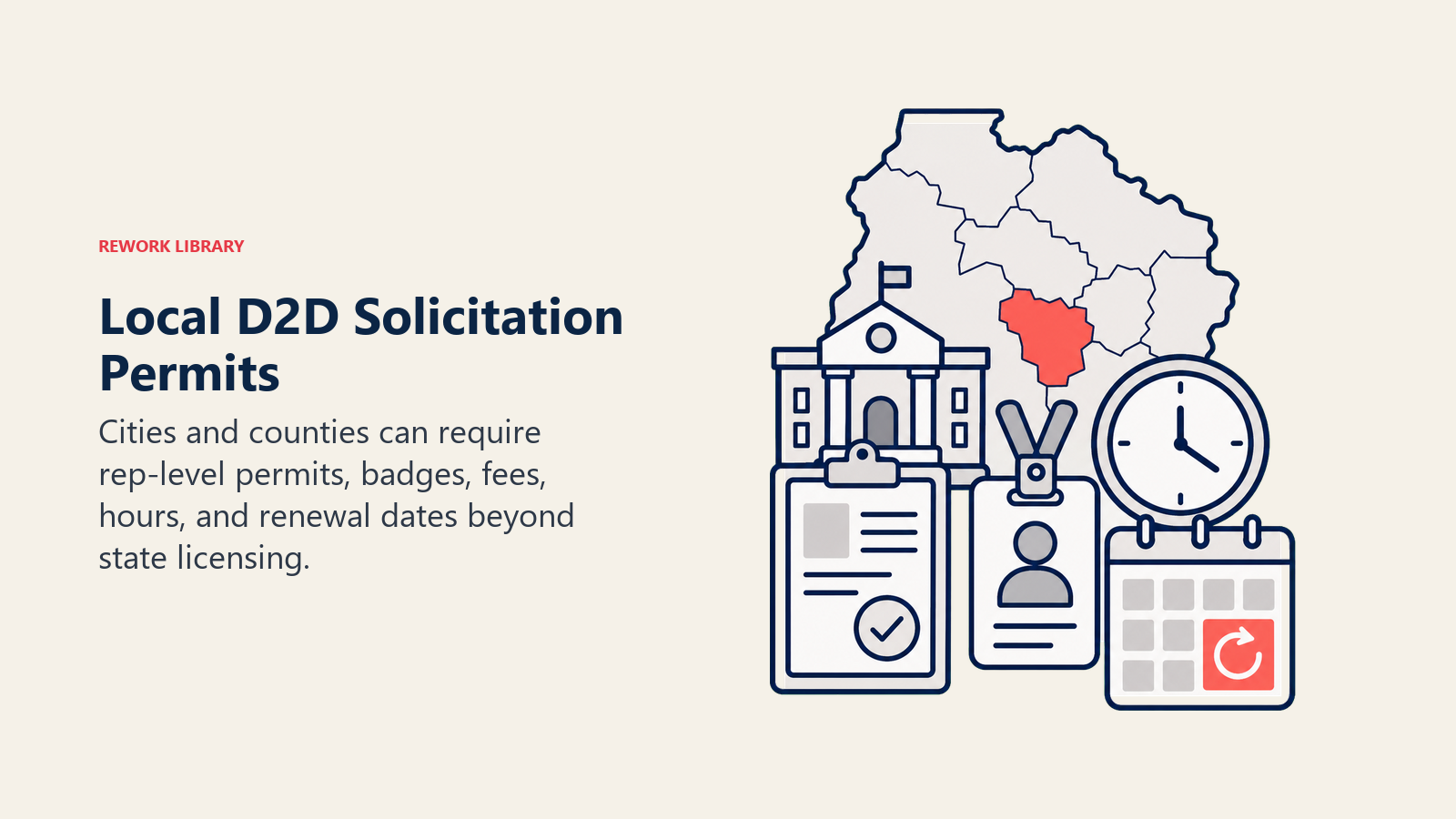
Most municipalities require solicitors to obtain a local peddler's or solicitor's permit before canvassing. The application process typically involves:
- Submitting company registration documents
- Providing a list of reps who will canvass (sometimes with photos)
- Paying a per-rep or per-company permit fee (typically $10 to $100)
- Waiting for approval, which can take days to weeks
Some cities require permits to be renewed monthly. Others require a new permit every time you add a rep to the roster. If your territory management relies on rapidly deploying new reps into a new city, permit lead time needs to be baked into your territory design and assignment process.
Failure to hold a valid local permit can result in immediate removal from the territory, fines assessed per rep per day of unlicensed canvassing, and in repeat cases, permanent bans from canvassing within that jurisdiction.
Tracking local permits at scale:
If you operate in dozens of cities, a spreadsheet won't cut it. You need a system that tracks:
- Permit status by city (active, pending, expired, banned)
- Renewal dates
- Rep-level permit assignments where required
- Fee payment records
This is especially important for seasonal and summer sales programs, where you might staff up quickly in new territories and outpace your permit coverage.
Do-Not-Knock Registries: The Lists Your Reps Must Check
Many municipalities maintain Do-Not-Knock (DNK) registries, which are official lists of households that have opted out of door-to-door solicitation. These are distinct from the federal Do-Not-Call Registry, which governs phone outreach, not in-person visits.
Visiting a household on a DNK registry can result in:
- Immediate permit revocation
- Per-visit fines
- Criminal trespass charges in some jurisdictions
How DNK registries work:
Residents sign up directly with their city or county. The registry is then made available to solicitors, usually downloadable as a spreadsheet or address list. Some jurisdictions update their registry monthly; others update it in real time.
Your obligation is to cross-reference your canvassing routes against the current registry before deploying reps into a territory. This isn't a one-time check. If you're canvassing the same neighborhood over multiple weeks, you need to refresh the list before each deployment.
Some properties also display physical "No Soliciting" or "Do Not Knock" signs. While these signs don't have universal legal force, many local ordinances treat them the same as a DNK registration. Train your reps to respect these signs even when they're not on the official registry.
Integrating DNK scrubbing into your canvassing fundamentals and knock process is the cleanest approach. The list check happens before the territory goes into your D2D CRM and canvassing app, so reps never see a flagged address as a knock.
What Are Green-River Ordinances and When Can They Shut Down Your Operation?
Green-river ordinances are local laws that prohibit door-to-door solicitation unless the resident has previously invited the solicitor. They're named after Green River, Wyoming, which passed one of the earliest versions in 1931. The practical effect: in a city with an active green-river ordinance, unsolicited door-to-door selling is illegal by default. Every homeowner on a route is presumed to have said "no" unless they've explicitly requested a visit.
Current landscape:
Green-river ordinances exist in hundreds of municipalities across the US, though enforcement varies enormously. Some cities actively enforce them; others have the ordinance on the books but don't pursue it unless residents complain. Before entering a new market, verify whether your target cities have active green-river ordinances.
This matters particularly for expansion planning. A city that looks attractive on paper because of its demographics and density might have a green-river ordinance that makes canvassing legally impossible without significant pre-qualification infrastructure (such as referral-based appointments or inbound lead campaigns).
Navigating green-river cities:
Options for operating in green-river jurisdictions include:
| Approach | How it works | Effort level |
|---|---|---|
| Referral-only D2D | Only knock doors where existing customers have made a referral | Medium |
| Inbound appointment setting | Drive inbound interest via digital/mail, then send reps to those homes | High |
| Event-based selling | Set up at community events, fairs, or retail locations | Medium |
| Advocate knocking | Knock a neighbor's door when invited by a current customer on the street | Low |
Some companies use a two-step model in green-river markets: a postcard or digital touch establishes the "prior contact," and the rep follows up as an invited visitor. Consult legal counsel on whether your specific approach satisfies local ordinance requirements before deploying it at scale.
Building a Compliance System That Scales
For a small team working one market, compliance is manageable with a checklist. For a company running hundreds of reps across multiple states and dozens of cities, it needs to be a system. The Federal-State-Local (FSL) Compliance Stack: the three-layer framework every D2D home services company must clear before deploying reps. Federal compliance means Cooling-Off disclosures, cancellation forms, and refund processing are built into the close and post-sale workflow. State compliance means solicitor licenses, industry-specific permits (pest applicator, alarm company, telecom registration), and surety bonds are in place for every state of operation. Local compliance means city permits are active, Do-Not-Knock lists are loaded into the canvassing app, and green-river ordinance status is confirmed before any rep touches a door in that municipality. The FSL Stack treats compliance not as a legal function but as a pre-launch operations checklist, because a single layer failure can shut down canvassing at any time.
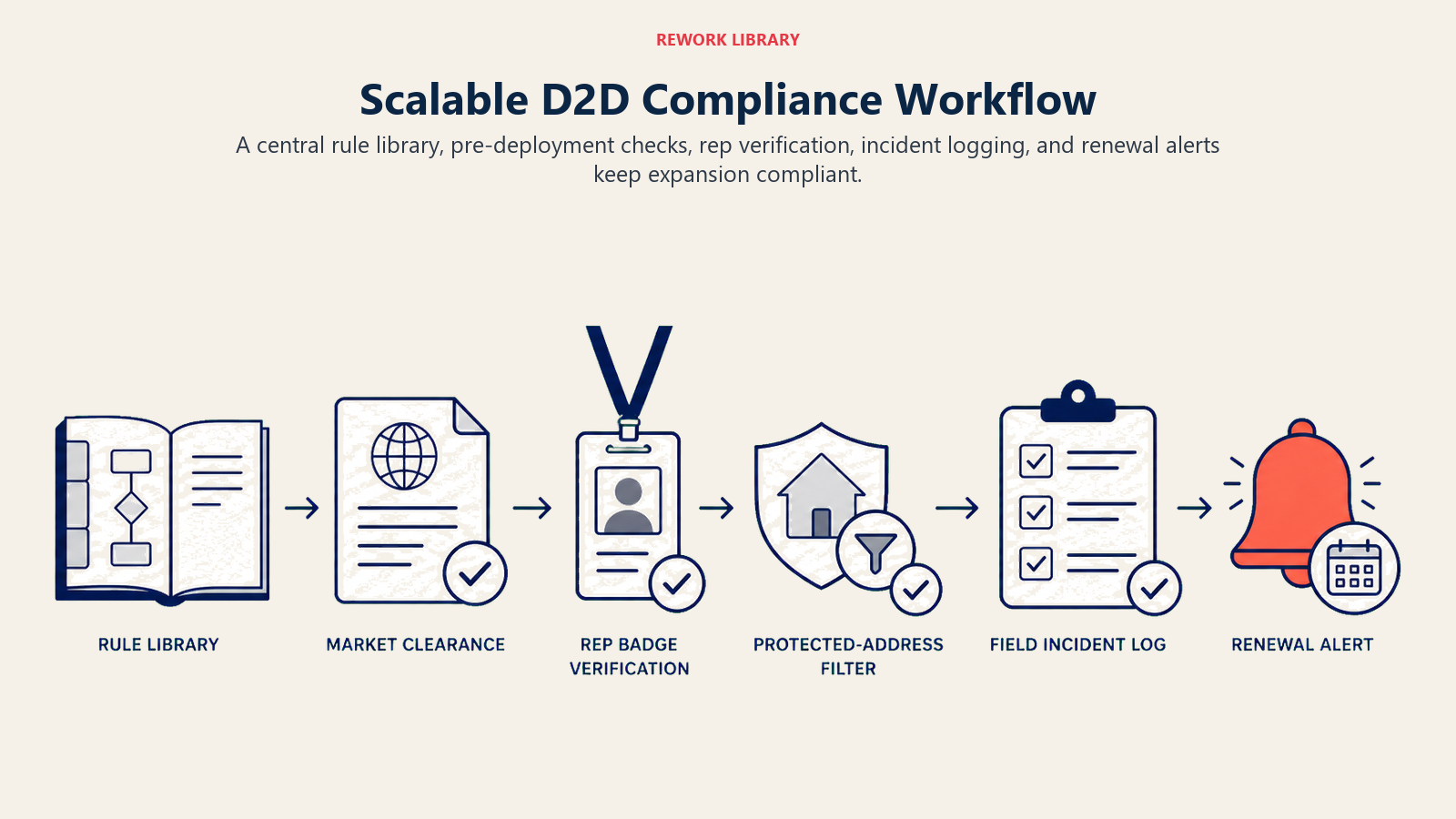
Core elements of a scalable compliance system:
Rep onboarding: Every new rep completes compliance training before they knock a single door. This covers the Cooling-Off Rule disclosure, local permit requirements for their assigned territory, DNK list procedures, and how to handle a resident who claims the rep is violating a local ordinance.
Territory clearance: Before a territory goes live, a designated compliance owner confirms: local permit is active, DNK list has been downloaded and loaded into the canvassing app, no green-river ordinance blocks standard D2D, and any state-level rep licensing is current.
Cancellation processing: Build a dedicated workflow for Cooling-Off cancellations. The moment a cancellation request comes in, it should trigger a same-day service hold (or cancellation if within the window) and a refund initiation. Don't let this fall into a general customer service queue where it might sit past the 10-day refund deadline.
Incident tracking: When a rep gets a complaint, a citation, or a removal notice, log it immediately. Patterns in specific territories often signal a compliance gap that will only get worse.
1099-NEC reporting update: If your reps are classified as independent contractors, note that the threshold for filing Form 1099-NEC rises from $600 to $2,000 for payments made after December 31, 2025, under Section 70433 of the One Big Beautiful Bill Act. This does not change the underlying tax liability for reps (all income remains reportable to the IRS regardless of whether a form is issued), but it does reduce the paperwork burden for companies paying lower-volume seasonal contractors. Update your payroll or contractor management system to reflect the new threshold before the 2026 filing season. (IRS reporting guidance)
Compliance also connects directly to your retention metrics. Customers who felt their rights weren't respected at the point of sale cancel faster and complain more. The relationship between clean selling practices and reduced early cancellations is direct.
Ethical selling and airtight compliance turn out to be the same discipline viewed from two angles.
Quotable Nuggets
"Failing to provide the FTC's required cancellation notice doesn't just create enforcement risk. It actually extends the customer's right to cancel indefinitely, meaning a customer who never received proper notice can legally cancel and demand a full refund weeks or months after the sale." (FTC Cooling-Off Rule, 16 CFR Part 429)
"Green-river ordinances exist in hundreds of municipalities across the U.S. In those jurisdictions, every homeowner is presumed to have opted out of door-to-door solicitation unless they've explicitly requested a visit, making unsolicited canvassing illegal by default." (First Amendment Encyclopedia, MTSU)
"The Electronic Security Association tracks licensing requirements across all 50 states for alarm companies, and those requirements change frequently. A compliant security D2D operation today may need a new state license next quarter if a legislature updates its requirements." (ESA State Licensing Guide)
Frequently Asked Questions about Legal and Licensing for Door-to-Door Sales
What is the FTC Cooling-Off Rule and how does it apply to D2D sales?
The FTC's Cooling-Off Rule (16 CFR Part 429) gives buyers three business days to cancel any door-to-door sale of $25 or more without penalty. Sellers must provide two copies of a cancellation form at the point of sale and verbally inform the buyer of their right to cancel. If the required notice isn't provided, the customer's right to cancel extends indefinitely.
What happens if a customer cancels under the Cooling-Off Rule?
You must refund all payments within 10 business days and return any traded-in goods or down payments. If services were delivered before the cancellation but you failed to provide proper notice, you cannot charge for them. For recurring subscription contracts, the three-day window applies to the initial service agreement.
Do state solicitor licenses apply to individual reps, the company, or both?
It varies by state. Some states require the company to register as a direct-selling organization and require each rep to individually hold a license. Others require only company-level registration. Several states require reps to carry a physical license while canvassing. Check each state's solicitor licensing requirements before deploying reps there.
What is a Do-Not-Knock registry and how should companies manage it?
A DNK registry is a municipal list of households that have opted out of door-to-door solicitation. Unlike the federal Do-Not-Call Registry (which covers phone outreach), DNK registries cover in-person visits. Visiting a registered household can result in immediate permit revocation, per-visit fines, or trespassing charges. Companies should download the current registry for each city and load it into their canvassing app before each deployment.
Can a city completely ban door-to-door sales?
Effectively, yes. Green-river ordinances prohibit unsolicited D2D selling within a municipality. They exist in hundreds of U.S. cities. In those jurisdictions, canvassing must be invitation-based (referrals from existing customers, prior contact via direct mail, or event-based selling) rather than cold-knock. Confirm green-river ordinance status before entering any new market.
What does the 2026 1099-NEC threshold change mean for D2D companies?
The threshold for filing Form 1099-NEC with the IRS rose from $600 to $2,000 for payments made after December 31, 2025. Companies paying D2D reps as independent contractors only need to issue a 1099-NEC when total payments reach $2,000 or more in 2026. But contractors are still legally required to report all income regardless of whether they receive a form, so this change reduces paperwork, not tax liability.
What industry-specific licenses do pest control D2D companies need beyond general solicitor licenses?
Most states require pest control companies to hold separate pesticide applicator licenses, which govern who can apply chemicals, not just who can sell the service. Reps who discuss specific treatment methods during the pitch may need to be licensed applicators or be careful about what they promise. State agriculture departments typically regulate these licenses. Requirements vary significantly across states, so verify before expanding into new markets.
Quick-Reference Compliance Checklist
Use this before deploying reps into any new territory: Federal (one-time setup):
- Cooling-Off Rule disclosure forms in contract packet
- Verbal cancellation disclosure scripted into close
- Refund processing workflow defined (within 10 business days)
State (per state of operation):
- State solicitor licenses obtained for company and/or reps
- Industry-specific licenses confirmed (pest, alarm, telecom)
- Surety bond in place if required
- Rep ID badge requirements met
Local (per city/municipality):
- Local solicitor permit active
- DNK list downloaded and loaded into canvassing app
- Green-river ordinance status confirmed
- Physical "No Soliciting" signs training complete
Compliance isn't a one-time project. It's an ongoing operating discipline. The companies that treat it as a system rather than a checklist are the ones that scale into new markets without costly interruptions.
Learn more:
- Reducing early cancellations
- Lead qualification frameworks (lead management library)
- Solar canvassing and door-to-door techniques
Related reading: Territory Design and Assignment covers how to build compliant canvassing zones from the ground up. Ethical Selling and Buyers' Remorse addresses the sales behaviors that reduce post-close cancellations.

Senior Implementation Consultant
On this page
- The FTC Cooling-Off Rule: Your Most Important Federal Obligation
- State-Level Licensing: It Varies More Than You Think
- Local Permits: The Layer Most Companies Miss
- Do-Not-Knock Registries: The Lists Your Reps Must Check
- What Are Green-River Ordinances and When Can They Shut Down Your Operation?
- Building a Compliance System That Scales
- Quick-Reference Compliance Checklist