Qualifying at the Door: How to Spot Real Buyers in 60 Seconds
Turn this article into takeaways for your work.


Each assistant summarizes the article only for you and suggests best practices for your work.
The fastest way to kill your close rate is spending 20 minutes pitching someone who rents the house, doesn't pay the bills, or already has a competing service locked in for two more years. Door-to-door, or D2D, qualification isn't a step you do after the pitch. It's something that happens in the first 60 seconds, before you've committed a single minute of real sales energy.
This guide covers what qualification actually looks like at the door for recurring-service D2D businesses: security, pest control, lawn care, and fiber internet. You'll get the questions to ask, the signals to read, and the decision rules that tell you when to move on fast.
On any given residential street, a meaningful share of doors open to a renter who simply can't sign a service contract. The U.S. Census Bureau's Housing Vacancies and Homeownership data shows that roughly 65% of U.S. households are owner-occupied nationally, with suburban areas running closer to 73%. That gap is exactly why the ownership check is your single highest-leverage qualifying question.
Why Qualification Fails at the Door
Most reps skip qualifying because they're afraid of getting a "no" before they've had a chance to pitch. So they launch straight into their opener and spend 15 minutes on a renter who has zero decision-making power, or a homeowner who just signed a 3-year ADT contract last month.
That's not a sales problem. It's a time-management problem. A rep working a good territory can knock 30-40 doors in an afternoon. Wasting three pitches on unqualifiable households costs you six to eight knockable doors. Over a week, that's the difference between hitting quota and falling short.
The fix isn't a longer script. It's a short, conversational qualification sequence you run before you go deeper into your pitch.
Key Facts: D2D Lead Qualification
- Healthy D2D teams achieve a contact rate of 30-40% of doors knocked, meaning the majority of doors yield no conversation at all (SPOTIO)
- D2D teams convert at 2-5% of doors knocked on average, making every wasted pitch on an unqualified prospect a meaningful drag on revenue (SPOTIO)
- Field reps spend 37% of their workweek in face-to-face selling, so protecting that time with fast qualification is one of the highest-leverage habits a rep can build (SPOTIO 2026 State of Field Sales)
The Four Qualification Dimensions for D2D Subscriptions
The Four-Gate Qualification Framework: a sequential four-check process run in the first 60 seconds at the door, confirming ownership, decision authority, contract status, and financial fit before a single minute of pitch energy is spent.
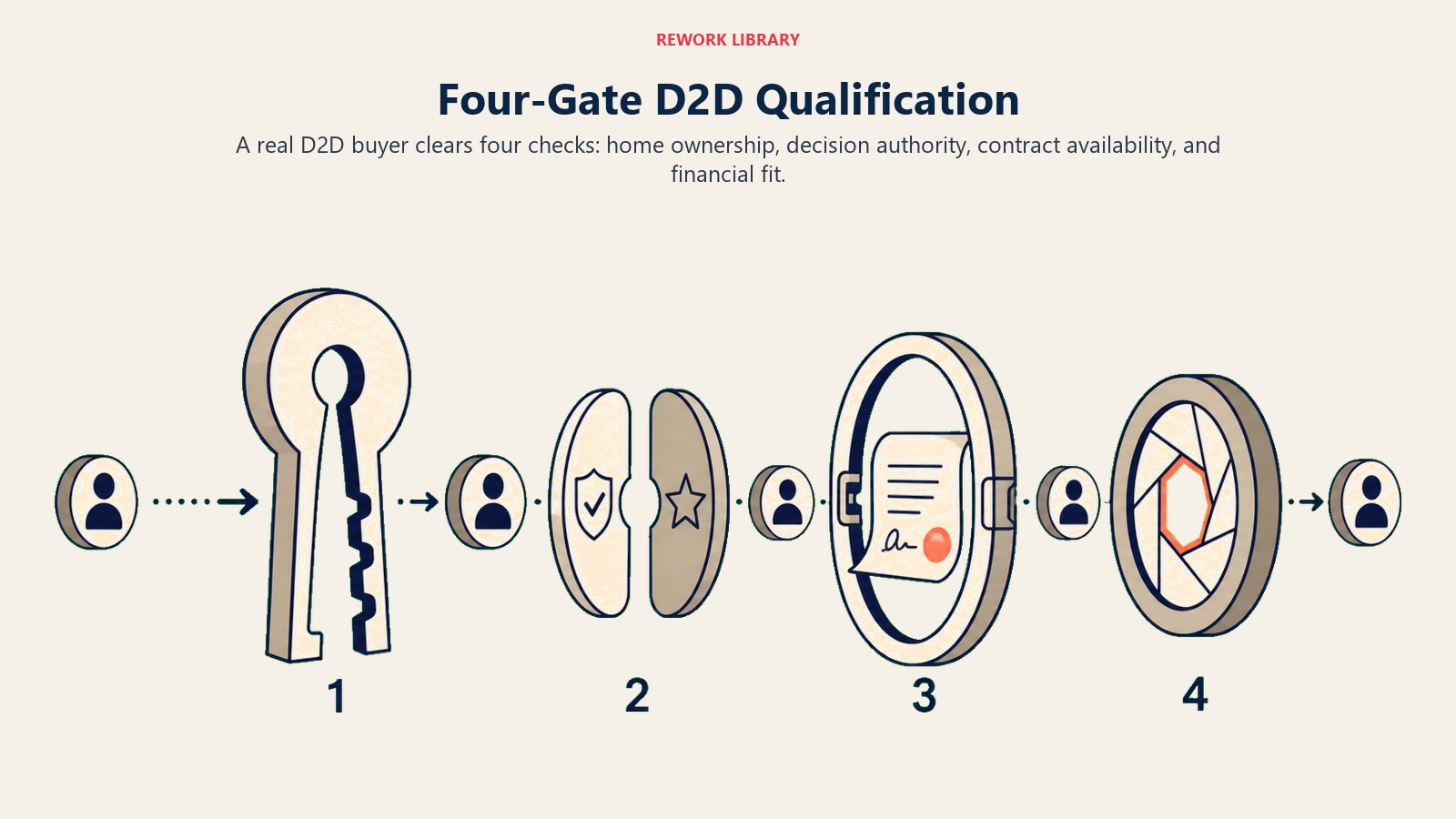
Every recurring-service sale depends on four things being true about the person at the door. Think of these as the four gates your prospect has to pass through before your pitch is worth delivering.
| Gate | Question You're Answering | Why It Matters |
|---|---|---|
| Ownership | Does this person own the home? | Renters can't sign a service contract |
| Decision authority | If they own, can they decide alone? | Spouse-absent households often stall |
| Existing contract | Is there a competing service already in place? | Lock-in windows close opportunities |
| Financial fit | Does the home profile match your service tier? | Some homes simply won't convert |
A prospect who clears all four is a real buyer. Missing one doesn't always disqualify them, but it changes how you position the next 10 minutes.
The Qualification Sequence
Don't fire these as interrogation questions. Weave them into natural conversation during your opening exchange. Here's a framework that feels human and still gets you the information you need.
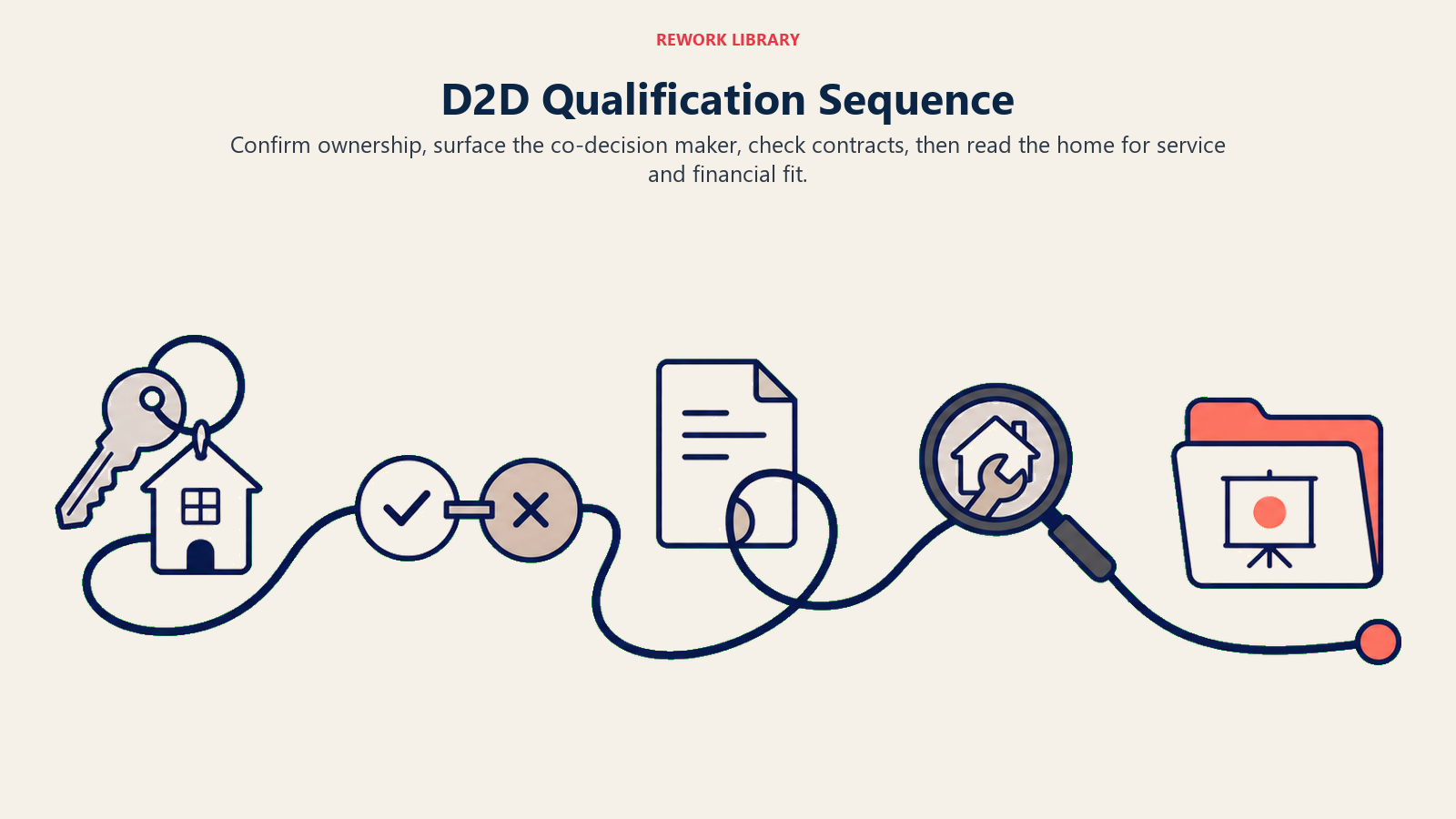
Step 1: Confirm ownership before anything else
As you introduce yourself, build the ownership check into your context-setting:
"Hi, I'm [name] with [Company]. We're actually working with homeowners on your street who have been dealing with [specific problem: mosquitoes / break-ins / spotty internet]. Do you own this home?"
The word "homeowners" primes the question without it feeling like an interrogation. If they say they rent, thank them and move on. Don't pitch renters.
Step 2: Check for a co-decision maker
If they own the home but their partner isn't present, you want to know that now, not after a 20-minute presentation.
"Is your [spouse / partner / the other person on the property] home today? I'd love for both of you to hear this since it affects the whole household."
This does two things. It respects the family dynamic, and it surfaces a potential stall point early. If the partner isn't home and the owner says they need to check with them, you can either reschedule or do a shorter mini-pitch and come back for the full sit-down.
Step 3: Surface any existing contracts
For security, pest, and internet: ask about current service in a way that opens a conversation rather than triggering defensiveness.
"Are you currently using a [security / pest / internet] provider, or is that something you haven't gotten around to setting up yet?"
If they have a service, your follow-up question is: "How long have you been with them?" If they're 18+ months in, ask if they've ever looked at alternatives. A lot of homeowners stay with a provider out of inertia, not loyalty. If they're locked into a contract with less than six months left, flag it, get their contact info, and come back.
Step 4: Read the home for financial fit
You can't ask "can you afford this?" at the door. But you can read signals. A well-maintained lawn signals someone who cares about their property (good for lawn or pest). A newer door security camera already installed signals tech comfort (good for smart security). A satellite dish on the side of the house signals someone who has been paying for TV/internet bundles (possibly a good fiber target if they're frustrated with current speeds).
Match your read to your service. For lawn care, look at grass condition. For fiber, look for cable lines and older equipment. For security, look at entry points and neighborhood context.
What Non-Verbal Signals Tell You About Qualification?
What people say matters. What they do matters more. Here are the behavioral signals good D2D reps learn to read fast.
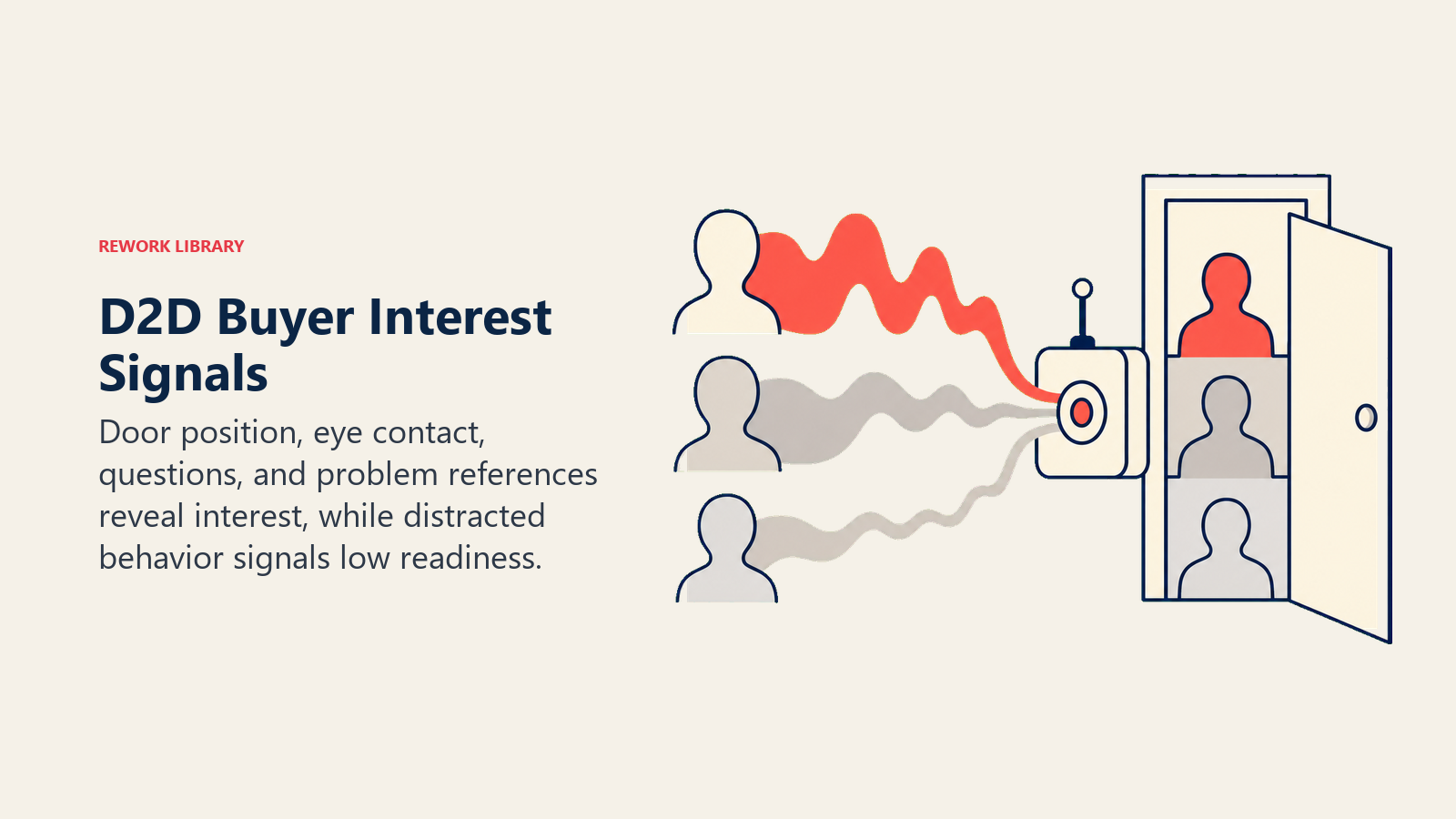
Signals that suggest real interest:
- They step outside or open the door wider
- They make eye contact and ask follow-up questions
- They reference a recent problem ("actually, we've been getting ants lately")
- They mention a neighbor who mentioned the service
Signals that suggest low probability:
- They stay behind a screen door and don't open it
- They say "just leave some information"
- They immediately reference a recent competitor interaction ("we just talked to someone from ")
- They keep glancing back inside (distracted, time-pressured)
Signals that are neutral (don't over-read):
- Arms crossed (sometimes just cold, not hostile)
- Short answers (some people are just private)
- Saying "I'm not interested" in the first five seconds (this is a reflex, not a decision)
The third category is where most reps give up too soon. A polite redirect to your qualification question can shift the conversation: "Totally fair, I won't take much of your time. I just want to ask one quick thing..."
When Should You Keep Going vs. Walk Away?
Use this decision tree at the door:
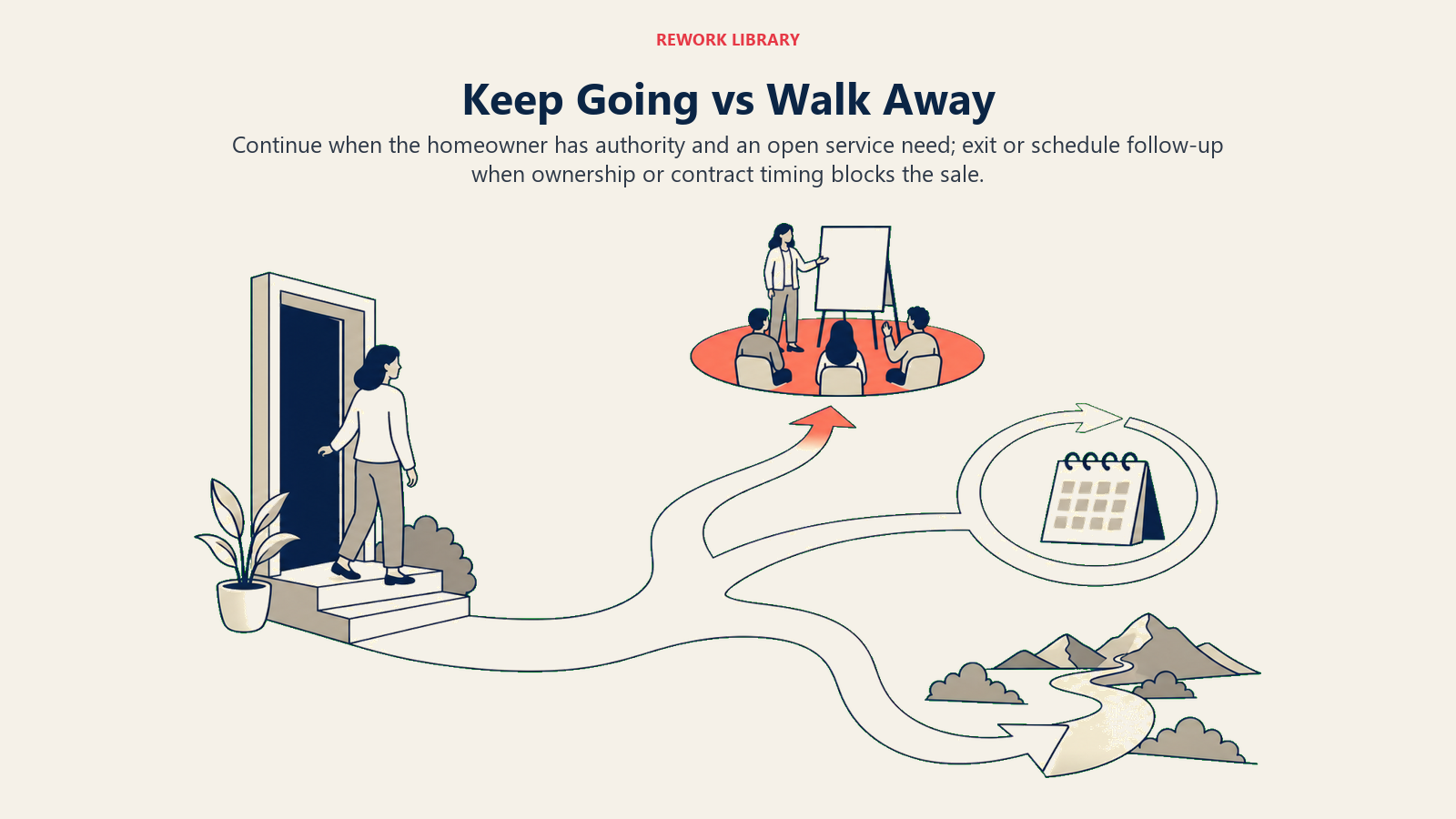
Did they answer the door?
  No -> Note the home, skip for now, come back later in the route
  Yes ->
    Do they own the home?
      No -> Thank them, move on
      Yes ->
        Do they have a competing service?
          Yes, and under contract with 6+ months left -> Get contact info, schedule a callback
          Yes, but out of contract or month-to-month -> Continue with pitch
          No -> Green light, proceed
This isn't about being mechanical. It's about protecting your time and the homeowner's time. Most people appreciate a rep who reads the situation and doesn't waste their afternoon.
A rep who qualifies fast and pitches fewer people will consistently outperform one who pitches everyone, because real pipeline quality drives close rate more than raw volume does.
Qualification for Each D2D Vertical
The core framework above applies across all recurring-service D2D. But each vertical has a specific wrinkle.
Security: The biggest qualifier beyond ownership is emotional. Has the household experienced a break-in or a crime event nearby? Ask: "Have you heard about anything happening in the area lately?" If they have, your qualification conversation becomes your pitch setup.
Pest control: Seasonal timing matters. Qualifying in February for mosquito service is an uphill battle in most markets. But qualifying at the right time of year, when homeowners have already started seeing bugs, means your qualification question almost answers itself. The National Pest Management Association reports that over 13.25 million U.S. households already receive professional recurring pest control, with that number growing at nearly 8% annually. Most of those customers converted because a rep caught them at the right seasonal moment with the right opening question.
Lawn care: Check the grass before they open the door. If the lawn is dead or overgrown, they either don't care or can't afford care. Both are low-probability. The best lawn care prospects have decent but not great lawns and clear signs they maintain but are frustrated with the results.
Fiber internet: Ask about their current provider before anything else. If they're with a cable company and paying for bundled services, they're likely a good candidate. If they already have fiber from a competitor, find out if they signed a contract or are month-to-month.
Qualifying as Part of Your Funnel
Qualification at the door is the first real filter in your door-to-door sales funnel. It feeds directly into your pipeline numbers. If you're closing at 15% of pitches but only qualifying 40% of contacts, that's a very different problem than closing at 15% and qualifying 80%. The upstream filters change everything about how you hit your daily numbers.
The most consistent reps track their qualification rate alongside their close rate. If you're pitching everyone and closing few, you probably need to qualify harder. If you're qualifying aggressively but still not converting, the pitch is the problem.
For a formal framework on how to structure your qualification criteria into a scoring model, see lead qualification frameworks. The principles from inbound lead management translate well to building consistent D2D qualification standards across your rep team.
Handling Common Pushback at the Qualification Stage
"I'm not interested." This is almost always a reflex. Respond with: "No problem at all. I just have one quick question before I let you go..." Then ask your ownership or contract question. You'll be surprised how many people answer and re-engage.
"We already have [Competitor]." Don't compete yet. Just ask: "How long have you been with them?" and "Have you been happy with the service?" Two questions. If they light up with complaints, you're back in the conversation.
"Can you just leave a flyer?" This is a polite dismissal. You can say: "Of course. I just want to make sure it's relevant to your situation first. Do you own the home?" You've restarted the conversation without being pushy.
"My husband/wife handles this." Ask when the partner will be around and offer to come back. This keeps the door open and positions you as respectful rather than aggressive.
Building a Team-Wide Qualification Standard
If you manage a team of reps, qualification consistency is one of the biggest levers you have. Reps who don't qualify generate inflated pipeline numbers and poor close rates. Reps who over-qualify never pitch enough people.
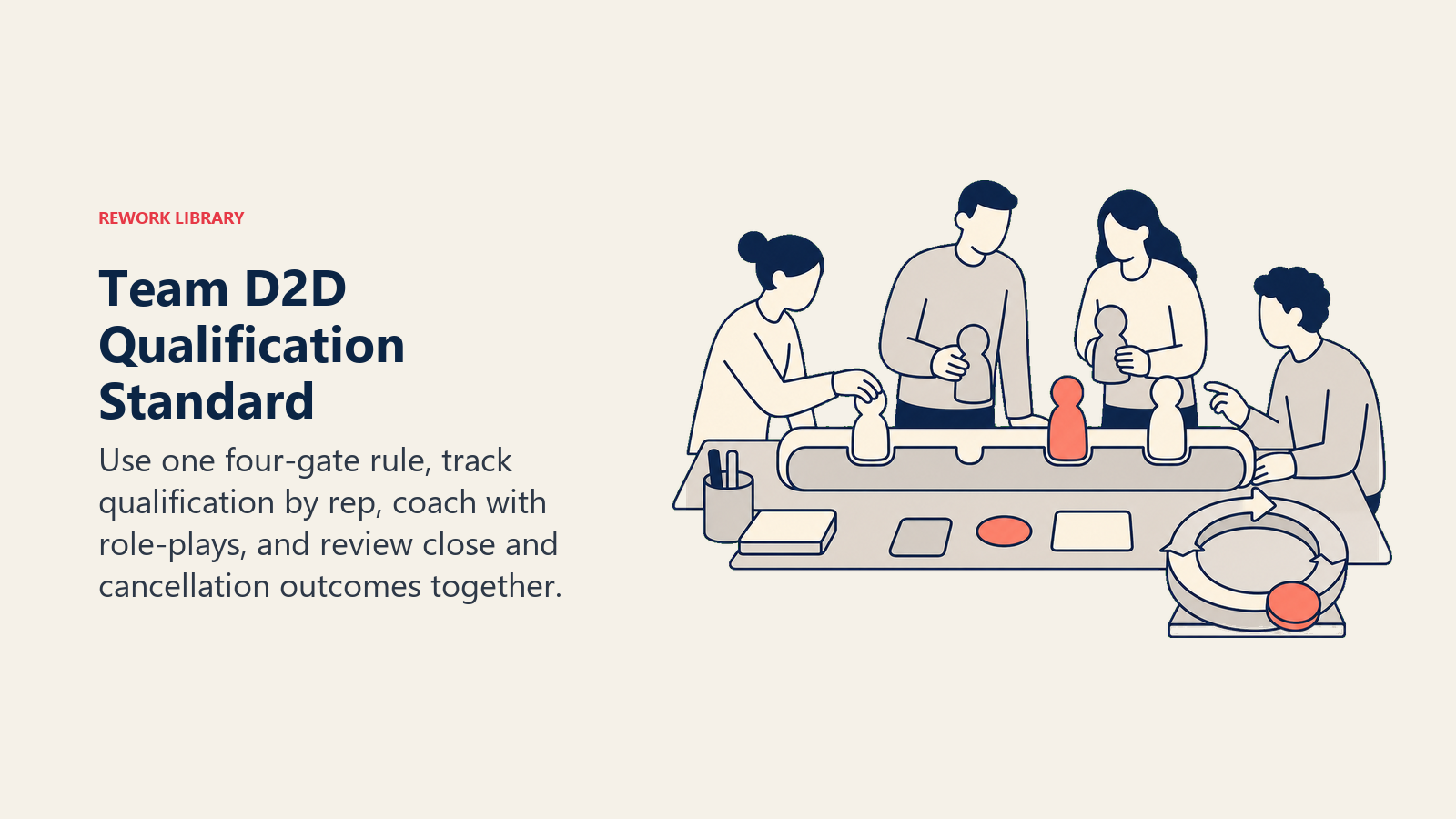
A good standard for a recurring-service D2D team:
- Qualify at least 3 of 4 gates before committing to a full pitch
- Track qualification rate per rep in your D2D CRM or canvassing app
- Include qualification role-plays in weekly coaching and ride-alongs (see coaching and ride-alongs culture)
- Review D2D sales KPIs and metrics weekly to spot reps who pitch everyone vs. reps who qualify nothing
The goal is a team where every rep makes fast, confident decisions at the door, keeps their energy for real opportunities, and closes at a rate that reflects genuine pipeline quality.
Teams that invest at least 3 hours of weekly coaching and ride-along feedback retain reps 30% longer, according to SalesRabbit's 2025 Field Sales Report. Qualification practice belongs in that coaching time, not just pipeline review.
For a deeper look at how qualification connects to the broader opportunity evaluation process, opportunity qualification is a strong cross-reference.
The One-Sentence Rule
If you can't explain why a specific homeowner is a qualified prospect in one sentence, you're not ready to pitch them. The sentence sounds like: "She owns the home, no current pest service, just moved in three months ago, and mentioned she's been seeing ants in the kitchen."
That's a buyer. Everything else is practice.
Build the habit of running the four gates fast, reading the non-verbal signals, and making a clean decision: pitch now, come back later, or move on. Reps who can do that consistently are the ones who hit their numbers every week, regardless of what territory they're working. A few specific scenarios still trip reps up, and those are worth walking through directly.
Learn more: Lead scoring systems

Senior Implementation Consultant
On this page
- Why Qualification Fails at the Door
- The Four Qualification Dimensions for D2D Subscriptions
- The Qualification Sequence
- Step 1: Confirm ownership before anything else
- Step 2: Check for a co-decision maker
- Step 3: Surface any existing contracts
- Step 4: Read the home for financial fit
- What Non-Verbal Signals Tell You About Qualification?
- When Should You Keep Going vs. Walk Away?
- Qualification for Each D2D Vertical
- Qualifying as Part of Your Funnel
- Handling Common Pushback at the Qualification Stage
- Building a Team-Wide Qualification Standard
- The One-Sentence Rule