Objection Handling at the Door: Responses That Keep D2D Conversations Alive
Turn this article into takeaways for your work.


Each assistant summarizes the article only for you and suggests best practices for your work.
Every objection at the door is a question in disguise.
"That's too expensive" is really asking: is this worth what you're asking? "I need to think about it" is really asking: why should I decide today? "I'm already with someone" is really asking: what would make switching worth it?
Reps who hear objections as rejection stop the conversation. Reps who hear them as questions keep it going and close.
This article covers the real objections you'll hear in D2D subscription sales, what they actually mean, and how to respond in a way that moves the conversation forward instead of into a defensive debate.
What Is the Right Mindset for Handling Objections at the Door?
Start with mindset: objections are normal. A homeowner who says nothing and agrees to everything without pushback isn't engaged. They're either not listening or they'll cancel by the end of the week. Objections mean the homeowner is thinking about whether this service is right for them. That's a good sign.
Your job isn't to defeat the objection. It's to understand it, validate it, and address the real concern underneath it. That distinction matters. Reps who try to "beat" objections come across as argumentative. Reps who genuinely engage with concerns build trust, and trust converts a skeptical homeowner into a long-term subscriber.
A meta-analysis of 664 effect sizes and 400,020 observations, published in the Journal of Business and Psychology (Kluger et al., 2023), found an overall correlation of r = .51 between perceived listening and relationship quality, and r = .36 between perceived listening and performance. Making someone feel heard isn't just good manners. It's the mechanism behind objection resolution.
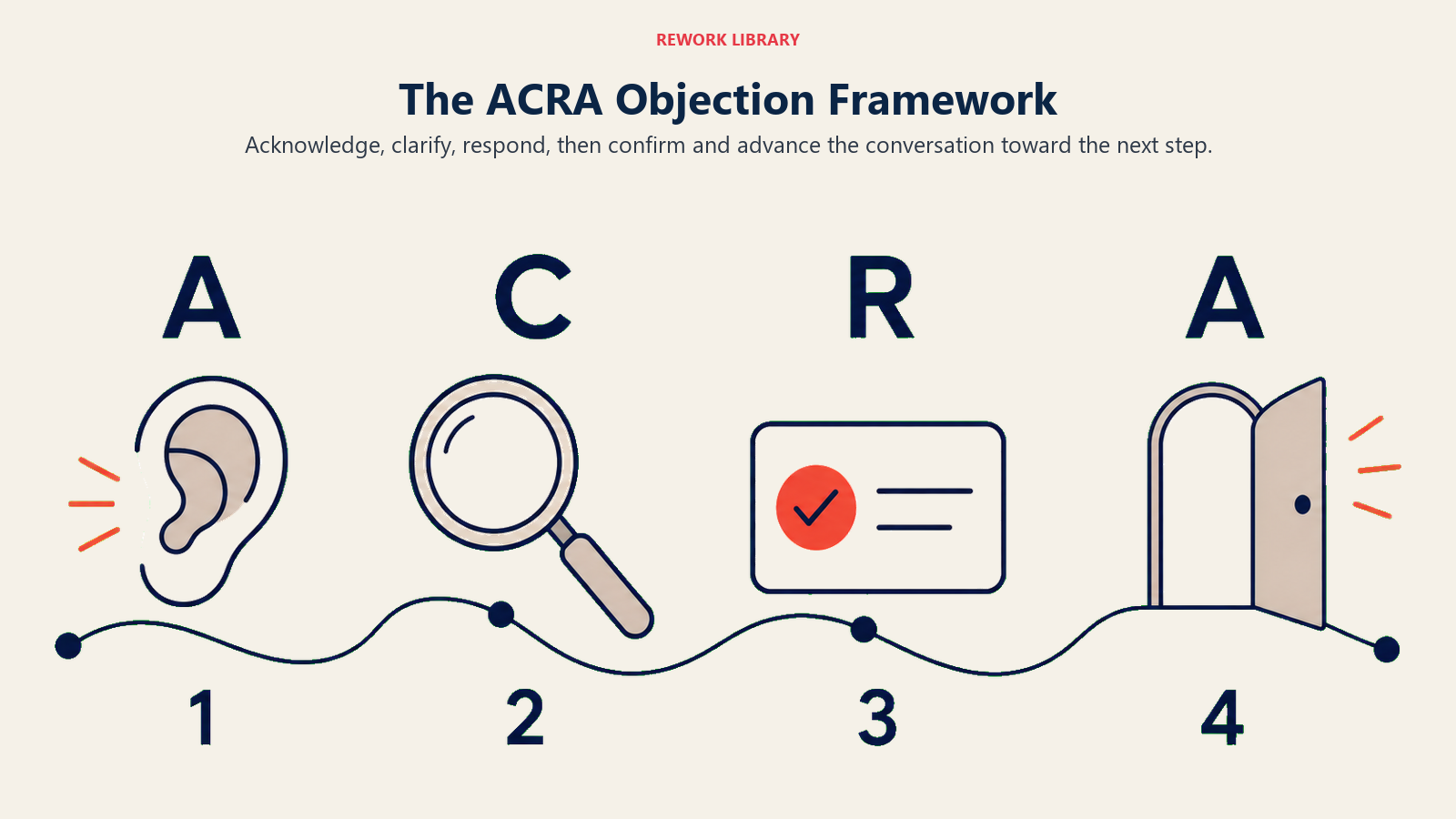
The ACRA Framework: The structure for almost every objection is the same:
- Acknowledge: Show you heard the concern.
- Clarify: Make sure you understand the real concern beneath the surface one.
- Respond: Address the actual concern with specifics.
- Confirm and Advance: Check that your response landed, then move back toward the close.
Key Facts: Objection Handling
- A meta-analysis of 664 effect sizes and 400,020 observations found a correlation of r = .47 between active listening behaviors and sales volume outcomes. (Itani, Goad and Jaramillo, Journal of Business Research, 2019)
- Analysis of 67,149 recorded B2B sales calls by Gong Labs found that top-performing reps ask questions in response to objections 54% of the time, compared to 31% for average performers. Top closers also pause significantly longer after an objection rather than rushing into a monologue.
- D2D reps who canvass an area three separate times can reach approximately 90% of homes in a territory, per data aggregated by Zety. That means persistent, respectful follow-up through objection cycles is what converts territory reach into sales.
Here's how that plays out across the most common objections in D2D subscription sales.
Price Objections
"That's too expensive."
What they usually mean: I'm not sure the price is worth it relative to what I'd get. Or: I'm not sure I have room in my budget.
Acknowledge: "I hear you. It's definitely a commitment."
Clarify: "Can I ask, is it more about the monthly cost, or are you comparing it to something specific?"
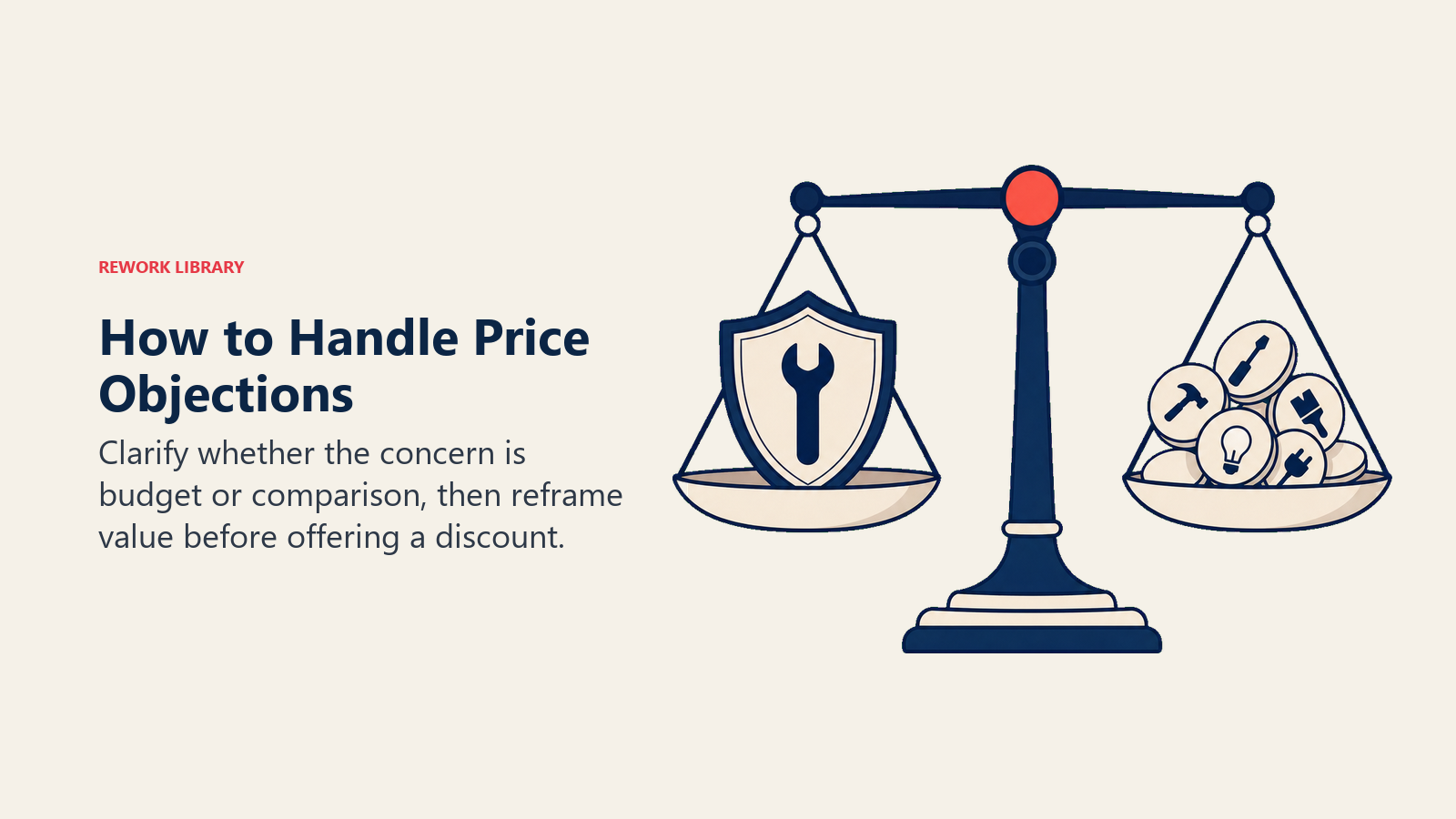
Their answer tells you which direction to go. If it's a budget concern, you reframe the value and possibly introduce a lower tier. If it's a comparison, you address the comparison directly.
Respond (budget): "At $49 a quarter, that's about $16 a month. Most of our customers who've tried to handle this themselves tell us they were spending more than that on products that didn't work. This is handled for $16 a month."
Respond (comparison): "What are you currently using or comparing us to?" Then address the gap specifically.
Confirm and advance: "Does that change how it looks?" Then move to the close.
Avoid immediately offering a discount. If you have a genuine introductory offer, hold it until after you've attempted the reframe. Dropping price at the first "too expensive" signals that the original price wasn't real and invites negotiation on everything. See negotiation fundamentals for a fuller treatment of when and how to negotiate on price.
"I can get it cheaper somewhere else."
Acknowledge: "That's fair. There are a lot of options out there."
Clarify: "Do you mind if I ask who you're comparing us to?"
Respond: Focus on what differentiates your service. Free re-treatments? A longer guarantee? A local presence vs. a national company? Don't badmouth the competitor but be specific about what they typically don't include.
"One thing I'd flag: a lot of the lower-priced services charge for re-treatments if you see activity between visits. Ours are included. So when you add that up over the year, you're often in the same range."
For deeper competitive positioning, competition objections covers the frameworks for this kind of comparison objection.
Timing Objections
"I need to think about it."
This is the most common D2D objection and also the one most reps mishandle. Most treat it as a polite no and pack up. It's not.
Acknowledge: "Of course. What kind of decision is this for you?"
Clarify: "What part of it would you want to think through? Is it the service itself, the price, or something else?"
Most homeowners will tell you the real concern when asked directly. "I'd want to talk to my spouse" is a different conversation than "I'm just not sure this is the right time of year."
Respond: Address whatever they name. If the answer is genuinely vague ("I just like to think things through"), you can gently surface the cost of waiting:
"I get it. The one thing I'd mention is that we're treating your block this week, so scheduling is easier to get right now. By next week I can't guarantee the same slot. That said, I want you to feel good about this, so if there's a specific concern, I'd rather work through it now."
Confirm and advance: "Is there anything specific that would help you decide today?"
"Can you come back another time?"
Acknowledge: "Absolutely, I can do that."
Clarify: "When would be a good time? I want to make sure I have availability."
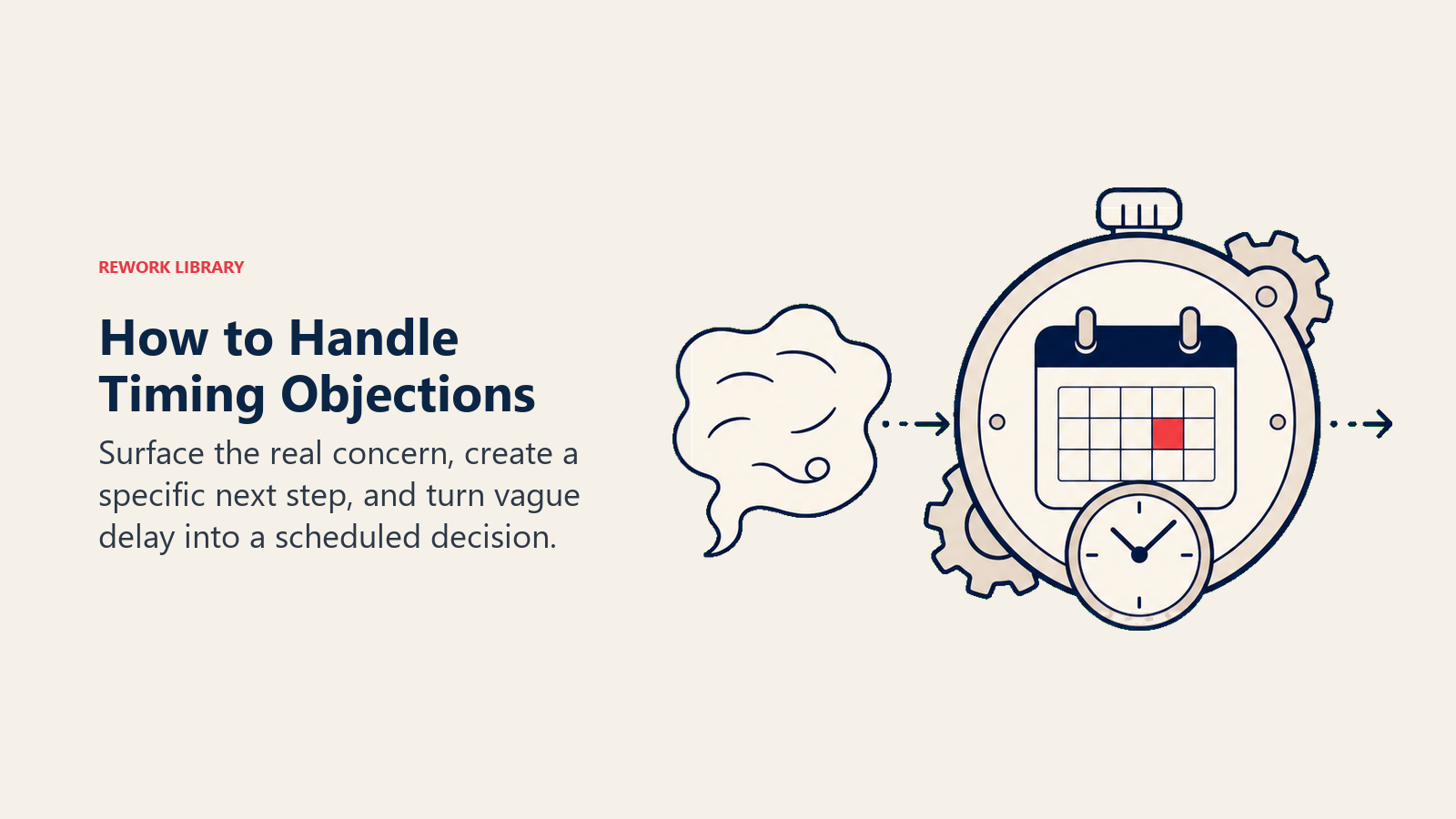
The goal is to lock in a specific return visit before you leave. "Let me check back" with no date or time is a soft no. "I'll be back Thursday at 6, will you both be home?" is something you can actually work with.
If they give you a specific time, honor it exactly. Reps who set a return and show up on time close at dramatically higher rates than those who "try to circle back."
Skepticism Objections
"I've had bad experiences with door-to-door companies before."
This objection deserves genuine respect, not a quick pivot.
Acknowledge: "That's completely fair. The door-to-door industry has a history of companies that overpromise and underdeliver. I wouldn't want you to have that experience again."
Clarify: "What happened, if you don't mind me asking?"
Let them tell you. Don't interrupt. The specific bad experience tells you exactly what reassurance to give.
Respond: Address the specific failure, not a generic industry complaint.
"It sounds like the main issue was they didn't come back when you called. Our agreement includes unlimited re-treatments if you see activity between visits, and you call a local office, not a national call center. I can give you the direct number."
Confirm: "Does that sound different enough from what you experienced before?"
Advance: "I'd like to earn your trust. Let me show you the first visit at a reduced rate so you can see how we work before committing to the annual plan."
A reduced-rate trial visit is a legitimate tool for this specific objection. The homeowner who's been burned before needs evidence, not promises.
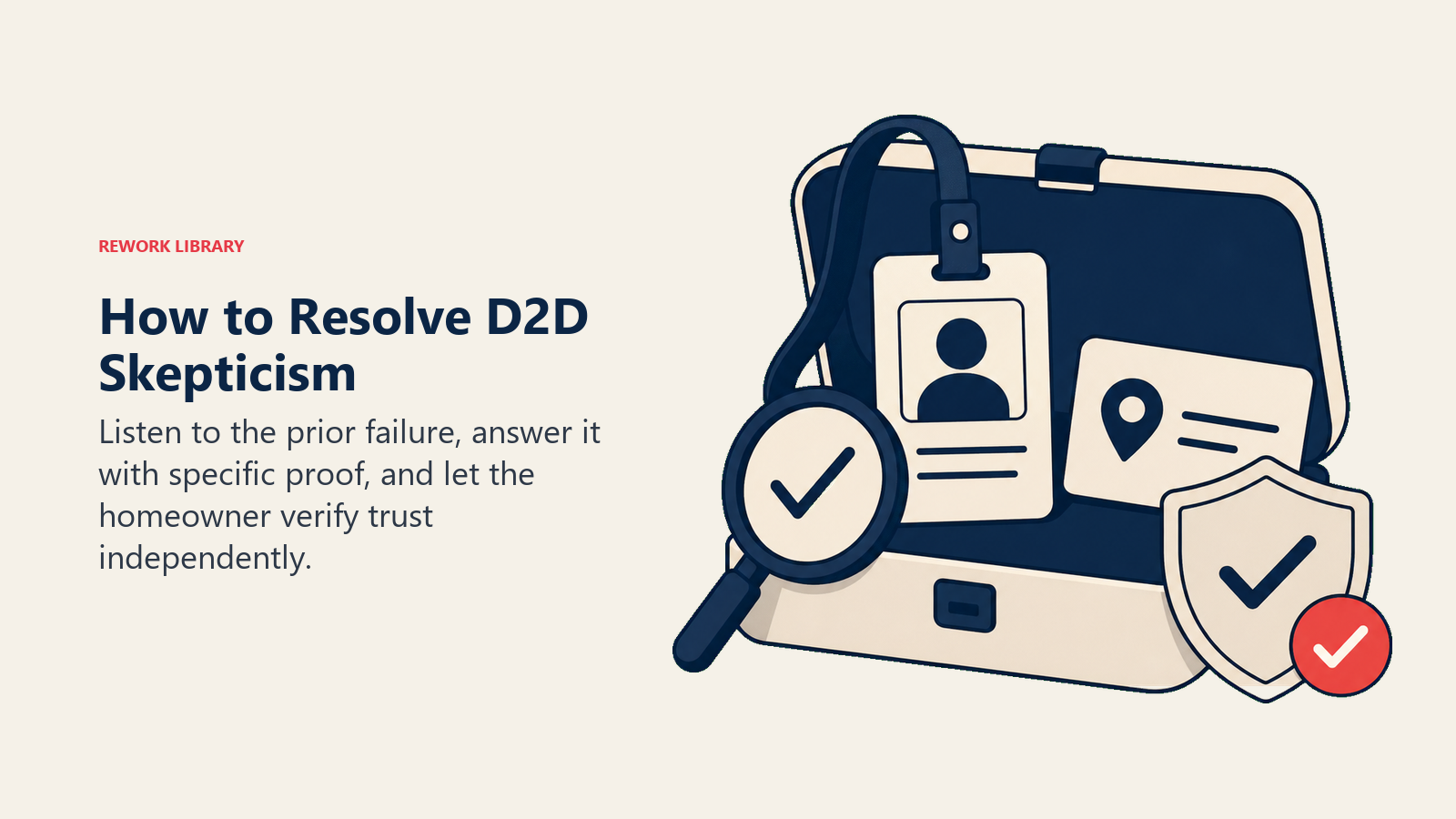
"How do I know you're legit?"
Homeowners, especially in areas with recent scam activity, sometimes challenge your identity or the company's credibility.
Don't get defensive. This is a reasonable question.
Acknowledge: "That's a smart thing to ask. I'd want to know the same thing."
Respond: Be ready with:
- Your company ID badge
- A business card with the local office number
- The company's local address
- A QR code to the company's Google review page
"You can look us up right now. We're licensed in [state], we've been operating in this market for [X] years, and we have [X] Google reviews from your area. Happy to wait while you check."
This kind of transparency closes the skepticism loop fast. A homeowner who looks you up and finds legitimate reviews often becomes your most committed subscriber because they did the verification themselves.
See also ethical selling and buyer's remorse for the practices that prevent skepticism objections from arising in the first place.
Competitor Objections
"I'm already with [Company X]."
The worst response is "well, we're better." The best response is curiosity.
Acknowledge: "Oh, how has that been going for you?"
Most homeowners who are happy with their current service will say so and end the conversation. But many will reveal a gap: "They're fine, but I never know when they're coming" or "We've still been seeing spiders even after treatments."
Any gap they name is your opening. But it has to be their words, not your leading question.
Clarify: "Has there been anything you'd change about the service if you could?"
Respond: "That's actually one of the things we do differently. [Specific feature that addresses their gap]. So you'd still get treated on a schedule, but you'd also get [specific benefit they named]."
Advance: "Some of our best customers switched from [Competitor] because of exactly that. I can set you up to start at the renewal date for your current plan, so there's no overlap."
A transition offer (starting at their current contract's renewal) removes the "but I'm locked in" objection before it comes up.
"I tried a service like this and canceled."
Acknowledge: "What made you cancel?"
This question is essential. Don't skip it. "It didn't work" covers everything from wrong product to wrong frequency to wrong tech to the homeowner never seeing results because they canceled too early.
Respond: Based on what they tell you:
"If the issue was that you were still seeing pests after the first treatment, that's actually common with a lot of the spray-only approaches. What we do is [specific method] that targets the colony rather than just the surface insects. Most customers see a real difference after the second treatment."
Or: "If it was a service issue, not a product issue, that's a different thing. Our [specific differentiator] is designed to prevent exactly that."
For the homeowner who genuinely tried the category and wasn't satisfied, a parallel framework for re-engaging people who've already said no to a category, not just a company, applies here too (see Learn More below).
The Closed Door
Sometimes the homeowner shuts the conversation down entirely. "Not interested." Door closes, or is about to.
What not to do: Chase them with rapid-fire rebuttals. It's disrespectful and it burns the address for every rep who comes after you.
What to do: Respect the boundary. Leave a door hanger or a card if it's allowed. If you can say anything before the door closes:
"I understand. If that ever changes, we're the company you want to call. We do [specific area/street]. Here's a card with a local number."
A homeowner who hears that and was just having a bad day will sometimes call the number. Not often. But it happens.
More importantly, respecting closed doors maintains the company's reputation in the neighborhood, which matters for referrals from your subscribers. See referral generation from subscribers for how existing customers in a neighborhood affect close rates at neighboring homes.
Building Your Objection Response Library
The best D2D reps don't improvise objection responses. They've practiced them until they're automatic.
Here's a template for building your own library:
| Objection | What it really means | First response | Clarifying question | Response if price | Response if timing | Response if trust |
|---|---|---|---|---|---|---|
| Too expensive | Not sure it's worth it | "I hear you." | "Is it the monthly amount or something you're comparing to?" | Reframe monthly equivalent | Urgency angle | Proof/guarantee |
| Need to think | Unknown specific concern | "Of course." | "What part would you want to think through?" | Hold on trial offer | Lock in return time | Address named gap |
| Already have service | Happy? Or has gaps? | "How has that been?" | "Anything you'd change?" | Reframe differentiator | Transition at renewal | Specific evidence |
| Bad past experience | Needs evidence, not pitch | "That's fair." | "What happened?" | Trial visit offer | Follow-up if skeptical | Credentials + reviews |
Run new objections through the Acknowledge/Clarify/Respond/Confirm/Advance structure and add them to this table. Over a summer, you'll build a response library that covers 95% of what you hear at the door.
Connecting Objections to the Close
Every objection response should end with an advance toward the close. Not a pitch restart, just a step forward.
After addressing a price objection: "Does that work better for you? Want to go ahead and get you set up?"
After addressing a timing objection: "Is there a concern we haven't addressed? If not, let's lock in your first visit."
After addressing a skepticism objection: "I'd like to earn your business and show you how we work. Does Thursday work for the first visit?"
The assumptive close pairs well here: after resolving an objection, assume the yes and move to the next step without waiting for an explicit invitation.
If you're working through multiple objections in a single visit, see same-visit close techniques for the sequencing that connects objection resolution to the final signature.
Key Takeaways
- Objections are questions in disguise. Hear what the homeowner is really asking before you respond.
- Use the Acknowledge/Clarify/Respond/Confirm/Advance structure for every objection.
- Don't discount immediately on price objections. Reframe value first, save incentives as genuine closers.
- "I need to think about it" requires a clarifying question, not a pack-up. Find the real concern.
- Skepticism objections need respect and evidence, not a quick pivot or defensive response.
- For competitor objections, lead with curiosity: ask how their current service is going and listen for the gap.
- For closed doors, leave respectfully. The neighborhood reputation is worth more than a last-ditch attempt.
- Build a personal objection response library over time. Practice until responses are automatic.
- Every objection response ends with an advance toward the close.
The rep who handles objections well doesn't win arguments. They build trust. And trust, at the door, is what puts ink on the agreement. SPOTIO's field sales data shows that D2D reps generate roughly one lead per 50 doors knocked, which means objection-handling skill is the primary lever on the conversion side of that ratio.
Learn more: Solar objection handling has a parallel framework for re-engaging homeowners who've already said no to an entire category, not just one company.
The Listening-Performance Link: A meta-analysis of 400,020 observations in the Journal of Business and Psychology (Kluger et al., 2023) found a correlation of r = .51 between perceived listening and relationship quality. Homeowners who feel heard are more likely to trust the service, sign the agreement, and stay subscribed.
The Question Response Habit: Gong Labs analysis of 67,149 recorded sales calls found that top-performing reps asked questions in response to objections 54% of the time, versus 31% for average performers. They responded with shorter, conversation-sustaining replies rather than extended monologues. At the door, that same habit separates reps who keep the conversation going from those who lose it.
The Respectful Exit Rule: A closed door handled badly costs more than the lost sale. The BBB's consumer advice for evaluating door-to-door salespeople specifically highlights that credible reps carry photo ID, provide a local contact number, and accept a firm no without pressure. Reps who violate this pattern damage the company's neighborhood reputation and reduce close rates on nearby doors.

Senior Implementation Consultant
On this page
- What Is the Right Mindset for Handling Objections at the Door?
- Price Objections
- "That's too expensive."
- "I can get it cheaper somewhere else."
- Timing Objections
- "I need to think about it."
- "Can you come back another time?"
- Skepticism Objections
- "I've had bad experiences with door-to-door companies before."
- "How do I know you're legit?"
- Competitor Objections
- "I'm already with [Company X]."
- "I tried a service like this and canceled."
- The Closed Door
- Building Your Objection Response Library
- Connecting Objections to the Close
- Key Takeaways