Sale to Service-Start Handoff: Connecting D2D Sales to Operations
Turn this article into takeaways for your work.


Each assistant summarizes the article only for you and suggests best practices for your work.
The rep closes the deal, shakes hands at the door, and walks away. The customer watches them go and has one question running in the background: "So what happens now?"
If that question doesn't get answered clearly and quickly, the customer fills in the blanks themselves. Sometimes they get anxious. Sometimes they call to cancel because they're not sure the company is legitimate. And sometimes they do nothing, the service visit shows up unannounced, and they're caught off guard and annoyed before the relationship even starts.
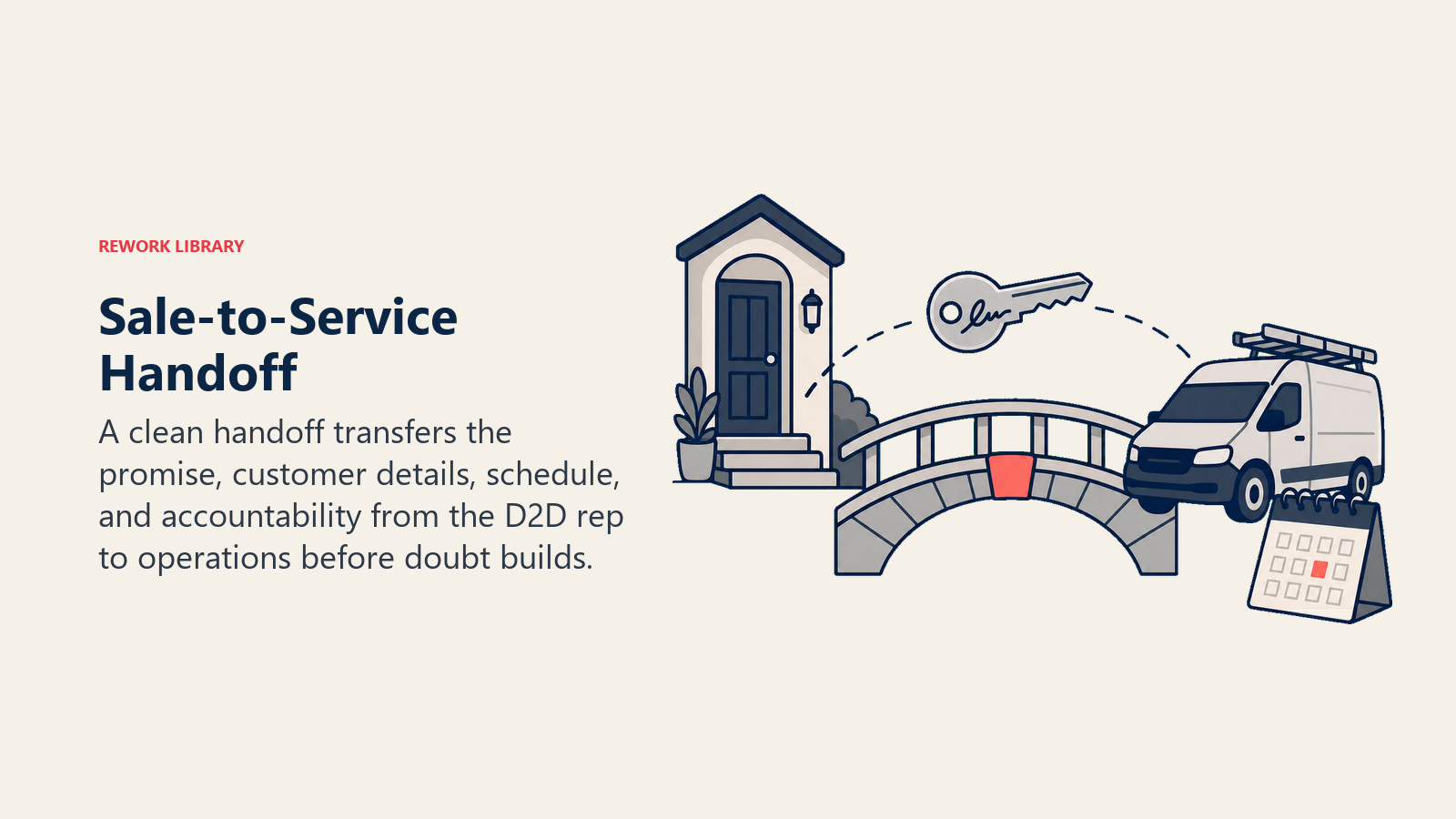
The sale-to-service handoff is the bridge between what the rep promised and what operations delivers. When it's handled well, it's one of the strongest retention tools in the D2D subscription business. When it's handled poorly, it produces early cancellations that no amount of door-knocking can outpace. Harvard Business Review notes that a 5% improvement in customer retention can raise profits by 25% to 95%, which frames the handoff window not as an administrative formality but as a direct revenue lever.
Why Is the Handoff Window So Critical?
In most home-service subscription models, there's a gap between when the customer signs and when service actually starts. That gap can be anywhere from 24 hours to two weeks depending on your scheduling capacity and the service type.
During that window, the customer is in a state of uncertainty. They made a commitment at the door, under some degree of social presence from the rep, and now they're alone with the decision. This is when buyer's remorse is most likely to surface. And it's when a competitor knock or a second-guessing spouse can undo the sale.
The handoff process is your tool for filling that gap with confidence-building communication and clear next steps instead of silence.
Key Facts: The Handoff Window
- A 5% improvement in customer retention can raise profits by 25% to 95%, according to research by Frederick Reichheld of Bain and Company, as reported in Harvard Business Review. This frames the handoff not as paperwork but as a direct margin lever.
- Acquiring a new customer costs 5 to 25 times more than retaining an existing one, per the same HBR analysis, making every pre-service cancellation disproportionately expensive.
- Low-turnover D2D teams are 2.4 times more likely to run consolidated tech stacks of one or two systems, according to SPOTIO's State of Field Sales research, meaning handoff infrastructure decisions ripple into rep retention as well as customer retention.
What Happens in the First 24 Hours After the Sale
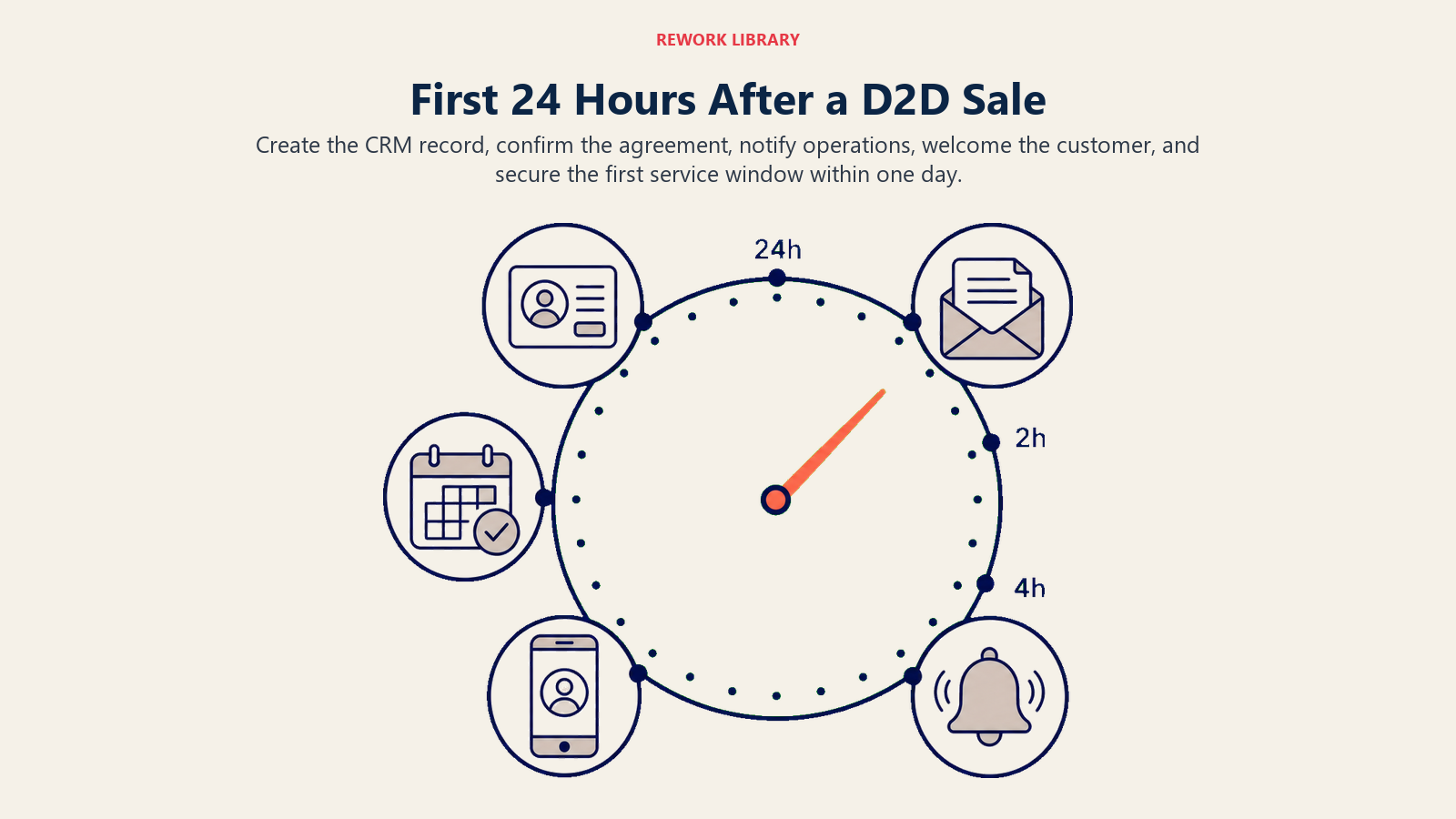
The first 24 hours after a signature are the most important window in the early customer relationship. Here's what should happen inside that window, and who owns each step:
| Timeline | Action | Owner |
|---|---|---|
| Within 2 hours of signing | Customer record created in CRM with full agreement details | Sales rep or CRM auto-sync |
| Within 2 hours of signing | Agreement confirmation emailed to customer | System or dispatch |
| Within 4 hours | Operations team notified of new customer, territory, and service type | Automated or sales-to-ops notification |
| Within 24 hours | Welcome call or text from the company (not the rep) | Dispatch or customer service |
| Within 24 hours | First service date confirmed or scheduling window offered | Dispatch or scheduling team |
The 24-hour welcome contact is the most commonly skipped step, and it's one of the highest-impact. A brief call or text that says "Welcome, your first [pest control / lawn care / security setup] is scheduled for [date] between [window]" does more to prevent early cancellations than almost any other single action.
For more on what that first post-sale communication should say, see Welcome and Onboarding New Customers.
What the Sales Rep Needs to Transfer
A clean handoff requires the rep to pass complete and accurate information to operations. Incomplete transfers are one of the most common causes of service failures and customer frustration at the first visit.
Required data in the handoff record:
- Customer name, full service address, and best contact number
- Preferred communication method (call, text, email)
- Service type and tier purchased
- Specific scope notes ("has dogs, must call 30 min ahead," "access through back gate," "only treat perimeter")
- Billing details confirmed and payment method on file
- Start date expectation set with customer during the sale
- Any special instructions or concerns raised by the customer
- Copy of the signed agreement attached or linked in CRM
That last point matters more than people think. Operations teams who can't find the customer's agreement when questions arise create delays that damage trust. The agreement should be in the customer record before operations ever touches the account.
The CRM as the Handoff Spine
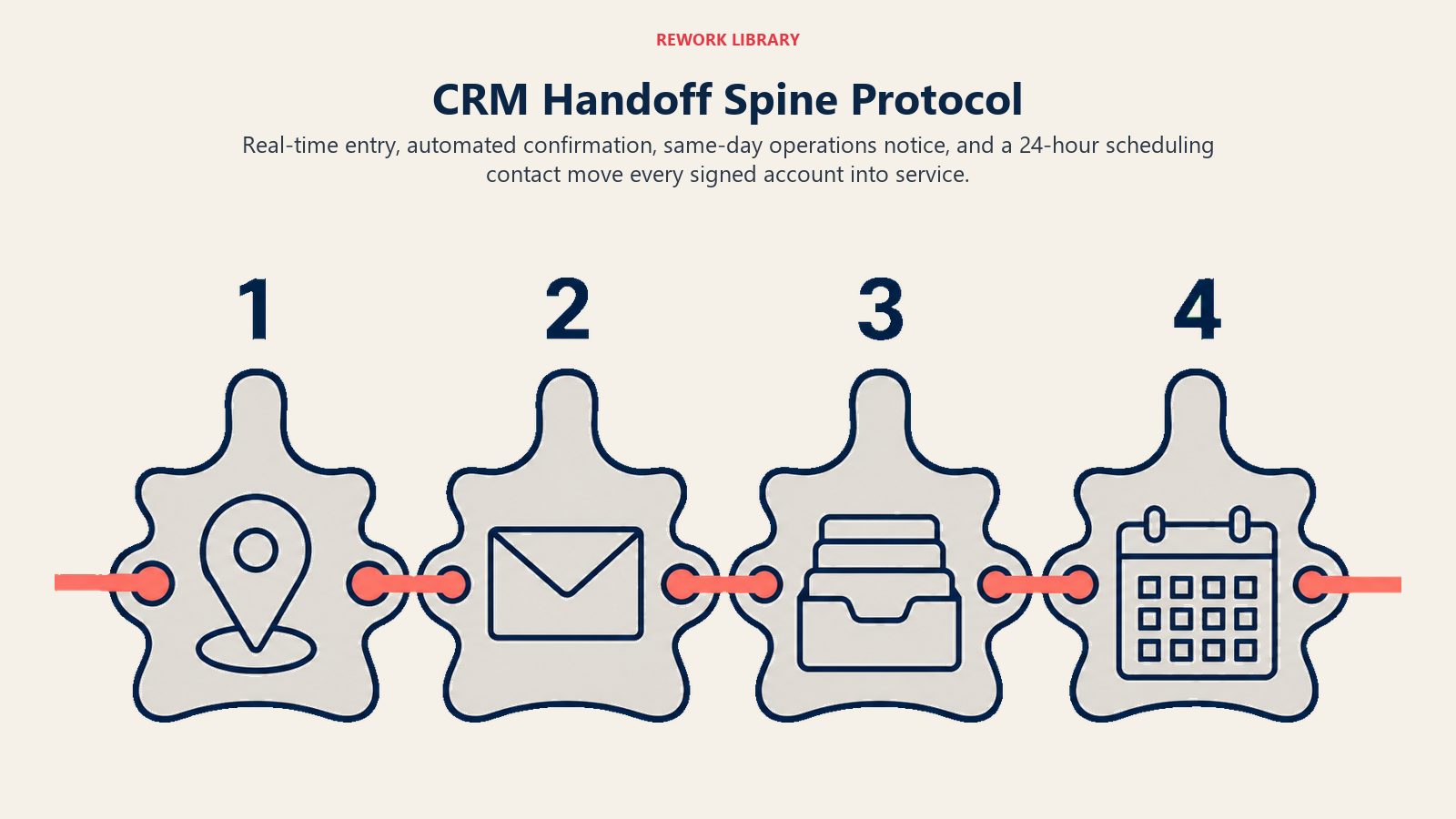
The Handoff Spine Protocol: a four-step framework for moving a signed agreement from rep to operations without information loss. Step one is real-time CRM entry at close. Step two is an automated welcome confirmation within two hours. Step three is an ops notification that puts the new account in the service queue same day. Step four is a scheduling call or text within 24 hours that gives the customer a specific first-visit window. When all four steps fire in sequence, pre-service cancellations are primarily driven by external factors (competitor offers, household budget changes) rather than internal failures the company could have prevented.
The sales-to-service handoff only works reliably if it flows through a shared system that both teams can see in real time. When reps are entering customer notes in a personal spreadsheet or texting details to dispatch, things get lost. Customers fall through cracks. First service visits happen without context.
A proper D2D CRM setup means:
- The rep closes the agreement in the field app, and the customer record appears automatically in the operations queue
- Ops can see all notes the rep entered, including access instructions and customer preferences
- Scheduling is done inside the same system, so the customer's record shows their upcoming appointment
- Any customer contact during the handoff window is logged in the shared record, not in someone's phone
This isn't about technology for its own sake. It's about making sure the person who answers the customer's question the day before their first service has the same information the rep had at the door. SPOTIO's 2026 State of Field Sales survey found that low-turnover D2D teams are 2.4 times more likely to run consolidated tech stacks of one or two systems, which means the handoff infrastructure decision has downstream effects on rep retention as well as customer retention. See D2D CRM and Canvassing Apps for more on field-to-ops system setup.
Common Handoff Failures and How to Fix Them
Most early cancellations in the handoff window trace back to a small number of recurring failures. Here's a practical troubleshooting guide:
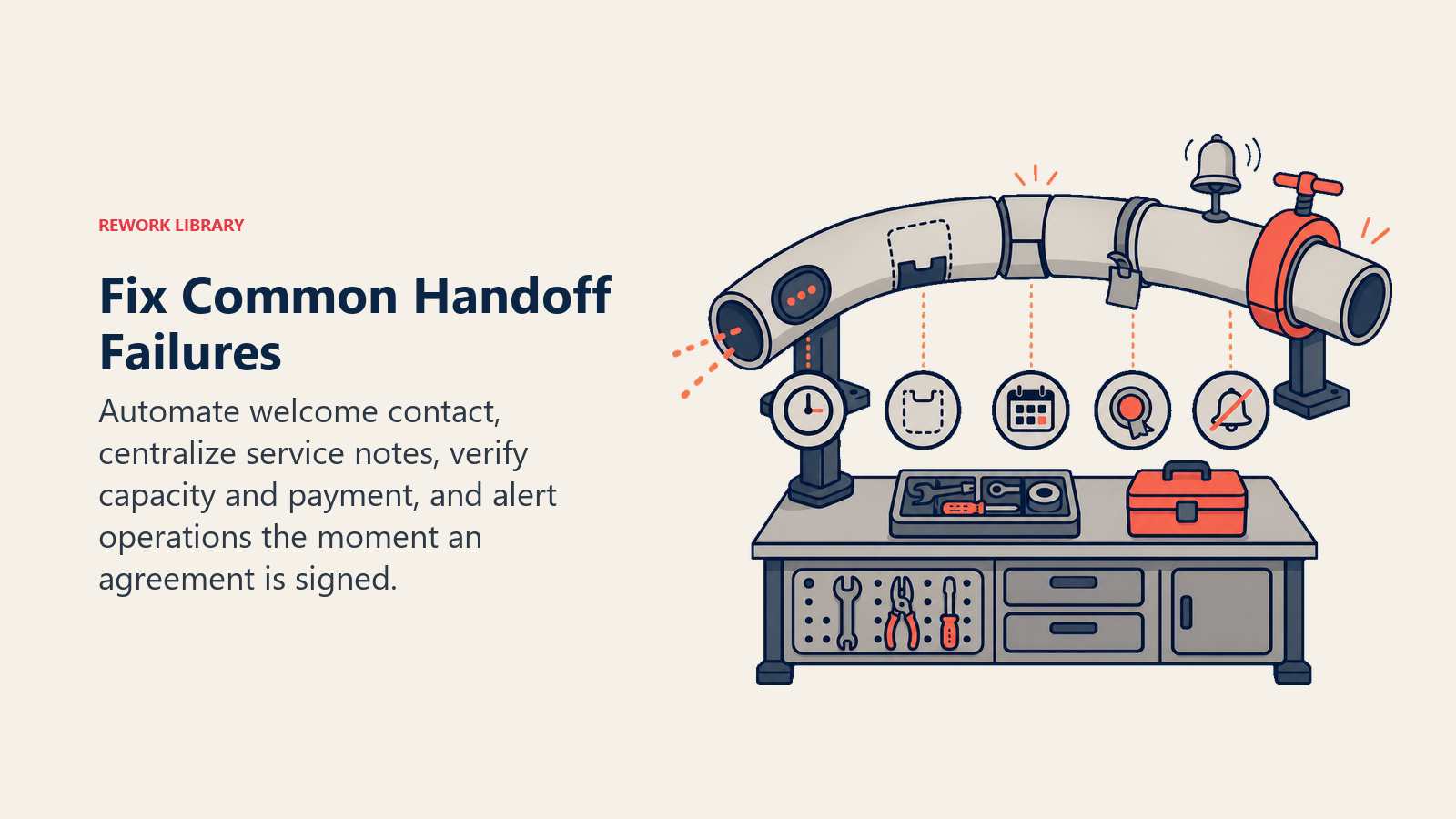
Problem: Customer didn't receive a welcome contact and called to cancel. Root cause: The handoff notification to dispatch was delayed or lost. Fix: Automate the welcome email to trigger the moment the agreement syncs. Don't make it a manual step.
Problem: First service showed up and the tech had no notes about access or pets. Root cause: Rep entered notes in a personal log instead of the CRM. Fix: Make CRM entry mandatory at close. Ride-alongs should check that reps are entering notes, not just signatures.
Problem: Customer was told service would start "next week" by the rep, but it was actually two weeks out. Root cause: Rep set a start-date expectation without checking scheduling capacity. Fix: Give reps real-time access to scheduling availability during the pitch so they can set accurate expectations, or train them to say "dispatch will confirm your exact date within 24 hours" rather than committing to a specific timeline.
Problem: Customer's payment failed and no one caught it before the first service. Root cause: Payment verification was disconnected from the handoff workflow. Fix: Include a payment verification step as part of the handoff checklist, before scheduling the first service visit.
Problem: Operations didn't know the customer signed until the next morning. Root cause: No same-day handoff alert from sales to ops. Fix: Set up real-time or near-real-time alerts when a new agreement is entered in the field. Most modern D2D CRM platforms support this natively.
What to Say to the Customer at the Door About What Comes Next
One of the simplest ways to prevent handoff anxiety is for the rep to set explicit next-step expectations before leaving the door. The customer should know exactly what will happen and when.
A clean close-out script might sound like this:
"So here's what happens next. You'll get an email confirmation of the agreement in the next couple of hours. Then our scheduling team will reach out within 24 hours to confirm your first [service] appointment. They'll give you a specific window. On the day of your first visit, the tech will call about 30 minutes before they arrive. Any questions about that process?"
That's less than a minute of script. It confirms the follow-up sequence, sets time expectations, and gives the customer a mental picture of what "next" looks like. It also gives them a reason NOT to cancel before hearing from ops, because they're expecting that contact.
The Sales and Operations Alignment Gap
The handoff isn't just a data-transfer problem. It's also a culture problem. In many D2D companies, sales and operations run as separate worlds. Sales celebrates the close. Operations inherits the result, sometimes without the context they need to serve the customer well.
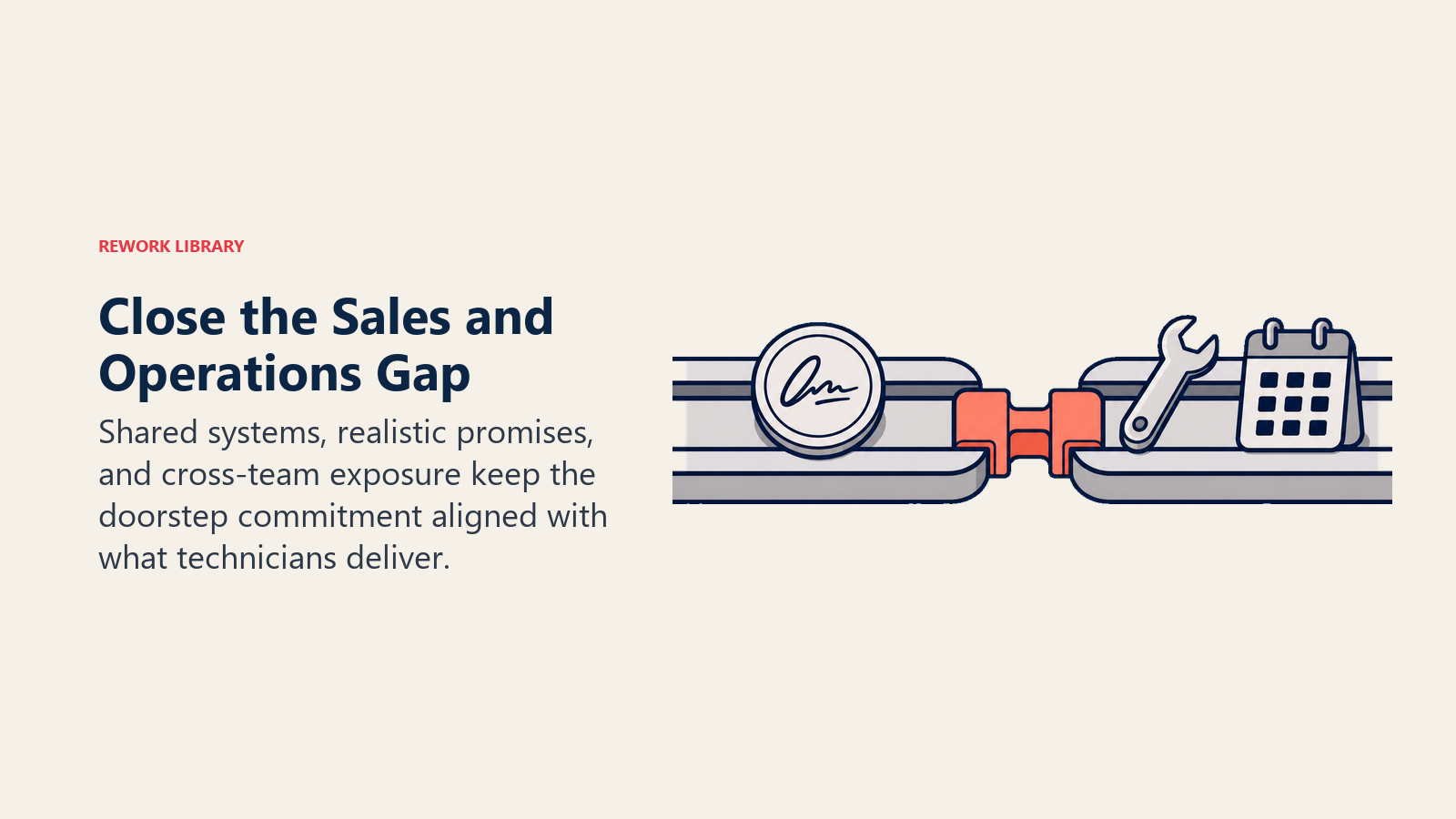
When those two teams aren't aligned, customers experience the gap directly. The rep said one thing. The tech does something slightly different. The billing cycle starts on a date no one warned the customer about. These are small failures individually, but they compound into a pattern of broken trust that drives early cancellations.
Reps who ride along with service techs even once tend to become significantly better at setting accurate expectations during the pitch. Operations teams who see the sales process tend to ask better questions when they onboard new customers. Cross-team exposure is one of the cheapest alignment tools available.
For a deeper look at the structural alignment between sales and service operations, see Sales and Service Operations Alignment.
A strong handoff process also depends on how well the post-sale relationship is structured. The retention fundamentals framework explains how the habits built in the handoff window carry directly into long-term subscriber health, and the numbers below show exactly where that window tends to break.
Which Metrics Tell You Whether the Handoff Is Working?
If you're running a D2D subscription business and not tracking handoff performance, you're making retention decisions without the data you need. Here are the metrics worth monitoring:
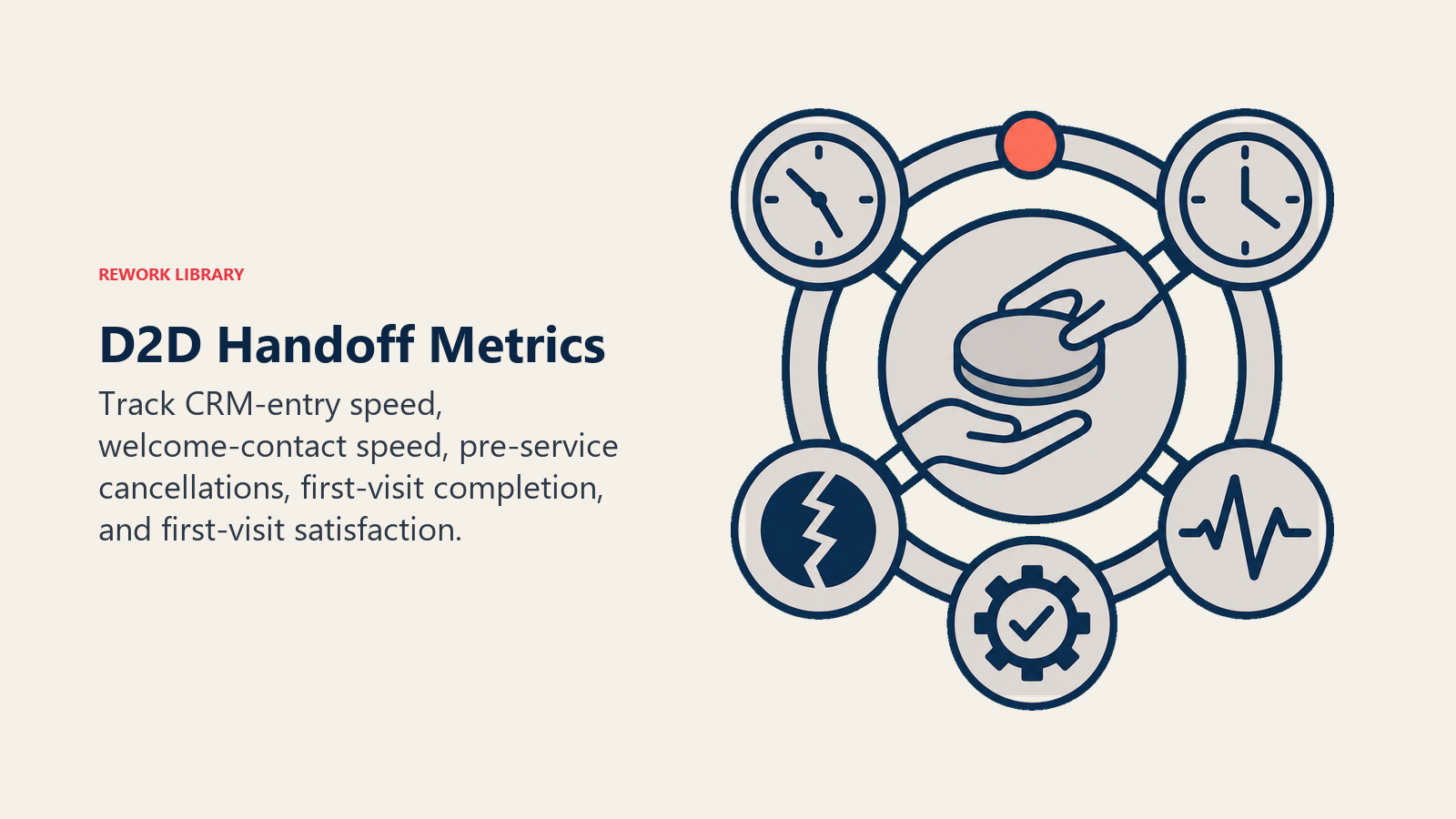
| Metric | What It Tells You | Target Range |
|---|---|---|
| Time from signature to CRM entry | How fast reps are completing the handoff record | Under 2 hours |
| Time from signature to welcome contact | How fast ops is engaging the new customer | Under 24 hours |
| Pre-service cancellation rate | Customers who cancel before the first visit | Under 5% |
| First-visit completion rate | Customers whose first service actually happens | Over 90% |
| First-visit satisfaction score | How the customer feels after service starts | 4.2+ out of 5 |
Pre-service cancellation rate is the clearest measure of handoff quality. If your cancellations are clustering in the window between signing and first service, that's a handoff problem, not a sales problem, and the checklist below is where you start fixing it.
"Pre-service cancellation rate is the clearest single measure of handoff quality in a D2D subscription business. If cancellations cluster in the window between signing and first service, that's a handoff problem, not a sales problem."
"Reps who ride along with service techs even once tend to set meaningfully more accurate expectations during the pitch, because they understand what the service actually looks like on delivery day."
"D2D teams that automate the post-signature welcome contact within two hours see fewer buyer's-remorse cancellations than teams relying on manual follow-up, because the automation fires before buyer doubt builds. (Rework Analysis, based on standard subscription onboarding practice)"
Checklist: Clean Sale-to-Service Handoff
Use this as a rep-level checklist before leaving a new customer's door:
- Customer has a copy of the signed agreement
- Customer knows when to expect the welcome/scheduling contact (within 24 hours)
- Customer knows when first service will happen (or that dispatch will confirm the date)
- Customer knows what to expect on the day of first service (tech arrival process, what access is needed)
- Customer has a number or email to contact with questions
- CRM record is complete with all access notes, contact preferences, and any special instructions
- Payment method is confirmed and on file
- First service date or scheduling window is consistent with what was told to the customer
Completing this checklist at every door is the single best thing a rep can do to protect the sales they make. The close that sticks is the one where the customer felt taken care of from signature to first service.
For the next step in the customer lifecycle, see First Service and Install Scheduling and Reducing Early Cancellations.
Learn more: Churn Prevention Strategy
Frequently Asked Questions about Sale to Service-Start Handoff
What is a sale-to-service handoff in door-to-door home services?
A sale-to-service handoff is the process of transferring a new customer's account, agreement details, and service requirements from the sales rep who closed the deal to the operations team that will deliver the service. A clean handoff ensures the customer receives a welcome contact, a confirmed first-service date, and an informed technician, all without having to repeat information they already gave at the door.
How soon after signing should a customer hear from the company?
Within 24 hours is the standard target for the welcome or scheduling contact, and within 2 hours for an automated confirmation message. Customers who don't hear from the company within 24 hours of signing are significantly more likely to cancel before their first service, because silence is interpreted as disorganization or indifference.
What information should a rep transfer to operations at close?
The handoff record should include the customer's full name, service address, and best contact number; preferred communication method; service type and tier purchased; access notes (gate codes, pets, entry instructions); billing details confirmed; start-date expectation set with the customer; and a copy of the signed agreement linked in the CRM.
What is the pre-service cancellation rate and what should it be?
Pre-service cancellation rate measures the percentage of new subscribers who cancel before their first service visit is completed. For well-run D2D subscription operations, this should be under 5%. Rates above 8-10% typically indicate a handoff breakdown: customers aren't being contacted quickly enough, expectations aren't being set clearly, or scheduling is taking too long.
Why does the rep's script at the door affect handoff outcomes?
When the rep explains exactly what happens next (email confirmation within two hours, scheduling call within 24 hours, tech arrival call 30 minutes before the first visit), customers know what to expect and wait for that contact rather than cancelling preemptively. A 30-second close-out script that sets next-step expectations is one of the simplest retention interventions available.
What happens when sales and operations don't share a CRM?
When reps log agreements in personal spreadsheets or communicate via text, information gets lost and customers experience the gap directly. The technician arrives without access notes. Billing starts on a date no one warned the customer about. Ops doesn't know the account exists until the next morning. Each of these failures erodes trust before the service relationship has a chance to develop.
How do you measure whether the handoff process is working?
Track three metrics: time from signature to CRM entry (target under 2 hours), time from signature to welcome contact (under 24 hours), and pre-service cancellation rate (under 5%). If cancellations cluster in the window between signing and first service, the handoff process is the primary lever to investigate.

Senior Implementation Consultant
On this page
- Why Is the Handoff Window So Critical?
- What Happens in the First 24 Hours After the Sale
- What the Sales Rep Needs to Transfer
- The CRM as the Handoff Spine
- Common Handoff Failures and How to Fix Them
- What to Say to the Customer at the Door About What Comes Next
- The Sales and Operations Alignment Gap
- Which Metrics Tell You Whether the Handoff Is Working?
- Checklist: Clean Sale-to-Service Handoff