Welcome and Onboarding the New Customer: Turning a Signed Agreement Into a Loyal Subscriber
Turn this article into takeaways for your work.


Each assistant summarizes the article only for you and suggests best practices for your work.
A rep just closed a pest control agreement on a Tuesday afternoon. The customer was excited at the door, signed the contract on a tablet, and waved goodbye. By Thursday morning, they've googled the company name, read two mixed reviews, and are wondering if they made a mistake.
That gap between signature and first service is where recurring revenue lives or dies. In door-to-door subscription businesses, the onboarding window spans roughly 72 hours to 14 days, and what happens inside it determines whether a new customer becomes a loyal subscriber or a cancellation statistic.
This article breaks down a structured onboarding approach that security, pest, lawn, and fiber companies can apply immediately.
Why Is Onboarding a Revenue Problem, Not Just a Courtesy?
Most D2D businesses treat onboarding as an administrative step: send a confirmation email, schedule the first service, move on. But data from recurring-revenue operators consistently shows that customers who cancel in months one and two cite the same root causes: they felt forgotten after signing, their expectations weren't set correctly, or the first service disappointed them.
Each of those is a fixable onboarding failure. Early cancellations are expensive because the customer acquisition cost (door knock, rep time, commission) has already been paid. You've spent $150 to $400 acquiring someone you never actually kept. Research by Frederick Reichheld of Bain and Company, cited in Harvard Business Review, shows that acquiring a new customer costs anywhere from 5 to 25 times more than retaining an existing one.
Onboarding is the bridge between the door-to-door sales funnel and long-term retention. Without that bridge, you're losing customers before they've even experienced the product. See also reducing early cancellations for what happens when onboarding fails.
Key Facts: New Customer Onboarding
- Acquiring a new customer costs 5 to 25 times more than retaining an existing one, per research by Frederick Reichheld of Bain and Company cited in Harvard Business Review, which means every early cancellation is a loss that compounds the original acquisition spend.
- D2D subscription customer acquisition typically costs $150 to $400 per account (covering rep time, commission, and canvassing investment), making a cancellation before the third or fourth service a net-negative account that leaves the company worse off than if the sale had never happened. (Rework Analysis, based on reported D2D CAC ranges)
- Low-turnover D2D field teams are 2.4 times more likely to use consolidated tech stacks, per SPOTIO's State of Field Sales research. Consolidated systems are what make automated onboarding sequences possible without manual labor at each step.
The 72-Hour Onboarding Window
The first 72 hours after a signature carry disproportionate weight. This is when buyer's remorse peaks, when customers are most likely to call and cancel "before anything starts," and when a proactive touchpoint has its highest impact.
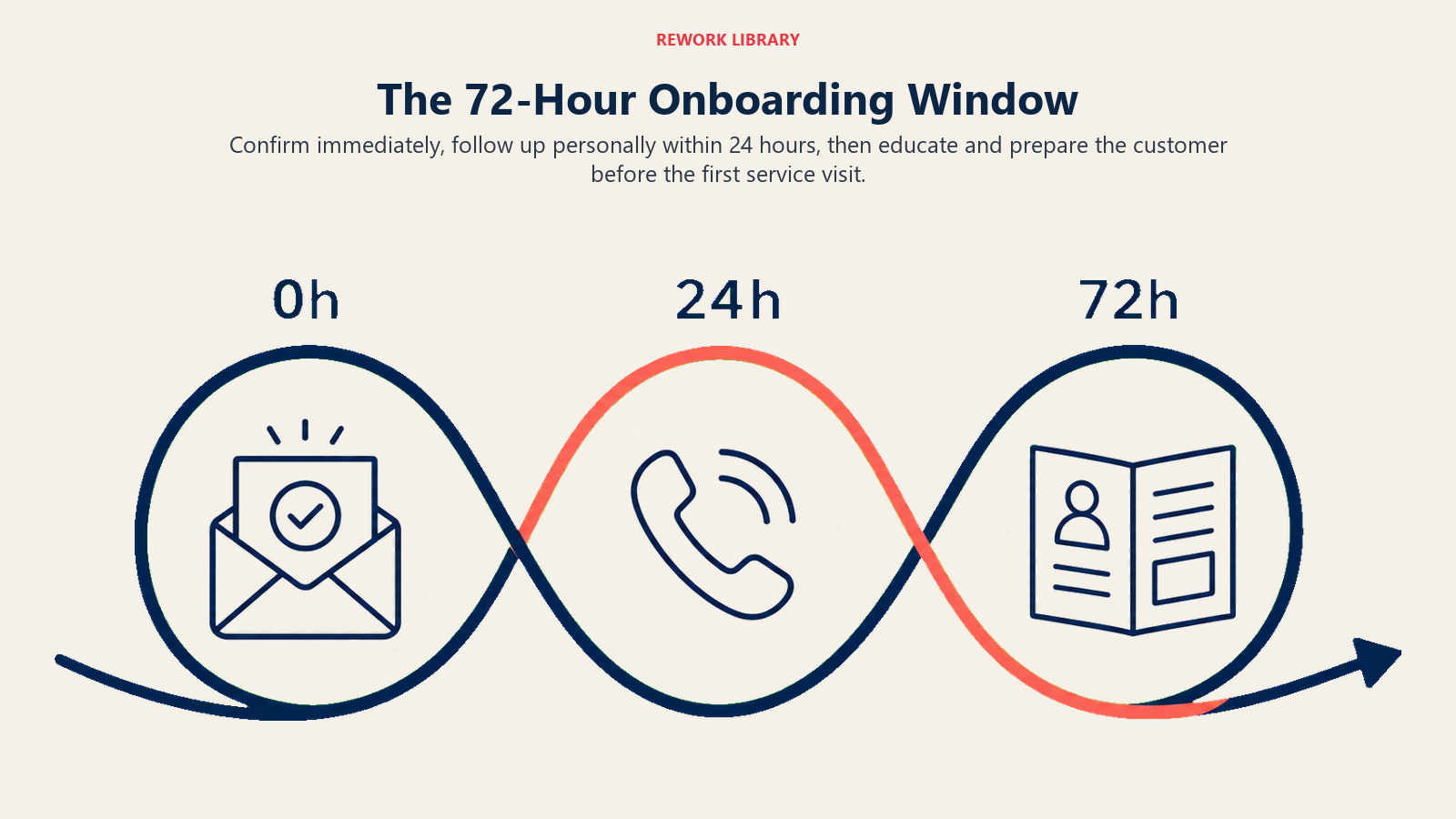
Hour 0 to 1: The Thank-You Confirmation
Within minutes of the close, the customer should receive a personalized confirmation. Not a generic system email, but something that reinforces the rep's name, the specific service agreed upon, the first scheduled date, and a direct line to reach the company.
In practice this looks like:
- Automated SMS: "Hi [Name], this is [Company]. Your [service type] is confirmed for [date/window]. Your rep was [Rep Name]. Questions? Reply to this number or call [#]."
- Confirmation email with: the contract summary, a photo of the rep to build trust, a welcome video from the owner or a team member, and an FAQ on what to expect before the first visit.
The goal is to make the customer feel the company is real, organized, and paying attention. Buyer's remorse is largely a confidence deficit. You're refilling that confidence before it drains.
Hours 1 to 24: The Rep Follow-Up Call
Many high-performing D2D operations require reps to make a personal follow-up call within 24 hours of the sale. This isn't a sales call. It's a short, warm check-in:
"Hi [Name], this is [Rep] who stopped by yesterday. I just wanted to make sure you got our confirmation and to answer any questions before your first service."
This call does three things: it humanizes the company, it surfaces any anxiety the customer has before it becomes a cancellation request, and it builds the rep's personal relationship with that account, which pays dividends in referrals later. See referral generation from subscribers for how that rep relationship becomes a growth channel.
Days 2 to 7: Education Sequence
Between confirmation and first service, customers benefit from short, practical information about what they're about to receive. The format depends on your channel mix, but the content should cover:
| Day | Content |
|---|---|
| Day 2 | "What to expect on service day" (prep checklist, time window, what the tech will do) |
| Day 4 | "Meet your service team" (photo, name, certifications if applicable) |
| Day 6 | Reminder for upcoming appointment + a tip relevant to the service (pest prevention tips, lawn prep, security camera placement, etc.) |
These touches cost almost nothing to automate. But they shift the customer from passive, waiting and wondering, to informed and prepared. Informed customers ask fewer anxious questions and cancel less. None of it matters, though, if the first service visit itself falls flat.
The First Service Visit
No matter how good your presale communication is, the first service visit is the real moment of truth. If it disappoints, no amount of follow-up email saves the account.
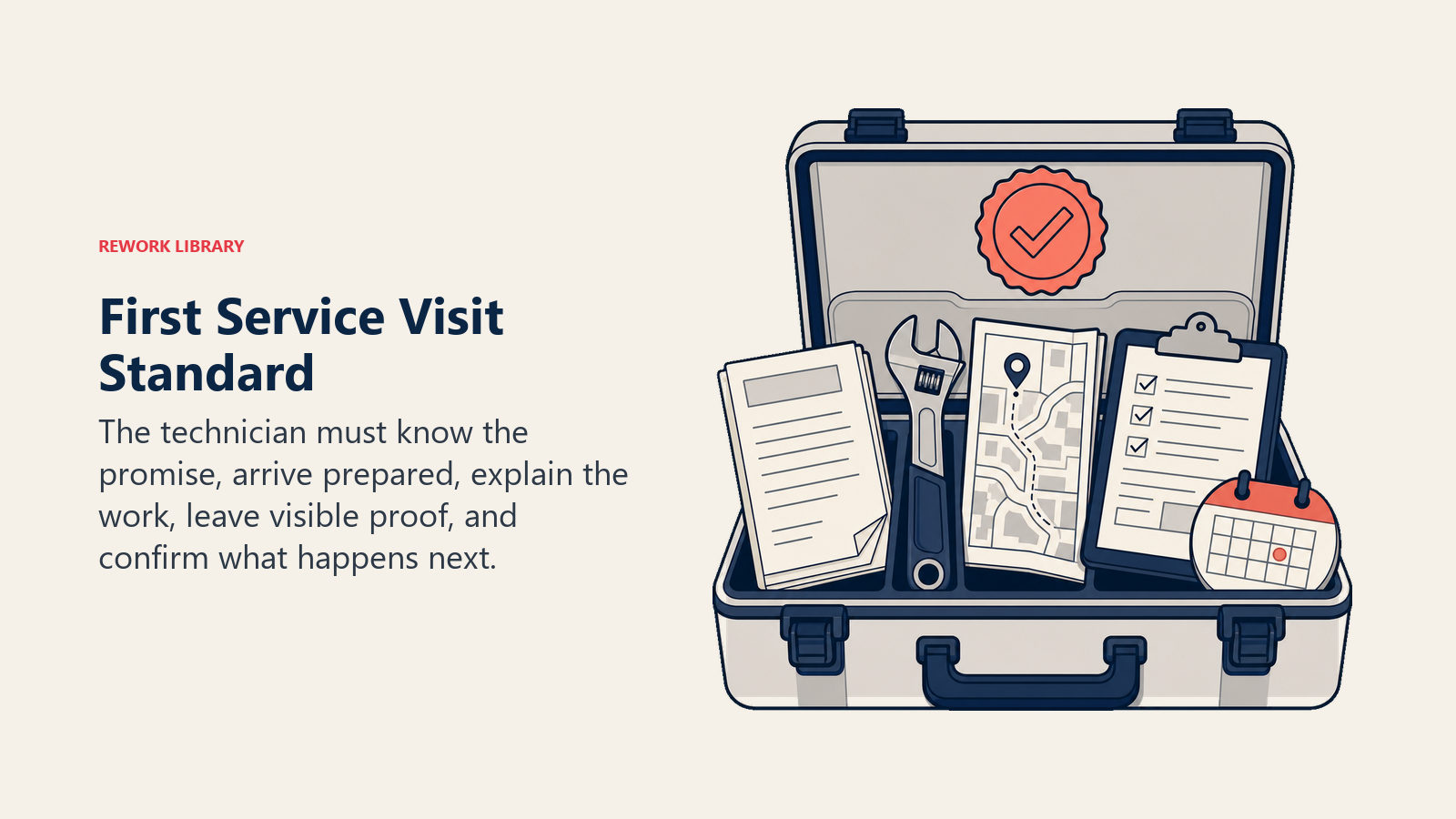
Setting the Technician Standard
The technician who shows up for the first service inherits the promise the rep made at the door. They need to know what was sold, what expectations were set, and what the customer's specific concerns are.
A simple pre-service brief (pulled from your CRM or canvassing app) should give every technician:
- Customer name and correct pronunciation if unusual
- Service type and scope agreed upon
- Any notes from the rep about property layout, specific concerns, or customer personality
- The communication tone to match (some customers want detailed explanations, others want quick professional service)
The sale-to-service start handoff and first service and install scheduling articles cover the operational mechanics of this hand-off in detail.
What the Technician Does During the Visit
First-visit protocol should include:
Greeting: Introduce by name, reference the company, confirm the service scope ("I'm here for your quarterly pest treatment, covering interior and exterior, just as agreed").
Walk-through: For security installs, walk the property before starting. For pest and lawn, briefly note any problem areas observed and explain what you're addressing. This demonstrates competence and builds confidence.
Leave-behind: A written summary of what was done, dated and signed. For pest and lawn, include findings. For fiber and security, include setup confirmation. This is the physical receipt that makes the service feel real.
Close of visit: Give the customer the next service date, confirm contact details, and ask if they have any questions. Don't rush this. Five minutes at the end of a service visit is among the highest-ROI time a technician spends, and it's the moment that turns a one-time visit into a repeatable operating procedure.
Onboarding Checklist for Operations Teams
The 72-Hour Trust Window: the framework for structuring new subscriber onboarding around three sequential goals. In the first 2 hours, confirm the agreement exists and the company is real (automated SMS and email). In hours 1 to 24, surface and resolve any buyer hesitation before it hardens into a cancellation request (rep follow-up call). In days 2 to 7, replace waiting-and-wondering with education and anticipation (drip sequence). Companies that execute all three phases consistently report lower pre-service cancellation rates than companies that rely on a single confirmation message, because each phase addresses a distinct psychological risk in the new-customer journey.
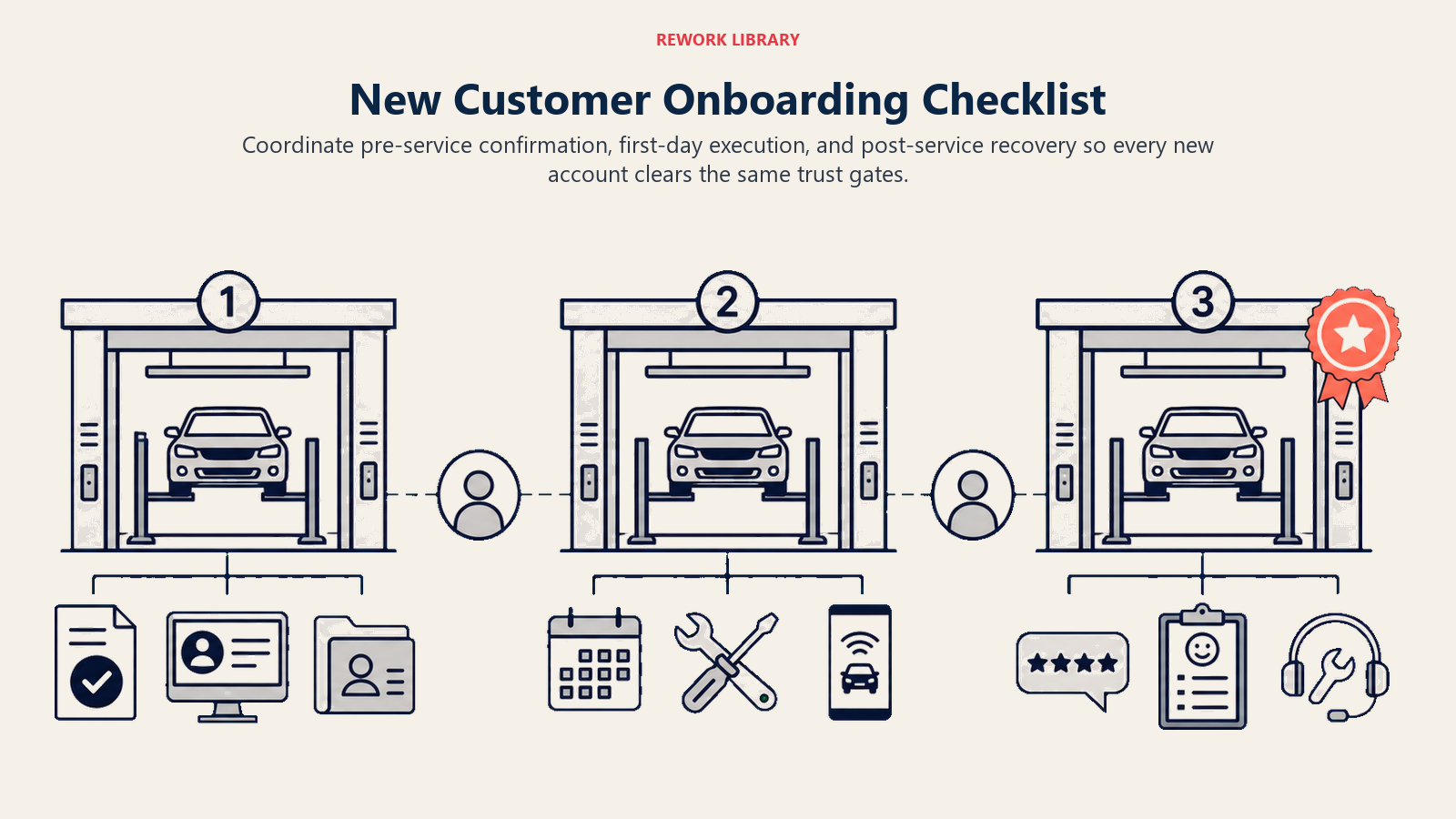
Use this as a standard operating procedure. Every new customer should pass through each step.
Pre-First-Service Checklist
- Confirmation SMS sent within 30 minutes of sale
- Confirmation email sent within 1 hour with contract summary and rep photo
- First service appointment scheduled and confirmed with customer
- Customer record created in CRM with rep notes attached
- Education email sequence triggered (Days 2, 4, 6)
- Rep follow-up call completed within 24 hours
First Service Day Checklist
- Technician has read rep notes and knows customer name and specific concerns
- Customer notified by SMS with tech name and ETA (30-minute window)
- Tech arrives on time or communicates delay proactively
- Tech performs walk-through or greeting protocol
- Service delivered per agreement
- Leave-behind summary provided to customer
- Next service date confirmed verbally and in writing
Post-First-Service Checklist
- Satisfaction check-in sent (SMS or call) within 24 hours of first service
- Any issues flagged to operations immediately
- Customer NPS or feedback captured
- Rep notified of customer status (happy, neutral, concern flagged)
Common Onboarding Failures and How to Fix Them
Even well-run companies stumble in the same places. Here are the most common gaps and their solutions.
Failure: No contact between signature and first service Fix: Automate an SMS sequence. Three touchpoints in the first 7 days requires no additional headcount and can be built in any basic CRM.
Failure: Technician doesn't know what was sold Fix: Require sales reps to log detailed notes in the CRM at close. Make technician pre-brief a mandatory step before dispatch.
Failure: First service window is too wide Fix: "We'll be there Tuesday between 10 and 2" is unacceptable to most modern customers. Narrow it to a 2-hour window and send a 30-minute heads-up text. This alone reduces no-shows and irate calls.
Failure: No feedback capture after the first service Fix: Send a one-question text within 24 hours: "On a scale of 1 to 5, how was your first [Company] experience?" Anything below 4 triggers an immediate manager callback. This catches problems before they become cancellations, and it feeds directly into whether the customer sticks around long-term.
How Does Onboarding Connect to Long-Term Retention?
Good onboarding doesn't just reduce cancellations in the first 30 days. It builds the behavioral and emotional foundation for multi-year retention.
Customers who feel well-onboarded are:
- More likely to say yes to upsell conversations
- More likely to refer neighbors and friends (in D2D contexts, the referral is as simple as knocking next door)
- Less likely to cancel when a competitor knocks on their door, because they already trust your company
The economics are clear. A pest customer who stays 3 years is worth 3 to 5x their first-year value in lifetime revenue. Bain & Company's research on customer loyalty economics shows that a 5% increase in retention can lift profits by 25% to 95%, making onboarding one of the highest-return operational investments a subscription business can make.
For a deeper look at the retention mechanics that follow a strong onboarding, read subscription retention fundamentals, which picks up right where this checklist leaves off.
What Good Onboarding Looks Like at Scale
A lawn care company running 200 new accounts per month can't rely on manual follow-up for each one. Here's what a scalable onboarding system looks like:
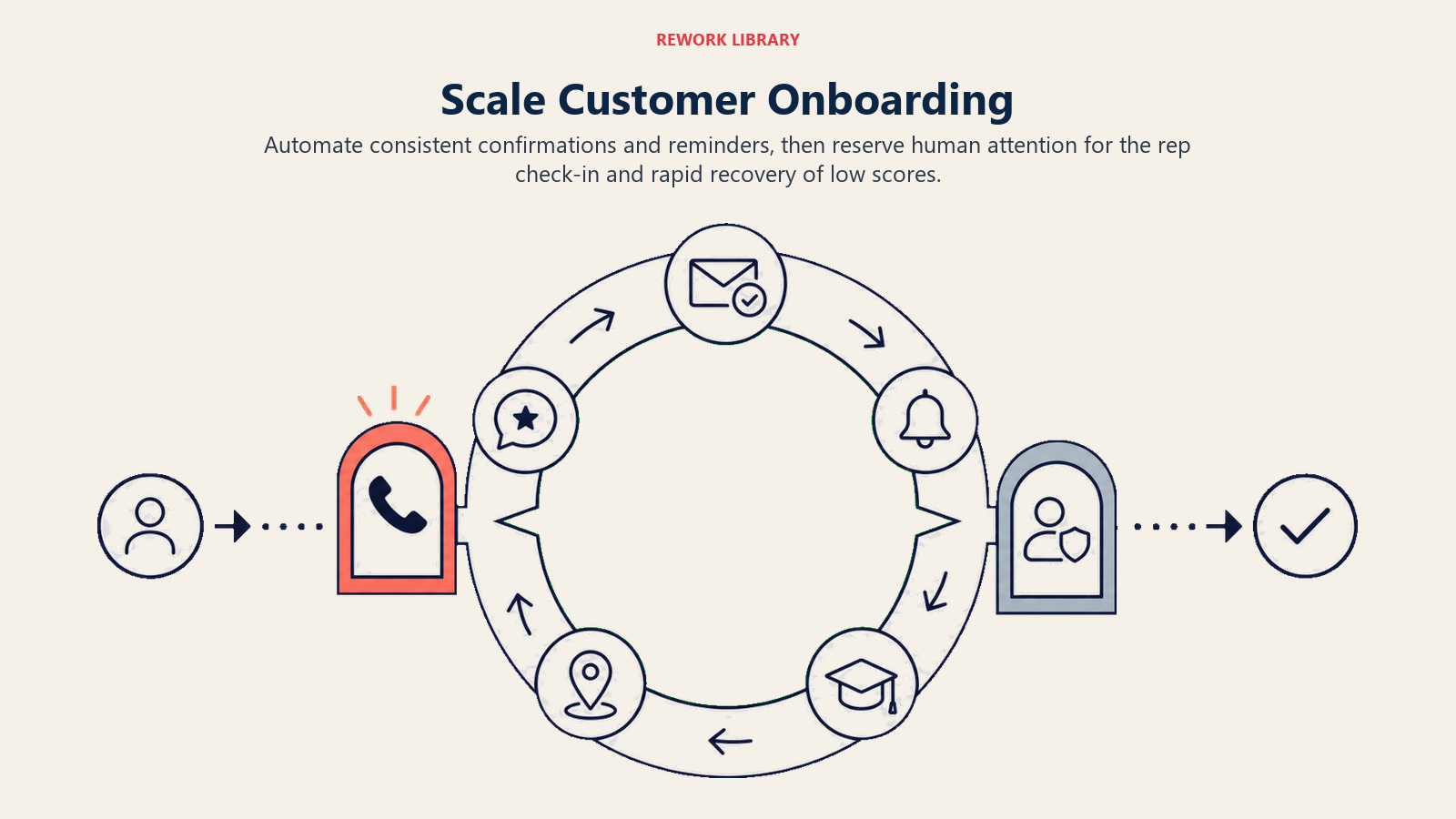
| Step | Method | Owner | Timing |
|---|---|---|---|
| Confirmation SMS | Automated (CRM trigger) | System | Within 30 min of sale |
| Confirmation email | Automated (template + personalization) | System | Within 1 hour |
| Rep follow-up call | Manual with rep accountability | Rep | Within 24 hours |
| Education sequence | Automated 3-part drip | System | Days 2, 4, 6 |
| Tech pre-brief | CRM notes pulled to dispatch | Operations | Day before service |
| Tech arrival alert | Automated SMS | System | 30 min before arrival |
| Post-service check-in | Automated SMS | System | Within 24 hours of service |
| Issue escalation | Manual callback on low scores | Manager | Same day as flagged score |
The goal is to automate the consistent touchpoints and reserve human attention for the moments where it matters most: the rep's 24-hour call and the manager's callback on problem scores. Get that balance right and onboarding stops being a cost center.
"The rep follow-up call within 24 hours of signing is the single highest-impact manual step in the D2D onboarding process. It surfaces buyer hesitation before it becomes a cancellation request, and it reminds the customer that a real person is accountable for their account."
"A D2D company that loses a customer before the third service is funding its own subscriber losses. Onboarding is the mechanism that converts a paid-for acquisition into an actual retained subscriber. (Rework Analysis)"
"Customers who feel well-onboarded refer neighbors and accept upsells at higher rates than customers who were merely signed up. In D2D specifically, the referral is as simple as knocking next door, which means strong onboarding compounds the original sales effort."
Final Thought
Onboarding is the first chapter of a subscription relationship, not a formality that follows the close. The D2D companies that grow recurring revenue reliably don't just sell well at the door. They stay present, organized, and proactive from signature through first service and beyond.
Every account you onboard well is an account you won't have to re-acquire.
Learn more: Customer Success Check-Ins | Churn Prevention Strategy
Frequently Asked Questions about Welcome and Onboarding the New Customer
What is customer onboarding in D2D home service subscriptions?
Customer onboarding in D2D home services is the structured sequence of communications and service actions that bridge the gap between a signed agreement and an active, satisfied subscriber. It typically spans the first 7 to 14 days after signing and includes an automated confirmation, a rep follow-up call, a pre-service education sequence, and a first-visit execution that matches what the rep promised at the door.
When does buyer's remorse peak for door-to-door customers?
Buyer's remorse peaks in the first 24 to 72 hours after signing, when the customer is alone with their decision without the social presence of the rep. This is the window when competitors who knock the same door, skeptical spouses, or negative online reviews have the most influence. Proactive communication during this window is the primary tool for keeping the sale intact.
What should the automated confirmation message include?
The automated confirmation should include the rep's name (to humanize the company), the specific service type agreed upon, the first scheduled service date or when scheduling will contact them, and a direct phone number or reply-to number for questions. Generic confirmation emails that don't reference the rep or the specific service are significantly less effective at reducing buyer anxiety.
How does the rep follow-up call reduce early cancellations?
The rep's 24-hour call gives the customer a low-stakes opportunity to voice any hesitation before that hesitation becomes a cancellation call. Most new customers who are having second thoughts won't proactively call to cancel if they feel a real person is accountable for their account. The call itself is the proof. A one-minute check-in captures most of the benefit.
What goes in the pre-service education sequence?
Three touchpoints work well: Day 2 covers what to expect on service day (what the tech will do, how long it takes, what access is needed). Day 4 introduces the service team (name, photo, certifications if applicable). Day 6 is a reminder of the upcoming appointment plus a practical tip relevant to the service type. These touches cost almost nothing to automate and shift the customer from passive waiting to informed anticipation.
What is the most common onboarding failure in D2D home services?
The most common failure is no contact between signature and first service. When customers don't hear from the company for 5 to 10 days after signing, many assume the company is disorganized or that the agreement was lost. A second common failure is a technician who arrives for the first service without any notes from the rep, forcing the customer to repeat information and starting the relationship with friction.
How does a strong onboarding process affect lifetime value?
Customers who feel well-onboarded are more likely to stay through the first renewal cycle, more likely to accept upsell offers, and more likely to refer neighbors. Because acquisition costs in D2D are already paid by the time of signing, any improvement in early retention drops directly to the lifetime value of that cohort. A customer retained through year two is typically worth 3 to 5 times the first-year revenue in total lifetime contribution.

Senior Implementation Consultant
On this page
- Why Is Onboarding a Revenue Problem, Not Just a Courtesy?
- The 72-Hour Onboarding Window
- Hour 0 to 1: The Thank-You Confirmation
- Hours 1 to 24: The Rep Follow-Up Call
- Days 2 to 7: Education Sequence
- The First Service Visit
- Setting the Technician Standard
- What the Technician Does During the Visit
- Onboarding Checklist for Operations Teams
- Pre-First-Service Checklist
- First Service Day Checklist
- Post-First-Service Checklist
- Common Onboarding Failures and How to Fix Them
- How Does Onboarding Connect to Long-Term Retention?
- What Good Onboarding Looks Like at Scale
- Final Thought