Churn Prediction and Save Offers for D2D Subscription Companies
Turn this article into takeaways for your work.


Each assistant summarizes the article only for you and suggests best practices for your work.
By the time a customer calls to cancel, you've already lost significant ground. The decision to cancel, in most cases, was made days or weeks earlier. The call is the announcement, not the decision.
That gap between when a customer emotionally disengages and when they formally cancel is where churn prediction creates real value. Identify the signals early enough and you can intervene before the customer has made up their mind. Wait until the cancellation call and you're trying to undo a decision that already has momentum.
This article covers how to build a predictive churn system for D2D subscription services, how to design save offers that work, and how to run a save desk that recovers accounts without destroying margin.
Why Does Standard Churn Management Fail?
Most D2D subscription companies have some version of the same process: a customer calls to cancel, a rep reads from a script, offers a discount, and either retains the account or doesn't. This is a reactive save model, and it has three serious problems.
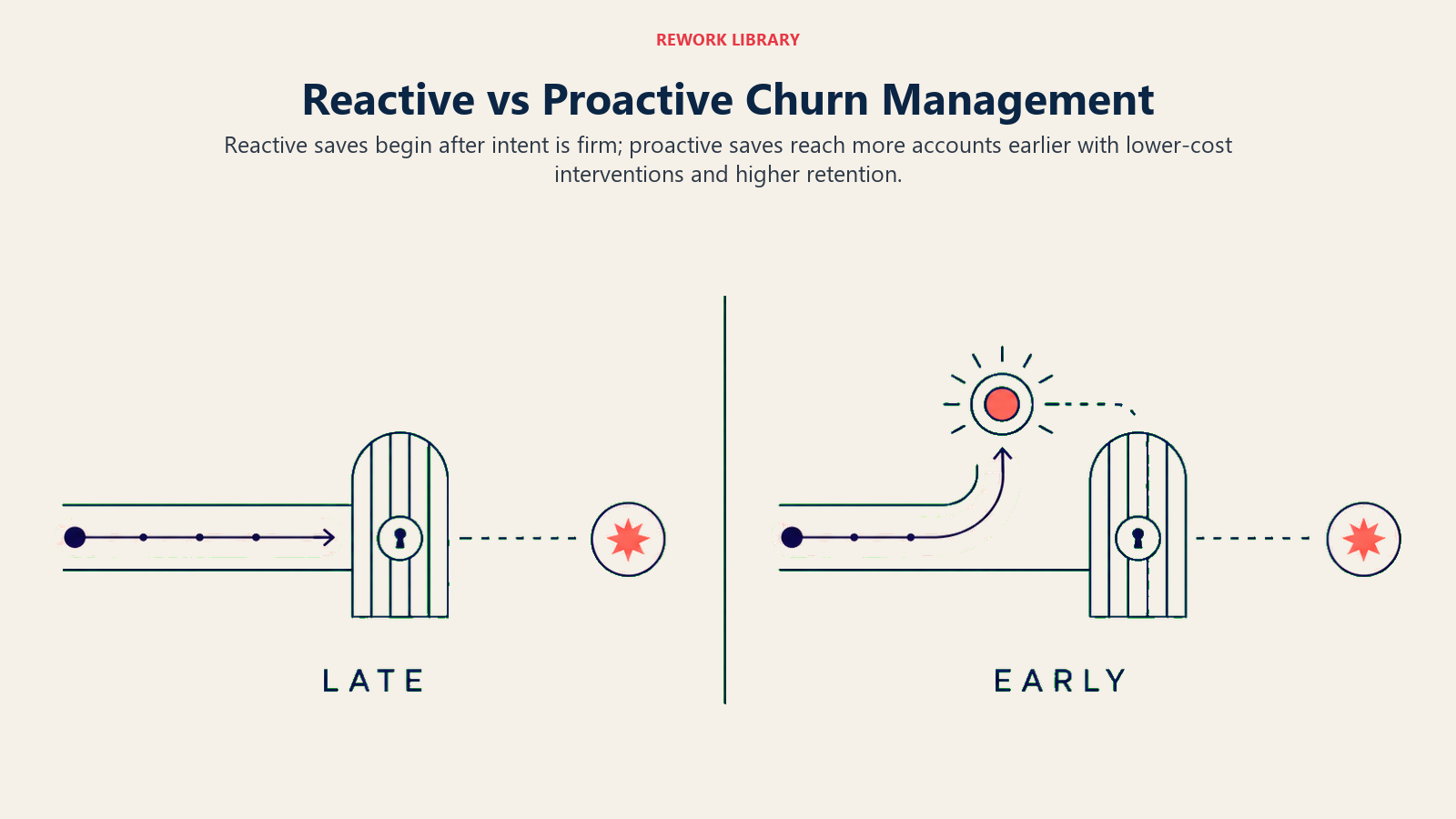
First, it only reaches customers who call. A significant portion of churn is passive: customers who simply stop responding to service notifications, let billing lapse, or move without notifying the company. These accounts disappear without a save attempt.
Second, reactive saves cost more. Customers who have already called to cancel are in a stronger negotiating position. Save offers at this stage tend to be more aggressive (deeper discounts, extended pauses, free services) to overcome the stated intention to leave.
Third, reactive saves work less often. When a customer has decided to cancel and taken the step of calling, the emotional work of disengaging is largely done. Retention rates from reactive saves typically run 15 to 30%. Proactive saves, where you reach out to at-risk accounts before they call, run 40 to 65%.
The math favors prevention. But prevention requires prediction. Bain and Company's research on retaining customers confirms that companies increasing retention by as little as 5% can boost profits by up to 95%, which makes proactive churn intervention one of the most direct levers on net margin. Building that prediction capability starts with knowing which signals actually matter.
Key Facts: Churn Prediction and Save Programs
- Proactive save rates in D2D subscriptions (reaching at-risk accounts before they call) typically run 40% to 65%, compared to 15% to 30% for reactive saves after the customer has initiated a cancellation request. (Rework Analysis, based on reported save desk benchmarks across subscription home service operators)
- A structured proactive save program that retains 50% of flagged at-risk accounts, combined with a 25% reactive save rate on inbound cancellation calls, can reduce annual churn by 3 to 6 percentage points on a 1,000-account subscriber base. (Rework Analysis)
- Bain and Company's research confirms that retaining customers through a 5% improvement in retention can boost profits by up to 95%, making each saved account worth far more than the direct revenue recovery alone.
Building a Churn Signal Framework
Churn prediction in D2D home services doesn't require a data science team. It requires discipline around tracking the right behavioral signals inside your CRM.
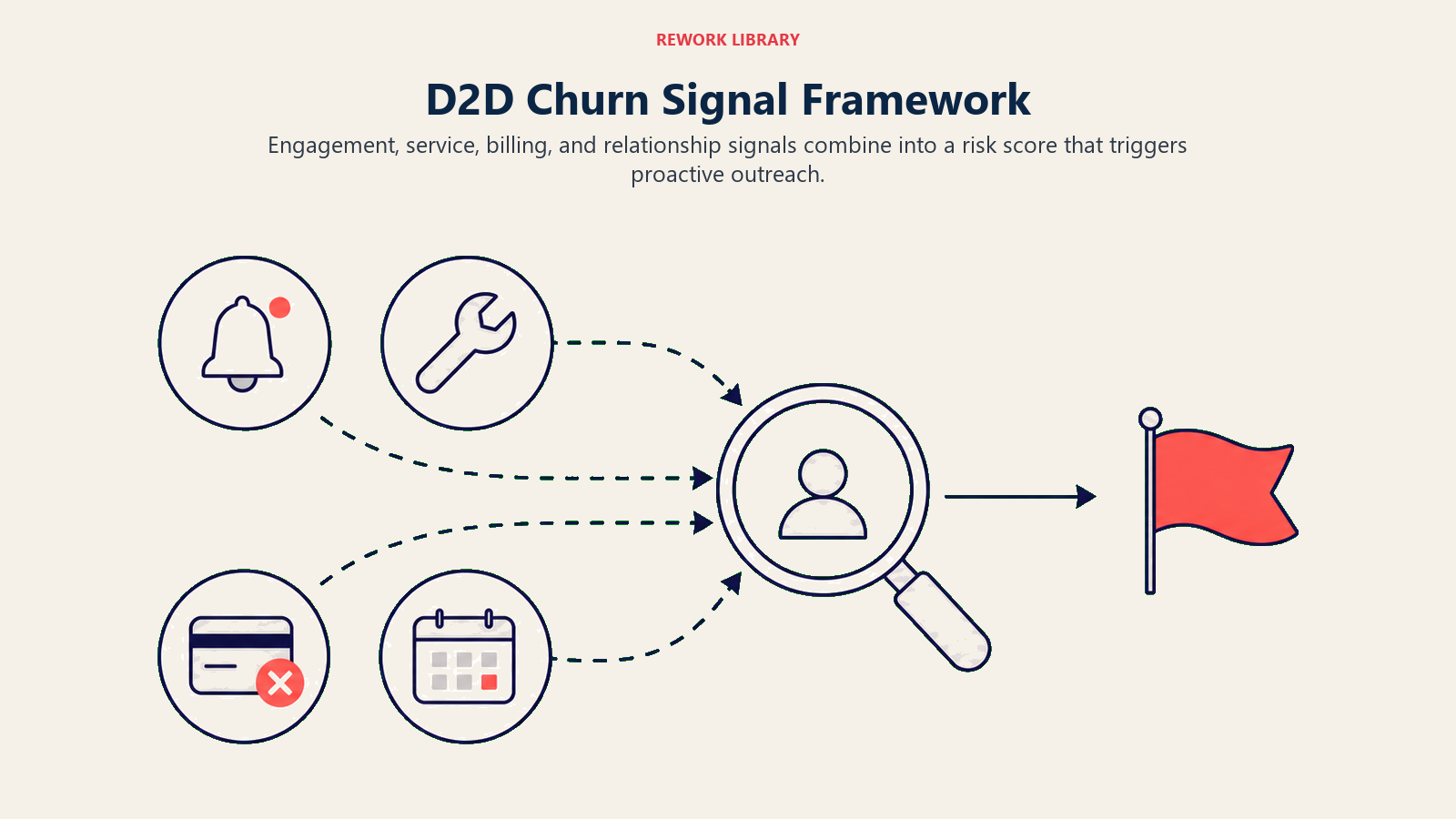
Here are the most reliable early indicators, organized by signal type.
Engagement Signals
These measure whether the customer is paying attention and responding to normal service communications.
| Signal | Churn Risk Level |
|---|---|
| Did not respond to last appointment reminder | Low (watch) |
| No-showed 1 scheduled service | Medium |
| No-showed 2+ scheduled services | High |
| Has not opened last 3 service notification emails | Medium |
| Has not responded to any communication in 45+ days | High |
Service Experience Signals
These measure problems with the delivery relationship.
| Signal | Churn Risk Level |
|---|---|
| Filed a service complaint | High |
| Submitted re-service request | Medium (depends on resolution) |
| Left a 1-3 star review or feedback | Critical |
| Requested a tech change | Medium |
| Had 2+ re-service requests in a 90-day period | High |
Billing Signals
These measure financial friction.
| Signal | Churn Risk Level |
|---|---|
| Payment method declined once | Medium |
| Payment method declined twice | High |
| Disputed a charge | High |
| Requested billing information or contract terms | Medium |
Relational Signals
These measure the relationship between the customer and the company.
| Signal | Churn Risk Level |
|---|---|
| Account tenure under 90 days | Medium baseline (all new accounts) |
| Account tenure 10 to 14 months (approaching annual renewal) | Medium |
| Rep who sold account left the company | Low to medium |
| Technician who serviced account left the company | Medium |
| Received a competitive offer (self-reported or canvassed territory) | High |
Build a simple scoring system: assign points to each signal category. Any account crossing a threshold (say, 8+ points) gets flagged for proactive outreach. You don't need a sophisticated model. A spreadsheet or a CRM workflow handles this at most D2D company scales.
See D2D sales KPIs and metrics for how to integrate churn risk scoring into your standard operations dashboard.
The Proactive Save Call
When an account is flagged as at-risk, someone should reach out before the customer does. The framing of this call matters enormously.
What This Call Is Not
It's not a sales call. Don't lead with an offer. Don't mention that you noticed they might cancel. Customers find that either creepy or presumptuous.
What This Call Is
It's a relationship check-in that happens to surface concerns and give you a chance to address them before they escalate.
Script framework (adapt to your voice):
The call can come from the original rep or a customer service representative (CSR):
"Hi [Name], this is [rep or CSR name] from [Company]. I'm calling to check in on your service and make sure everything's going well on our end. How has your [pest/lawn/security] been over the last few weeks?"
Then listen. Most at-risk customers will tell you what's wrong if given the invitation. The complaint might be minor (they're not sure the service is working), medium (they had a scheduling issue that annoyed them), or major (they had a bad experience with a tech).
Your response depends on what you hear:
- Minor: Validate, educate, reassure. "I understand it can feel that way. Here's what's actually happening in your home right now..."
- Medium: Apologize specifically, fix it, offer a small make-good (free re-service, credit on next invoice).
- Major: Apologize without qualification, fix it with urgency, escalate to manager, offer a meaningful make-good.
In many cases, the simple act of someone calling proactively is enough. The customer's concern was that the company didn't care. The call itself is the proof that they do. Sometimes, though, a conversation isn't enough, and you need something tangible to offer.
Designing Save Offers That Work
When you need to make a tangible offer to retain an account, design matters. Poor save offer design either fails to retain the customer or retains them at a margin-damaging cost.
Principles of Effective Save Offers
Match the offer to the churn reason. A customer leaving because of service quality problems doesn't want a discount. They want a credible promise that the problem is fixed. A customer leaving because of price needs a cost-related offer. Diagnose the reason before presenting the offer.
Use a menu, not a single offer. Giving the customer a choice between two or three options (and letting them feel agency in the resolution) increases save rates compared to presenting a single take-it-or-leave-it option.
Set an expiration. Save offers with an expiration create urgency without pressure. "I can hold this for you until [date]. After that I won't be able to make this available." This stops the customer from shopping the offer or putting off the decision indefinitely.
Protect the contract value where possible. A discount that runs for 3 months is far less expensive than a permanent price reduction. A free re-service costs less than a monthly bill credit. Structure offers to minimize long-term margin impact.
The Tiered Save Offer Framework
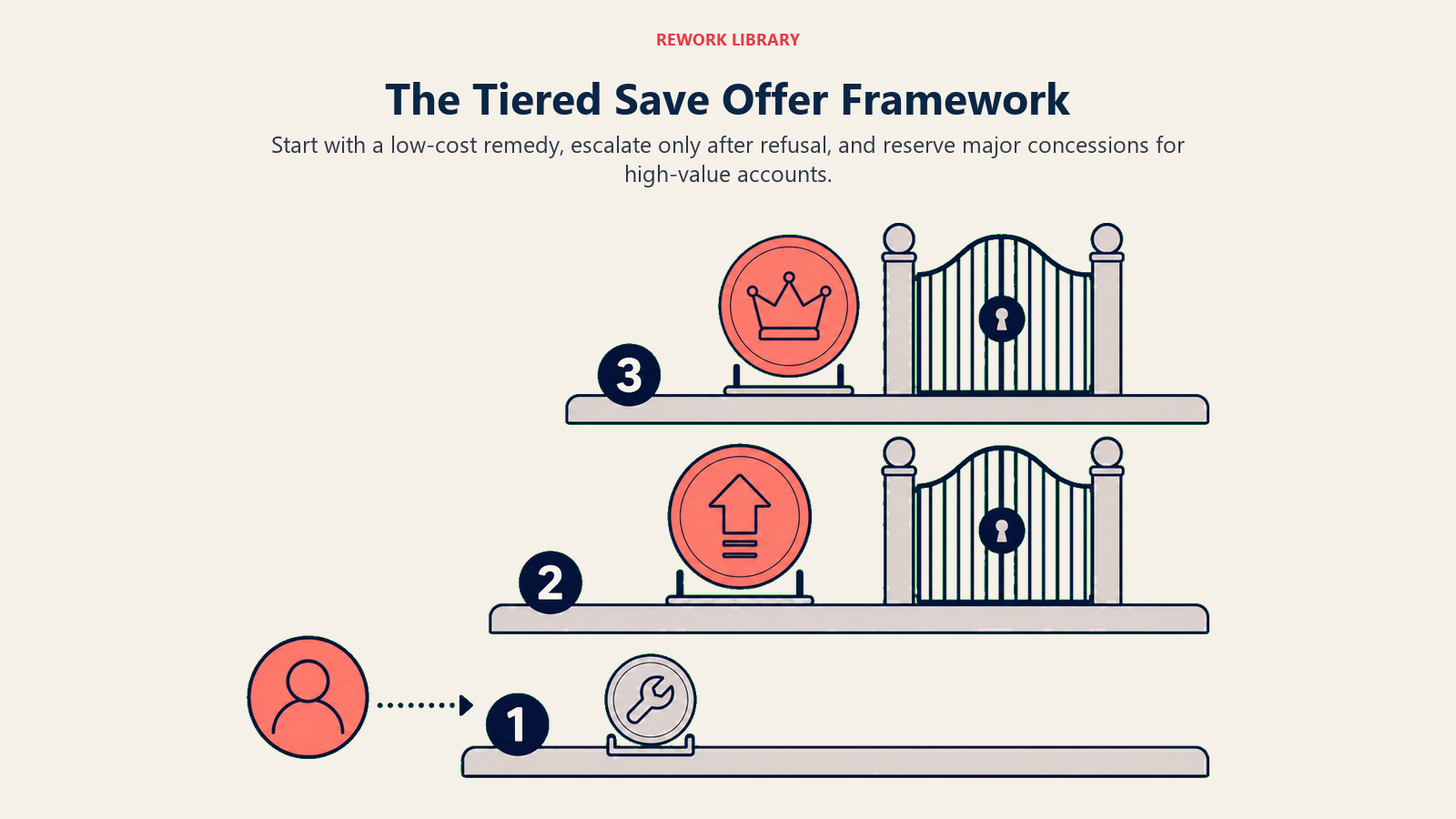
The Tiered Save Offer Framework: a three-level escalation system that matches offer cost to account risk without overspending on saves that didn't need to be expensive. Level 1 offers (free re-service, one-month credit, short pause) can be approved by any frontline CSR and resolve the majority of save conversations. Level 2 offers (multi-month discount, service upgrade, re-sign at promotional rate) require manager approval and are deployed when Level 1 is explicitly declined. Level 3 offers (significant rate lock, premium tech assignment, loyalty bonus) are reserved for high-value or long-tenure accounts and require executive sign-off. Starting at Level 1 and escalating only when necessary preserves margin on the saves that don't need a deep concession.
Design three levels of save offers, authorized at different levels of your organization.
Level 1: Front-line save (CSR or rep can offer)
- One free re-service within 30 days
- One month's bill credit (applied to next invoice)
- Temporary schedule change or pause (up to 4 weeks)
Level 2: Manager escalation save
- Two months reduced rate (15 to 20% discount)
- Free upgrade to next service tier
- Cancel existing contract, re-sign at promotional rate
Level 3: Executive save (high-value or long-tenure accounts)
- Significant rate adjustment or lock-in
- Premium tech assignment guarantee
- Loyalty acknowledgment + retention bonus (gift card, referral credit)
Start at Level 1 and only escalate when the customer explicitly declines and stays intent on cancelling. Many saves happen at Level 1, and escalating prematurely costs margin you didn't need to spend. None of this works, though, without a system to run it at volume.
How Do You Run a Save Desk at Scale?
At scale (roughly 500+ active subscribers), a dedicated save desk or retention team is worth the investment. Here's what the function looks like.
Save Desk Responsibilities
Monitor the churn risk dashboard daily. Pull flagged accounts from the CRM and prioritize by risk score and account value.
Execute proactive outreach on high-risk accounts. 5 to 10 calls per day per CSR is a sustainable pace for quality conversations.
Handle all inbound cancellation requests. Every call where a customer expresses intent to cancel should route to the save desk, not a general service queue.
Log save attempts and outcomes. Track reason for at-risk flag, offer made, outcome (retained, declined, paused), and account value.
Report weekly to management. What's the save rate? What are the most common churn reasons? Which accounts are we losing that we should have caught earlier?
Save Desk Metrics
| Metric | Definition | Target |
|---|---|---|
| Proactive save rate | Retained / Total flagged proactive contacts | 40 to 65% |
| Reactive save rate | Retained / Total inbound cancellation requests | 20 to 35% |
| Save offer utilization by type | Which Level 1/2/3 offers are used most | Track monthly |
| Average save margin | Revenue saved vs. discount given per retained account | Positive |
| Re-churn rate | % of saved accounts that cancel within 90 days | Under 25% |
The re-churn rate is particularly important. A save that retains a customer for 2 more months before they cancel anyway is only marginally better than no save at all. If your re-churn rate is high, the root issue (service quality, value perception, competitive pricing) hasn't been addressed, just delayed. This connects directly to the churn fundamentals framework from our post-sale management series.
Handling the Difficult Save Conversation
Some customers are firm in their intent to cancel and no save offer will change their minds. How you handle this matters for two reasons: the potential for a referral from even a departing customer, and the possibility of a future win-back.
What to Say When the Save Fails
"I completely understand. I'm sorry we weren't able to meet your expectations, and I appreciate the time you gave us. If there's anything I can learn from your experience to help us do better, I'd genuinely appreciate it. And if your situation changes in the future, we'd love the opportunity to earn your business back."
This framing does three things. It leaves the relationship intact. It opens the door to feedback that improves your retention system. And it plants the seed for a future win-back, which in many D2D markets is a real revenue opportunity. See win-back campaigns for how to operationalize this.
The Exit Survey
Every cancelled account should receive a brief exit survey, separate from the conversation at cancellation. A short 3-question form sent by SMS 24 hours after cancellation captures feedback when the customer is past the friction of the cancellation call itself.
Ask:
- Why did you decide to cancel? (Multiple choice + write-in)
- Was there anything that could have kept you as a customer?
- Would you consider returning if your situation changed? (Yes / Maybe / No)
This data, aggregated monthly, is among the most valuable insight a D2D subscription company can collect. It tells you exactly why you're losing customers and what would have changed their minds.
Integrate your exit data with your churn signal framework. If customers are frequently citing a reason that wasn't being flagged as a risk signal, add it. Your prediction model should get better every month.
Connecting Churn Prediction to the Broader Retention System
Churn prediction and save offers are one component of a larger retention architecture. They work best when the other components are also in place.
Welcome and onboarding the new customer reduces early churn so your save desk isn't overwhelmed by the most recoverable accounts, new subscribers who had a fixable experience. Reducing early cancellations addresses the structural root causes before they create save situations. Subscription retention fundamentals build the ongoing service and communication habits that keep satisfied customers from becoming at-risk in the first place.
The save desk is the safety net. Make it excellent. But the goal is to need it less as the rest of the retention system matures.
For additional frameworks on managing long-term subscriber health, see churn prevention strategy.
Learn more: Subscription Retention Fundamentals | Lead Nurturing Programs
The Compounding Benefit
A D2D subscription company that runs a proactive save system at 50% effectiveness on flagged accounts, combined with a reactive save rate of 25% on inbound cancellation calls, will typically reduce its annual churn rate by 3 to 6 percentage points compared to a company running no structured save program. For context on why that matters, Harvard Business Review notes that acquiring a replacement customer costs 5 to 25 times more than keeping an existing one, so each saved account avoids both a lost revenue stream and a disproportionate re-acquisition expense.
On a 1,000-subscriber base at $60 per month, a 4-point improvement in annual retention is worth roughly $28,800 in additional annual revenue from preserved accounts, plus the avoided acquisition cost of replacing those accounts (roughly $80,000 at $200 per account). Combined value: over $100,000 per year, on a program that typically costs far less to run.
Build the system. Work the signals. Make offers that match the reason. And keep refining the prediction model every time an account slips through.
That's how churn management becomes a competitive advantage.
"Proactive saves consistently outperform reactive ones in D2D subscriptions, and the gap isn't small. The difference is entirely in the timing of the intervention: reach the account before the customer has made up their mind, and the odds of keeping them flip in your favor. (Rework Analysis, based on operator-reported save desk benchmarks)"
"The exit survey sent 24 hours after cancellation, not during the cancellation call, captures feedback when the customer is past the friction of the conversation. That data, aggregated monthly, is among the most actionable insight a D2D subscription company can collect."
"A save that retains a customer for 2 months before they cancel anyway costs margin and time. The re-churn rate, the percentage of saved accounts that cancel within 90 days, tells you whether you're solving the actual problem or just delaying the same outcome."
Frequently Asked Questions about Churn Prediction and Save Offers for D2D Subscription Companies
What is proactive churn prediction in D2D subscription services?
Proactive churn prediction is the practice of identifying behavioral signals that precede a cancellation, such as missed appointments, billing declines, or unanswered service notifications, and triggering human outreach before the customer initiates a cancellation request. The goal is to intervene during the window when the customer is dissatisfied but hasn't yet made a firm decision to leave, when save rates are 2 to 3 times higher than after the cancellation call.
What churn signals should D2D companies track in their CRM?
The most reliable signals fall into four categories: engagement signals (missed appointments, no response to communications), service experience signals (complaints, re-service requests, low satisfaction scores), billing signals (payment declines, charge disputes), and relational signals (approaching annual renewal, rep or tech change on the account). Assigning point values to each signal and flagging accounts above a threshold creates a simple, automatable early-warning system.
What is a proactive save call and how should it be framed?
A proactive save call is a relationship check-in initiated by the company before the customer calls to cancel. It should not reference the risk signals that triggered it or lead with an offer. The most effective framing is a genuine service check-in: asking how the service has been, listening for concerns, and responding proportionally to what you hear. In many cases, the call itself resolves the issue because the customer's concern was that the company didn't care.
How should save offers be structured to protect margin?
Save offers should escalate through three levels, starting with low-cost options (free re-service, one-month credit, short pause) that frontline staff can approve, and escalating to meaningful concessions (multi-month discounts, service upgrades) only when the customer explicitly declines the first-level offer. Starting with the smallest effective offer and escalating only when needed preserves margin on the majority of saves that would have accepted a modest concession.
What is the re-churn rate and why does it matter?
Re-churn rate measures the percentage of saved accounts that cancel again within 90 days. A high re-churn rate (above 25%) indicates that the save addressed the symptom (the cancellation call) but not the root cause (service quality, billing confusion, perceived value). Tracking re-churn separately from the initial save rate shows whether the retention program is actually solving problems or just delaying them.
When should a D2D company build a dedicated save desk?
A dedicated save desk becomes operationally valuable at approximately 500 active subscribers, when the volume of at-risk accounts justifies dedicated monitoring and outreach. Below that threshold, save desk responsibilities can be handled by a customer service role with specific retention accountability. Above 500 subscribers, a dedicated function with its own dashboard, scripts, and escalation authority typically delivers a positive return compared to handling saves ad hoc.
How do exit surveys improve churn prediction over time?
Exit surveys sent 24 hours after a cancellation, distinct from the cancellation conversation itself, capture feedback when the customer is past the emotional friction of the call. A three-question format covering reason for cancellation, what could have changed their mind, and likelihood of returning generates structured data that, aggregated monthly, shows whether your churn signal framework is missing any high-frequency reasons. Any frequently-cited reason that wasn't in your signal model should be added, making the prediction system more accurate over time.

Senior Implementation Consultant
On this page
- Why Does Standard Churn Management Fail?
- Building a Churn Signal Framework
- Engagement Signals
- Service Experience Signals
- Billing Signals
- Relational Signals
- The Proactive Save Call
- What This Call Is Not
- What This Call Is
- Designing Save Offers That Work
- Principles of Effective Save Offers
- The Tiered Save Offer Framework
- How Do You Run a Save Desk at Scale?
- Save Desk Responsibilities
- Save Desk Metrics
- Handling the Difficult Save Conversation
- What to Say When the Save Fails
- The Exit Survey
- Connecting Churn Prediction to the Broader Retention System
- The Compounding Benefit