Route and Time Management for Door-to-Door Sales Reps
Turn this article into takeaways for your work.


Each assistant summarizes the article only for you and suggests best practices for your work.
There's a simple truth about door-to-door sales: reps who knock more doors close more deals. Not because they're more persuasive. Because the math works. If you convert one in eight pitches, a rep who pitches 24 people a day closes 3 deals. A rep who pitches 40 people a day closes 5. Same skill, different output.
Route and time management is what separates those two reps. It's not glamorous. It's planning where you go, when you go there, and how you protect every minute between your first knock and your last. This guide is built for door-to-door, or D2D, reps and managers at home-services companies: security, pest control, lawn care, and fiber. The principles are the same across verticals.
Most reps lose that time without ever noticing. SPOTIO's 2026 State of Field Sales report found that field sales reps spend just 37% of their workweek in actual face-to-face selling, with the remaining 63% consumed by admin, meetings, planning, and transit. Reclaiming even half of that lost time through structured routing can add 8 to 10 additional door contacts per day.
The Time Budget: Where Your Day Actually Goes
Before you optimize a route, you need to understand how you're losing time. Most reps don't track this. They show up, they start knocking, they wonder why they only hit 22 doors. Here's where the time actually goes in a typical unplanned D2D day.
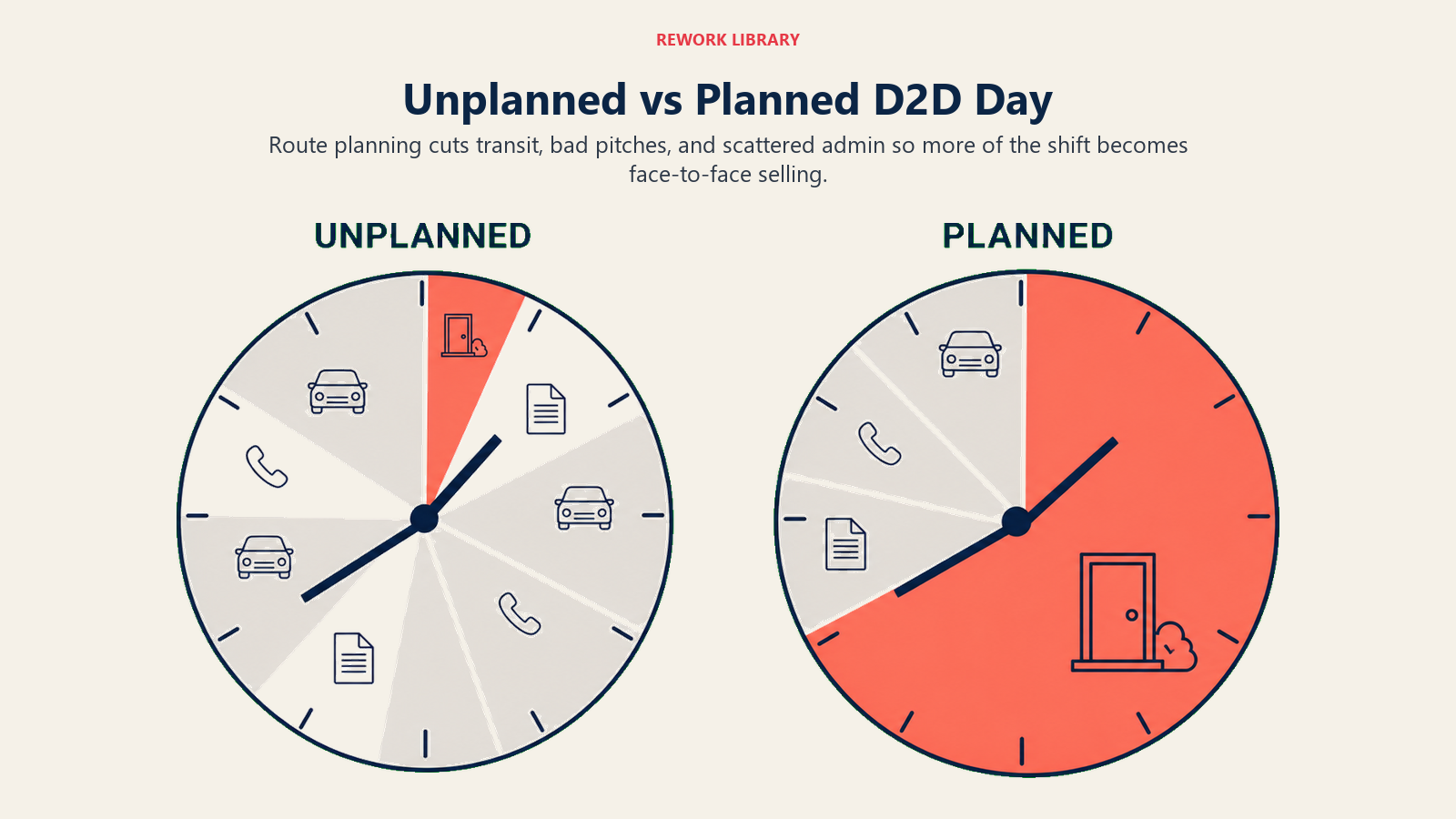
| Activity | Unplanned Day | Planned Day |
|---|---|---|
| Drive to territory | 25 min | 15 min |
| Parking and walking between homes | 40 min | 20 min |
| Actual knocking + conversations | 3.5 hrs | 5.5 hrs |
| Non-qualified pitches (wasted time) | 45 min | 15 min |
| Paperwork / CRM entry (during day) | 30 min | 10 min |
| Lunch + breaks | 45 min | 45 min |
| Drive home | 25 min | 15 min |
The biggest losses are transit and non-qualified pitches. A planned rep saves 30 minutes on driving and 30 minutes on bad pitches. That's an extra hour of selling time, which translates to 8-10 additional doors per day at a normal walking pace.
Key Facts: D2D Route Productivity
- D2D teams typically convert 2-5% of doors knocked into closed deals, which means door volume directly determines how many closes are possible each day (SPOTIO)
- A healthy contact rate for D2D canvassing is 30-40% of doors knocked, meaning timing and density planning can swing daily contacts by a factor of two (SPOTIO)
- The U.S. door-to-door sales industry generates approximately $30 billion in annual revenue, making efficient route management a high-stakes operational discipline at scale (SPOTIO)
The Four Elements of a Good Daily Route
A well-structured D2D route does four things. It minimizes backtracking. It matches timing to homeowner availability. It concentrates knocks in the highest-density zones. And it accounts for realistic break points.
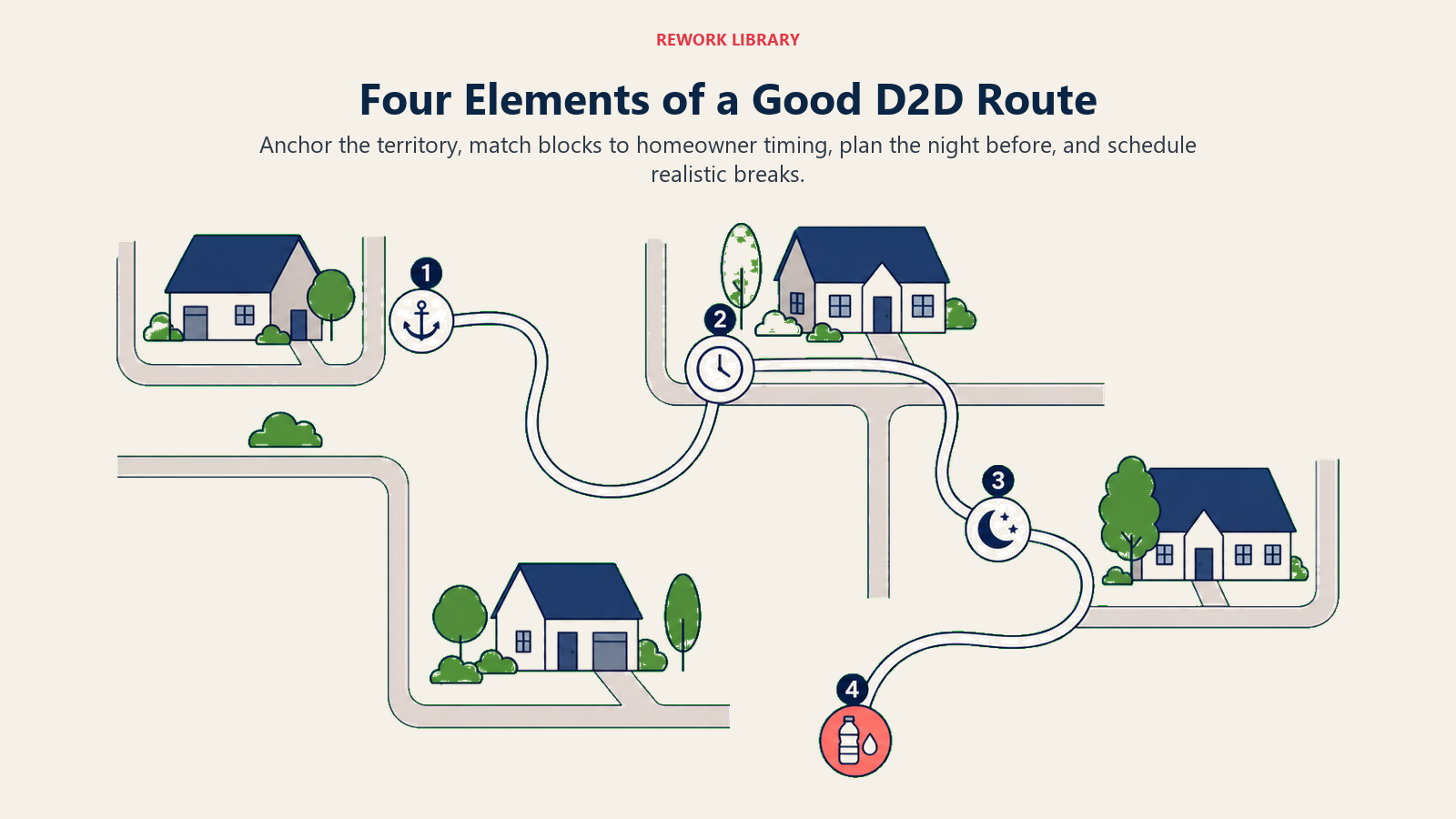
1. Pick a geographic anchor and work outward
The biggest route mistake is the zigzag pattern, where reps drive from one end of the territory to the other without logic. Pick an anchor point (a cross-street, a cul-de-sac cluster, a subdivision entrance) and work outward in a loop before moving to the next zone.
The Lawnmower Route System: a systematic row-by-row sweep of a neighborhood block, completing each full row before advancing to the next, designed to eliminate backtracking and minimize car repositioning between knocks. Work row by row through a neighborhood, finishing each row before starting the next. This keeps walking distances short and car moves minimal.
2. Start where homeowners are most likely to answer
Not all blocks knock equally at all times. In residential neighborhoods, late afternoon (4:30-7:30 PM) is the highest-answer-rate window because working adults are home. But earlier in the day, you'll find more retirees, remote workers, and stay-at-home parents, which isn't a bad thing if your service fits them.
Map your route to start at your highest-density blocks during peak hours and use your lowest-density blocks for off-peak travel time.
3. Build the route the night before, not the morning of
Planning your route in the car or in the parking lot of your first neighborhood is the single most common time killer in D2D. Every minute you spend figuring out where to go is a minute you're not knocking.
Use a canvassing app like D2D CRM, SalesRabbit, or Spotio (see D2D CRM and canvassing apps) to pre-load your route the night before. Mark which blocks you've already worked, where callbacks are scheduled, and which homes to skip (already customers, on a do-not-knock list, or flagged no-answer twice).
4. Build in realistic break points
Reps who skip breaks don't perform better. They perform worse in hours three and four. A good daily structure includes:
- Morning: 60-90 minutes of knocking before a short water break
- Midday: 30-45 minute lunch (not in your car, ideally somewhere you can reset)
- Afternoon: 90-120 minutes of continuous knocking before a 10-minute reset
- Evening push: the last 60-90 minutes before wrap-up, when energy matters most
Your evening push should always be in your best block, not your cleanup block. Reps who save the worst streets for last lose energy at exactly the moment when homeowners are most available.
Door Target Math: How Many Knocks Do You Actually Need?
Work backward from your close goal to set your daily door target.
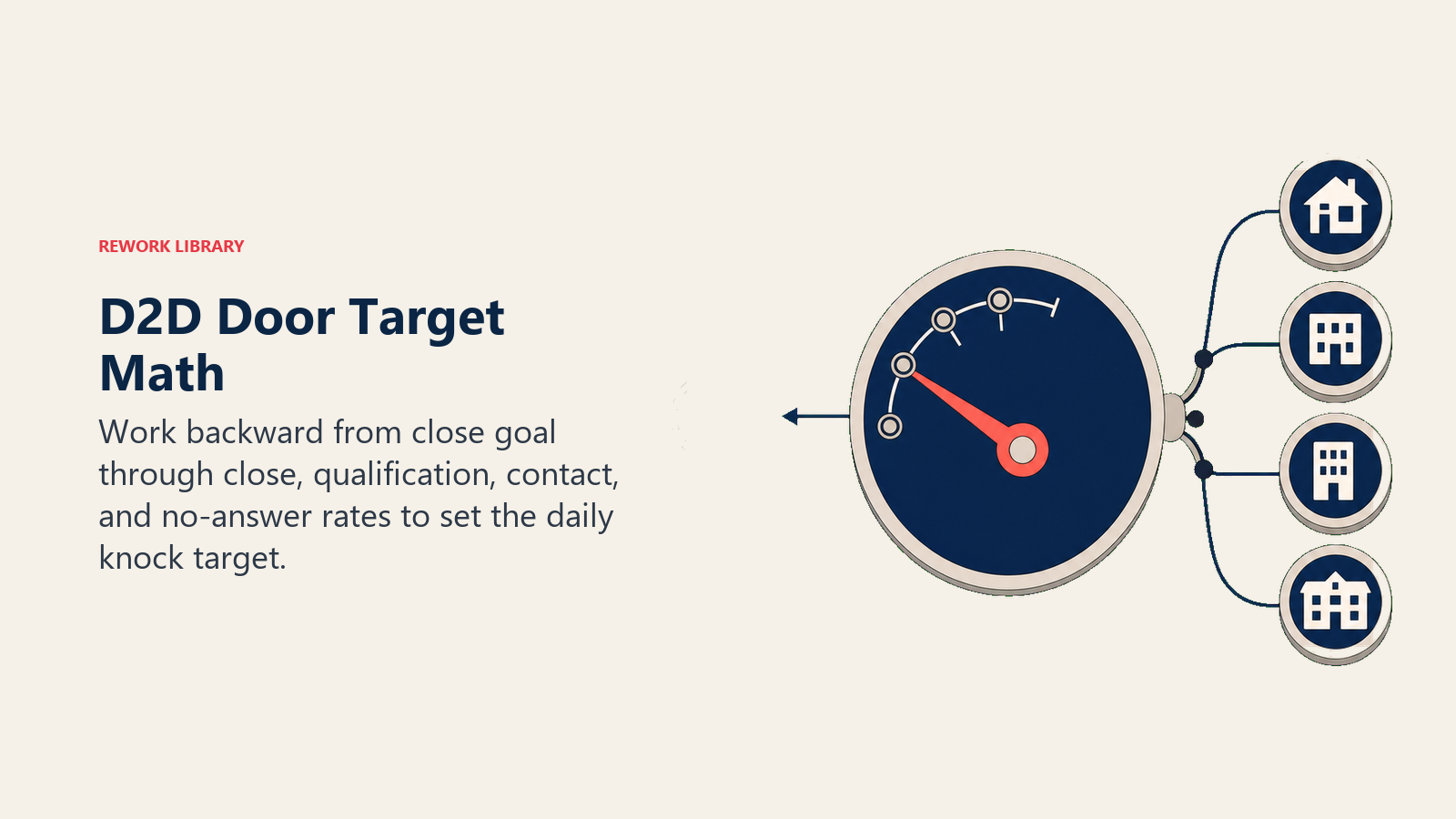
| Metric | Example Rep |
|---|---|
| Weekly close goal | 10 subscriptions |
| Days per week knocking | 5 |
| Close goal per day | 2 |
| Close rate (closes / full pitches) | 25% |
| Pitches needed per day | 8 |
| Qualification rate (pitches / contacts) | 50% |
| Door contacts needed per day | 16 |
| No-answer rate | 55% |
| Doors to knock to get 16 contacts | ~36 |
At a 2-5% close rate on doors knocked, a rep who adds just 10 extra doors per day gains 2-5 additional closed deals per week without changing a single word of their pitch.
This is a simplified version of your D2D sales KPIs framework. The point isn't to find the exact number but to understand the relationship. If you're closing 25% but only qualifying 30% of contacts, the fix is earlier in the funnel (see qualifying at the door). If your qualification rate is fine but your contact rate is low (too many no-answers), that's a timing and density problem, not a skill problem.
The same math shows up in solar D2D teams thinking about daily door targets in a longer-pitch sale, which offers a useful reference point when you're calibrating targets for your own team.
Managing Your Time in High-Density vs. Low-Density Areas
Not all neighborhoods knock the same. High-density areas (tighter streets, more homes per block) reward walking efficiency. Low-density areas (large lots, rural routes, longer driveways) eat time quickly.
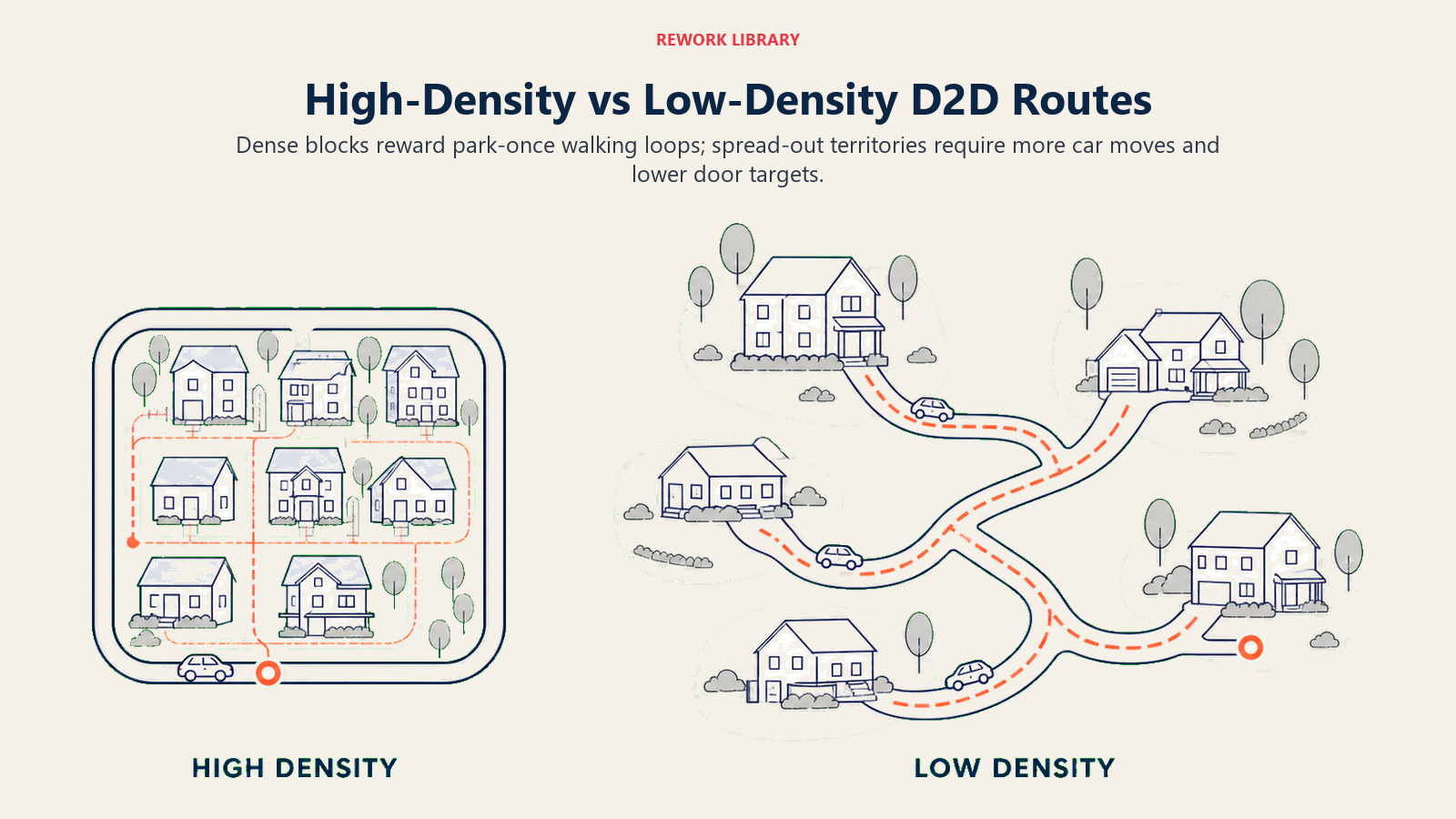
For high-density areas:
- Park once and walk a full loop before moving the car
- Target 12-15 doors per 30 minutes of working time
- Use this zone during peak hours to maximize contacts
For low-density areas:
- Move the car more frequently to reduce dead walking time
- Target 6-8 doors per 30 minutes
- Use this zone during off-peak hours or as a wrap-up sweep
Some managers assign a single density type per rep per day. If Monday is high-density subdivisions, the rep can realistically hit 45-50 doors in an afternoon session. If Tuesday is rural roads, 25-30 is more realistic. Planning for that gap prevents rep frustration and manager disappointment when the numbers don't look the same day over day.
What Is Eating Your Selling Time Between Doors?
The three biggest time thieves in a D2D rep's day aren't knocking the wrong doors. They're things that happen between doors.
Phone distractions. Reps who check their phones between doors lose 4-8 minutes per hour to social media and texts. That's 30+ minutes over an afternoon. The standard: phones go away when you're working a block. CRM notes get entered at the end of each street, not after each door. SPOTIO's research found that 65% of field reps spend five or more hours weekly on manual CRM data entry, with 19% losing 8 to 10 hours per week to it. Batching your logging to street-end breaks is one of the simplest ways to stop that drain without skipping the data your manager needs.
On-the-spot paperwork. Writing up contracts, texting managers, or looking up pricing in the middle of a route kills momentum. Have your pricing sheet memorized. Know your contract structure cold. Anything that requires you to stop and look something up is something you should practice until it's automatic.
Unscheduled callbacks. When a prospect says "come back when my wife is home," that's a callback. Unscheduled callbacks that pull you back to a different part of the territory mid-route kill efficiency. Batch callbacks into the last 45 minutes of your shift or the first 15 minutes of the next day. Don't chase them live.
Tracking Your Route Performance
You can't improve what you don't measure. At the end of each day, log four numbers:
- Total doors knocked
- Total contacts (someone answered)
- Total pitches delivered
- Total closes
Those four numbers tell you where the leak is. If contacts are low relative to knocks, your timing is off or your density is wrong. If pitches are low relative to contacts, your qualification is too loose or your opener isn't working. If closes are low relative to pitches, that's a pitch or objection-handling problem.
Review these numbers in your rep performance dashboard weekly. A rep whose contact rate is dropping probably needs a weather and timing adjustment, not a new pitch.
Route Management for Teams and Managers
If you're a sales manager, your job around route planning is to remove friction so your reps spend their time selling. A few practical moves:
Pre-assign territories before reps arrive in the morning. Reps shouldn't be negotiating territory at the morning huddle. That's manager work that should happen the night before. See territory design and assignment for how to structure this.
Batch manager check-ins to non-selling hours. A manager who calls reps during peak knocking hours is pulling them out of the field at exactly the wrong time. Set a 4:00 PM check-in call and don't interrupt before that unless it's urgent.
Use ride-alongs to audit time use, not just pitch quality. Most ride-alongs focus on what reps say at the door. But you learn more by watching how they manage the time between doors. A rep who pauses at every walkway to check their phone or drives three minutes between adjacent houses has a time discipline problem, not a pitch problem. Coaching this specifically pays off fast.
Set daily door minimums by territory type. A rep working a dense subdivision should hit 40+ doors. A rep working spread-out rural routes might do 22. Using the same minimum for both creates unfair comparisons and should feed directly into how you build fair daily targets into your compensation structure.
The reps who manage their time best aren't necessarily the most talented closers. They're the ones who show up at the right doors at the right hour, every day, with a route already planned.
The Mental Game of Route Management
There's a psychological element to route and time management that most training guides skip. The reps who manage their time best aren't just more organized. They're better at managing energy across the day.
A common pattern for struggling reps: they knock hard for two hours, hit a string of no-answers, and start going through the motions. Doors get slower, walks get longer, phone comes out more. The external structure of a route can reinforce or undermine this.
A few habits that help:
End each block with your best street. Finishing strong creates momentum into the next block.
Set a micro-goal per street, not per day. "I'm going to knock every house on this block" is more manageable than "I need 40 doors today." Chaining micro-goals is how experienced reps keep energy high across a full afternoon.
Give yourself a physical reset between blocks. Walk to the car, drink water, take 60 seconds. This is a real performance pattern, not laziness. Reps who build micro-resets into their routine outperform reps who try to stay in motion every second.
The reps who internalize route and time management as a skill, not an obligation, build careers in D2D. The ones who treat it as optional stay stuck wondering why they can't hit their numbers. One thing that makes a real difference at the rep level is understanding how to score and triage the doors you're knocking once you're standing in front of them, which is where qualification comes in.
Frequently Asked Questions about Route and Time Management for Door-to-Door Sales Reps
How many doors should a D2D rep knock per day?
The realistic daily range is 25-50 doors depending on territory density and shift length. High-density subdivisions allow 40-50 doors in an afternoon session; low-density or rural routes typically yield 22-30. The right target comes from working backward: set a weekly close goal, apply your close rate and contact rate, and calculate the daily door number that gets you there.
What time of day is best for door-to-door knocking?
Late afternoon and early evening, roughly 4:30 to 7:30 PM, consistently produces the highest contact rates in residential territories because working adults are home. Morning hours (9 AM to noon) work well for retirees, remote workers, and stay-at-home parents. Midday is typically the weakest window for contacts and is better used for route planning, callbacks, and CRM cleanup.
What is the lawnmower pattern in D2D sales?
The Lawnmower Route System is a systematic row-by-row sweep of a neighborhood block, completing each full row before advancing to the next. It eliminates the zigzag driving pattern that wastes time and fuel by bouncing across a territory without logic. Working row by row keeps walking distances short, reduces car moves, and ensures every home in a zone gets covered before you move on.
How do I stop wasting time between doors?
The three biggest drains are phone use between doors, on-the-spot paperwork, and unscheduled callbacks. Batch CRM notes to the end of each street rather than after each door. Memorize pricing and contract details so nothing requires stopping to look up. Schedule callbacks into a dedicated window at the start or end of your shift rather than chasing them mid-route. Research from SPOTIO found that 65% of field reps spend five or more hours weekly on manual data entry, and batching log entries is one of the simplest ways to reduce that without skipping the data.
What is a healthy contact rate for door-to-door canvassing?
A healthy D2D contact rate, meaning the share of knocked doors where someone actually answers, falls in the 30-40% range according to SPOTIO's canvassing benchmarks. Rates below 20% typically signal a timing problem (knocking when no one is home) or a density problem (too many no-solicitation areas or low-occupancy blocks). Improving contact rate is usually a route and scheduling fix, not a pitch fix.
Should I plan my route the night before or in the morning?
Always plan the night before. Planning your route in the car or parking lot at your first stop is one of the most common time killers in D2D, and it also means you start the day reactive rather than focused. Use a canvassing app to pre-load your blocks, mark completed streets and callbacks, and flag homes to skip. A rep who arrives at their territory already knowing the first 10 doors they'll knock is more focused and hits a higher daily door count.
How should managers set fair daily door targets across different territory types?
Territory type directly affects how many doors a rep can physically reach in a shift. A rep working dense subdivisions should reasonably hit 40 or more doors; a rep on rural roads may only reach 22-30. Setting a single blanket minimum for both creates unfair performance comparisons and demoralizes reps on harder routes. Build territory-specific minimums into your daily targets and compensation structure so numbers reflect actual working conditions rather than theoretical capacity.
Learn more: Solar canvassing and door-to-door · Commission and comp design for D2D · Lead qualification frameworks · Opportunity qualification

Senior Implementation Consultant
On this page
- The Time Budget: Where Your Day Actually Goes
- The Four Elements of a Good Daily Route
- 1. Pick a geographic anchor and work outward
- 2. Start where homeowners are most likely to answer
- 3. Build the route the night before, not the morning of
- 4. Build in realistic break points
- Door Target Math: How Many Knocks Do You Actually Need?
- Managing Your Time in High-Density vs. Low-Density Areas
- What Is Eating Your Selling Time Between Doors?
- Tracking Your Route Performance
- Route Management for Teams and Managers
- The Mental Game of Route Management