Reducing Early Cancellations in Door-to-Door Subscription Services
Turn this article into takeaways for your work.


Each assistant summarizes the article only for you and suggests best practices for your work.
In the door-to-door recurring revenue model, there's a painful irony built into the first 90 days. The company has already spent the most expensive money it will ever spend on that customer: the rep's commission, the sales manager's time, the canvassing investment in that territory. And it hasn't collected nearly enough revenue to break even on that cost.
Early cancellations, those that happen before the third or fourth service, don't just hurt. They often leave the company operating at a net loss on accounts it thought it had won.
Understanding why early cancellations happen, and how to prevent them systematically, is one of the highest-leverage problems any D2D subscription operator can solve.
What Causes an Early Cancellation in D2D Subscription Services?
Early cancellations in D2D services cluster around a few predictable causes. Knowing which type you're dealing with changes which intervention you deploy.
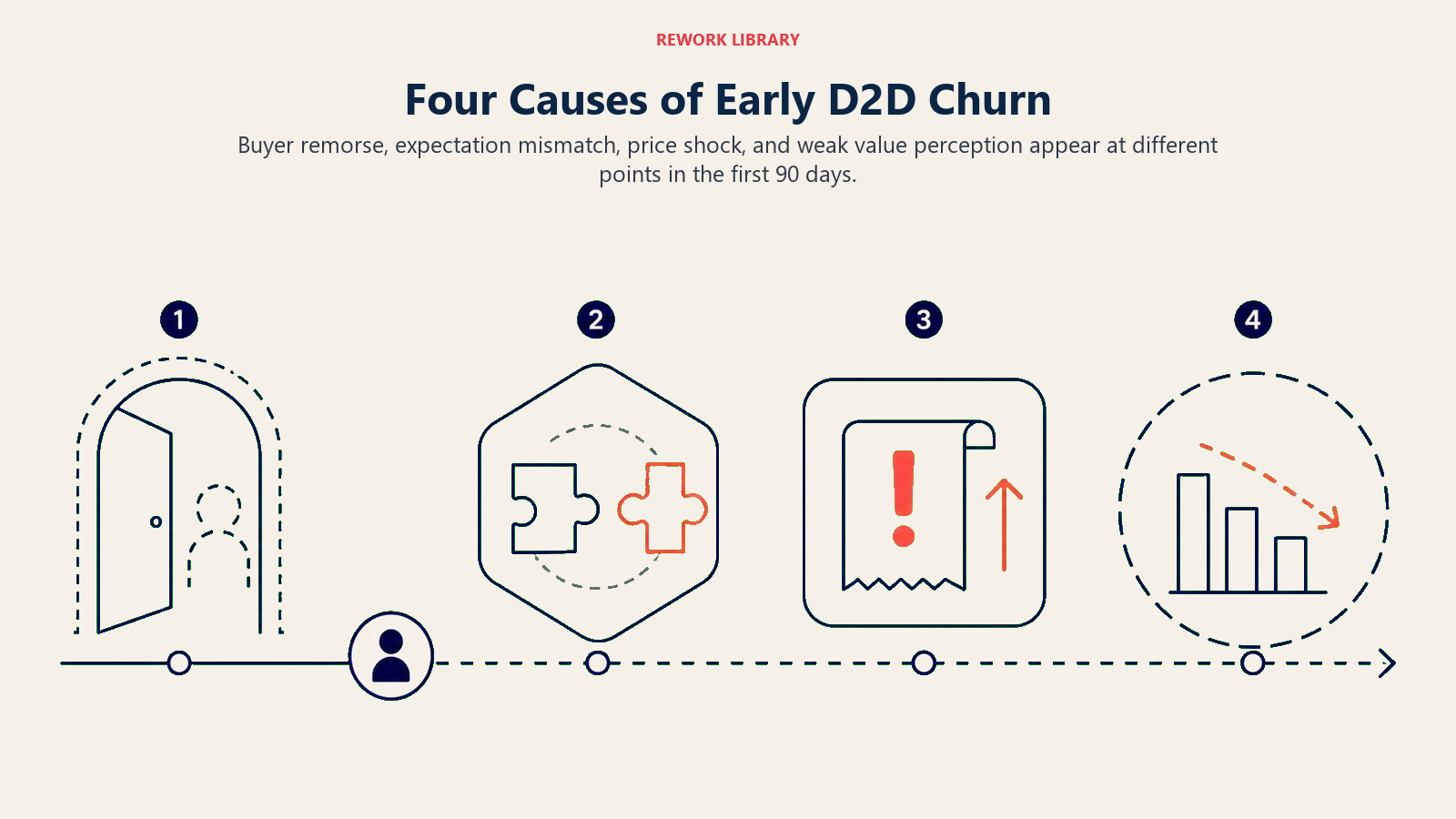
Type 1: Buyer's Remorse Cancellation (Days 1 to 7)
This happens before the first service. The customer felt some pressure at the door, signed under mild social obligation, and then talked themselves out of it overnight. Or they mentioned it to a spouse who wasn't aware of the purchase and now there's friction at home.
Most of these are avoidable with the right welcome and onboarding process. A warm 24-hour follow-up from the rep, paired with clear confirmation of what was agreed and when, cuts this type significantly.
Signs: Customer calls to cancel within 48 hours, mentions "my spouse" or "I didn't realize," or is vague about the reason.
Type 2: Expectation Mismatch Cancellation (Days 7 to 30)
The customer received the first service but it wasn't what they expected. Maybe the pest control tech spent 12 minutes on a job the rep implied would be thorough. Maybe the lawn treatment left brown patches. Maybe the fiber installer was rude or left a mess.
These cancellations are signals about your service delivery, not your sales process. The fix lives in operations, not in the CRM.
Signs: Customer received first service, mentions a specific complaint about the experience, or is clearly disappointed versus angry.
Type 3: Price Shock Cancellation (Days 30 to 90)
This is the customer who was fine initially but sees the first or second charge on their bank statement and reconsiders. Sometimes the amount is different than they remembered. Sometimes the service intervals feel more frequent than they expected, so the total cost feels higher too. Sometimes a competitor knocks on their door and offers a lower price.
Signs: Customer mentions the cost, asks if there's a cheaper option, or references a competing offer.
Type 4: No-Value Cancellation (Days 60 to 90)
The customer isn't seeing results. The bugs are still there. The lawn isn't improving. The security system feels like a hassle. They're paying for something that, in their view, isn't working.
Signs: Customer describes a specific outcome that hasn't improved, asks what they're actually getting, or hasn't been home for service visits and has lost connection with the service.
Key Facts: Early Cancellation in D2D Subscriptions
- Acquiring a new customer costs 5 to 25 times more than retaining an existing one, per research by Frederick Reichheld of Bain and Company cited in Harvard Business Review, making each early cancellation a compounding loss against an already-paid acquisition spend.
- D2D subscription customer acquisition typically runs $150 to $400 per account in fully-loaded costs (rep time, commission, canvassing). A cancellation after one service generates $60 in revenue against that cost, a net loss before technician time is counted. (Rework Analysis, based on reported D2D CAC ranges)
- Strong pest control businesses maintain annual retention rates of 80% to 90%, according to industry practitioners cited by Wexford Insurance. The gap between a 70% and an 85% retention business on 1,000 accounts roughly doubles customer lifetime value, making early-cancellation prevention the highest-leverage retention lever available.
The Cost Math That Should Change Your Priorities
Before the fixes, consider the financial reality. A mid-size pest control company might spend $200 in fully-loaded customer acquisition cost per account. The average monthly contract value is $60. That means the company needs roughly 3 to 4 months of retention just to break even, and 6+ months to generate meaningful margin. Harvard Business Review cites research showing that acquiring a new customer costs 5 to 25 times more than retaining an existing one, which makes every early cancellation a compounding loss.
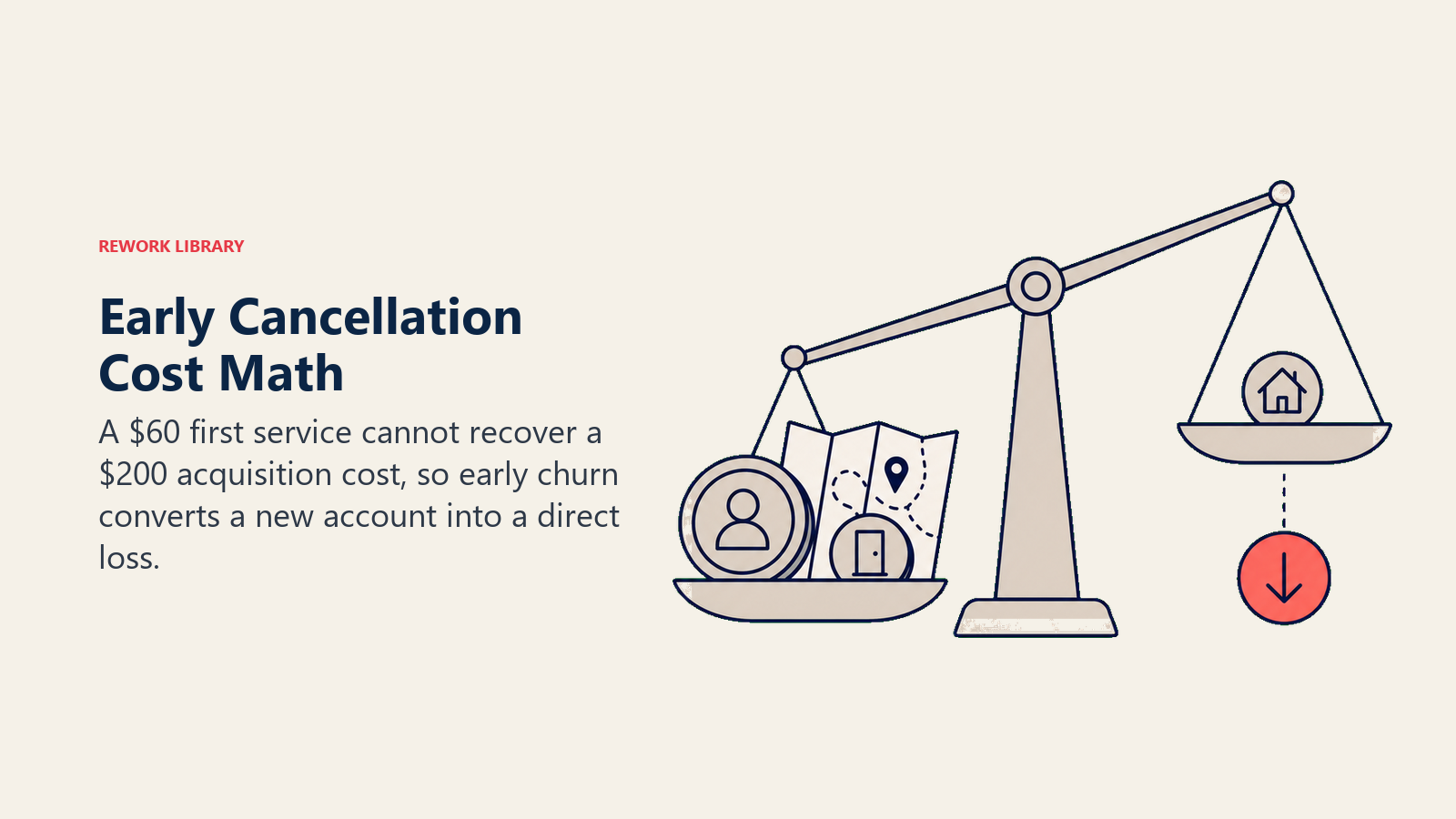
An account that cancels after one service has generated $60 in revenue against $200 in cost. That's a $140 loss, before technician time and overhead.
Multiply that across 15% early churn on 200 new accounts per month. You're absorbing $420,000 per year in losses from accounts you thought you'd won. Cutting early churn from 15% to 7% doesn't just improve retention metrics. It fundamentally changes your unit economics. Review subscription unit economics and LTV to see how this math compounds across a subscriber base.
Intervention 1: The 24-Hour Rep Call
The most effective single intervention for buyer's remorse cancellations is a personal rep call within 24 hours of the close. Not a text, not an automated email: a call from the person who was at the door.
The call should be brief and warm, not sales-y:
"Hi [Name], this is [Rep] from [Company]. I wanted to follow up and make sure you got our confirmation email and that everything looked right. Do you have any questions before your first visit?"
This does two things. It gives the customer a moment to voice any hesitation in a low-stakes conversation, rather than calling the cancellation line when that hesitation builds into action. And it reminds them that a real human being is accountable for their account, which makes cancellation feel more personal and therefore less likely.
Track rep follow-up call completion rates in your D2D sales KPIs dashboard. Reps who consistently make these calls show lower early churn on their accounts.
Intervention 2: Pre-Service Education
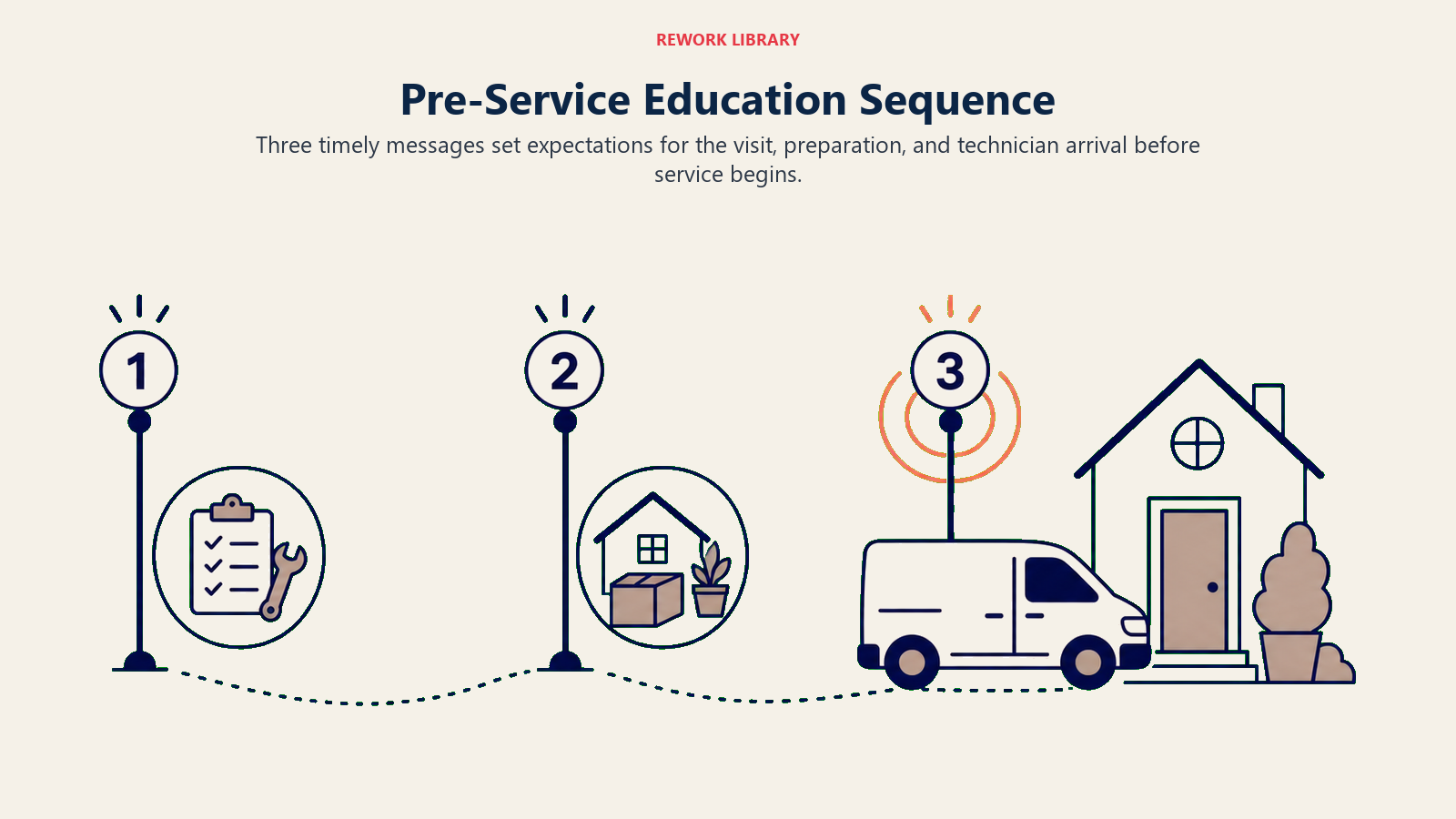
Customers who know what to expect from their first service are less likely to be disappointed by it. A simple 3-day drip before the first visit, sent via SMS or email, sets realistic expectations without requiring any manual work from your team.
Sample sequence for a pest control company:
| Day | Message |
|---|---|
| 2 days before | "Your first pest treatment is [date]. Here's what our tech will do and how long it takes." |
| 1 day before | "Reminder: [Tech Name] will be there [time window]. Here's how to prepare: move items away from baseboards, have interior access ready." |
| Day of | "Your tech is on the way. You'll get a heads-up 30 minutes before arrival." |
This sequence reduces "I didn't know what to expect" cancellations and also reduces no-shows and service complications on first visits. But even a well-prepped customer can still walk away if the visit itself falls short.
Intervention 3: The First-Service Experience Audit
If you're seeing Type 2 (expectation mismatch) cancellations, the problem is on the service side, not in sales. The fix requires auditing what actually happens during first-service visits.
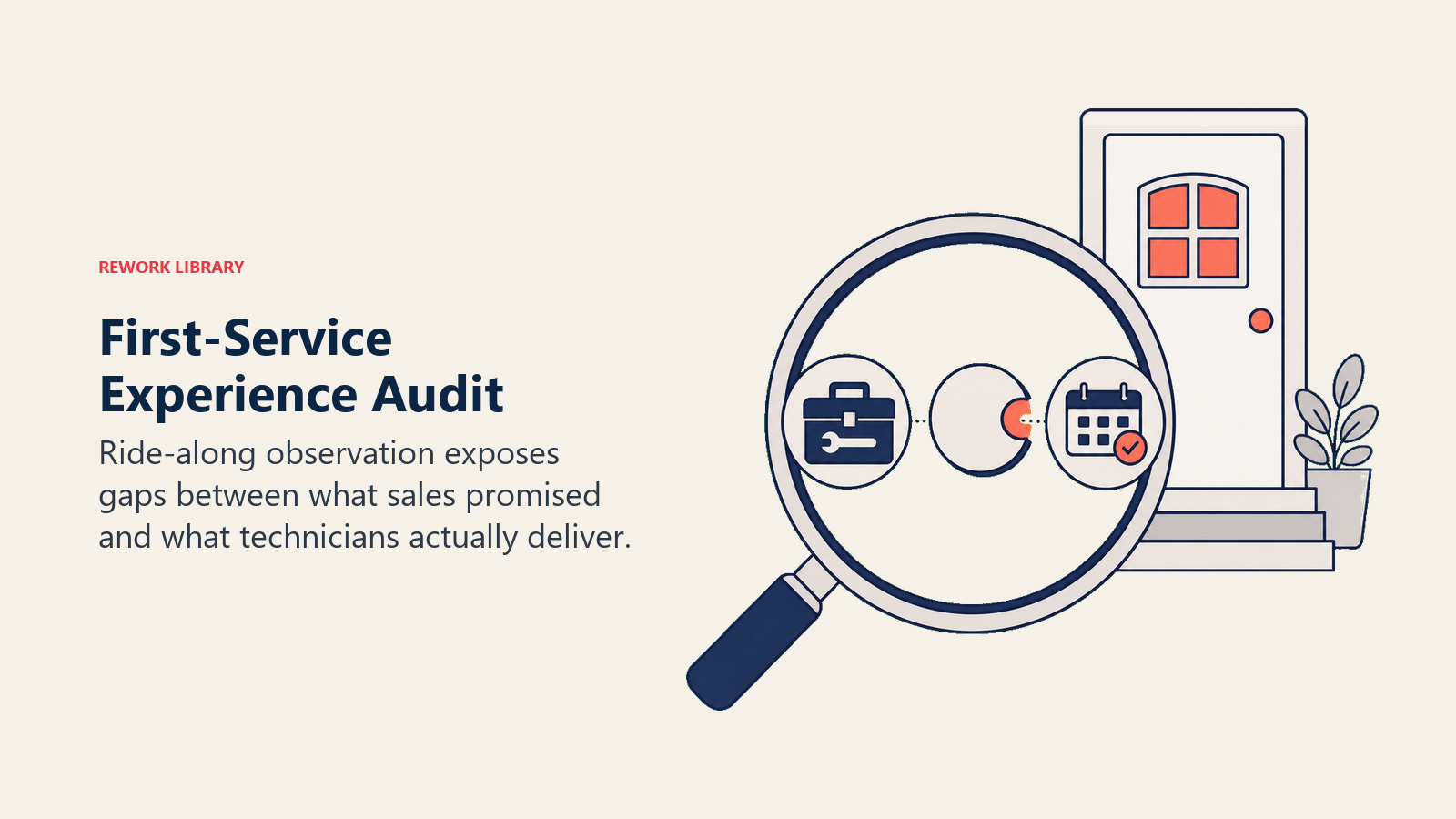
Assign a manager or quality coordinator to ride along on 10 to 20 first-service visits per month. Document what you observe:
- How long does the tech spend on site compared to what was promised to the customer?
- Does the tech explain what they're doing, or do they just do it and leave?
- Is the leave-behind documentation provided?
- Is the next visit date confirmed?
- Does the tech greet the customer by name?
Most companies that do this exercise find wide variation between technicians. The best techs have retention rates 30 to 40% higher on their accounts than the worst. That's a coaching opportunity, not a firing one. Read coaching, ride-alongs, and culture for how to build a systematic field quality program.
Intervention 4: The Post-First-Service Check-In
Send a one-question satisfaction check-in within 24 hours of every first service. The message can be simple: "Hi [Name], how was your first [Company] experience? Reply 1-5."
Any response of 3 or below triggers an immediate manager callback. Not a queue, not a ticket: a call from someone with authority to fix the problem and, if needed, offer a make-good.
Most customers who have a bad first experience don't complain. They just cancel. This check-in gives them an invitation to complain to you instead of silently churning, and gives your team a chance to recover the account before it's lost.
A pest company running this protocol found that roughly 60% of dissatisfied customers who received a manager callback within 24 hours stayed as subscribers. Without the callback, almost none of them would have been retained. Price complaints need a different kind of fix.
Intervention 5: Transparent Billing Confirmation
Price shock cancellations (Type 3) often happen because the customer didn't fully absorb the billing terms at the point of sale. The fix is a plain-language billing confirmation sent at or just after signing.
This message should include:
- The service name and what's included
- The billing frequency (monthly, quarterly, annual)
- The exact dollar amount per charge
- When the first charge occurs
- How to contact customer service with billing questions
Clarity here doesn't reduce sales. It reduces surprise later. Customers who know exactly what they'll pay are far less likely to be shocked when they see the charge and call to cancel. The Federal Trade Commission (FTC) has long maintained that subscription businesses must clearly disclose all material billing terms before charging, and its Negative Option Rule framework reflects the principle that consumers deserve transparent auto-renewal terms and an equally accessible cancellation path. Plain-language billing confirmation isn't just good practice; it aligns with the regulatory direction the FTC has consistently signaled for subscription commerce.
Intervention 6: Early Check-In Calls at Day 30 and Day 60
Some companies schedule automated satisfaction outreach at 30 and 60 days for every new account. Others assign this to a customer success role. Either approach works. What matters is that someone proactively reaches out before the customer reaches out to cancel.
The 30-day check-in asks: Are you seeing results? Any questions about your service? Is there anything we can do better?
The 60-day check-in is an opportunity to reinforce value: "You've been a customer for two months now. Here's what we've done for your property." A brief summary of services rendered, outcomes observed, and anything proactively addressed on their behalf.
These calls build relationship equity. Customers who have had a real conversation with someone at the company are much harder to cancel than customers who have only interacted with automated systems.
How Do You Build an Early Cancellation Tracking System?
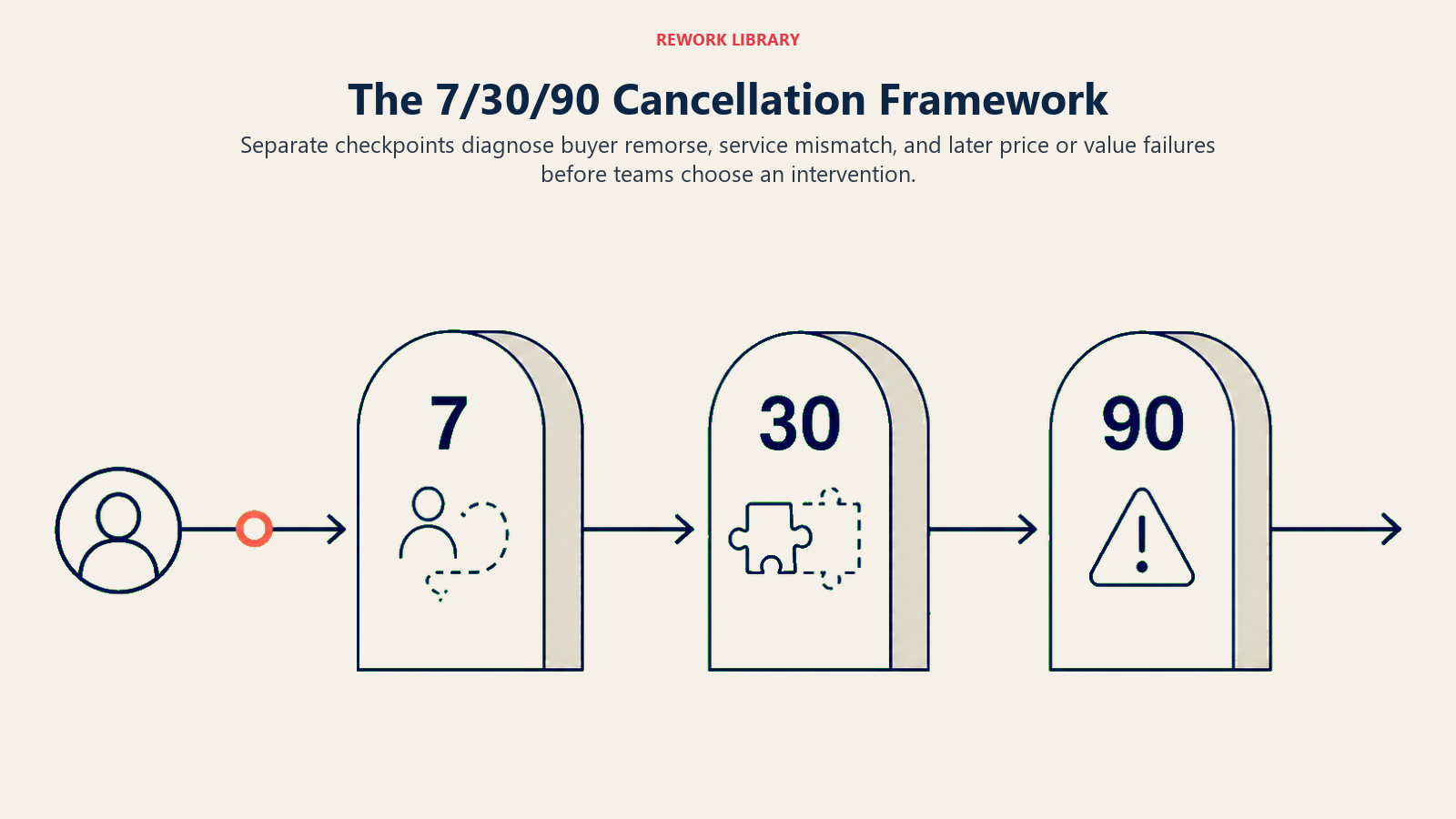
The 7/30/90 Cancellation Framework: a three-checkpoint measurement system for diagnosing where early churn is actually happening. Day-7 cancellation rate catches buyer's-remorse failures (onboarding and follow-up problems). Day-30 rate catches expectation-mismatch failures (first-service experience and post-visit communication). Day-90 rate catches no-value and price-shock failures (service quality, billing clarity, and proactive check-in cadence). Tracking all three checkpoints separately shows which intervention type is most needed, rather than treating early churn as a single undifferentiated problem. Companies that implement this framework can diagnose and fix the highest-volume churn type without over-investing in interventions targeting the wrong window.
You can't manage what you don't measure. Every D2D company should track early cancellation data at a granular level.
Metrics to Track
| Metric | Definition | Target |
|---|---|---|
| Day-7 cancellation rate | % of new accounts that cancel within 7 days | Under 3% |
| Day-30 cancellation rate | % of new accounts that cancel within 30 days | Under 8% |
| Day-90 cancellation rate | % of new accounts that cancel within 90 days | Under 12% |
| Cancellation reason distribution | % of cancellations by root cause type | Tracked monthly |
| Rep early churn rate | Day-90 cancellation rate by originating rep | Tracked per rep |
| Territory early churn rate | Day-90 cancellation rate by territory | Tracked by zone |
Analyzing Rep-Level Data
Rep early churn rate is one of the most valuable and most ignored metrics in D2D sales. A rep with a 25% Day-90 churn rate on their book is either selling to the wrong prospects, setting wrong expectations, or skipping the post-close follow-up that prevents buyer's remorse.
Compare each rep's early churn rate against their closing rate. A high close rate paired with high early churn is a red flag: the rep may be using pressure tactics that win agreements at the door but generate cancellations a week later. This is a coaching conversation, not a celebration.
The Role of Ethical Selling in Early Cancellation Rates
Cancellations that happen because a customer felt pressured, misled, or confused are not just a revenue problem. They're an operational signal about how selling is happening at the door.
If your same-visit close techniques are generating high close rates but also high early churn, the close isn't as clean as it looks. A genuine agreement that the customer feels good about the next morning doesn't cancel. A pressure-driven agreement does.
Read ethical selling and buyer's remorse for a detailed look at how to build sustainable close rates that don't degrade your retention performance.
Checklist: Early Cancellation Prevention System
Use this to audit your current process:
- Rep follow-up call completed within 24 hours of every new sale
- Confirmation SMS and email sent within 1 hour of signature
- Pre-first-service education sequence active (3 touchpoints minimum)
- First-service technician briefed with rep notes before dispatch
- Technician arrival notification sent 30 minutes before arrival
- Post-first-service satisfaction check-in sent within 24 hours
- Manager callback triggered for satisfaction scores under 4/5
- Plain-language billing confirmation sent at or just after signing
- Day-30 and Day-60 proactive check-in calls scheduled
- Early churn rate tracked by rep, by territory, and by reason
"A rep with a high close rate and a 25% Day-90 cancellation rate on their book is not performing well. They are generating a pipeline of short-tenure accounts that cost the company more to acquire than the revenue they produce."
"A pest company that asks 'how was your first experience, rate 1 to 5' within 24 hours of every first service, and calls back anyone who scores below 4, can recover roughly 60% of dissatisfied customers who would otherwise cancel silently. (Rework Analysis, based on operator-reported outcomes)"
"The most expensive cancellation in D2D is the silent one. The customer who never calls, just stops responding. Buyer's remorse cancellations call within 48 hours and can be saved. Silent churners disengage over weeks and are almost never recovered."
Final Thought
Early cancellations aren't random. They cluster around predictable failure points in the transition from sale to subscriber, and most are preventable with structured, consistent operations.
The companies that get this right don't just have better retention numbers. They have healthier unit economics, more confident reps, and a subscriber base that actually grows instead of running in place on a treadmill.
Fix the first 90 days and everything downstream gets easier.
Learn more: Customer Success Check-Ins | Retention Fundamentals
Frequently Asked Questions about Reducing Early Cancellations in Door-to-Door Subscription Services
What is an early cancellation in a D2D home service subscription?
An early cancellation is a subscriber who cancels before the third or fourth service visit, typically within the first 30 to 90 days. Early cancellations are particularly costly because the full customer acquisition cost has already been paid but not yet recovered through subscription revenue. A customer who cancels after one service in a $60-per-month pest control plan has generated $60 against a $150 to $400 acquisition investment.
What are the most common reasons subscribers cancel in the first 90 days?
The four most common early-cancellation types are buyer's remorse (cancels within 7 days, often cites a spouse or reconsideration), expectation mismatch (cancels after first service, disappointed by what was delivered versus what was promised), price shock (cancels at first or second billing, surprised by the amount or frequency), and no-value perception (cancels at 60 to 90 days, doesn't see results and questions why they're paying).
How does the rep follow-up call reduce buyer's remorse cancellations?
A personal call from the rep within 24 hours of signing gives the customer an opportunity to voice hesitation in a low-stakes conversation rather than calling the cancellation line when that hesitation has built into a firm decision. The call also reinforces that a real person is accountable for the account, which makes cancellation feel more personal and therefore less impulsive.
What should the post-first-service check-in include?
A one-question satisfaction check sent by SMS within 24 hours of every first service is the standard. "On a scale of 1 to 5, how was your first experience?" Any score below 4 should trigger an immediate manager callback, not a form email or a ticket. Most customers who have a poor first experience don't complain proactively; the check-in gives them a channel to raise issues to you instead of cancelling silently.
How do you track early cancellations by rep?
Rep early churn rate is calculated as the percentage of that rep's closed accounts that cancel within 90 days. Tracking it by rep, rather than only in aggregate, shows patterns that aggregate metrics hide. A rep with a high close rate but a well-above-average Day-90 churn rate is a coaching priority. A rep with a modest close rate but an 8% churn rate is producing more durable revenue per door knocked.
Is transparent billing confirmation required by law for subscription services?
The FTC has consistently maintained through its Negative Option Rule framework that subscription businesses must clearly disclose all material billing terms before charging and provide an accessible cancellation mechanism. Beyond the regulatory baseline, plain-language billing confirmation is a churn-reduction tool: customers who understand what they agreed to call to cancel at much lower rates than customers who are surprised by their first charge.
What is the Day-90 cancellation rate benchmark for D2D home services?
Well-run D2D subscription operations typically target a Day-90 cancellation rate under 12%. Day-7 rate should be under 3% and Day-30 under 8%. Rates consistently above these benchmarks signal structural problems at a specific phase of the early subscriber journey rather than random variation, and should be treated as operational diagnostics rather than acceptable averages.

Senior Implementation Consultant
On this page
- What Causes an Early Cancellation in D2D Subscription Services?
- Type 1: Buyer's Remorse Cancellation (Days 1 to 7)
- Type 2: Expectation Mismatch Cancellation (Days 7 to 30)
- Type 3: Price Shock Cancellation (Days 30 to 90)
- Type 4: No-Value Cancellation (Days 60 to 90)
- The Cost Math That Should Change Your Priorities
- Intervention 1: The 24-Hour Rep Call
- Intervention 2: Pre-Service Education
- Intervention 3: The First-Service Experience Audit
- Intervention 4: The Post-First-Service Check-In
- Intervention 5: Transparent Billing Confirmation
- Intervention 6: Early Check-In Calls at Day 30 and Day 60
- How Do You Build an Early Cancellation Tracking System?
- Metrics to Track
- Analyzing Rep-Level Data
- The Role of Ethical Selling in Early Cancellation Rates
- Checklist: Early Cancellation Prevention System
- Final Thought