Commission and Comp Design for Door-to-Door Sales Teams
Turn this article into takeaways for your work.


Each assistant summarizes the article only for you and suggests best practices for your work.
Compensation is the engine of a D2D sales team. Get it right and reps are motivated, attrition drops, and the top performers stay because the money is good enough to make leaving feel costly. Get it wrong and you'll be constantly recruiting to replace reps who left for a competitor who pays $40 more per account, or you'll have reps gaming the system by closing low-quality deals that cancel in week three.
D2D comp design is harder than standard inside sales compensation because of a few factors unique to the channel: most reps are 1099 contractors rather than W-2 employees, the work is seasonal and variable, and the revenue you're selling is a subscription that plays out over months or years rather than a one-time transaction. These factors shape every comp decision you make.
This guide covers the core structures, the common mistakes, and the specific adjustments that work across pest control, home security, lawn care, and fiber/internet D2D verticals.
The Foundational Choice: Draw vs. Commission-Only
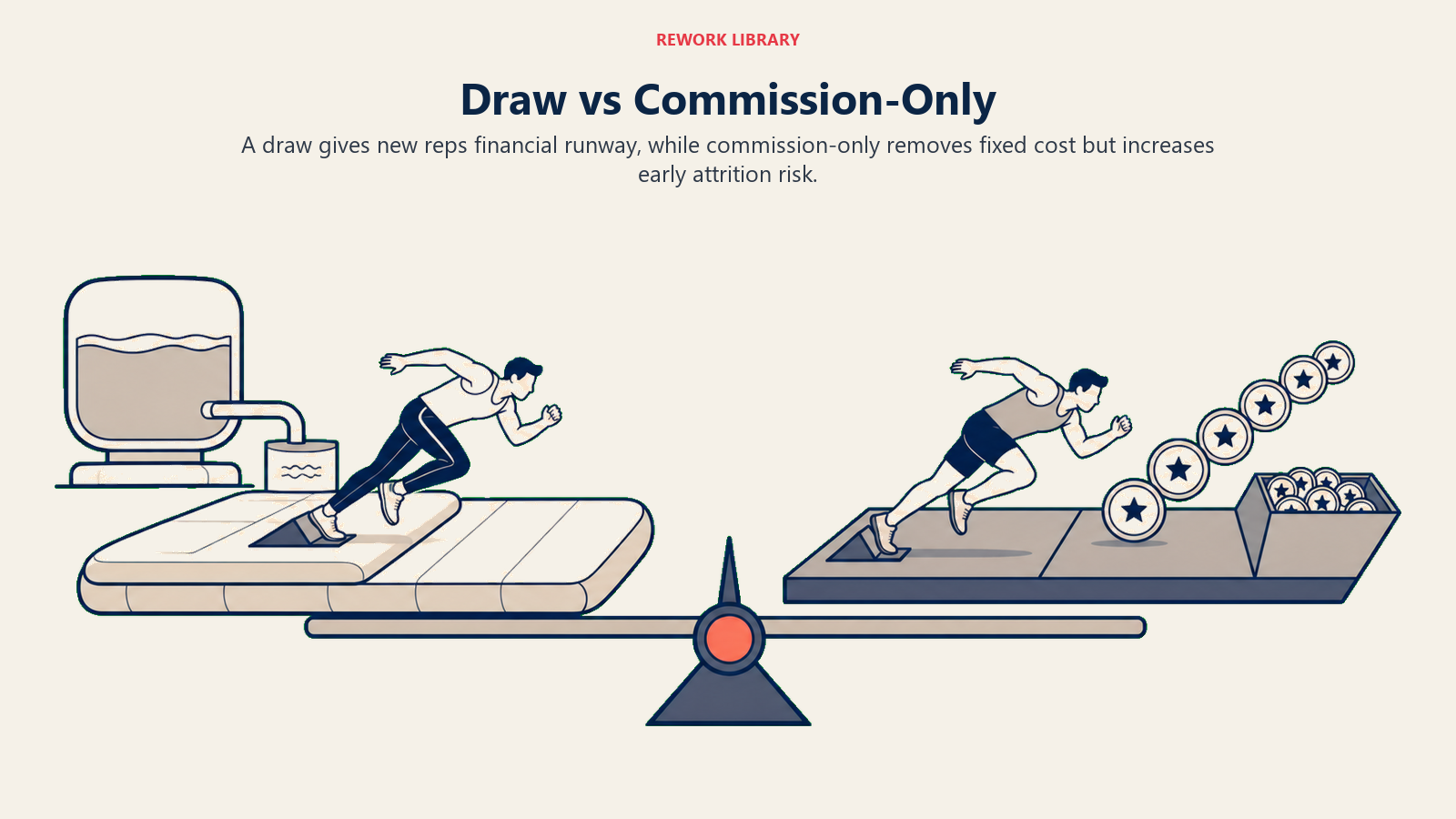
Before you design rates, decide on the structure. Most D2D operations run some version of one of these three models:
Pure Commission (1099, No Draw)
The rep earns a set amount per account sold. No base, no draw. If they don't sell, they earn nothing.
Who uses it: Summer sales programs, large-scale pest control and security operations with high rep volume.
Strengths: Zero fixed cost per rep. High performers earn uncapped. The ramp period self-selects for people who actually want to be in D2D.
Weaknesses: High early churn. New reps who hit a slow week in month one often quit because they can't afford to stay. This model burns through talent unless paired with great onboarding and territory management.
Draw Against Commission (Often 1099)
The rep receives a weekly or biweekly draw, a fixed advance against future commissions. If they don't earn enough commission to cover the draw, they carry a balance that rolls forward.
Who uses it: Companies that want to attract better candidates and reduce early attrition, especially for year-round roles.
Strengths: Reduces early-stage attrition. Gives new reps a financial runway to ramp. Signals that the company believes in them enough to invest.
Weaknesses: Carry balances can pile up fast for underperformers and create awkward situations when a rep wants to leave. Requires careful management of who's in draw deficit and when to intervene.
W-2 Base Plus Commission
A true base salary with commission on top. More common in fiber/internet D2D, where reps may also handle customer service functions and where companies have larger operational infrastructure.
Who uses it: Telecom contractors, some security dealers, companies that prefer the control and predictability of a W-2 structure.
Strengths: Strongest retention, easiest recruiting, clearest legal classification.
Weaknesses: Highest fixed cost. Can reduce urgency for mediocre performers if the base is high enough to be comfortable.
For the subscription economics that should anchor your commission design, see subscription unit economics and LTV.
What Are the Commission Rate Benchmarks by Vertical?
Key Facts: D2D Comp Design
- McKinsey research on sales incentive design found that smart revisions to compensation models have 50% higher impact on sales than equivalent investment in advertising, and that meaningful differentiation between top and bottom performer pay is essential to moving behavior. (McKinsey)
- The IRS evaluates worker classification across three dimensions (behavioral control, financial control, and type of relationship) to determine whether a 1099 rep is a true independent contractor. Comp plan structure directly affects the financial control and relationship factors. (IRS.gov)
- The Department of Labor applies the FLSA's economic reality test when assessing misclassification risk: the test looks at whether the worker is economically dependent on the company, which draw structures and exclusivity requirements directly affect. (DOL FLSA guidance)
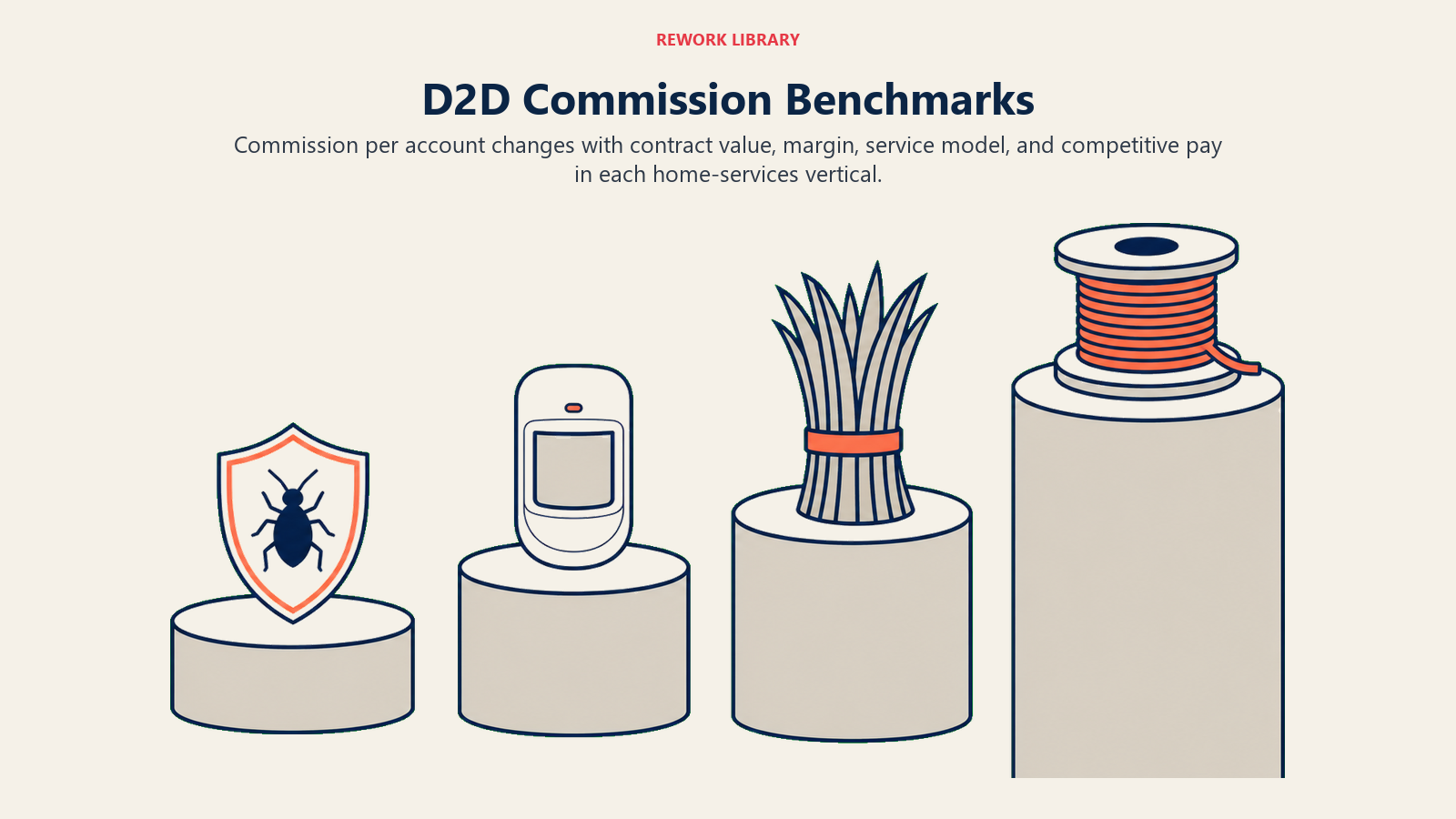
Rates vary significantly by vertical, contract value, and whether the rep is selling the initial agreement or managing recurring revenue. Here are representative ranges:
| Vertical | Typical Annual Contract Value | Commission per Account (Pure Commission) | Notes |
|---|---|---|---|
| Pest control | $400 to $800 | $80 to $200 | Higher end for quarterly plans; lower for monthly |
| Home security | $1,000 to $2,400 | $150 to $400 | Varies heavily by equipment bundle and monitoring term |
| Lawn care | $600 to $1,200 | $50 to $150 | Many programs pay per application scheduled, not per contract |
| Fiber/internet | $600 to $1,440 | $100 to $250 | Often W-2 structure; commission is on top of base |
These are starting points. Competitive rate intelligence matters: if a rival pest operator is paying $160 per account and you're paying $100, you will lose reps who find out.
The calculation every rep makes is: "What can I realistically earn in a week?" If the math doesn't pencil to at least $1,000 to $1,500 per week for an average producer, you'll struggle to attract and keep people with options.
Quotable Nuggets "McKinsey research found that smart comp model revisions have 50% higher impact on sales than equivalent increases in advertising investment, making the design of your pay plan one of the highest-ROI decisions in the D2D operating model. (McKinsey)"
"A draw that functions like a salary weakens the financial control argument in IRS and DOL worker classification analysis. Comp design is not just a retention tool. It is a legal classification decision. (IRS; DOL)"
"The single most effective chargeback-reduction mechanism in D2D comp design is a 90-day retention bonus that pays reps $10 to $25 per retained account, because it puts the rep's own money at stake in whether the customer they sold actually stays."
The Lock-in Accelerator Structure: A tiered per-account commission design where rates increase in defined weekly volume bands (for example, $100 for accounts 1 to 5, $125 for 6 to 10, $150 for 11 to 15, $175 for 16 and above), layered with a 90-day retention bonus and season-completion lump sum. The combination creates three distinct reasons for a rep to stay: higher rates for volume, bonus for quality, and a completion payment for tenure.
Accelerator Structures: The Real Retention Tool
A flat per-account rate is fine. An accelerator structure that rewards top performers with meaningfully higher rates is what keeps your best reps from shopping around.
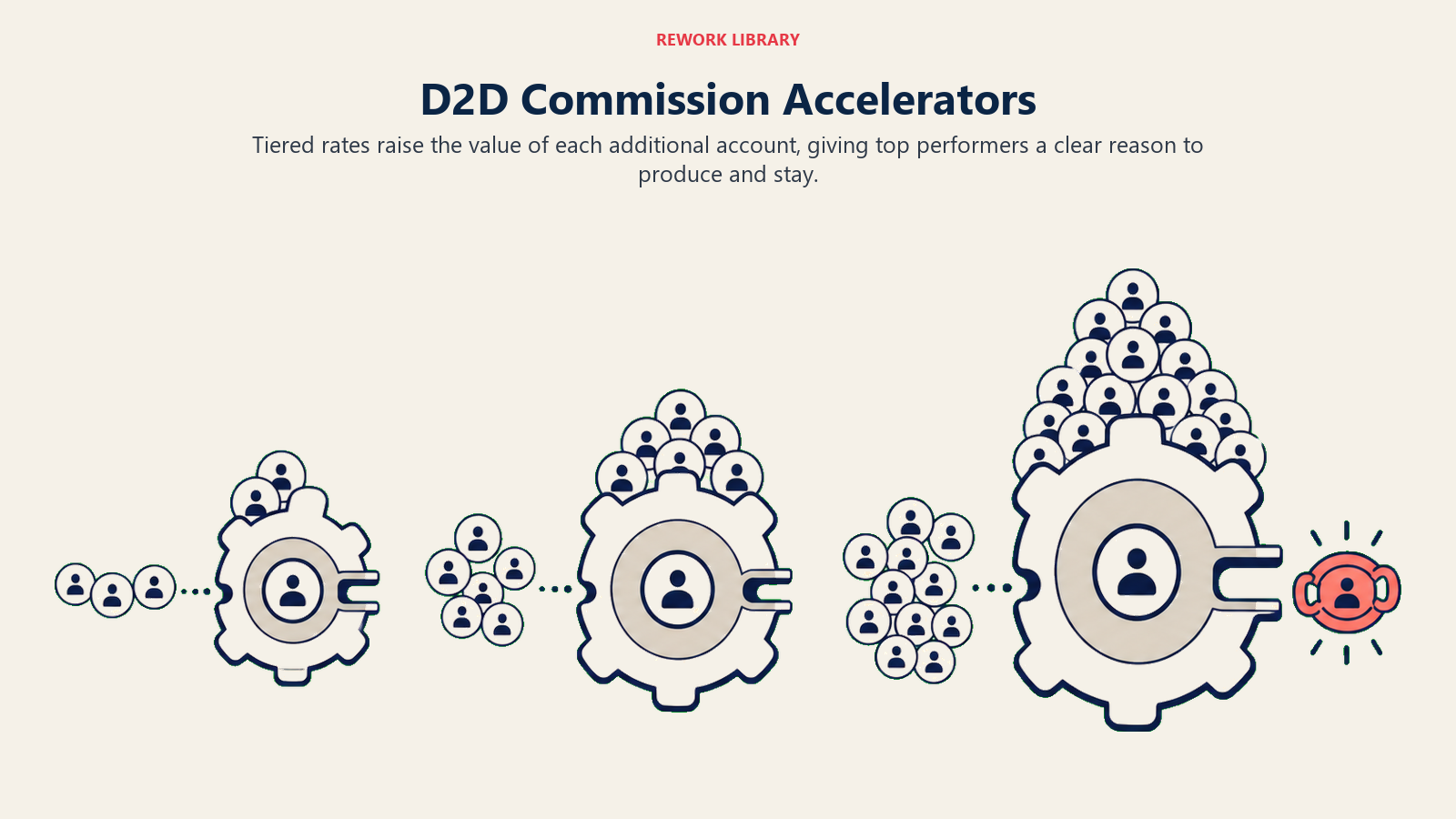
The logic: your top 20% of reps are producing a disproportionate share of your revenue. They have options. They know what competitors pay. A tiered accelerator gives them a reason to stay and produce at your company rather than starting over somewhere else. As the McKinsey research cited above suggests, meaningful differentiation between top and bottom performers is essential: small spread won't move behavior.
Example accelerator structure (pest control):
| Weekly Accounts Sold | Commission Per Account |
|---|---|
| 1 to 5 | $100 |
| 6 to 10 | $125 |
| 11 to 15 | $150 |
| 16 and above | $175 |
A rep selling 18 accounts in a week earns $175 per account, a 75% premium over base rate. That rep is earning $3,150 in a week and has a very concrete reason to push hard on Fridays when they're at 14 accounts.
Team-based accelerators layer on top of individual ones and work especially well for summer programs. When the whole branch hits a weekly number, everyone earns a bonus. This creates peer accountability that no manager intervention can fully replicate.
For how individual performance targets connect to overall team productivity benchmarks, see D2D sales KPIs and metrics.
Chargeback Policy: The Most Contentious Comp Element
Chargebacks are deductions from rep commissions when customers cancel. In a subscription model, they're unavoidable because you can't pay full commission on accounts that don't activate or that cancel in week two.
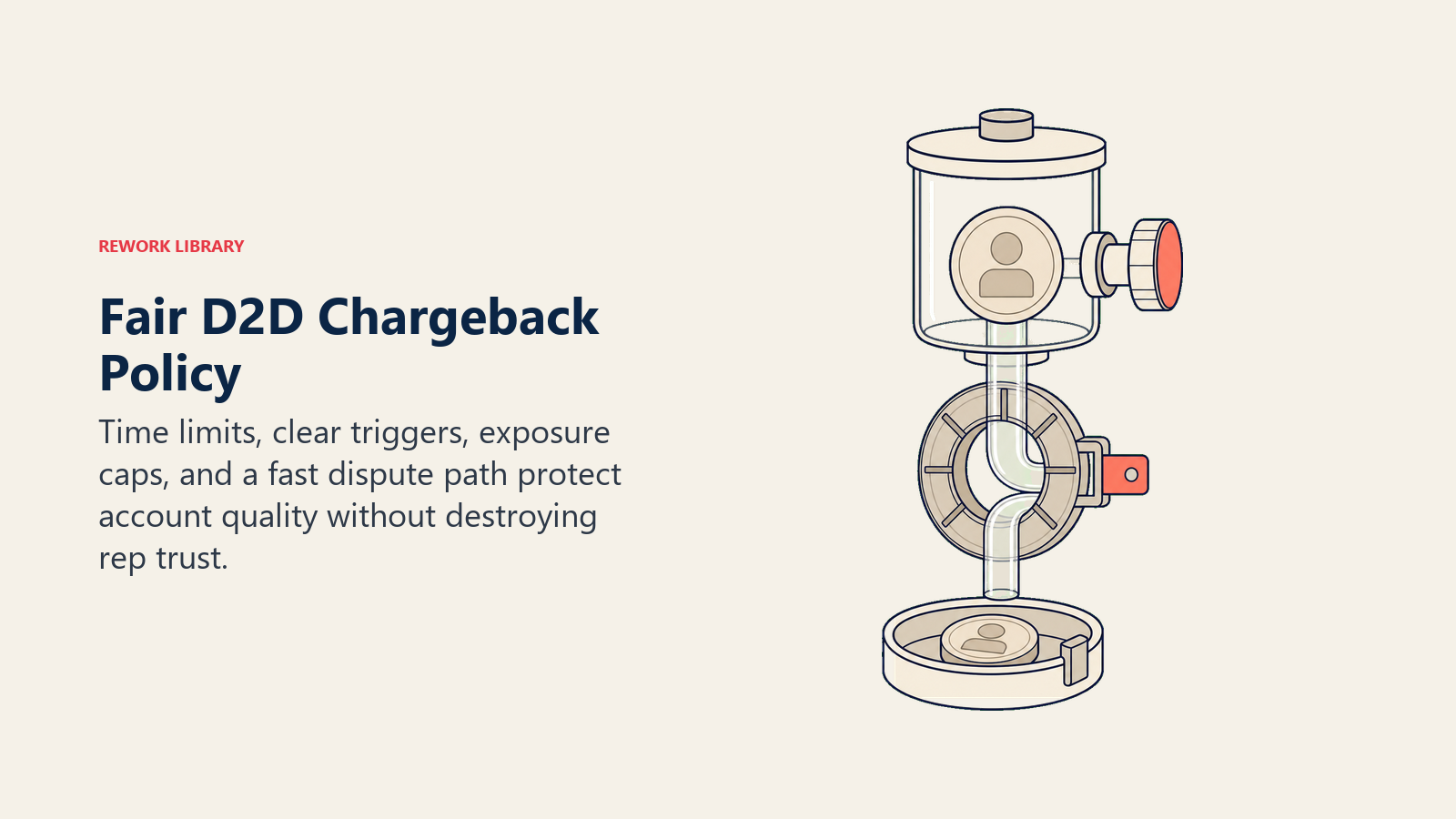
But chargeback policy is one of the fastest ways to destroy rep trust if it's designed poorly or applied inconsistently.
The principles that hold:
Time-bound chargebacks only. Commission should be protected after a customer is retained for a reasonable period, typically 60 to 90 days depending on your vertical. A rep who sold a pest control account six months ago shouldn't be charged back when that customer cancels today. You're not holding them accountable for long-term retention decisions driven by service quality. You ARE holding them accountable for customers who cancel before the first service or within the first few weeks, which signals a qualification or consent issue at the door.
Transparent trigger definitions. Reps need to know exactly what triggers a chargeback. "Did not activate" is clear. "Customer said they didn't understand what they signed up for" is ambiguous and creates disputes. Write the triggers into the comp agreement before anyone knocks a door.
Cap total chargeback exposure. Some operations cap chargebacks at a percentage of weekly earnings, say 20%, so a bad week of cancellations can't completely wipe out what a rep earned. This feels fair and reduces the sense of arbitrary financial punishment.
Dispute process. Reps who believe a chargeback was incorrect need a clear, fast dispute process. Unresolved disputes that drag on for weeks breed resentment that eventually walks out the door.
For the retention practices that reduce the cancellations that trigger chargebacks in the first place, see reducing early cancellations.
Bonus Structures That Actually Motivate
Beyond the per-account rate and accelerators, most D2D teams use one-time bonuses to drive specific behaviors. The ones that work:
First-week sales bonus. A rep who closes a sale in their first three days gets an immediate cash bonus, often $50 to $200. This does two things: it rewards early momentum and signals that the company wants them to succeed fast. It also tends to happen during or right after onboarding, when morale is most fragile.
Monthly retention bonus. A bonus paid at the end of each month based on how many of the rep's accounts from the prior month are still active. A 90-day retention bonus at $10 to $25 per retained account gives reps a tangible incentive to sell quality customers rather than just volume. This is the single most effective chargeback-reduction mechanism because it puts reps' money at stake in the retention outcome.
Referral bonus. When a rep's customer refers a neighbor who buys, the original rep earns a smaller commission, often $25 to $50, in addition to the standard rate for the referred sale. This incentivizes reps to make the referral ask at every door, which referral generation from subscribers covers in detail.
Contest bonuses. Weekly or monthly contests with a specific prize (cash, a gift card, a weekend trip for top performers) work particularly well for summer programs where the competitive energy is already high. The key is short duration: a one-week contest with a clear leaderboard beats a 90-day contest where most people lose interest by week three.
Comp Plan Design for Summer Programs
Summer 1099 programs have different comp constraints and opportunities than year-round teams.
Because summer reps are temporary and high-volume, the comp plan needs to front-load earning potential to attract candidates. But it also needs retention mechanics because the cost of replacing a rep mid-summer who has already been trained is significant.
Summer comp considerations:
- Pay commissions weekly, not biweekly. Cash flow matters more for 20-year-olds than for career sales professionals. Weekly pay reduces "I need to take a week off to deal with money stuff" situations.
- Build in a season-completion bonus. A lump-sum bonus paid at the end of the summer if the rep hits a cumulative account target and stays through a final date. This is one of the most effective summer retention tools available.
- Set a summer-specific accelerator tier. Higher per-account rates for reps who stay productive across 10 weeks rather than burning hot for two and then coasting.
- Consider a small equipment or clothing stipend. Reps who are paying out of pocket for work clothes and supplies in a commission-only environment feel the financial squeeze more acutely. A small weekly stipend, $25 to $50, reduces that friction.
For the broader operational context of these programs, running a summer sales program and managing seasonal 1099 teams cover the logistics side of the same season.
Comp Plan Communication
The best-designed comp plan in your industry fails if reps don't understand it. And D2D reps, especially new ones, often don't fully understand how their comp works until they receive a payment that doesn't match their mental math. That moment of confusion is a trust-breaker.
What clear comp communication looks like:
Walk through the plan in onboarding, with examples. "Here's what you'd earn on 8 accounts this week. Here's what you'd earn on 12. Here's what happens to a commission if the customer cancels before their first service."
Provide a one-page summary they can keep. Not a PDF of legal terms. A plain-language summary with a sample earnings calculator.
Build a weekly earnings statement. Even for 1099 reps, a clear weekly statement showing accounts sold, commissions earned, chargebacks applied, bonuses added, and net payment builds trust. Reps who can see exactly how their pay was calculated don't file disputes or assume they're being underpaid.
Create a live earnings tracker in your CRM or canvassing app. If reps can see their current commission balance in real time as they sell, it's both motivating and trust-building. See D2D CRM and canvassing apps for the tools that support live rep dashboards.
What Are the Legal Considerations for 1099 Comp Design?
D2D companies running 1099 structures need to be careful about how comp plans are designed to avoid misclassification risk. The core issue: if your 1099 reps are functionally employees because of how much behavioral control you exert, the 1099 classification may not hold. The IRS evaluates worker status across three dimensions: behavioral control (how much the company directs the work), financial control (who sets rates, provides tools, and absorbs business risk), and the type of relationship (written contracts, benefits, permanency). The Department of Labor applies the FLSA's economic reality test and looks at whether the worker is economically dependent on the company, which comp plan design directly affects.
Comp design touches this in a few ways:
- Paying a draw that functions like a salary can weaken the 1099 argument
- Non-compete clauses attached to comp plans are enforceable to different degrees by state
- Chargeback policies need to be disclosed and agreed to in writing, not imposed unilaterally
- Independent contractors generally can't be required to use only your leads or operate exclusively in your territories
None of these are reasons to avoid a 1099 structure. But they are reasons to have employment counsel review your contractor agreements before you're managing 50 summer reps under terms that could create liability.
See D2D legal and licensing compliance for the broader compliance framework your comp plan sits inside.
Benchmarking Your Comp Plan
Once your plan is live, check it quarterly against two things: your rep retention data and your market. If reps are leaving and the exit interviews point to pay, your comp plan has a specific problem. If you're not doing exit interviews at all, that gap is worth closing.
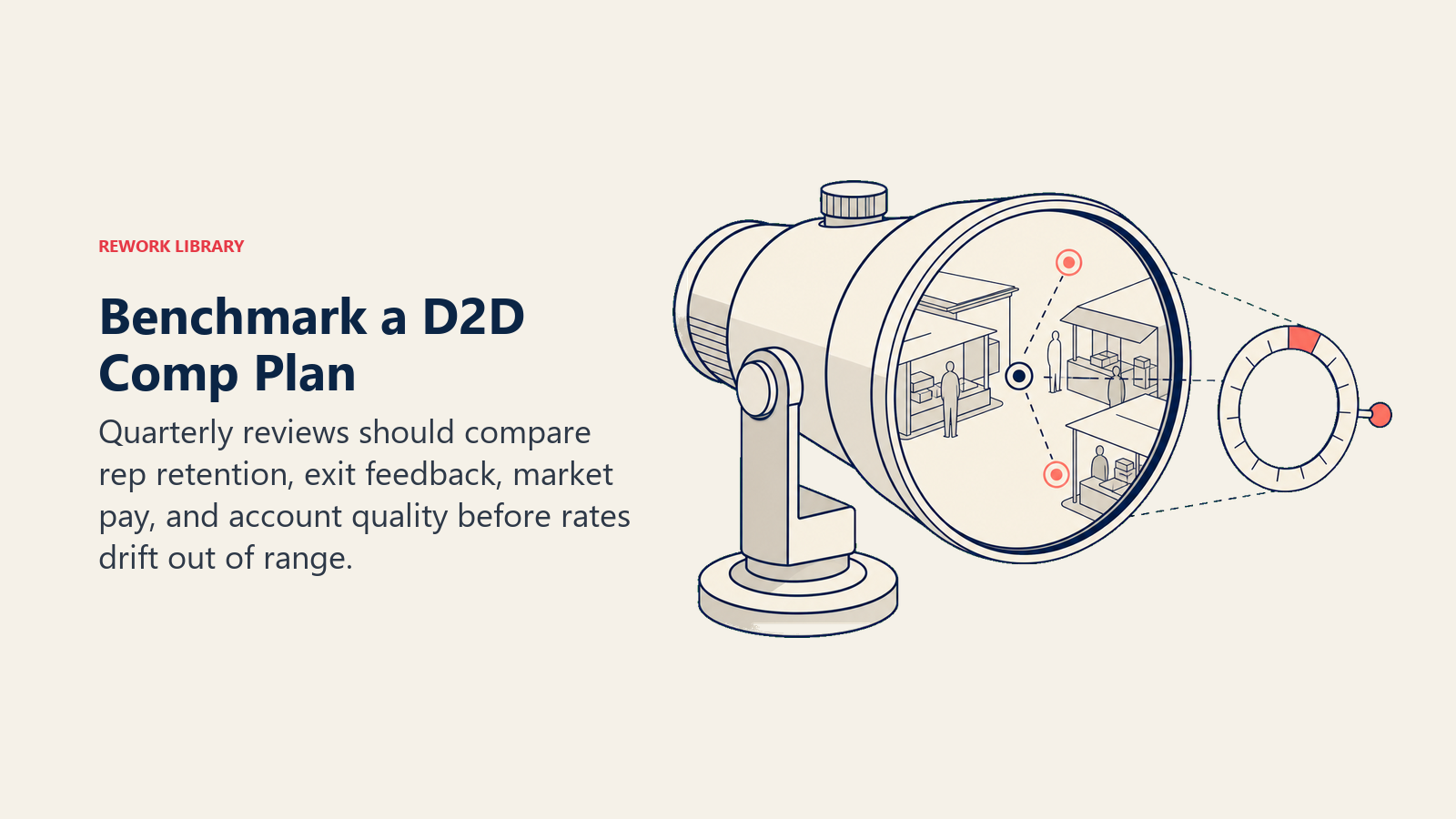
Talk to reps who chose to work for you over a competitor. Ask them directly what they compared. Talk to reps who left. Ask what the new place offered.
The comp environment in D2D shifts. Security dealers who were paying $200 per account in 2022 found themselves needing to hit $300 or $350 in high-competition markets by 2025. The companies that stayed current kept their producers. The ones that didn't had to recruit, train, and ramp replacements every quarter.
Good comp design isn't a one-time task. It's a competitive tool that needs ongoing maintenance, transparent communication, and the flexibility to adjust when the market shifts. The reps who are worth keeping will know what they're worth. Make sure your plan makes it easy to say yes to staying.
Learn more: Solar commission and comp design covers parallel structures for an adjacent D2D vertical worth comparing. Negotiation fundamentals covers how comp pressure affects a rep's negotiation and close process. Running a summer sales program and managing seasonal 1099 teams cover the operational context behind summer comp design.
Frequently Asked Questions about Commission and Comp Design for Door-to-Door Sales Teams
What is the difference between a draw and a base salary for D2D reps?
A draw is an advance against future commissions: reps receive money up front that is deducted from commission payments as they earn. If a rep doesn't earn enough commission to cover the draw, they carry a debit balance forward. A base salary is paid regardless of commission performance. Draws reduce early attrition without creating the full fixed-cost exposure of a base salary, but carry balances can create conflict when underperforming reps want to leave. For 1099 classification, a draw that functions like a reliable income floor can weaken the financial control element of the IRS worker classification analysis.
What is a chargeback in D2D sales compensation?
A chargeback is a deduction from a rep's commission when a customer cancels within a defined window after the sale. It is the mechanism that aligns rep pay with account quality: reps who sell customers likely to cancel quickly lose a portion of commission on those accounts. Best practice is to make chargebacks time-bound (typically 60 to 90 days), define the triggers explicitly in the comp agreement, cap total chargeback exposure per pay period, and include a dispute process for reps who believe a chargeback was applied incorrectly.
How does the IRS determine if a D2D rep is a 1099 contractor or an employee?
The IRS uses a three-factor framework: behavioral control (whether the company controls how the work is done, not just the outcome), financial control (whether the worker can realize profit or loss, sets their own rates, and provides their own tools), and type of relationship (written contracts, benefits, and whether the relationship is permanent or project-based). For D2D programs, requiring reps to work specific hours in specific locations, providing all their tools, and structuring draws that resemble salaries all pull toward employee classification. Employment counsel should review contractor agreements before scaling a 1099 program.
What does the 1099-NEC threshold change mean for D2D programs?
For calendar year 2025 payments, the 1099-NEC filing threshold is $600. For payments made after December 31, 2025, the threshold rises to $2,000. Any 1099 rep who earns at or above the applicable threshold in a calendar year must receive a 1099-NEC from the company by January 31 of the following year. Collecting a completed W-9 from every rep on day one (before any earnings) is the only reliable way to have tax identification numbers available when the filing deadline arrives.
What commission rate should a D2D pest control rep earn?
Representative commission ranges for pest control run $80 to $200 per account on pure commission structures, with typical annual contract values between $400 and $800. The higher end applies to quarterly service plans with multi-year commitment terms; the lower end applies to monthly billing structures. Competitive intelligence matters: if a competing operator in the same market is paying $160 per account, a $100 flat rate will lose reps as soon as they find out. An accelerator structure that reaches $150 to $175 per account at higher weekly volumes is often a more sustainable way to compete on pay than simply raising the flat rate.
How do accelerator tiers work in D2D comp?
Accelerators pay reps a higher per-account rate once they hit defined weekly volume thresholds. A rep selling 6 to 10 accounts in a week earns more per account than one selling 1 to 5, typically 15% to 25% more per tier. The result is that a rep at 18 accounts in a week can earn 50% to 75% more per account than at the base rate, creating a concrete reason to push through Friday afternoon on week 14 rather than coast. McKinsey research confirms that meaningful spread between top and bottom performer pay is essential for accelerators to actually change behavior.
What is a season-completion bonus and why does it reduce summer attrition?
A season-completion bonus is a lump sum paid to summer reps who hit a cumulative account target and remain with the program through a defined final date. It is one of the most effective summer retention tools because it converts an abstract "stay through August" request into a specific dollar amount the rep can see building over the summer. The closer the rep gets to the cumulative target, the more expensive leaving becomes. Best practice is to announce the completion bonus amount during April comp finalization and remind reps of their current trajectory weekly in weeks 8 to 10 when attrition risk is highest.

Senior Implementation Consultant
On this page
- The Foundational Choice: Draw vs. Commission-Only
- Pure Commission (1099, No Draw)
- Draw Against Commission (Often 1099)
- W-2 Base Plus Commission
- What Are the Commission Rate Benchmarks by Vertical?
- Accelerator Structures: The Real Retention Tool
- Chargeback Policy: The Most Contentious Comp Element
- Bonus Structures That Actually Motivate
- Comp Plan Design for Summer Programs
- Comp Plan Communication
- What Are the Legal Considerations for 1099 Comp Design?
- Benchmarking Your Comp Plan