D2D Vertical Playbooks: How Pest, Security, Lawn, and Fiber Sales Really Differ
Turn this article into takeaways for your work.


Each assistant summarizes the article only for you and suggests best practices for your work.
A new sales director takes over four regional teams: pest control, home security, lawn care, and fiber internet. He assumes the training is basically the same across all four. Every rep knocks doors and closes subscription agreements on the spot. Six months later, his pest team is hitting quota. His security team is bleeding reps.
The problem wasn't effort. He trained security reps like pest reps. The two verticals ask a homeowner to make a completely different kind of decision.
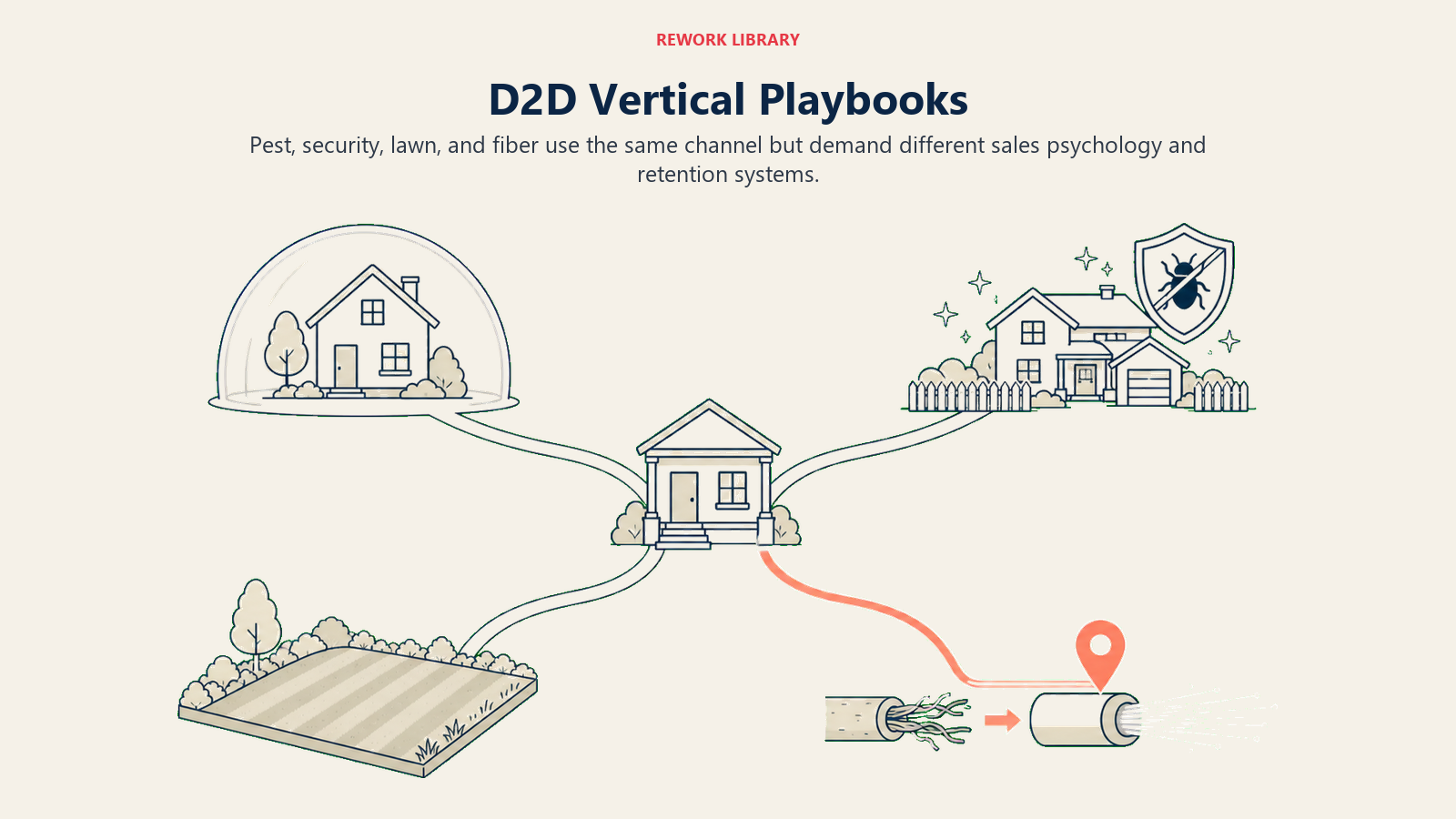
Pest control sells relief from an active annoyance. Security sells protection against something that hasn't happened yet. Lawn care sells a visible, comparable result. Fiber sells a straight swap of one utility bill for a supposedly better one. Each frame needs a different door approach, a different objection response, and a different retention play. Companies that run multiple door-to-door (D2D) verticals, or that are expanding from one into another, lose time and reps by assuming a single playbook transfers cleanly.
This article lays out where the four verticals converge and where they genuinely diverge, so you can adapt training instead of copying it.
Where the Four Verticals Are Actually the Same
Before getting into the differences, it's worth naming what doesn't change. The door-to-door sales funnel structure, from canvassing to qualifying to presenting to closing to onboarding, applies across all four. So does the underlying D2D recurring revenue model: the rep isn't selling a single job, they're starting a subscription relationship.
Canvassing fundamentals hold across verticals. The physical mechanics of a good door approach, the first 30 seconds, the tone, the body language, transfer regardless of what's being sold. See canvassing fundamentals and the knock for the base mechanics every rep needs before vertical-specific training even starts.
Territory logic is similar, with different saturation math. All four verticals benefit from territory design and assignment that avoids over-knocking the same streets. The saturation thresholds differ, since a fiber territory can support more knocks per week than a security territory in some markets, but the discipline is the same.
All four run on subscription unit economics. Whatever the price point, the business model depends on retention beating churn. The math changes by vertical, but the framework doesn't.
That's the floor. Now the differences, which matter more than most training programs admit.
Key Facts: D2D Vertical Economics
- The US structural pest control industry generated $12.654 billion in service revenue in 2024, up 7.9% from 2023's $11.72 billion, with recurring residential service accounting for 85.2% of residential revenue (NPMA / Specialty Consultants, LLC).
- The Urban Institute found that 90 to 99% of alarm calls police respond to turn out to be false, a figure the Electronic Security Association cites directly as the industry's core retention and reputation problem.
- US direct selling, the broader channel that door-to-door subscription sales sit inside, generated $34.7 billion in retail sales in 2024 across 5.4 million sellers, according to the Direct Selling Association's 2025 Growth & Outlook Study.
What Is the Core Psychological Frame Behind Each D2D Vertical?
Every D2D vertical maps to what this playbook calls the Vertical Psychology Match: the idea that close rate, script effectiveness, and rep retention all depend on matching the pitch to the specific emotional decision the homeowner is actually making, not to a generic subscription sales script. Get the match wrong, as the sales director in the opening example did, and even good reps underperform.
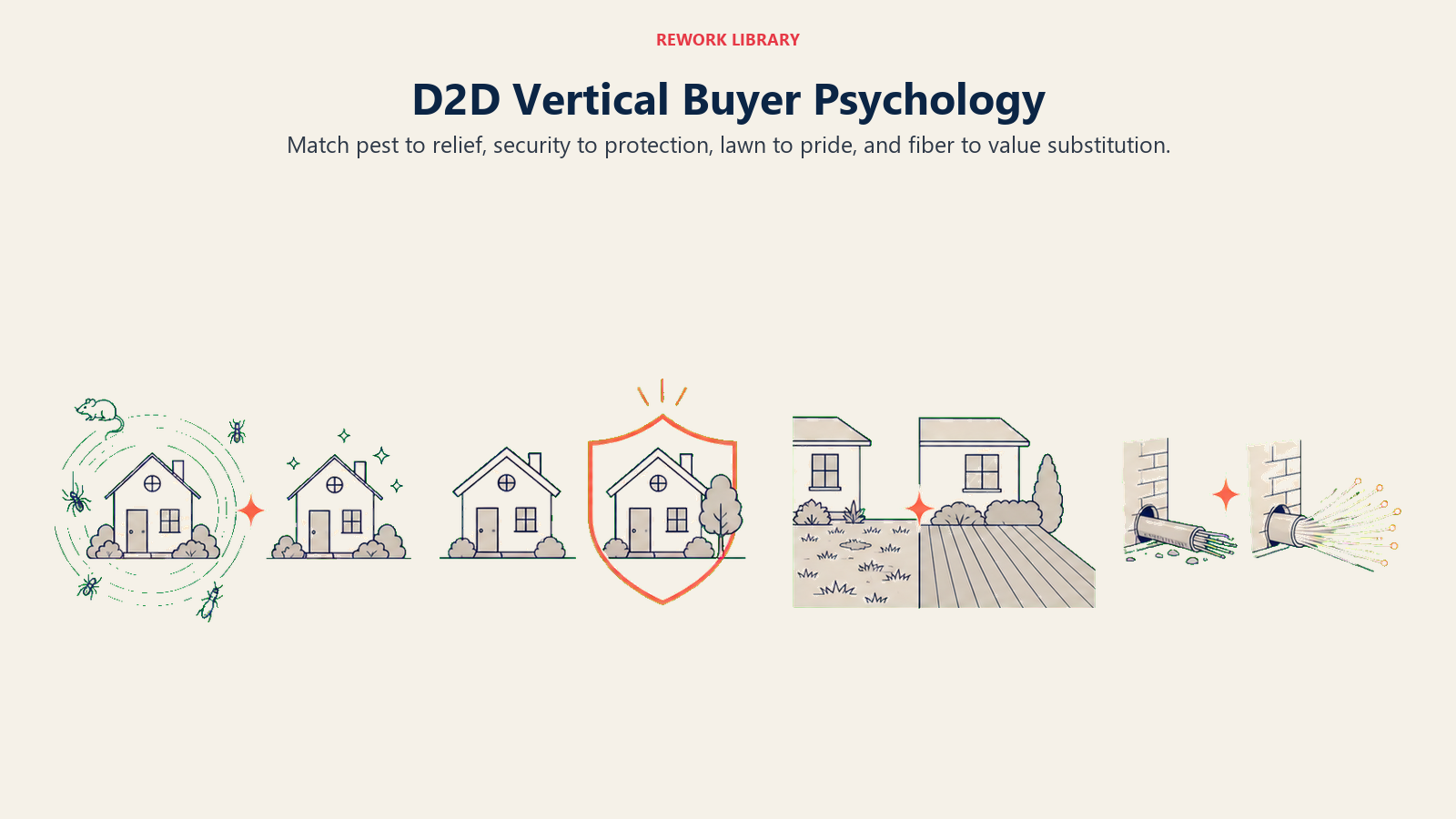
| Vertical | What the customer is really buying | Emotional driver | Typical decision speed |
|---|---|---|---|
| Pest control | Relief from an active, visible problem | Disgust, urgency | Fast, often same visit |
| Security/alarm | Protection against a risk that hasn't happened | Fear, control | Moderate, sometimes needs a second conversation |
| Lawn care | A visible result and status among neighbors | Pride, comparison | Fast to moderate, seasonal |
| Fiber/telecom | A better version of something they already pay for | Value, frustration with incumbent | Fast, transactional |
Pest control reps sell against an itch that already exists. A homeowner who's seen ants in the kitchen or a wasp nest under the eaves doesn't need to be convinced a problem exists. The rep's job is to diagnose it precisely and present the subscription as the logical, ongoing answer, not a one-time spray. Reps who lead with price before establishing the specific pest problem consistently close at lower rates than reps who ask two or three diagnostic questions first.
Security reps sell against a risk the homeowner hasn't experienced yet. This is fundamentally harder. Nobody has an active break-in happening at the door. The pitch has to build a credible sense of vulnerability (neighborhood incident data, package theft trends, the fact that unmonitored homes are targeted more often) without feeling like fear-mongering, which homeowners recognize and resent immediately. The best security reps use local, specific, verifiable information rather than generic scare language.
Lawn care reps sell a result the neighbor can see. This is the one vertical where the product markets itself once it's working. A green, weed-free lawn next to a patchy one is the best sales tool the industry has. Reps lean heavily on before-and-after visuals and neighbor references ("We just started service two doors down") because social proof closes lawn care faster than almost any other tactic in this collection.
Fiber and telecom reps sell a straight substitution. The homeowner already has internet service. The pitch isn't "you need something new," it's "you're overpaying for something worse." This makes the close mechanically simple (compare price and speed, sign if it's better) but makes the objection handling heavily about specific competitive claims, contract terms with the current provider, and installation logistics.
Quotable: A pest control rep is diagnosing a felt problem, a security rep is building a case for an unfelt risk, and a fiber rep is running a side-by-side comparison against a bill the homeowner already opens every month. Three different sales motions, wearing the same door-to-door uniform.
How the Door Approach Changes By Vertical
The first 30 seconds at the door should not sound the same across these four verticals, even though the underlying door approach fundamentals apply to all of them.
Pest control opener: Ask, don't tell. "Hey, I'm out in the neighborhood today, have you noticed any ant or spider activity around the house this summer?" This invites a yes/no that immediately qualifies the lead and opens a conversation about a real, current condition.
Security opener: Lead with local relevance, not generic fear. "We've been doing security assessments in this neighborhood this week, mostly because of a couple of incidents a few streets over. Do you have a system in place right now?" This grounds the pitch in something specific and shifts the conversation to what they currently have (or don't).
Lawn care opener: Lead with observation and specificity. "I noticed some brown patches near the sidewalk, that's usually a sign of grub damage this time of year. Are you treating for that currently?" It's specific and visible, and it signals expertise in the first sentence.
Fiber opener: Lead with comparison, not features. "We're running fiber down this street this month, and most of your neighbors are paying less for faster service than what's currently available here. Mind if I show you what that would look like for your address?" This gets straight to the value proposition. The customer already understands what internet service is, so there's no need to educate on the category.
Objection Handling Differences That Actually Matter
General objection handling at the door principles, acknowledge, isolate, respond, confirm, apply everywhere. But the actual objections and effective responses vary sharply by vertical.
"I don't have a pest problem" (pest control): The strongest response reframes prevention as predictable instead of optional. "That's great, and quarterly service is what keeps it that way. Scheduled visits are a steady cost you can plan for, instead of an emergency call after something's already gotten in." This works because it doesn't argue with the customer's stated reality. It just reframes the value, a point the National Pest Management Association's consumer guidance on routine service supports: it describes monthly pest control as "more predictable and routine, at a relatively constant price," compared with the unplanned cost of reacting after an infestation is already visible.
"I already have a system" or "I'm not worried about security" (security/alarm): This objection needs the most care, because pushing too hard reads as manipulative. The better move is a genuine comparison question: "Totally fair, can I ask what you're using now, just so I know if there's a real gap or if you're already covered?" This often surfaces that the existing system is outdated, unmonitored, or the homeowner isn't sure what it actually covers, which reopens the conversation honestly.
"I do my own lawn care" (lawn care): Respect the DIY instinct rather than dismissing it. "A lot of our customers did too, until the time investment or the results plateaued. What are you finding hardest about keeping it looking the way you want?" This surfaces the specific pain (time, weeds, uneven results) that the service actually solves.
"I'm under contract with my current provider" (fiber/telecom): This is the most common fiber objection and needs a factual, not emotional, response. Know the competitor's contract terms, typical early termination fees, and how they compare to what you're offering. "Let's look at the numbers, even with an early termination fee, you might come out ahead within four months given the price difference." Reps who don't know competitor contract structures lose this objection every time.
Why Do Retention and Churn Patterns Differ So Sharply By Vertical?
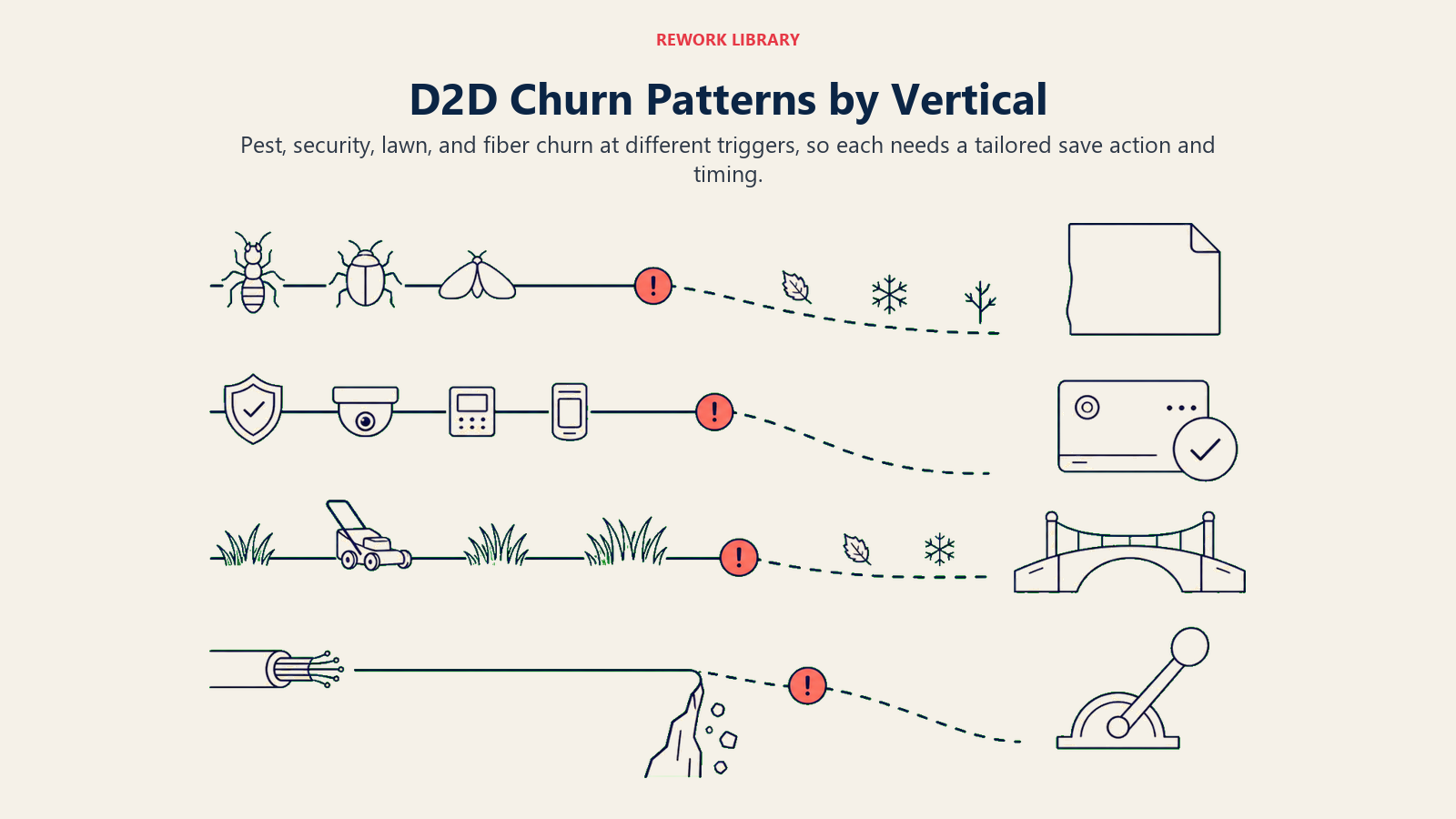
Each D2D vertical has a distinct churn signature tied to its psychological frame: pest churns when the problem stops being visible, security churns at contract renewal and after equipment failures, lawn churns seasonally, and fiber churns when a promotional rate expires. Retention teams that build one generic save process for all four miss the specific trigger and timing that actually drives cancellations in each.
This is where the differences matter most for the business, not just the individual rep.
| Vertical | Typical churn trigger | Peak churn window | Retention lever |
|---|---|---|---|
| Pest control | "I don't see bugs anymore, why am I paying" | Late fall/winter | Proactive "here's what we found" communication after every visit |
| Security/alarm | Equipment issues, false alarms, moving | Contract renewal points | Equipment reliability, responsive support, retention-focused renewal calls |
| Lawn care | End of growing season, visible results plateau | End of season | Off-season value-adds (aeration, fall cleanup) to bridge the gap |
| Fiber/telecom | Price increases after promo period, competitor win-back offers | 12-month promo expiration | Proactive repricing conversation before the promo cliff hits |
Pest control churn concentrates when the visible evidence of the problem disappears, ironically, because the service is working. Communication that shows what was found and treated at each visit (even when nothing was found) keeps the value visible.
Security and alarm churn concentrates around contract renewal and after negative experiences with the equipment. False alarms are a leading complaint driver: the Electronic Security Association cites Urban Institute research showing that 90 to 99% of alarm calls police receive turn out to be false, exactly the kind of experience that erodes a homeowner's confidence in the system they're paying for. The subscription retention fundamentals guide covers proactive renewal outreach that applies especially well here, since the multi-year contract structure gives retention teams visibility into exactly when a customer is at risk.
Lawn care churn is seasonal and largely unavoidable in cold climates, but smart operators sell off-season services (fall cleanup, snow removal in some markets, early spring aeration bookings) to keep the relationship alive through the gap rather than losing the customer entirely and re-acquiring them next spring.
Fiber and telecom churn spikes hard when a promotional rate expires and the bill jumps. This is predictable to the day, which means it's preventable. Proactive outreach before the price increase, offering a modest retention discount or a service upgrade, costs far less than losing the account to a competitor's win-back offer.
Quotable: Franchise and multi-branch D2D operators that run more than one vertical are, in effect, running several different sales psychologies under one roof. Treating fiber, security, pest, and lawn as variations of the same pitch is the single fastest way to burn out a good rep in the wrong vertical.
Compensation and Contract Length Differences
Pest control typically runs shorter commitment periods (often 12-month agreements with quarterly or monthly billing) and lower per-unit commissions, offset by higher volume per rep. Reps close more accounts per week but each is worth less individually.
Security and alarm often bundles equipment cost into a 3 to 5 year agreement, which means higher commission per close but far fewer closes per week. Commission and comp design for D2D covers how equipment financing changes commission structure, since the company is often carrying hardware cost that needs to be recovered over the contract term.
Lawn care commissions are frequently tied to the full-season contract value rather than a per-visit rate, and upsell commissions (aeration, overseeding) are a meaningful part of total rep income.
Fiber and telecom often pays the highest single-close commission of the four verticals because the customer lifetime value is high and switching costs keep retention strong once installed. But close rates depend heavily on network availability at the specific address, which reps can't control, making territory quality unusually important to individual rep earnings.
A Practical Framework for Running Multiple Verticals
If your company operates across two or more of these verticals, or is expanding into a new one, resist the urge to write one training deck and apply it everywhere. Use this checklist when adapting the core D2D playbook to a new vertical:
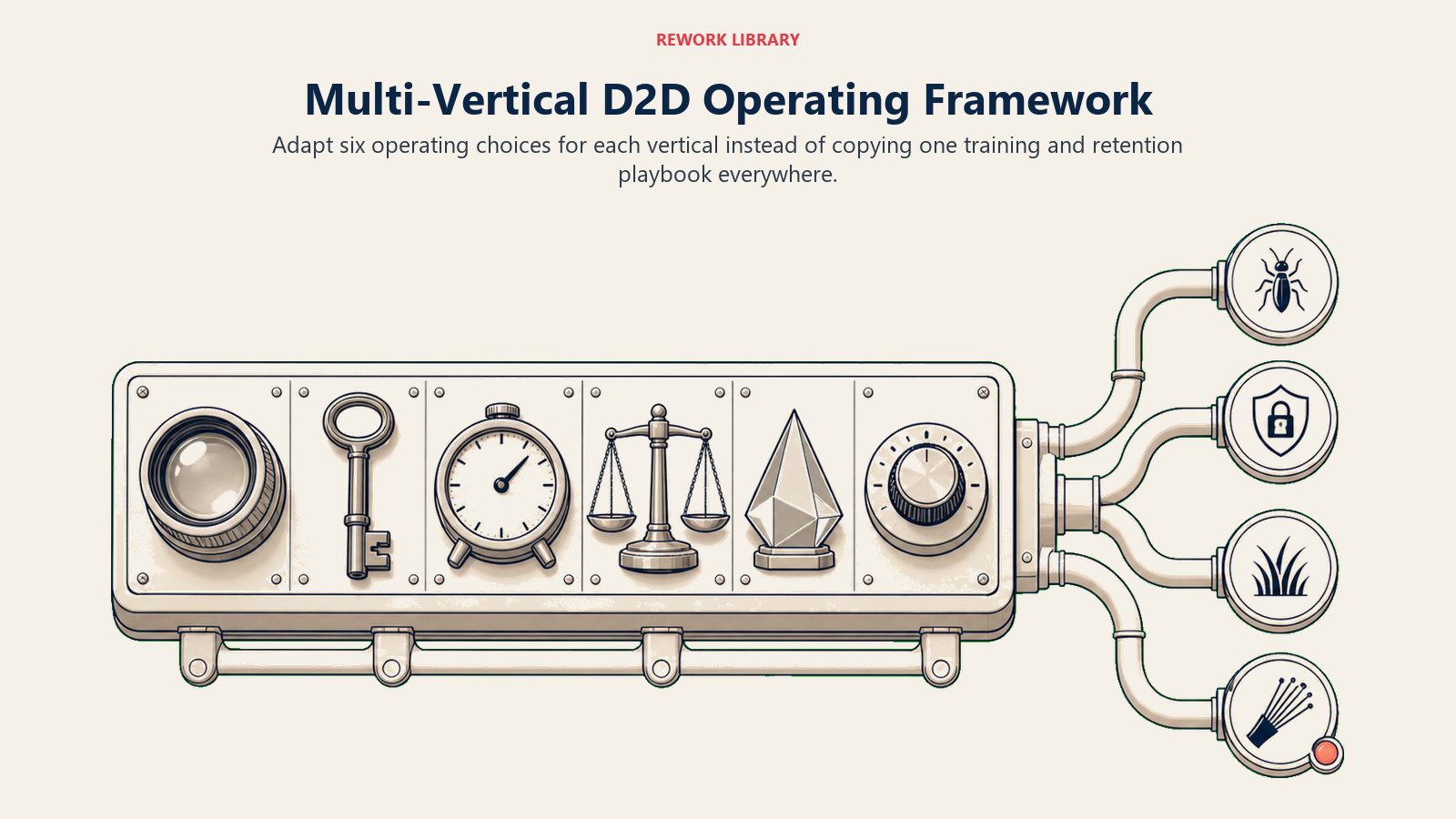
- Identify the core psychological frame (relief, protection, pride, or value substitution) and build the opener around it
- Map the top 5 objections specific to the vertical and write vertical-specific responses, not generic rebuttals
- Determine the churn signature and peak churn window, then build retention touchpoints around it proactively
- Set commission structure to reflect contract length and equipment cost, not a copy-pasted flat rate from another vertical
- Train reps on competitor-specific knowledge where the sale is a substitution (fiber, security) rather than a net-new purchase
- Adjust territory saturation thresholds to the vertical's realistic knock-to-close ratio
Companies that run this exercise honestly for each vertical, rather than assuming their best pest control training deck will work for a new security division, ramp new verticals faster and lose fewer reps to frustration in the first 90 days.
The verticals differ in psychology, objections, and churn, but they converge again at the strategic level: every one of them is a subscription business built door by door, and the value-selling discipline of connecting the pitch to a specific, felt customer outcome rather than a generic feature list works across all four when it's adapted to the right emotional frame.
Learn more: Territory design and assignment covers saturation math that varies by vertical. D2D legal and licensing compliance covers the regulatory differences, especially relevant for security. Lead nurturing programs covers how to follow up with prospects who didn't close at the door across any of these verticals.
Frequently Asked Questions about D2D Vertical Playbooks
Why can't the same D2D training work across pest, security, lawn, and fiber?
Each vertical asks the homeowner to make a different kind of decision. Pest control sells relief from an existing problem, security sells protection against a risk that hasn't happened, lawn care sells a visible comparative result, and fiber sells a straight substitution for an existing service. A door approach, objection response, or retention play built for one psychological frame underperforms when copied into another.
Which D2D vertical has the fastest close rate?
Pest control and fiber tend to close fastest, often in a single visit, because the decision is either low-risk (fiber, a straightforward comparison) or responds to an existing felt problem (pest control). Security typically takes longer because the homeowner is being asked to recognize a risk they haven't experienced, which sometimes requires a follow-up conversation.
What causes the most churn in each vertical?
Pest control churns when customers stop seeing evidence of the problem and question the value. Security churns around contract renewal points and after negative equipment experiences like false alarms. Lawn care churns seasonally at the end of the growing season. Fiber and telecom churns sharply when a promotional rate expires and the bill increases.
Should commission structures differ by vertical?
Yes. Security and fiber typically justify higher per-close commissions because of longer contract terms or bundled equipment costs, while pest control commissions are usually lower per unit but higher in volume. Lawn care commissions often include upsell components tied to seasonal add-on services.
How should a company expanding into a new D2D vertical adapt its playbook?
Start by identifying the new vertical's core psychological frame and its distinct churn signature, then rebuild the opener, objection responses, and retention touchpoints around those specifics rather than reusing a deck from an existing vertical. Commission structure should also be recalibrated to reflect the new vertical's typical contract length and any equipment or installation costs.

Senior Implementation Consultant
On this page
- Where the Four Verticals Are Actually the Same
- What Is the Core Psychological Frame Behind Each D2D Vertical?
- How the Door Approach Changes By Vertical
- Objection Handling Differences That Actually Matter
- Why Do Retention and Churn Patterns Differ So Sharply By Vertical?
- Compensation and Contract Length Differences
- A Practical Framework for Running Multiple Verticals