Managing Seasonal and 1099 Sales Teams in Door-to-Door Home Services
Turn this article into takeaways for your work.


Each assistant summarizes the article only for you and suggests best practices for your work.
You hire twenty reps in May. You run a tight summer blitz. By August, half of them have ghosted you. Most D2D owners know this story too well. Seasonal and 1099 team structures power growth for security, pest control, lawn care, and fiber companies. But they come with management problems no standard HR playbook covers.
Companies that crack this get a repeatable seasonal machine. The ones that don't spend every spring starting from scratch.
Why Seasonal D2D Is Different from Any Other Sales Model
When you hire a W-2 salesperson, you control their schedule, their territory, and their daily activities. With 1099 reps, especially seasonal ones, the dynamic flips. They're running their own small business inside yours. They show up because the deal is good, the training is real, and they believe in what you're selling.
That changes how you recruit, how you structure comp, and how you manage performance. You can't micromanage someone who legally works as an independent contractor. But you also can't just drop a product sheet and a territory map on them and hope for the best.
The companies with the best seasonal programs build what amounts to a franchise model for reps: clear rules of engagement, strong training, transparent earnings, and enough autonomy that high performers stay engaged rather than bolt to a competitor.
Key Facts
- The IRS 1099-NEC filing threshold is $600 for payments made through December 31, 2025, rising to $2,000 for payments made on or after January 1, 2026, under the One Big Beautiful Bill Act. (IRS FAQ: Form 1099-NEC and Independent Contractors)
- As of July 2023, 11.9 million Americans worked as independent contractors as their primary job, representing 7.4% of total U.S. employment, up from 6.9% in 2017. (BLS Contingent Work Supplement, November 2024)
- Field sales reps spend just 44% of their time on active selling; the rest goes to admin tasks, data entry, internal meetings, and preparation, which makes structured management systems essential for 1099 teams. (SPOTIO State of Field Sales 2026)
Who Actually Survives the Summer? How to Recruit Seasonal D2D Reps
Most D2D managers make one consistent mistake in recruiting: they hire for enthusiasm and filter for fitness afterward. By the time you figure out who can't handle rejection, you've wasted three weeks of onboarding.
Better criteria to screen for upfront:
Past commission-only or gig work. Someone who's driven Uber for six months or worked real estate knows their income is tied directly to their effort. They've already self-selected into the right mindset.
Appetite for discomfort. D2D means doors slammed, heat, rain, dogs, and days where nothing closes. Ask candidates directly: "Tell me about a time you had a really bad day at work and kept going anyway." The answer tells you more than any personality test.
References from structured sales programs. College summer sales programs (Vivint, Aptive, and their alumni) produce reps who already know the rhythm of summer D2D. They don't need to be taught that 3-8pm is prime time.
Run a one-day paid field orientation before you extend longer offers. Put candidates out with a senior rep for a half-day. You'll lose some before day one, but the ones who stay are genuinely interested.
Onboarding Seasonal Reps Fast
You've got a narrow window. For pest and lawn care, that might be March to September. For security, it's year-round but peaks around summer. Fiber rollouts often follow construction timelines that compress everything.
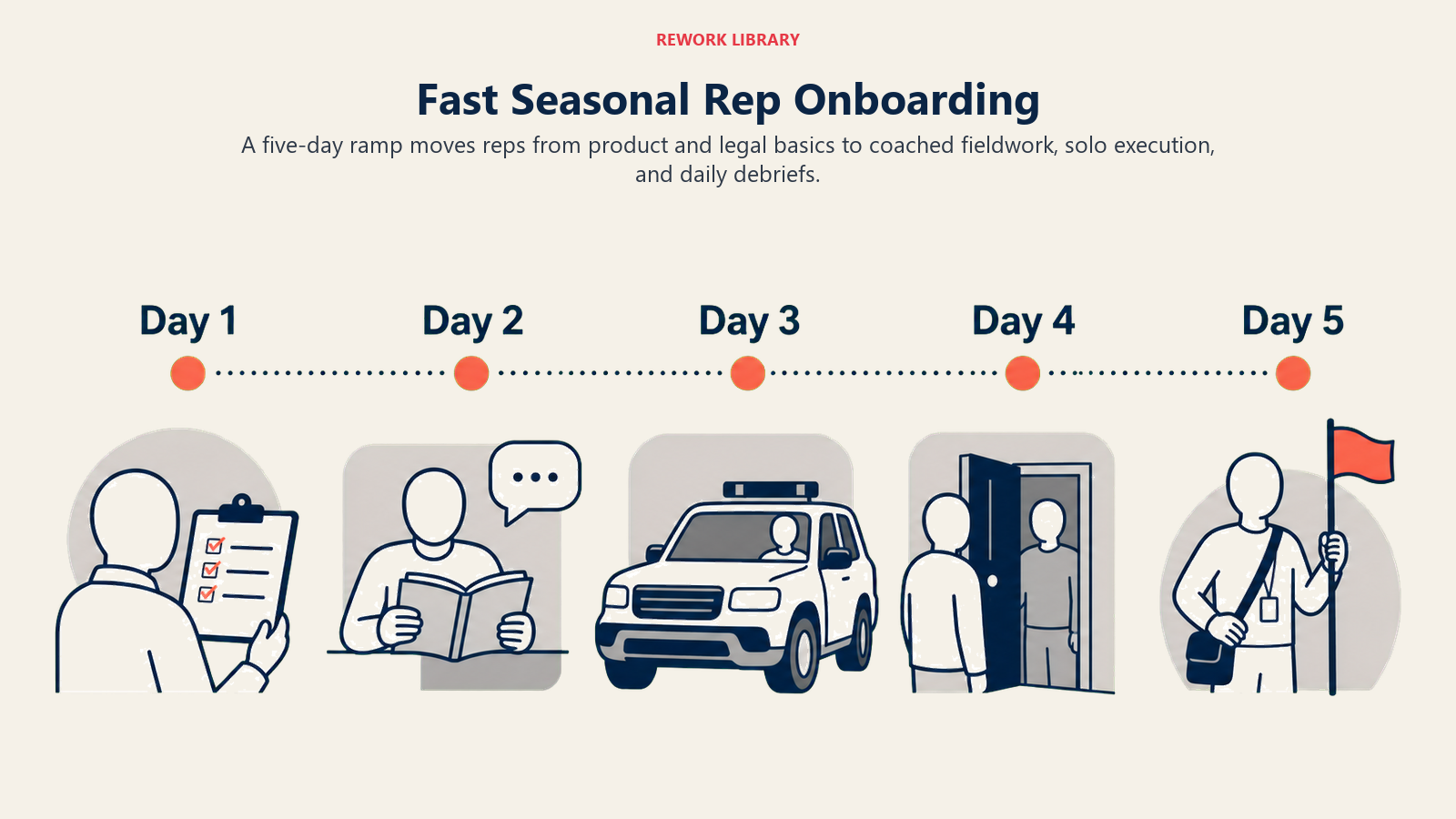
A solid onboarding track looks like this:
| Day | Activity |
|---|---|
| Day 1 | Product knowledge (what you're selling and why it matters), legal briefing on D2D ordinances, 1099 contract signing |
| Day 2 | Script fundamentals, objection framework, door approach roleplay |
| Day 3 | Field ride-along with your best closer |
| Day 4 | Solo field with manager shadowing |
| Day 5 | Solo with end-of-day debrief |
| Week 2 | Daily team huddle + performance tracking begins |
Anything longer and you're burning the window. Anything shorter and you'll have reps in the field who don't understand what they're selling.
For 1099 relationships, make sure your onboarding packet includes a clear contractor agreement that spells out territory exclusivity (or lack of it), submission process for signed agreements, chargeback policy, and payment schedule. You're also required to file Form 1099-NEC for any contractor paid $600 or more in a calendar year. That threshold rises to $2,000 for payments made after December 31, 2025. Collect W-9s on day one, not at season's end. Ambiguity here causes rep departures faster than a bad quota will.
Comp Design That Keeps Reps Through the Full Season
The biggest retention lever you have is comp structure. Pay too flat and your best closers leave for a company that rewards output. Pay too top-heavy and you lose mid-performers who would've kept grinding with the right incentive.
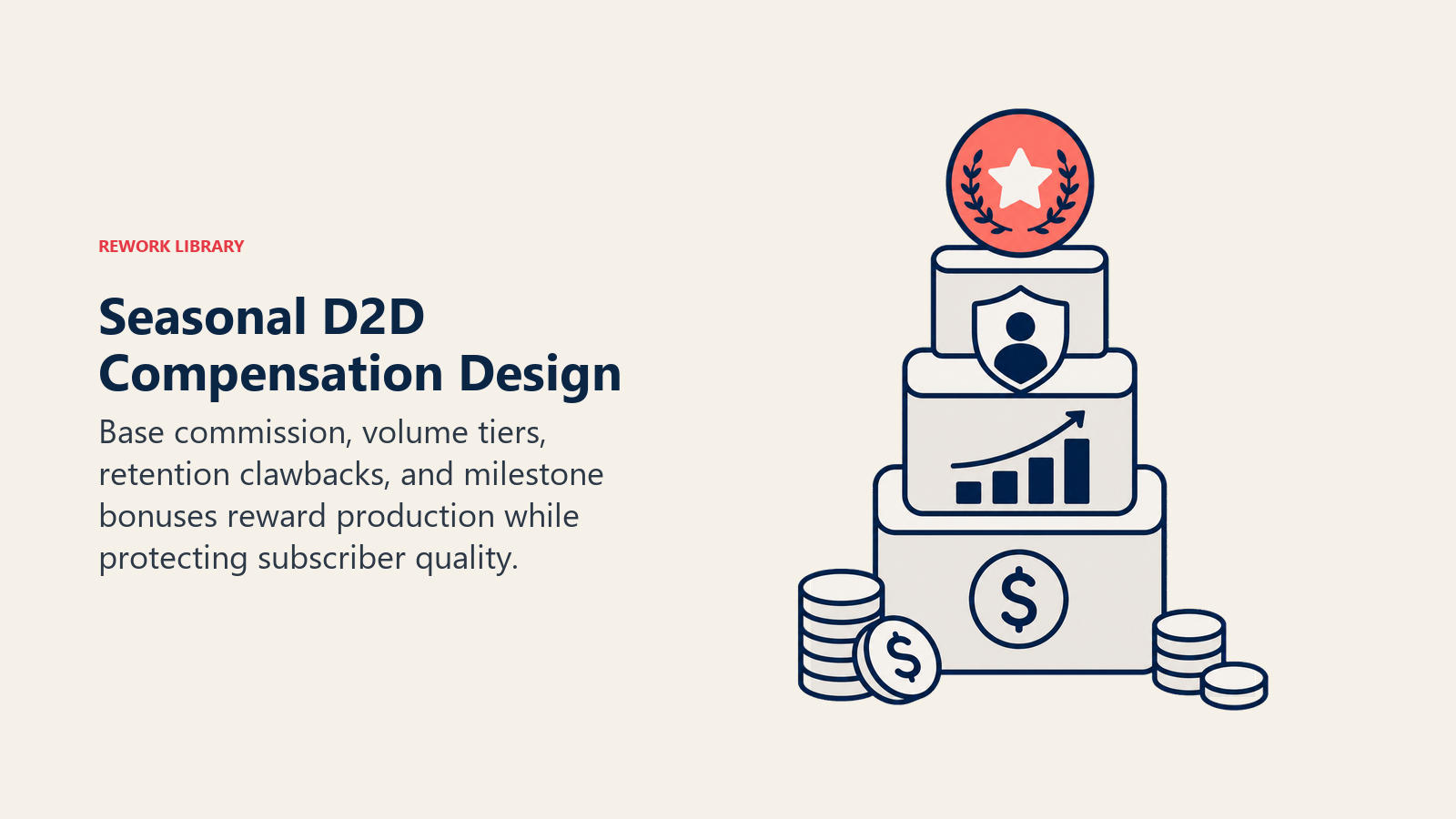
Most successful D2D home services companies use a tiered commission structure:
Base tier: Straight commission per signed agreement. For a $49/month security subscription, that might be $100-150 per close.
Volume tier: Bonus per close once the rep hits a weekly threshold. If the base is $100 per close and they hit 5+ closes in a week, every close that week pays $125.
Retention clawback: Commission is fully earned once the customer completes their first 90 days of service. If the customer cancels before that, part of the commission is deducted from future earnings. This aligns rep incentives with customer retention rather than just initial signatures.
Monthly milestone bonus: A flat bonus for reps who maintain a monthly close rate above a target. Something like $500 for hitting 20+ closes in a month creates urgency without punishing people for slow weeks.
The clawback piece is critical for D2D subscriptions. Without it, reps have every incentive to close a customer who was never really sold. You end up with high early cancellation rates that erode your subscriber base. Connect the compensation to lifetime value, not just the signature.
See subscription unit economics and LTV for the math behind why customer retention is worth paying reps to care about. The same logic that scores inbound leads by quality can help you evaluate which rep behaviors produce subscribers who actually stick.
Managing Day-to-Day Performance in the Field
You can't sit in your car and watch twenty reps knock doors all day. But you also can't manage a D2D team from a spreadsheet alone. The practical answer is a combination of daily structure and data visibility.
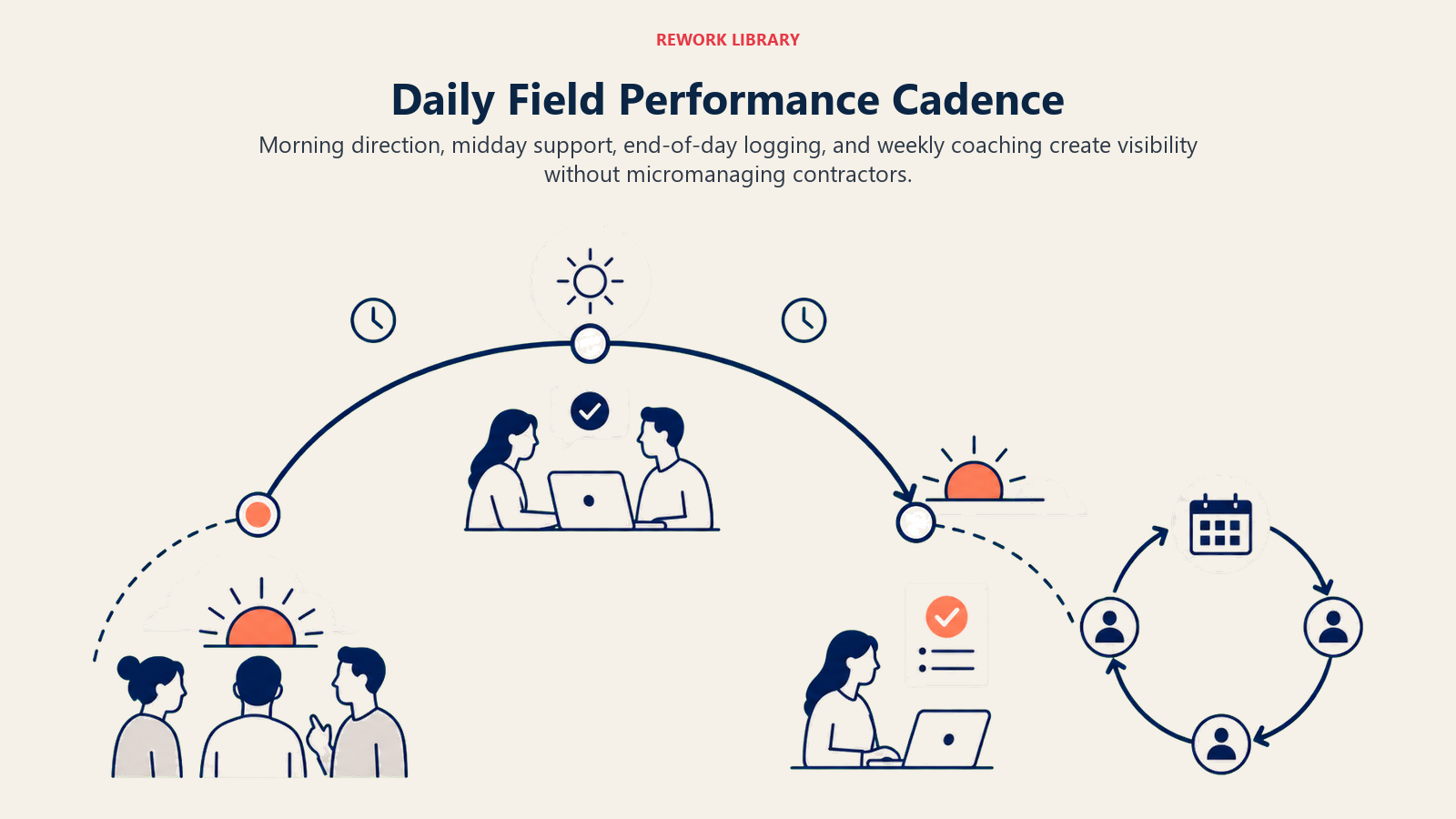
Morning huddle (15 minutes max). Run it at the deployment location or over a team chat. Cover the day's territory assignments, any policy updates, yesterday's top performers (by name), and one skill focus. Keep it tight. Reps need to be at doors during prime hours, not sitting in meetings.
Midday check-in. A five-minute text or app check-in around 1pm. How's the territory? Any door issues? Any good objections they hit that need a script answer? This keeps you plugged in without being intrusive.
End-of-day submission. Every rep submits their closes for the day through your CRM or canvassing app. This isn't optional. Closes not logged don't get paid. That's the rule, and it solves most data integrity problems.
Weekly one-on-ones. For any rep hitting less than 70% of their weekly target, do a 20-minute call or in-person debrief. Not to punish, but to diagnose. Are they working the wrong hours? Struggling with a specific objection? Getting weak territory? Performance management at the rep level requires specificity, not just "you need more closes."
For deeper context on building coaching rhythms, read coaching, ride-alongs, and D2D culture.
Why Do So Many Reps Quit Before August?
By most industry estimates, summer D2D programs lose between 40% and 60% of their reps before the season ends. This figure circulates widely in D2D operator communities. No single primary study has quantified the mid-season number, but it's consistent with general sales turnover data showing the sector runs well above the cross-industry average of 13%. Some of this is unavoidable. College students go back to school. Life happens. But a lot of it is preventable.
The top reasons reps leave mid-season:
- Comp ambiguity. They don't understand when they'll get paid or why a close got charged back.
- Territory frustration. They're working a neighborhood that's already been knocked to death.
- Social isolation. D2D is lonely work. Reps who don't have strong team connection leave when things get hard.
- No visible career path. The best performers want to know what's next.
Fix comp ambiguity by giving reps access to their real-time earnings in your canvassing app or CRM. When they can see every close, every chargeback, and their current payout estimate, disputes disappear and trust builds.
Fix territory frustration by rotating territories on a two-week cycle and being transparent about saturation data. If a neighborhood has a 40% penetration rate already, don't send a new rep in there and expect them to hit quota. See territory design and assignment for how to model this.
Fix isolation with a team culture that goes beyond Slack messages. Weekly team dinners, a group chat for sharing wins, and in-person contests create the social glue that keeps reps invested. The money has to be there, but for many reps, team energy is what keeps them knocking when the money slows down.
Fix the career path problem by being explicit about advancement. Your best summer reps should know that strong performers get first access to off-season territory, team lead roles, or full-time positions. If there's no path, they'll go find one elsewhere.
Quotable Nuggets
"The 1099 rep isn't an employee you manage; they're a business owner you partner with. Build your program so the partnership is worth more to them than any alternative." (Practitioner principle widely shared in D2D operator communities)
"Commission clarity is your cheapest retention tool. A rep who can see their earnings in real time disputes less, trusts more, and knocks longer." (Field observation from D2D software operators; consistent with SPOTIO's finding that low-turnover field teams adopt integrated platforms at nearly 1.5x the rate of high-turnover teams)
"The best seasonal programs aren't built for this summer. They're built so next summer's first week runs like this summer's eighth week." (Operational philosophy documented across D2D training communities including alumni from Vivint and Aptive summer programs)
The Seasonal Rep Lifecycle Framework
The Four-Phase Retention Arc: Experienced D2D operators describe seasonal rep retention through four predictable phases that each require different management responses.
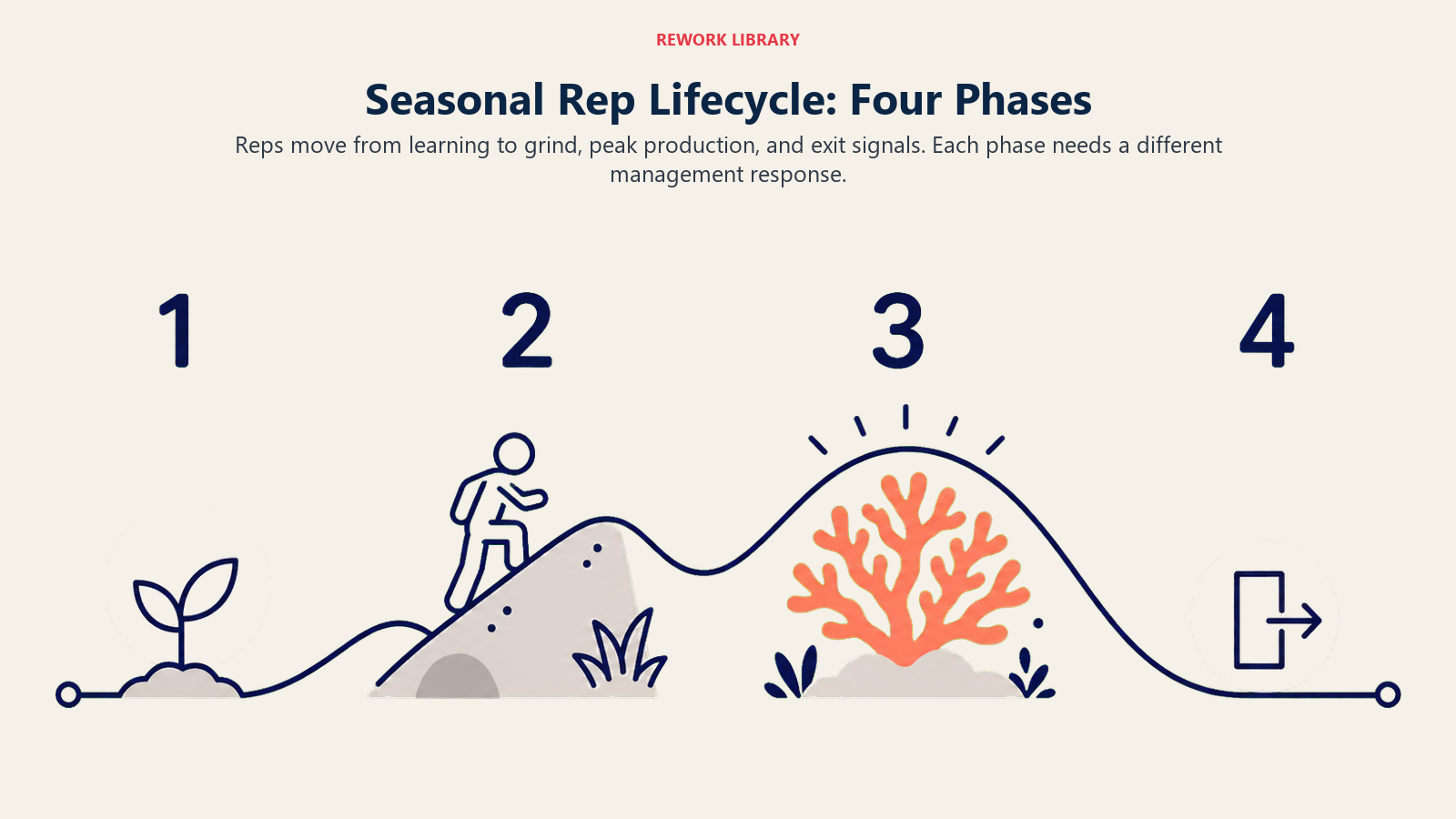
Phase 1 (Weeks 1-2): The Learning Curve. New reps are energetic but not yet productive. Close rates are low and frustration is high. The management priority is preventing early exits by coaching intensively and celebrating small wins.
Phase 2 (Weeks 3-6): The Grind. Reps have learned the pitch but the novelty has worn off. This is when comp clarity and team culture matter most. Reps who are uncertain about their earnings or isolated from teammates leave in this window.
Phase 3 (Weeks 7-10): Peak Production. Reps who survive Phase 2 are now at or near their peak efficiency. Territory familiarity, objection mastery, and confidence compound. Management priority shifts to challenging top performers and keeping territory fresh.
Phase 4 (Weeks 11+): The Exit Signal. Reps who plan to leave usually show it two to three weeks early. Close rates drop, attendance gets spotty, submission timing slips. Catching exit signals early lets managers have retention conversations while there's still time.
Knowing which phase each rep is in lets managers apply the right response rather than a generic one.
Legal Compliance for 1099 D2D Teams
This section deserves its own article (and there's a full one at D2D legal, licensing, and compliance), but a few critical points:
1099 vs. W-2 classification. The IRS applies a three-factor test covering behavioral control, financial control, and type of relationship to determine worker status. If you dictate exactly when and where reps must work, require your specific tools, and control all aspects of how they sell, the IRS may reclassify them as employees. The IRS independent contractor guidance explains these factors in detail. Know your state's rules too: California AB5, for instance, applies a stricter ABC test than most states.
Municipal D2D permits. Many cities require a solicitor's permit or license for each rep. This is the company's responsibility to track, not the rep's. Operating without proper permits exposes you to fines and, in some cities, can get reps detained.
Do Not Knock registries. Some municipalities maintain their own DNK lists in addition to the national Do Not Call registry. Your canvassing app should filter these addresses before you assign territory.
Contract right of rescission. In most states, customers have a 3-day right to cancel a contract signed at their home. Your reps need to know this, explain it to customers, and your ops team needs a process for handling rescission requests cleanly.
Building for Next Season While the Current One Runs
The best seasonal D2D operators are always building the next season while running the current one. That means:
Keeping a record of every rep who performs well, even if they're seasonal. When May comes around again, you want to call your top reps from last year before they commit somewhere else.
Documenting what worked. Which territories produced the highest close rates? Which objection scripts held up? Which neighborhoods had the best retention rates? This data becomes your competitive advantage year over year.
Refining your onboarding process. Every season, your training should get tighter. New objections get added. Script updates get documented. The rep who joins in year three of your program gets better training than the one who joined in year one.
Building a talent pipeline. College campuses near your operating markets are a recurring source of reps. Relationships with university career centers, student clubs, and D2D alumni networks mean you're not starting from scratch every spring.
The same discipline that builds a strong renewal pipeline with existing customers applies to building a strong rep pipeline. Senior reps who can communicate service worth at the door give team leaders a framework for coaching reps who struggle to articulate why a subscription is worth buying.
Performance Benchmarks for Seasonal 1099 Teams
Here's what healthy numbers look like across different vertical performance expectations:
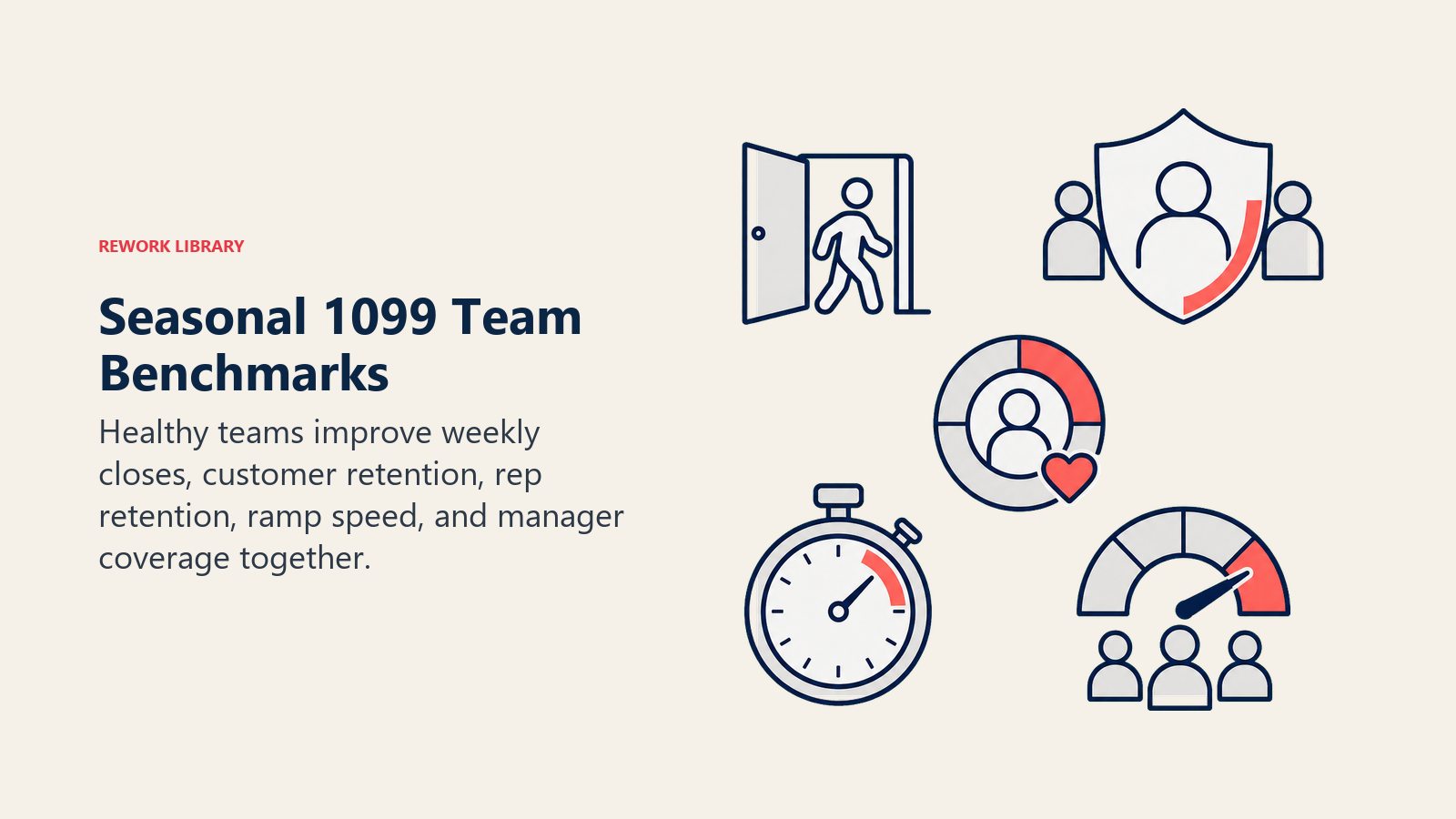
| Metric | Underperforming | Solid | Strong |
|---|---|---|---|
| Closes per rep per week | Under 3 | 4-6 | 7+ |
| 90-day customer retention | Under 70% | 75-85% | 88%+ |
| Rep retention through season | Under 50% | 60-70% | 75%+ |
| Days to first close for new reps | 10+ days | 5-7 days | 2-4 days |
| Manager: Rep ratio | 1:25+ | 1:15 | 1:10 |
Track these metrics monthly, not just at season end. A rep who's on pace for a 65-day first close isn't going to magically turn around. Catching underperformers at week two rather than week eight saves a lot of sunk cost.
The companies that run the most efficient seasonal programs treat management itself as a skill that improves with every season. Your first summer program will have problems. Your fifth one, if you've been tracking data and refining process, should run almost automatically.
For a complete view of the performance metrics that drive D2D subscription businesses, read D2D sales KPIs and metrics. And to see how strong onboarding connects to early subscriber retention, see reducing early cancellations.
The questions below cover the details owners ask most: classification, filing thresholds, manager ratios, and what actually belongs in a rep agreement.
Learn More

Senior Implementation Consultant
On this page
- Why Seasonal D2D Is Different from Any Other Sales Model
- Key Facts
- Who Actually Survives the Summer? How to Recruit Seasonal D2D Reps
- Onboarding Seasonal Reps Fast
- Comp Design That Keeps Reps Through the Full Season
- Managing Day-to-Day Performance in the Field
- Why Do So Many Reps Quit Before August?
- Quotable Nuggets
- The Seasonal Rep Lifecycle Framework
- Legal Compliance for 1099 D2D Teams
- Building for Next Season While the Current One Runs
- Performance Benchmarks for Seasonal 1099 Teams
- Learn More