First Service and Install Scheduling: Converting Signatures Into Starts
Turn this article into takeaways for your work.


Each assistant summarizes the article only for you and suggests best practices for your work.
Most door-to-door (D2D) subscription businesses obsess over the close rate. Very few put the same rigor into what comes right after: scheduling the first service or install visit. But that gap is where a surprising number of subscriptions quietly die.
Picture a customer who signed two weeks ago and still hasn't had their first visit. They've had two weeks to second-guess the decision, hear a neighbor complain about your company, or take a competing offer from someone who knocked their door on day three. First-service scheduling isn't just a logistics problem. It's a retention problem, and it deserves to be treated like one.
Why Does Speed to First Service Matter More Than Most Teams Think?
The evidence from subscription home service companies consistently shows that speed to first service is one of the strongest predictors of 90-day retention. Here's the pattern:
- Customers who receive their first service within 5 days of signing retain at rates 15 to 25 points higher than customers who wait 2 weeks or more (Rework Analysis, based on operator-reported benchmarks across pest, lawn, and security categories)
- Pre-service cancellation rates roughly double for each additional week of delay
- Customers whose first service happens within the window the rep described retain at meaningfully higher rates than customers who experienced even a small schedule discrepancy
Speed signals reliability. A company that can schedule a first visit within a few days of signing demonstrates organizational competence. A company that takes three weeks signals the opposite, regardless of how good the service actually is. SPOTIO's field sales research puts the D2D industry's annual US revenue at roughly $30 billion, with conversion rates between 2% and 3% per door, which means operations efficiency after the close has an outsized effect on whether that revenue actually sticks.
This doesn't mean you should overpromise scheduling speed during the pitch. It means operations should build capacity to honor the windows your reps are describing.
Key Facts: First Service Scheduling
- Acquiring a new customer costs 5 to 25 times more than retaining an existing one, per research cited in Harvard Business Review, which makes a missed or delayed first visit one of the most expensive operational failures in the D2D model.
- The U.S. door-to-door sales industry generates roughly $30 billion in annual revenue with field conversion rates between 2% and 3% per door, according to SPOTIO's field sales research, meaning the margin on each close is thin enough that a single pre-service cancellation can wipe out the economics of several doors knocked.
- Strong pest control businesses maintain annual customer retention rates between 80% and 90%, according to industry operators tracked by Wexford Insurance. First-service speed is among the controllable factors that separate the top of that range from the bottom.
The Three Scheduling Models Used in D2D Home Services
How you handle first-service scheduling depends partly on your service type and partly on your dispatch infrastructure. Three models are common:
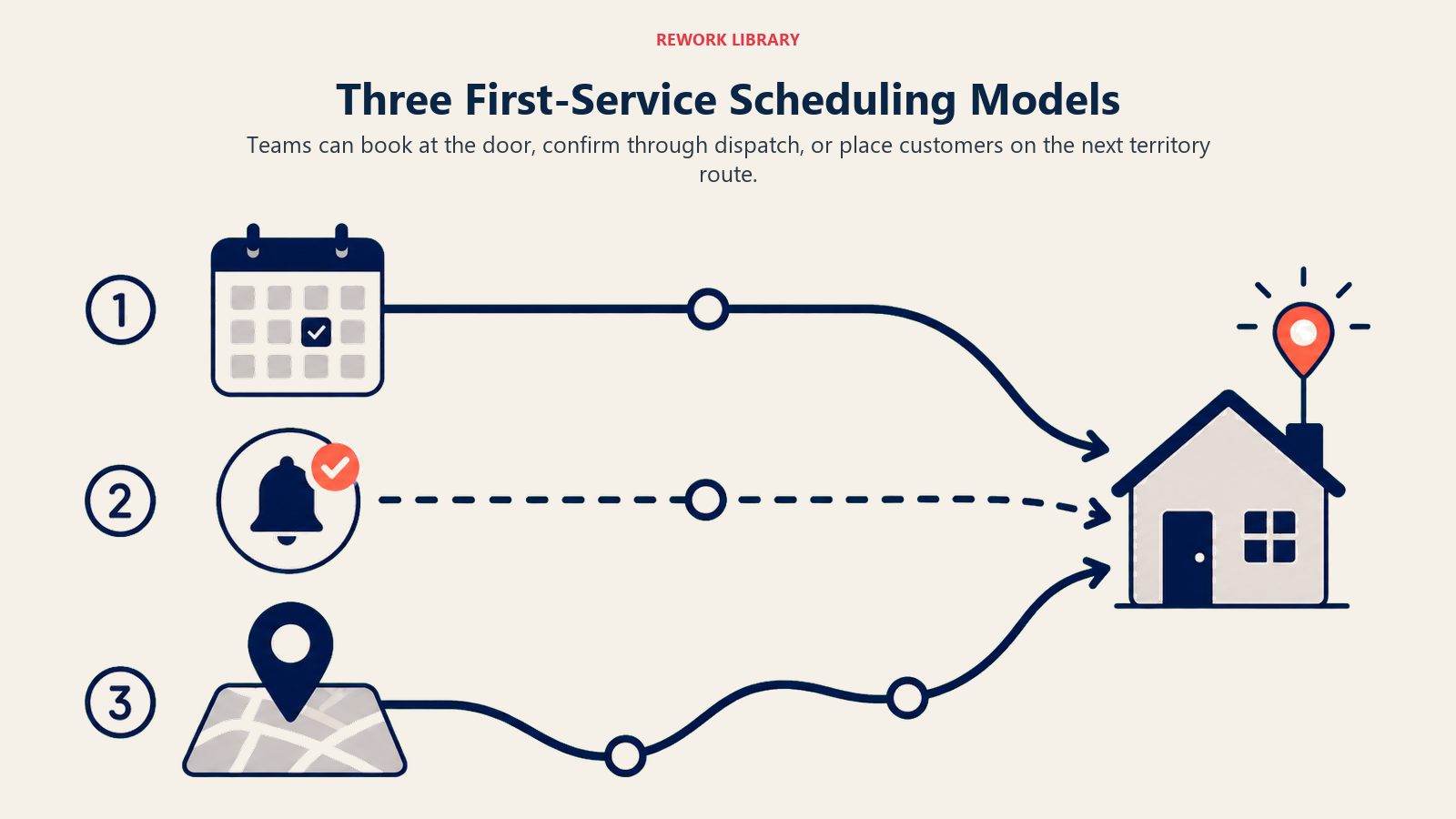
Model 1: Rep-commits scheduling (synchronous close) The rep has access to live scheduling availability during the pitch and commits to a specific appointment window before leaving the door. This is the fastest model for customer confidence but requires field-accessible dispatch tools and real-time route visibility.
Best for: Security installs, fiber connections, or any service with a fixed appointment window where a tech needs to be specifically prepared.
Model 2: Dispatch-confirms within 24 hours The rep closes the agreement and tells the customer that scheduling will contact them within 24 hours to confirm a date and window. The rep doesn't commit to a specific time.
Best for: Pest control, lawn care, or other services where route density matters and scheduling is optimized in batches. The 24-hour contact window is critical. Beyond that, customer anxiety starts to build.
Model 3: Automatic scheduling based on territory routing The customer is told their first service will happen on the next available route day for their zone (e.g., "your neighborhood runs every Tuesday, so you'll see your first visit next Tuesday"). No separate scheduling contact needed.
Best for: Established route-based services with predictable density, like weekly or biweekly lawn programs.
Each model has trade-offs. Model 1 gives the highest close-confirmation rate but requires the most infrastructure. Model 3 is the most operationally efficient but only works when route density is high enough to make the auto-schedule feel personal rather than impersonal. Whichever model you pick, the conversation that follows still has to cover the same ground.
What the Scheduling Conversation Should Cover
Whether scheduling happens at the door or in a follow-up call, the conversation needs to cover the same core elements. Gaps in this conversation are the direct cause of first-visit failures.
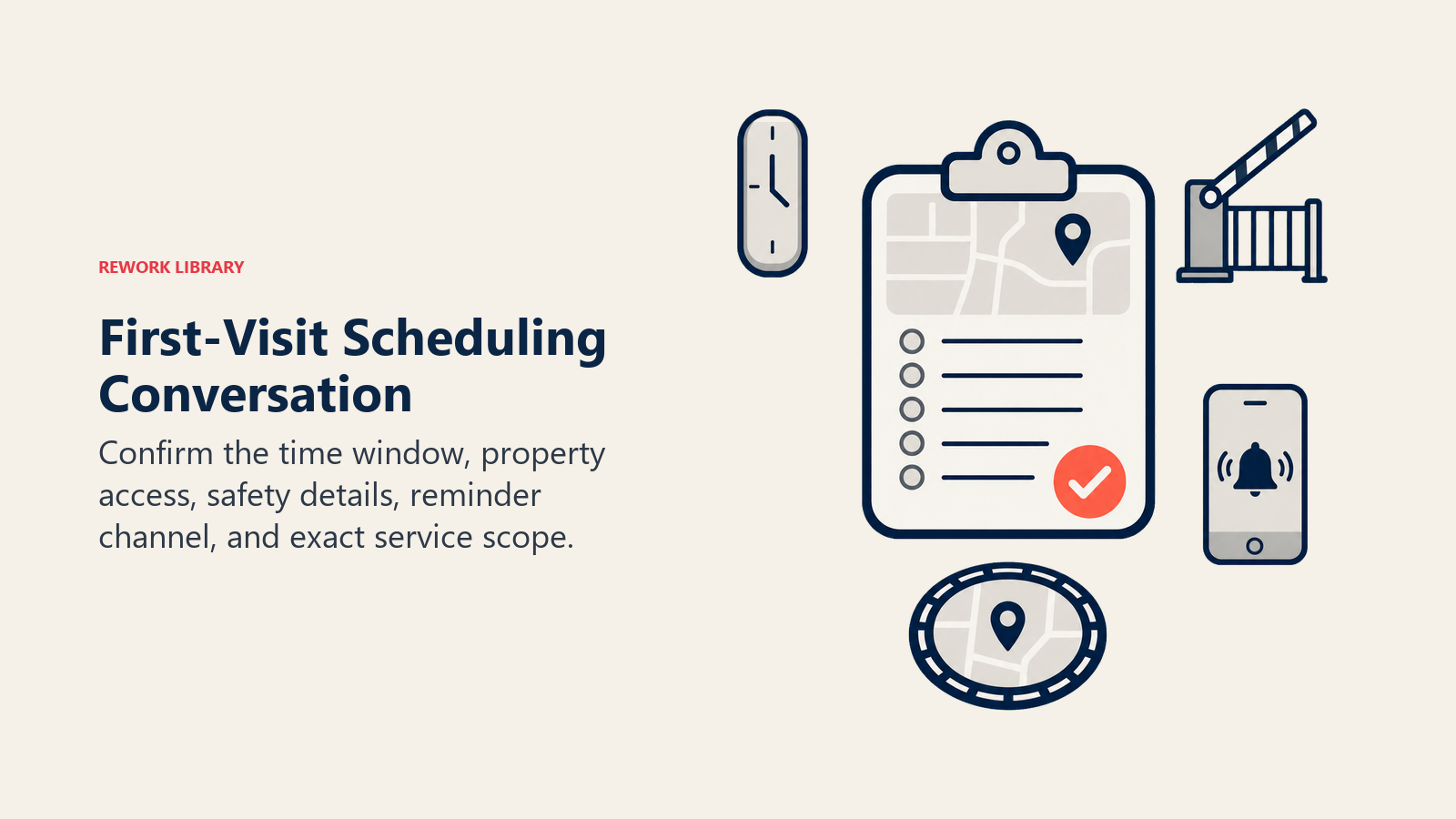
Appointment window: The specific date and a service window narrow enough to be useful. "Between 8am and 5pm" is not a service window. "Between 9am and 12pm" is usable. "We'll be there Thursday between 10 and 11, and the tech will call 30 minutes before" is excellent.
Access requirements: What does the tech need to complete the first service? For pest control, it might be access to crawl spaces or inside the garage. For lawn care, it might be unlocking the back gate. For fiber, it could be a two-hour window with an adult present. Get this information before the visit, not on arrival.
Pet or safety considerations: Dogs that need to be secured, children with allergies to treatment products, elderly residents who need advance notice before anyone enters the property. These aren't optional extras. They're risk-management details that affect whether the first visit completes successfully.
Confirmation method: How will the customer receive the appointment reminder? Text, email, phone call? What's their preferred contact number? Confirm it explicitly. CRM records filled with wrong phone numbers are shockingly common.
What the first visit includes: Be specific. "Your first pest treatment will cover the interior perimeter of the home and the exterior up to two feet from the foundation. The tech will need about 45 minutes." That sets an accurate expectation and prevents confusion when the tech arrives.
The Confirmation and Reminder Sequence
One scheduling confirmation isn't enough. Operators who have moved from a single confirmation to a multi-touch reminder sequence consistently report meaningful reductions in no-shows and rescheduled first visits. As a planning benchmark, a four-touch sequence (day-of confirmation, 48-hour reminder, day-before reminder, morning-of ETA) cuts missed first appointments by a significant margin compared to a single confirmation, because each touch catches customers at a different moment of attention. The confirmation sequence is not a courtesy step; it's a revenue protection step.
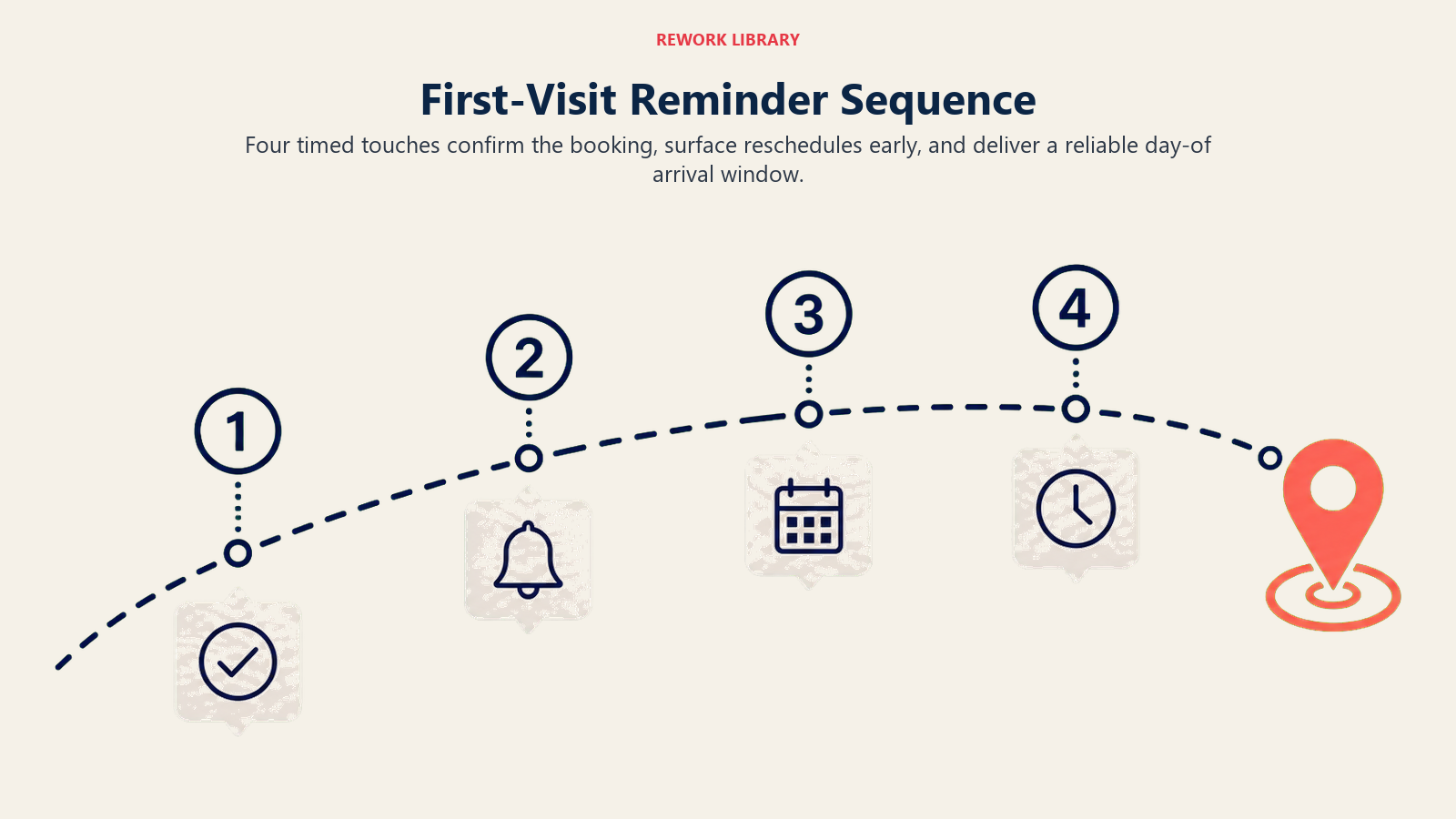
A standard sequence looks like this:
| Timing | Contact Type | Content |
|---|---|---|
| Day of scheduling (or next morning) | Email or text | Appointment confirmation with date, window, tech name if available |
| 48 hours before | Text reminder | "Your [service] is scheduled for [day] between [window]. Reply CONFIRM to confirm or RESCHEDULE to change." |
| Day before | Text or call | Final reminder with "here's what to expect" details |
| Morning of | Text with ETA | "Your tech [Name] is scheduled between [window] today and will call 30 minutes before arrival." |
The confirmation request in the 48-hour text is valuable because it gives you early warning of customers who need to reschedule. Finding that out 48 hours in advance is far less costly than a tech showing up to a locked house. The harder question is what to do when the customer doesn't respond to any of it.
What Happens When the Customer Doesn't Respond
Customers who go silent after signing are a scheduling risk. Some are genuinely busy. Some are having second thoughts. And some just missed your messages.
Build a no-response protocol into your scheduling workflow:
- If no confirmation is received within 24 hours of the scheduling contact, send a second touch (different channel: if you texted, try calling)
- If no response after 48 hours and a first-service appointment is upcoming, trigger a personal call from customer service, not just an automated text
- If the customer actively declines to reschedule or can't be reached before the first visit window, flag the account as "at-risk" and escalate to a save attempt before the service date passes
Accounts that miss their first scheduled visit cancel at extremely high rates unless someone makes direct personal contact. Most of those saves are simple: the customer had a scheduling conflict, they just didn't communicate it, and a personal call is all it takes. What that first visit actually needs to cover depends heavily on which service you're delivering.
Service Type Considerations for First-Visit Scheduling
Not every service type has the same first-visit requirements. Each service category has different requirements, and operations leads who know the differences build far better scheduling protocols:
Pest control: First visit often includes an interior inspection and initial treatment. Requires an adult to be home. Longer time window (60-90 minutes typical). Access to interior areas and any crawlspaces relevant to the treatment plan.
Lawn care (recurring maintenance): Often does NOT require an adult present if the yard is accessible. Gates need to be unlocked. Dogs need to be inside. First visit may include a walk-through assessment, especially for fertilization programs that need a soil or condition read.
Home security install: Always requires an adult present. Typically 2-4 hours for a full install. The customer needs to be briefed on what the tech will need to do in each room. Pre-visit tech confirmation call is standard.
Fiber / internet install: Requires a 2-4 hour window with adult present. Involves drilling, cable routing, and device configuration. Customers need to know where they want the router and whether there are constraints (e.g., no drilling through certain walls). First visit completion rate depends heavily on how well these logistics were gathered at sign-up.
How Does Route Density Affect First-Service Scheduling?
The Density-First Scheduling Rule: when adding a new account to the service queue, always check whether the customer's address falls on an existing route day before offering a standalone appointment slot. Fitting the first visit into the nearest route day reduces cost-per-visit, gets the customer into the standard service cadence faster, and avoids the scheduling inefficiency that occurs when new accounts are scattered across ad-hoc days. For companies running 50 or more active accounts in a territory, this rule alone can reduce first-service cost by a meaningful amount and improve 30-day retention because customers enter the rhythm of service more quickly.
For route-based services like pest control and lawn care, scheduling the first service in isolation is a missed optimization. If the new customer's address is on a Tuesday route but their sign date is Wednesday, scheduling them for the very next Tuesday is better operationally than scheduling them for a one-off Friday visit.
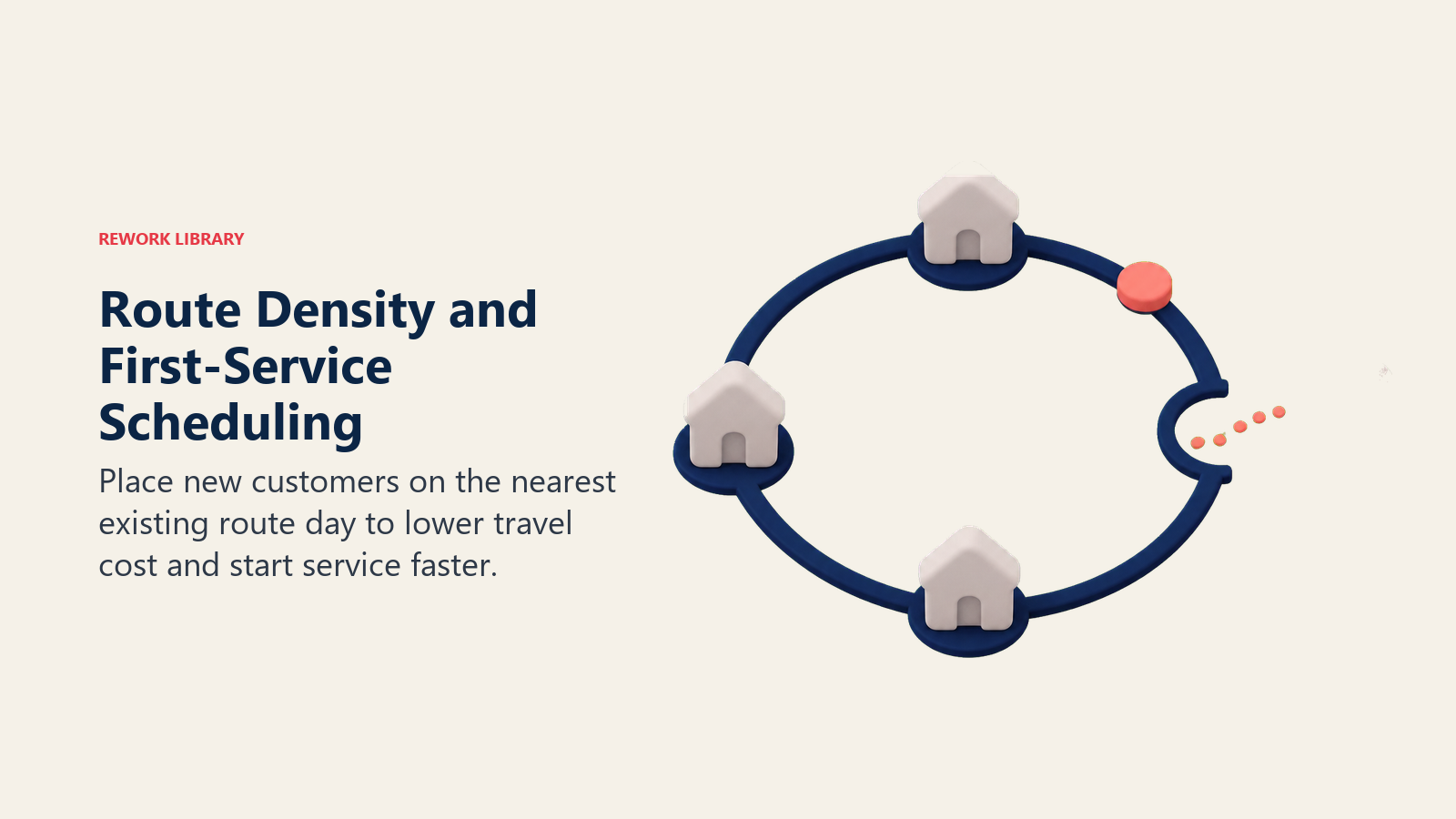
Building first-service visits into existing route patterns means:
- Lower cost-per-visit because the tech is already in the area
- Faster response time because route days are more frequent than ad hoc visits
- Better long-term retention because the customer immediately enters the standard service cadence
This is part of why territory management and scheduling are connected at the operational level. Reps who knock territory that doesn't match current route density create scheduling inefficiencies that show up as higher cost-per-customer and lower first-visit completion rates.
For more on how territory design affects operational efficiency, see Territory Design and Assignment and Route and Time Management.
First-Visit Completion Checklist for Operations
A first service visit isn't just a service event. It's a relationship-defining moment. Operations teams should build this checklist into every tech's first-visit briefing:
- Customer's name and preferred name confirmed
- Access notes and special instructions reviewed before arrival
- Tech has confirmed the appointment window with dispatch
- 30-minute pre-arrival call or text scheduled
- Service scope for the first visit is clear (what is and isn't covered)
- Payment method confirmed on file before dispatch
- Post-visit follow-up sequence is queued (satisfaction text or call within 24 hours)
That post-visit follow-up is the bridge to long-term retention. A satisfied customer who hears from you the day after their first service is far more likely to stay, refer, and respond positively to future upsell conversations.
When the First Visit Goes Wrong
No operation runs perfectly. Sometimes the tech is late. Sometimes the wrong product is used. Sometimes the customer wasn't ready for what the visit required. How your team handles those moments matters enormously.
Customers who experience a service failure during the first visit and receive a fast, personal response from your company are often more loyal long-term than customers who had a flawless first visit. Recovery done well builds trust faster than a smooth experience that nobody noticed.
Build a first-visit failure protocol:
- Any tech-reported issue (access denied, service incomplete, customer unhappy) triggers a same-day manager call, not a form email
- Re-schedule failures within 48 to 72 hours, prioritized over new customer requests
- Offer something concrete as an apology (a free add-on, a credit, a priority rescheduled window)
- Log the failure in the CRM so future visits are flagged and the account is monitored for early cancellation risk
For the broader retention picture after the first service, see Welcome and Onboarding New Customers and Reducing Early Cancellations.
Metrics That Tell You If Scheduling Is Working
Track these across your operation and by service type:
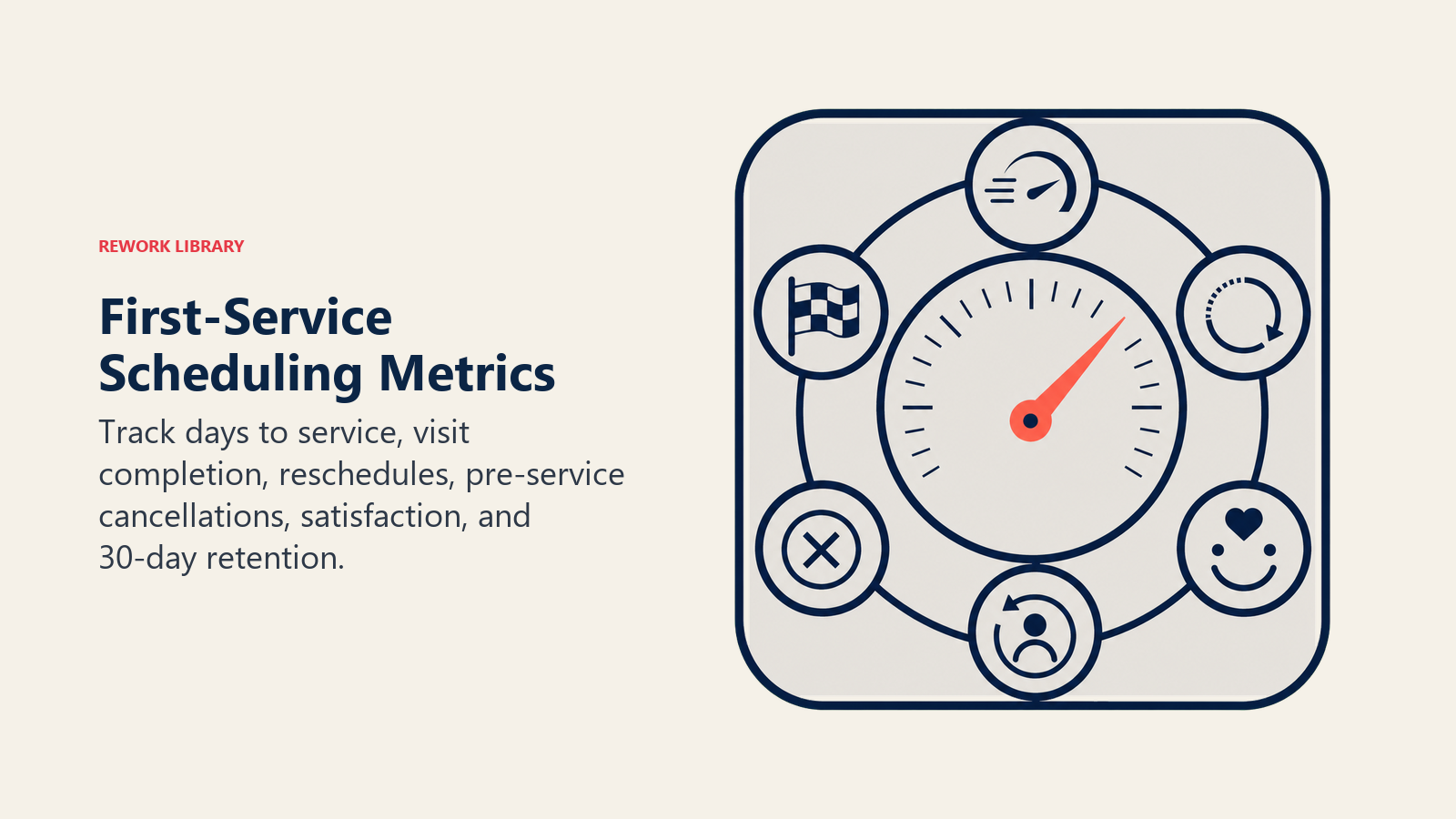
| Metric | Healthy Target |
|---|---|
| Days from signature to first service | Under 7 days (under 5 for highest-retention benchmark) |
| First-visit completion rate | 90%+ |
| Rescheduled first visits | Under 15% |
| Pre-service cancellation rate | Under 5% |
| Post-first-visit satisfaction score | 4.2+ out of 5 |
| Day-1 retention rate (still active at 30 days) | 92%+ |
If either number is off, the fix is rarely more reps. It's usually the confirmation sequence and the operations capacity behind it.
First-service scheduling is one of those operational details that feels like a back-office function but has a direct line to your revenue. Getting it right is how you turn a D2D sales team into a subscription business that actually grows. For the long-term retention and renewal picture that first visit sets up, see Subscription Retention Fundamentals and Churn Prevention Strategy.
Learn more: Retention Fundamentals
"A D2D company that can schedule a first service visit within five days of signing is demonstrating operational credibility before the customer has even experienced the product. That credibility is one of the hardest things to rebuild once it's lost."
"First-visit completion rate is the clearest leading indicator of 90-day retention in subscription home services. If your completion rate is under 85%, check your confirmation sequence before looking anywhere else."
"The most common first-service failure is a technician who arrives without notes from the rep. The customer has to repeat information they already gave at the door, and the relationship starts with a trust deficit rather than a trust deposit. (Rework Analysis)"
Frequently Asked Questions about First Service and Install Scheduling
What is first-service scheduling in door-to-door home services?
First-service scheduling is the process of converting a signed agreement into a confirmed, completed first visit. It includes booking the appointment, communicating the date and window to the customer, preparing the technician with all rep notes, sending reminder sequences, and executing the visit. In subscription home services, this step determines whether the customer actually starts service or cancels before experiencing the product.
How quickly should the first service be scheduled after signing?
The target for top-performing D2D operators is within 5 days of signing, with under 7 days as the general benchmark. Pre-service cancellation rates increase materially for each additional week of delay because the customer's confidence in the company erodes during periods of silence and inactivity.
What should the scheduling conversation cover?
The scheduling conversation must confirm: the specific appointment window (narrowed to 2 hours or less), access requirements (gate codes, pets, interior areas needed), pet or safety considerations, the customer's preferred contact number and reminder method, and what the first visit will include. Gaps in any of these elements are the direct cause of most first-visit failures.
What is the best scheduling model for pest control versus security installs?
Pest control and lawn care typically use dispatch-confirms-within-24-hours or automatic route-day scheduling, since the service can often happen without the homeowner present and route efficiency matters. Security and fiber installs require a committed appointment window with an adult present and 2 to 4 hours of access, making rep-commits or dispatch-confirms the right models. The service type should determine the model, not company preference.
Why do some customers miss their first service appointment?
Most missed first appointments trace to inadequate confirmation sequences, incorrect contact information in the CRM, or customers who had second thoughts and didn't communicate a reschedule request. A four-touch reminder sequence (day-of confirmation, 48-hour text, day-before call or text, morning ETA) catches most of these before the tech dispatches.
How does first-visit completion rate affect retention?
First-visit completion rate is a leading indicator of 90-day retention. Customers whose first service actually happens stay at higher rates than customers who miss it and need to reschedule. Missed first visits give the customer a second window to cancel, and a meaningful percentage of rescheduled first visits never complete at all.
What should happen when the first service goes wrong?
Any tech-reported issue (access denied, service incomplete, customer unhappy) should trigger a same-day manager call, not a form email. Re-service failures should be prioritized within 48 to 72 hours. A concrete apology and a specific make-good (credit, free add-on, priority rescheduled window) turn a service failure into a relationship-building moment. Customers who receive a fast, personal recovery often show stronger long-term loyalty than customers who had a flawless first visit.

Senior Implementation Consultant
On this page
- Why Does Speed to First Service Matter More Than Most Teams Think?
- The Three Scheduling Models Used in D2D Home Services
- What the Scheduling Conversation Should Cover
- The Confirmation and Reminder Sequence
- What Happens When the Customer Doesn't Respond
- Service Type Considerations for First-Visit Scheduling
- How Does Route Density Affect First-Service Scheduling?
- First-Visit Completion Checklist for Operations
- When the First Visit Goes Wrong
- Metrics That Tell You If Scheduling Is Working