Franchise and Multi-Location D2D Scaling: Running Door-to-Door Across Branches
Turn this article into takeaways for your work.


Each assistant summarizes the article only for you and suggests best practices for your work.
A pest control company builds a great door-to-door (D2D) sales operation in its home market. The founder trains reps personally and hits 90% of quota most quarters. Then the company opens a second location three states away. The new manager has never run a D2D team. Results come in at half the home market's rate.
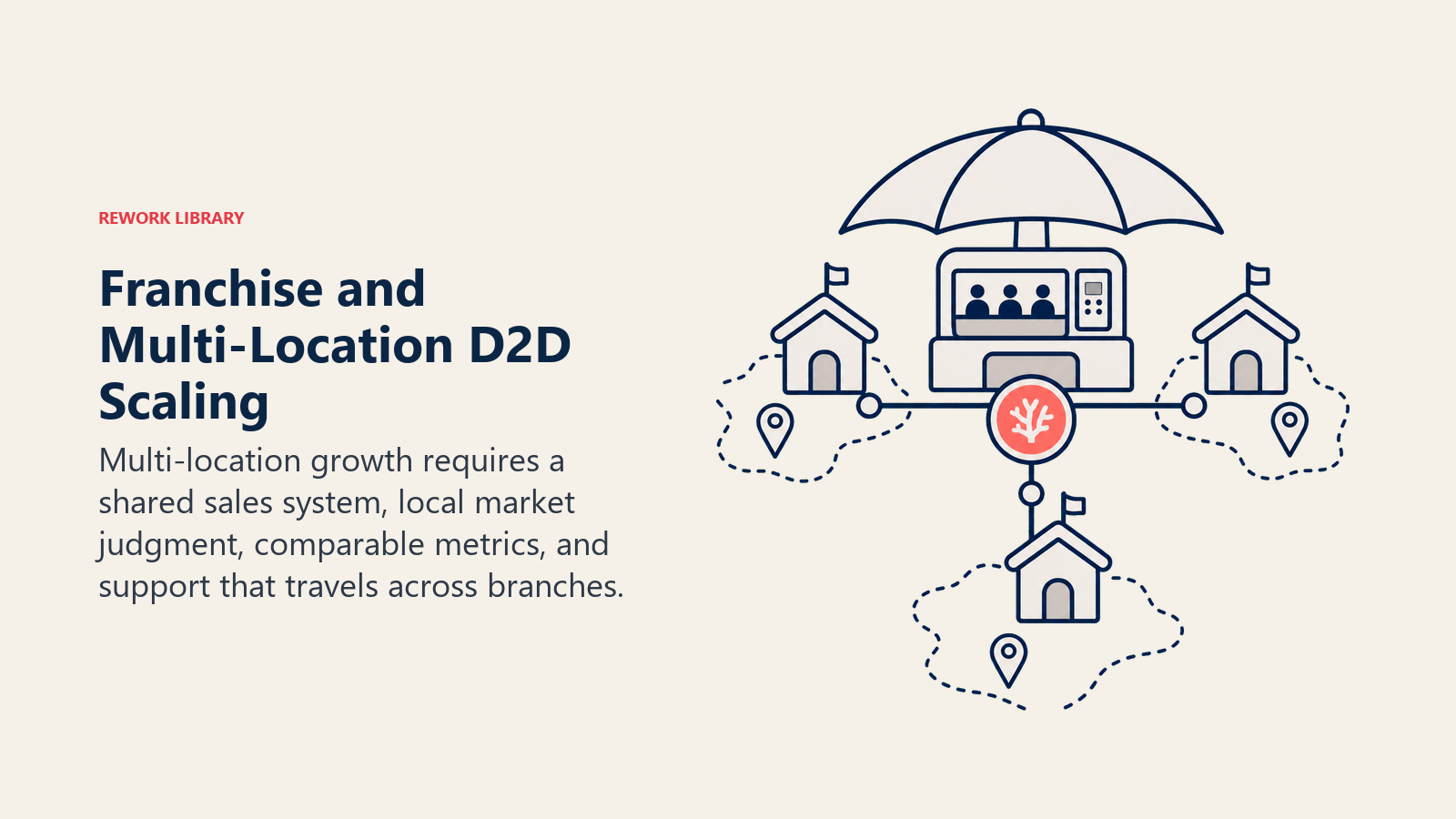
The problem is common. What worked because one person was in the room doesn't automatically work once that person is gone. Scaling door-to-door sales across franchises or company-owned branches means turning tacit knowledge into a repeatable system, without stripping out the local judgment that makes any single location perform.
This article covers what to standardize, what to leave flexible, and how to build the operating cadence that keeps ten locations performing more like the best one than the average one.
Why D2D Scales Differently Than Other Sales Models
Inside sales teams scale by adding reps to a shared floor, using the same scripts, the same CRM, and the same manager oversight. D2D scaling is harder because the unit of production, a rep walking physical territory, is inherently local and hard to observe directly from headquarters. A regional VP can listen to a call center rep's calls in real time from anywhere. That same VP cannot watch every door a canvasser knocks across ten branches. This visibility gap is the core challenge multi-location D2D operators have to solve, and it shapes every decision covered below, from what gets centralized to how performance gets measured.
The D2D recurring revenue model still applies at every location: each branch is building its own subscription book of business. But at scale, the company also needs to see the aggregate book across all locations, spot which branches are healthy and which are quietly accumulating churn risk, and move resources accordingly.
Key Facts: Franchise and Multi-Location Scale
- The US had roughly 832,521 franchise establishments in 2025, with the International Franchise Association projecting growth to 845,000 by 2026, meaning most operators scaling D2D across locations are competing inside a system with hundreds of thousands of similar multi-unit businesses.
- Under the FTC Franchise Rule, a franchisor must give a prospective franchisee a completed Franchise Disclosure Document (FDD) at least 14 calendar days before that franchisee signs an agreement or pays any money, the legal window this article treats as the natural point to also set sales-methodology expectations.
- Under the FTC's Cooling-Off Rule, a homeowner who buys door-to-door has 3 business days to cancel on purchases of $25 or more made at their home ($130 or more at other covered locations), a compliance detail that has to be trained identically at every branch or franchise location.
What Should Be Standardized Across Locations
Not everything should be centralized. But some things absolutely should be, because letting every branch reinvent them wastes time and creates inconsistent customer experience.
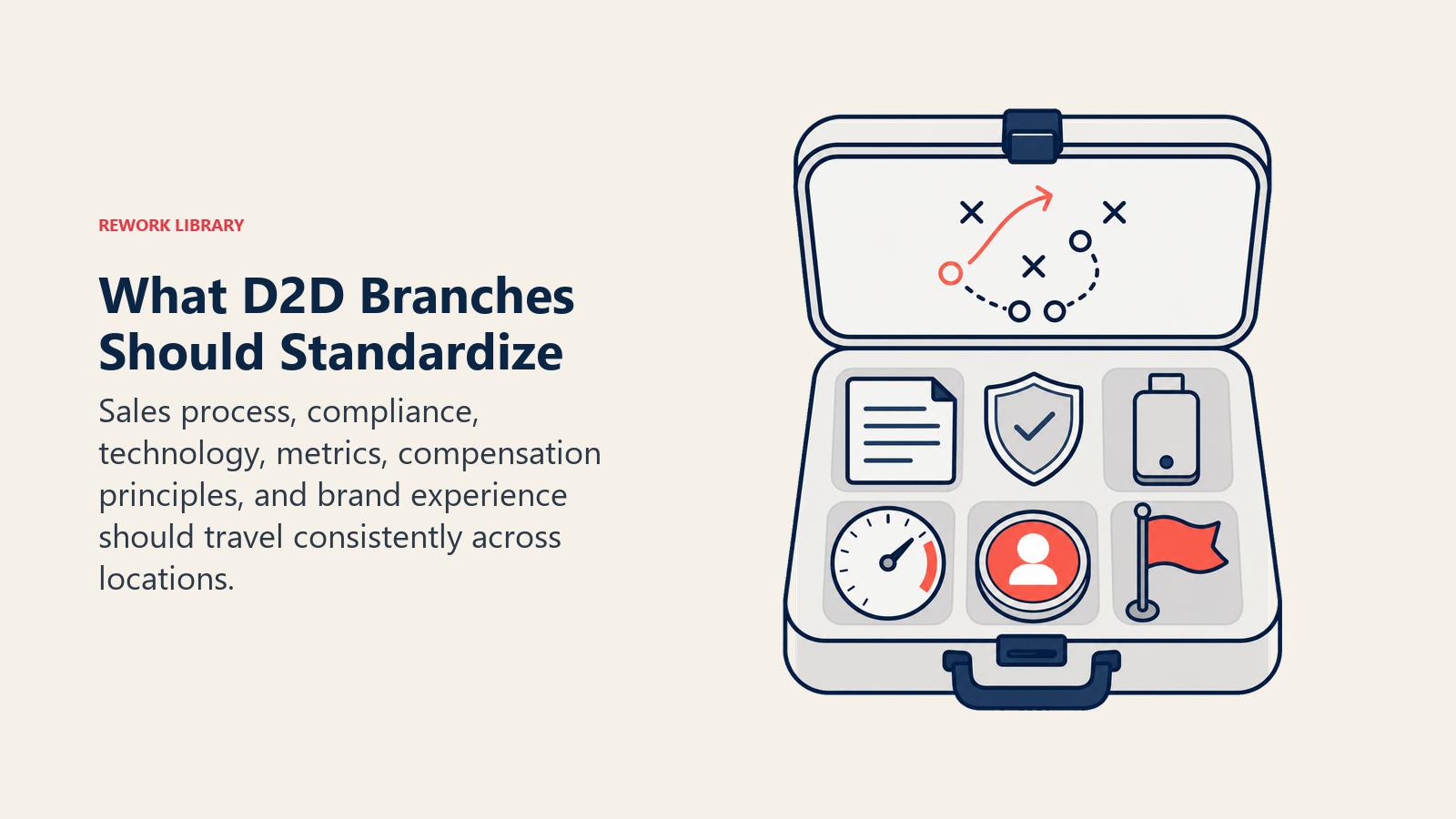
The core sales process and script framework. The fundamentals of canvassing and the knock, qualifying at the door, and objection handling should be trained the same way everywhere, built from what's actually working in the best-performing locations, not from a corporate assumption of what should work. The value-selling discipline behind that script, tying the pitch to a specific customer outcome rather than a generic feature dump, should travel to every branch intact even as local delivery style varies.
Legal and compliance requirements. D2D legal and licensing compliance varies by state and municipality, and this is exactly the kind of thing that shouldn't be left to individual branch managers to figure out independently. A centralized compliance function that tracks local solicitation ordinances, licensing requirements, and consumer protection rules like the FTC's Cooling-Off Rule (a federal right to cancel within three business days on door-to-door sales of $25 or more at the buyer's home, and $130 or more at other covered locations) protects the whole company from the liability created by one undertrained branch.
Contract terms, pricing bands, and comp plan structure. Individual branches can have some pricing flexibility for local market conditions, but the underlying commission and comp design should follow a consistent framework. Ten different comp plans across ten branches makes it impossible to compare performance or move reps and managers between locations.
CRM and reporting systems. Every location using the same D2D CRM and canvassing app stack is what makes company-wide visibility possible at all. A branch running its own spreadsheet-based tracking because the manager prefers it creates a blind spot at headquarters and makes it much harder to diagnose problems early.
Brand standards and customer-facing materials. Contracts, marketing collateral, and the customer onboarding experience should feel consistent whether the customer is in the home market or a branch opened last quarter.
Quotable: A regional VP can listen to a call center rep's calls in real time from anywhere. That same VP cannot watch every door a canvasser knocks across ten branches. This visibility gap, not headcount or budget, is the real reason D2D scales harder than inside sales.
What Should Stay Local
Over-centralizing is its own failure mode. Some decisions genuinely need local judgment because conditions differ enough between markets that a one-size-fits-all rule underperforms.
Territory design specifics. The framework in territory design and assignment should be applied consistently, but the actual territory maps, household density assumptions, and knock-frequency limits need local market knowledge. A branch manager who knows which neighborhoods have HOA restrictions on solicitation, or which areas have been recently oversaturated by a competitor, makes better territory calls than a spreadsheet at headquarters.
Seasonal timing and weather-driven scheduling. Weather, timing, and density planning is inherently regional. A lawn care branch in the Southeast and one in the Upper Midwest are not running the same calendar, and forcing them to would waste selling days in one market or push reps into unproductive conditions in the other.
Local hiring and team culture. The recruiting playbook framework travels well, but the actual recruiting channels, local college partnerships, and team rituals that build culture in a specific branch are things a strong branch manager builds locally. Corporate mandating identical team culture rituals across branches usually feels forced and doesn't stick.
Specific competitive responses. A branch competing against a well-known regional competitor needs messaging and positioning tailored to that competitor, which headquarters often doesn't have visibility into in real time.
How Is Franchise D2D Scaling Different from Company-Owned Branch Scaling?
Everything above applies to company-owned branches. Franchise models add what this playbook calls the Franchisor Proof Requirement: because the franchisor doesn't directly control the sales team, a standardized D2D process only spreads across the system when franchisees see evidence it works, not because corporate mandated it. The franchise agreement should specify sales process, not just brand standards. Many home services franchise agreements are thorough on branding, territory rights, and royalty structure but thin on sales methodology, leaving each franchisee to figure out D2D execution independently. This produces enormous performance variance across the system. Franchisors already have a compliance deadline built into the relationship that most sales training gets bolted onto as an afterthought: under the FTC Franchise Rule, every franchisor must hand a prospective franchisee a completed Franchise Disclosure Document at least 14 days before that franchisee signs an agreement or pays any money. That same pre-sale window is the natural point to also set expectations on sales methodology, not just royalty and territory terms. Franchisors that treat the sales playbook as part of the franchise system, the same way they'd treat a required point-of-sale system or a required uniform, see far more consistent performance across locations, a pattern the International Franchise Association points to when it describes what separates well-run franchise systems from loosely managed ones.
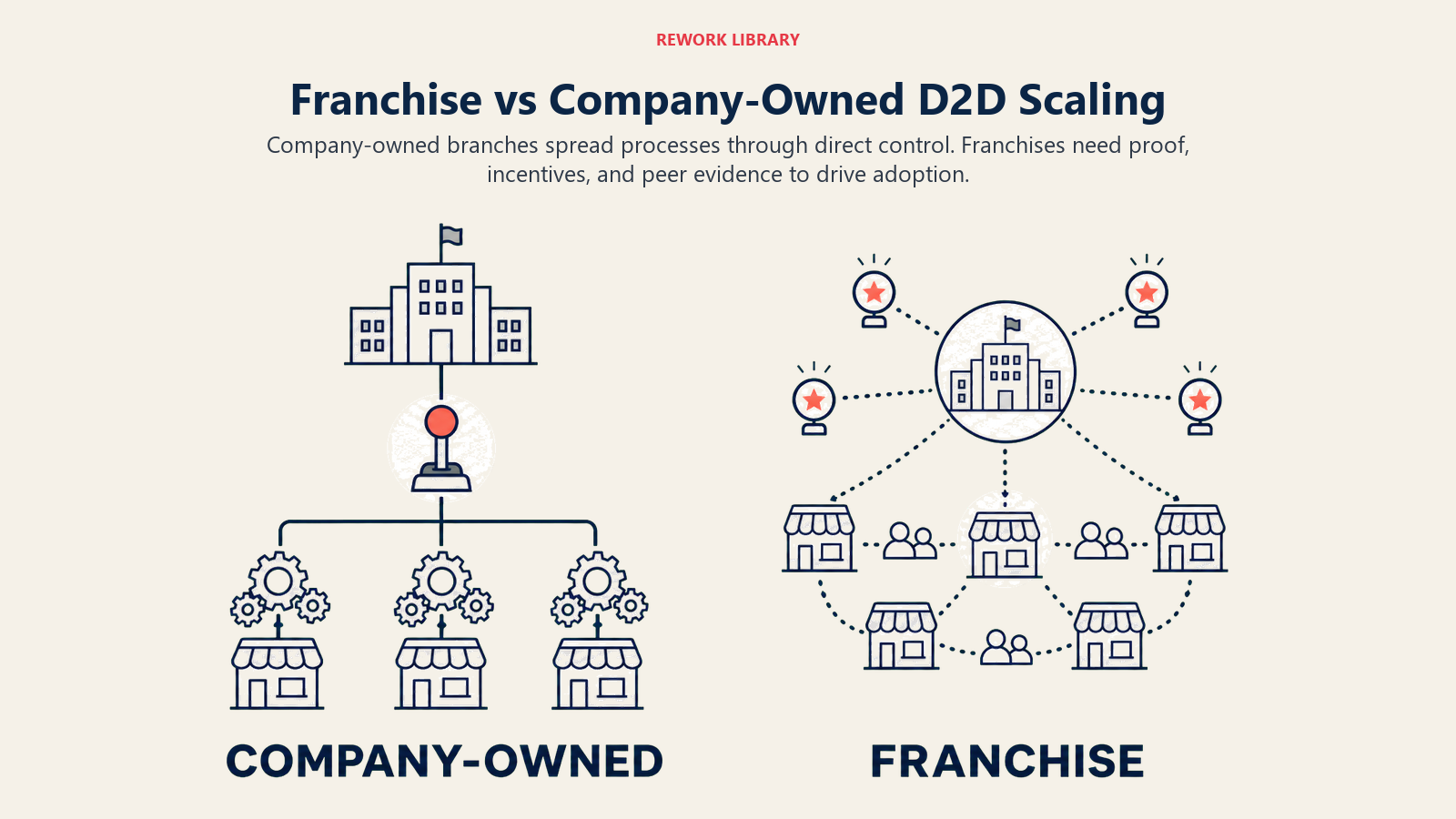
Franchisee buy-in requires proof, not mandate. A franchisee who owns their business and takes on the financial risk won't adopt a sales process just because corporate says so. They adopt it because they see evidence it works, ideally from another franchisee's real results. Building a small number of visible success stories inside the franchise system, and having those franchisees speak directly to peers, moves adoption faster than a corporate directive ever will.
Quotable: In a company-owned branch, headquarters can mandate a sales process and enforce it directly. In a franchise, the franchisor can only earn adoption of that same process, one convinced franchisee at a time.
Support infrastructure needs to scale independently of any single franchisee's expertise. Training materials, a shared CRM instance or integration standard, marketing co-op programs, and a compliance resource library all need to exist at the franchisor level so a new franchisee isn't starting from zero. The strongest franchise systems treat "how do we run D2D well" as a franchisor core competency they sell as part of the franchise value proposition, not an afterthought.
Royalty and comp interactions need explicit rules. If franchisees run their own comp plans for reps, clarify how that interacts with any company-wide programs, such as national contests or company-wide bonus pools, so reps in different franchise locations aren't operating under confusing or conflicting incentive structures.
| Model | Sales process control | Comp flexibility | Compliance ownership |
|---|---|---|---|
| Company-owned branches | Centralized, mandatory | Framework centralized, bands may flex locally | Centralized compliance function |
| Franchise with strong system | Franchisor-provided, contractually required | Framework provided, franchisee sets final rates | Franchisor provides resources, franchisee executes locally |
| Loose franchise/licensing | Franchisee discretion | Fully franchisee-controlled | Franchisee owns entirely, high variance risk |
Building the Multi-Location Performance Cadence
Once the standardize-vs-local decisions are made, the ongoing operating rhythm is what actually keeps performance consistent over time. Weekly branch scorecards, compared apples-to-apples. Every branch should report the same core metrics on the same schedule: gross new accounts, cancellation rate, average deal value, and rep headcount/productivity. The D2D sales KPIs and metrics guide covers the specific dashboard structure. The multi-location version of this just adds a branch dimension to every metric.
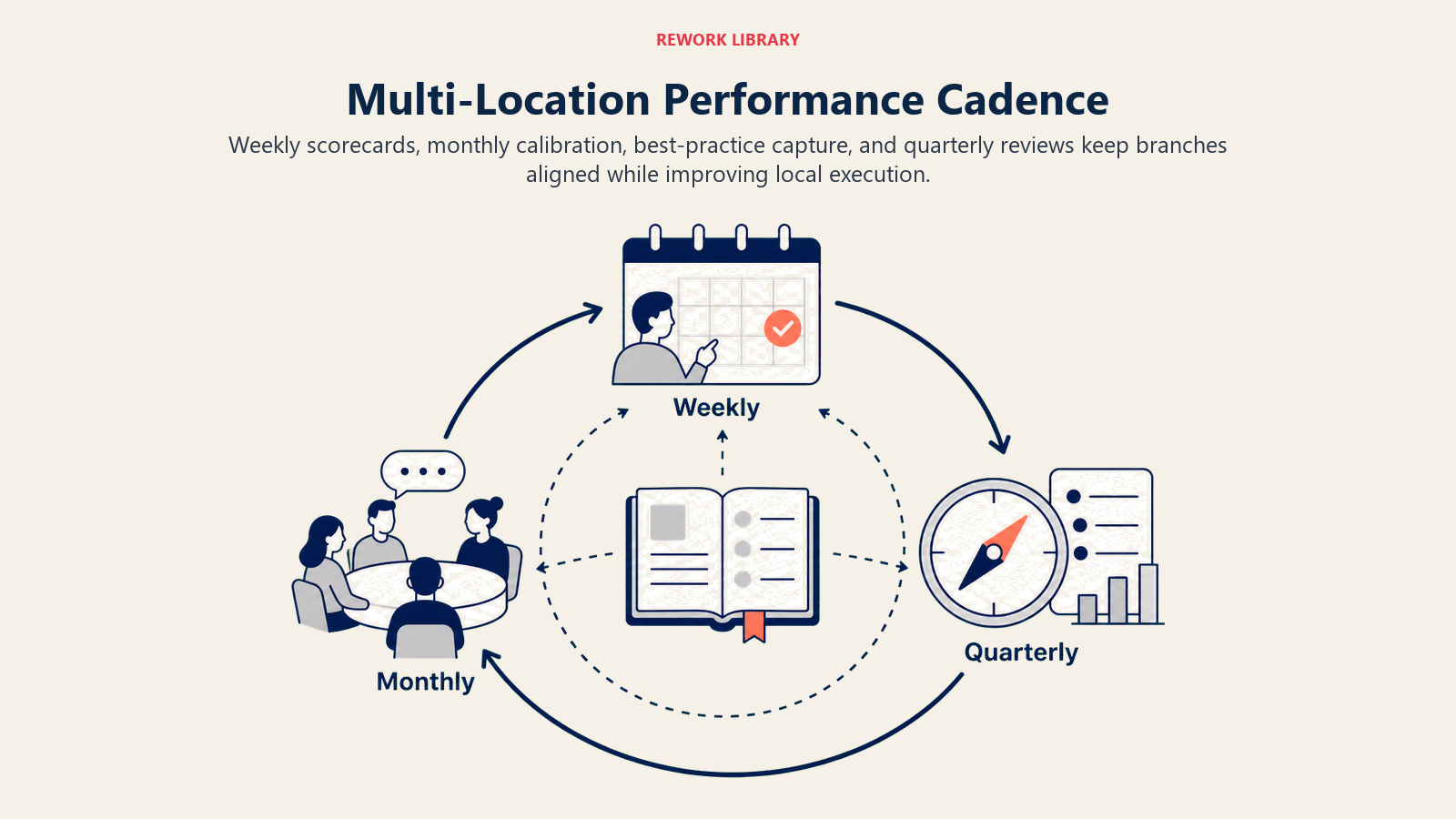
Monthly cross-branch calibration calls. Bring branch managers together to review what's working. The manager whose branch is running 20% above target on close rate has something to teach the manager who's struggling, and peer-to-peer sharing between managers who respect each other's results often lands better than a corporate directive saying the same thing.
A "best practice capture" process, not just a "best practice broadcast" process. Headquarters should have a defined way to notice when a branch discovers something that works (a script tweak, a territory rotation approach, a local partnership) and test whether it generalizes before rolling it out company-wide. Without this, good ideas stay trapped in the branch that found them.
Struggling-branch intervention triggers, defined in advance. Decide ahead of time what performance threshold triggers direct support, not just a strongly worded email. A branch running below 70% of its account target for two consecutive quarters, for example, might automatically trigger a site visit from a regional director rather than waiting for the annual review cycle to catch it.
Common Multi-Location Scaling Mistakes
Promoting the best individual rep into a multi-branch role with no management training. The skills that make someone a great door-to-door closer are not the skills that make someone a great multi-location operator. Companies that assume production talent transfers automatically to management and oversight talent create weak branch leadership repeatedly.
Rolling out new branches faster than the training and support system can absorb. Opening three new locations in the same quarter that headquarters can barely staff support for guarantees at least one of them underperforms for reasons that have nothing to do with the local market.
Ignoring early warning signs because top-line growth looks fine. A company can be adding branches and growing gross accounts company-wide while several individual branches are quietly churning through reps and customers. Aggregate numbers hide branch-level problems. The weekly scorecard discipline above exists specifically to prevent this.
Underinvesting in the compliance function as the company expands into new states. Solicitation ordinances, licensing requirements, and consumer protection rules vary by jurisdiction, and a company that scaled its sales process without scaling its compliance oversight is carrying legal risk that often doesn't surface until it becomes expensive.
What "Scaled Well" Actually Looks Like
A multi-location D2D operation that's scaling well doesn't look like every branch performing identically. Local market conditions, competitive intensity, and team tenure will always create some natural variance. What it looks like instead is every branch operating from the same playbook, reporting the same metrics on the same cadence, and having access to the same support infrastructure, with the variance between branches shrinking over time rather than headquarters discovering a struggling branch only when it's already lost significant ground. The founder who trained every rep personally in the first location built something valuable. The job of scaling is turning what was in that founder's head into a system that a manager who's never met the founder can execute well. That's a harder problem than opening a second location, and it's the actual work of building a multi-branch or franchise D2D business rather than just a collection of separate sales teams sharing a logo.
Learn more: Recruiting door-to-door reps covers building local hiring pipelines that support multi-branch growth. Coaching, ride-alongs, and culture covers the manager development side that multi-location scaling depends on. Retention fundamentals covers building the post-sale infrastructure that needs to scale in step with sales headcount across every branch.
Frequently Asked Questions about Franchise and Multi-Location D2D Scaling
What's the biggest mistake companies make when scaling D2D across multiple locations?
Assuming what worked in the founding location, often built on one person's direct involvement and tacit knowledge, will transfer automatically to a new branch without a deliberate effort to systematize it. New locations staffed by managers who weren't part of building the original playbook need that knowledge documented and trained, not assumed.
What should be standardized across all D2D branches or franchise locations?
The core sales process and script framework, legal and compliance requirements, contract and pricing structure, comp plan framework, and the CRM/reporting system should all be consistent. These create the shared foundation that makes cross-branch comparison and support possible.
What should be left to local branch managers to decide?
Territory design specifics, seasonal scheduling and weather-driven timing, local hiring channels and team culture, and competitive positioning against locally relevant competitors all benefit from local judgment rather than a centralized, one-size-fits-all rule.
How is franchise D2D scaling different from company-owned branch scaling?
Franchisors don't directly control the sales team, franchisees do, which means adoption of a standardized sales process depends on the franchisee seeing proof it works rather than a corporate mandate. Franchise agreements that treat the sales playbook as a core part of the franchise system, alongside brand standards and territory rights, produce far more consistent performance across locations than agreements that leave sales methodology up to each franchisee.
How often should multi-location D2D companies review branch performance?
Weekly scorecards on core metrics like gross new accounts, cancellation rate, and rep productivity, plus monthly cross-branch calibration calls where managers share what's working. Struggling-branch intervention thresholds should be defined in advance so underperformance triggers direct support automatically rather than waiting for an annual review cycle.
Why do aggregate company-wide numbers sometimes hide serious problems at the branch level?
A company can be adding new branches and growing total accounts while several existing branches are quietly losing reps and customers. Top-line growth from new locations can mask branch-level churn and rep turnover unless performance is tracked and reviewed at the individual branch level on a consistent, frequent cadence.

Senior Implementation Consultant
On this page
- Why D2D Scales Differently Than Other Sales Models
- What Should Be Standardized Across Locations
- What Should Stay Local
- How Is Franchise D2D Scaling Different from Company-Owned Branch Scaling?
- Building the Multi-Location Performance Cadence
- Common Multi-Location Scaling Mistakes
- What "Scaled Well" Actually Looks Like